Tag Archive for: LMI

Mitigation Spending Correlates Even More Strongly with LMI Population than Damage

12/11/2021 – Data obtained via a Freedom of Information Act Request shows that four Harris County watersheds – those with the highest low-to-moderate income (LMI) populations – have received more flood mitigation spending than all other 19 watersheds combined since 2000.

Recent Harris County Flood Control District (HCFCD) figures show that the size of an LMI population in a watershed correlates more highly with mitigation spending than even damaged structures. Previously, I coined the phrase “funding flows to damage.” That’s still true, but the number of LMI residents in a watershed now correlates even more strongly.

The latest spending data through the third quarter of 2021 also debunks the myth that flood mitigation projects always go to neighborhoods with the highest home values.

How Correlation Works

Correlation is not causation. A coefficient of correlation indicates the strength of a relationship between two variables. In a perfect correlation (1.0), every unit of change in one variable produces a proportional amount of change in a second variable. Variables move together by the same percentage and direction 100% of the time. But in real life, one rarely finds perfect correlations. However, these come close. Statisticians consider them very strong.

Funding Correlates Strongly with Both LMI Population and Damage

Dollars spent on mitigation have the following coefficients of correlation:

  • .93 for LMI population by watershed
  • .84 for structures damaged in five major storms

The storms included Allison, Tax Day, Memorial Day, Harvey and Imelda. Spending included HCFCD and partner dollars from 1/1/2000 through 9/30/2021.

You would expect mitigation spending to correlate highly with damage. After all, no one spends money to fix areas that didn’t flood. And the most attention would be focused on areas that flooded the worst. So they vary closely in the same direction.

But why does flood mitigation spending correlate so strongly with LMI population? That’s less expected.

Hypothesis to Explain High LMI Correlation

Observation suggests that LMI households tend to be in older neighborhoods often built to lower standards. For instance, homes tend to be closer to street level.

Moreover, in Houston, these neighborhoods tend to have roadside ditches rather than storm sewers. And those drainage ditches tend to fill in with silt over time, trapping water in neighborhoods.

Population density is also literally twice as high in LMI watersheds compared to affluent ones (3,947.11 people per square mile for watersheds above 50% LMI vs. 1,831.52 for watersheds below 50% LMI). So homes tend to be closer together, have a higher percentage of impervious cover, and crowd floodplains. Said another way, more people live in harm’s way.

Brays Bayou is a good example. It has the largest LMI population, the highest density and the most damage. It has received the most flood mitigation money since 2000 – $544 million or $158 million more than any other watershed.

At the opposite end of the spectrum, Luce Bayou has the smallest population and suffered the least damage. It received the least flood mitigation spending – only about 1% of Brays’ total.

LMI neighborhoods also tend to be in areas (inside the Beltway) surrounded by more upstream development. When developers built those older neighborhoods, they probably weren’t expecting the Houston Metro Area to explode from 700,000 people in 1950 to almost 7 million today.

We also didn’t know as much about flood mitigation in 1950. We didn’t force upstream developers to build detention ponds and didn’t reserve rights of way for future channel expansion. (Or at least not as much as we needed.)

Buying that additional right of way typically costs almost as much as construction – even more in densely populated areas. White Oak Bayou, for instance, has the third highest population and the fourth highest population density. Out of the $386 million it has received since 2000, a whopping 61% has gone toward right-of-way acquisition and 20% toward construction.

As a result of all these complex historical factors and dependencies, LMI population, damage and flood-mitigation spending tend to co-vary. That’s the best explanation I can offer.

In Harris County, Mitigation Spending Favors Low-, Not High-Income Areas

The narrative often heard in commissioners court is that higher home values increase the benefit cost ratio (BCR) for flood mitigation projects and that FEMA favors the highest BCRs. Those, in turn, theoretically favor mitigation projects in affluent communities. But that argument ignores:

For proof positive, see the charts below.

Brays, White Oak, Sims and Greens all have the highest LMI populations. And all have received the most flood-mitigation dollars since 2000. In fact, those four LMI watersheds alone received more money than all other 19 watersheds combined.

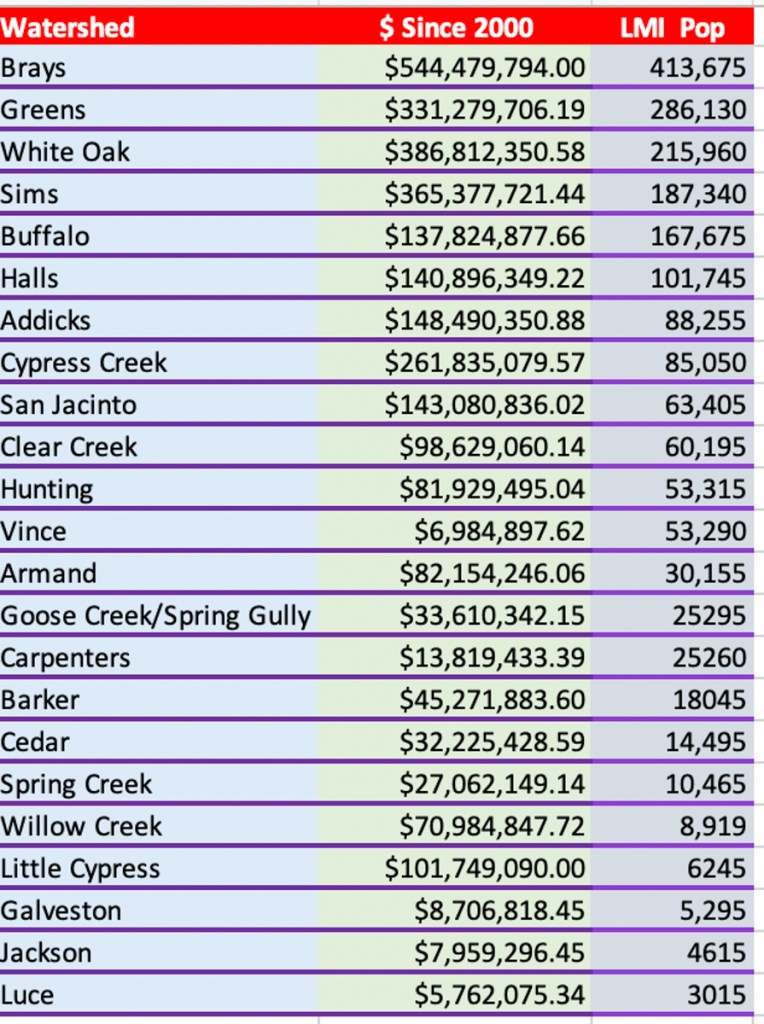
Watersheds with large low-income populations tend to cluster on the left; those with high-income on the right with a few exceptions.
Spending since 2000 for each Harris County Watershed shown with watershed’s LMI Population

To me, this debunks the myth that having less-expensive housing disadvantages some areas. In Harris County, density, public policy and other factors more than compensate for any influence home values exert on BCRs and the allocation of flood-mitigation dollars.

Posted by Bob Rehak on 12/11/2021

1565 Days since Hurricane Harvey

The thoughts expressed in this post represent opinions on matters of public concern and safety. They are protected by the First Amendment of the US Constitution and the Anti-SLAPP Statute of the Great State of Texas.

The MoCo/LJA Way: Build First; Work Out Drainage Details Later

LJA Engineers submitted a master drainage plan for the 2,200 acre Artavia development that Montgomery County approved. It has no detention ponds. And the drainage channels currently do not connect to the San Jacinto river. Even though LJA said they would connect to the river, the plans do not specify how, when or where. As you will see below.

Dead-end drainage. Currently, the Artavia drainage channel stops just short of the Liberty Materials Moorehead mine in the background. The San Jacinto River lies beyond the mine. This and all other aerial photos below were all taken March 6, 2020.

A Sand Mine Is Not the San Jacinto

The plans DO show the channel terminating in a sand mine between Artavia and the river. A spokesman for the sand mine said the developer is still trying to work out environmental and easement issues.

Aerial photos show the main channel stops about a 100+ yards short of LMI’s shipment facility. Meanwhile, during heavy rains, the dead-end drainage overflows onto surrounding properties. A spokesman for the mine claimed that the overflow flooded the mine last year and caused the dikes to break. He alleged that was the proximate cause for 56 million gallons of white sediment-laden water entering the West Fork.

Exhibit 2 of Artavia Drainage Impact Analysis from 9/20/2018 shows the project outfall in the middle of the LMI sandpit that borders Moorehead Road and the San Jacinto West Fork in Montgomery County.

The project manager for LJA did not return calls to explain their position on the dead-end drainage. And when asked for an explanation, the new Montgomery County Engineer (not the one who signed these plans) only referred me back to LJA.

Below are the drainage plans for Artavia, obtained by a Freedom of Information Act request to Montgomery County.

Several things have jumped out at me so far. LJA has not yet returned phone calls, so to me they remain…

Unaddressed Issues

Elevation Change Accelerates Flow

Elevation drops suddenly as you get near the river – 12 feet. That accelerates water flow and threatens the sand mine. As you can see above and below, the channel is like a firehose aimed at the mine. That mine has enough problems of its own. In the past, dike breaches have affected Lake Houston water quality; we don’t need more of that. The mine blames the breaches on water overflowing from the Artavia ditch.

Note how the water in this short section of Artavia’s drainage ditch does not even pond at one end and reaches halfway up the banks at the other. That shows the slope. The SJR West Fork is between the two sections of the mine in background.
Flow Rates Understated

LJA calculations appear to understate the volume and velocity of flow. They use a Manning’s coefficient of .035, a value associated with pasture/farmland or channels filled with stones and cobbles. The coefficient recommended for smooth channels is 0.022. The difference creates a 63% increase in velocity and a 60% increase in volume of flow. See for yourself. With no real way yet for the water to get to the river or under FM1314, that will cause water to pile up much faster.

Not too many cobbles and boulders in this channel. All sand and silt which is already blocking culverts.

LJA also uses pre-Atlas rainfall statistics in their calculations of 10-, 25- and 100-year peak flows. The new Montgomery County standard is 16.1 inches in 24 hours compared to the 12.17 that LJA used for the 24 hour, 100-year flood.

Did LJA use “good engineering practices” and model Atlas 14 to ensure that it actually contained the 100-yr, 24-hr storm? There’s an ethical issue here. Did they put public safety first? We don’t know because they didn’t say so in any of their documents.

No Mention of Wetlands

LJA never mentions wetlands in their analysis. However, the National Wetlands Inventory shows wetlands on Artavia property and other property Artavia drains through.

Wetlands on Artavia Property or property Artavia drainage would likely have to go through.
Threat to Pipeline

A pipeline crosses the Liberty Materials mine. High velocity flow through the mine could undermine and threaten that pipeline like it did at another Liberty mine and at the Triple PG mine on the East Fork.

Green line shows path of pipeline across across Liberty Materials Mine. White line shows current path of drainage ditch.
No Outlet

There’s no explanation for how Artavia will get water through the pit at the end of their ditch. They can not store Artavia’s runoff in the pit. Their pit is already filled to the brim with highly silty, turbid water. Another unauthorized discharge could affect water quality in Lake Houston...again!

Level of water in the pit that Artavia’s ditch would have to drain through. Pit is already overflowing. West Fork is in background. TCEQ measured suspended solids in pit’s water at 25X higher than river.
Threat to Mine

A representative for the mine owner says the mine owner doesn’t want more water in the pit. They can’t afford the cost from environmental or business perspectives. With the COVID-19 threat, construction activity is way down. So margins are slim. And they can’t afford to have water fill their deep pit where they dry mine.

“No Adverse Impact”

LJA claims the project will have no adverse impact on downstream properties. But it already has. Properties along Greenbaugh and in Oak Tree have flooded since Artavia started clearing land and filling in wetlands.

Oak Tree detention pond (behind camera) used to overflow into wetlands. Then Artavia started clearing and filling. Now water backs up into the 40+ homes in the small subdivision.

The Liberty Materials mine also alleges it was flooded by Artavia’s overflow, resulting in the discharge of 56 million gallons of silty water into the West Fork.

The day the West Fork turned white. TCEQ blamed LMI. LMI blamed Artavia.
Who Pays to Get Water Under FM1314?

LJA can only convey 68 cfs under FM1314. Meanwhile, TxDoT has not yet finished the design for a bridge. They hope to start bidding the job by the Fall of this year. Residents, not the developer, will pay for the improvement through the local municipal utility district.

Artavia ditch on north side of FM1314
Where water exits on the downstream side of FM1314
Channel downstream/south of FM1314.

LJA claims “The culvert crossings were designed to have capacity to convey 100-year storm events.” But they certainly aren’t doing that now.

Diverting Water From East to West Fork

The developer appears to be diverting water from the East Fork watershed to the West Fork watershed. See Section 1.4 and Exhibit One.

It would be harder to “beat the peak” to the East Fork. It’s 12 times farther away; water would take much longer to get there. So the diversion appears to be an attempt to avoid building detention ponds. But the diversion adds to flood volume in heavily populated West Fork areas where far more homes flooded during Hurricane Harvey.

Will LJA Figure It Out In Time?

For the sake of adjacent residents and businesses, let’s hope they figure these loose ends out before the next flood.

We heard of many of the same problems and promises on the Perry Homes Woodridge Village project north of Kingwood that LJA also engineered. Hundreds of homes flooded there twice last year.

Posted by Bob Rehak on 3/20/2020

934 Days after Hurricane Harvey

The thoughts expressed in this post represent opinions on matters of public concern and safety. They are protected by the First Amendment of the US Constitution and the Anti-SLAPP Statute of the Great State of Texas.

“Sand Mines Destroyed Our Lives”

Randy Reagan is tough. He grew up in the Conroe oil fields and riding bulls. But nothing prepared him for flooding five times in four years and the series of events that followed.

Reagan raised his family on a 5-acre lot in Bennett Estates. That’s a neighborhood between the San Jacinto West Fork and FM1314, just south of SH242. He made a modest living for himself as an oil-field technician by repairing turbines, first for a local company and then for GE. He harvested all the meat his family ate from his own property and the surrounding forests. Life was good.

Built Home Above 1994 High Water Mark

Bennett Estates rises up from the banks of the San Jacinto West Fork through the 100- and 500-year flood plains to even higher ground. Reagan’s slab is a foot above the high-water mark from the 1994 flood, which at the time involved a massive release from the Lake Conroe dam. So he figured he was safe for anything the future brought. Wrong!

Reagan lives between the sand mines east of the river, just above the mine at the bottom, in the aqua-colored 100-year flood plain. Source: FEMA.

A Happy Life, Until…

While Reagan was never destined for riches, he led a happy life. Until the sand mines came. Then everything changed.

Reagan now lives in a neighborhood five blocks deep – sandwiched between three sand mines comprising almost 1500 acres.

Despite being in the 100-year flood plain, his property has only flooded twice from the San Jacinto – in 1994 and 2017 during Harvey. However, in the last four years, he says, it has also flooded four times from sand mines – twice in 2016, once in 2018 and once in 2019 during Imelda.

As the sand mines have grown, they’ve removed forests and wetlands that used to slow water down during rainfalls.

Now the water rushes through sand pits largely unimpeded. While the mines like to tout how they offer detention capacity in storms, aerial photos show that they offer little. That’s because they are often filled to the brim…even before storms. So, it doesn’t take much to make them overflow in heavy rains. 

Water level in LMI Pit to south of Reagan. Photo taken 2/13/2020 during a mild drought shows little room for more water. This is the mine cited by the TCEQ for discharging 56 million gallons of white gunk into the West Fork last year.

Water flows down into the mines from higher ground and quickly fills the pits. The pits can then spill over into the river and surrounding neighborhoods.

LMI Pit to the North Sends Water South into Neighborhood

That’s what Reagan contends happened with the LMI pit to the north of him. 

  • During Harvey, a satellite photo in Google Earth shows the water blew out the mine’s perimeter road, sending water gushing into Reagan’s neighborhood. 
  • During other recent events, Reagan has ground-level photos that show silty, sandy-brown water coming from the direction of the mine, not the river. 
LMI breach into Reagan neighborhood on 8/30/2017 during Harvey. Five HVL pipelines are now trying to repair damage caused when this mine mined too close to them.
The LMI mine to the north of Reagan on Feb. 13, 2020. In heavy rains, there’s little to keep water from the mine from escaping into Reagan’s neighborhood out of frame at the bottom of the photo. Photo taken in moderate drought conditions.

Hanson Pit to South Backs Water Up into Neighborhood

The mine to the south of Reagan affects him in a different way. Twice, says Reagan, the mine has built walls that blocked the flow of ephemeral streams that used to run through his neighborhood.

The mine dug a ditch to the river in 2011 to let the water drain to the river. That worked for about five years. Then the ditch became overgrown and the volume of water coming from the northern mine became too much. Reagan flooded on Tax Day and Memorial Day in 2016, 2018, and Imelda in 2019. Not to mention the 93 inches he got during Harvey in 2017.

Dirt wall erected by Hanson Aggregates between their pond and Reagan’s property. The drainage ditch in the foreground that they dug in 2011 is no longer any match for water flowing south from the LMI mine behind the camera position.

Problems Grow as Sand Mines Grow

“The sand mines have destroyed our lives,” said Reagan. “We’ve lived here all our lives. This all used to be woods for acres and acres and acres. The first problem I had was back in the 90’s when the sand pits were getting bigger.”

“As they started developing more ponds, they started interrupting the natural runoff.”

Randy Reagan

“When we moved here in the late ’90’s, we had our homesite raised four feet. That’s where FEMA drew the line for insurance at the time. We figured if we built higher than the high water mark from 1994, we would never have to worry. Because in 1994, we had Lake Conroe releasing all that water on us.”

“There was another flood in 1998, but it never affected us. We were high and dry here. LMI still had not built the mine to the north of us at that point,” said Reagan. 

“Now we’ve got water coming at us up from the river, downhill from one mine and backing up from another mine. Sand from the mines even blocks the street drains that lead to the river,” said Reagan.

“All this used to be woods back here with natural creeks and natural drainage. It’s just all gone now. These sand pits done tore it out,” said Reagan. “They’re like giant lakes with no water control.”

Memorial Day Flood in 2016 invades Reagan’s shop.
Memorial Day Flood in 2016 nearly invades Reagan’s home. Note color of water. 93″ of floodwater took this home in Harvey one year later.

“In 2016, we got a lot of rain, but the river never got out of its banks much,” he continued. “The people that live next to LMI (on the north) tell me that the LMI walls keep breaking. The water rushes through their property, coming from the sand pit. In 2016, we had milky brown, silty water sweeping through here. It was so swift that it almost took my truck off the road. I got about 20 inches in my garage during Tax Day and Memorial Day storms. But it never got in my home at that point.”

“The Tax Day Flood in 2016 was our wedding anniversary. We tried to celebrate our anniversary while our garage got flooded. That was LMI. And then we got flooded again on Memorial Day. That was LMI,” said Reagan. “In 2016, the river here was NOT out of its banks. We got flooded from the sand pits.” 

“Then came Harvey. We might have been fine if all we got was the rainwater. It came close. But then they opened the gates at Lake Conroe. And the sand mine upstream of us broke loose again.

Floods Cause Cascading Series of Problems

“Not only did we lose our house, I lost my job and I lost my health. We really hit bottom.” 

“I’ve got breathing problems,” says Reagan. “Everybody in our family has breathing problems.” 

“I was still trying to recover from Harvey, the day I lost my job in 2018. I was admitted into the emergency room because of my breathing that same day.” 

“In the meantime, we were living in a used camper. And it caught on fire. We didn’t have insurance on it,” said Reagan. “My mother had just died. So we were going through that grieving process. Then the camper burns!”

Never-Ending Noise and Vacant Homes

“It used to be quiet here,” he says. “The sand trucks used to run during the days, but never on weekends and never at night. Now they run 24/7 it seems.”

The sand mines and floods took more than Reagan’s health and home. When long-time residents fled to higher ground, they left behind vacant houses. He worries about a criminal element coming in now.

During Harvey, Reagan says water reached 93 inches in his shop. That’s above the door frame.
Reagan yard during Imelda. Note color of water…again.

 “We’re living in my shop now. Everything we have left is in there.” 

Posted by Bob Rehak on 3/3/2020

917 Days since Hurricane Harvey and 166 since Imelda

The thoughts expressed in this post represent opinions on matters of public concern and safety. They are protected by the First Amendment of the US Constitution and the Anti-SLAPP Statute of the Great State of Texas.