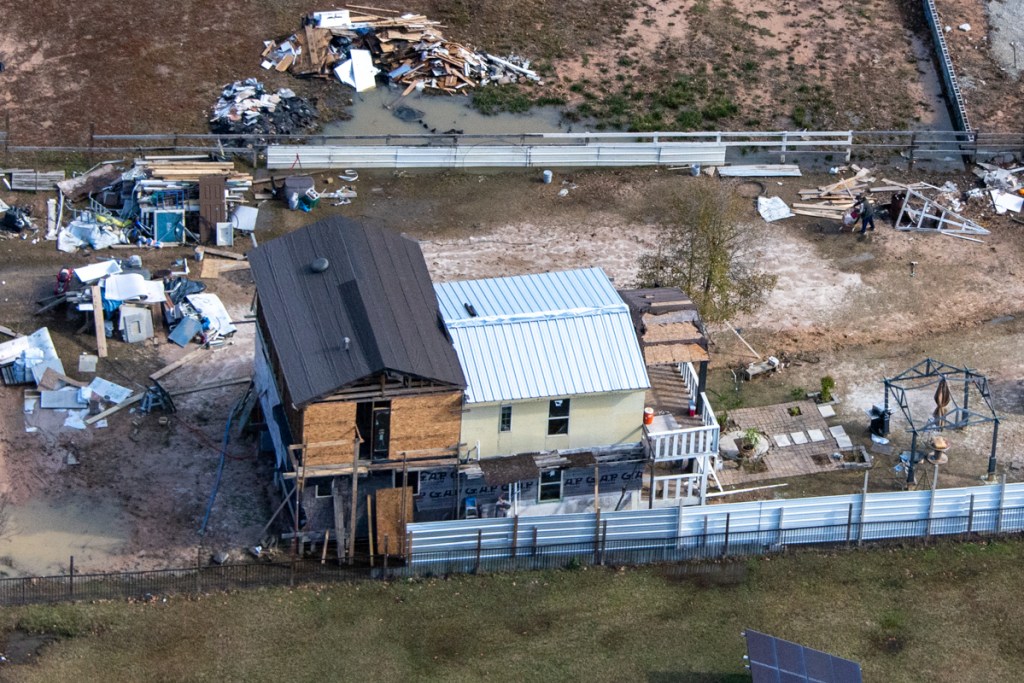
Castle Hill Partners in Austin, the company that owns CH-B Kingland LLC, did not return phone calls re: its development plans. However, since tollway construction is moving from west to east, it would make sense to develop the western portions in Montgomery and Harris Counties before moving east into Liberty County.
Kingland’s 2017 sales brochure shows that almost half of the western section lies in Montgomery County along the San Jacinto East Fork. The remainder of the western section lies within Harris County. Both portions lie partially within the City of Houston’s Extra Territorial Jurisdiction.
Western section of Kingland shows a 41.3 acre detention pond, plus seven smaller ponds. But it’s unclear whether they will lie in the floodway or floodplain.
FEMA’s National Flood Hazard Layer Viewer shows the extent of the floodway and floodplains in that area.
Crosshatched area = floodway. Aqua = 100 year floodplain. Brown = 500 year.
I interviewed a family in that small development south of Kingland property that straddles the Harris/Liberty County Line and discovered that they flooded from the East Fork during both Harvey and Imelda. They live more than 1.5 miles from the nearest mapped floodplain. However, that could soon change when the new post-Harvey flood maps are redrawn.
Anyone downstream on the East Fork or Luce needs to keep a close eye on this one. It has the potential to further alter the hydrology of the watershed.
Posted by Bob Rehak on 1/11/2021
1231 Days since Hurricane Harvey and 480 since Imelda
The thoughts expressed in this post represent opinions on matters of public concern and safety. They are protected by the First Amendment of the US Constitution and the Anti-SLAPP Statute of the Great State of Texas.
https://i0.wp.com/reduceflooding.com/wp-content/uploads/2021/01/20210101-RJR_4417-1-e1610410584123.jpg?fit=1200%2C800&ssl=18001200adminadmin2021-01-11 18:25:112021-01-11 22:16:33Thousands of Acres in East Fork, Luce Bayou Watersheds to be Developed as Part of Kingland
Wayne Dolcefino announced this afternoon that Liberty County Judge Jay Knight has confirmed the county will launch a major investigation into the controversial Colony Ridge Development. Dolcefino is one of the country’s leading investigative journalists.
Flooding Concerns at Heart of Investigation
The massive housing development between the San Jacinto East Fork and Luce Bayou has sparked flooding concerns for tens of thousands of families both nearby in Plum Grove and downstream as far as Lake Houston.
The probe will focus on the accuracy of soil reports and drainage plans used to justify approval of the neighborhoods.
Wayne Dolcefino
Plum Grove hired Dolcefino to fight years of neglect by county officials as floods washed out roads and damaged most of the structures in the tiny town.
“Right before the new year, two inches of rain in Colony Ridge produced flooding. Creeks in Plum Grove were full to the brim. That’s raising alarm bells,” said Dolcefino.
Pictures of flooded lots WITHIN Colony Ridge also raised alarms. They show that water is not soaking in or running off the way it should.
Flooded lot 24 hours after a 2 inches of rain in two days. Resident keeps throwing sand into the ponds, but it’s not helping much.A newly developing portion of Colony Ridge.Another newly developing portionof Colony Ridge. Much of the area has been carved out of wetlands. See USGS map below.Note water surrounding the house.New lot next to drainage ditch won’t even drain.When water won’t soak in, people suffer.
So instead of water soaking into the ground, it runs off. The presence of so many wetlands in Colony Ridge before development should have been a tipoff.
Most of the wetlands in Colony Ridge before development are gone now, but the problems remain. This USGS map shows where they were.Some areas just should not be developed.
By misrepresenting soil types, LandPlan Engineering understated the amount of detention and drainage capacity needed by 6X to 9X, according to TXDoT guidelines.
Had LandPlan properly represented the soil, Colony Ridge would have had to put in more detention ponds and widen ditches to prevent flooding. But that would have been costly for the developer.
Harris County Flood Control officials worry the drainage problems in Colony Ridge increase flood risk in Harris County. So do downstream residents. I talked to one in Harris County today who has flooded repeatedly since Colony Ridge started clearing land. She is disabled and can’t afford to move. Neither can she afford to stay.
Liberty County Attorney Matthew Poston confirmed to Dolcefino that 19 missing reports will be part of the investigation.
Hopefully, the investigation will also explain why virtually all the surviving reports are labeled “preliminary.” The county could not supply ReduceFlooding.com with any documents showing changes to or final approvals of the plans.
“We want to see what Bergman signed, and if the investigation proves claims about the soil are untrue that could be a big problem,” Dolcefino said. The former county engineer has refused comment.
His daughter is the new District Attorney for Liberty County. One can only hope that she recuses herself from any part of this investigation.
If damning evidence exists in reports the county DID supply, one can only imagine what’s in those the County can’t or won’t produce.
How the Other Half Lives
Colony Ridge developers “owner financed” many of the lots in the sprawling neighborhood, in part, because many residents do not have driver’s licenses and Social Security numbers. Nearly 97 percent of the foreclosures in Liberty County last year came from Colony Ridge.
Said Dolcefino, “This is the first step in holding Liberty County officials accountable before another neighborhood is approved. We need to know why these documents are missing, and we are going to get to the bottom of this one way or the other.” I second that.
Posted by Bob Rehak on 1/4/2021 based in part on information from Wayne Dolcefino
1224 Days since Hurricane Harvey
The thoughts expressed in this post represent opinions on matters of public concern and safety. They are protected by the First Amendment of the US Constitution and the Anti-SLAPP Statute of the Great State of Texas.
https://i0.wp.com/reduceflooding.com/wp-content/uploads/2021/01/20210101-RJR_4712.jpg?fit=1200%2C800&ssl=18001200adminadmin2021-01-04 19:06:382023-09-20 09:15:15Liberty County Launches Major Investigation into Colony Ridge Irregularities
The National Weather Service distinguishes between four major types of flooding: coastal, riverine, street and sheet flow. After flying over Colony Ridge on New Year’s Day, I would add a fifth: flooding by government neglect.
Despite dire predictions for the New Year’s Eve storm, the Plum Grove/Colony Ridge area in Liberty County only got about two inches of rain. Yet I saw hundreds of flooded lots. They were all in a development that:
Worst of all, when residents asked for help from their elected Liberty County officials, those officials berated and rebuffed them. They refused even to acknowledge problems in Colony Ridge.
Where It Starts
Irregularities that most banks would catch as part of a title search and survey during the mortgage application process never get caught here.
That’s because the developer targets a vulnerable population more likely to use Western Union money orders than banks. He offers them owner financing with low down payments and interest rates five times higher than the market.
These un-savvy buyers are so desperate to own a piece of the American dream that they wind up mired in one nightmare after another. Many speak English as a second language if they speak it at all.
A Two-Inch Rain
Trade those SVUs in for swamp buggies. Here’s what much of the development looked like 24 hours after two inches of rain fell on New Year’s Eve.
Note how the drainage stops in the middle foreground.Also note how it’s not infiltrating like the engineers said it would.Close up of home in first shot. At least the home didn’t flood although the four-wheelerand dining area did.Even if an owner builds up one part of his/her lot, it can flood another.Lot after lot flooded. Water would not sink in. The soils have a low rate of infiltration, not the high rate promised by LandPlan Engineering.Totally flooded lot. Note how drainage stops to left of driveway.Do-it-yourself repairs.But are they up to code?Former wetlands?
Targeting the Vulnerable
Most of these people never complain. The areas in Mexico and Central America where many came from may have conditions far worse. So what you see here may be an improvement for them.
Still, one can’t wonder whether – in its zeal to grow – Liberty County has turned a blind eye to conditions that violate its own regulations as well as human dignity.
Conditions such as these will take generations to improve. In the meantime, the County’s residents are in for decades of pain due to government neglect. Not just in Colony Ridge, but in neighboring communities such as Plum Grove and others farther downstream.
This developer has permanently altered the hydrology of the watershed in a way that increases flood risk for everyone.
And the county has lowered its standards in a way that will likely discourage investment from quality developers.
Posted by Bob Rehak on 1/3/2021
1223 Days after Hurricane Harvey and 472 after Imelda
The thoughts expressed in this post represent opinions on matters of public concern and safety. They are protected by the First Amendment of the US Constitution and the Anti-SLAPP Statute of the Great State of Texas.
https://i0.wp.com/reduceflooding.com/wp-content/uploads/2021/01/20210101-RJR_4809.jpg?fit=1200%2C800&ssl=18001200adminadmin2021-01-02 20:55:332021-01-03 16:57:55Flooding of the Fifth Kind: By Government Neglect
This is the confluence of Caney Creek (left) and the San Jacinto East Fork (right) one day after a New Year’s Eve storm dumped two inches of rain on the area, including Plum Grove and Colony Ridge. The rain turned Colony Ridge, to the right, into a river of mud again.
Looking north at the confluence of Caney Creek and the San Jacinto East Fork (right). The sediment coming from Colony Ridge is a man-made disaster in the making.Photo taken 1/1/2021.
Where the Pollution Came From
Picture courtesy of Michael Shrader, Plum Grove Resident, of Maple Branch near his home on 12/31/2020 as rains ended. Colony Ridge drainage ditch in Camino Real subdivision enters into Maple Branch and then into East Fork.
Colony Ridge Drainage Ditch. Photo taken 1/1/2021. Note lack of sediment controls such as grass, backslope interceptor swales, and silt fences. TCEQ has previously cited the development for piling dirt next to ditches like this and for lack of sediment controls, but has done nothing about it.See caption above.Likewise.And note how the piles of dirt on the left have almost completely eroded away.Photo 1/1/2021.
Posted by Bob Rehak on 1/2/2021 with thanks to Michael Schrader
1222 Days since Hurricane Harvey and 471 since Imelda
The thoughts expressed in this post represent opinions on matters of public concern and safety. They are protected by the First Amendment of the US Constitution and the Anti-SLAPP Statute of the Great State of Texas.
https://i0.wp.com/reduceflooding.com/wp-content/uploads/2021/01/20210101-RJR_4297.jpg?fit=1200%2C800&ssl=18001200adminadmin2021-01-01 22:03:192021-01-02 21:05:18Guess Which Way to Colony Ridge
In 2016, one of the owners of the Colony Ridge Development in Liberty County tried to sue the former Mayor of Plum Grove for defamation. The developer alleged that the mayor bad-mouthed his development while making false statements. The judge ultimately dismissed the suit.
But as part of the lawsuit, Louis W. Bergman, III, PE, provided a glowing affidavit, lauding the development. Bergman served as the County Engineer and Flood Plain Administrator at the time. He also issued licenses and permits for Liberty County. In that regard, he reviewed all plat submittals for compliance with Texas statutes and Liberty County’s subdivision rules.
What a Difference Four Years Makes
Below are some quotes from Bergman’s affidavit. I took all the pictures from a helicopter on 12/7/2020 while flying over Colony Ridge. They show how quickly conditions have deteriorated there.
“In my experience, Colony Ridge has been one of the best land developers in Liberty County.”
“I respect Colony Ridge Development … and their business because they have earned my respect by representing themselves with integrity and working to build quality developments.”
Louis W. Bergman, III, PE in Paragraph 15
“In my opinion, Colony Ridge Development has built some of the best infrastructure for residential neighborhoods in Liberty County and Colony Ridge Development’s lots do not create a health, safety, or welfare threat to Liberty County.”
Louis W. Bergman, III, PE in Paragraph 11
“I have heard [the former mayor of Plum Grove] make statements that Colony Ridge Development has violated environmental laws, such as regulations by the Texas Commission on Environmental Quality, and I disagree with these statements and believe they are false statements.”
Liberty County’s own Strategic Plan cites the need to improve drainage infrastructure and building codes. But it doesn’t mention Colony Ridge by name.
Likewise for Liberty County’s Hazard Mitigation Plan. It discusses the need to improve a variety of safety issues such as drainage; street lighting; electrical service; communications infrastructure; high percentages of mobil and self-built homes; emergency access; and flooding … in every city in the county … all without mentioning Colony Ridge by name.
So maybe Bergman was right after all. Maybe this IS the best that Liberty County has to offer.
But I suspect the judge who dismissed the lawsuit, might take exception.
Posted by Bob Rehak on 12/21/2020
1211 Days since Hurricane Harvey and 459 since Imelda
The thoughts expressed in this post represent opinions on matters of public concern and safety. They are protected by the First Amendment of the US Constitution and the Anti-SLAPP Statute of the Great State of Texas.
https://i0.wp.com/reduceflooding.com/wp-content/uploads/2020/12/20200616-RJR_4084.jpg?fit=1200%2C800&ssl=18001200adminadmin2020-12-22 21:16:002020-12-22 21:39:36“One of the Best Land Developers in Liberty County”
The Liberty County Hazard Mitigation Plan contains no mention of Colony Ridge, the largest and most vulnerable community in the entire county. Like Liberty County’s Strategic Plan, this is another example of shoot-yourself-in-the-foot planning. It, too, has Grand-Canyon-sized disconnects between intention and execution that could jeopardize thousands of lives.
Overlooked or Ignored?
Liberty County last updated its Hazard Mitigation Plan in 2017. Yet it contains no specific mention of Colony Ridge, a 12-13,000 acre development. At buildout, Colony Ridge projects it will cover 22,000 acres. By comparison, Kingwood occupies 14,000 acres.
The former Mayor of Plum Grove estimates more than 20,000 people currently call Colony Ridge home. Exact counts are difficult since many people are undocumented. But if the Mayor was correct, it would make Colony Ridge two timeslarger than the largest cities in the county. Plus…
Colony Ridge has extreme vulnerabilities caused by sub-standard drainage; poverty; language barriers; lack of street lighting and fire hydrants; poor electrical and communications infrastructure; a high percentage of mobil and self-built homes; poor access through flood-prone roads; and leaky sewage systems.
Such risk factors make residents especially vulnerable to floods, hurricanes, wildfires, tornadoes, and extreme temperatures. Moreover, poverty makes it harder for people to recover from such disasters.
Yet the plan does not contain one recommendation to address this high concentration of vulnerabilities in Colony Ridge. Even though the plan addresses vulnerabilities in much smaller areas, “the largest vulnerable population in the county” receives only one mention. That was as an unnamed area near Plum Grove. Plum Grove has a population of approximately 400-500 people compared to Colony Ridge’s 20,000.
It’s as though the people who live in Colony Ridge are invisible. For instance, the plan addresses two mobile homes in Dayton Lakes, but not the thousands in Colony Ridge.
Purpose of Plan
The purpose of Liberty County’s Hazard Mitigation Plan is to “reduce the loss of life and property within the county and lessen the negative impacts of natural disasters.” The plan addresses specific vulnerabilities in a dozen communities, but never the largest.
Educational Programs Targeted to Government Officials
This section starts with the need to develop and implement educational programs for residents and government officials, that address, among other things, the need to improve existing local ordinances. That was a familiar theme from the Liberty County Strategic Plan (which also failed to mention Colony Ridge). The idea: better building codes can enhance survivability of structures during threats such as tornadoes, fires, hurricanes and floods.
But that idea hasn’t yet filtered down to Colony Ridge where the developer caters to a do-your-own-thing, follow-your-American-dream, build-it-yourself-on-weekends crowd. The results are predictably creative and eclectic. See below.
Colony Ridge D-I-Y housing. Photo taken 12/7/2020.Typical neighborhood in Colony Ridge. Photo taken 12/7/2020.Note how cream-colored home (bottom left) has apparently fallen off its base.
Public/Private Collaboration to Minimize Hazards
A similar objective to the one above: Foster collaboration between public and private partners throughout the county to create and implement local ordinances and county-level programs that minimize hazards. Here are several common problems:
No evacuation routes marked.
No traffic-control signals along what would be evacuation routes.
Unlit streets at night
People walk on streets because there are no sidewalks.
Only a handful of fire hydrants in 13,000 acres where residents commonly start brush fires and overwhelm the volunteer Plum Grove fire department.
No school-zone warning lights or signs
No grocery stores for emergency supplies.
Missing street signs make emergency response difficult in many areas.
On a special note, as of 9PM tonight, the temperature has dropped into the 30s and reports of widespread power outages are pouring in from Colony Ridge due to poor electrical infrastructure that has not kept pace with the area’s growth.
Improve Drainage to Reduce Flooding and Erosion
Another goal: improve drainage throughout the county to reduce the impact of flooding and erosion on residents and structures.
FM1010 at Rocky Branchhas gone un-repaired for the 3.5 years since Harvey. This road would be the major evacuation route for 20,000.
The Mitigation Plan was developed after Harvey and adopted by Liberty County Commissioner’s Court on October 9, 2018. But the Plan makes no mention of the repairing the washout above.
Create Drainage Ponds Throughout County
The plan calls for widening existing culverts and creating drainage ponds throughout the county. Yet for the entire 13,000 acres, Colony Ridge apparently has one functioning detention pond. A second pond seems to have largely silted in.
One of the few, if not the only functioning detention ponds in Colony Ridge. This is in Sante Fe Section 3 in the extreme southwestern corner of the development.Colony Ridge engineers claim such ponds would make flooding worse. See below.
Beat-The-Peak Analysis Applied to 22,000 Acres
LandPlan Engineering’s Hydraulic Analysis from March 2020 concludes on page 8 that “…detention would increase the overall peak release from [Sante Fe] Section 6 as well as those portions of upcoming Sections 7 and 8 discharging to the Luce Bayou.”
It’s hard to understand how detention ponds would increase the peak flow. The conclusion refers readers to two graphs in Appendix D. But neither mentions anything about detention assumptions such as volume or rate of release. This is yet another “beat the peak” claim which Liberty County Drainage Regulations don’t explicitly bar.
So the Hazard Mitigation Plan encourages detention ponds and the drainage regulations give developers financial incentives NOT to build them. Again, the Grand-Canyon-sized gap between intentions and execution.
As we have seen in Montgomery County, beat-the-peak claims don’t consider changes to upstream or downstream conditions. They rely on infrequently updated data that becomes increasingly out of date with the development of each new subdivision. And they encourage all developers to get their water to rivers ASAP in heavy rains, which is exactly the opposite of what you want people to do in floods.
Posted by Bob Rehak on 12/16/2020
1205 Days since Hurricane Harvey and 454 since Imelda
The thoughts expressed in this post represent opinions on matters of public concern and safety. They are protected by the First Amendment of the US Constitution and the Anti-SLAPP Statute of the Great State of Texas.
https://i0.wp.com/reduceflooding.com/wp-content/uploads/2020/10/20201025-DJI_0919.jpg?fit=1200%2C900&ssl=19001200adminadmin2020-12-16 21:09:122020-12-16 21:46:46Liberty County Hazard Mitigation Plan Contains No Mention of Largest, Most Vulnerable Community in County
Wayne Dolcefino, one of the country’s great investigative journalists, has been digging into Colony Ridge, as I have. So when he asked me last week if his videographer could hitch a ride on my helicopter, I said “sure.”
New Dolcefino Video Covers More Dimensions of Flooding Problem
While I shot hundreds of stills over Colony Ridge, his videographer shot 90 minutes of video. Dolcefino edited it together with other footage. His 8-minute video includes:
The most recent Liberty County Commissioner’s meeting
Attempted interviews with Trey Harris, the Colony Ridge developer
Some mind-boggling political donations made by Harris
An interview with a Harris County flood official
Articles from ReduceFlooding.com, including my recent Colony Ridge post, Rivers of Mud.
Wayne Dolcefino begs Liberty County Judge Jay Knight and commissioners to watch video of drainage violations at Colony Ridge before voting on new plats for the developer. They approved the plats without watching his video.
While I have focused primarily on the physical issues involved in flooding, Dolcefino has also focused on political issues. He literally digs deeper into the problem.
From Colony Ridge to the Liberty County Courthouse
The background for Dolcefino’s latest video is a Liberty County Commissioner’s Court meeting in which he attempted to show Commissioners video of drainage violations in Colony Ridge before they voted on additional plats for the developer.
Commissioners approved the plats after refusing to watch the video. Then, incredibly, one said he didn’t see any proof of violations.
And that – in one brief soundbite – explains why flooding is such a difficult problem to solve.
Colony Ridge violates Liberty County drainage standards because ditches have no backslope interceptor swales to reduce erosion.Most also lack grass.
I highly recommend Dolcefino’s video if you want to understand – in your gut – how politics can affect local flooding.
Out-Scrooging Scrooge
You may also find Trey Harris’ refusal to answer questions about deplorable living conditions in Colony Ridge, coupled with interest rates up to 13% on land purchases, quite interesting. It only took 177 years for someone to out-Scrooge Ebenezer Scrooge, the protagonist from Charles Dicken’s A Christmas Carol. But, in my opinion, the Colony Ridge developer now sets the standard.
Posted by Bob Rehak on 12/13/2020 based on reporting by Wayne Dolcefino
1202 Days since Hurricane Harveyand 451 since Imelda
The thoughts expressed in this post represent opinions on matters of public concern and safety. They are protected by the First Amendment of the US Constitution and the Anti-SLAPP Statute of the Great State of Texas.
https://i0.wp.com/reduceflooding.com/wp-content/uploads/2020/12/20201213-Screen-Shot-2020-12-13-at-5.14.33-PM.jpg?fit=1200%2C680&ssl=16801200adminadmin2020-12-13 18:08:472020-12-13 18:22:09Rivers of Mud, Part Dos: Wayne Dolcefino Uncovers More Liberty County Dirt
But aerial photos taken this week show that drainage ditches in the massive Colony Ridge development rarely have grass on their banks. And while criss-crossing the development in a helicopter on Monday, December 7, 2020, I did not see one backslope interceptor swale. This, DESPITE Colony Ridge being the largest development in Liberty County. Or maybe it’s BECAUSE Colony Ridge is the largest development in the county. Perhaps they think they can flaunt regulations.
Colony Ridge is even larger than any of the cities in Liberty County – by far. You would think that would make violations more visible. But apparently, it makes them less so. Much to the detriment of downstream communities.
What Ditches Should Look Like If Regulations Were Followed
Regs in Liberty County are similar to those in Harris County. Here’s a photo of a drainage ditch in Harris. It shows both grass and interceptor swales in use and how they help prevent erosion. Note the swales behind the shoulders of the ditch. Also notice the concrete structures that help pipe rainwater from the swales to the bottom of the ditch. They prevent water from washing down the ditch slopes and causing erosion. Had the developer followed the regs, which represent best practices, his ditches should look like the one below.
Backslope interceptor swales with drain pipes leading to bottom of ditch help prevent erosion. Photographed in Humble in Harris County.
Erosion Control as Practiced in Colony Ridge/Liberty County
Now, compare that to the following 18 photos. I took all of them over Colony Ridge on Monday. Some show newly developing areas subject to the latest regulations adopted in 2019. Others show areas already developed under regulations from 2004. The older regs required grass, but no interceptor swales. The newer regs require both. No attempt has been made to bring the older ditches up to newer standards despite obvious erosion problems.
Note how the developer has a habit of piling dirt next to the ditches. The TCEQ cited the developer for that practice earlier this year because dirt could wash back into ditches during rains. However, the developer obviously doesn’t fear the TCEQ. He’s still doing it. On a grand scale.
Ditch on right has grass on banks but no backslope interceptor swales.Note dirt piled on banks and how it’s already eroding into ditch. No grass. No swales. Piles of dirton the ditch’s shoulders.Again. No grass. No swales. More dirt on shoulders.Some weeds, but no grass. No swales. And a river of mud.Another river of mud.Rio de Lodo. “Lodo” translates to mud, sludge or mire in English.This ditch has more corrugations than a cardboard factory thanks to the total absence of erosion-control measures.Ditch in new area without erosion control measures near Highway 99 extension (in upper left of frame). Note eroded sediment already moving down the ditch.See close-up detail below.Regulations say that grass should be planted on ditch shoulders immediately after ditch construction.Detail from upper right of previous photo.Note erosion in ditch in foreground and other ditch T-ing into it.Pipe from resident’s home enters ditch at top, accelerating erosion. Enlargement shows brownish liquid dripping from pipe.Even newer stick-built homes on left don’t get erosion protection.Note a wheelbarrow next to the man. Perhaps he’s trying to excavate blockages in the ditchbehind his house.Note how erosion has taken dirt from under fences.Better keep the dog on a leash!The mud in ditches has made them playgrounds for ATVs, further contributing to erosion.The mother of all eroding ditches in Colony Ridge.(BTW, note the absence of fire hydrants on the long street left of ditch.)Baby ditch with another river of mud.Erosion has created a training ground for mountain goats in Colony Ridge.
Externalizing Development Costs
All this erosion (from approximately 12-13,000 acres) eventually winds up in the East Fork of the San Jacinto and Lake Houston. There, taxpayers must pay to have it dredged and filtered out of the water supply.
Meanwhile, the developers cheaping it out are counting their change all the way to the bank.
Posted by Bob Rehak on 12/10/2020
1199 Days since Hurricane Harvey and 448 since Imelda
The thoughts expressed in this post represent opinions on matters of public concern and safety. They are protected by the First Amendment of the US Constitution and the Anti-SLAPP Statute of the Great State of Texas.
https://i0.wp.com/reduceflooding.com/wp-content/uploads/2020/12/20201207-Aerial-Dec-2020_1103.jpg?fit=1200%2C800&ssl=18001200adminadmin2020-12-10 14:12:222020-12-11 13:16:11Rivers of Mud: Largest Development in Liberty County Openly Flaunts Drainage Regulations
In my lifetime, I’ve taken more than half a million pictures. I spent four years photographing in Chicago’s Uptown neighborhood, which was the poorest neighborhood in that city at the time. I’ve also photographed in Appalachia and the poorest parts of Central America. But in the heartbreak department, nothing compares to a photo I took this afternoon while flying over Colony Ridge in Liberty County. The developer there has reportedly foreclosed on 1900 properties so far this year.
Colony Ridge home, December 7, 2020.
Plastic Sheeting for a Roof in 40 Degree Weather
The photo in question: a mobile home with plastic sheeting for a roof. Duct tape held down the sheeting. The temperature last night fell into the low forties. It’s hard to believe that this is probably someone’s dream home. But everything is relative. And I have no idea where the owner came from. This could be a step up.
Capturing this photo took 1/8,000th of a second. But I’ve stared at it for hours since downloading it. I can’t take my eye off the crib and the children’s toys strewn around it. Nor the breakfast table with a cup of coffee and a half eaten meal.
It’s hard to believe that people live in conditions like this. To be fair, most homes in Colony Ridge don’t approach this level of poverty. But it’s not unusual for the development.
A Reminder at Christmas
I hope this image serves as a reminder this Christmas that despite our wealth, tremendous need exists in our midst. Please support the charity of your choice this year if you can.
Posted by Bob Rehak on 12/7/2020
1196 Days since Hurricane Harvey
The thoughts expressed in this post represent opinions on matters of public concern and safety. They are protected by the First Amendment of the US Constitution and the Anti-SLAPP Statute of the Great State of Texas.
https://i0.wp.com/reduceflooding.com/wp-content/uploads/2020/12/20201207-Aerial-Dec-2020_1210.jpg?fit=1200%2C813&ssl=18131200adminadmin2020-12-07 20:00:512020-12-08 08:03:13Merry Christmas from Colony Ridge
Drainage ditches in Colony Ridge appear to violate Liberty County drainage standards from both 2004 and 2019.
Both 2004 and 2019 regulations require developers to plant the slopes of ditches with grass to control erosion.
In addition, 2019 regulations require backslope interceptor swales, another erosion-control measure. These prevent stormwater from running down the sides of ditches.
According to residents, the developer has made little effort to do either or to bring older ditches up to current standards.
The violations contribute to sedimentation of the East Fork San Jacinto and its tributaries, and flooding from Lake Houston to Plum Grove.
Soil-Stabilization Violations
2004 Liberty County Road and Drainage Standards for Subdivisions and Development stipulate in Section 3.72 on Page 28 that, “All channels, and adjacent area, which has been disturbed by construction equipment shall be seeded with Bermuda grass or other grass as approved by the Precinct Commissioner or Designated Agent at the rate of eight pounds per acre (8 lb/ac). Seeding shall conform to Item 164 Seeding for Erosion Control of the “TxDOT Standards”.
Note erosion on sides of ditches. Colony Ridge 6/16/2020
2019 regulations also mandate additional erosion-control measures. The section on Erosion Control on page 100 states: “All drainage facilities must be designed and maintained in a manner which minimizes the potential for damage due to erosion. No bare earthen slopes will be allowed. Various slope treatments, including turf establishment, concrete slope paving, and rip-rap, are accepted. Flow velocities should be kept below permissible values for each type of slope treatment. Interceptor structures and backslope swale systems are required to prevent sheet flows from eroding the side slopes of open channels and detention facilities.” [Emphasis added.]
The emphasis on “All” and “maintained” would seem to require developers to bring all ditches up to the 2019 standard, but that clearly has not happened.
Colony Ridge 6/16/2020. Note severe erosion, lack of grass on slopes and absence of backslope interceptor swales.
What Backslope Swales Look Like
Liberty County regulations don’t provide schematics of backslope interceptor swales, but Harris County Flood Control regulations do. See below. At the top of the ditch embankment, a notch is cut into the horizontal area. This notch collects rain and channels it to a series of corrugated metal or HDPE drains that empty into the bottom of the channel. This prevents water from pouring over the banks of the channel and eroding them.
As you look at the pictures below, see if you can spot the:
Backslope swales (notches)?
Drain pipes?
Grass-lined banks?
You can’t. They aren’t there.
Colony Ridge 6/26/2020. Note severe erosion on banks. This ditch was built in 2015.Colony Ridge 6/26/2020Colony Ridge ditch draining into Maple Branch. 4/25/2019.Colony Ridge 6/14/2020 in newly developing area.
But construction technique does not seem to be the problem in Colony Ridge. They simply have not been built. That’s why erosion on the sides of the channels is so rampant.
Consequences of Erosion
All this eroded sediment has to go somewhere. And it did.
Between Kingwood and Huffman, the East Fork Mouth Bar downstream from Colony Ridge grew 4000 feet during Harvey and Imelda. Average water depth through this area decreased from 18 feet to 3 feet.
Colony Ridge isn’t 100% responsible for ALL this sedimentation. Natural erosion and sand mines also contributed. But substandard drainage practices in a 12-13,000 acre development had to play a large role.
The City of Houston is still dredging the West Fork Mouth Bar, more than three years after Harvey. Cost to taxpayers to date: more than $100 million. No one yet knows how much it will cost to remove the East Fork Mouth Bar.
Backslope interceptor swale on Taylor Gully in Harris County.12/4/2020Taylor Gully in Harris County 9/7/2020.
Posted by Bob Rehak on 12/5/2020
1194 Days since Hurricane Harvey and 453 since Imelda
The thoughts expressed in this post represent opinions on matters of public concern and safety. They are protected by the First Amendment of the US Constitution and the Anti-SLAPP Statute of the Great State of Texas.
https://i0.wp.com/reduceflooding.com/wp-content/uploads/2020/12/20200616-RJR_4085.jpg?fit=1200%2C800&ssl=18001200adminadmin2020-12-05 20:47:342020-12-06 10:08:27Colony Ridge Ditches Violate Liberty County Drainage Standards