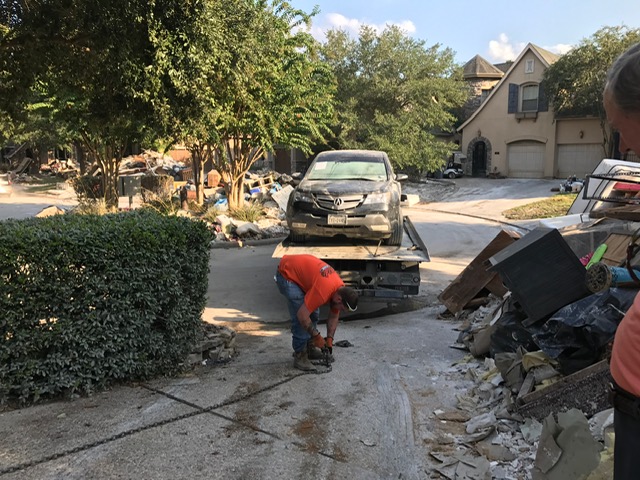
Colleen Ulrich gave me permission to share her family’s Hurricane Harvey experience. She captured the terror in this letter to the San Jacinto River Authority Board. It supports the continued seasonal lowering of Lake Conroe to provide a buffer against flooding until other mitigation measures can be put in place.Her home did not flood UNTIL AFTER the Lake Conroe release.
Full Text of Ulrich Letter
Dear SJRA Board Members,
The purpose of my email is to petition all SRJA Board Members to approve the temporary, seasonal lowering of Lake Conroe for 2020. As an introduction, I have been a resident of Kingwood since August 2005 when I evacuated from New Orleans due to Hurricane Katrina. We never moved back because our family fell in love with our adopted state of Texas and our adopted home town of Kingwood. I live in the Barrington neighborhood with my husband and 10-year-old daughter. Our home was flooded with 2 feet 2 inches of water in August 2017.
Colleen Ulrich’s vehicle during Hurricane Harvey after Lake Conroe release. This photo and those below courtesy of Colleen Ulrich. All used with permission.
Childhood Memories
One of the issues that those opposed to the temporary, seasonal lowering of Lake Conroe is that they feel deprived of their ability to enjoy the lake and to create fun summer time boating memories for their families and children. As a mother and Kingwood resident, I am petitioning you to vote in favor of the temporary, seasonal lowering of Lake Conroe to ensure the safety of my child and all of the children of Kingwood and to ensure none of the Kingwood area children have any memories similar to the ones that were created from the flood in August 2017.
Colleen Ulrich’s dining room during Hurricane Harvey after the SJRA opened the flood gates on Lake Conroe.
Our daughter, Alexandra, was 7 1/2 at the time and her memories include sitting on our stairwell alone in our home while my husband carried me on his back to be evacuated by boat because the quickly rising water was too high and the current too strong for me to walk by myself. Alexandra’s memories include riding in that same boat out of our neighborhood and seeing the houses with up to 4 feet of water in them. Alexandra’s memories include having her childhood bedroom destroyed by floodwaters.
I promise you that these memories will never fade for her.
The Ulrich living room after the Lake Conroe release during Harvey.
Fun Vs. Safety
So I petition to the Board, what is more important – creating fleeting childhood memories of a boat ride in the summer on Lake Conroe or averting traumatic childhood memories of a flood?
What is more important – the perceived Lake Conroe falling property values or the safety of our children and residents?
Heirlooms underwater.
I am in agreement that the lowering of Lake Conroe and Lake Houston are both temporary solutions. And of course these temporary solutions should be revisited once all of the other permanent measures including the installation of additional gates in Lake Houston are put in place. But until that time, I pray that you will make the right decision and keep the temporary, seasonal lowering in place until permanent measures can ensure the safety of all the children and of all the residents of Kingwood and the surrounding areas.
Ulrich kitchen, cabinets and appliances destroyed.
The piano that’s not so grand since Harvey.
Video of Evac
For your consideration, my husband recorded this video and posted it on YouTube so we can remind others of the trauma of that day. This was his boat ride out of Barrington.
I appreciate your service to our community and your consideration of my appeal to approve the lowering of Lake Conroe.
Regards,
Colleen Ulrich
Address and Phone Number Withheld for Purposes of This Post
Tell the SJRA Board about your Harvey experience and why you would like to see them continue lowering Lake Conroe seasonally until other flood mitigation measures can be put in place. Come to the next board meeting and tell them in person or write them by visiting https://www.sjra.net/about/board/. Scroll down to the bottom of the page to see the email form.
Posted by Bob Rehak on 1/18/2020
872 Days after Hurricane Harvey
https://i0.wp.com/reduceflooding.com/wp-content/uploads/2020/01/Ulrich-Evac.jpg?fit=1182%2C662&ssl=16621182adminadmin2020-01-18 17:11:252020-01-19 07:50:57Childhood Terror From Harvey: Ulrich Family’s Experience and Letter to SJRA Board
During Hurricane Harvey, the San Jacinto River Authority (SJRA) released almost 80,000 cubic feet per second from the Lake Conroe Dam. This amounted to ONE-THIRD of all the water coming down the highly populated corridor between Humble and Kingwood. Massive damage resulted.
How Lake Lowering Policy Started
Almost 6,000 structures along the West Fork flooded. That number includes more than 1,100 between Lake Conroe and Porter. Forty-four percent of all the businesses in the Lake Houston Area Chamber experienced damage. The release inundated entire subdivisions. They included Forest Cove townhomes, Barrington, Kingwood Cove, Kingwood Greens, Kings Harbor, and Town Center. Large parts of other subdivisions flooded, too. Some more than two miles from the West Fork.
After touring the damage, Governor Gregg Abbott directed the SJRA to reduce flooding. The SJRA established a Flood Management Division. It also adopted a temporary policy of lowering Lake Conroe from 201 feet to 200 feet in the rainiest months of Spring and 199 feet during the peak of hurricane season.
The extra capacity in Lake Conroe provides a buffer against flooding downstream. It reduces both the volume and rate of water that SJRA must release in a flood.
How Long Policy Will Last
The policy is temporary until other flood mitigation measures can be completed. Those include:
Dredging the West Fork. According to the Army Corps, it had become 90% occluded in places from all the sediment washed downstream by Harvey.
Adding ten additional floodgates to Lake Houston to it can keep up with the volume released by Lake Conroe. Currently, the gates on Lake Houston can release 10,000 cubic feet per second while the gates on Lake Conroe can release 150,000, 15X more.
Pushback by Lake Conroe Residents
After 1.5 years, Lake Conroe residents rebelled against the policy based on misinformation provided by the Lake Conroe Association (LCA). LCA argues that lowering the lake:
Is permanent.
Is needless, because dredging is done.
Has no scientific basis.
Has not worked.
Damaged home values and bulkheading around Lake Conroe.
Makes boating difficult, especially for people far north on the lake.
Reduces the recreational potential of Lake Conroe.
Damages the lake-bottom environment
Will damage Montgomery County’s tax base.
Some of these claims are just outright false. Most are exaggerated. And virtually all stem from false premises; the policy is not permanent and dredging is not done. Regardless, the LCA has whipped people into a hysterical frenzy. Billboards around the lake ask them to SAVE OUR LAKE.
In contrast, the Lake Houston Area Chamber has launched a fact-based campaign called Lives Over Levels.
Please support the the Lake Houston Chamber’s Lives over Levels Campaign by emailing the SJRA Board or coming to one of their meetings. See below.
Background Information to Help You Write a Letter of Support
The links below provide information that you can use to write letters/emails supporting the lowering of Lake Conroe until dredging is complete and additional floodgates have been added to Lake Houston.
Please write an email showing your support for continuing the temporary seasonal lowering of Lake Conroe. The SJRA Board of Directors also welcomes input via mail or email. To contact the Board please visit: https://www.sjra.net/about/board/. Scroll down to the bottom of the page to see the email form. Or email floodmanagementdivision@sjra.net.
Generally, original letters carry more weight than form letters. However, many people do not feel comfortable writing or speaking. So…
At the December SJRA board meeting, busloads of Lake Conroe residents flooded the boardroom and the Fire Marshall turned away busloads more. To ensure everyone who wants to speak or show their support gets a chance, the SJRA will hold two special meetings at a larger venue closer to Lake Houston.
BOARD OF DIRECTORS SPECIAL MEETING DATES, TIME, AND LOCATION
Tuesday, January 21, 2020
6pm at Lone Star Convention and Expo Center
9055 Airport Road, Conroe, Texas 77303.
Doors open at 5pm.
Thursday, February 20, 2020
6pm at Lone Star Convention and Expo Center
9055 Airport Road, Conroe, Texas 77303
Doors open at 5pm.
Those wishing to address the board or register a comment at a special meeting may fill out a Comment Registration Form https://www.sjra.net/wp-content/uploads/2020/01/Comment-Registration-Form_01062020.pdf. Comment Registration Forms may be submitted at the special meeting. The form may not be mailed, emailed, or dropped off prior to the meeting date.
For Future Reference
For your convenience, this post has become a permanent page called Lake Lowering with all related blog posts and sample letters. You can access it through the main menu. Please share it with friends and family and get them to come to one of the board meetings or write an email of support.
https://i0.wp.com/reduceflooding.com/wp-content/uploads/2019/04/LC-Dam-e1719277556742.jpg?fit=1200%2C549&ssl=15491200adminadmin2020-01-17 08:44:122020-01-18 15:35:11Overview: Background Information on Lake Lowering Issue
MoCo commissioners don’t make the decision to continue the policy. Their resolution shows only symbolic support for Lake Conroe residents. The SJRA board will make the final decision. So Daryl Palmer’s valiant solo appearance won’t necessarily end this story. But if “diffusion of responsibility” similarly affects turnout at the next SJRA board meeting, I fear that will send a message to the SJRA board. That message: downstream residents no longer care.
Ten Two Letter Words That Make All the Difference in the World
Somebody told me once about ten two-letter words that make all the difference in the world.
“If it is to be, it is up to me.”
I’ve tried to live my life by those words since then. Unfortunately, yesterday, I had a meeting conflict and could not attend the MoCo commissioner’s meeting.
When people believe success requires their involvement, most get involved. If you care about your community and neighbors who flooded, I challenge each of you to come to the next SJRA board meeting. Tell why lowering Lake Conroe is important to you personally.
Photo courtesy of Laura Vowinkle. Shows Kingwood Town Center Apartments during Harvey. That’s the top of an SUV in the foreground. These apartments are more than a mile north of the West Fork.
US59 During Harvey after the Lake Conroe release. Looking south from Sorters-McClellan overpass toward the Deerbrook Mall and Humble commercial district. Photo courtesy of Melinda Ray.
During the Lake Conroe release, Janet Wilson lost her home, two cars, 48 years worth of family heirlooms, pictures, books, keepsakes and furniture. She says the greatest damage though was the two years it took to restore family’s life; time that could have been spent with her aging and now deceased parents.
Another photo of Janet Wilson’s life on the curb.
Lowering Lake Conroe seasonally until other mitigation measures are complete is insurance. You don’t use insurance every year. But who would own a home or drive a car without it. The costs could be catastrophic.
Don’t think the SJRA board will automatically do the right thing.
Don’t rely on our political representatives to carry the day. They face opposition from representatives on the other side of this question.
Don’t assume that your voice won’t make a difference.
Don’t believe that because you didn’t flood, your home’s value was not affected.
Don’t pretend flooding could not happen again.
Four 100-year or greater storms hit this area in the last five years.
So act on those ten two-letter words. “If it is to be, it is up to me.”
Make Your Voice Heard
BOARD OF DIRECTORS SPECIAL MEETING DATES, TIME, AND LOCATION
Tuesday, January 21, 2020
6pm at Lone Star Convention and Expo Center
9055 Airport Road, Conroe, Texas 77303.
Doors open at 5pm.
Thursday, February 20, 2020
6pm at Lone Star Convention and Expo Center
9055 Airport Road, Conroe, Texas 77303
Doors open at 5pm.
Those wishing to address the board or register a comment at a special meeting may fill out a Comment Registration Form https://www.sjra.net/wp-content/uploads/2020/01/Comment-Registration-Form_01062020.pdf. Comment Registration Forms may be submitted at the special meeting. The form may not be mailed, emailed, or dropped off prior to the meeting date.
The SJRA Board of Directors also welcomes input regarding the seasonal lake lowering strategy via mail or email. To contact the Board please visit: https://www.sjra.net/about/board/. Scroll down to the bottom of the page to see the email form. Or email floodmanagementdivision@sjra.net.
The Lake Houston Area Chamber of Commerce has automated email that makes the process easy. But original emails that tell your particular story likely will carry far more weight.
Tomorrow, I will add a special page to this web site. It will contain all the information you need to compose your own letter or prepare spoken comments. Please continue to send in your photos of Harvey via the Submissions page on this web site so that we can dramatize the difference between real and perceived damages. In the meantime…
Don’t let diffusion of responsibility victimize you a second time.
Posted by Bob Rehak on 1/15/2020
869 Days since Hurricane Harvey
https://i0.wp.com/reduceflooding.com/wp-content/uploads/2020/01/Kingwood-Town-Center-Apts.jpg?fit=1200%2C563&ssl=15631200adminadmin2020-01-15 18:45:102020-01-17 08:52:46Lake Lowering and Diffusion of Responsibility
Everyone from County Commissioners to people on the street are picking up sides.
MoCo Commissioners Oppose Lowering in Split Vote
In a 3-2 vote this morning, Montgomery County Commissioners approved a resolution to OPPOSE the seasonal lowering of Lake Conroe. Judge Keough, Commissioner Meador and Commissioner Noack voted FOR the resolution. Commissioners Riley and Metts voted against.
Despite the news from Montgomery County, other local leaders released letters SUPPORTING the continuation of the policy.
Houston At-Large Council Member Sallie Alcorn Supports Lowering
Sallie Alcorn, Houston City Council Member At-Large, Position 5, sent the SJRA a letter supporting the continuation of the lake lowering policy. Ms. Alcorn, a new member of City Council, used to work with Chief Recovery Officer Stephen Costello and saw first hand how the lake lowering strategy helped prevent flooding in May of last year. See the full text of her letter below.
Sallie Alcorn Letter supporting lake lowering.
Woodlands Leader Robert Leilich Supports Lowering
Robert Leilich, president of Municipal Utility District #1 in the Woodlands, wrote a poignant letter to the SJRA board expressing his own personal experience and opinions.
January 14, 2020
Dear SJRA Board Members,
I witnessed first-hand the devastation wreaked by the necessity to open Lake Conroe’s Tainter Gates during Hurricane Harvey. I worked in a home of a disabled veteran in River Plantation that had recently recovered from the Memorial Day Flood. Water in this home went from a few inches up to ten feet in a matter of a few hours after the gates were opened. I spent many hours pulling down wallboard from the ceiling and walls after it ruined everything. Over 400 homes were flooded in River Plantation, alone, most of which would not have flooded if it were possible to not open the gates.
Taking steps to utilize the capability of Lake Conroe to contain more floodwaters beyond its current limited capabilities is a positive step to mitigate or prevent future flooding by waters flowing from Lake Conroe. This common-sense flood prevention capability must take precedence over minor inconveniences to a few homeowners and businesses, who greatly exaggerate claims of harm and loss. After all, the primary purpose to building the lake in the first place was never to serve those interests. SJRA has no obligation to give priority to these interests over the welfare of residents downstream of the dam.
In 1917, an amendment to the Texas constitution, referred to as the “Conservation Amendment,” authorized the Legislature “to create governmental entities with the authority to develop large-scale, regional projects, such as dams, reservoirs, and delivery systems, for the purpose of conserving and developing the state’s water resources, including the control, storing, preservation, and distribution of its storm and flood waters, the water of its rivers and streams, for irrigation, power, and all other useful purposes…” (from SJRA ‘s 75th Anniversary brochure, page 5).
In 1937, the San Jacinto River Conservation and Reclamation District (now SJRA) was formed “to develop, conserve, and protect the water resources of the San Jacinto River basin.” Enabling legislation also gave the Authority rights “to impound flood waters.” It is entirely appropriate and prudent that the SJRA exercise this authority.
The present policy to temporarily drop lake levels one-foot in the spring and two-feet in August and September is a fair compromise between flood prevention and recreation.
Since Governor Abbott directed the SJRA on March 15, 2018, to implement immediate and long-term solutions to protect lives and property of Texans living in the watershed, the SJRA Board has taken positive action. It is my hope that the Board will continue to follow the Governor’s directives when the board once again considers the temporary and seasonal lowering of Lake Conroe, continuing the present policy until (and if) more permanent flood control measures are implemented.
The ability of Lake Conroe to mitigate potential flooding was demonstrated during the May 10, 2019, rain event. (SJRA data from the May 2019 floods show that had no releases occurred prior to the event, Lake Conroe would have been forced to release at a higher CFS during the event.) Lowering Lake Conroe protected numerous lives, homes and businesses.
Access to lake recreation should never be at the expense of endangering lives downstream, especially considering the Charter of the SJRA states that its express purpose was for responsible water management. Further, if the Board chooses to not continue lowering Lake Conroe, it would be out of compliance with Governor Abbott’s mandate.
The San Jacinto River Authority has a legal and moral responsibility to many more people than just those who live and work around Lake Conroe. It is my hope and expectation that the SJRA Board will continue the present policy that is proving to protect lives and property against those who have a sense of entitlement that supersedes public interests.
I respectfully request that you vote in favor of the temporary, seasonal lowering of Lake Conroe on February 20, 2020.
Very truly yours, (Signed) Robert H. Leilich President, MUD #1
Lake Houston Area Grassroots Flood Prevention Initiative Supports Lowering
The Lake Houston Area Grassroots Flood Prevention Initiative supports the Lake Houston Chamber to mobilize people throughout the region. The Grassroots organization sent the following note to its members on Monday afternoon.
Dear ______________:
On Tuesday, Jan 7th, the Lake Houston Area Chamber of Commerce sent an email highlighting the various ways you can support the SJRA’s temporary seasonal Lake Lowering program for 2020.
We encourage everyone to be involved in any way you can. So, if you are not able to attend the SJRA Public Board meeting on Tuesday January 21st meeting at 6:00 pm at the Lone Star Convention and Expo Center, we encourage you to send an email to the SJRA board members sharing your support of this temporary lake lowering program. The Lake Houston Area Chamber of Commerce has created a very easy way to send an email via the RecoverLakeHouston.com website. It only takes a few seconds to complete their form. We highly recommend using this method to send an email.
In the Lake Houston Long Term Recovery Task Force Meeting this morning, the Lake Houston Area Chamber reported as of this morning, 689 emails had been sent via RecoverLakeHouston.com. While that is a good start, we are confident that with your help we can exceed 2000 emails to show SJRA that the Lake Houston area appreciates their support in providing temporary solutions to reduce the flood risk. So please share in your social media feeds and on Nextdoor to help spread the word. If it is easier to share directly from the Lake Houston Area Chambers Facebook post, the link is https://facebook.com/story.php?story_fbid=10158743067093357&substory_index=0&id=139473188356
It is important for EVERYONE to be involved as the Lake Conroe Association which is requesting SJRA to “Stop The Drop” is growing. They have obtained support from State Representative Will Metcalf and State Senator Robert Nichols. Bob Rehak with ReduceFlooding.com shared a recent blog post that includes the letters.
Again thank for being involved and please help spread the word.
Sincerely,
Lake Houston Area Grassroots Flood Prevention Initiative
Lake Houston Chamber Supports Lowering
The Lake Houston Chamber sent this letter to members.
January 7, 2020
I am calling on you, once again, to help us protect the Lake Houston Area from future flooding. We are launching a “Lives Over Levels” email campaign to the San Jacinto River Authority (SJRA) Board of Directors requesting their approval of temporary, seasonal lowering of Lake Conroe in 2020. The SJRA Board meets on January 21 to hear comments and again on February 20 to call the vote.
As you may recall, our area fought hard to initiate a seasonal lake lowering program during the wettest months of our year and in the height of hurricane season. The lake lowering program calls for Lake Conroe to be lowered 1 ft. below Lake Conroe’s normal pool elevation during the months of April and May and by 2 ft. below normal pool elevation in the months of August and September. The seasonal lowering program must be approved by the SJRA Board each February.
An organized group of homeowners on Lake Conroe has recently launched a campaign to the SJRA Board and a petition to Governor Abbott to stop the temporary and seasonal lowering program. They contend the temporary, seasonal lake lowering program impedes lakefront residents’ ability to get their boats from their slips during months with lower lake levels. They also claim that the lake lowering program has no scientific basis of flood protection and is thus merely offers a “placebo effect” for Lake Houstonians.
However, as residents and business professionals in Lake Houston, we know the benefits the seasonal and temporary lowering of Lake Conroe has had on our area and we also have data which proves seasonal lowering mitigated flooding.
HERE IS HOW YOU CAN HELP: SEND an email to the SJRA Board Members through our RecoverLakeHouston.com site.
SHARE the RecoverLakeHouston.com site with your employees, co-workers, friends, neighbors, and customers so they can also participate in the campaign. Forward this email and engage their participation.
SPREAD the campaign on social media using #LivesOverLevels #SJRA #RecoverLakeHouston. To make it easy, simply share posts from our Lake Houston Area Chamber social media pages. SJRA On Twitter: @SJRA_1937 SJRA On Facebook: @SanJacintoRiverAuthority SJRA on Instagram: @sanjacintoriverauthoritysjra
SHOW UP to the SJRA Board Meetings at 6:00 pm on Tuesday, January 21 and Tuesday, February 20 at the Lone Star Convention and Expo Center located at 9055 Airport Road, Conroe, Texas 77303. The opposition group in Lake Conroe will have several hundred people attend.
The future of the Lake Houston Area depends largely on our community rallying together, fighting for action to prevent flooding.
Join me in support of this campaign,
Jenna Armstrong, IOM President & CEO Lake Houston Area Chamber of Commerce
Posted by Bob Rehak on 1/14/2020
868 Days after Hurricane Harvey
https://i0.wp.com/reduceflooding.com/wp-content/uploads/2020/01/image-4.png?fit=960%2C540&ssl=1540960adminadmin2020-01-14 18:38:212020-01-17 08:53:57More People, Groups Line Up For, Against Lowering of Lake Conroe
To avert another seasonal lowering of Lake Conroe, the Lake Conroe Association is appealing to State Representatives, State Senators, the Governor, the Conroe City Council, and Montgomery County Commissioners. They focus on the temporary loss of recreation in some parts of the lake. They also say that “damages” home values and businesses.
Finally, they’re telling officials there’s no proof that lowering the lake helps prevent downstream flooding and that it wastes $10 million of water.
They are NOT telling officials, however, that ending the program before other mitigation measures are in place could potentially open up the SJRA and State of Texas to billions of dollars in law suits.
Fifth Amendment “Takings Clause”
The issue has to do with the Fifth Amendment of the U.S. Constitution. It says that private property shall not be taken for public use, without just compensation. This so-called takings clause forms the basis for many of the lawsuits against the SJRA stemming from Harvey flooding. Those have not yet gone to trial. But lawsuits in a parallel case have.
He said the flooding of homes was a foreseeable result of government actions.
Rulings in Addicks/Barker Cases
“U.S. Judge Charles F. Lettow detailed how government officials knowingly and intentionally used private property to store rising floodwaters,” said a Houston Chronicle article about the decision. The key point in the case, according to the judge: The government knew for decades that the reservoirs could NOT contain the floodwaters in a deluge and did NOTHING over decades to prevent it. “Plaintiffs have sufficiently demonstrated that the inundation of floodwaters onto their private property was the ‘direct, natural, or probable result’ of the government’s activity,” he wrote.
How Addicks Case Applies to SJRA Lake Lowering Policy
Hold that thought. Now apply those principles to the SJRA today. It faces a decision between the temporary seasonal lowering of Lake Conroe or NOT lowering the lake. Not lowering the lake would placate recreational boaters and lakefront property owners like LCA president Mike Bleier (who did not flood during Harvey).
That’s almost 6000 structures on the West Fork. One structure might include a whole apartment complex housing hundreds of families, a shopping center employing hundreds, a high school with 4000 students, a hotel providing housing to flood victims or a hospital treating them.
None of these numbers includes damages to East Fork property, which Lake Conroe releases do not affect
Now let’s assume that the SJRA eliminates the seasonal lowering policy which it has publicly stated prevented flooding twice so far.
Let’s also assume that a big storm comes along that dumps 10-12 inches of rain on Lake Conroe and that because that buffer no longer exists, people flood again.
Parallels
Lake Conroe and downstream residents now have a ready-made, almost watertight case against the SJRA and its financial backer, the State of Texas. All the essential elements from the Barker/Addicks decision are there.
Government knew that downstream flooding was likely.
SJRA had a proven strategy at its disposal to reduce flooding.
SJRA chose not to use the strategy, which the governor endorsed.
Governor had made flood mitigation a top priority for SJRA.
SJRA chose instead to increase recreational possibilities on public property (Lake Conroe).
Private property then flooded as a foreseeable result.
It seems like a pretty close parallel to me. Perhaps it’s even more of a textbook case. Especially considering recent directives by the governor for the SJRA to focus on flood mitigation and his public endorsement of the lake lowering strategy.
Mandates in SJRA Enabling Legislation
The state created the SJRA to “conserve, control, and utilize to beneficial service the storm and flood waters of the rivers and streams of the State.” Section 2 of the enabling legislation mentions floodwaters three times. It doesn’t mention recreational boating or lakefront home values once.
In addition, the enabling legislation also says that the purpose of the SJRA is to:
Prevent the devastation of land from recurrent overflows.
Protect life and property.
Regulate the waters of the San Jacinto River and its tributaries.
Conserve “soils against destructive erosion … thereby preventing the increased flood menace incident thereto.”
If the SJRA floods people again when it might have been avoided, this sounds more and more like a slam-dunk case for plaintiffs.
That includes understanding how the seasonal lowering strategy helps. It is designed more for “less than 100-year” rain events, than it is for another Harvey. Another Harvey would fill up that 1-2 foot buffer quickly and repeatedly. The value of the strategy lies in offsetting storms that we experience far more frequently, but which could still flood people, such as those last May.
For Those Who Have Never Personally Flooded
Before closing, I’d like to publish several images that West Fork residents Rhonda Haney and Alexis Faust sent me. The images show their Harvey experiences. Thank God, most Lake Conroe residents didn’t have to suffer through what Rhonda and Alexis did. Most Lake Conroe residents may not know the financial and emotional devastation of flooding. I wouldn’t wish that on anyone.
Harvey Photo courtesy of Alexis FaustHarvey Photo courtesy of Rhonda Haney
Harvey Photo courtesy of Rhonda Haney
Harvey Photo courtesy of Rhonda Haney
Harvey Photo courtesy of Alexis Faust
Harvey Photo courtesy of Alexis Faust
Harvey Photo courtesy of Alexis Faust
Posted By Bob Rehak on 1/13/2019 with thanks to Alexis Faust and Rhonda Haney for sharing their photos
867 Days since Hurricane Harvey
The thoughts expressed in this post represent opinions on matters of public concern and safety. They are protected by the First Amendment of the US Constitution and the Anti-SLAPP Statute of the Great State of Texas.
https://i0.wp.com/reduceflooding.com/wp-content/uploads/2020/01/Alexis-Lehman.jpg?fit=900%2C1200&ssl=11200900adminadmin2020-01-13 00:49:342020-01-17 08:53:24Legal Aspect of Lake Lowering That Lake Conroe Association Won’t Tell Officials About
With 2019 almost behind us, we should look back to see what we accomplished on flood mitigation. Tomorrow, I’ll take a look at the stories that will likely define 2020.
Limited Dredging
In 2018, FEMA and the Army Corps announced that they would dredge 2.1 miles of the San Jacinto West Fork when they were given authority to dredge 8 miles. Questions immediately started to swirl about why they were not dredging all the way to Lake Houston. The answer was “part of the mouth bar was there before Harvey and we can only spend disaster relief funds on what Harvey deposited.”
The mouth bar as it existed shortly after Hurricane Harvey. Photo taken 9/14/2017.
Regardless, they left the biggest blockage in the river. Imelda washed a tremendous amount of sediment downriver. In mid-October, RD Kissling sent me a photo from his kayak. He as standing in water less than knee deep 700 yards south of the mouth bar. It’s important to understand that sand bars are like ice bergs. You only see the tip above water. Most of the bar exists below water. And much of this mouth bar remains to be removed.
To learn more about this controversy, search this site using the key words “mouth bar.”
Flood Mitigation Legislation: A Big Win
No one budgets for disasters, such as Hurricane Harvey. So after the disaster, cities and counties had to scramble for grant money to even qualify for matching funds from the Federal government. More than two and a half years after the event, money is finally starting to trickle down to the areas that need it to implement flood mitigation projects. That’s thanks in large part to Senator Brandon Creighton who authored Senate Bill 7.
SB7 creates dedicated Texas Infrastructure and Texas Infrastructure Resiliency Funds for flood control planning and the funding of flood planning, mitigation, and infrastructure projects. The Texas Water Development Board is finalizing rules for the distribution of those funds right now. SB500, a supplemental appropriations bill, includes funding for SB7 and an amendment that would dedicate $30 million for dredging at the confluence of the San Jacinto and Lake Houston. State Representative Dan Huberty authored the amendment to SB500 that provides the $30 million.
For more information about legislation affecting this area, see the Legislation page of this web site or search using the key words “SB7” or “SB500.”
Sand Mining Legislation: One Small Gain, Some Big Losses
Activists statewide pushed for legislation to reign in the excesses of an out-of-control aggregate industry. Here in the Houston area, State Representative Dan Huberty introduced HB 907. It passed and doubles the penalties for not registering a sand mining operation. It also increases the frequency of inspection from every three years to two years and established a registry of active sand mines.
Picture of the West Fork of the San Jacinto the day it turned white (11/4/2019). The TCEQ later issued a notice of enforcement to the Liberty Materials mine upstream for dumping 56 million gallons of white goopy pollution into the West Fork.Water samples indicated 25 times the normal amount of suspended solids.
That was the only bill that the high powered lobbyists of TACA (the Texas Aggregate and Concrete Association) would allow to pass. That’s mostly because their members are already registered.
However, other important bills died in committee due to the lobbying power of TACA.
HB 908 would have provided for penalties up to $50,000 for water code violations and every-other-year inspections.
HB 909 would have created best management practices for sand mines.
HB 1671 would have extended water quality protections to the West Fork of the San Jacinto currently enjoyed by the John Graves District on the Brazos and attached penalties for non-compliance with best practices defined under HB909.
HB 2871. Would require sand mines and other aggregate production operations to acquire a reclamation permit and to file a performance bond ensuring reclamation.
For more information about sand mining in the Lake Houston area, see the Sand Mining page of this web site. You can also search on the key words “sand mining, TACA, Triple PG, TCEQ, breach, Liberty, and white water.”
Artist’s conceptual drawing of a high-rise development called The Herons: Kingwood.
The tallest buildings would have been 500 feet and located on the edge of the current floodway. That floodway will almost certainly expand in light of new Atlas-14 rainfall data. The developers also announced a marina that would have held 640 40-foot boats and 200 jet skis. There were no evacuation routes that would have remained above water in the event of a flood.
The developer’s web site now says the project is on hold, pending improvements to the West Fork and Lake Houston.
For more information on this development, see the High Rises page of this web site or search for the key words “Romerica, high rises, eagle, or The Herons.”
The $2.5 Billion Flood Bond Equity Flap
When the wording for Harris County’s historic $2.5 billion flood bond offering was worked out in early 2018, leaders from the Humble/Kingwood area in Precinct 4 argued to include the notion of an equitable distribution of funds. Why? Historically the Flood Control District had focused more on projects in other parts of the county, especially Precinct 1, that Precinct 4.
In one meeting after another, Ellis’ ringers showed up in commissioners court to complain about discrimination in the distribution of funds for buyouts, construction spending, and more. Yet in every category, Ellis’ precinct already had the lion’s share of funding.
This is an on-going controversy that affects everyone in the Lake Houston area. Ellis is looting transportation dollars from Precinct 4. You have to hand it to Ellis. Even if he doesn’t know what equity means, he knows how to work the system.
For more information on this topic, search this site using the key words “equity or Ellis.”
Meanwhile, the Supreme Court of Texas ruled that the language in the summary of the referendum on the ballot was misleading. It failed to disclose that the money would be raised through a new tax. So the Court ordered a revote.
In 2018, the Mayor “resold” the fee by saying, “If you want a lockbox around the money, vote FOR Proposition A. If you don’t want a lockbox around the money, vote AGAINST it.”
It was another artful dodge. There was nothing in the language of the bill to create a lockbox. The language in Prop A was almost identical to the original bill. But the funding formula was even looser!
Unaware voters once again approved the fee. And the Mayor continued to divert money from the fund. These diversions became a central element in the Mayoral campaign this year after thousands of people flooded in May and again during Imelda.
Nevertheless, the Mayor won re-election.
To learn more about this topic, search this site using the key word “Proposition A.”
10 New Gates for Lake Houston
The flood gates on Lake Conroe can release water 15 times faster than the gates on Lake Houston. During Harvey, that bottleneck contributed to the flooding of thousands of homes. A study showed that additional gates would have lowered the water level by almost two feet in the event of another Harvey. During smaller storms, the gates would also help pre-release water faster to create a buffer against possible flooding.
Lake Houston can shed water at 10,000 cubic feet per second. Lake Conroe can shed it at 150,000 cubic feet per second.
The City of Houston applied for a grant from FEMA and the Texas Division of Emergency Management to add ten new gates. FEMA approved the project. It’s happening in two phases. The first includes design and an environmental survey. The second includes construction. Each will take 18 months. We’re now six months into Phase One.
Details of dam improvement project.
For more information on this topic, search this site using the key word “gates.”
Temporary Seasonal Lowering of Lake Conroe
After Harvey, people in the Lake Houston area started pleading for more upstream detention, dredging and gates. Dredging started immediately. The project to add more gates to the Lake Houston spillway has also started. Upstream detention is still years way. The San Jacinto Watershed Study is only now beginning to identify possible locations.
Many lakefront property owners on Lake Conroe, however, claim the lowering hurts their property values and damages their bulkheads. Buses full of protesters showed up at the December SJRA Board meeting wearing red shirts that say, “Stop the Drop.” So many came that two busloads full of people had to be turned away.
Angry Lake Conroe residents showed up at the last SJRA board meeting in busloads.
Net: the policy to lower Lake Conroe temporarily is under assault. The SJRA will likely vote on whether to continue the policy in February. The SJRA will hold two additional meetings at the Lonestar Convention and Conference Center in January and February to give everyone who wants to provide input a chance to do so.
For more information on this topic, search this site using the key words “lake lowering.”
This is another issue that will carry over into 2020.
For more information on this topic, search this site using the keywords “Perry Homes, Woodridge Village, Figure Four Development, PSWA, Elm Grove, Spurlock, cease and desist, detention, what went wrong, North Kingwood Forest, or drainage criteria.”
There’s your digest of the biggest stories of 2019. 2020 to follow.
Posted by Bob Rehak on December 19, 2019
842 Days after Hurricane Harvey and 92 since Imelda
The thoughts expressed in this post represent opinions on matters of public concern and safety. They are protected by the First Amendment of the US Constitution and the Anti-SLAPP Statute of the Great State of Texas.
https://i0.wp.com/reduceflooding.com/wp-content/uploads/2019/12/Slide11.jpeg?fit=1200%2C900&ssl=19001200adminadmin2019-12-19 11:45:402019-12-19 12:01:13The Biggest Stories of 2019
Two and a half busloads of additional “Stop the Drop” protesters from Lake Conroe had to be turned away from the SJRA’s December Board Meeting because of capacity issues related to fire safety.Photo courtesy of David Feille.
Special Meetings Called to Handle High Volume of Public Input
Due to the overwhelming response, the San Jacinto River Authority’s (SJRA) Board of Directors will hold TWO SPECIAL meetings.
January 21, 2020, at 6:00 P.M.
February 20, 2020, at 6:00 P.M.
Both will be held at the Lone Star Convention and Expo Center. It has the capacity to accommodate everyone who wants to speak. The center is located at 9055 Airport Road, Conroe, Texas 77303.
The purpose: to hear public comment on the temporary flood mitigation strategy of lowering Lake Conroe on a seasonal basis.
The lowering of Lake Conroe one foot in the spring and two feet in the fall is intended to provide flood mitigation benefits for downstream residents by increasing capacity to catch rainfall and runoff in the lake. The SJRA Board reviews the strategy annually. Both the SJRA and the City of Houston own water rights in Lake Conroe. For full details of the strategy, including timing, click here.
The SJRA Board of Directors will receive a presentation from staff at the January 21st special meeting and listen to public comment.
The board will conduct no other business at these meeting and will not consider the lake lowering strategy at either of its regular board meetings in January or February. Any vote on the strategy will take place at the February 20th special meeting.
Special Meeting Dates, Time, Location
Tuesday January 21, 2020
6 P.M.
Lone Star Convention and Expo Center
9055 Airport Road, Conroe, Texas 77303
Thursday, February 20, 2020
6 P.M.
Lone Star Convention and Expo Center
9055 Airport Road, Conroe, Texas 77303
The SJRA Board of Directors says it welcomes all input regarding its seasonal lake lowering strategy.
Posted by Bob Rehak on 12/18/2019 with a photo courtesy of David Feille
841 Days since Hurricane Harvey and 90 since Imelda
https://i0.wp.com/reduceflooding.com/wp-content/uploads/2019/12/STD-Protesters.jpg?fit=1200%2C900&ssl=19001200adminadmin2019-12-18 14:40:492020-01-17 08:55:35SJRA Board Will Hold Two Special Meetings to Discuss Seasonal Lowering of Lake Conroe
More than 150 red-shirted “Stop the Drop” protesters packed the SJRA board meeting at the Lake Conroe Dam this morning. Lake Conroe lakefront homeowners came to protest the seasonal lowering of Lake Conroe. According to SJRA Board Member Mark Micheletti, two and a half busloads of additional angry protesters had to be turned away because they exceeded the building’s capacity.
Five Lake Houston area residents came to speak. However, they were outnumbered by more than 30 to 1. The Lake Houston Area residents made good presentations, but on the basis of numbers alone, the well organized sea of protesters overwhelmed them. The disparity in numbers between the two sides sent a not-so-subtle message to SJRA board members.
People protesting the Lake Conroe seasonal lowering policy packed the SJRA board meeting on 12/12/2019. Photo taken before meeting shows only half the room.
Because some Kingwood East Fork residents flooded during Imelda, it proves that Lake Conroe has nothing to do with Kingwood flooding. The East and West Forks (which includes Lake Conroe) are in different watersheds. During Imelda, the East Fork received 20 inches of rain while Lake Conroe received only 2.
Lake Conroe releases during Harvey comprised just 15% of the water flowing into Lake Houston and that was not a large enough percentage to affect flooding. The statistic may be literally true. But it’s misleading. It has nothing to do with the flooding on the West Fork. And that’s where the vast majority of all damage occurred. Lake Conroe releases comprised ONE THIRD of the water coming down the West Fork. Furthermore, they came at the peak of the flood.
Two More Board Meetings Before Vote
The SJRA board meets again in January and February before voting on whether to extend the seasonal lowering of Lake Conroe another year. The next meeting will be at the The Lonestar Convention & Expo Center so more people can attend.
The board was afraid that if it chose a Lake Houston venue for the meeting, it would look as if they were trying to stifle dissent.
Watch for more details in January about the next board meeting.
Another meeting like this could mean the end of Lake Houston’s only flood protection measure at the moment.
Posted by Bob Rehak on 12/12/2019
835 Days after Hurricane Harvey and 82 since Imelda
https://i0.wp.com/reduceflooding.com/wp-content/uploads/2019/12/Stop-Drop.jpg?fit=1024%2C768&ssl=17681024adminadmin2019-12-12 15:29:552020-01-17 10:17:10SJRA Board Meeting Packed by “Stop the Drop” Protesters
Lake Conroe residents organizing opposition to the SJRA’s lake lowering policy have found it easy to “blame” Kingwood for their inconvenience. Kingwood is an affluent community in another county. But the Lake Conroe people ignore more than 1100 homes between Kingwood and Lake Conroe in Montgomery County (MoCo) that also flooded.
The lake lowering reduces downstream flood risk by creating extra capacity within the lake during months with the heaviest rainfall. It is a temporary measure until flood mitigation measures can be completed that help protect the Lake Houston Area.
ESRI GIS Database Shows Counts of Damaged MoCo Homes
ESRI operates a Montgomery County GIS (geographic information system) database called the Harvey Story Map. (Unfortunately, this may not work with all versions of Safari. Try Chrome if you have trouble.) Clicking on Section 12 shows the location of homes that flooded during Harvey in MoCo.
As you to zoom, you can see counts of flooded structures within the visible area. For instance, around Lake Conroe, 292 homes flooded during Harvey. The map below shows the location of those homes.
292 homes flooded on Lake Conroe during Harvey. Lake lowering gives them an extra buffer against flooding.
If you continue to zoom in, you can even see how individual houses fared in other floods as well.
Below are six screen captures that give you a sampling of what you will find. This first area is just below the Lake Conroe dam where 30 homes flooded during Harvey.
Below is River Plantation, just downstream from I-45. Put your water wings on, Bucko! The count here: 527.
Here are four more subdivisions farther downstream.
The West Fork subdivisions shown above had 1159 flooded structures during Harvey. But more homes flooded than in these six images. For starters, there were the 298 homes around Lake Conroe itself.
I’m not sure how many people have waterfront lots on Lake Conroe, but is their boating convenience really worth risking the possibility of flooding even a subset of these homes again?
Posted by Bob Rehak on 11/24/2019
817 Days after Hurricane Harvey
https://i0.wp.com/reduceflooding.com/wp-content/uploads/2019/11/image-1.png?fit=1911%2C917&ssl=19171911adminadmin2019-11-23 21:29:122020-01-17 08:56:39Lake Conroe Lowering Benefits MoCo Residents, Too; More Than 1100 Flooded on West Fork During Harvey
At its February 2020 board meeting, the San Jacinto River Authority (SJRA) Board of Directors will consider NOT lowering Lake Conroe during the spring and fall rainy seasons. Lake Conroe residents have mobilized to protest the lowering which they see as a costly inconvenience. They have started spreading disinformation about the policy. The SJRA Board has reportedly already received more than a hundred letters protesting the policy.
Reason for Lowering and Current Status
The strategy of lowering Lake Conroe on a seasonal basis reduces the risk of flooding downstream residents by increasing the capacity of Lake Conroe to store water. The SJRA Board of Directors and City of Houston review the strategy annually. Both entities own water rights in Lake Conroe.
The gates at Lake Conroe can release water at up too 150,000 CFS but are currently releasing 0 CFS. Lake lowering ended October 1st.
After Hurricane Harvey, the State of Texas called on the SJRA Board of Directors and the City of Houston to participate in regional strategies to reduce flooding. The temporary lowering of Lake Conroe has reduced releases from Lake Conroe during storms. SJRA and downstream communities realize and understand the inconvenience that the strategy can create around Lake Conroe. We ask for understanding for the duration of this temporary mitigation strategy.
Seasonal Lake-Lowering FAQs
Who Decides?
The City of Houston and the SJRA collaborate on the decision to temporarily lower Lake Conroe for flood mitigation because it effects the water supply of both entities.
How Long Will It Continue?
Seasonal lake lowering is a temporary flood mitigation initiative to increase the capacity of Lake Conroe to catch rainfall and runoff while long-term and short-term flood mitigation strategies are implemented downstream.
The motion made by the SJRA Board states that the intent of the proposal is to provide “a near-term, temporary flood mitigation benefit while more permanent mitigation strategies, such as dredging of the lower West Fork, are completed.”
When Does It Happen?
Seasonal lake lowering occurs twice annually – first in April/May and second in August/September.
How Much is It Lowered and for How Long?
In the spring, releases begin on April 1st. SJRA gradually reduces the level of Lake Conroe to 200’ mean feet above sea level (msl)—one foot below the normal Lake Conroe pool level of 201’ msl. Starting on June 1st, SJRA recaptures flows to restore normal lake elevation to 201’ msl.
In the fall, releases begin on August 1st. SJRA gradually reduces the level of Lake Conroe with a goal of reaching 200’ msl by August 15th. After August 15th, gradual lowering continues with a goal of reaching (and maintaining) 199’ msl—two feet below normal pool—by August 31st. Starting October 1st, SJRA begins to capture flows to restore normal lake elevation to 201’ msl.
What If The Lake Is Already Down?
If the lake level has already dropped to the target elevation due to evaporation, no releases are made.
What if It Rains While the Lake is Already Lowered?
If a storm enters the forecast while seasonal releases are being made to lower the lake level, releases are stopped and the river is allowed to drain out until rainfall is out of the forecast.
Is There Science Behind This Policy?
Two engineering reports by Frees & Nichols from early 2018 show the benefits in terms of flood mitigation and the potential negative impacts to water supply. These reports as well as additional information about seasonal lowering can be found at: https://www.sjra.net/floodmanagement/.
Has it worked? Is there real value in terms of flood mitigation?
Yes. Looking at recent rainfall events, seasonal lowering resulted in both lower peak lake levels during storms and lower release rates from the dam.
Seasonal lowering also reduces the peak Lake Conroe level during storms, which reduces negative impacts around the lake such as damage to docks and other personal property. During Harvey, several hundred homes around Lake Conroe flooded.
Data for the May event, and for all releases from the dam, including those during seasonal lowering periods, can be monitored by visiting SJRA’s home page at www.sjra.net. Click on the “Lake Operations and Rainfall Dashboard.”
What is the cost of the release?
Lake Conroe was built as a water supply reservoir in the 1970s through a partnership between SJRA and the City of Houston. Two thirds of the water in Lake Conroe belongs to the City of Houston and one third to SJRA. The City of Houston can call for the release of its water at any time, and water supply reservoirs are built to fluctuate as demands or operational needs dictate.
Releases such as those made for dam repairs and seasonal lowering are not charged to any particular customer, therefore it is not possible to assign a value to the water released. In addition, temporary, non-customer releases do not reduce long-term water supplies, therefore they are not considered lost revenue.
To be considered as lost revenue, releases would have to happen at a time when the SJRA could not meet demand with water from Lake Conroe. But that has not happened.
And most important, if the water supply in Lake Conroe were ever threatened, say from drought, the SJRA would not be releasing water anyway. The lake level would already be far below the target level, making a release unnecessary.
Is This a Permanent Program?
No. Seasonal lowering is a temporary flood mitigation strategy that must be reconsidered each year by the City of Houston and the SJRA Board of Directors while more permanent mitigation strategies, such as dredging of the lower West Fork, are completed.
https://i0.wp.com/reduceflooding.com/wp-content/uploads/2019/04/LC-Dam-e1719277556742.jpg?fit=1200%2C549&ssl=15491200adminadmin2019-11-23 11:00:262020-01-17 08:57:17FAQs About Lowering Lake Conroe to Reduce Downstream Flood Risk