Tag Archive for: Lake Conroe Association

Lake Conroe Association Applies for Temporary Restraining Order To Prohibit Seasonal Lowering of Lake Conroe

They’re baaaa-aaaack. Yesterday, less than a day before the SJRA spring seasonal lowering program was set to kick in, the Lake Conroe Association (LCA) applied for a temporary restraining order to prohibit it. The LCA also seeks a permanent ban on the entire program. For the complete text of their 30-page lawsuit, click here. For a summary, see below.

Seasonal Release from Lake Conroe, 529 cfs from one tainter gate open six inches.
SJRA Seasonal Release on 4/15/2020. One tainter gate open six inches releases a slow, steady stream of 529 cfs.

History of Lake Lowering Policy

After disastrous flooding during Hurricane Harvey in 2017, Governor Abbott instructed the SJRA to get into the flood mitigation business and identify strategies to reduce the risk of downstream flooding. The simplest, fastest, most effective strategy that required no grants, funding, design or construction was to lower Lake Conroe during the peaks of spring and fall flood seasons. This created an extra buffer against downstream flooding by creating extra capacity in the upstream lake.

The seasonal-lowering policy started in 2018 and continued in 2019. By late 2019 when the SJRA was getting ready to review the policy for another year, the Lake Conroe Association mobilized opposition in a major-league way. People came to SJRA Board meetings in busloads. There were so many that they couldn’t all get in the SJRA boardroom to be heard. So the next meeting was held in the Conroe Convention Center. Close to a thousand “Stop the Drop” protesters showed up. They argued that lowering the lake a foot was destroying businesses around the lake, undermining property values, destroying the local school system, and threatening the entire tax base of Montgomery County.

They also argued that Lake Conroe was never intended to be a flood control reservoir, and that the policy wasted water, produced no benefit, and had minimal effect. The current lawsuit makes many of these same hyperbolic arguments.

Allegations in Lawsuit

Below, see the major allegations in the seasonal-lowering lawsuit (italics) and my responses (normal text).

The SJRA and City of Houston are unlawfully discharging billions of gallons of water from Lake Conroe which causes it to remain below full capacity. However, a quick check tonight showed that the lake was actually above its normal capacity.

The Lake Conroe Dam is being operated contrary to state law. The operation was initiated at the request of the governor and approved by the TCEQ as an emergency measure while permanent downstream flood mitigation efforts could be put in place.

Lake Conroe Dam operation is contrary to the interests of the parties “for whom the lake is maintained, regulated and conserved.” The City of Houston paid for the construction of the dam and owns two thirds of the water in the lake. The operation benefits Houston residents and was requested by the Mayor of Houston. So I ask, “For whom is the lake maintained, regulated and conserved?”

The State is entitled to regulate water to protect its citizens’ health and safety. Isn’t that what the lake-lowering policy ensures?

Lake Conroe is not a flood control reservoir. Right! We’re trying to do the best with what we have.

The policy doesn’t conserve water. Right again! But it does conserve downstream property and lives. Somehow those got lost in the LCA arguments. For a list of Lake Houston Area damages during Harvey, click here.

Flood control is not permitted for Lake Conroe. But the TCEQ did permit it. And the TCEQ rejected an LCA appeal last year.

There’s no evidence that the policy works. Tell that to the people who didn’t flood in this storm.

The policy is not really temporary. Why was the policy enacted for three years then? It’s intended to allow safe completion of additional gates on the Lake Houston Dam.

The seasonal releases happen far in advance of a storm. Lake Conroe’s gates can release water 15 times faster. If a major storm approaches and a large release becomes necessary, it could overwhelm the gates on Lake Houston. The slow seasonal release safely reduces that risk.

Harris County Flood Control’s Harvey Report found the benefits of lowering Lake Conroe to be “negligible.” That’s a lie. The word negligible never appears in the report. And the lawsuit distorts the figures. It claims the Lake Conroe release accounted for at most 16% of the water going over the Lake Houston Dam. But it was one third of all the water coming down the West Fork where the vast majority of the damage occurred. The lawsuit allegation includes East Fork water to exaggerate its claim. The Lake Conroe Dam has no effect on East Fork flow. Also consider this. All by itself the Lake Conroe release during Harvey would have ranked as the ninth largest flood in West Fork history. Hardly negligible!

Petitioners continue to be affected in their rights to their use and enjoyment of Lake Conroe. Now we’re getting to the heart of the matter. But these photos show little impact on recreation even when the lake was lowered two feet.

Water released as part of a seasonal lowering will never be available for use. Rain replenishes the lake at no cost.

As of 8pm on 3/31/2021, Lake Conroe was at its normal “target level.” The SJRA lake lowering policy calls for lowering it one foot during April and May.

Without the TRO, Lake Conroe residents will have no adequate remedy to protect the “public’s interest.” Which public? The owners of the water? Or residents of Lake Conroe?

Lake Conroe Residents Don’t All Agree with LCA

Not all Lake Conroe residents agree with this petition. Though the petition gives no hint of that. Many who flooded during Harvey have previously testified that they want the lake lowered – permanently!

Exaggeration Upon Exaggeration

This lawsuit exaggerates. And that’s its biggest flaw. It sounds like the kid who tells the teacher “My dog ate my homework, right before a bus ran him over, and a 747 crashed into the bus. I tried to retrieve my homework, but the fire department washed it down the sewer. And now it’s floating in Lake Conroe where water skiers are tripping on it. That’s going to destroy home values on Lake Conroe and undermine the tax base of the school district. So you see, Teach, we have much bigger things to worry about. Like your salary and job security.”

For more about the seasonal lake lowering policy, click on this page.

Hearing Scheduled

It’s not clear yet how this lawsuit will affect the spring lowering of Lake Conroe scheduled to start Thursday. The lawsuit is scheduled for a hearing on 4/19/2021 in Montgomery County.

Posted by Bob Rehak on 4/1/2021

1311 Days after Hurricane Harvey

The thoughts expressed in this post represent opinions on matters of public concern and safety. They are protected by the First Amendment of the US Constitution and the Anti-SLAPP Statute of the Great State of Texas.

Lake Conroe Association Complains to TCEQ about Seasonal Lake Lowering

In June, the Lake Conroe Association (LCA) filed a 102-page complaint to the Texas Commission on Environmental Quality (TCEQ) through Austin attorneys about the San Jacinto River Authority’s (SJRA) policy of seasonally lowering Lake Conroe. The SJRA’s purpose for the lowering: to lower flood risk for downstream residents.

To download the complete complaint by Birch, Becker & Moorman LLP, click here. Warning: 20-meg file size.

Complaint Based on Three Arguments

The attorneys make three arguments.

  • State law prohibits the wasting of water.
  • The policy will not prevent downstream flooding.
  • Also, the policy threatens the area’s water supply.

“In summary,” says the complaint, “SJRA and Houston are only authorized to divert or release and use water from Lake Conroe for municipal, industrial, mining, and agricultural purposes. Any other use of surface water from Lake Conroe is not authorized by the Amended Certificate, and thus, is a violation of the Amended Certificate and state law.”

The complaint fails to mention flood control in that last list (prominently mentioned in the SJRA’s enabling legislation). To follow the LCA’s arguments to their logical extreme, SJRA would not have been allowed to release water during Harvey. Every home on Lake Conroe would have flooded.

TCEQ Response to Complaints

On July 29, the TCEQ replied to the complaint. Toby Baker, TCEQ’s Executive Director, says that:

  • “TCEQ does not have jurisdiction over future water supply strategies or State and Regional Water Planning.”
  • “Both SJRA and the City have adopted Water Conservation Plans that comply with TCEQ’s Chapter 288 rules.”
  • “Therefore, these diversions, which are in compliance with the terms of the Certificate and the Conservation Plan, are not a waste of water under the law.”
  • The City and SJRA are within their rights.

LCA Lodges Supplemental Complaint

Just the day before, on July 28, 2020, the same law firm filed a 4-page supplemental complaint to halt the fall lowering. The second complaint and the TCEQ’s response to the first complaint may have crossed in the mail.

The law firm acknowledged in its supplemental complaint that the lowering would only amount to 2.75 inches. However, the firm also claimed the water would be needed in a drought. Then it showed a Texas Water Development Board Drought Map as evidence. But map showed that no drought near the San Jacinto watershed.

TCEQ Finds City and SJRA in Compliance

Mr. Baker of the TCEQ replied to the supplemental complaint on August 6. He concluded, “After review, the TCEQ determined that the San Jacinto River Authority and the City of Houston are in compliance with the terms and conditions of Certificate of Adjudication 10-4963.”

In the End, Mother Nature, Not SJRA, Lowers Lake This Year

After all of that, evaporation alone took Lake Conroe down to the SJRA’s seasonal lowering target of 200 feet. It took Mother Nature an extra week to get there, but…

SJRA RELEASED NO WATER from Lake Conroe to achieve its August target level.

SJRA still has not released any water since the early spring.

Lake Conroe dashboard as of 4pm Saturday, August 15, 2020. Source: SJRA.net.

LCA Pleads for More Money to Keep Fighting

Now the Lake Conroe Association is pleading with residents for donations to replenish its war chest. It will be interesting to see what they plan next.

Posted by Bob Rehak on August 15, 2020

1082 Days since Hurricane Harvey

Lake Conroe Lowered to Target Level for August; LCA May Be Gearing Up For Another Fight

Since August 1, the level of Lake Conroe has hovered around 200 feet. As of this writing, it stands at 199.95 feet, virtually at the target level of the seasonal lowering for the month. That’s three hundredths of a foot above its seasonal average for the last 46 years and five hundredths of a foot below the target level. Yet the Lake Conroe Association appears to be gearing up for another fight to end the program.

Lake Conroe level as of 8/10/20 at 4:30 pm. Source: SJRA.net.

Seasonal Averages

Lake Conroe seasonal levels by month. Source: SJRA

History of Strategy

The SJRA started seasonally lowering the level of Lake Conroe in 2018 after Governor Abbott directed the SJRA to develop strategies to help protect downstream communities from flooding. Due to a slight drought in late 2019, the lake level did not recover quickly. The Lake Conroe Association (LCA) then organized protests as the SJRA reconsidered the strategy for this year.

Seasonal Release from Lake Conroe, 529 cfs from one tainter gate open six inches.
SJRA Seasonal Release on 4/15/2020. One tainter gate open six inches releases a slow, steady stream of 529 cfs. No one flooded downstream last Spring during the release.

Ultimately, the strategy adopted by the SJRA represented a compromise. During September/October, the lake will remain a half foot higher than in previous years (200 vs 199.5).

Here’s how the current and previous targets compare to what Mother Nature provides through rainfall and evaporation.

In August, little manual lowering should be needed. In September and October, much less lowering will be needed compared to the previous plan adopted in 2018.

SJRA’s Plan for Fall Lowering

SJRA’s current official policy reads as follows.

Beginning August 1, release only an amount of water from Lake Conroe to create a one foot capacity to catch rainfall and storm runoff (from 201’ msl to 200’ msl). After September 1, increase capacity an additional six inches (from 200’ msl to 199.5’ msl). If a named storm is predicted to impact our region, the COH may initiate an additional release of six inches (to 199’ msl) by notifying SJRA in writing of their call for release. Recapture beginning October 1.”

Compared to the seasonal average, the plan really only amounts to lowering the lake 2 to 3 inches in September and October.

Lake Conroe Association Gearing Up for Another Fight?

Regardless, the Lake Conroe Association (LCA) is reportedly gearing up for another fight.

Community Impact newspaper reported in its August 2020 issue that LCA filed a complaint with the TCEQ on June 30 to end the seasonal lowering of Lake Conroe.

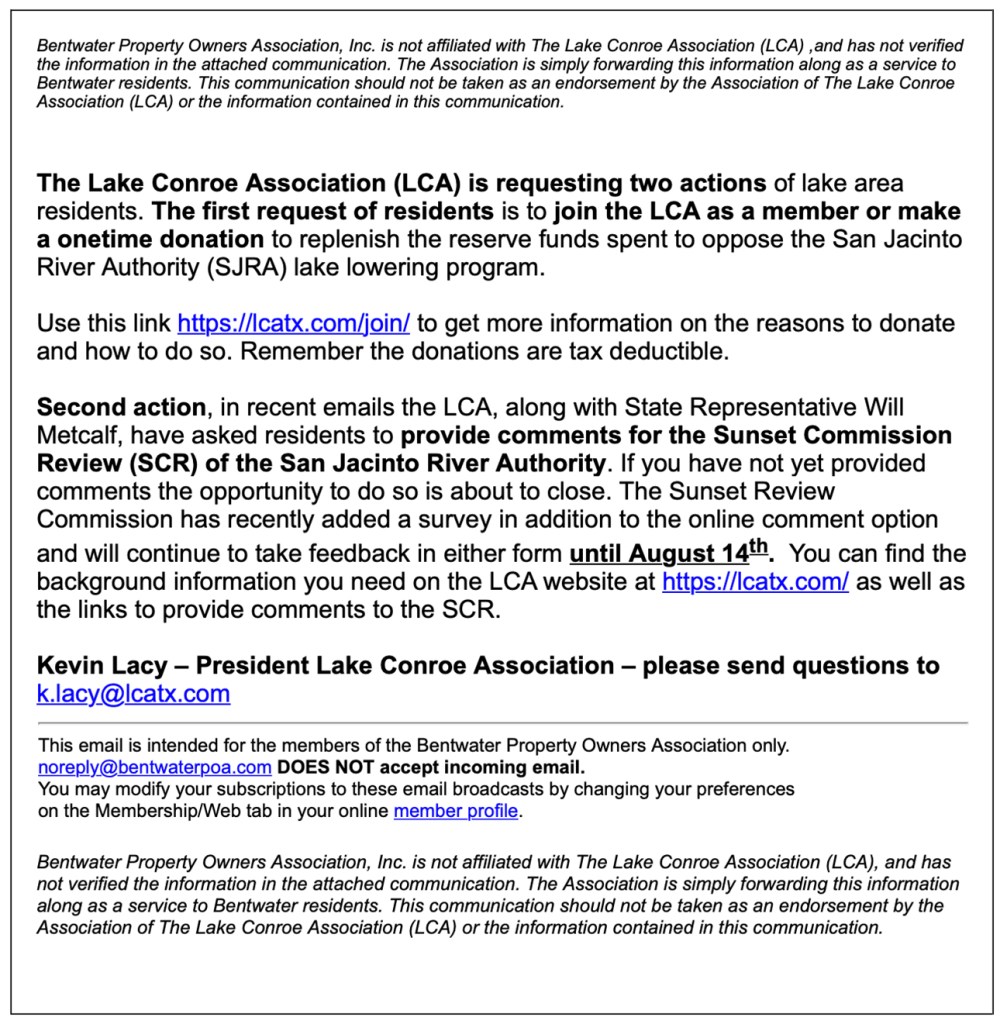
On August 7, they sent an email out to requesting Lake Conroe residents to donate money to the Lake Conroe Association so that it could “replenish the reserve funds spent to oppose the San Jacinto River Authority (SJRA) lake lowering program.”

In the next paragraph, they ask Lake Conroe residents to provide comments to the Sunset Commission reviewing the SJRA.

Screen Capture of LCA Communication on 9/7/2020. Links not active.

Neither of those two actions is a threat. But juxtaposing them like that is certainly walking up to the firing line … with the chamber loaded.

There sure is a lot of energy expended over two or three inches of water.

Lake Conroe people claimed last winter, when the SJRA was reconsidering the policy, that the lowering would not help Lake Houston Area residents. Lake Houston Area residents, still feeling the pain of Harvey, want all the help they can get.

Enough said.

Posted by Bob Rehak on 8/10/2020

1077 Days after Hurricane Harvey

Harvey Remembered

“For a couple of weeks, I wasn’t able to work due to Hurricane Harvey,” said Kingwood resident Mike Combat Willcox. “So I documented the storm the best I could. I was thinking years into the future that we would need to remember how it happened and have something to show to our kids.”

He was right. We need this NOW as Lake Conroe residents fight to keep their lake full to the brim during rainy seasons.

A former TV producer-editor-photographer at ConocoPhillips, Willcox now runs his own real-estate photography business. Mike is also a world champion aeromodelling pilot, a skill he puts to good use in this video of Harvey.

8-Minute YouTube video courtesy of Mike Combat Willcox

I still have yet to see any comparable pictures of the damage to Lake Conroe homes and businesses caused by lowering the lake an average six inches beyond the normal amount lost due to evaporation.

Suggestion for Next SJRA Board Meeting

I wish the SJRA would play THIS before its next board meeting so that Lake Conroe residents could see why Kingwood residents are so eager to continue the temporary, seasonal lowering of Lake Conroe. Then maybe we could see a video from the Lake Conroe Association about all the damage caused by the lake lowering. That might help the two sides understand each other better.

Just sayin’.

Posted by Bob Rehak with thanks to Mike Combat Willcox for sharing his video

878 Days since Hurricane Harvey

Lake Conroe Swamps Lake Houston Again

The SJRA held its second of three board meetings last night to consider public input on its temporary policy of lowering Lake Conroe seasonally. Once again, red-shirted protesters from Lake Conroe showed up in busloads. About 50 people from the Lake Houston Area made it to the meeting. Lake Conroe people outnumbered them by an estimated 25:1. See below.

Lake Conroe people in red shirts vastly outnumbered Lake Houston people in the white, clustered in a corner.

Lake Houston People Forced to Wait up to Four Hours to Speak

With the exception of several Lake Houston Area officials who spoke early, the vast majority of Lake Houston Area residents had to wait three to four hours for their 3 minutes at the microphone. Many had to leave before they got their chance to speak. Sadly, I knew what they planned to talk about. The SJRA needed to hear it; Lake Conroe residents needed to hear it, too. But neither group did.

Lake Conroe Residents Still Laboring Under Misinformation

During those three to four hours, scores of Lake Conroe residents took the mic to spout misinformation. The Lake Conroe Association fed them exaggerations, lies, and half-truths designed to whip them into a hysterical frenzy. To be fair, several told poignant personal stories about businesses that suffered at the shallow north end of the lake. A realtor mentioned that homes there were on the market longer and some were not getting their asking price.

But virtually all of the rest seemed unrestrained by facts or issues.

For instance, SJRA staff told the crowd upfront that one third of the water coming down the West Fork came from the Lake Conroe release. At least twenty Lake Conroe residents then got up and claimed that 14% of the water coming into Lake Houston was from the release. Statistical subterfuge!

While technically true, that distorts the picture. The SJRA has no control over East Fork water. The lake-lowering policy is designed to reduce West Fork damage.

Ripley’s Believe It or Not

Here are some more:

  • “Lake Conroe had nothing to do with flooding Kingwood.” (Why were most areas dry then until Lake Conroe water hit town?)
  • “If Kingwood people don’t want to flood, they shouldn’t buy homes in a flood plain.” (As if everyone who flooded was in a flood plain.)
  • “There’s no proof that lowering Lake Conroe will help prevent flooding in Kingwood.” (The SJRA’s flood mitigation manager had just given a presentation explaining when it did.)

Six Inches Killing A 79′ Deep Lake

And then there were outright exaggerations. Staff explained that evaporation normally lowered Lake Conroe to within six inches of target levels in spring and hurricane season. That means, they’re really only lowering the lake intentionally another six inches! That’s as deep as a glass of ice tea. But still, scores of Lake Conroe residents steadfastly claimed that intentionally lowering the lake another six inches was “destroying”:

  • The environment
  • Montgomery County’s tax base
  • Recreation
  • The lake
  • The county’s school system
  • Home values
  • Safety on the lake
  • Bass fishing

Lake Conroe is normally 79 feet deep at its deepest point.

Adding Insult to Injury

Lake Conroe residents repeatedly blamed Kingwood residents for not whipping the City of Houston into shape and getting it to act faster. They blamed Harris County Flood Control for dragging its feet and not spending its flood bond money fast enough. Incredibly, they denied that people died after the Lake Conroe release hit Kingwood. They even heckled State Rep. Dan Huberty and interrupted other Kingwood speakers.

All in all, it was more fun than a firing squad.

Sadly, I don’t think many, or even any, of those who talked had any idea of the real devastation that happened in Kingwood.

There has to be a better way to discuss these issues.

Posted by Bob Rehak on 1/22/2020

876 Days after Hurricane Harvey

Overview: Background Information on Lake Lowering Issue

During Hurricane Harvey, the San Jacinto River Authority (SJRA) released almost 80,000 cubic feet per second from the Lake Conroe Dam. This amounted to ONE-THIRD of all the water coming down the highly populated corridor between Humble and Kingwood. Massive damage resulted.

How Lake Lowering Policy Started

Almost 6,000 structures along the West Fork flooded. That number includes more than 1,100 between Lake Conroe and Porter. Forty-four percent of all the businesses in the Lake Houston Area Chamber experienced damage. The release inundated entire subdivisions. They included Forest Cove townhomes, Barrington, Kingwood Cove, Kingwood Greens, Kings Harbor, and Town Center. Large parts of other subdivisions flooded, too. Some more than two miles from the West Fork.

After touring the damage, Governor Gregg Abbott directed the SJRA to reduce flooding. The SJRA established a Flood Management Division. It also adopted a temporary policy of lowering Lake Conroe from 201 feet to 200 feet in the rainiest months of Spring and 199 feet during the peak of hurricane season.

The extra capacity in Lake Conroe provides a buffer against flooding downstream. It reduces both the volume and rate of water that SJRA must release in a flood.

How Long Policy Will Last

The policy is temporary until other flood mitigation measures can be completed. Those include:

  • Dredging the West Fork. According to the Army Corps, it had become 90% occluded in places from all the sediment washed downstream by Harvey.
  • Adding ten additional floodgates to Lake Houston to it can keep up with the volume released by Lake Conroe. Currently, the gates on Lake Houston can release 10,000 cubic feet per second while the gates on Lake Conroe can release 150,000, 15X more.

Pushback by Lake Conroe Residents

After 1.5 years, Lake Conroe residents rebelled against the policy based on misinformation provided by the Lake Conroe Association (LCA). LCA argues that lowering the lake:

  • Is permanent.
  • Is needless, because dredging is done.
  • Has no scientific basis.
  • Has not worked.
  • Damaged home values and bulkheading around Lake Conroe.
  • Makes boating difficult, especially for people far north on the lake.
  • Reduces the recreational potential of Lake Conroe.
  • Damages the lake-bottom environment
  • Will damage Montgomery County’s tax base.

Some of these claims are just outright false. Most are exaggerated. And virtually all stem from false premises; the policy is not permanent and dredging is not done. Regardless, the LCA has whipped people into a hysterical frenzy. Billboards around the lake ask them to SAVE OUR LAKE.

In contrast, the Lake Houston Area Chamber has launched a fact-based campaign called Lives Over Levels.

Please support the the Lake Houston Chamber’s Lives over Levels Campaign by emailing the SJRA Board or coming to one of their meetings. See below.

Background Information to Help You Write a Letter of Support

The links below provide information that you can use to write letters/emails supporting the lowering of Lake Conroe until dredging is complete and additional floodgates have been added to Lake Houston.

For more information, visit the Lake Lowering page.

Where to Send Correspondence

Please write an email showing your support for continuing the temporary seasonal lowering of Lake Conroe. The SJRA Board of Directors also welcomes input via mail or email. To contact the Board please visit: https://www.sjra.net/about/board/. Scroll down to the bottom of the page to see the email form. Or email floodmanagementdivision@sjra.net.

Generally, original letters carry more weight than form letters. However, many people do not feel comfortable writing or speaking. So…

The Lake Houston Area Chamber of Commerce has automated email that makes the process easy.

Also Show Your Support in Person

At the December SJRA board meeting, busloads of Lake Conroe residents flooded the boardroom and the Fire Marshall turned away busloads more. To ensure everyone who wants to speak or show their support gets a chance, the SJRA will hold two special meetings at a larger venue closer to Lake Houston.

BOARD OF DIRECTORS SPECIAL MEETING DATES, TIME, AND LOCATION 
  • Tuesday, January 21, 2020
  • 6pm at Lone Star Convention and Expo Center
  • 9055 Airport Road, Conroe, Texas 77303. 
  • Doors open at 5pm. 
  • Thursday, February 20, 2020
  • 6pm at Lone Star Convention and Expo Center
  • 9055 Airport Road, Conroe, Texas 77303
  • Doors open at 5pm.

Those wishing to address the board or register a comment at a special meeting may fill out a Comment Registration Form https://www.sjra.net/wp-content/uploads/2020/01/Comment-Registration-Form_01062020.pdf. Comment Registration Forms may be submitted at the special meeting. The form may not be mailed, emailed, or dropped off prior to the meeting date.

For Future Reference

For your convenience, this post has become a permanent page called Lake Lowering with all related blog posts and sample letters. You can access it through the main menu. Please share it with friends and family and get them to come to one of the board meetings or write an email of support.

Houston Mayor Sylvester Turner Supports Continuing to Lower Lake Conroe Seasonally to Help Mitigate Flooding

On January 10, Mayor Sylvester Turner wrote the SJRA Board to support continued lowering of Lake Conroe. “This temporary measure,” said the Mayor, “will help mitigate against future flooding until permanent flood gates can be installed and dredging of the San Jacinto’s West Fork can be completed.”

Reminding LCA Who Owns the Water

The Mayor also reminded the Lake Conroe Association (LCA) that the City of Houston owns two thirds of the water in Lake Conroe.

Changing the LCA Narrative

Turner also addressed an LCA narrative that claims Lake Conroe was not built for flood control. It was built for drinking water, they say. But the letter changes that narrative. It says, “While the lake was originally constructed as a reservoir for drinking water, the Houston region has become increasingly prone to flooding due to population growth, development and more frequent storms with record rainfall. Both the City of Houston and the State of Texas recognize that flood control must be a consideration. The proactive release water is an effective measure until more permanent solutions can be completed.” See the full text of the Mayor’s letter below.

I have not always agreed with Mayor Turner, but I support him wholeheartedly on this.

Clash of Political Titans

Tuesday, Montgomery County Commissioners will vote on a resolution recommending to END the seasonal lowering of Lake Conroe.

I suspect Harris County Commissioners and the governor may enter this fray before the final vote.

Posted by Bob Rehak on 1/14/2019

868 Days after Hurricane Harvey

Legal Aspect of Lake Lowering That Lake Conroe Association Won’t Tell Officials About

To avert another seasonal lowering of Lake Conroe, the Lake Conroe Association is appealing to State Representatives, State Senators, the Governor, the Conroe City Council, and Montgomery County Commissioners. They focus on the temporary loss of recreation in some parts of the lake. They also say that “damages” home values and businesses.

Finally, they’re telling officials there’s no proof that lowering the lake helps prevent downstream flooding and that it wastes $10 million of water.

They are NOT telling officials, however, that ending the program before other mitigation measures are in place could potentially open up the SJRA and State of Texas to billions of dollars in law suits.

Fifth Amendment “Takings Clause”

The issue has to do with the Fifth Amendment of the U.S. Constitution. It says that private property shall not be taken for public use, without just compensation. This so-called takings clause forms the basis for many of the lawsuits against the SJRA stemming from Harvey flooding. Those have not yet gone to trial. But lawsuits in a parallel case have.

In December, a federal judge ruled in favor of plaintiffs flooded behind the Addicks and Barker reservoirs. He found the Army Corps liable for damages.

He said the flooding of homes was a foreseeable result of government actions.

Rulings in Addicks/Barker Cases

“U.S. Judge Charles F. Lettow detailed how government officials knowingly and intentionally used private property to store rising floodwaters,” said a Houston Chronicle article about the decision. The key point in the case, according to the judge: The government knew for decades that the reservoirs could NOT contain the floodwaters in a deluge and did NOTHING over decades to prevent it. “Plaintiffs have sufficiently demonstrated that the inundation of floodwaters onto their private property was the ‘direct, natural, or probable result’ of the government’s activity,” he wrote.

How Addicks Case Applies to SJRA Lake Lowering Policy

Hold that thought. Now apply those principles to the SJRA today. It faces a decision between the temporary seasonal lowering of Lake Conroe or NOT lowering the lake. Not lowering the lake would placate recreational boaters and lakefront property owners like LCA president Mike Bleier (who did not flood during Harvey).

The lowering provides a buffer against flooding for BOTH Lake Conroe and downstream communities on the West Fork of the San Jacinto. They include Woodloch, Porter, Humble, Atascocita and Kingwood. During Harvey, approximately 300 structures flooded on Lake Conroe, 1100 between Lake Conroe and US59, 3652 in Kingwood along the West Fork, 366 in Atascocita, and 466 in Humble.

That’s almost 6000 structures on the West Fork. One structure might include a whole apartment complex housing hundreds of families, a shopping center employing hundreds, a high school with 4000 students, a hotel providing housing to flood victims or a hospital treating them.

None of these numbers includes damages to East Fork property, which Lake Conroe releases do not affect

Now let’s assume that the SJRA eliminates the seasonal lowering policy which it has publicly stated prevented flooding twice so far.

Let’s also assume that a big storm comes along that dumps 10-12 inches of rain on Lake Conroe and that because that buffer no longer exists, people flood again.

Parallels

Lake Conroe and downstream residents now have a ready-made, almost watertight case against the SJRA and its financial backer, the State of Texas. All the essential elements from the Barker/Addicks decision are there.

  • Government knew that downstream flooding was likely.
  • SJRA had a proven strategy at its disposal to reduce flooding.
  • SJRA chose not to use the strategy, which the governor endorsed.
  • Governor had made flood mitigation a top priority for SJRA.
  • SJRA chose instead to increase recreational possibilities on public property (Lake Conroe).
  • Private property then flooded as a foreseeable result.

It seems like a pretty close parallel to me. Perhaps it’s even more of a textbook case. Especially considering recent directives by the governor for the SJRA to focus on flood mitigation and his public endorsement of the lake lowering strategy.

Mandates in SJRA Enabling Legislation

The state created the SJRA to “conserve, control, and utilize to beneficial service the storm and flood waters of the rivers and streams of the State.” Section 2 of the enabling legislation mentions floodwaters three times. It doesn’t mention recreational boating or lakefront home values once.

In addition, the enabling legislation also says that the purpose of the SJRA is to:

  • Prevent the devastation of land from recurrent overflows.
  • Protect life and property.
  • Regulate the waters of the San Jacinto River and its tributaries.
  • Conserve “soils against destructive erosion … thereby preventing the increased flood menace incident thereto.”

If the SJRA floods people again when it might have been avoided, this sounds more and more like a slam-dunk case for plaintiffs.

Officials Should Get the Facts

Before Montgomery County Commissioners, the Conroe City Council, Representative Will Metcalf and Senator Robert Nichols fire off more letters telling the SJRA what to do based on Mike Bleier’s misinformation, one hopes they would at least ask for a briefing from the SJRA to get the whole picture.

That includes understanding how the seasonal lowering strategy helps. It is designed more for “less than 100-year” rain events, than it is for another Harvey. Another Harvey would fill up that 1-2 foot buffer quickly and repeatedly. The value of the strategy lies in offsetting storms that we experience far more frequently, but which could still flood people, such as those last May.

For Those Who Have Never Personally Flooded

Before closing, I’d like to publish several images that West Fork residents Rhonda Haney and Alexis Faust sent me. The images show their Harvey experiences. Thank God, most Lake Conroe residents didn’t have to suffer through what Rhonda and Alexis did. Most Lake Conroe residents may not know the financial and emotional devastation of flooding. I wouldn’t wish that on anyone.

Harvey Photo courtesy of Alexis Faust
Harvey Photo courtesy of Rhonda Haney
Harvey Photo courtesy of Alexis Faust

Posted By Bob Rehak on 1/13/2019 with thanks to Alexis Faust and Rhonda Haney for sharing their photos

867 Days since Hurricane Harvey

The thoughts expressed in this post represent opinions on matters of public concern and safety. They are protected by the First Amendment of the US Constitution and the Anti-SLAPP Statute of the Great State of Texas.

Lake Conroe Association Misleads Area’s Own State Representative and Senator

The problem with incendiary lies: once you start them, they’re hard to stop. In its initial meetings with area residents, the Lake Conroe Association (LCA) told people that West Fork dredging was done. Therefore, said the LCA, the SJRA should stop the temporary seasonal lowering of Lake Conroe.

Lie Takes on Life of Its Own

People believed the lie. They started putting up web sites and YouTube videos to spread the word. Soon, the lie took on a life of its own. And it became impossible for the LCA to stamp it out – even if they were so inclined, which they aren’t.

Residents started writing their state reps. And soon Will Metcalf who represents the Lake Conroe Area took up the cry. See the letter below dated Jan. 6.

A week before Representative Metcalf sent this letter to the SJRA Board, the City of Houston pulled the trigger on the next phase of West Fork dredging. It will start this week, says the City. Now, Metcalf doesn’t just have egg on his face; he has a whole omelette. Made from stale eggs and rancid ham.

State Senator Robert Nichols wound up with the same omelette on his face.

Whole Series of Lies, Half-Lies and Logical Fallacies Spread by LCA

The LCA fueled this whole sad, sorry food fight that embarrassed their own representatives with an entire a SERIES of lies, half-lies and logical fallacies that it fed to unknowing people.

For instance, in addition to “the dredging is done”, I see and hear these comments constantly:

  • Because the East Fork flooded during Imelda and Lake Conroe didn’t release water, that proves we don’t need to keep lowering Lake Conroe.
  • The Lake Conroe release during Harvey comprised only 5% of the water going through Lake Houston.
  • All of Kingwood was built in a flood plain. Kingwood people should just move to higher ground.
  • Kingwood’s flooding problems come from upstream developers.
  • No scientific study supports the lowering policy.
  • Lake Houston wants to make the lowering of Lake Conroe permanent.
  • They should lower Lake Houston.

For the Record…

To set the record straight:

  • West Fork dredging is NOT done. Just the portion FEMA paid for.
  • The East Fork and West Fork are in different watersheds. Imelda affected the East Fork, but not the West. Plum Grove got 33 inches of rain while Lake Conroe got two.
  • The Lake Conroe release during Harvey comprised ONE THIRD of the water coming down the West Fork where approximately 80-90% of all the damage occurred in the Humble/Kingwood area.
  • All of Kingwood was not built in a flood plain. For instance, 110 out of 250 of my neighbors in Kings Forest were not in a flood plain yet still flooded. We live more than TWO MILES from the river.
  • Some of Kingwood’s flooding problems come from upstream developers. But that’s a separate issue; they have nothing to do with West Fork flooding due to Lake Conroe releases.
  • The SJRA did commission an engineering study that supported lowering Lake Conroe.
  • Lake Houston IS and HAS BEEN lowered…longer than Lake Conroe.
  • No responsible/knowledgeable person that I know in the Lake Houston area is talking about making the lowering of Lake Conroe permanent.

To correct some of these misperceptions, I met the president of the LCA last year for a whole day. More recently, I spent an hour on the phone with him. I thought I had corrected these misperceptions. But they keep recurring. This is NO accident; this is intentional.

Posted by Bob Rehak on 1/8/2020

862 Days after Hurricane Harvey and 111 since Imelda

The thoughts expressed in this post represent opinions on matters of public concern and safety. They are protected by the First Amendment of the US Constitution and the Anti-SLAPP Statute of the Great State of Texas.

Billboard on FM105 Implies Lake Conroe Is Threatened and Near Death

Lake Conroe is being drained, says the billboard. The lake is threatened. It MUST be saved. Homes are being destroyed. Armageddon is at hand.

Lake Down About a Foot, No Releases in 3 Months

Well, the Lake IS down a foot compared to its average January level thanks to evaporation and a dry Fall.

But the SJRA stopped releasing water more than 3 months ago.

So what’s all this “Stop Draining the Lake” stuff about?

When You Don’t Have Facts on Your Side, Rile Their Bile

The Lake Conroe Association is trying to rile people up to protest the seasonal lowering of Lake Conroe. That seasonal-lowering strategy, developed at Governor Abbott’s request, helped provide an extra measure of protection against downstream flooding by lowering the lake one foot in the Spring and two during the peak of hurricane season. It helped prevent West Fork flooding last May.

But it evidently has also triggered the demise of Western Civilization and recreational boating on Lake Conroe. People can no longer boat to their favorite float-in restaurants to clog their arteries with fried shrimp and shatter their neighbor’s eardrums with the shrill screams of outboard engines.

According to the Lake Conroe Association, the economy of the county and lake are collapsing – except for the second fastest growth rate in the region, which they fail to mention.

World Leaders Rally to Boaters’ Side

In New York, the United Nations called a special session to raise awareness of the threat to Lake Conroe. In Rome, the Pope considered gathering Cardinals from around the world to debate the threat to bass fishing. In Hollywood, the Screen Actors Guild summoned Bruce Willis to star in a thriller about the next “Threat to Life on Earth as We Now Know It.”

“If they can drain Lake Conroe,” said Willis, “What’s next? Fort Knox? Your IRA? Your crankcase?”

In Washington DC, the EPA declared the seasonal lowering of Lake Conroe a larger threat than climate change, deforestation and baby wipes flushed down your toilet … put together.

“This is an existential threat to Budweiser and the American way of life,” intoned Larry the Cable Guy from a stand-up gig at Hooters on 105. “Why can’t we all live in peace? Two feet of water out of a 75-foot-deep lake is outrageous. Those Kingwood people whose homes and businesses were flooded just don’t recognize the sacrifice Lake Conroe bass fishermen are making.”

Showdown in Conroe on the 21st

Lake Conroe lakefront homeowners are reportedly renting a flotilla of tour buses to ferry them to the Montgomery County Convention Center at 6PM on January 21. There, insiders say, the Lake Conroe Association plans to pack the room and shout Kingwood people down, as they did at the last SJRA board meeting, to deny Kingwood residents a chance to tell their side of this story.

At press time, it is unclear what the Lake Houston response will be, if any.

Some community organizers were considering a rally of flooded cars around a “Days of Thunder and Lightning” theme. For a spokesperson, they were reportedly negotiating with Tom Cruise to play the role of Hurricane Harvey.

Personally, I would like to see the five to six thousand West Fork home and business owners who flooded submit pictures of their damage. Then maybe policy makers can consider real vs. imagined threats as they debate whether to extend the seasonal lake lowering policy another year.

Posted by Bob Rehak on 1/4/2020

858 Days since Hurricane Harvey

The thoughts expressed in this post represent opinions on matters of public concern and safety. They are protected by the First Amendment of the US Constitution and the Anti-SLAPP Statute of the Great State of Texas.