Tag Archive for: HCFCD

HCFCD Briefs Community on Last Cypress Creek Major Maintenance Project

6/27/25 – In a virtual public meeting tonight, the Harris County Flood Control District (HCFCD) briefed the public on the last Cypress Creek Major Maintenance Project associated with the 2018 Flood Bond. The project name: Cypress Creek Channel Rehabilitation and Stormwater Detention Basin, Main Stem, Batch 5.

Batch 5 consists of two smaller packages:

  • Channel Rehab at Kuykendahl and the Cypress Hill Stormwater Detention Basin, expected completion by Q4 2027.
  • Channel Rehab near I-45 and the first phase of the Senger Stormwater Detention Basin, completed by Q2 2028.
Cypress Creek Batch 5
From HCFCD.org

Currently, HCFCD is finalizing design for both packages. They expect to complete design by July 2025 and advertise it for bids beginning in Q2 of 2026.

Batch 5 consists of channel repairs for 1.4 miles of the creek and its tributaries, plus two major detention basins that together will hold 631 acre feet.

All Flood Control District projects receiving U.S. Department of Housing and Urban Development Community Develop Block Grant mitigation funds must be completed by March 31st, 2028. 

During the channel repairs, HCFCD says it will make the side slopes of channels less steep to minimize future erosion.

About Cypress Creek and Repairs

The first four batches of repairs restored approximately 24 miles of Cypress Creek and its tributaries. HCFCD has completed Batches 1-3 and Batch 4 is still in progress. Estimated completion for Batch 4: Q1 2026.

Cypress Creek is a highly developed watershed located in northwest Harris County. It extends into Waller County. The watershed comprises 267 square miles, making it one of the county’s larger watersheds. It has 250 miles of open channels including Cypress Creek itself.

During Hurricane Harvey, 29 inches of rain fell across the watershed, damaging more than 9,500 structures.

No Adverse Impact Allowed Downstream

This is the fifth of five major maintenance programs along Cypress Creek associated with the 2018 Flood Bond.

The detention basins are actually designed to mitigate the channel rehabilitation work. Specifically, the channel rehabilitation work will speed floodwater up. The basins will offset that by slowing floodwaters down and reducing the volume in the creek.

As one presenter tonight pointed out, “The flood control district is a “no-adverse-impact” agency. That means we do not allow our projects to reduce flooding risks for one area, while increasing risks somewhere else. That’s why stormwater detention basins are often built before or at the same time as channel conveyance improvements or channel rehabilitation to prevent any unintended impacts downstream.”

The detention basins will hold enough water to cover a football field to a depth of 478 feet.

Getting Closer to Lake Houston Area

Batch 5 includes two separate packages. One is near Kuykendahl.

And the other is near I-45.

HCFCD should hear from the Texas General Land Office (GLO) and HUD on funding soon. The District submitted a grant application for almost $54 million that is still under review (as of 6/7/25) by GLO.

Project Benefits

The District was a little hazy about the benefits. Of course, this is a maintenance program, not a capital improvement program.

A spokesperson said, “Pre-Atlas-14 100-year design storm models show a water-surface elevation reduction of up to one foot near the I-45 project limits” for the Kuykendahl package.

Altogether, HCFCD estimates the benefit area of this project will include nearly 40,000 people, who either live near and/or commute through the area.

Posted by Bob Rehak on 6/17/2025

2849 Days since Hurricane Harvey

HCFCD Seeks to Enhance its Gauge Adjusted Radar Rainfall System

6/5/25 – Harris County Flood Control District (HCFCD) is seeking to negotiate an agreement with the University of Oklahoma to help enhance the county’s Gauge Adjusted Radar Rainfall system. See Item 103 on the 6/12/25 agenda.

The system  tells how much rain has fallen over a specific area during a certain period, thus providing input for the county’s flood forecasting model. Upgrades will:

  • Make it significantly easier to evaluate rainfall data using a more intuitive and interactive platform.
  • Provide a cloud-based data archive to overcome limitations in current workflows.
  • Enable “nowcasting” with rainfall estimates updated as frequently as every 10 minutes.

What is Gauge Adjusted Radar Rainfall?

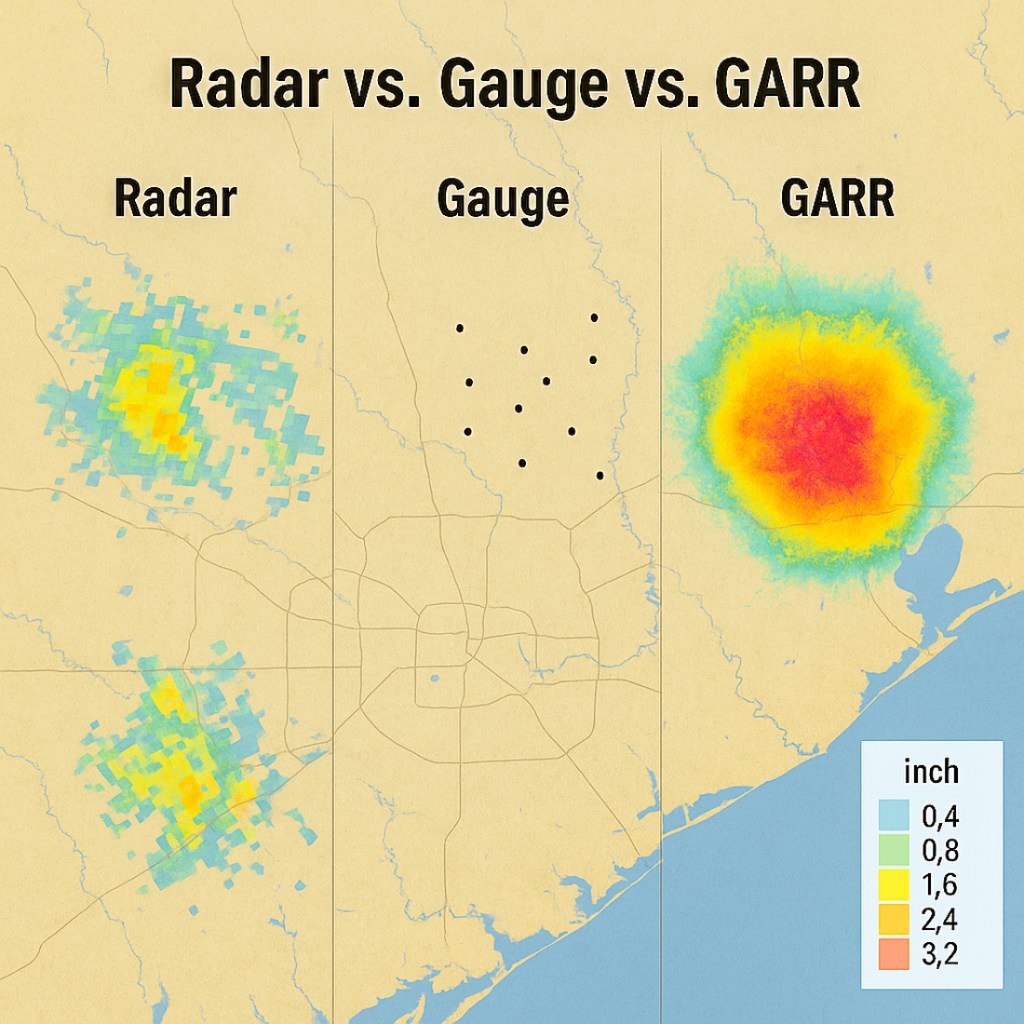
Gauge Adjusted Radar Rainfall (GARR) systems estimate rainfall by combining radar-based precipitation estimates with ground-based rain-gauge measurements. The two together produce more accurate rainfall data over wider areas.

  • Radar can provide rainfall data over large areas with high frequency (e.g., every 5 minutes), but it’s prone to errors due to beam blockage, calibration issues, or interpreting non-rain targets (such as birds or dust) as rain.
  • Rain gauges give point-accurate rainfall measurements, but huge distances/gaps exist between gages. And rainfall is rarely uniform across wide areas.
Hypothetical image created by ChatGPT. Demonstrates differences in technologies.

Gauge adjusted radar rainfall systems blend both types of data. They use the broad coverage of radar but “correct” or adjusts the radar estimates using actual gauge readings. Great advances in the systems have been made in recent years.

Is It Good?

Yes. GARR is generally considered superior to using radar or gauges alone. It is widely used by agencies like the National Weather Service, USGS, and local flood control districts (e.g., HCFCD).

According to ChatGPT, the systems offer multiple benefits.

Benefits of Gauge Adjusted Radar Rainfall

BenefitExplanation
Improved AccuracyCombines radar’s spatial resolution with gauge accuracy, reducing biases in radar-only estimates.
Better CoverageProvides rainfall estimates across areas with few or no gauges
Real-Time UtilityEnables near real-time rainfall mapping, critical for flood forecasting and emergency response.
Hydrologic ModelingOffers high-resolution inputs for stormwater modeling, floodplain mapping, and watershed management.
Event VerificationAllows engineers and flood managers to verify how much rain actually fell over an entire basin during a storm.

How is GARR Used?

GARR data is often used in:

  • Post-storm analysis
  • Designing detention basins
  • Flood alert systems
  • Atlas 14 and extreme rainfall calibration

GARR systems are widely used for both real-time monitoring and hydrologic planning. And they are particularly valuable in flood-prone areas.

Success Stories

Harris County Flood Control

During Hurricane Harvey in 2017, GARR data provided near real-time insight into rainfall distribution — helping emergency managers prioritize rescues, issue flood alerts, and allocate resources.

Post-storm, GARR helped analyze where detention basins were effective and where flooding exceeded expected design thresholds.

HCFCD reportedly credits GARR with saving lives and informing infrastructure improvements after Harvey.

San Antonio River Authority (SARA)

SARA integrated GARR into its real-time models to monitor stormwater flow in the river basin. It:

  • Improved rainfall inputs to models that simulate flooding during storms
  • Enabled automated forecasts of creek levels and road closures
  • Reduced false positives/negatives from radar-only systems.

They used it to improve public safety, automated alerts and floodgate operations.

North Carolina

Mecklenburg County (Charlotte) uses GARR to fill data gaps across watersheds and create real-time flood forecasts with more accurate rainfall inputs.

They credit GARR systems with improved warning lead times and better informed design updates for critical infrastructure like culverts and detention ponds.

Recent Advances in GARR

HCFCD hopes to improve accuracy and operational capabilities that support improved flood forecasting. The District did not elaborate with more specifics, but GARR technology has improved greatly in recent years. Advances include:

1. Integration of AI and Machine Learning

Artificial intelligence (AI) and machine learning techniques are improving GARR system accuracy. For instance, deep learning models have been employed to enhance precipitation “nowcasting” for emergency response.

2. Enhanced Data Assimilation Techniques

Advances in data assimilation now allow seamless integration of GARR data into hydrological models for more accurate flood forecasting.

3. Development of High-Resolution GARR Products

Companies like AEM have developed GARR products with resolutions as fine as 1 km² and temporal resolutions of 5 minutes. Such resolution is essential for urban planning, infrastructure design, and real-time flood monitoring.

4. Application in Urban Flood Management

During the unprecedented rainfall event in the United Arab Emirates in April 2024, GARR data played a crucial role in analyzing the hydrologic and flood impacts.

5. Expansion of Historical Data Archives

Organizations like OneRain have expanded their historical radar data archives, providing GARR data back to 1993. This helps planners analyze trends and infrastructure resilience to develop disaster risk reduction strategies.

HCFCD Request and Rationale

HCFCD hopes to provide an enhanced Gage Adjusted Radar Rainfall (GARR) Multi-Radar Multi-Sensor (MRMS) product that improves flood forecasting in Harris County.

This project expands the initial agreement between HCFCD and the National Severe Storms Laboratory (NSSL). That agreement established a limited Multi-Radar Multi-Sensor (MRMS) domain over Harris County using HCFCD’s dense rain gauge network.

The new agreement should enhance the accuracy and operational capability of HCFCD’s GARR MRMS system. It will integrate verification tools, cloud-based processing, and sub-hourly nowcasting capabilities. These improvements should lead to better spatial representation of rainfall, improved short-term forecasting, and ultimately strengthen flood risk prediction and response efforts across Harris County.

Looking for a summer science project for your student? Here it is.

Posted by Bob Rehak on 6/5/25 and updated on 6/6/25

2837 Days since Hurricane Harvey

HCFCD Regrades Kings Crossing Ditch

6/1/25 – Harris County Flood Control District has performed maintenance excavation and regrading of the Kings Crossing Ditch that runs from behind the Memorial Hermann Convenient Care Center to Kingwood Drive.

Kingwood projects
See #9.

Here’s what that area looks like in a satellite view. Note the Kingwood Park N Ride at the top left and H-E-B below it. This short ditch drains more than 50 acres of concrete by my estimate.

NE quadrant of Kingwood Town Center with Kings Crossing Ditch (G103-33-04-X007) highlighted.

A resident alerted me to the maintenance. He said, “The ditch was already in decent shape and depth, but this looks to have deepened the ditch and sharpened the toe.” He estimates HCFCD removed at least 15-20 cubic yards of sediment. Workers have already removed the sediment.

Not only does the bottom of the ditch collect silt, it is the first to fill and the last to drain. So keeping it clear and properly graded is critical to reducing flood risk.

Protecting the Commercial Center of Kingwood

The northeast quadrant of Kingwood Town Center contains numerous essential services from the area’s largest grocery store to 24-hour emergency room and advanced medical imaging services, not to mention more than a dozen restaurants.

Unfortunately, the area is low lying and prone to flooding. A flood in May of 2024 had the parking lots underwater. It also forced closure of the Memorial Hermann facility.

Kingwood Flooding
May 4, 2024, as floodwaters receded. High water had forced the cancellation of appointments at the Convenient Care Center in upper left. Note ditch in top center. Also note barricades by front door under canopy.

Pictures of Maintenance Repairs

I took the pictures below on May 31 and June 1, 2025. Here’s what the ditch looked like after the operation. First from high up.

Kings Crossing Ditch Maintenance. H-E-B at top of frame.
Kings Crossing Ditch Maintenance. Memorial Hermann at top of this frame.

And then from a lower angle…

It wasn’t the largest HCFCD effort ever, but flooding is often a matter of inches. One inch in a building can mean major repair bills.

The merchants of Kings Crossing and all the people who depend on them appreciate the effort.

If you see other HCFCD operations in progress, please alert me through the contact form of this website so I can photograph them.

Posted by Bob Rehak on 6/1/2025

2833 Days since Hurricane Harvey

HCFCD Begins Repairs to Bens Branch Tributary

5/29/25 – On 5/16/25, Harris County Flood Control District (HCFCD) announced a series of maintenance repairs in Kingwood. One was on a tributary of Bens Branch that runs down the west side of West Lake Houston Parkway toward Kingwood Town Center. Yesterday, I received a report from Chris Bloch, a flood activist in Kingwood, that they had started.

HCFCD is making repairs to a ditch romantically named G103-33-01-X007. See #10 in the center of the map below.

Kingwood projects

Photos Taken on 5/29/25

Below are several pictures taken today at the start of the project. I’m sure it will look better when they finish.

Bens Branch Tributary Repairs near Rustic Woods in Kingwood Town Center
Closer shot shows extent of slide slope and back slope repairs.

Swales behind the side slopes intercept water draining toward the ditch. In the lower right above, you can see a cement structure that helps convey water through a pipe from that swale to the bottom of the ditch. That helps prevent erosion to the side slopes.

Closer shot of same general area.
Looking S toward Kingwood Drive at top of frame behind the old HEB shopping center
Looking N from Rustic Woods at current extent of repairs. Note the difference in the width of the ditch above and below where the pipe enters near the center of the frame.

More News to Follow

I’ll post more pictures as the project progresses. It’s important to maintain the conveyance of ditches as the flooded merchants in the shopping center above can attest. It still hasn’t completely recovered from Harvey flooding almost eight years ago. This should be very welcome news for them.

Maintenance is a never-ending challenge for HCFCD. They have more than 2500 miles of ditches to maintain. If you see them working near you, please give me a heads up through the contact page of this website.

Posted by Bob Rehak on 5/29/25

2830 Days since Hurricane Harvey

HCFCD Announces Kingwood Projects

5/16/2025 – Harris County Flood Control District (HCFCD) made several announcements about projects recently that will affect Kingwood and areas upstream.

Two Stormwater Detention Basins Now on Bid List

The District expects two major detention basin projects to go out for bids soon. The:

  • East TC Jester Basin on Cypress Creek will bid in the third quarter this year.
  • Woodridge Village Basin on Taylor Gully will bid in the first quarter next year.

The clearcutting of the Woodridge Village flooded hundreds of homes in Elm Grove, Sherwood Trails and Mills Branch twice in 2019. HCFCD started excavating an additional detention basin in 2021 to help address the risk of downstream flooding. But they were forced to discontinue the excavation in 2023 when they applied for a HUD grant to finish the project.

HCFCD held a press conference about funding availability at the TC Jester property in 2022.

Ten More Maintenance Projects in Kingwood

HCFCD also announced 10 more maintenance projects on area channels. They expect to start eight this year.

What Will Happen Where

The map below shows the location of the projects. It’s keyed to the numbers above in the first column.

The maintenance will help ensure the continued effectiveness of the area’s flood control systems.

HCFCD will repair or replace…

  • Existing damaged concrete channel linings
  • Slope paving
  • Outfall pipes

…for the following channels

  • G103-38-02-X005 (Kingwood Diversion Ditch) 
  • G103-80-01-X012(Green Tree Ditch) 
  • G103-41-00-X014 (Sand Branch) 
  • G103-33-03-X003 (Hidden Pines to Bens Branch) 
  • G103-38-01-X015 (Chestnut Ridge Rd. to Kingwood Diversion Ditch) 
  • G103-38-01-X016 (Chestnut Ridge Rd. to Kingwood Diversion Ditch) 

HCFCD will also remove sediment from:

  • G103-80-01-X013 (Green Tree Ditch) 
  • G103-33-04-X007 (Kings Crossing Ditch) 
  • G103-41-00-X013 (Sand Branch) 

They will repair erosion on:

  • G103-33-01-X007 (North Park Dr. to Bens Branch) 
  • G103-80-03.1-X037 (Taylor Gully) 

Finally, HCFCD will reshape side channels on:

  • G103-33-04-X007 (Kings Crossing Ditch) 
  • G103-41-00-X014 (Sand Branch)  

During this time, residents in work areas may notice crews with large trucks and heavy equipment such as excavators and bulldozers. Stay well clear of the equipment.

HCFCD estimates it will complete all this work by early 2026. The District and Precinct 3 Commissioner Tom Ramsey who helped arrange the work stated that each specific effort will move on its own timeline. 

Posted by Bob Rehak on 5/16/2026

2817 Days since Hurricane Harvey

Blocked Ditch Under Kingwood Drive Near High School

4/27/25 – A drainage ditch that runs under Kingwood Drive about a tenth of a mile west of Kingwood High School is blocked. Where the ditch runs through the median, it has become so overgrown, you cannot even see it.

Historical images in Google Earth suggest that the City has not cleared the ditch since 2002. Full height trees have grown up in it, contributing to the blockage.

During Harvey, Kingwood High School flooded to the second floor. Four-thousand students had to be bussed to other schools for a year during decontamination and reconstruction.

4000 Students at Kingwood High School
Kingwood High School during Harvey. Kingwood Drive (upper left), one of the area’s main evacuation routes, was also cut off.

Ditch is So Overgrown, You Can’t See It

Harris County Flood Control labels the ditch as G-103-36-01. It crosses under Kingwood Drive about one-tenth of a mile west of Valley Manor and the high school.

Location of ditch and blockage relative to Kingwood High School. Shown with floodplains in Harris County Flood Education Mapping Tool.

See the pictures below. Can you even see where the ditch is? Hint: it’s in the center of the frame.

Looking slightly south. Lake Kingwood is toward the top of the frame.
Opposite direction. The ditch runs between the two storm drains on either side of Kingwood Drive.
From a lower elevation, you can see under the forest canopy. Still no clear path for drainage.

The City has cleared all the other ditches in the map above, but not this one. It’s so overgrown, they likely can’t find it and confuse it with one of the other ditches they’ve already cleared.

Because this blockage has the potential to cut off a major evacuation route, we can’t afford to wait any longer.

I have reported it previously several times already. To be clear, Harris County Flood Control District is responsible for keeping the channel clear. But the City is responsible for cleaning out the channel under its roads, i.e., Kingwood Drive.

Posted by Bob Rehak on 4/27/25

2798 Days since Hurricane Harvey

What Happens When Flood Maps Don’t Illustrate True Risk

3/25/25 – Almost eight years after Hurricane Harvey and a massive region-wide effort to update flood maps, FEMA still features maps on its website based on decades-old data that don’t come close to showing true flood risk. The old maps cause confusion among homebuyers who may not understand their limitations. And that helps developers pursue and profit from risky ventures in floodplains.

Three-Year Delay for New Maps and Still Counting

FEMA has yet to release maps based on recent Atlas-14 data developed after Hurricane Harvey. Harris County Flood Control District (HCFCD) anticipated release of FEMA’s new preliminary maps three years ago and release of the final maps by now. See the timeline below published in 2020.

Source: Screen Capture from Harris County Flood Control District MAAPnext site in 2020.

I requested the release date for the new maps from Harris County and Federal officials. However, they did not respond.

Delays Contribute to Confusion about Safety of New Developments

The delays have contributed to confusion about the safety of new developments near or in floodplains.

Take, for instance, the lawsuit between the City of Houston and one of the area’s largest developers. According to a Texas Supreme Court decision released last Friday, the Signorelli Companies want to develop more than 500 lots near the San Jacinto East Fork as part of The Commons of Lake Houston.

Plats show most of the lots outside the current 100-year floodplain. But floodplains will reportedly expand by 50-100% when the new flood maps come out. At that point, most if not all the lots will likely be deep in the floodplain.

So, the City imposed higher elevation requirements for homes in anticipation of the new flood maps. That triggered a property-rights lawsuit by the developer, which claimed the City’s requirements made the property “undevelopable.”

Sometimes We Just Never Learn

Sometimes, it feels as if we just never learn. I understand a company’s desire to make money from its land. But unsuspecting homebuyers could lose their life savings. Worse, more people could die.

Flood insurance is becoming unaffordable for many. Insurance companies are fleeing high-risk areas.

And we haven’t even mentioned yet the costs of flood mitigation, disaster relief, buyouts, and restoration of the natural ecosystems – that already protect people for free.

In my opinion, for the public good, some land just shouldn’t be built on.

The Commons of Lake Houston Proposal

The flood map for the Commons area on the East Fork was last updated in 2007. It is based on data acquired after Tropical Storm Allison in 2001. New Atlas 14 rainfall data is 30-40% higher than previous estimates and represents the current best efforts of scientists.

The map below shows the extent of those 100- and 500-year floodplains in 2007 maps as dotted lines superimposed over a proposed new section of the Commons called the Crossing.

Close up of plat. Floodway is to left of heavy dotted line. 100-year and 500-year floodplains are shown as lighter dotted lines farther right.

Two Pictures Worth 2,000 Woods

These two pictures, sent to me by a nearby resident of an existing home on higher ground in the Commons, illustrate the problem.

First image shows extent of the Harvey flood. Second shows Signorelli’s proposed development. High water mark during Harvey identified as Position 1.

Think such a flood can’t happen again in your lifetime? That Harvey was a thousand-year storm?

It almost happened again in May 2024 during a no-name storm a month before the start of hurricane season. The screen capture below shows historical HCFCD data from a gage just upstream from the Commons. Note the last three entries.

Historical flood heights from Harris County Flood Warning System Gage at East Fork and SH99.

That no-name storm produced flooding almost five feet higher than Imelda and only about four feet lower than Harvey. It was the second highest flood at that location since HCFCD started keeping records!

Will We Repeat Mistakes of the Past?

The thing about floodplains is that they keep growing with upstream development – especially as other developers push into wetlands near rivers and streams. And the area upstream from the Commons is growing very quickly.

At some point (like now), it may make more sense to donate this land to an organization such as the Bayou Land Conservancy, Houston Parks, or Texas Parks and Wildlife. That would offer the developer some tax benefits. That could also help protect the public, protect lenders, help hold down insurance rates, provide recreation, and reduce future mitigation costs. It would even likely add value to homes on higher ground.

Posted by Bob Rehak based on 3/25/25

2765 Days since Hurricane Harvey

The thoughts expressed in this post represent opinions on matters of public concern and safety. They are protected by the First Amendment of the US Constitution and the Anti-SLAPP Statute of the Great State of Texas.

HCFCD Calls Projects Complete that Have Not Even Started

3/10/25 – In the last week, Harris County Flood Control District (HCFCD) launched a new interactive map at the bottom of its homepage. In it, HCFCD calls many projects complete that have not even started.

The map supposedly contains the status of each project in the county along with links to more project details.

However, the information is riddled with errors. The map also contains several usability issues that place barriers between people and information.

Together, the issues show a disturbing lack of attention to detail and quality control that undermines the credibility of HCFCD.

Examples of Incorrectly Coded Projects

For instance, you may be pleased to know that the project to add more floodgates to the Lake Houston Dam is “complete.” It’s not. Ask Houston City Council Member Fred Flickinger who just provided an update on the ongoing engineering of the gates.

This and all other screen captures below taken on 3/10/25. Note project status in lower right corner.

Neither are the projects complete to add stormwater-detention capacity to Woodridge Village and to improve Taylor Gully. However, the map shows them completed also.

HCFCD also marked the Kingwood Diversion Ditch Project “in progress.” It’s not.

“None of this information is true!”

– Bob Rehak

With the exception of the Woodridge project, the District has not turned one shovel of dirt on any of the projects above.

The District tabled the Woodridge project in November 2023 when it decided to seek HUD funding to complete it. Here’s how HCFCD left the site.

“Completed” Woodridge Village Detention Basin. Photo taken today, 3/10/25.

HCFCD even marked the TC Jester Detention Basins on Cypress Creek complete.

However, that project won’t even go out for bid until the fourth quarter of this year.

From HCFCD’s 12-month Bid Calendar. Arrow added.

HCFCD did not respond to questions about the errors, nor did it take the error-ridden, interactive map down as of close of business today.

Usability Flaws, Too

In addition to the project-status errors, the map also contains some serious usability flaws.

For instance, clicking on the link for more information about a project sometimes takes one to a page that asks you to sign into “ArcGIS Online.”

But that requires HCFCD employee credentials.

However, take heart. If you wait several minutes, information may eventually load OFFSCREEN and ABOVE the sign-in prompt…where few would ever bother to look for it. Very clever!

A source familiar with Harris County Universal Services, the county’s IT department, attributed the bizarre performance of the map, in part, to incompetent coders and project managers with forged credentials working on H1-B visas.

That may be an even bigger problem! If you think Elon Musk rummaging through IRS data is an issue, imagine foreign nationals rummaging through your Harris County tax information. But I digress.

Why An Untested Map?

The sudden appearance of the map follows fast on the heels of the Harris County Commissioners Court meeting on February 27, 2025.

In the meeting, Commissioners adopted several measures to limit the financial impact to the county in case DOGE rescinds $1.1 billion of previously promised HUD disaster-relief and flood-mitigation funding.

In the same meeting, Commissioners also demanded an update from HCFCD Executive Director Tina Petersen about the status of every project. The reason: so they could make sure so-called “equity projects” were completed in low-to-moderate income areas before those in more affluent areas.

Precinct 1 Commissioner Rodney Ellis said he didn’t want to wait “until all the money was gone.” He added, “I know there’s not enough money to do all the projects we talked about and everybody else knows it.”

I hope Ms. Petersen provides better information to her bosses than to the public. She just received a $90,000 raise. You could hire several proofreaders for that!

No telling how many errors are embedded in the interactive HCFCD map; I am not familiar with every project in the county. If you know of other errors in projects near you, please send me a note through the contact form on this website.

Posted Bob Rehak on 3/10/25

2750 Days since Hurricane Harvey

The thoughts expressed in this post represent opinions on matters of public concern and safety. They are protected by the First Amendment of the US Constitution and the Anti-SLAPP Statute of the Great State of Texas.

HCFCD Finishes Removing Beryl Debris from Bens Branch

3/3/25 – A Harris County Flood Control District (HCFCD) spokesperson reports that the District finished picking up Hurricane Beryl debris at numerous locations along Bens Branch in Kingwood on February 27, 2025.

Hurricane Beryl struck the Houston area on July 8, 2024, with winds gusting up to 83 MPH at Bush Intercontinental Airport. Sustained winds exceeded tropical storm strength for approximately six hours in the Lake Houston Area. Wet grounds over a large part of the area from well above average spring and early summer rainfall led to widespread downing of trees.

The storm damage came on top of a derecho earlier in the year that created chaos.

HCFCD claims the piles were not theirs but couldn’t say who they belonged to. However, local leaders who monitored cleanup efforts disagreed.

But Eric Heppen, Harris County Precinct 3’s Director of Engineering, said, “We’re past that now. We’re just going to pick up the piles.” Thank you, Commissioner Ramsey. And thank you, HCFCD.

Some piles, such as those along Bens Branch opposite Bear Branch Elementary on Tree Lane, became highly visible eyesores. They also became temptations for young boys eager to show off their mountain-climbing skills.

HCFCD picking up Beryl Debris from Bens Branch along Tree Lane
Beginning of Tree Lane pickup of Beryl Debris on Tuesday, February 25, 2025

The pictures below show what remained of the Tree Lane piles today.

Nothing. Piles gone!

Thanks to Harris County Precinct 3 Commissioner Tom Ramsey for breaking the logjam (pun intended) over who was responsible for the Beryl debris and arranging for the pickup.

Posted by Bob Rehak on 3/3/25

2743 Days since Hurricane Harvey and 238 since Beryl

Harris County Commissioners Demand Flood-Bond Project Update

3/1/25 – At the 2/27/25 Harris County Special Commissioners Court meeting, commissioners spent more than an hour discussing the need for a 2018 Flood-Bond update to help deal with a potential billion-dollar funding shortfall.

Previous Flood Control District department heads published a flood-bond update monthly. But the frequency has fallen to annually under the current department head as activity slowed and inflation soared.

Harris County Commissioners Court 69 minute discussion on need for bond update.

Commissioners Openly Concede Funding Shortfall

Against that backdrop, Commissioners and the County Judge openly conceded that all promised bond projects will not get done because of a lack of money. That’s despite assurances on the Flood Control District website that all will get done.

Screen capture on 3/2/25

However, discussion made it clear that commissioners worry whether projects in their precincts will end up on the chopping block. They also worry whether the Flood Control District has followed the Equity Prioritization Frameworks adopted by Commissioners Court.

Reasons for Concerns

The request for an update came as commissioners fretted about the potential cancellation of projects associated with $1.1 billion allocated to Harris County from the U.S. Department of Housing and Urban Development (HUD) via the Texas General Land Office.

Earlier in the meeting , Commissioners had voted on financial strategies designed to limit the County’s financial exposure in case HUD funding fell through. (See previous post about Item 11),

Thirty-five percent inflation in the non-residential construction sector since the beginning of the bond has also affected the Flood Control District’s purchasing power.

Finally, an unexplained four-year slowdown in activity at the Flood Control District also has commissioners concerned. The slowdown continually decreases purchasing power over time by delaying projects as inflation builds.

Already, the current activity level in dollars adjusted for inflation is lower than before voters passed the 2018 bond.

Analysis of data from HCFCD and U.S. Bureau of Labor Statistics

See below.

Flood Control annual spending since 2017.
HCFCD spending in 2024 roughly equaled 2017 spending after adjustment for inflation.

To complicate matters, the Flood Control District’s website “Active Projects” Page no longer works and hasn’t for months. The District blames it on a problem with their geographic information systems. That affects an interactive map.

But the page also featured a text-based list of active projects and their locations. That has also disappeared with no explanation. And a Harris County source, speaking on condition of anonymity, told me Flood Control has not made an effort to fix the page/map.

Getting up-to-date information out of the Flood Control District has definitely become more difficult. And not just for journalists. Clearly that has commissioners worried, too.

Commissioners Grill HCFCD Head for More Than Hour

Commissioners could have conveyed the update request in a simple memo. Instead they vented their frustrations for one hour and nine minutes. At one point, Adrian Garcia even accused fellow Democrat Rodney Ellis of filibustering!

See the Commissioner’s Court Video from the 2/28/25 meeting. Click on Departments 2 or 2 and scroll to the discussion of Item 164 at 3:33. Commissioner Ellis kicks off the discussion.

Commissioners feared many projects would not be completed. Each explained why he/she wasn’t getting a fair share.

Ellis Request

Rodney Ellis worried whether the District was following his Equity Prioritization Framework. He requested that the update include:

  • Prioritization scores for each project.
  • A clear demonstration of how the bond prioritization framework is being implemented and tracked
  • An explanation of the prioritization of planning, design, constructing and funding of flood-bond projects.
  • Financial analysis showing all completed projects and sub-projects.
  • Lists of all:
    • Projects and sub-projects under construction and awaiting funding.
    • Committed partnership agreements.
    • Signed Inter-local Agreements (ILAs).
    • ILA commitments still in discussion.
  • Remaining available funds.

He emphasized that he “didn’t want to wait until all the money is gone.” He added…

“I know there’s not enough money to do all the projects we talked about and everybody else knows it. I’m just crazy enough to say it in public.”

Harris County Precinct 1 Commissioner Rodney Ellis
Ramsey Concerns

Tom Ramsey worried about $257 million in subdivision drainage projects taken out of his budget. He pointed out that he has 2-3X the number of road miles to maintain compared to other precincts. Yet he has the smallest percentage of the total budget.

Ramsey concluded, “Come back in a way that we can live up to the commitment that we made to the voters in 2018. Right now, we’re struggling to make that happen.”

Garcia Concerns

Adrian Garcia complained about heavy trucks tearing up the roads in his highly industrialized precinct. He also worried about getting enough dollars to complete projects in his precinct.

Briones Concerns

Lesley Briones also worried about getting a fair share of dollars for projects in her precinct. Most of it leaned Republican before redistricting. Without saying it, she implied that the area had been penalized for the way it leaned politicly. She added, “I personally will not feel comfortable going out for a future bond if we haven’t delivered on the 2018 bond.”

Hidalgo: “Is There a Billion Dollars Sitting Somewhere?”

Judge Lina Hidalgo said she remained committed to “lifting up folks that had historically been left behind.” Then she asked, “Has that been achieved to any degree? To what extent have we achieved that?”

“We know we don’t have enough money. What are we going to do, folks?”

Lina Hidalgo, Harris County Judge, during discussion of Item 164 on 2/27/25.

She then discussed pausing non-equity projects and redirecting money to equity projects.

“The other option … go to the voters. I’m not hearing an appetite for that, so I just don’t understand how we solve this without additional money. So my final question, ‘Is there $1 billion sitting somewhere?'”

“It would just be sad to find out that the [projects] not completed rank higher on prioritization.” 

Equity Wins Again

In the end, Commissioners Court requested a recommendation from the Director of Flood Control that would maximize the goal of finishing projects according to the equity prioritization framework, with highest scoring projects finishing first.

Flood Control agreed to present the analysis on May 22. This has the potential to slow Flood Control’s work even more.

Posted by Bob Rehak on 3/2/25

2742 Days since Hurricane Harvey