Tag Archive for: HCFCD

Flood Insurance Rate Maps Slip for Fourth Straight Year

9/6/2025 – On August 26, 2025, Harris County Flood Control District (HCFCD) transmitted an update to Commissioners Court on the release of new flood insurance rate maps. The update showed the release date slipping yet again. This makes at least the seventh postponement in four years.

The amount of time it’s taking FEMA to vet the maps may now exceed the time it took HCFCD to create the maps.

Visual Chronology of Updates

Below are seven screen captures that I took from MAAPnext’s website, presentations and transmittals through the years.

On 11/30/2021, the maps were going to be available to the public by Spring, 2022.
But by Jan 26, 2022, the release had slipped to summer or fall that year.

By November 2022, the release was an unspecified date sometime in 2023, a much larger window.

On June 8, 2023, the release date window widened to two full years.
Three months later, on Sept. 6, 2023, the release had been firmly pushed to 2024.
The update presented at the 8/26/25 Commissioners Court meeting shows release of maps in early 2026, but…
…copy on the MAAPnext project-schedule page says “end of 2026.

Keep in mind that it can take another 2-3 years for the preliminary maps to go through public review, public comment, appeals and become the final “effective” maps.

Here’s the full update presented to Commissioners Court on 8/26/25.

Why the Delays?

Many different groups depend on having the best information available. They include, but are not limited to:

  • Developers
  • Home builders
  • Home buyers
  • Home sellers
  • Lenders
  • Realtors
  • Politicians
  • The National Flood Insurance Program

In some cases, their interests may be diametrically opposed.

Delays may help some in the short term. However, in the long term, sound public policy must rest on data, not delusions.

HCFCD does not have to wait for FEMA to release MAAPnext data. The District could make it publicly available with the flip of a software switch today.

If FEMA wants to change something, HCFCD can modify its maps later. But at least in the meantime, all those interests above could make decisions based on the best available data.

Harris County Appraisal District and HAR.com report that 85,163 single-family homes sold in Harris County in 2024. The same HAR report gives a total dollar volume of $41.1 billion in 2024 for single-family home sales in the Houston region. And those numbers do not even include townhomes, condos, or commercial real estate.

I would urge anyone who suspects they may have purchased a home in a floodplain that isn’t currently shown in a floodplain – or anyone considering purchasing a home – to complain to the Texas Board of Professional Engineers and Land Surveyors.

If they start yanking licenses, we may quickly see maps more current than those developed 24 years ago after Tropical Storm Allison.

Posted by Bob Rehak on 9/6/25

2930 Days since Hurricane Harvey

The thoughts expressed in this post represent opinions on matters of public concern and safety. They are protected by the First Amendment of the US Constitution and the Anti-SLAPP Statute of the Great State of Texas.

Leadership Crisis in Harris County Government

8/7/25 – Lina Hidalgo threw another temper tantrum in Commissioners Court today, left and never returned. She also received a censure from her colleagues, the commissioners.

Worse, Harris County Flood Control District (HCFCD) seems adrift. Current HCFCD leadership seems to have no sense of urgency. Eight years after Harvey, less than a quarter of flood-bond IDs have been completed. And once again, despite tight deadlines that could mean the loss of hundreds of millions of dollars in funding, HCFCD brought no construction or capital improvement contracts to Court today for approval or even bidding.

Flood Control Slowdown

Eight years ago this month, Hurricane Harvey struck Harris County. It caused an estimated $125 billion dollars of damage. It dramatized our vulnerability and the need for improvements in flood control.

To address those needs, voters approved a $2.5 billion bond. Partners pledged another $2.7 billion.

Out of that money, HCFCD still has $3 billion waiting to build scores of projects. Yet…

Not one construction bid was brought to Commissioners Court for approval today.

Ability to Deliver Projects At Critical Time In Doubt

In the seven years since passage of the flood bond in 2018, HCFCD has completed only 43 of 181 Bond IDs. And yet, see what HCFCD asked for in Commissioner’s Court today. It’s typical of recent meetings.

Today’s agenda provides a glimpse of HCFCD’s ability to deliver projects and its priorities. Forty-two Flood-Control-related items were listed.

I summarized today’s flood-related agenda items below under their agenda category headings.

As you read through the items, notice how not one has to do with construction or a capital improvement project. Even as fixed deadlines for hundreds of millions of dollars in HUD grants are fast approaching.

Flood-Related Items on Agenda

Flood-Control-related items DID include:

Management and Budget

#8 – Debt service payments on September bonds

#9 – Debt service payments on October bonds

#13 – Approval of a methodology for charging indirect costs

#17 – Budget transfers

County Engineer

#24 – A 2-acre easement

#25 – A 15-acre easement

#53 – An agreement with a MUD to build a pedestrian bridge across a channel

#155 – Correction to a deed

#156 – Correction to another deed

Flood Control District

#157 – Mowing agreement with a MUD

#158 – Trail maintenance agreement with a MUD

#159 – Mowing reimbursement for a MUD

#160 – Landscaping maintenance agreement for one residential lot

#161 – Abandon an easement

#162 – Abandon another easement

#163 – Engineering agreement to re-certify a levee

#164 – Change order adding 120 days to a maintenance agreement

Economic Equity and Opportunity

#172 – Letter of non-objection for a foreign trade zone

Auditor

#270 – Approval of payroll

Purchasing

#289 – Bid approval for erosion and slope repair

#300 – Vision insurance for next calendar year

#301 – Dental insurance for next calendar year

#305 – Life insurance for next calendar year

#306 – Disability insurance for next calendar year

#314 – Pest management services

#315 – Tree removal services

#319 – Group medical insurance for next year

#339 – Change in contract amount for channel repair job

#356 – Inventory adjustment

Precinct 1

#366 – Maintenance agreement with City of Houston for detention basin

Transmittals

#451 – Transmittal of tax rate

#452 – Advertisement of channel-repair project

#456 – Tree-trimming and tree-removal contract

#460 – Mowing contract

Executive Session

#476 – Flood Control’s nominee for Appraisal District

Emergency/Supplemental Items

#490 – Contract with corrugated metal pipe provider

#491 – Repair contract for South Harris County

#492 – Channel rehab

#502 – Contract to supply modular buildings

#510 – Vehicle leases

#520 – Flood-bond update discussion (requested by Ramsey)

#521 – Flood-control maintenance discussion (also requested by Ramsey)

A Crisis of Leadership

Harris County government under the current administration has slowed to a crawl. Taxes go up. Yet delivery of service is down. Instead of doing more with less, Lina Hidalgo is doing less with more.

We have a crisis of leadership that started with a brain drain when political appointees under Lina Hidalgo replaced experienced, professional department heads.

Then despite performance issues, many of those new heads were given massive pay increases. For instance, HCFCD’s new department head received a raise of almost $90,000 per year despite declining performance.

HCFCD spending rate through Q2 2025

Judge Meltdown Leads to Censure

So, who is pushing projects ahead? It’s certainly not the county judge. She blew another gasket today. It was an embarrassing meltdown of epic proportions…shocking even by Harris-County standards.

At approximately 6:45 PM, Precinct 3 Commissioner Ramsey initiated a discussion of Rules of Conduct at Decorum during Commissioners Court Meetings.

Immediately after the members present adopted the rules, Ramsey made a second motion to censure Lina Hidalgo for her tantrum today and a previous use of profanity when children were present. That motion also passed. In legislative terms, a censure is a formal reprimand or strong rebuke of a member’s conduct or character.

Ramsey Addresses HCFCD Issues

Just before executive session Ramsey also addressed issues at HCFCD and the progress of projects. He specifically mentioned that no construction or capital improvement projects were on the agenda today, and requested an update from HCFCD on when projects were going out for bid.

Ramsey also reminded people that HCFCD promised to come back to court in September with details about what could and couldn’t be done within the available time and budget, and what would have to be phased.

Ramsey concluded with an admonishment. “We have some real severe deadlines that we’ve got to meet,” he said.

The sad thing is that by the time the next election rolls around, hundreds of millions of dollars in HUD funding could be off the table. It’s not gone yet. But the County needs to solve its leadership crisis if it ever hopes to reduce flood risk with that money.

Posted by Bob Rehak on 8/7/2025

2900 days since Hurricane Harvey

The thoughts expressed in this post represent opinions on matters of public concern and safety. They are protected by the First Amendment of the US Constitution and the Anti-SLAPP Statute of the Great State of Texas.

HCFCD Releases White Paper on Flood-Tunnel Pilot Program

8/5/25 – Harris County Flood Control District (HCFCD) has released a high-level white paper on a flood-tunnel pilot program that could cost several billion dollars.

The 15-page white paper lays out a starting point for implementation of the 1,860-page Phase II engineering study released by Black & Veatch in March 2022.

The pilot project would do several things:

  • Give HCFCD experience with tunnels before full-scale implementation
  • Create institutional knowledge throughout several Harris County departments (flood control, purchasing, engineering, etc.)
  • Start reducing flood risk right away
  • Document proof of concept to help obtain state and federal funding for additional tunnels

Conceptual Overview

Tunnels are a proven concept to help reduce flooding. They have helped other cities, such as San Antonio, Austin, Dallas, Chicago, Washington DC and more.

In Houston, 10-40-foot tunnels placed 50-100 feet underground could reduce the load on creeks and bayous without the need to purchase large amounts of real-estate. Nor would tunnels displace families or businesses.

They might not provide enough capacity to handle a large river, such as the San Jacinto, but they could reportedly make a dent in flooding along smaller creeks and bayous, especially those with dense populations.

Some rights-of-way would require acquisition for intakes, shafts and outfalls, plus subterranean easements.

Total cost of each tunnel would depend on diameter and length.

Primary Recommendations

According to the white paper, Harris County Commissioners Court expressed interest in pursuing two pilot projects:

  • One would cross Greens, Halls and Hunting watersheds.
  • The second would run along Buffalo Bayou and help drain Addicks and Barker Reservoirs.

Each would outfall in the Ship Channel near the turning basin and exceed 18 miles in length.

And each could also someday form the “trunk” of a tunnel network that branches out into surrounding areas. So, they could provide both immediate and future benefits.

Other Conceptual Alternatives

The white paper also outlines four other shorter/narrower tunnels that could help reduce flooding. They are primarily in areas that already have stormwater detention basins but inadequate channel conveyance between them. These alternatives include:

  • Brickhouse Gully from Bingle to TC Jester Park
  • Halls Bayou from Keith Weiss Park to the Hall Park detention basin east of 59 near the Fiesta.
  • Hunting Bayou from Lockwood to Buffalo Bayou
  • Little Cypress Creek for three miles from Cypress Rose Hill Road to the Gulf Club at Longwood

Each of these alternatives is conceptual and would require further study. Initial cost estimates range from tens to hundreds of millions of dollars.

Timing

Pre-construction planning (including preliminary engineering, final design, environmental permitting, right-of-way acquisition, and bidding) could easily take 4-6 years. Construction could take another 2-4 years. So think of tunnels as roughly a decade-long endeavor.

For More Information

See the:

Posted by Bob Rehak on 8/5/25

2898 Days since Hurricane Harvey

Why You Still Live with Higher Flood Risk than Necessary

7/18/2025 – Harris County Flood Control District (HCFCD) under the county’s current Democratic leadership has not put a high priority on improving flood risk in the San Jacinto watershed. That’s despite the fact that the San Jacinto had the highest flooding in Harris County during Harvey. And almost half of the deaths due to Harvey occurred in Kingwood.

“Put Your Money Where Your Mouth Is”

An analysis of spending in all Harris County watersheds shows where the focus has been to date. The table and graphs below show the county’s true priorities.

“Put your money where your mouth is” means you back up your words with action. But that is not happening with 2018 Flood Bond money. Promises made long ago have not been kept. Words do not match actions.

One caveat about the numbers below: During the initial days of the bond, HCFCD contributed money to the Army Corps to complete projects the Corps had been working on in several watersheds: Brays, Hunting, Clear Creek and White Oak. That skewed the figures below slightly.

Total and Construction Spending by Watershed To Date

The table below shows dollars budgeted to each watershed in the 2018 bond. It also shows how much has been spent in total and against construction to date. It is arranged by descending order in the “% Spent” Column. Only one watershed has gone over budget to date: Carpenters. It had three small projects. The other watersheds range from almost 90% spent to 4%.

Calculated from original bond spreadsheet and spending through the first half of 2025 as shown on HCFCD’s website.

Critical Role of Construction in Reducing Flood Risk

Preliminary engineering reviews, feasibility studies and design are absolutely necessary to document the need for a project, determine its scope, and bid it. But they don’t reduce flood risk one iota. They only talk about how to do it.

Only when someone actually starts turning dirt during construction does flood risk start to come down.

The bar graph below compares “total budgeted dollars,” “total dollars spent,” and “construction dollars spent” for each watershed in the 2018 bond.

Note the huge variation in all three columns. The blue “budgeted” bars show the most dramatic difference from high to low.

Beyond that, note how White Oak, Cypress, Greens and Brays are close to $200 million in spending to date and how all four have more than $100 million in construction spending.

Now compare that with the San Jacinto Watershed. It had the fifth largest budget. But…

The San Jacinto ranks second from the bottom both in terms of “% Spent” and “% of Construction $ Spent.”

Other Lake Houston Area watersheds such as Spring Creek, Luce Bayou and Cedar Bayou show similar disparities.

This is not an accident. The cherry-picked metrics in the Rodney Ellis’ Equity Prioritization Framework favor other watersheds and no longer even include flood risk.

Critical Role of Construction

Construction is the most critical component of spending. Historically, it comprises the largest share of a project life cycle.

Eight years after Harvey and seven after passage of the flood bond, we’ve only spent about 17% of the total budget on construction.

Beyond that, comparing individual watersheds with the Brays Bayou watershed shows tremendous disparities in construction spending.

Halls Bayou, for instance, has the highest percentage of people in the county making less than the median income for the region. It also suffered the most “damage per square mile” in five major storms (Harvey, Imelda, Tax Day, Memorial Day and Allison). See below how it compares to Brays, where Rodney Ellis lives.

Halls had far more dollars allocated than Brays, but Ellis’ formula put Halls residents at the back of the bus compared to where he lives in the Brays Bayou watershed.

Halls Bayou was budgeted to receive 55% more dollars than Brays. But it has received far less than half of Brays’ total funding to date. And far less than a quarter of Brays’ construction spending!

The San Jacinto story is similar.

The bond promised the San Jacinto watershed more than Brays. But Brays has received 4 times more total dollars and six times more construction dollars to date.

The Great Irony

We should be coming into the home stretch with this bond money. Far more than half should have been spent by now and far more construction should have been completed or in progress.

The great irony is that both total and construction spending are decreasing when they should be increasing.

I have been told by many people that capacity among construction contractors is not the issue.

From HCFCD Activity Page. Shows spending through Q2 25. Both overall and construction spending would continue to decline even if first half spending were annualized.

And despite having more than $3 billion left to spend, with only one watershed over budget to date by a tiny amount, HCFCD’s Director is talking about a $1.3 billion shortfall without providing any public explanation about her projections. And commissioners are using that as an excuse to cancel projects in watersheds that have received minuscule funding to date.

Posted by Bob Rehak on 7/20/2025

2882 Days since Hurricane Harvey

The thoughts expressed in this post represent opinions on matters of public concern and safety. They are protected by the First Amendment of the US Constitution and the Anti-SLAPP Statute of the Great State of Texas.

Correction to Revised 2025 First-Quarter Flood-Bond Update Story

7/14/25 – I incorrectly reported four totals in my 7/12/25 story about the revised 2025 first-quarter, flood-bond update. I would like to set the record straight. I would also like to apologize to people at the Harris County Flood Control District (HCFCD) and my readers. I take great pains to present accurate, reliable information that readers can count on. And I want to correct the historical record for future reference.

What Happened

In the first iteration of the 2025 Q1 report, I found a billion-dollar discrepancy. HCFCD admitted the mistake and corrected it in the revised report.

While double checking the revised report, I thought I discovered some other inconsistencies between the high-level, summary information at the front and the backup documentation at the end. They included:

  • “Bond Funds”
  • “Partner Funds”
  • “Secured Funds”
  • “Funds Spent”

Unfortunately, the discrepancies resulted from an inaccurate automated export of data from a PDF file to Microsoft Excel. Four lines out of hundreds did not translate properly. Using different, third-party software, HCFCD did the same export/import operation and encountered the same problem.

Highlighted and enlarged translation error from PDF to Excel. Note how expenditures became misaligned.

So, the incredibly dedicated person I talked to manually copied and pasted hundreds of figures to double check the totals in a ten-page spreadsheet.

That led to the discovery of the translation error, which explained the inaccurate totals.

During the translation, the programs shrank the size of the type. So, the figures no longer appeared in their proper columns. They also became virtually invisible because of their small size.

New Totals Agree

After hours of checking, I’m confident that the totals in the documentation now agree with the claims in the introduction. For the record:

  • 2018 Bond Funds = $2.5 billion
  • Partner Funds = $2,697,565,889 (rounded to $2.7 Billion)
  • Total Funds = $5,227,103,996 (rounded to $5.2 billion)
  • Total Spent to Date = $1,569,557,746.

Questions about Other Figures Still Unanswered

In my 7/12/25 post, I also raised other questions that HCFCD has not yet answered.

First, where does the half-billion dollar increase in work in progress during the first quarter come from? I don’t see it in construction activity on the ground, in bids, or in work approved by Commissioners Court.

Second:

  • Where does the $1.3 billion funding shortfall came from that HCFCD Executive Director Tina Petersen claimed in Commissioner Court?
  • Why did no mention of the shortfall appear in the 2024 Year-End Bond Update or either of the two first-quarter updates?

A Start on Answers

HCFCD is starting to work on answers to those questions. Regarding the $1.3 billion shortfall, an HCFCD spokeswoman said, “One of the big asks was to produce our (sometimes rough) estimates of unmet need. That fell into two categories:

  1. Current unmet need – Funding needed to take current projects through construction, even if the bond only originally provided funds for a study or engineering work. A good example of this is the projects included in Bond ID F-14. (Planning, Right-Of-Way Acquisition, Design and Construction of General Drainage Improvements Near Kingwood.)
  2. Future unmet need – Funding needed to take the next phase of a project through construction. Examples would include engineering work that showed we need channel conveyance improvements and a stormwater detention basin in an area, but we currently only have funding for the stormwater detention basin. Or if studies showed we could construct a four-compartment basin, but we currently only have funding for two compartments.

“That is not how we have managed the bond program to date, so it represented a shift in thinking. These were meant to be high-level estimates for discussion, not an actual estimate of need associated with the bond program.”

Working to Make Financial Reporting More Transparent

In working with HCFCD to resolve these an other questions, I found them very open and collaborative. At this point, I no longer feel they are trying to hide something.

I also have a greater appreciation for the complexities the 2018 bond program. Finding a way to summarize changes in scope on hundreds of projects and Bond IDs is difficult, especially when tracking money from multiple sources. From a communication point of view, it all comes down to inspiring trust instead of raising skepticism.

HCFCD has not yet agreed to any specific changes. But they did accept the challenge to find clearer ways to communicate.”

Posted by Bob Rehak on 7/14/2025

2876 Days since Hurricane Harvey

The thoughts expressed in this post represent opinions on matters of public concern and safety. They are protected by the First Amendment of the US Constitution and the Anti-SLAPP Statute of the Great State of Texas.

Commissioners Clarify Stance on Flood-Bond Partnership-Project Funding

7/10/25 – In today’s Harris County Commissioners Court meeting, the Court clarified its stance on funding flood-bond partnership projects in the face of spending cuts announced in the last meeting.

Commissioners revisited a vote on a motion from their 6/26/25 meeting that cast doubt over completion of 80% of the projects in the 2018 flood bond. Among them were many projects that involved money pledged by partners at the federal, state and local levels.

Today’s meeting clarified that Commissioners do intend to fund partnership projects that fell below the first quartile on Rodney Ellis’ Equity Prioritization Framework. Including more flood gates for Lake Houston.

Revisiting Vote that Potentially Defunded Partnership Projects

Precinct 3 Commissioner Tom Ramsey kicked off the discussion on Item 277. (Note, however, that the video, which starts at approximately 58 minutes, calls it #177.)

The debate addressed the consequences of the vote in the last meeting to focus all remaining money in the bond on the top quartile of equity projects.

Further, the 6/26/25 motion said that future phases of those projects would also be funded – even if they weren’t included in the original bond.

That motion from June was approved 4:1 along party lines. However at the time, Precinct 3 Commissioner Tom Ramsey warned that it could potentially impact projects that had already received federal, state and local funding commitments. Partners included FEMA, HUD, the Texas Water Development Board, cities, and MUDs.

And, in fact, a scramble occurred among officials at all those levels as well as affected citizens to understand what the impacts were. They wanted to know whether Harris County was still committed to projects it originally had promised to help fund.

Prominent among those was the project to add more floodgates to the Lake Houston Dam. The County had pledged to donate $20 million to that project to complement more than $100 million pledged by other parties. But the project did not even receive an equity ranking.

Before the debate, Houston District E City Council Member Fred Flickinger spoke to Court about how important the gate project was. He addressed water security as well as flood safety. He also reminded commissioners about damage to the Lake Livingston dam after massive rains in May 2024. Flickinger’s message was clear: jeopardizing the water supply for more than two million people is unthinkable.

Ramsey Presents A Simplified Bond-Spending Analysis

Commissioner Ramsey presented much simpler bond-spending analysis than HCFCD had in the previous meeting.

Truth about the bond
Ramsey’s Full Presentation

And he arrived at very different conclusions. Ramsey made several key points.

  • The county needed to send a clear message about its commitment to HUD CDBG projects regardless of which quartile they fell into.
  • We have enough money left in the bond for many projects below the first quartile, plus contingency funds if we don’t fund future projects not in the original bond.
  • Decisions about funding should be on a project-by-project basis. But that may take several months to work through.

In the meantime, Ramsey made three motions to help reduce uncertainty re: the county’s commitment to certain projects. He introduced motions to fund:

  • All current needs of projects with CDBG commitments
  • Gates for Lake Houston (CI-028) and Buffalo Bayou Storage and Channel Conveyance Improvements (CI-017) for TIRZ 17
  • All current needs for Quartile 1

None of Ramsey’s motions received a second.

Ramsey Motions Modified by Ellis

Ellis then made a substitute motion which Ramsey agreed to:

“To fund all existing CDBG and other secured partnerships and grants tied to the Harris County 2018 Flood Bond.”

Ellis’ substitute motion carried unanimously. In other news…

Outrageous Travel Costs Approved

Also on the agenda was an $8,120 Flood Control District request for one person to attend a three day convention in San Francisco.

Ramsey made a motion to approve all spending requests except that one. However, the other commissioners and the county judge approved the junket.

The voting confused many viewers who initially thought Ramsey’s motion to kill the request was approved. That’s because of an unexplained two-part procedure for such motions.

Ramsey provided this clarification. “If we are pulling expenses out of a list of expenses, the process is for the Court to approve all expenses except the one I targeted. Then someone else makes a motion to approve the one I pulled. And that vote passed 3 to 1.”

Still confused?

All parties involved have confirmed the trip IS still on.

Commissioner Ramsey and HCFCD

The junket includes:

  • $3500 for three nights in a hotel when rooms could be booked through the convention sponsors for $249 per night.
  • $1700 for a registration fee listed at $945
  • $1500 for airfare that could be booked through Expedia for $185.

A HCFCD spokesperson explained that “The amount submitted was a rough estimate and is intended to provide an upper limit for approval and include buffers.”

Then she added, “All actual expenses are paid at reasonable market rates and in line with applicable public-sector pricing policies.”

No wonder we’re debating which projects to cut!

Posted by Bob Rehak on 7/10/2025

2872 Days since Hurricane Harvey

The thoughts expressed in this post represent opinions on matters of public concern and safety. They are protected by the First Amendment of the US Constitution and the Anti-SLAPP Statute of the Great State of Texas.

HCFCD Data Shows Spending Going Up and Down Simultaneously

7/1/25 – Caution: This post will make your head swim; but it’s better than drowning in the next flood. Harris County Flood Control District (HCFCD) data presented to the public differs radically from data presented to commissioners last week. One audience sees spending going up. The other sees spending going down.

Commissioners used confusing, contradictory data like this, at least in part, to cut 80% of the remaining projects in the flood bond last week with a claimed 25% funding shortfall.

Some areas will get little or no support from HCFCD while others that have already received hundreds of millions of dollars will get hundreds of millions more. My conclusion: flood-mitigation decisions have become purely political, not data driven under this commissioners court.

How Reliable is the Data?

So how reliable is the data? In this and upcoming posts, I’ll look at several different examples. Today, let’s look at two trend lines: one presented by HCFCD Director Dr. Tina Petersen last week to commissioners. The other comes from HCFCD’s public-facing website.

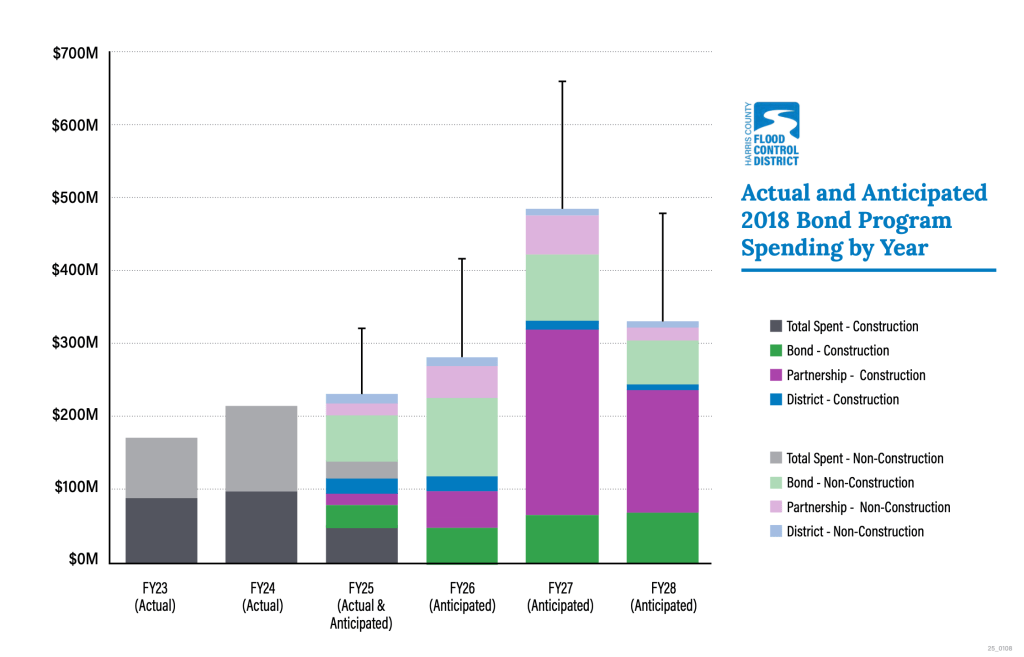
Here is a graph from the last page of Petersen’s presentation. It paints a pretty rosy picture. Work and spending going straight up for five years. If you’re a commissioner, you’re probably thinking, “Gee, I better get my project completed before the money runs out.”

See graph on last page of Petersen’s transmittal to Commissioners Court.

But buried on HCFCD’s website several layers down is this graph. It paints a bleaker picture. If you’re a resident, you’re probably asking, “With billions of dollars in the bank and inflation eating up bond dollars, why is mitigation activity slowing down? Hurry up and finish my projects!”

Another portion of the page below shows that HCFCD has only spent $1.5 billion from the bond so far, but Petersen’s presentation shows they have $5.2 billion when you include partner funds.

Declining graph
Screen Capture from HCFCD on 7/1/25

This is a very concerning graph that raises questions about the efficiency of HCFCD and how much of the bond has been lost to inflation.

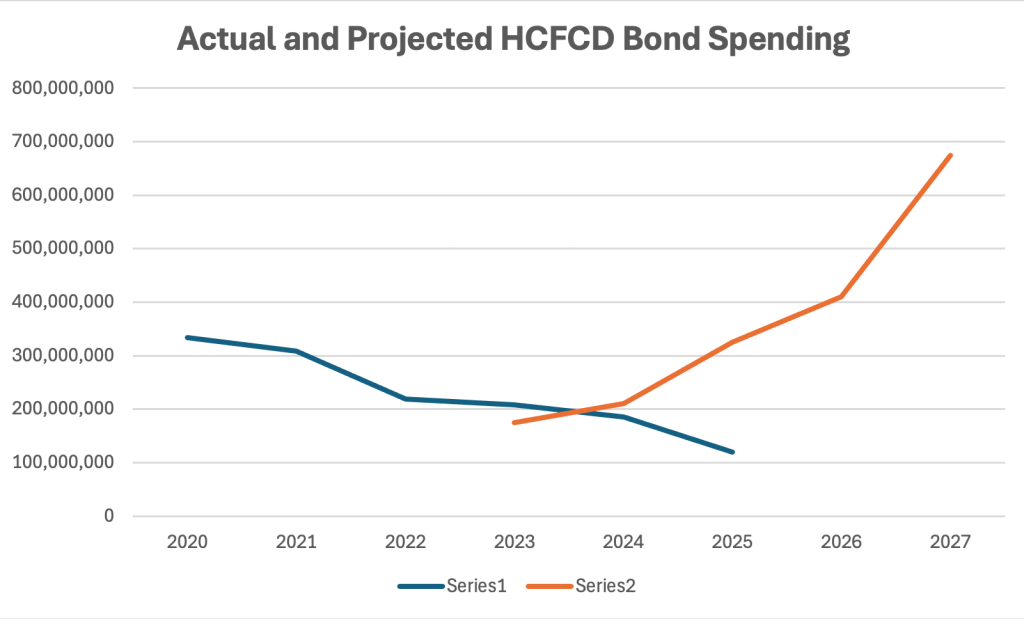
To show the differences between the two trends, I combined them in a third graph. It’s one thing to paint rosy projections for your bosses. And it’s another to overcome years of lost momentum. But there’s an even bigger problem. Look at the years where lines overlap in the middle. The data for past spending doesn’t agree. Oops!

  • Series1 represents reported spending data except for 2025, where I annualized first-quarter spending.
  • Series 2 takes reported and projected spending from Petersen’s bar graph.

Where the lines overlap, the graphs should match perfectly, but they don’t. So I called for an explanation.

HCFCD explains the difference by saying the dark line uses calendar-year data and the orange line uses fiscal-year data. They vary by three months and $23 million. But HCFCD says that otherwise the two sources “numerically align.” I asked what that meant and was told “They match.” Ooooookayyyyy….

But according to data obtained via Freedom of Information Act (FOIA) Requests in previous years, HCFCD spent:

  • $217 million in FY2023, not the $175 million shown in Petersen’s bar graph.
  • $254 million in FY2024, not the $210 million shown in her bar graph.

Now my head is swimming. We have THREE values that vary by $42 million for 2023 and $69 million for 2024. See below.

You could build a major project with $69 million!

Unanswered Questions and Uncertainty

An old proverb says, “A man with two watches never knows what time it is.”

Harris County Flood Control District has a real problem. Their financial projections have all the certainty of a 5-year weather forecast. They can’t even agree on LAST year’s weather.

Yet they’re making policy decisions that affect people’s lives with this data. And in the process, they’re destroying trust in government.

There may be a logical explanation. But it’s not apparent or explained anywhere with the data people see.

Why are their numbers different in different places? Who is getting the truth and who is not? 

More examples to follow. This is Part One of Three.

Posted by Bob Rehak on 7/1/25

2863 Days since Hurricane Harvey

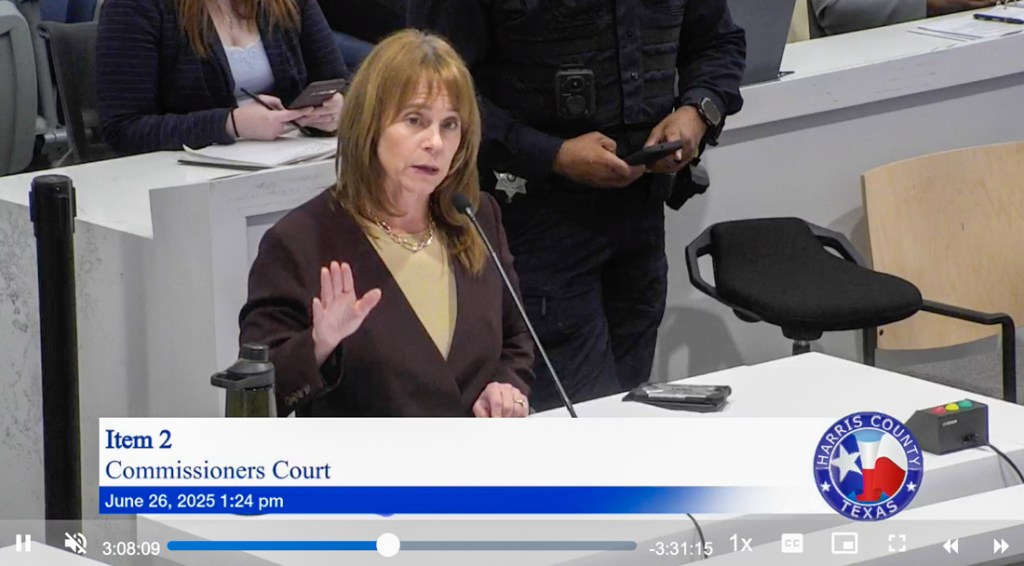
With 25% Funding Shortfall, 80% of Flood-Bond Projects Cut

6/30/25 and 7/3/25 – Updated to clarify a distinction between Bond Projects and Bond IDs, and also correct several entries in tables.

6/29/25 – Analysis of documents released after the Harris County Commissioner’s Court meeting on 6/26/25, shows that because of a claimed 25% flood-bond funding shortfall, the county will stop funding 80% of Bond IDs and 75% of Bond projects. Precinct 3 will bear the most cuts.

Usually, precincts share equally, but in this case, Precinct 3, the lone Republican-led district will retain only 14% of active projects.

Before the meeting, the county had released only one blank page about what turned out to be the disappearance of more than a billion dollars.

Even worse, to make up for the claimed shortfall, Democratic Commissioners voted 4:1 along party lines to defund most of the remaining projects voters approved in the 2018 Flood Bond.

Something’s not adding up that demands an explanation.

Huh? 80% of Projects Cut after Losing 25% of Funding?

The $2.5 billion Bond was sold with a project list that totaled roughly $5.1 billion. However, partner funding more than made up the difference. Harris County Flood Control District (HCFCD) has commitments for another $2.7 billion – bringing the total available to $5.2 billion. A $1.3 billion shortfall is 25% of that total.

Questions:

  • Why the shortfall?
  • Why the disproportionate cuts?
  • Why are we only learning now – seven years into the bond?
  • Are the proposed cuts fair?

Reasons Proposed for Shortfall

In her presentation Dr. Tina Petersen, executive director of HCFCD, attempted to explain the shortfall by alluding to:

  • Cost increases (i.e., due to inflation)
  • Grant requirements
  • Changing regulations
  • Right-of-way acquisitions
  • Program structure

Others have alluded to:

  • Scope creep
  • Cumbersome processes related to Ellis equity formula
  • Slow execution
  • Political interference
  • Need for more money in the original bond
  • Changes in leadership at HCFCD
  • Personnel turnover at lower levels
  • Unnecessary bureaucracy that adds cost without adding value
  • Covid
  • Low initial estimates
  • Addition of projects
  • IT system issues

Why Such Draconian Cuts?

Why are the cuts so disproportionate to the shortfall?

High on the list of possible explanations would be the motion that Democratic members of Commissioners Court approved.

It called to focus only on projects in the top quartile of Ellis’ Equity Prioritization Index.

But it also called to fully fund future costs associated with those projects. That builds scope creep into the bond.

If, for instance, the Flood Bond only included a preliminary engineering review for a project, it will now include full engineering, design, right-of-way acquisition, construction, landscaping, turnover costs and bagels.

In other words…

Funding for projects that voters approved is being cut to pay for projects they didn’t approve.

It’s a fundamental breach of public trust.

Why Are We Only Learning Now?

Since Harris County Democratic Commissioners brought in new management, HCFCD has largely gone dark. For example:

  • The District, once a paragon of transparency, efficiency, and speed under the previous leadership, has largely stopped updating its website as performance decreased.
  • Harris County Flood Control bid only three projects last year.
  • Active projects used to be updated weekly. Now they’ve disappeared from the website.
  • Bond-update frequency fell from monthly to quarterly to semi-annually to whenever-we-get-around-to-it. The last one took more than a year.
  • When commissioners asked for an update in February, it took HCFCD five months to produce an overly complicated report that few understood.
  • The County’s Flood Resilience Task Force is still waiting for flood-risk data it requested years ago.

The lack of information masks serious issues that have built for years concerning the efficiency and transparency of Flood Control.

In last week’s discussion, Judge Lina Hidalgo complained repeatedly and bitterly about her lack of understanding, a lack of transparency and her inability to get simple, straight answers.

But hey, what kind of manager puts up with that? For seven years!

Are Cuts Fair?

The County uses Rodney Ellis’ Equity Prioritization Index to rank flood-mitigation Bond IDs from 0 to 10 using a multi-factor index. Some Bond IDs contain multiple projects. But whether you assess the cuts by Bond ID or Projects, P3 still suffers the most.

After a marathon 5-hour discussion, Commissioners voted to continue funding only projects scoring above 7.5. The rest will die.

Ellis’ scoring matrix gives 65% weight to factors such as race, household income, social vulnerability, population density, and housing density.

It gives no weight to flood damage, severity of flooding, flood frequency, or flood risk.

Ellis cherry-picked statistics to gerrymander flood-control dollars, not reduce damage.

Many of the remaining dollars in the bond will go to watersheds that have already received hundreds of millions of dollars in mitigation funds. Meanwhile…

Other watersheds that have been shortchanged will now have their pockets picked.

Precinct 3 had the highest flooding in the county during Harvey.

Yet Precinct 3, the lone, Republican-led precinct, bore the brunt of the funding cuts wide margins.

Precinct 3 projects will suffer the most.

Here’s a breakdown of the totals by quintile and precinct. Because projects sometimes cross precinct boundaries, when a project did so, I counted it once for each precinct it benefitted.

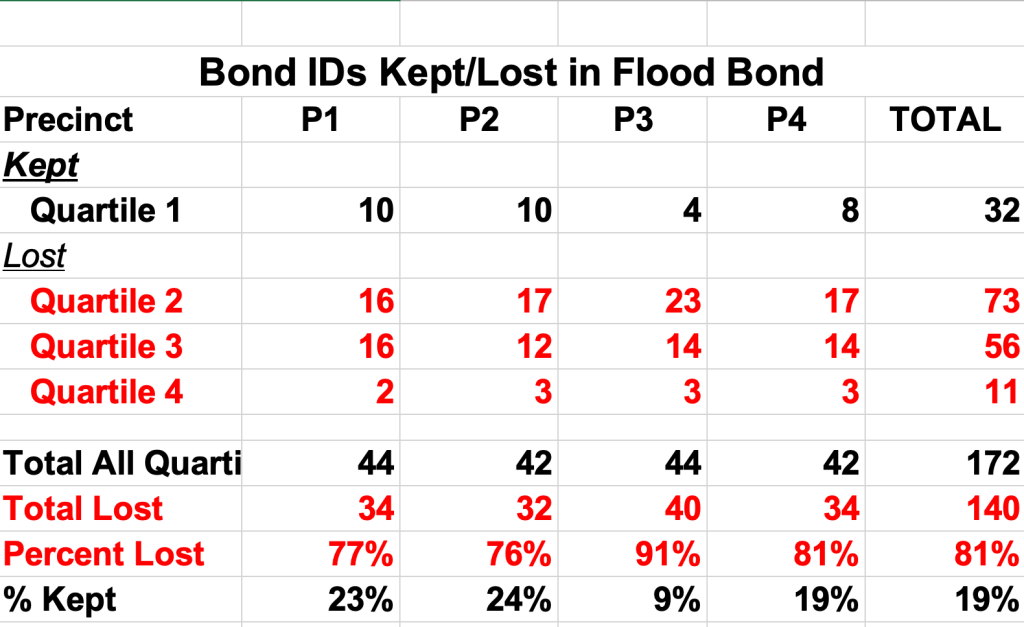
Next, look at Bond IDs. A bond ID may contain multiple projects. And again, when a Bond ID benefited two precincts, I counted it twice. Percentages change slightly. But the same basic picture emerges…only more so:

Precinct 3 had the most Bond IDs defunded and kept the fewest.

Barrett Station is in Precinct 3. It’s one of the poorest areas in the county. And it had its funding cut. That shows this is more about politics than concern for the poor.

To compile these tables and the pie chart above, I counted Bond IDs and Projects in each quartile in this spreadsheet,

The funding cuts likely won’t affect a subset of 29 projects funded by HUD because those are 100% federally funded. Regardless…

The county will now pursue only one in four or five of the remaining bond projects/IDs.

Stunned citizens are struggling to comprehend the scope of the cuts, which will negatively impact roughly 80% of the county.

No wonder the county kept a tight lid on its analysis and didn’t post anything for the public to review before the meeting. Protesters might have showed up to counter two hours of testimony by Ellis’ surrogates last Thursday.

We Need to Demand…

  • Answers.
  • Action.
  • Accountability.
  • Fairness.

And we need them fast. Frankly, I’m surprised no one has filed a lawsuit yet. This feels like slow-motion voter fraud.

Posted by Bob Rehak on 6/29/25 and updated on 6/30/25

2861 Days since Hurricane Harvey

The thoughts expressed in this post represent opinions on matters of public concern and safety. They are protected by the First Amendment of the US Constitution and the Anti-SLAPP Statute of the Great State of Texas.

Why HCFCD’s Report on Remaining Flood-Bond Funds is One Blank Page

6/25/2025 – On February 7, 2025, Harris County commissioners, expressed concerns about budget shortfalls in flood-bond and subdivision drainage projects. They asked Harris County Flood Control District (HCFCD) for an accounting of where the money went and how much was left. One hundred and thirty-eight days later, after missing repeated deadlines, HCFCD filed the report below for Agenda Item #2 – one blank page. It has nothing on it. Nada. Zip. Bupkis. Zero.

For a souvenir printable PDF, click here.

This is what passes for “transparency” in Harris County and the Commissioners Court’s Orwellian world of double-speak. There’s a reason for this.

They’re trying to shift funds around without you knowing.

Commissioners Secretly Debating Scenarios for Dealing with Shortfall

I would hasten to add that Harris County Flood Control District (HCFCD) has shared information with commissioners, just not you. And according to Commissioner Tom Ramsey of Precinct 3, all commissioners are engaged in a heated debate about five different scenarios for dealing with the shortfall.

Only one scenario would treat each precinct equally – Ramsey’s. The other four would take money from Republican Precinct 3 and give it to Democratic precincts.

For instance, under one scenario, Precinct 3 would get cut by $223 million while Democratic precincts would be cut only by an average of $120 million. So…

Precinct 3 would be cut $100 million more than other precincts.

According to Ramsey, they’re using “equity” to defend allocations that have nothing to do with equity. For instance, Barrett Station, an underserved neighborhood in Precinct 3 with flooding problems, would receive nothing under the Democratic funding scenarios.

Unacknowledged Scope Creep, Bloat, and Massive Slowdown

Another complaint that Ramsey has is about “scope creep.” Some line items in the flood bond were limited to engineering studies.

However, now that those studies are complete, some commissioners want to increase those limited financial commitments to include full-blown construction costs as well. That was never originally intended.

And when you factor in 27.5% inflation since the 2018 flood bond, you can understand why Democrats are grabbing Ramsey’s fair share.

Of course, they would never acknowledge that they created Harris County’s bloated, process-bound, equity-obsessed bureaucracy that has reduced HCFCD spending to pre-bond levels – making inflation take an ever larger toll on purchasing power.

From https://www.hcfcd.org/Activity

Lake Houston Floodgates at Risk Tomorrow

That has also put essential, life-saving projects at risk. For instance, on the chopping block: the project to add more floodgates to Lake Houston. The flood bond allocated $20 million that is now at risk of going elsewhere.

GLO Takes Stand Against Partisan Politics, Encourages Speed

Ramsey has drawn a line in the sand on the floodgate issue in particular and the unfair allocation issue in general. He says he has talked with Texas General Land Office Commissioner Dawn Buckingham about the money grab.

According to Ramsey, Buckingham supports a fair and equal allocation of remaining bond funds among all precincts.

Buckingham issued this statement:

“My mission at the Texas GLO is to serve those we are supposed to serve and do it well. Since becoming Commissioner in 2023, I have put politics aside and done what is right for Harris County. Flood waters do not respect political boundaries, and neither should prioritization of resilience efforts. I encourage the Harris County Commissioners’ Court to put aside partisan politics and focus on maximizing effectiveness of the funds available as well as putting them to work as quickly as possible.”

Democrats may have a majority. But Ramsey likely has a bigger stick. Harris County cannot afford to lose Buckingham’s support at a time when her team is reviewing $850 million in Harris County grant applications with tight federal deadlines.

Will the other precincts share the pain? Will they vote for an equal allocation of the remaining funds? Or will they try to steal from Ramsey’s fair share?

How Did We Get Here?

The County’s complete and utter lack of transparency raises the question, “What are they trying to hide from us?” They have clearly forgotten that this is our money, not theirs. Where is it going? Why? Why can’t HCFCD move faster? And how are we to know whether remaining dollars are going where they are most needed? (HCFCD doesn’t publish flood risk data either.)

And most important: How are we to hold executives and elected officials accountable? We can’t without information.

This is the opposite of transparency. Secrecy will increase flood risk for large segments of Harris County’s population that have received little to no help from HCFCD up to now. Like the Lake Houston Area.

Watch the 6/26/25 commissioners court meeting. The meeting starts at 10AM. Don’t miss Agenda Item #2. And remember that blank page and broken promises during the next election.

Posted by Bob Rehak on 6/25/2025

2857 Days since Hurricane Harvey

The thoughts expressed in this post represent opinions on matters of public concern and safety. They are protected by the First Amendment of the US Constitution and the Anti-SLAPP Statute of the Great State of Texas.

HCFCD to Unveil Final Design of Woodridge/Taylor Gully Project on July 1

6/20/25 – Harris County Flood Control District (HCFCD) has announced that it will unveil the final design of the Woodridge/Taylor Gully Project in Kingwood on July 1. Based on preliminary engineering, HCFCD applied to the the U.S. Department of Housing and Urban Development (HUD) via the Texas General Land Office for a grant of $42 million to cover the cost of construction.

HCFCD will reveal the final design in a virtual public meeting at 6:30 PM on July 1, 2025. Sign up here to attend the webinar.

History of Woodridge/Taylor Gully Project

According to long-time residents, Taylor Gully never flooded, even during Harvey, until Perry Homes purchased and cleared the 270-acre Woodridge Village property immediately north of Sherwood Trails, Elm Grove and Mills Branch Villages. The property, just across the county line in Montgomery County, forms the headwaters of Taylor Gully and used to be heavily forested.

But shortly after Perry’s contractors started clearing the property, hundreds of homes along Taylor Gully flooded twice in 2019.

Rustling Elms Bridge over Taylor Gully in May 2019
Rustling Elms near Taylor Gully in May of 2019

Engineering documents specified that the contractors should have cleared the property in sections and built detention basins for each section before moving onto the next. However, the contractors clearcut the whole property and sloped it toward the homes that flooded before building the required detention.

The fiasco turned into a giant class-action lawsuit. During the lawsuit, Perry’s contractors scrambled to build the stormwater detention basins. However, it also became clear that the detention they were building was about 30-40% short of Atlas-14 standards which Montgomery County had not yet adopted.

County/City Purchase Property from Perry

HCFCD and the City of Houston purchased the property from Perry to keep it from being developed. Early on, they announced plans to turn it into a giant regional stormwater detention basin to reduce flood risk.

Preliminary-engineering plans later recommended:

  • Building another stormwater detention basin on Woodridge Village holding 412 acre-feet (virtually doubling capacity).
  • Expanding a portion of Taylor Gully and lining it with concrete.
  • Replacing the culverts at Rustling Elms with a clear-span bridge.

HCFCD entered into an Excavation and Removal Contract with Sprint Sand and Clay to get a head start on excavating the new Woodridge Basin. However, when HCFCD applied for HUD funding, by law, they had to terminate the contract. That happened at the end of 2023. Why? Conditions on the property can’t change while the GLO and HUD evaluate grants. It’s a fraud prevention measure.

Woodridge
New Excavation on Woodridge Village as of May 31, 2025

Generic Differences Between Preliminary and Final Design Recommendations

During preliminary engineering, managers try to prove up the value of a concept. But along the way to final design, they sharpen their pencils.

As a project progresses from concept to constructible plans, typically they tighten and incorporate:

  • Hydraulic and Hydrologic Modeling – with higher resolution topography, updated rainfall data, and detailed channel/basin geometry.
  • Right-of-Way and Easements – Whereas preliminary layouts assume general access needs, final design incorporates, precise right-of-way limits, utility conflicts, coordination with surrounding landowners, and legal descriptions for acquisition and/or dedication.
  • Geotechnical Investigations – Soil borings for slope-stability analyses for embankments, groundwater-level monitoring, channel linings, etc.
  • Structural-Design Finalization – Including sizes, materials, and load capacities for bridges , weirs and detention outlet structures.
  • Environmental and Permitting Integration
  • Cost Estimate Updates – Whereas preliminary estimates often have ±30 accuracy, final design includes detailed quantities, updates unit costs and construction phasing for more precise budgets and schedules.
  • Constructability and Value Engineering – Engineers and sometimes contractors look for ways simplify/reconfigure designs that lower costs.
  • Utility Coordination – Precise identification of existing utilities (water, sewer, fiber, gas) along with plans to relocate them if necessary or change design.
  • Public Involvement and Stakeholder Feedback – Where we are now. Feedback sometimes results in design modifications for aesthetics, access, noise or neighborhood concerns. It might also be valuable for inclusion of trails, parks or other recreational elements.

HCFCD has not yet released any of the specific changes between their preliminary and final plans for this property.

Rustic Elms Bridge on Taylor Gully
Preliminary plans called for replacing these culverts at Rustling Elms and Taylor Gully with a clear-span bridge like the one farther downstream.

HCFCD Hopes to Bid by October

According to HCFCD spokesperson Emily Woodell, “We’re wrapping up design for this project, which is what we plan to cover at the community engagement meeting. Based on current project schedules, this is set to go out for bid for construction contracts in October of this year.”

“We’re planning to amend this into the overall contract with the General Land Office in the very near future, which will allow us to draw grant funds. None of the design work has been funded by CDBG, it was all locally funded. Grant funds will be used for construction.”

HCFCD urges community members to attend the virtual meeting. Remember, it’s:

Tuesday, July 1, 2025

Starting at 6:30 PM

If you have suggestions after seeing the plans, now is the time to share them. So sign up now.

Posted by Bob Rehak on 6/20/25

2852 Days since Hurricane Harvey