Tag Archive for: Colony Ridge

Town Fighting for Survival Stonewalled By County, State Officials at Every Turn

In the last year, I have researched and written more than 50 posts that mentioned Colony Ridge, the controversial Liberty County development with suspect drainage practices. In the last six months, County and State officials have stonewalled requests for documents that could help prove or disprove Colony Ridge violations of the County’s own drainage regulations.

Lack of back-slope interceptor swales and drains means water from lots erodes ditches and sends sediment downstream. Liberty County drainage regulations require back-slope interceptor systems and grass. See Section M on page 100 of Liberty County Subdivision and Development Regulations. But lack of those measures has widened ditch more than 35 feet due to erosion in 6 years, according to Google Earth.

During that year, Wayne Dolcefino, an eminent investigative journalist with a long list of awards, also started investigating Colony Ridge. He, too, has been stonewalled.

Dolcefino Consulting is independently investigating on behalf of neighboring Plum Grove. Residents allege that water spilling out of Colony Ridge has repeatedly contributed to flooding their properties. They have been stonewalled.

Likewise, Colony Ridge drainage wiped out FM1010, a major access road to Plum Grove, because of uncontrolled drainage coming the ditch shown above.

Dolcefino and the City of Plum Grove have filed even more requests for information than I and received little. Today, Dolcefino launched another broadside to remind people that their elected representatives seem to be representing a developer instead of them. See his report below.


Dolcefino Stonewalled; Issues Press Release

The tiny Liberty County, Texas town of Plum Grove has been fighting to save itself from real estate developer Colony Ridge, and now the town is battling back with subpoenas for the records that will prove whether missing drainage records ever existed at all. 

One of those subpoenas was delivered to LandPlan Engineering—the engineering firm that allegedly prepared the plans for the sprawling Colony Ridge subdivision that caters to illegal immigrants with owner-financed lots that do not require government documents to prove identity. 

LandPlan has been asked to produce drainage records, but they have also been asked to show the information that they received about flooding events that have helped swamp Plum Grove properties and destroy the town’s roads. In other words, once Colony Ridge created a subdivision that flooded its neighbors, did anyone care?

The fact that drainage records were missing was uncovered by Dolcefino Consulting, who were hired by the town to investigate possible corruption involving the Liberty County officials who approved what is now becoming the biggest community in the entire county. 

“Good Ole’ Boy Protection Racket”

Liberty County has known for months the drainage records were missing and has ignored calls to force LandPlan and Colony Ridge developer Trey Harris to produce the records. An alleged investigation by the Liberty County Attorney Matt Poston has never been produced. Emails show that the county engineering firm LJA hasn’t pressed the issue either. 

“There is absolutely no excuse for Liberty County to have not forced the production of these records long ago,” said Wayne Dolcefino, President of Dolcefino Consulting. “The Liberty County Judge Jay Knight has proven his negligence, his absolute disdain for the people of Plum Grove, and the next time it floods, if animals or people die, the blood will be on his hands. That’s the bottom line. I bet he would care if it was his neighborhood.” 

The former county engineer Louis Bergman was also subpoenaed. When Bergman left his job with Liberty County, he left with many of the Colony Ridge development records. 

“Bergman should have been brought before a grand jury to detail his relationships with Colony Ridge and whether his recommendations to approve these neighborhoods were based on facts or good ole’ boy engineering,” Dolcefino said. 

Bergman is the father of the Liberty County District Attorney, who has ignored calls from Dolcefino Consulting. 

The flood dangers created by Colony Ridge have threatened the world-famous Ima Survivor Sanctuary in Plum Grove, prompting angry calls for action from hundreds of thousands of supporters across the globe. 

“Time is running out Judge Knight,” Dolcefino said. “When Plum Grove proves the truth—and the lawyers at Lloyd Gosselink will—the truth will come out.” 

The Plum Grove investigation has led to the filing of a criminal complaint by Dolcefino Consulting against the State Representative for Plum Grove Ernest Bailes. 

Bailes refused to provide phone records that were sought in the investigation of his relationship with developer Trey Harris. Bailes has refused to deny acceptance of any trips or private business from Harris. The San Jacinto Sheriff Greg Capers has refused to investigate Bailes. 

“This good ole’ boy protection racket would rather protect Representative Bailes than the public right to know,” Dolcefino said. “Since our reporting on San Jacinto County began, we have received some interesting tips. Stay tuned.”


I might add that for months I have been stonewalled, too. Not one of my inquiries about the county’s drainage investigation which was launched last January has even received an “I can’t comment about ongoing investigations”!

Posted by Bob Rehak on 7/15/2021 based on a press release by Dolcefino Consulting

1416 Days since Hurricane Harvey and 655 since Imelda

The thoughts expressed in this post represent opinions on matters of public concern and safety. They are protected by the First Amendment of the US Constitution and the Anti-SLAPP Statute of the Great State of Texas.

Colony Ridge Expanding North Into More Wetlands

After months of expanding Colony Ridge to the east, the developer is now pushing north. The new area is outlined in red below.

From Google Earth Pro. Red box shows new expansion area to the north of those currently being developed.

US Fish and Wildlife Shows Area Contains Many Wetlands

According to the US Fish and Wildlife Service, the new area contains numerous wetlands. So did the partially developed area below it.

Here’s the same general area highlighted within the USGS National Wetlands Inventory.

Wetlands are nature’s way of slowing water down after a rain. They also filter runoff before it reaches streams, reducing the amount of sediment pollution.

The photos below, all taken on 5/26/2021, show the same kinds of business practices that just earned Colony Ridge eight complaints from the Texas Commission on Environmental Quality during nine investigations.

Looking north from a helicopter. Notice how ditch and roads are beginning to push into woods at top of frame.
As with previous sections recently developed, Colony Ridge is not too picky about piling dirt next to ditches where sediment can wash back in.
Piling dirt next to the ditches seems to be a standard practice. Note how it’s already washing back into the ditch in the lower left of this photo.

If the developer were following best management practices, according to the TCEQ and Stormwater Pollution Protection Plan recommendations, you would expect to see temporary grass, rock gabions, silt fences, and hay bales in these photos. All check the flow of sediment into ditches.

Draining the swamp
Looking SE toward the east part of Sante Fe (Sections 6-11) already cleared. Note swampy areas at bottom left.

Biden Trying to Restore Clean Water Act Protections

Ironically, all this development comes as the EPA under the Biden administration seeks to put teeth back into the Clean Water Act. The administration is trying to restore the definition of “Waters of the United States” that Trump restricted. Yesterday, the Justice Department submitted a legal filing that begins that process.

The EPA and Department of the Army have formally requested repeal of the Trump-era rule. That rule exempted many developments near upstream tributaries such as Luce and Tarkington Bayous from the need to obtain permits under the Clean Water Act. It basically removed large swaths of land from regulation by the US Army Corps of Engineers.

According to this Associated Press article by Matthew Daly on 6/9/2021, environmental groups and public health advocates said Trump’s interpretation of Waters of the US “allowed businesses to dump pollutants into unprotected waterways and fill in some wetlands, threatening public water supplies downstream and harming wildlife and habitat.”

Daly quotes Jaime Pinkham, acting assistant Army secretary for civil works as saying, “The Trump-era rule resulted in a 25% reduction in the number of streams and wetlands that are afforded federal protection.”

It’s unclear at this time whether rollback of Trump regulations will affect Colony Ridge. Even if the changes survive legal and legislative challenges, it could be years before they take affect.

By then, the world’s largest trailer park will have doubled again in size.

Posted by Bob Rehak on 6/10/2021

1381 Days since Hurricane Harvey

The thoughts expressed in this post represent opinions on matters of public concern and safety. They are protected by the First Amendment of the US Constitution and the Anti-SLAPP Statute of the Great State of Texas.

Eight TCEQ Investigations Reprimand Colony Ridge Construction Practices

The Texas Commission on Environmental Quality (TCEQ) finalized nine investigations into Colony Ridge construction practices this week. Eight of the nine found violations. And six of the eight scolded Colony Ridge for lack of best management practices relating to erosion controls. The other two cited Colony Ridge for operating without a permit.

Summary of Violations

The TCEQ meticulously documented the findings with dozens of photos and supporting documents. The nine investigations total 2,341 pages. Below is a summary of the investigation numbers, subdivisions and violations:

  • #1699286, Sante Fe #6, operating without a permit
  • #1704908, Long Branch, best management practice (BMP) violations
  • #174909, Sante Fe #5, failure to meet final stabilization requirements, large bare areas of unstabilized soil
  • #1704910, Sante Fe #7, BMP violations, unstabilized drainage channels, damaged BMPs, improperly installed BMPs
  • #1704912, Sante Fe #8, erosion control measures not installed
  • #1404914, Sante Fe #9, erosion control measures not installed
  • #1704916, Sante Fe #10 and #11, erosion control measures not installed
  • #1704918, Sante Fe #10 and #11, no violation
  • #1707467, Sante Fe #10 and #11, operating without a permit

The best management practices and erosion control measures cited above are designed to prevent the rivers of mud seen coming from Colony Ridge. The mud has partially plugged local creeks in Plum Grove, contributing to flooding. It has also contributed to sediment buildup farther downstream near the mouth bar of the San Jacinto East Fork.

Violations apply only to TCEQ regulations, not Liberty County’s drainage standards. The Liberty County attorney is reportedly conducting a separate investigation into Colony Ridge construction practices and engineering reports.

Nature of Violations

Six of the TCEQ violations relate to best management practices and erosion control. For instance:

  • Planting grass can stabilize soils.
  • Silt fences can prevent dirt from entering ditches.
  • Rock gabions can reduce the velocity of water, thus reducing erosion.

But the investigations found little evidence of any such practices. And when they did, the measures were often ineffective due to lack of maintenance. For instance, water eroded around and under silt fences, rendering them useless.

Dirt piled on sides of ditches. No silt fences, grass, or gabions. Photo taken May 26, 2021.

When you clear thousands of acres at a time, erosion control is important to protect downstream neighbors.

Two of the other investigations found Colony Ridge operating without a valid permit.

Conditions For Obtaining Permits

The National Pollution Discharge Elimination System (NPDES) requires developers to formulate Stormwater Pollution Prevention Plans (SWPPP) as a condition of obtaining their permits. The plans should:

  • Control the perimeter of the site
  • Protect receiving waters adjacent to the site
  • Follow pollution prevention measures
  • Protect slopes and channels
  • Stabilize the site as soon as possible
  • Minimize the area and duration of exposed soils at any one time
Part of Colony Ridge expansion area covered in TCEQ investigations. Photo taken March 3, 2021.

The goals of pollution prevention plans include:

  • Retaining sediment on the property
  • Selecting, installing, inspecting, and maintaining sediment control measures in accordance with good engineering practices
  • Removing offsite accumulations of sediment that escapes the property at a frequency sufficient to minimize offsite impacts
  • Preventing litter from becoming a pollutant source in stormwater discharges
Accumulations of litter on banks of Colony Ridge ditchdefinitely not a best management practice. Photo taken March 3, 2021.

Penalties Unclear at This Time

It’s unclear at this time whether the TCEQ violations will result in any fines for Colony Ridge. Typically, the TCEQ gives regulated entities a chance to remedy violations before levying fines. However, the recurring nature of these violations may call for a new approach. TCEQ has warned Colony Ridge about similar issues in the past, saying that Colony Ridge violations could adversely affect human health. However, violations continue.

Clearly, the ability to fix problems without a fine – after silt has been discharged into bayous, streams and rivers – seems like an incentive to ignore, not obey, regulations. Violators can simply fix problems if caught and, if not, take their profits to the bank.

Looking south. Photo taken May 26, 2021. Colony Ridge continues to push north with same construction practices.

Conclusions of All Nine Reports

The reports comprise almost 650 megabytes. They are far too large to post in a forum like this. However, I have captured screen shots of the reports’ conclusions for those who wish more detail.


#1699286: operating without a permit

#1704908: failure to maintain and properly install BMPs

#1740909: failure to achieve final stabilization requirements, large areas of bare soil

#1704910: Failure to maintain BMPs, install them properly and stabilize drainage channels.

#1704912: erosion control measures not installed

#1704914: failure to install even minimum erosion controls.

#1704916: no erosion control measures installed

#1704918: No violations.

#1704467: Operating without a permit.

For full reports, visit the TCEQ website.

Posted by Bob Rehak on 6/5/2021, based on TCEQ investigations

1376 Days since Hurricane Harvey

The thoughts expressed in this post represent opinions on matters of public concern and safety. They are protected by the First Amendment of the US Constitution and the Anti-SLAPP Statute of the Great State of Texas.

Family Trapped For Three Days As Floodwaters Ripped Through Sand Mine, Then Under Their Home

Yesterday, I wrote how the San Jacinto East Fork seemed to have re-routed itself through an abandoned sand mine. This morning I got a call from a couple who live near the mine. The woman and her husband had been trapped in their home for three days by the river which is now – incredibly – running right beneath their home. As of 5 p.m. Tuesday, floodwaters subsided enough for them to boat to safety. But their story is a gripping lesson in how quickly life can change.

Dream Turned into Nightmare

Jack Arnold bought 25 acres in the country back in 2002 to have a retreat from the noise of the city. He works in structural steel and quiet Plum Grove in Liberty County seemed like the perfect place to unwind. He and his sons built a home in 2011 on steel poles 21 feet in the air about 400 feet east of the San Jacinto East Fork.

The spot Arnold cleared for his home in 2011, east of the East Fork San Jacinto which runs through the woods to the left of the red box.

Then three things happened.

  • In 2012, a sand mine started up about 1100 feet south of him.
  • Later that year, Colony Ridge started building northeast of him.
  • His ex-wife sold 16.5 acres of their property to the sand mine, which then expanded around him.

It didn’t take long for Arnold’s flooding woes to start.

Sand Mine and Colony Ridge Permanently Alter Hydrology of Area

Here’s what the surrounding area looks like today.

Arnold’s home is partially surrounded by a sand mine (white box) on three sides. And the first two Colony Ridge subdivisions are dumping water into the East Fork upstream of him with fewer detention ponds than they likely should have to meet Liberty County regulations.
FEMA’s National Flood Hazard Layer Viewer shows that the sand mine’s dikes have constricted the East Fork floodway (cross-hatched area) about 90%. This puts tremendous pressure on the mine’s dikes as water tries to squeeze through a fraction of the space. That also increases erosion which further breaks down the dikes. The constrictions could be one reason why the river rose 10 feet in 24 hours at this location.

Arnold says his property never flooded in the first five years he lived there. Then in 2015, as Colony Ridge and the sand mine expanded around him, he started flooding regularly. Last Sunday, the water started rising again. This time, it was from an 8-inch rain that areas upstream received. Plum Grove itself received only a little more than 3 inches. Harris County’s meteorologist characterized the 8-inch rain, which fell over a two-day period, as a ten-year rain.

Near Death Experience, Not to Mention…

As floodwater rose around the Arnolds last Sunday morning, they had a hard time understanding why. But it kept coming up and up. Three days later, it’s still four-feet deep (waist high) under their house and moving so fast it could knock strong men over.

Arnold nearly died in a previous flood event when he was swept away. He clung to a tree for two hours until his second wife and stepdaughter rescued him. Then all three had to be rescued by the game warden three days later. Now, Arnold takes no chances. He and his wife have been holed up alone for three days waiting for the water to go down. They each have missed two days of work so far this week, because they couldn’t reach their cars which they parked on higher ground.

Altogether, they have lost nine vehicles, two campers, and a boat since the flooding started. Another reason they were reluctant to leave their home despite being trapped: looters stole all their valuables after they evacuated during a previous flood.

Begging For a Buyout that Hasn’t Yet Come As Flooding Gets Worse

The Arnolds don’t want to move; after all, Arnold built the home with his own hands. But he and his wife just can’t take any more flooding. Now, they just want out. They’re begging for a buyout that hasn’t yet come.

And their flood woes will likely not change. Colony Ridge built the subdivisions north of them using dubious engineering reports that classified the soils as more permeable than the USDA did. That enabled the developer to avoid building detention ponds and maximize the amount of land he sold. But the runoff is likely greater than the developer promised the county engineer. And now the officials have stopped producing documents that might prove suspicions.

Perhaps worse, the sand mine has been sold to a company that wants to turn it into an RV park. Which means there’s no one to fix the dikes which ruptured during the latest flood. In a phenomenon that geologists call pit capture (or river capture), the East Fork rerouted itself through the sand mine and then filled the mine up like a water balloon. The water balloon then broke more dikes on the southern end of the mine in a location that is not aligned with the bridge openings over the East Fork.

The main current of the river has been running through the mine and under the Arnolds’ home for days now.

House Built in the New River Bed?

Now the Arnolds worry they may have a house built in the river. Of course, they won’t know until the flood water goes down. And even though the water level has lessened slightly since yesterday, it is still too high and too dangerous to venture out. See images below.

Looking SE. Sand mine dikes have broken on the lower right and now water rushes out of the west fork, crosses the mine and goes under Arnolds’ house in the trees on the left.
Looking NW. Note how the pressure of the water has collapsed the swimming pool in their side yard.
Looking NW. The water then rushes back into the mine from the south side of the property.

Posted by Bob Rehak on 5/4/2021 based on personal observations and interviews with Michael Shrader, and Jack and Pamela Arnold

1344 Days since Hurricane Harvey and 593 since Imelda

The thoughts expressed in this post represent opinions on matters of public concern and safety. They are protected by the First Amendment of the US Constitution and the Anti-SLAPP Statute of the Great State of Texas.

Silence: Liberty County, Colony Ridge, Landplan Engineering Remain Mute on Missing Documents

Wayne Dolcefino titles his latest video “The Sounds of Silence.” It’s about the Colony Ridge problems in Liberty County and the response of officials.

On December 26, 2020, I reported about missing drainage reports for the Colony Ridge development in Liberty County. The post also discussed the mischaracterization of soil types in the reports that did exist. The mischaracterization let the developer overestimate the infiltration of rain and thus underestimate runoff. That meant he needed fewer detention ponds and smaller ditches. And that, in turn, meant the developer could sell more lots. But then the flooding started. Coincidental?

Sounds of Silence

On January 4, 2021, Liberty County Attorney Matthew Poston launched an investigation.

But four months later, the documents are still missing. Without explanation.

Either they got lost or were never developed in the first place. And no one will defend or explain the soil sampling in the documents that were produced.

Neither will anyone talk about how large parts of Colony Ridge got approved by the County without the required engineering documents certifying “no negative effect” on drainage upstream or downstream from the development (see page 5). Note: Plum Grove Road has been washed out since Harvey and keeps getting worse. Neither will they talk about whether conditions at Colony Ridge comply with Liberty County regulations.

  • Jay Knight, the Liberty County Judge, won’t talk.
  • Greg Arthur, Liberty County Precinct 2 Commissioner, won’t talk.
  • David Douglass, the Liberty County Engineer, won’t talk.
  • Louis Bergman, the former Liberty County Engineer, won’t talk.
  • Trey Harris, the developer of Colony Ridge, won’t talk.
  • Earnest Bailes, Liberty County’s state rep won’t talk.
  • Phil Struble, CEO of Landplan Engineering, won’t talk.

Enter Wayne Dolcefino, Investigator Extraordinaire

Wayne Dolcefino, formerly one of the country’s foremost investigative journalists and now a private investigator for the Plum Grove City Council, picked up the scent of a coverup. And he’s running it to ground…all the way to the Liberty County Courthouse and the headquarters of Landplan Engineering in Kansas. Landplan served as the engineering company for the Colony Ridge developer.

Merry Christmas from Colony Ridge. Photographed December 7, 2020. On August 11, 2015, Trey Harris, Colony Ridge Developer, told Liberty County Commissioners he “would work with the County to assure his subdivisions were ones Liberty County could be proud of.” (See top Page 5).

Simon and Garfunkle’s 1965 hit The Sounds of Silence became the theme song for Dolcefino’s latest exposé. In the 13-minute video, Dolcefino asks officials difficult questions about persistent problems that have driven off half of tiny Plum Grove’s population in the last few years.

I never get tired of watching Dolcefino wave his microphone in front of people who walk away to avoid answering questions.

From Dolcefino’s latest video on Colony Ridge. Trey Harris turns his back to Dolcefino and walks away rather than answering questions.

For those who enjoy hard-hitting investigative journalism that speaks truth to power, this is a must-view video.

When it’s all over, you’ll ask yourself the biggest question of all: “Are these officials protecting the people who elected them or each other?”

We may soon find out. I interviewed Dolcefino this afternoon. He told me that his company, Dolcefino Consulting, is filing criminal complaints against State Representative Earnest Bailes and Commissioner Greg Arthur for failure to produce records requested under the Texas Public Information Act.

Keep your eye on this one. It has the potential to affect cozy relationships between developers and officials throughout the state.

Posted by Bob Rehak on 4/23/2021 based on a video by Wayne Dolcefino

1333 Days after Hurricane Harvey

The thoughts expressed in this post represent opinions on matters of public concern and safety. They are protected by the First Amendment of the US Constitution and the Anti-SLAPP Statute of the Great State of Texas.

Photo Essay: How “Backslope Interceptors” Reduce Erosion, Ditch Maintenance, Flood Risk

“Backslope interceptors” help prevent erosion that can clog drainage ditches and contribute to flooding. Most people have probably seen them, but never paid much attention to them. Nor do they understand can reduce ditch maintenance costs by lengthening maintenance intervals. This photo essay shows what a difference they can make. All three counties in the Lake Houston Area require them, but Liberty County doesn’t enforce its own regulations. So the visual differences are dramatic.

What Are They? How Do They Work?

We’ve all observed water flowing through drainage ditches. But how does it get into the ditch? Broadly speaking, it can get into the ditch by a) flowing down the banks or b) through pipes. Option A increases erosion. Option B decreases it. B also reduces flood risk and the long-term cost of ditch maintenance.

What is a backslope interceptor? Imagine a small ditch (or swale) parallel to but offset from the main ditch. The swale captures runoff and overland sheet flow before it gets to the main ditch. The swale then funnels the flow into pipes that run under the banks of the main ditch. Keeping large volumes of water off those banks reduces erosion which could otherwise quickly fill the ditch with dirt and reduce its carrying capacity. If erosion reduces carrying capacity enough, water can flood nearby homes and businesses. The illustration below shows how backslope interceptors work.

Real-Life Examples

On 3/3/2021, I flew over three counties: Harris, Montgomery and Liberty. The “with/without” photos below illustrate the difference that properly constructed backslope interceptors can make. I shot the first one over the new Artavia development in southern Montgomery County. Note how the backslope interceptors let the developer establish grass on the banks of the ditch despite construction still in progress.

Ditches WITH Backslope Interceptors
Artavia ditch in Montgomery County. Note series of backslope interceptors behind the maintenance roads that flank the ditch.
Drainage ditch in Atascocita in Harris County. Again, backslope interceptors let grass establish on the sides of ditches, reducing erosion.
Wider shot along same ditch.
Ditches WITHOUT Backslope Interceptors

The rest of these examples came from Colony Ridge in Liberty County.

Lack of backslope interceptors has led to severe erosion. Runoff goes straight down the banks of ditch and into the East Fork San Jacinto.
Close up of same Colony Ridge ditch.

Role in Establishing Grass

The next two photos show the role of backslope interceptors in establishing grass. By preventing bank erosion from sheet flow, the interceptors give grass time to establish and grow, reducing erosion even more.

Ditch in Artavia, a still-developing area in Montgomery County, where developer has recently hydromulched to establish grass.
Liberty County ditch in newly developing part of Colony Ridge, also recently hydromulched. Without backslope interceptors, hydromulch has washed into bottom of ditch and will eventually wash away, leading to more severe erosion.

How Enforcing Regulations Can Reduce Costs, Flooding

Ironically, Liberty County drainage regulations updated in 2019 require developers to install backslope interceptors and plant grass on the banks of drainage ditches.

Page 100 states: “Erosion Control: All drainage facilities must be designed and maintained in a manner which minimizes the potential for damage due to erosion. No bare earthen slopes will be allowed. [Emphasis added] Various slope treatments, including turf establishment, concrete slope paving, and rip- rap, are accepted. Flow velocities should be kept below permissible values for each type of slope treatment. Interceptor structures and backslope swale systems are required [Emphasis added] to prevent sheet flows from eroding the side slopes of open channels and detention facilities.”

Unfortunately, Liberty County does not enforce its own regulations.

When the developer eventually tries to turn Colony Ridge over to Liberty County, the county will inherit as massive maintenance burden because of non-compliance with these regulations. But even before then, the developer is creating rivers of mud that reduce the conveyance of ditches, and thus contribute to flooding nearby residents in Plum Grove.

This Colony Ridge drainage ditch in Liberty County is rapidly filling in. Residents use it for joy-riding in their ATVs, which further contributes to erosion.

The sediment also contributes to dredging and water purification costs for people downstream in Harris County.

Posted by Bob Rehak on 3/6/2021

1285 Days since Hurricane Harvey and 534 since Imelda

The thoughts expressed in this post represent opinions on matters of public concern and safety. They are protected by the First Amendment of the US Constitution and the Anti-SLAPP Statute of the Great State of Texas.

Colony Ridge Developer Sues Critics For More Than Million Dollars Based on Questionable Allegations

(Updated 2/2/2021 at 8PM) In the “lawsuits-are-stranger-than-fiction department,” Colony Ridge developer Trey Harris has filed yet another lawsuit against the Plum Grove City Council and Plum Grove’s former Mayor Leann Walker. This time, Harris wants more than a million dollars. Among other things, the suit alleges that by hiring Wayne Dolcefino, they attempted to smear Harris. But in the next sentence, Harris trumpets “Their smear tactic was not successful.” So where was the damage?

More Questionable Allegations

Dig a little deeper and you’ll find several more equally questionable allegations. For instance, he alleges that elected officials acting in their official capacity can be sued as private citizens. To support this assertion, Harris alleges that council members had personal vendettas against him when they tried to defend residents from road damage, flooding and more.

Harris also alleges that:

  • The City Council doesn’t represent the public’s interest. Yet Colony Ridge issues have been front and center in multiple elections during the last decade.
  • Harris is a citizen of Plum Grove although he reportedly lives in Huntsville.
  • Defendants “trespassed” on his property, presumably by driving on a public road.
  • The Council refused Harris’ offer to help repair roads when, in fact, they accepted his $25,000.
  • Stopping road damage and flooding has “nothing to do with what is in the best interest of the public.”
  • Defendants do not like Harris.

Geez! When does a City Council have an obligation to like someone who they believe has destroyed the homes, roads and safety of City residents?

History of Disputes with Multiple Parties Contradicts Vendetta Claim

A long history of legal and political disputes between Colony Ridge and Plum Grove under different councils and mayors contradicts Harris’ claim that current criticisms are “personal vendettas.”

Harris previously sued Walker and lost in 2015. The judge ordered Harris to pay Walker’s legal fees. Harris also sued the City, which was under a different mayor at the time, and reportedly settled.

Numerous Plum Grove residents have complained about Colony Ridge to Liberty County officials for years. Resident’s concerns have included destruction of wetlands, inadequate detention pond capacity, damage to roads, public safety issues, violation of county regulations, plat irregularities and more.

Downstream residents in neighboring counties have also expressed concerns about flooding and road damage related to Colony Ridge construction practices.

TCEQ has repeatedly investigated Colony Ridge contractors and found multiple sewage leaks and substandard construction practices that jeopardize human health. Erosion caused by piling dirt next to ditches has clogged Plum Grove creeks with sediment and contributed to repeated flooding.

Colony Ridge Drainage Ditch Photographed on January 1, 2021, months after the TCEQ warned that such practices could adversely affect human health.
Sediment coming down the East Fork (right) from Colony Ridge on Jan. 1, 2021.

Rumor also has it that the Army Corps in Galveston has an open investigation into wetland mitigation issues in Colony Ridge.

Finally, last year, Plum Grove sued Colony Ridge to get the developer to repair roads his trucks have damaged. Could Harris’ recent suit simply be a countersuit designed to intimidate Plum Grove into dropping its suit? Possibly. But there’s something else going on, too.

Enter Wayne Dolcefino, Investigative Journalist

Having found no way to get Liberty County to enforce its own regulations in Colony Ridge, last October, Walker and the City Council hired Wayne Dolcefino, one of the country’s leading investigative journalists. They hired him to help shine a light on problems there. And for the first time ever, Liberty County started paying attention.

In January, Dolcefino’s reports forced Liberty County officials to investigate irregularities related to engineering reports that may have been falsified and alleged violations of County drainage/development regulations.

A short while later, Harris filed his latest lawsuit.

Intimidating People into Silence

Harris seeks more than a million dollars from the tiny city of Plum Grove. On Page 4 of the suit, Harris alleges, “This action [the hiring of Dolcefino] was not taken with the public’s best interest in mind. It was taken as a calculated and vindictive action in an attempt to harm Plaintiff.” But in the very next sentence, Harris also claims, “Their smear tactic was not successful.” So if he wasn’t damaged, why is he suing? To intimidate people into silence?

I’m not a lawyer and this is not legal advice, but the State’s Anti-SLAPP statute (AKA, the Texas Citizens Participation Act) may help Walker and the council members as individuals without governmental immunity. The act protects free speech on matters of public concern. If a legal claim is dismissed under the Texas Anti-SLAPP statute, the Court must award attorneys’ fees and may sanction plaintiffs from bringing improper lawsuits in the future.

But like the boxer he was, Harris has come out swinging. Things will soon get interesting.

Posted by Bob Rehak on 2/1/2021 and updated on 2/2

1252 Days after Hurricane Harvey and 490 Days since Imelda

The thoughts expressed in this post represent opinions on matters of public concern and safety. They are protected by the First Amendment of the US Constitution and the Anti-SLAPP Statute of the Great State of Texas.

Based on new information obtained on 2/2/2021, mention of the Texas Municipal League paying for legal costs was deleted.

Rosemay Fain’s Harvey and Imelda Stories

Rosemary Fain and Archie Savage live on three acres in Magnolia Estates, in far northeast Harris County just a block from the Liberty County line, about halfway between Luce Bayou and the San Jacinto East Fork. They’re more than two miles from each and never flooded before the development of Colony Ridge, one mile north. Since then, during both Harvey and Imelda, East Fork floodwater rose so high that it came through their property and started flowing down toward Luce Bayou. The water damaged their home, barn, garage, workshop, pool, hot tub, well, septic system, chicken coop and more. But they were lucky compared to neighbors who had homes swept off foundations. This interview discusses their attempts to recover and their advice for others.

Rehak: How long have you all lived here?

Fain: Archie’s lived here since 1995. I joined him in 2015.

Never Flooded Before Harvey

Rehak: Did the property ever flood before Hurricane Harvey?

Fain: No, not at all.

Rehak: OK. How far are you from the East Fork of the San Jacinto?

Fain: More than two miles.

And Then Came Harvey

Rehak: What happened during Harvey?

Fain: Well, we knew that the hurricane was coming. And we did as much as we could to prepare for high winds. But how could we prepare for that much water? We never expected that much. It just…it looked like a river.

It looked like we were sitting in the middle of a river. 

Rosemary Fain

We had people calling from all over the country to make sure we were OK. Then we lost power. Power lines went down at Magnolia Boulevard and Plum Grove Road and there were kids riding four wheelers in the water!

I have video of the water. It was coming from the East Fork and running into that gully that goes to Luces Bayou. And it was just a torrent. It was just an absolute torrent.

Video of Hurricane Harvey in Magnolia Estates courtesy of Rosemary Fain

On FM1485, people were loading boats to go down Huffman/Cleveland Road and rescue people that had their homes washed completely off foundations. And the East Fork … Oh, my God, way up here. Way up here! 

After, on FM1485, people with tractors were pulling cows out of the ditches.

Rehak: You’re kidding.

Fain: No.

Rehak: Dead cows?

Fain: A lot … dead. They found an awful lot of carcasses down in the culvert. 

Imelda “Much, Much Worse”

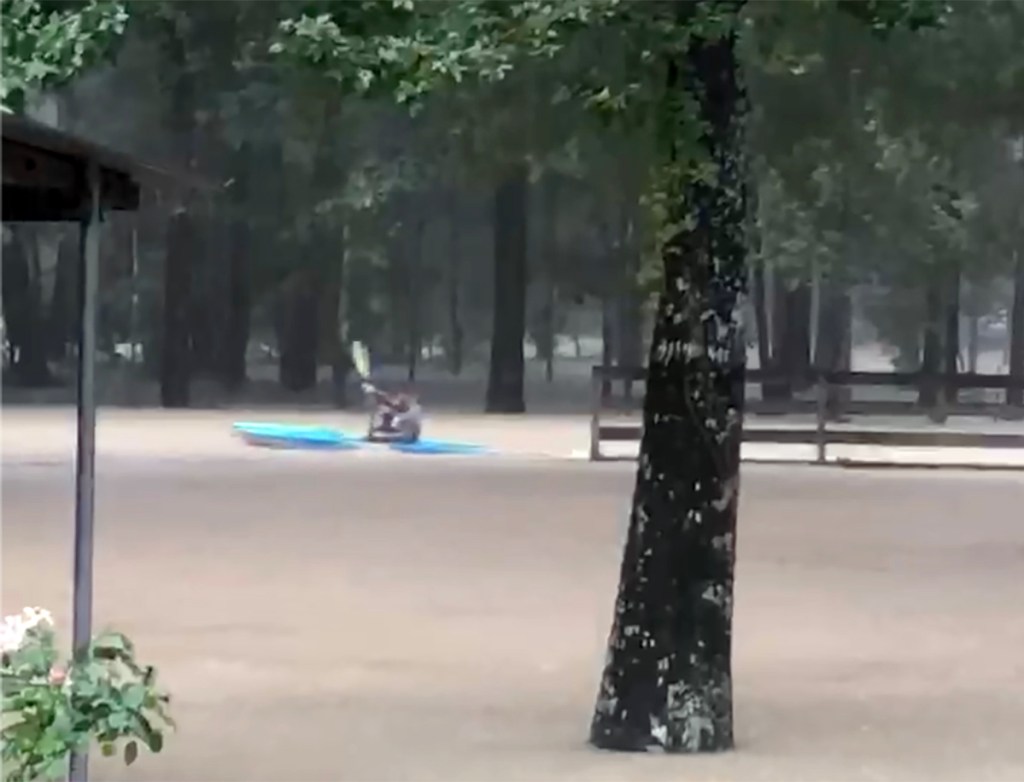
Two years later, Imelda came along. And it was worse! Much, much worse. Kids were kayaking out on the street. That’s how bad it was.

Kayaking down the street in front of Fain’s house during Imelda

Rehak: Wow.

Fain: Archie had made it to work that morning and I called him and asked, “Do I need to start getting blankets and comforters to put in front of the door? And he says, “Honey, it’s water. Nothing’s going to stop it. If it’s coming in, it’s coming in.” And that’s when it came right up to the top step. It was within inches of coming in the house.

Video of Tropical Storm Imelda in Magnolia Estates courtesy of Rosemary Fain

Rehak: Did it undermine the corner of your house?

Fain: It messed up more than that.

Rehak: Catalog the losses for me. You lost some machinery in your wood shop.

Fain: We lost the jumper pump in our well house. Our septic system flooded. We had damage to the pier and beam foundation under our kitchen and dining room, where the foundation later collapsed – between Christmas and New Years of 2020. We had no idea how bad it was.

Part of damage caused by delayed collapse of one corner of house after Imelda
Corner of the house in kitchen that bore the brunt of Imelda’s floodwaters.

The pier-and-beam foundation and kitchen floor have to be completely replaced, as well as the bottom kitchen cabinets. We lost the motor and the heater to the hot tub, and the hot tub footings shifted, causing the hot tub to crack. We lost the motor to the pool. Our chicken and pigeon coops had to be demolished.

The neighbors behind us lost their sheep pens, but there were no sheep there at the time.

Neighbors sheep pens destroyed by Imelda.

And there’s now black mold in the well house and the garage shop.

Black mold in well house.

And, you know, by law we can’t sell this place with the black mold issues. So, what do we do? 

We can’t afford to fix it and we can’t afford to move. This house is paid for. It’s our investment for retirement. But we can’t afford to fix what needs to be fixed and sell it.

Insurance doesn’t cover black mold. 

Who would have thought we’d need flood insurance this far from the river? We have it now. But we didn’t when the floods hit.

Poorly Drained Soils Now Much Worse

Rehak: What can you tell me about the soils around here? Were they a factor?

Fain: It’s all clay-based.

Rehak: How does it drain?

Savage: Not well. These properties, if there’s a lot of water, they’ll hold it a good while to where it should percolate down. But it doesn’t. It cannot go through clay. Harvey deposited a lot of silt. Since Harvey, it just seems like the ground is constantly saturated even during the summer. And, if you dig down two … two and a half feet, it gets really, really messy.

Clay-based soil throughout area drains poorly.

Rehak: When you first moved here, did you go up Plum Grove Road and explore?

Savage: You could tell that it was a low-lying area.

Rehak: A lot of palmettos up there? 

Savage: Yeah. 

Loss of Thousands of Acres of Forest, Wetlands with Colony Ridge

Fain: The first time I came out here, it was a very pleasant, beautiful little drive. I was really impressed with the canopy of the trees and this whole area. And I’m telling you, it just is such a shame what it’s come to. It was all woods and all trees, and now it’s just nothing but tore up roads and mud.

Rehak: How did the changes coincide with development of Colony Ridge? 

Fain: We never flooded before Colony Ridge. All the problems came after they started clearing trees. I remember all the logging trucks coming up and down Plum Grove Road. And then in 2017, Harvey hit and it was just horrendous. 

Rehak: Do you feel that if the development hadn’t happened you would have been safer?

Fain: Definitely. It was scary. I mean, I wish we had taken our little flat bottom boat and tied it to that tree.

Slow Recovery and Then More Disaster

Rehak: How has the recovery been? 

Fain: FEMA came out and they cut us a check for $357.

Rehak: $357!

Fain: And there is nothing available for Imelda. Project Recovery … I’ve called them twice, emailed them, and they haven’t responded at all. 

Rehak: Are you in the City of Houston?

Fain: No, this is New Caney. But we’re in Harris County. The Liberty County line is about a block east.

Rehak: Tell me more about the damage to the corner of your house?

Fain: We just didn’t know the extent of the damage under our house after Imelda. We were just thankful that it didn’t get in. Then all of a sudden the whole corner of the house collapsed more than a year after the storm.

One day between Christmas and New Years of 2020, I walked into the kitchen to get dog food and I saw the whole corner of the house had collapsed. I went, “Oh, my God, oh, my God, Archie! There’s something going on in the kitchen.” 

Close up of corner of the house that collapsed suddenly 15 months after Imelda.

We started pulling the flooring and floorboards away. I marked the wall and it’s gotten much worse since. We just had no idea what the extent of the damage was. 

And now it looks like the window has closed for any assistance. So we’re having to repair this essentially on our own. Insurance will cover some of it, but they’re not going to cover all of it.

Refrigerator resides in front entry hall until repairs to kitchen can be made.

Disabled and Trying to Recover With One Income

Rehak: You’re disabled now? 

Fain: Yes, I can’t work anymore.

Rehak: How has the COVID situation affected Archie’s job? 

Fain: He’s been lucky. They cut him back to forty hours. There’s no overtime, but he’s been very fortunate to keep his job through all this.

Rehak: He’s the sole breadwinner. That has to make doing all these repairs tougher.

Fain: Oh yeah! 

Rehak: Is there anything else around here, besides Colony Ridge, that may have affected flooding?

Fain: Not in our neighborhood. There are no new homes going in at all. It’s been built out for a long time.

Doesn’t Want to Move, But Can’t Afford to Fix

Rehak: If you could sell this house right now without taking too much of a loss on it, what would you do? Would you find another place in the country?

Fain: We’re so close to retirement, we don’t really want to move. But if we did, it would definitely be to a place in the country. And away from anywhere with a hurricane, tropical storm or any of that.

Rehak: Until you’ve gone through a few of them, it’s hard to imagine the destruction.

Fain: Well, I’ve been through two in five years now, Harvey and Imelda. I’d never been through one before.

Rehak: Did this place flood during Tropical Storm Allison?

Fain: No. Archie told me that he could see the trees leaning, leaning, leaning in front. And then he went to the back and he’d see them lean in the other direction. But it didn’t flood.

Rehak: What about during Ike?

Fain: Same thing. Wind, but no water near the house.

Advice to Others

Rehak: If you could tell the world one thing, what would it be?

Fain: If you see development going on around you or your neighborhood … get involved. Make sure they understand they’re being watched. If they don’t do things right with their drainage, it could ruin your neighborhood and ruin your home and ruin your life.

Posted by Bob Rehak on 1/17/2021 based on an Interview with Rosemary Fain and Archie Savage

1237 Days since Hurricane Harvey

Thousands of Acres in East Fork, Luce Bayou Watersheds to be Developed as Part of Kingland

Back in 2015, HHF and Land Advisors advertised 8,673 acres of timberland for sale that bracketed the State Highway 99 extension in Montgomery, Harris and Liberty Counties. They called the property “Kingland” and billed it as one of the largest undeveloped areas left in the Houston area – perfect for a masterplanned community.

Subsequently, CH B-Kingland LLC (the owner) sold 4,394 acres in Liberty County to Colony Ridge in 2016.

Colony Ridge has already started the process of clearing and developing most of their purchase, north and east of the new Grand Parkway (SH99). But ironically, Colony Ridge’s construction practices are sending rivers of mud down the once pristine river and bayous where Kingland could itself soon start developing also.

North of Lake Houston, South of Colony Ridge, Spanning 3 Counties

Here’s a 2017 map of the 4000+ acres remaining in Kingland after the partial sale to Colony Ridge.

From 2017 sales brochure by HHF and Land Advisors. Map shows remaining parts of Kingland not sold to Colony Ridge, the area to the north.

Here’s what the property looks like from the air in January.

From near the San Jacinto East Fork looking east. SH99 bisects property. Photo January 1, 2021
Reverse angle. Looking northwest across Kingland from where SH99 turns south. You can see part of Colony Ridge in the upper right.

Development Usually Follows Concrete

TXDoT says this section of the Grand Parkway should open sometime in the spring or summer of 2022. When it does, you can expect development in this area to accelerate rapidly.

Castle Hill Partners in Austin, the company that owns CH-B Kingland LLC, did not return phone calls re: its development plans. However, since tollway construction is moving from west to east, it would make sense to develop the western portions in Montgomery and Harris Counties before moving east into Liberty County.

Kingland’s 2017 sales brochure shows that almost half of the western section lies in Montgomery County along the San Jacinto East Fork. The remainder of the western section lies within Harris County. Both portions lie partially within the City of Houston’s Extra Territorial Jurisdiction.

Western section of Kingland shows a 41.3 acre detention pond, plus seven smaller ponds. But it’s unclear whether they will lie in the floodway or floodplain.

FEMA’s National Flood Hazard Layer Viewer shows the extent of the floodway and floodplains in that area.

Crosshatched area = floodway. Aqua = 100 year floodplain. Brown = 500 year.

Wetlands pockmark the entire area, too.

I interviewed a family in that small development south of Kingland property that straddles the Harris/Liberty County Line and discovered that they flooded from the East Fork during both Harvey and Imelda. They live more than 1.5 miles from the nearest mapped floodplain. However, that could soon change when the new post-Harvey flood maps are redrawn.

Anyone downstream on the East Fork or Luce needs to keep a close eye on this one. It has the potential to further alter the hydrology of the watershed.

Posted by Bob Rehak on 1/11/2021

1231 Days since Hurricane Harvey and 480 since Imelda

The thoughts expressed in this post represent opinions on matters of public concern and safety. They are protected by the First Amendment of the US Constitution and the Anti-SLAPP Statute of the Great State of Texas.

Flooding of the Fifth Kind: By Government Neglect

The National Weather Service distinguishes between four major types of flooding: coastal, riverine, street and sheet flow. After flying over Colony Ridge on New Year’s Day, I would add a fifth: flooding by government neglect.

Despite dire predictions for the New Year’s Eve storm, the Plum Grove/Colony Ridge area in Liberty County only got about two inches of rain. Yet I saw hundreds of flooded lots. They were all in a development that:

Those residents also live in a county that:

Worst of all, when residents asked for help from their elected Liberty County officials, those officials berated and rebuffed them. They refused even to acknowledge problems in Colony Ridge.

Where It Starts

Irregularities that most banks would catch as part of a title search and survey during the mortgage application process never get caught here.

That’s because the developer targets a vulnerable population more likely to use Western Union money orders than banks. He offers them owner financing with low down payments and interest rates five times higher than the market.

These un-savvy buyers are so desperate to own a piece of the American dream that they wind up mired in one nightmare after another. Many speak English as a second language if they speak it at all.

A Two-Inch Rain

Trade those SVUs in for swamp buggies. Here’s what much of the development looked like 24 hours after two inches of rain fell on New Year’s Eve.

Note how the drainage stops in the middle foreground. Also note how it’s not infiltrating like the engineers said it would.
Close up of home in first shot. At least the home didn’t flood although the four-wheeler and dining area did.
Even if an owner builds up one part of his/her lot, it can flood another.
Lot after lot flooded. Water would not sink in. The soils have a low rate of infiltration, not the high rate promised by LandPlan Engineering.
Totally flooded lot. Note how drainage stops to left of driveway.
Do-it-yourself repairs. But are they up to code?
Former wetlands?

Targeting the Vulnerable

Most of these people never complain. The areas in Mexico and Central America where many came from may have conditions far worse. So what you see here may be an improvement for them.

Still, one can’t wonder whether – in its zeal to grow – Liberty County has turned a blind eye to conditions that violate its own regulations as well as human dignity.

Are they turning the county into another Tegucigalpa for their developer buddy? And in doing so, are commissioners mortgaging the county’s future?

Conditions such as these will take generations to improve. In the meantime, the County’s residents are in for decades of pain due to government neglect. Not just in Colony Ridge, but in neighboring communities such as Plum Grove and others farther downstream.

This developer has permanently altered the hydrology of the watershed in a way that increases flood risk for everyone.

And the county has lowered its standards in a way that will likely discourage investment from quality developers.

Posted by Bob Rehak on 1/3/2021

1223 Days after Hurricane Harvey and 472 after Imelda

The thoughts expressed in this post represent opinions on matters of public concern and safety. They are protected by the First Amendment of the US Constitution and the Anti-SLAPP Statute of the Great State of Texas.