Flickinger Provides Updates On Gates, Dredging, Northpark, More

City of Houston District E Council Member Fred Flickinger addressed a group of local executives at the Kingwood Country Club this morning. He covered a wide range of topics, both in his talk and during Q&A. They included the status of five flood-related topics for the Lake Houston Area:

  • New Gates for the Lake Houston Dam
  • Seasonal Lake Lowering
  • Additional dredging in Lake Houston
  • Kingwood Diversion Ditch expansion
  • Last weekend’s flooding on Northpark Drive
Flickinger addressing the Kingwood Executive Group at the Kingwood Country Club on 4/24/24

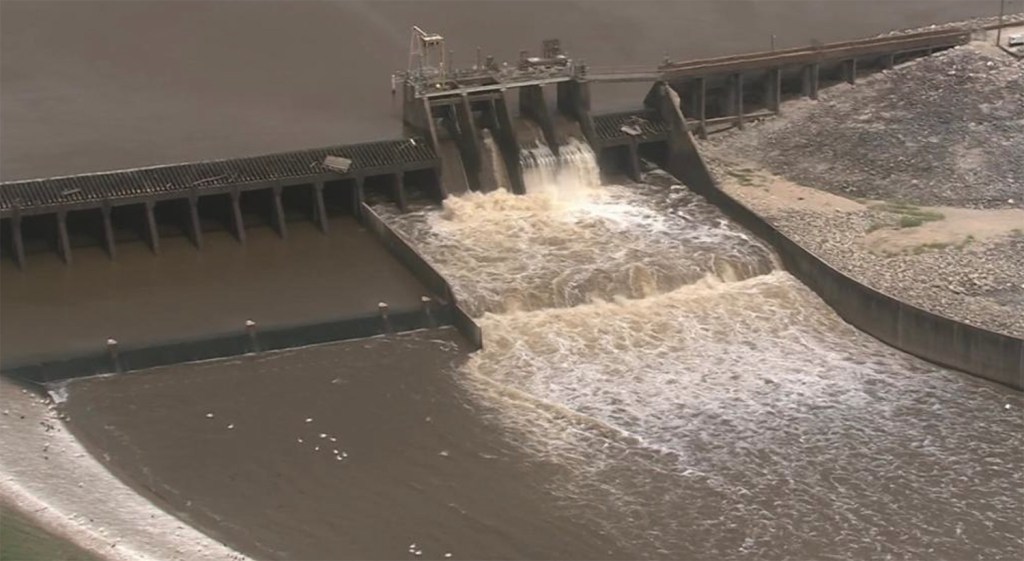
Floodgate Construction Could Start in ’25 or ’26

Within two sentences of standing up, Flickinger got straight to the subject of flooding and new, bigger floodgates for the Lake Houston Dam. He said, “Obviously, the big thing is getting additional gates. That is currently pending a FEMA review and approval.”

He continued, “We have about $150 million secured for those. Much of that has come via Rep. Dan Crenshaw’s office. Also the State, thanks to Representatives Dan Huberty and Charles Cunningham, and Dave Martin, my predecessor. Stephen Costello [the City’s Flood Czar] has also all done great work. They’ve all really done yeomen’s jobs getting money for the dam gates.”

Looking S. New gates will be built in the earthen portion of the dam to the left of the four small gates you see now.

“We’re looking at construction probably in late 2025 or sometime in 2026,” said Flickinger. “That’s obviously the biggest key to reducing flooding.”

Flickinger also said that he believes the current Mayor remains committed to the project.

Seasonal Lake Lowering

Regarding lowering Lakes Houston and Conroe, Flickinger said the City and SJRA have moved to an event-driven strategy rather than a seasonal one. Automatically lowering the level of Lake Conroe twice a year to reduce flood risk in the Lake Houston Area generated pushback from Lake Conroe residents.

For some time now, the politically divisive strategy has been replaced by an “as-needed” lake-lowering policy in one or both lakes depending on where and when rain falls.

However, the “as needed” policy requires precise forecasting. And several times lately, rain has shifted at the last minute. Ironically, that supports the need for bigger gates that release water faster. They can create extra storage in Lake Houston while still reducing the lead time needed, so forecasters can be absolutely certain of the need to lower the lake.

After all, that’s the drinking water supply for more than 2 million people. You don’t want to lower it needlessly if it won’t be refilled right away.

More Dredging on Tap

Flickinger next addressed the need for more dredging. He said that the City is currently removing another 800,000 yd³ of sediment between Kings Point and FM1960.

“Again, funding for that largely came from Rep. Dan Crenshaw’s office,” he said. “Some people in the government questioned whether that was Harvey-related sediment. But we got the funding! And dredging has started. So that’s a really good thing.”

Diversion Ditch/Walnut Lane Bridge

“The next issue with flooding,” said Flickinger, “is really the Kingwood Diversion Ditch.” The ditch cuts south from St. Martha’s Catholic Church to River Grove Park through the western portion of Kingwood.

“The Walnut Lane Bridge has about a fourth of the surface area below it that the Kingwood Drive and North Park Bridges have. Because of that, it works somewhat like a dam. Crenshaw just secured $4 million to address that, but we have got to have a cost/benefit ratio of one or greater, which will be a challenge. So, we’re working on that.”

Looking north along Diversion Ditch. Notice how it narrows under the Walnut Lane Bridge.

“And that money probably won’t become available for another six months. Hopefully, we can get that cost/benefit analysis to where we need it by then and use that money to rebuild the Walnut Lane Bridge. It’s a huge deal that affects Trailwood, Forest Cove, and even people who live along Bens Branch.”

“Part of the water from Ben’s branch is actually supposed to go to the lake via the Diversion Ditch,” said Flickinger. (That’s how the ditch got its name.) However, Flickinger noted that when the Diversion Ditch backs up, water goes down Bens Branch instead.

“And we’re getting more and more of that because of the development in Montgomery County…That’s part of why Kingwood High School flooded.”

Northpark Flooding

Last weekend, Northpark Drive flooded near the construction zone.

At the time, I conjectured that one or more of the drains may have been blocked. Flickinger revealed the cause this morning.

He said the drain was never tied into the new drainage system.

“It turns out that they had a change in foremen on the job, and one of the drains was not connected to the storm sewer.”

Houston City Council Member Fred Flickinger

“That is what caused that big fiasco. Now our office is going to contact the construction team every time we have a significant rain event and ask them to double check, so we don’t have any issues obstructing stormwater,” said Flickinger.

“Anytime you’ve got construction, there’s a certain amount of mess associated with it. But obviously, we don’t need somebody causing flooding by forgetting or blocking something.”

Looking E along Northpark on Sunday morning, 4/21/24 at area where drain was not tied in.

Before Flickinger had to leave for a meeting downtown, it became clear to everyone in the room that flooding was one of his primary concerns.

For someone who’s been in the job less than four months, he was very aware of the complex intricacies and interdependencies of the Lake Houston Area’s drainage problems. And that was very encouraging news!

Posted by Bob Rehak on 4/24/24

2430 Days since Hurricane Harvey

Harris County Changes Proposed Project Lists for HUD Funding

4/23/24 – In a transmittal to Harris County Commissioners Court today, Harris County Flood Control District (HCFCD) updated commissioners on how it hopes to spend $863 million in U.S. Department of Housing and Urban Development (HUD) funds.

Two projects in the Kingwood Area remain funding priorities: Taylor Gully Channel Improvements and Woodridge Village Stormwater Detention. However, the stormwater detention, currently listed as an alternate backup project, is being split up into two smaller projects to help improve funding chances for the most critical component. See more details below.

Ins and Outs of Funding

The HUD money comes in two “buckets” with different requirements – Disaster Relief ($322 million) and Mitigation ($541 million). Both buckets fall under HUD’s Community Development Block Grant Program (CDBG). CDBG’s flexibility lets people and communities design and implement strategies tailored to their own needs and priorities.

When I last reported on the CDBG lists, the Lake Houston Area had one project in each bucket.

  • In Disaster Relief, the Woodridge Village Stormwater Detention Basin was “below the line.” That means it was an alternate on the backup list; a primary project would have had to have been canceled for it to receive funding.
  • In Mitigation, Taylor Gully Improvements were above the line, i.e., primary recommendations.
Extent of Woodridge excavation when paused before applying to HUD

Changes Outlined in Transmittal

The latest updated project lists feature five main changes. They affect both Lake Houston Area projects. But first, let me explain the others that are changing, because their financial impact affects everything else.

HCFCD:

  • Deleted the Riggs Road Stormwater Detention Basin (Part 2) from the recommended DR list, saving $6.5 million.
  • Transferred the Boudreaux Basin (Phase 1) from the DR list to Mitigation, so that it could benefit from the longer timeline for Mitigation projects. This project is between Willow Creek and SH99 at Huffsmith Kohrville Road. The transfer will free up another $38.6 million on the DR list.
  • Moved an East TC Jester Stormwater Detention Basin from the mitigation list to the DR list. This put $23.8 million back on the DR list.
  • Removed the Mercer Stormwater Detention Basin from the mitigation list without transferring it to DR.

Thus, you would think approximately $21.3 million was freed up on the DR list. That would theoretically let the Woodridge Stormwater Detention Basin move up from “below the funding line.” However, it remains below…at least for now.

Moreover the Woodridge Stormwater Detention Basin has morphed into two projects. One provides the detention required to help mitigate Taylor Gully now. The other provides an extra safety margin as a hedge against future developments.

Splitting the detention up into two smaller pieces gives HCFCD more flexibility and greater confidence that the most important part will get funded.

The Woodridge/Taylor Gully discussion in the document is a bit confusing unless you speak HUD.

Amy Crouser, an HCFCD spokesperson provided this translation. Regarding the two DR detention projects, she said that the detention basin which HCFCD already began excavating (and which they paused in November 2023) remains the top priority.

“The second basin will provide additional regional stormwater detention. Splitting the project helps us ensure the compartment of the Woodridge basin that mitigates Taylor Gully can move forward,” said Crouser.

She concluded, “The ultimate goal is to eventually construct both compartments. This follows our traditional rationale for phasing projects when possible and practicable. Both compartments will be advanced to bid-ready state using local dollars. That will give us the maximum flexibility to advance the projects.” 

For More Information

This HCFCD document titled CDBG Program Financial Planning & Performance Management, lays out all the costs, restrictions, deadlines and accountabilities related to all the projects on each list.

Posted by Bob Rehak on 4/23/24

2429 Days since Hurricane Harvey

Latest Spending Trends: Flood-Mitigation Quarterly Update

Numbers for Harris County Flood Control District’s (HCFCD) first quarter are in. They show several spending trends.

Spending Decline Continues

They show that the pace of overall flood-mitigation spending continues to decline, though there are signs that it could turn around soon – depending on your basis of comparison.

Year over year, the totals show a pronounced decline. Annualized first-quarter spending is now less half of what it was at the post-Harvey peak in 2020.

All data for this and other graphs in this post was compiled from HCFCD spreadsheets in response to a FOIA request.

To underscore that trend, spending declined from $74 million to $51 million between the last quarter of 2023 and the first quarter of 2024 – a 31% decrease in one quarter. So I checked for seasonality.

Spending often drops between the fourth and first quarters, but it’s not consistent.

From the 7-year chart above, you can see that spending dropped five times after the holidays and increased two.

However, change the basis of comparison and you can see an encouraging sign. If you compare the first quarter of 2023 with the first quarter of 2024, the spending is up by 20% – from about $41 million to $51 million.

Where the Money Goes by Watershed

Harris County has 23 watersheds. The chart below shows the total of HCFCD spending in each since Hurricane Harvey. Variation between Brays on the high end and Galveston Bay on the low is more than 100 to 1.

From data supplied by HCFCD in response to FOIA request

Comparing the graphs above and below shows where the action shifted in Q1. Notice that Brays shifts from first to eighth place. White Oak moves from fourth to first. And Halls jumped from ninth to third.

To learn more about specific projects in each of these watersheds, click on a watershed’s link on HCFCD’s home page.

What Drives Investments in Some Watersheds and Not in Others

To a large extent: damage and political priorities. I compiled the chart below from Harris County Federal Reports. One of the first things you notice is that Brays is on the left and Galveston Bay is toward the right.

Data compiled from HCFCD Federal Reports

The next two charts show how prioritizing projects in low-to-moderate income (LMI) areas can skew spending in different watersheds. The first shows LMI funding since Harvey. The second shows LMI funding in the first quarter of 2024. Comparing them, you can see how higher and higher percentages of the total are going to watersheds with a majority of LMI residents.

In the longer run, about half the money has gone to watersheds with a majority LMI population. But currently, about two-thirds goes to LMI-majority watersheds.

Keep in mind that although you see two categories in these pie charts, the categories are not equal. The blue area contains eight watersheds and the orange area 15 – almost twice as many. Said another way…

Half as many watersheds now get twice as much money.

The eight LMI watersheds include: Brays, Greens, White Oak, Halls, Sims, Hunting, Vince, and Goose Creek/Spring Gully.

The government defines LMI as “below the average income for the region.” In the other 15 areas, a majority of residents make “above the average income for the region.”

Harris County uses an Equity Prioritization Formula to select projects it will fund. The formula places a premium the percentage of low-to-moderate income individuals who live in an area. The theory: low-income families are less able to repair their homes after a flood.

Other Variables Skew Funding

The deeper you dig into these numbers, the more you can see other variables that skew funding, too.

  • Dense building next to bayous can increase cost of land for mitigation projects by making buyouts necessary to widen channels or build stormwater detention basins.
  • Previous mitigation spending – Some watersheds received extensive mitigation before Harvey.
  • Spending by others, i.e., the Army Corps, which is not reflected here
  • Timing of studies – Some studies that would justify grants haven’t even been completed yet, whereas others completed before Harvey were shovel ready when the flood bond came along.
  • Land acquisition and construction represent the two largest component costs of flood mitigation. Some large projects haven’t reached those stages yet.
  • Building code variations – Newer codes generally stipulate safer standards, reducing flood risk and damage in newer areas at no cost to the public.
  • Frontier Program – The county sometimes acquires land in developing areas to prevent future flood damage. Prevention is always cheaper than correction, but that land can be expensive.
  • Speed of partnership funding – Just last week, Harris County, the City of Houston and GLO reached an agreement related to $322 million in Harvey Disaster Relief Funds. That will make more money available to watersheds that were heavily damaged during Harvey.
  • Protection of employment centers, such as the Medical Center, Downtown, the Ship Channel, etc.

Someday soon, I hope to do a series of posts on projects within each watershed and the specifics of why they were funded.

The San Jacinto Gap

For now, let me discuss just one. The San Jacinto is Harris County’s largest watershed. It had the highest flooding in the County during Harvey. It also had a quarter of all the flood-related deaths during Harvey.

The San Jacinto had the eighth most damage, but ranks 13th in funding since Harvey. Of the twelve watersheds that received more funding, five had less damage. 

  • Cypress Creek has received more than 4X the San Jacinto. 
  • Little Cypress has received 3X more.
  • Addicks has received 2.5X more.
  • Clear Creek and Willow Creek have each received approximately 50% more.

And most of those watersheds have more affluent populations than the San Jacinto. So how do you account for the gap between severity of flooding and flood-mitigation funding?

For one thing, most of the San Jacinto watershed lies outside of Harris County. And some commissioners have flat out rejected spending money to build projects outside the county even though the 2018 flood bond permitted it.

Protecting areas like Humble, Atascocita and Kingwood will most likely require building upstream projects outside the county. Until the political winds change, funding for such projects will most likely have to come from the state or federal government.

Posted by Bob Rehak on April 22, 2024

2428 Days since Hurricane Harvey

Northpark Flooded at Russell Palmer

Saturday night, Northpark flooded at the intersection of Russell Palmer and it remained flooded this morning.

On Saturday, 4/21/24 at 4:46 PM, Harris County Meteorologist Jeff Lindner communicated a flash flood advisory. He also warned of street flooding. And it happened. But the amount of rain at this location should not have caused flooding that lasted more than 12 hours.

1.72 Inches of Rain in About 12 Hours

According to the Harris County Flood Control Gage at the San Jacinto West Fork and US59, the western Kingwood area received 1.72 inches last night and this morning. The peak was 1.12 inches between 5 and 6 PM on Saturday, just minutes after Lindner’s warning.

Rainfall 4.20.24 to 4.21.24

Most streets handled the volume with only temporary ponding near storm drain inlets. But Northpark flooded near the construction zone at Russell Palmer Road. Saturday night, police had barricaded the westbound lanes.

Photo Courtesy of Eric Hayes, taken Saturday night after the 1.12 inches in an hour.

Looking West At Intersection Sunday Morning

As of this morning at 9 AM, Northpark remained flooded and police had erected barricades. But cars were running around them and plowing through water over their bumpers.

Looking W along Northpark at Russell Palmer intersection, Sunday, 4/21/24 at 9AM.

What happened?

Closer shot looking E shows depth of water where cars snaked around barriers.

Motorists, especially young ones, should know that if water gets over a car’s tailpipe, it will cause the engine to stall. And it could lead to expensive repairs.

Looking W again at vehicles evading barricades

Why Northpark Flooded

It’s not unusual for water to collect like this during intense storms. But it is unusual for it to stand like this for 15 hours.

Water in the Diversion Ditch and Bens Branch was slightly elevated this morning, but not very high. And there was barely a trickle of water entering the Diversion Ditch from the new Northpark culvert. That makes me suspect a drain was blocked somewhere.

Looking E at extent of culvert placement.

Before arriving at the scene this morning, I feared that the blockage might have been farther west. I saw contractors working on a junction box Friday afternoon about a hundred yards west of where Northpark flooded.

However, it appears that water in the ditch was flowing into the culvert.

Looking E. Water flowing through area where contractors were installing junction box.

So I suspect the trouble may be at the intersection itself. I reviewed the pictures I took Friday afternoon before the rain. It shows that the intersection is serviced by at least three drains.

Location of three drains circled in red at flooded intersection. Photo taken before rain.

This seems like a logical place to start looking for an explanation as to why Northpark flooded. This was the first test for the new drainage at this intersection. I’m sure Lake Houston Redevelopment Authority (LHRA) and its contractors will be out there soon diagnosing the problem. In the meantime, take alternate routes out of Kingwood.

This whole intersection will eventually be raised to the height of the manhole cover in the very first photo above. That should eliminate Northpark flooding problems at this location. But that will also take some time.

I will let you know what the contractors and LHRA find.

For More Information

For more information about Northpark expansion, visit the project pages of the LHRA/Tirz 10 website. Or see these posts on ReduceFlooding:

Posted by Bob Rehak on Sunday, 4/21/24 at noon

2427 Days since Hurricane Harvey

Entergy Makes Some Northpark Progress, but Significant Issues Remain

Entergy has made more progress on the Northpark Drive expansion project in the last two weeks than in the previous four years. But despite what you see in the photos below, significant issues remain to clear the way for the first all-weather evacuation route from Kingwood.

Some Progress, But…

Last week, Entergy, a $4 billion company in Texas, erected nine new power poles outside of the City’s right of way. This week, their contractor, Primoris Services, started the process of stringing wire. That’s good news. Really!

But unseen obstacles could still delay the project significantly. For instance:

  • Who will pay for moving Entergy’s ground-mounted transformer and associated power lines near the Exxon Station at US59? Entergy reportedly still wants the Lake Houston Redevelopment Authority (LHRA) to pay for upgrading and moving the transformer and buried cables. LHRA insists that’s an illegal ask because it would constitute a gift of public funds.
  • More power poles remain near Loop 494 that will be difficult to move because of conflicts with new storm drains.
  • Entergy must tunnel under rail tracks.
  • Entergy reportedly still refuses to commit to completion dates for moving its equipment.

Will Entergy Beat Union Pacific?

If Entergy does not resolve issues near the railroad tracks before Union Pacific crews arrive to install new signals and improve the road bed, the project could be delayed years.

Union Pacific reportedly has two crews that rotate through 27 states handling such issues. If we miss them this year, the Northpark project goes to the back of a very long line, according to Ralph De Leon, Northpark project manager for LHRA.

Entergy has already blown a City deadline to move its equipment by March 8. So they have already missed a 30-day deadline by 42 days. But according De Leon, Entergy still refuses to commit to any completion dates.

Ray of Hope

According to Houston Public Works (HPW), Entergy has assigned a new project manager and team to the project. This could be a sign of good things to come.

HPW Senior Division Manager Patrick Nguyen says the City is working with Entergy to resolve easement issues that could result in construction delays and cost escalation. Mayor John Whitmire, who is committed to seeing the project through, has reportedly asked Nguyen to act as an arbitrator.

In an email received today, Nguyen said that “Entergy has assigned a new project manager along with a team to the project.” While diplomatically expressing hope, he did not elaborate further.

Progress Last Week

All nine poles erected last week had pulleys and rope or cables threaded through them when I took these photos today. According to one expert I talked to, crews will use the rope or cables to “pull wire.”

Close up (top left) of cables/ropes and pulleys that will be used to pull new electrical wires from pole to pole.

Compare old and new poles in lower left. Once wire is pulled to a pole, it will be attached to the tip of the insulator.

Moving the poles farther from the street will create room for a six lane bridge plus two turn lanes on each side of the bridge (to meet TXDoT requirements).

LHRA first notified Entergy to move its equipment in 2020. Entergy still won’t commit to a completion date.

The mess at 494

Other Northpark News

Contractors are smoothing out the dirt placed over the culverts between the Kingwood Diversion Ditch and Russell Palmer Road.

Looking west toward Kingwood Diversion Ditch from over Russell Palmer Road

Northpark will expand inwards. Contractors will pour two lanes of concrete in the dirt-covered area above. If I read the schedule correctly, paving in the area above could start within the next two weeks.

West of Russell Palmer (below), contractors buried almost another hundred yards of 6’x8′ culvert last week. Weather permitting, and if they can keep up that same rate of progress, they should be to the railroad tracks in another three months or so.

Looking west along Northpark. Last week, culvert crews were barely past the Shipleys Donut sign the lower right.

However, the culvert will not go all the way to the tracks down the median. As it approaches the point where the bridge starts to rise, it will veer to the right and go under the turn lanes where Entergy is moving back its poles.

For More Information

For more information about Northpark expansion, visit the project pages of the LHRA/Tirz 10 website. Or see these posts on ReduceFlooding:

Posted by Bob Rehak on 4/19/24

2425 Days since Hurricane Harvey

The thoughts expressed in this post represent opinions on matters of public concern and safety. They are protected by the First Amendment of the US Constitution and the Anti-SLAPP Statute of the Great State of Texas.

Flood Digest: Flooding, Planning and More

Below is a digest of seven flood-related items in the news lately.

Dubai Floods 

On April 18, 2024, Dubai in the United Arab Emirates saw the heaviest flooding in 75 years. That’s as far back as their records go. Dubai began data collection efforts in 1949. The floods followed several cloud-seeding flights. They probably did not cause the heavy rain, but many believe they contributed to it. Highways, the airport and large parts of the city were under water.

“By the end of Tuesday, more than 142 millimeters (5.59 inches) of rainfall had soaked Dubai over 24 hours. An average year sees 94.7 millimeters (3.73 inches) of rain at Dubai International Airport,” said the AP. Wave after wave of thunderstorms from a strong low-pressure system triggered heavy rains in neighboring Oman that killed 19 people.

Sally Geiss, a former Kingwood resident, sent me a link to a dramatic collection of videos of the flooding on NotTheBee.com.

Regional Flood Planning Group Recommendations

The Texas Water Development Board (TWDB) has approved amendments to the first-ever regional flood plans. They recommend additional solutions to reduce the risk and impact of flooding across the state. The amendments bring the total estimated cost of flood-risk-reduction solutions for all 15 planning regions to more than $54 billion.

Significantly, 30 of the flood-mitigation projects could provide water-supply solutions if implemented.

All of the flood-risk-reduction solutions recommended in the amended regional flood plans should be included in the 2024 State Flood Plan. That will make them eligible for funding through the State’s Flood Infrastructure Fund.

San Jacinto Regional Flood Planning Group 

The San Jacinto Regional Flood Planning Group – Region 6 is currently underway to solicit a technical consultant for the second planning cycle. 

Harris County will advertise a request for qualifications (RFQ) within the coming weeks. The RFQ selection and process will follow standard Harris County procurement procedures.

Interested? The flood planning group provided this link to monitor opportunities:
https://purchasing.harriscountytx.gov/Services/Online-Solicitation-Opportunities

Harris County Purchasing

County Judge Lina Hidalgo held a press conference last week in which she blasted Harris County purchasing procedures. She wants to change them. According to Hidalgo, RFQs for Flood Control, Engineering and the Toll Road Authority are approved without bidding or documentation.

In virtually all cases, Purchasing rubber stamps the recommendations of Commissioners, according to Hidalgo. And she says that 93% of those approved contributed heavily to commissioners.

Here’s a link to her press conference video.

Lina Hidalgo Press Conference on Purchasing

She starts about 15-20 minutes into the video, and there’s a Spanish translation at the end. So it’s not as long as it looks.

Hidalgo based her allegations on a series of audit reports of the purchasing department, which were previously publicized by the Houston Chronicle.

Hidalgo never mentioned her own legal troubles re: the Elevate Strategies contract.

Kingwood Open House

Harris County Precinct 3 Commissioner Tom Ramsey’s office is hosting a Kingwood Open House on Thursday, April 25, 2024 between 6:30 and 8 PM at the Kingwood High School, 2701 Kingwood Drive.

The focus will be on infrastructure improvements and include representatives from Precinct 3, City of Houston, San Jacinto River Authority, and Harris County Flood Control District.

The Woodlands MUD Elections 

In Texas, Municipal Utility Districts (MUDs) have the legal authority to partner with other governmental agencies such as the Texas Water Development Board and Harris County Flood Control District for flood-mitigation projects.

Early voting for The Woodlands Municipal Utility District directors begins on April 22 at the Shenandoah Municipal Complex.

In preparation, The Woodlands Township Future Group will sponsor an informative talk by Robert Leilich, Director of the Board of The Woodlands MUD #1 and Erich M Peterson, PE, General Manager of the Woodlands Water Agency. 

Their topic: “All You wanted to Know about Municipal Utility Districts.”

Date: Monday, April 22, 2024

Time: 7 pm to 8 pm

Please copy the link below and paste in a browser to join the presentation via Zoom:

https://us06web.zoom.us/j/82866382552?pwd=IB2JnUwSD96Tq68oZLygYaNPRTbWT4.1

 Passcode: 346862

The discussion of Municipal Utility Districts will cover:

What is a MUD?

  • What services do MUDs provide The Woodlands?
  • Who determines and directs the activities of a MUD?
  • What is The Woodlands Water Agency (also known as WoodlandsWater) and what is its relationship to MUDs in The Woodlands?

Emergency Habitability Repairs

The City of Houston Planning Department publishes a weekly Permit Activity Report. I usually scan it for development projects in the Lake Houston Area. But in the last few weeks, I have noticed something else that’s highly interesting.

There’s an extremely high correlation between “emergency habitability repairs” and proximity to drainage ditches and bayous with a reputation for flooding, such as Greens Bayou.

In one of the previous reports, I found that 90% of the emergency repairs happened in apartment complexes right on the banks of Greens or within a block of it. 

This should underscore the risk of living close to waterways. Even though the permit applications may not have immediately followed a flood, they may have resulted from problems, such as mold that build up after floods. 

I intend to follow this trend and report more when I have more data.

Posted by Bob Rehak on 4/18/24

2424 Days since Hurricane Harvey

GLO Announces HUD Disaster Relief Deadline Extension

4/17/24 – While addressing Houston City Council this morning, Texas General Land Office (GLO) Commissioner Dawn Buckingham announced that the U.S. Department of Housing and Urban Development (HUD) has given the City and Harris County a two-year extension on the use of Harvey Disaster Relief funds.

Without this extension, the City of Houston and Harris County would have had until February 2025 to spend these funds. This extension means Harris County communities and communities in another 48 Harvey impacted counties will have an opportunity for more time to finish projects. 

GLO Commissioner Dawn Buckingham (purple dress) surrounded by Houston City Council and Mayor John Whitmire.

The GLO administers all HUD funds within the State of Texas.

Extension Needed to Complete Projects

The extension became necessary because time is running out to use the funds allocated by HUD several years ago. The delays were caused in part by distrust.

Under a previous mayor, Houston repeatedly failed to meet deadlines for the expenditure of funds. Eventually, GLO had to take over administration of several City programs. And a HUD investigation found irregularities in City programs.

The City and Harris County were also late in submitting project lists to the GLO. Twenty-two months after learning they would receive hundreds of millions of dollars, the two entities still hadn’t submitted project lists to use the money.

By the time Houston and Harris County submitted project lists, time was running short and fear of HUD clawbacks set in.

Today’s announcement means that $322 million worth of projects can move forward with a high degree of confidence that they will be successfully completed and reimbursed.

The announcement affects HUD Disaster Relief funds, which had the tightest deadlines. HUD Mitigation funds have more time.

The Mayor and several City Council Members including Twila Carter (an at-large member who lives in Kingwood) talked about “hitting the relationship reset button” in a positive way. The smiles and positive comments lasted 45 minutes. The sense of relief was palpable.

Mayor John Whitmire, who previously worked with Commissioner Buckingham in the Texas Senate, emphasized the importance of trust. He said that people were “hungry to see government working again.”

Harris County Precinct 3 Commissioner Tom Ramsey, helped stabilize strained Harris County relations with the GLO and attended the meeting.

Need to Find Displaced Families

The Council discussion also included several other topics including the high cost of insurance and affordable housing. Commissioner Buckingham emphasized that she herself lived below the poverty line while growing up “until the age of 35.”

Buckingham also announced the launch of a collaborative outreach effort to seek out Houstonians who were displaced under former Mayor Turner’s tenure and not offered relocation assistance.

Approximately 900 families at four apartment complexes that received HUD disaster relief funding should have been offered money to move. But they were not.

Now, it’s hard to find those displaced families. Buckingham and Whitmire announced a collaborative effort with community groups to help find those people. Once found, they can apply for the assistance they deserved, but didn’t get.

“We will use many resources to find these Houstonians, including outreach through schools, churches, and faith organizations, Houston Public Works, food banks, and community organizations,” said Commissioner Buckingham.

The four apartment complexes include:

Monticello Square Apartments
5312 Clarewood Drive, Houston 77081
Buyout date: August 24, 2021

Spring Village Apartments
11810 Chimney Rock Road, Houston 77035
Buyout date: June 2, 2021

Biscayne at City View
17030 & 17050 Imperial Valley Drive, Houston 77060
Buyout date: Nov. 17, 2021

Appian Way Apartments
3200 N. MacGregor Way, Houston 77004
Buyout date: May 5, 2021

Affected residents of these apartment complexes should visit recovery.texas.gov/URAHouston for information on eligibility for assistance. Or they can contact the URA Assistance Program at:

19219 Katy Freeway, Suite 100, Houston, Texas 77094
Telephone: 281-925-7155 or 1-844-893-8937 (toll free)
Fax: 832-582-2580
Email: cdr@recovery.texas.gov

Posted by Bob Rehak on 4/17/2024

2423 Days since Hurricane Harvey

Royal Pines Construction Begins

Royal Pines, a new, 150-acre development in Porter at the north end of West Lake Houston Parkway (WLHP) is mobilizing for construction. The developer began clearing and grading the site in April 2022. By September 2022, they finished. And by October 2022, they were flooding neighbors.

For the past 18 months, they’ve been working on building two detention basins to help solve the flooding problems as they finalized their drainage and construction plans. They recently received Montgomery County permits and are now mobilizing for construction.

In response to a FOIA Request, Montgomery County supplied the drainage impact analysis and construction plans today. But they are far too large to post here. They include 314 pages of technical drawings. And they total almost 400 megabytes. So I will provide a brief summary now and provide more detail after I dig deeper.

Two Phases, Three Sections in First

According to the drainage impact analysis, construction will take place in two phases.

The developer, Starlight Homes Texas, LLC, owns land in the floodplain and floodway of White Oak Creek. Approximately 40 acres – almost a third of the site – will be used for recreation and green space, but not homes.

The first phase of construction will have three sections clustered near the current northern terminus of WLHP. WHLP will later be extended farther north. Plans for Phase II have not yet been completed or approved.

Purple Area will be developed in Phase I and have three sections. Red area will be Phase II.

Altogether, the development will have 448 homes. About two thirds will be on 40′ wide x 125′ long, 1/8th acre lots. The rest will be 10 feet longer.

Drainage Impact Analysis Claims No Adverse Impacts

The drainage impact analysis was based on 2018 Lidar data and NOAA’s Atlas-14 rainfall probability statistics. Both are current.

Part of the site used to drain toward WLHP. But the drainage was altered during grading. Now, all but 2.5 acres flows to the two detention basins and White Oak Creek.

Western stormwater detention basin. Property in background flooded several times before basin was built.
Eastern stormwater detention basin does not quite follow schematic layout. It sits where White Oak Creek cut across property during a 5-year rain.

The drainage impact analysis provides a summary for how the detention basins will perform in 25- and 100-year storms. In either event and in either direction (White Oak or WLHP), the claimed post-development runoff is less than the pre-development. See table below.

From Page 15 of Drainage Impact Study by DE Corp., 10/9/23.

The drainage impact analysis makes a great deal about how the total discharge beats requirements by such a large margin. However, keep in mind that the analysis does not yet include runoff from Phase II.

The engineer, Amy Dziuk, makes a point that the surplus capacity will be used later for Phase II. She claims that Phase I will “not cause adverse impacts to the receiving waterways or surrounding areas.”

Photos of Equipment and Materials Being Staged

I took these photos on 4/15/24. Concrete and HDPE pipe as well as heavy equipment are scattered throughout Phase I of the site. See below.

Looking south toward Country Colony at equipment and materials being pre-positioned.
Green pipe is usually used for sewage or drain lines. Blue carries water.
Section 3, Phase I west of Country Colony

I also saw men cleaning the entrance to the site and repairing silt fence.

Looking S at north end of WLHP from entrance to Royal Pines

Perhaps the attention to housekeeping in the photo above will be a good omen. Let’s hope they keep it up.

Posted by Bob Rehak on 4/16/2024

2422 Days since Hurricane Harvey

The thoughts expressed in this post represent opinions on matters of public concern and safety. They are protected by the First Amendment of the US Constitution and the Anti-SLAPP Statute of the Great State of Texas.

Northpark Culvert Installation Resumes

Northpark culvert installation resumed in a major way last week.

For several months, utility conflicts stalled installation of the 6’x8′ box culverts down the center of Northpark Drive. During preparation of the center ditch, contractors found gas lines buried at insufficient depth.

With those conflicts now resolved, according to Project Manager Ralph De Leon, installation of the box culverts can now resume. When contractors complete the culverts, dirt will be placed on top of them, and then two lanes of pavement on top of the dirt. The result will be a Northpark Drive that expands inward instead of outward. It will create three lanes in each direction…that should not flood like the thoroughfare currently does.

The expansion project has two primary goals:

  • Get more people in and out of Kingwood faster…
  • …in all weather conditions, even when other thoroughfares are cut off by flooding.

During Hurricane Harvey, West Lake Houston Parkway, Hamblen, Kingwood Drive, and parts of Mills Branch Road were all blocked by rising floodwaters.

Pictures of Installation Progress as of 4/15/24

Since my last post on 4/8/24, contractors completed installation of the culvert at Parkwood Baptist Church and are working their way west past Russell Palmer Road. Today, they were working in front of Shipley’s Donuts.

Looking E. Northpark culvert installation west of Russell Palmer Road near top of frame.
Looking E at Northpark culvert installation. Heavy equipment lifting massive section of culvert to place in hole.
Once men finish prepping the hole in the background…
…step and repeat for almost another mile to 494.

In Other Northpark News

Entergy managed to install five more power poles in the last week. That brings their total to nine in four years.

The new power poles sit back farther from the street. That will create room for four more lanes of traffic adjacent to the bridge that will go over the railroad tracks at 494. The four include two inbound turn lanes and two outbound turn lanes to/from 494.

Project managers first notified Entergy of the need to move the poles in 2020. Construction experts tell me the project could have easily been completed by now.

Not much new has happened at the entry ponds at 59. Heavy rains a week ago have the bottoms covered with water.

Looking west at area that will become the North Pond. Parts of new turn lanes are already being used, reducing traffic congestion somewhat.
Looking SW at South Pond
More culvert awaiting installation which will carry excess stormwater between ponds and Ditch One.

See the route below. It will go behind the businesses on the north side of Northpark until reaching the Kingwood Diversion Ditch and Bens Branch.

Northpark Drive drainage improvements

That pretty much does it for visible progress during the last week.

For More Information

For more information about Northpark expansion, visit the project pages of the LHRA/Tirz 10 website. Or see these posts on ReduceFlooding:

Posted by Bob Rehak on 4/15/24

2421 Days since Hurricane Harvey

The thoughts expressed in this post represent opinions on matters of public concern and safety. They are protected by the First Amendment of the US Constitution and the Anti-SLAPP Statute of the Great State of Texas.

Why Flood Risk Increases During Construction

Pictures taken of a new Huffman development after a 3.75-inch, 2-year rain last week illustrate why flood risk increases during construction compared to other phases of a project.

Aerial images taken over Sila, west of the Huffman-Cleveland Road, show:

  • Cleared land that accelerates runoff and decreases infiltration
  • Partially constructed stormwater detention basins
  • Trenches not yet consistently sloped
  • Rampant erosion
  • Workers pumping water out of one flooded area under construction only to flood another

Friendswood took more precautions with the 553-acre Sila than most developers take with their projects.

Regardless, despite their best intentions, a 2-year rain still overwhelmed them in places. Let’s look at examples of each point above.

Accelerating Runoff, Decreasing Infiltration

Natural ground cover slows the rate of runoff. Removing the ground cover lets stormwater flow faster.

Contractors also grade the land to create consistent slopes for roads and storms drains. That can eliminate little ponds, pockets of wetlands, and other natural catchments that slow water down.

Construction clearing for Sila in Huffman
First phase of Friendswood’s Sila Development in Huffman. Looking east toward St. Tropez at top of frame across Huffman-Cleveland Road.

I took these pictures just hours after the rain stopped. Notice how fast the runoff accumulated, even without storm drains.

Reverse angle looking west. Note water rapidly collecting and running off cleared area compared to forested area.

Partially Constructed Mitigation Facilities

Stormwater detention basins collect accumulated runoff and later release it at slower pre-development rates. Thus post-development runoff rates equal pre-development rates. At least if everything is done correctly.

But what happens when a large rain slams you before you complete the detention basins?

Partially completed Sila detention basin.

Trenches Not Yet Consistently Sloped

During work in progress, like this, trenches may not be consistently sloped. In the picture below, water flowed downhill from left to right. A swale caught most of the runoff. And a silt fence backstopped it. Regardless…

Because the swale was not consistently sloped toward the top of the frame, stormwater overflowed onto a neighbor’s property.

Rampant Erosion

Backslope interceptor systems that reduce erosion on the sides of ditches and basins have not yet been built here. Neither has grass been planted on the side slopes of those ditches and basins. The result: rampant erosion that can clog ditches and streams, and reduce the capacity of basins.

Note silt in stormwater detention basin.

Workers Saving One Area Only to Endanger Another

The first three shots below show the partially completed detention basin and workers scrambling to expel the rapidly accumulating runoff.

Workers pump water out of the pond into a ditch.
Note the pumps washing dirt into the ditch.

From there, water raced downslope toward the East Fork of the San Jacinto.

But the high flow from the pumped water found a way around one set of rock gabions and destroyed another.

That turned the outfall for a neighboring ditch (right of greenish pond above) into a mass of muck. From there, the muck flowed toward the river.

Muck moves toward East Fork San Jacinto beyond top of frame.

Could Have Been Worse

I didn’t see any homes that flooded on this day. Muck did flow into a few yards and across roads. And the outfall to a neighborhood drainage ditch, which was just cleaned out, will have to be cleaned out again.

But no doubt, it could have been much worse. See below.

Contractors created a slight depression to keep water from rushing downhill into neighboring homes (top of frame).

It’s also worth noting that runoff from Sila must go through more than a half mile of forested wetlands before reaching the East Fork. That will slow the water down, capture some of the erosion before it reaches the river, and keep the sediment from reducing the conveyance of the river channel.

Construction always entails flood risk, especially large scale construction that can take years. But with the right precautions, large rains don’t have to spell disaster.

Posted by Bob Rehak on 4/14/2024

2420 Days since Hurricane Harvey

The thoughts expressed in this post represent opinions on matters of public concern and safety. They are protected by the First Amendment of the US Constitution and the Anti-SLAPP Statute of the Great State of Texas.