This is off topic but it affects thousands of readers. Today, Mayor Pro Tem Dave Martin announced that Kingwood Drive repairs will be extended farther west to Royal Forest beginning Monday, April 3.
The repairs began at Green Oak on March 20. Crews reached Chestnut Ridge today, March 31.
Houston Public Works will replace additional concrete panels in the westbound lanes of Kingwood Drive from Chestnut Ridge to Royal Forest beginning next week.
Repair work should finish by Monday, May 15, weather permitting.
After the contractor completes panels in the westbound lanes, construction will then shift to the eastbound lanes.
Westbound lanes under repair from April 3 to May 15
Allow extra time when traveling through this area or take an alternate route.
Work Hours
Kingwood Drive repairs will take place Monday through Friday from 8:00 a.m. to 5:00 p.m. and Saturday from 7:00 a.m. to 12:00 p.m.
Exercise Caution
Flagmen and orange traffic cones will help with traffic flow through the construction zone as the project will require a one-lane closure. Two-way traffic will be maintained at all times. Likewise, businesses and residents will have access to driveways and sidewalks at all times, but may experience an increase in noise levels due to trucks and equipment in the area.
The cost of the Kingwood Drive repairs is $160,000 and is funded with Mayor Pro Tem Martin’s Council District Service Funds.
Twenty-two months after learning it would receive $750 million from the US Dept. of Housing and Urban Development (HUD) and the Texas General Land Office (GLO) for Harvey Flood Mitigation, Harris County Commissioners finally approved a Method of Distribution (MOD) for the money on 3/14/23.
The MOD must be approved by the GLO and HUD before the county can begin spending the money. However, the plan virtually ignores flood risk and public comments.
What Happened to Flood-Risk Reduction?
The basic purpose of the HUD money, administered by GLO, is to reduce flood risk. The word “risk” appears 490 times in the MOD submission. Only one problem!
The proposed project scoring matrices never mention “risk,” at least not directly.
The plan contains one scoring matrix for Harris County Flood Control District (HCFCD) Projects and another for Partnership Projects.
HCFCD Projects
For the portion of the money going to the Harris County Flood-Control District, the MOD bases funding on:
LMI (Low-to-Moderate Income) Population Percentage (35 points)
Social Vulnerability (30 points)
Population (15 points)
Repetitive Flood Loss (20 points)
Unfortunately, giving weight to damages as opposed to risk, gives the same weight to areas that have already been mitigated as it does to areas that have not received a penny.
The MOD also says distribution of flood-control funds will be governed by the Equity Prioritization Framework (even though it doesn’t explain how). The 2022 version of that Framework gives 20% weight in scoring projects to “Existing Conditions.” Existing Conditions refer to the capacity of a channel to manage flood events of different intensities. But that’s as close as the MOD comes to addressing flood risk in project scoring.
Watersheds with a majority LMI population have roughly a billion dollars worth of uncompleted 2018 flood bond projects. With roughly a half billion of the $750 million going to HCFCD, the LMI and SVI requirements put on that portion of the money virtually guarantee that none will be left for more affluent watersheds.
So even though HUD and GLO rules allow 50% of the money to be spent in more affluent watersheds, the criteria adopted by Commissioner’s Court will likely preclude any of the money going there.
Partnership Projects
The portion of the money going to Partnership Projects has slightly different criteria. But that matrix also includes NO references to flood risk. It scores projects based on:
Project Readiness (20 points)
Percent LMI Population (25 points)
Project Efficiency (cost per person and building benefitted) (20 points)
Ancillary Benefits (environmental, economic, quality of life) (10 points)
Partner Contribution (25 points)
Nowhere did the plan provide direct comparisons of flood risk so that areas with the highest risk could be addressed first. Neither did the plan address flood severity. Thus, areas already mitigated that got one inch of flooding will rank as high as unmitigated areas that got 20 feet.
Chart showing feet above flood stage of 33 gages of misc. bayous in Harris County during Harvey.
Virtually No One Happy
The Harris County Community Resilience Flood Task Force submitted a letter strongly prioritizing flood-risk reduction. That got ignored as were most of the 235 pages of other public comments submitted.
Virtually no one seemed happy with the plan or the fairness of the distribution of money.
The county did not bother to respond directly to those who took the time to study the plan and submit comments. However, it did provide responses within the plan itself.
To paraphrase one of the generic responses: “Thank you for your comment. Here’s what we’re going to do. The GLO encourages regional and countywide investments in flood mitigation. But we’re prioritizing population in low income and socially vulnerable areas.”
Typical comment and response to proposed MOD.Name of commenter redacted.
Harris County has already spent $1.7 billion on flood mitigation since Harvey – the vast majority of it in LMI areas. There’s no hint of spreading the $750 million around to other areas.
Transparency Issues Also a Problem
The Harris County Community Services Department (CSD) will manage this money. But CSD has a serious transparency problem.
The MOD portion of the website hasn’t been updated for six weeks, even though much has changed since then.
Potential partners have complained about being in the dark.
Two weeks ago, the interim director promised to put out a call for partner projects. But the website still hasn’t announced the opportunities yet.
CSD still has not posted the plan approved by commissioners.
CSD’s lack of transparency was a major theme in the hundreds of pages of public comments.
What Next for Flood-Bond Projects in Outlying Areas?
With virtually all of the HUD money going to LMI areas, and with not enough money left in the flood bond to finish all the projects, Judge Lina Hidalgo and Commissioners Rodney Ellis and Adrian Garcia owe us an explanation. How do they intend to fulfill the County’s promise to voters who approved the 2018 Flood Bond thinking they would get something out of it?
Posted by Bob Rehak on 3/29/2023
2038 Days since Hurricane Harvey
https://i0.wp.com/reduceflooding.com/wp-content/uploads/2019/02/KingwoodGreens-e1551452236612.jpg?fit=1500%2C1038&ssl=110381500adminadmin2023-03-29 15:35:402023-03-29 16:22:20$750 Million Flood Plan Ignores Flood Risk, Public
On 3/22/23, I attended a lunchtime seminar on flood-mitigation best practices hosted by FEMA Region 3 (Philadelphia, Baltimore, Washington DC). The topics covered included building hazard-mitigation plans, resiliency hubs, and flood awareness programs.
The seminar showed dozens of excellent thought-provoking ideas – too many to list in one post. But three in the last category (awareness) really jumped out at me. I will share them below.
It Was How Deep!
This bright display below in a little pocket park shows the depth of flooding during historical and statistical (i.e., 100-year and 500-year) floods. The historical floods go back to 1937.
Image courtesy of FEMA
That will certainly keep people from forgetting.
How Deep Could It Get at My Home or Business?
Flood Depth Grids are a related idea. They go far beyond the types of flood maps we currently rely on that show flood frequency zones, like the 100-year (1% annual chance) flood zone. These answer the question, “How deep would the water get in a 100-year flood?” In this case, 2.88 feet of water would invade the building shown beneath the pointer.
Image courtesy of FEMA
This gives people additional useful information they can use to protect their homes and businesses from flood losses. For instance, how high do I need to elevate my home? Or how high do I need to elevate critical machinery used in my business? That’s far more useful than just knowing whether you’re in a zone that has a 1% annual chance of flooding.
How Much Damage Could I Expect?
The flood-mitigation best practice took that flood-depth information to the next level. It answers the question, “If we get a 100-year flood, how much damage would it do to my structure?”
The screen capture below shows a highlighted home on the right. The box on the left shows the assessed value of that home. And at the bottom in blue, it shows the estimated damage in dollars to that structure based on a flood that deep.
Image Courtesy of FEMA
Good or Bad for Property Values
Not everyone will like these ideas. Some might say they could affect property values negatively. But they also could affect property values positively. How? By giving people valuable information they need to protect themselves.
For instance, some people may feel they don’t need flood insurance. Two thirds of the people flooded in Harvey felt that way. But seeing those brightly colored markers dangling at the height of a basketball hoop could motivate you to get flood insurance. And that could protect your neighborhood from abandoned, derelict homes like we still see all over Houston five years after Harvey. All said, I’d personally rather know than not know.
These best practices could help in another way, too – by motivating home and business owners to keep up the pressure on political leaders to mitigate flood risk. Going a few years without a flood can lull people into believing their risk has been mitigated when it hasn’t.
Personalizing Risk
Getting a couple feet of water in my house sounds bad. But losing $168,700 dollars in the process really grabs my attention!
If you saved $200 dollars per month, it would take 500 months (41.6 years) to save just $100,000. During that time, you would have a 34.2% chance of experiencing a hundred year flood. Yep! More than one in three! Check out this flood risk calculator by the National Weather Service.
That kind of knowledge makes people think much harder about how much flood risk they take on.
MAAPnext Will Provide Similar Information
Harris County Flood Control District (HCFCD) currently has an ongoing effort called MAAPnext. It will provide similar information to residents in Harris County.
However, FEMA is reportedly still vetting all the LIDAR data and calculations. FEMA should release the new information sometime this year. They will not pin a date down closer than that.
Posted by Bob Rehak on 3/27/23
2036 Days since Hurricane Harvey
https://i0.wp.com/reduceflooding.com/wp-content/uploads/2023/03/20230322-Screenshot-2023-03-22-at-10.50.28-AM.jpg?fit=1200%2C675&ssl=16751200adminadmin2023-03-27 18:32:562023-03-27 18:32:57Three Flood-Mitigation Best Practices That Could Help Houston Region
Jeff Lindner, Harris County’s Meteorologist, has produced an excellent 20-minute video that explains flooding in Southeast Texas and how you can increase your situational awareness during extreme weather events. It’s now on YouTube and is called “Understanding Flooding in Southeast Texas.”
By Jeff Lindner, Harris County Meteorologist
Brief Outline of Video
The video begins with a description of things that make this area unique – namely extreme rainfall on flat topography.
Then Lindner begins by reminding us of extreme rainfalls, such as Tropical Storm Claudette in 1979 which set the U.S. 24-hour rainfall record – 43 inches in one day! To put that in perspective, it took Hurricane Harvey FOUR days to dump 47.4 inches.
Tropical Storm Allison in 2001 dumped 28.5 inches in just 12-hours. It turns out that…
Six of the ten wettest tropical cyclones ever to strike the US mainland struck Southeast Texas!
Jeff Lindner, Harris County Meteorologist
Video is signed for hearing impaired
Then the video:
Defines watersheds, describes local watersheds, and explains how water flows throughout Harris and surrounding counties
Discusses ponding and sheet-flow flooding, unrelated to watersheds
Explains how streets are designed as part of the floodwater retention system
Talks about the Harris County Flood Warning System and the distribution of gages in surrounding counties
Digs into some of the System’s features, such as Near-Real-Time Inundation Mapping
Tells you how sign up for Notification Alerts and explains different types of alerts you can set
Reviews the limitations of home insurance and flood insurance policies.
Who Can Benefit from Watching?
Many types of people can benefit from watching this video:
People new to the area
Young people
Anyone buying property or new homes
Long-term residents who have had close calls during previous floods
Those without flood insurance or those considering buying it.
Regarding insurance, Lindner reminds us that it takes 30-days for flood insurance to go into effect and that you can’t buy flood insurance when there’s a named storm in the Gulf. So the time to buy it is well before hurricane season, which starts on June 1.
It’s also important to remember that flooding can happen in non-tropical storms that occur in virtually any month of the year. Tax Day and Memorial Day storms are good examples. The Tax Day storm dumped 23.5 inches of rain in 12-hours!
Of the 154,170 estimated homes that flooded across Harris County during Harvey, only 36% had active flood insurance policies in place the day before the storm struck…64% did not have flood insurance.
If you think that government disaster relief will make you whole soon after a flood, think again. Five and a half years after Harvey, people are still waiting for aid or in the process of rebuilding their homes.
Posted by Bob Rehak on 3/26/2023
2035 Days since Hurricane Harvey
https://i0.wp.com/reduceflooding.com/wp-content/uploads/2023/03/Screenshot-2023-03-26-at-2.02.12-PM.png?fit=1614%2C798&ssl=17981614adminadmin2023-03-26 14:23:452023-03-26 14:23:47Intro to Flooding in Southeast Texas
Since 1980, tropical cyclones have been the costliest type of weather-related disaster in the United States, according to NOAA’s National Centers for Environmental Information (NCEI). The NCEI study includes events that caused at least one billion dollars in damages when adjusted for inflation.
Accounting for just under a fifth (17.6%) of the total number of events, tropical cyclones have caused more than half (53.8%) of the total damages.
Tropical cyclones also cause more deaths than any other type of weather-related disaster.
Types of Events Compared
NCEI monitors the following types of disasters:
Hurricanes
Drought
Inland floods
Severe local storms
Wildfires
Crop freeze events
Winter storms
Damages Quantified
Since 1980, the U.S. has sustained at least 341 billion-dollar, weather disasters (including Consumer Price Index adjustment to 2022). The total cost of these 341 events exceeds $2.4 trillion.
Out of that total, tropical cyclones have caused a combined $1.3 trillion in total damages—with an average of $22.2 billion per event. They leave droughts in the dust. Droughts are the second costliest.
Rank ordered based on average cost per event, they line up like this:
Tropical Cyclones – $22.2 billion
Drought – $10.9 billion
Wildfires – $6.3 billion
Flooding – $4.8 billion
Winter storms – $4.3 billion
Freezes – $3.9 billion
Severe storms – $2.4 billion
The table below contains additional information about the frequency of billion dollar events, their total costs, and the number of deaths they cause.
All parts of the county experience weather-related disasters. The dominant types of disasters vary by region. For instance winter storms are more costly in the north, droughts in the plains, and tropical cyclones along seaboards.
Cost of Disasters Increasing
Both the number and cost of billion-dollar weather-related disasters are increasing over time. Here’s the breakdown by year.
Exercise caution when interpreting the upward slope of the graph above. It would be easy to attribute the slope solely to climate change and many people will,
But NCEI points out that increases in population, and material wealth over the last several decades are an important factor for higher damages. So are the locations of population concentrations and failure to adopt better building codes.
“These trends are further complicated by the fact that many population centers and infrastructure exist in vulnerable areas like coasts and river floodplains, while building codes are often insufficient in reducing damage from extreme events,” says NCEI.
Data Sources
In calculating the cost assessments, we receive input from a variety of public and private data sources including:
Insurance Services Office
Federal Emergency Management Agency
U.S. Department of Agriculture
National Interagency Fire Center
Energy Information Administration
U.S. Army Corps
State agencies
Other partners
Costs Include…
Each of these data sources provides key pieces of information that capture the total, direct costs—both insured and uninsured—of weather and climate events. These costs include:
Physical damage to residential, commercial, and government or municipal buildings
Material assets within a building
Time element losses like business interruption
Vehicles and boats
Offshore energy platforms, electrical infrastructure, military bases
Public infrastructure like roads, bridges, levees, buildings
Agricultural assets like crops, livestock, and timber
Disaster restoration and wildfire suppression costs
One of the key transformations is scaling up insured loss data to account for uninsured and underinsured losses, which differs by peril, geography, and asset class.
Costs Do Not Include…
However, these loss assessments do not take into account losses to natural capital or assets, health-care-related losses, or values associated with loss of life. Therefore, consider NCEI estimates conservative with respect to what is truly lost, but cannot be completely measured.
Posted by Bob Rehak based on Information from NCEI
2034 Days since Hurricane Harvey
https://i0.wp.com/reduceflooding.com/wp-content/uploads/2023/03/Screenshot-2023-03-25-at-8.50.23-PM.png?fit=2258%2C1204&ssl=112042258adminadmin2023-03-25 21:49:042023-03-26 09:51:05Tropical Cyclones Costliest Type of Weather-Related Disaster By Far
Have you ever flown over a winding river and wondered why rivers move? Why do they wander across the landscape and evolve the way they do? The lower Mississippi River and its delta form a spectacular example. But others are all around us.
Take, for instance, the Trinity River where it enters Galveston Bay. Or look on any map. You will likely see landscapes carved by rivers that leave evidence of their former paths behind.
But why do rivers change course? The brilliantly simple YouTube Video by Practical Engineering below describes the basics of “fluvial geomorphology.” That fancy phrase describes the science behind the shape of rivers.
Fisk produced gorgeous historical maps of the river snaking across miles of river valley.
Screen capture of historical river maps by Harold Fisk shown in Why Rivers Move by Practical Engineering Video.
A decade later, Emory Lane, a civil engineer and hydrologist at Colorado State University, went on to develop a unified theory of sediment transport. His theory explains the movement and shape of such rivers in an “equation” that uses just four variables:
Quantity of sediment carried by the water
Median sediment size
Quantity of water
Slope of the landscape (length divided by elevation change)
Lane’s “equation” looks like this.
Screen capture of Lane’s equation from Why Rivers Move by Practical Engineering.
That funny symbol in the middle means ‘is proportional to.’ Scientists use it to show something that varies in relation to something else.
If you change one variable, one or more other variables change to bring the river back to its “normal” state. Scientists and engineers still use this formula today.
It means that in a stable stream, the flow of water multiplied by the slope is proportional to the amount of sediment being transported times the size of that sediment. (But don’t let that scare you!)
From Stream-Table Models to Real World
In the abstract, that may be a lot for average people to wrap their heads around. So the video uses a “stream table” and balance-scale model to illustrate what happens when you change each variable. They bring the formula to life and make it easy to understand. For example…
More water (say, in a flood) can move more and larger sediment. So, the banks of a river erode.
This can threaten roads, pipelines, and property. The eventual deposition of all that sediment can also choke a channel and contribute to flooding. Or fill up reservoirs and reduce water supply.
Sound familiar? All those things happened in the Lake Houston area.
To restore balance, the river changes its slope by increasing its length. This explains the meanders found in most rivers in this region. A meandering river wanders back and forth across the landscape like a snake instead of making a straight line through it.
Wherever slight bends occur, the river scours the outside of the curve (called the cut bank). That’s because the water moves faster on the outside of a curve. The river then deposits larger particles of sediment on inside curves farther downriver (called point bars) where water moves slower.
Eventually these curves in a river become so exaggerated, that they cut themselves off, leaving oxbow lakes behind.
Screen capture of meandering river and oxbow lakes from Practical Engineering video.
This National Park Service page contains an excellent series of illustrations that show the evolution of meanders over time plus their migration across the landscape.
Lane’s equation predicts that there’s no such thing as a stable river. All rivers change all the time in response floods, drought, development, dams, sand mining, farming and more.
When Natural Systems Lose Balance…
At every point along a river or stream, erosion and deposition are constantly balancing each other.
But Lane’s equation can’t predict exactly where or when a river will move. Nor can it predict the rate of change. The Practical Engineering video points out that the rate and volume of change depend on other factors not in the equation, such as vegetation and the “pulsing” of flows as you might see downstream of a dam like the one on Lake Conroe.
The screen capture below shows what happened in models comparing a steady flow and a pulsed flow.
Screen capture shows erosion differences between steady flow (left) and pulsed flows (right) using the same volume of water.
The pulsed flow creates much more erosion and faster movement of channels. And that has many real world implications.
Who Should Watch This Video?
This 16-minute video is a real eye opener for a variety of audiences. It’s suitable for students from late middle school and up. You don’t need to be a math or science whiz to understand it. Its power is its simplicity.
Among students, the video may stimulate curiosity in earth sciences, engineering, math, economics, history and urban planning. And for adults, it shows how four variables tie them all together.
It makes a great tutorial for policy makers struggling with issues such as setbacks from rivers for homes and businesses.
In addition, everyone who lives near or is considering buying property near a river, stream or channel should view this.
The producers say the next video in the Why-Rivers-Move series will show how human changes affect the flow of rivers. Can’t wait!
My thanks to Dr. Matthew Berg, CEO of Simfero Consultants for bringing this to my attention.
GLO Commissioner Dawn Buckingham, M.D., announced yesterday more than $43 million in HUD grants for 44 infrastructure projects stemming from 2019 Disasters. The $43 million is the combined total of grants made to counties and cities stretching from the Rio Grande Valley to southeast Texas.
Counties where 2019 community development block grant disaster-relief (CDBG-DR) money will be distributed for infrastructure projects.
The infrastructure-project grants will help communities recover from the 2019 South Texas Floods as well as Tropical Storm Imelda, which devastated SE Texas.
List of Recipients
The funds will be used to improve streets as well as water and drainage facilities in:
Counties:
Cameron
Chambers
Harris
Hidalgo
Jefferson
Liberty
Montgomery
Orange
San Jacinto
Willacy
Cities
Beaumont
China
Combes
Daisetta
La Feria
La Villa
Laguna Vista
Liberty
Mercedes
Mission
Nome
Old River-Winfree
Orange
Palmview
Pasadena
Pine Forest
Pinehurst
Plum Grove
Port Arthur
Port Isabel
Primera
Rio Hondo
Santa Rosa
Splendora
Vidor
West Orange
Woodloch
“Here to Help”
“Consecutive disasters have devastated communities in the Lower Rio Grande Valley and Southeast Texas, but the Texas General Land Office is here to help,” said Commissioner Buckingham. “These critical infrastructure awards will divert floodwaters away from homes, increase the resiliency of communities to respond to natural disasters, and restore peace of mind when the next storm hits.”
Out of the $227.5 million, GLO allocated $61,430,000 in disaster recovery funds for infrastructure projects. They will assist disaster relief, long-term recovery, and restoration of infrastructure for local communities. The rest of $227 million was allocated to grants that help individuals recover.
GLO announced the opening of the application for eligible counties and cities on March 15, 2022. Applications closed on August 1, 2022. Each applicant was eligible to submit a total of two applications. All activities had to contribute to the long-term recovery and restoration of infrastructure.
The GLO recognizes that repair and enhancements of local infrastructure are crucial components of long-term recovery and viability of communities.
Tropical Storm Imelda released an unprecedented 3-day total rainfall amount of 28 inches on Plum Grove. That limited the city’s ability to provide an immediate response due to the inundation of flood water. As a result, this project will provide much-needed drainage improvements within Orange Branch Creek which is located in the middle of the city and runs from the northeast down to the southeast. The project will install culverts and restore roads.
Splendora Lift Station Drainage Improvements – $596,625
Imelda flooding submerged the Pinewood Lift Station site, as well as its emergency generator and electrical switchgear located at the northern intersection of Pinewood Drive and First Street. Loss of both primary and emergency back-up power led to a sanitary sewer overflow at Pinewood lift station. Vehicular access, including emergency vehicle access, was not possible because of the depth of flooding in the area. This project includes drainage and generator improvements at the Pinewood Lift Station.
Construction will include the following activities:
Regrade ditch and install double headwalls
Install reinforced concrete pipe culverts under First Street with road restoration and ditch regrading
Install new natural gas generator and automatic transfer switch
Install an elevated metal platform, staircase and skid for generator
Liberty Water, Sewer Improvements – $1,000,000
The project will provide for water and sewer line improvements located within the eastern side of the city along Beaumont Road, Minglewood Road, Glenn Street and Tanner Street. These should reduce overflow concerns for residents and businesses along these streets. The project will make improvements to sewer lines and water lines and remove and replace existing lift stations with gravity sanitary sewer lines.
Descriptions of Other Grants
For a full description of other grants in this batch, see the GLO website.
Posted by Bob Rehak on 3/22/2023 based on information from the Texas General Land Office
2031 Days since Hurricane Harveyand 1280 Days since Imelda
https://i0.wp.com/reduceflooding.com/wp-content/uploads/2020/08/Screen-Shot-2020-08-03-at-5.55.45-PM.png?fit=846%2C780&ssl=1780846adminadmin2023-03-22 12:42:192023-03-22 12:50:55Plum Grove, Splendora, Liberty, Others Receive HUD Grants Through GLO
The Texas Water Development Board (TWDB) is soliciting feedback on its proposed scoring matrix to rank efforts for the state’s first flood plan. Each region has submitted proposed projects. The scoring matrix will help rank order them statewide. And the deadline is April Fools’ Day.
TWDB has provided several spreadsheets that show how the criteria and weights would affect ranking of sample projects. But understand that TWDB is only soliciting comments on scoring criteria and their weights at this time, not the rankings of the limited sample. All this is DRAFT data, not final recommendations.
39 Factors in Three Different Categories and Three Groups
TWDB has proposed weighing the relative merits of 39 factors that span three categories with benefits in three more groups:
Flood Management Evaluations (Studies)
Flood Mitigation Projects
Flood Management Strategies
TWDB uses three types of factors:
Flood risk
Risk reduction
Other related factors
“Other” includes such factors as cost and environmental benefits.
The 39 factors include:
Emergency Need (Y/N)
Estimated number of structures at 100yr flood risk
Residential structures at 100-year flood risk
Estimated Population at 100-year flood risk
Critical facilities at 100-year flood risk (#)
Number of low water crossings at flood risk (#)
Estimated number of road closures (#)
Estimated length of roads at 100-year flood risk (Miles)
Estimated farm & ranch land at 100-year flood risk (acres)
Number of structures with reduced 100yr (1% annual chance) Floodplain
Number of structures removed from 100yr (1% annual chance) Floodplain
Percent of structures removed from 100yr (1% annual chance) Floodplain (Calculated by TWDB from reported data)
Residential structures removed from 100yr (1% annual chance) Floodplain
Estimated Population removed from 100yr (1% annual chance) Floodplain
Critical facilities removed from 100yr (1% annual chance) Floodplain (#)
Number of low water crossings removed from 100yr (1% annual chance) Floodplain (#)
Estimated reduction in road closure occurrences
Estimated length of roads removed from 100yr floodplain (Miles)
Estimated farm & ranch land removed from 100yr floodplain (acres)
Cost per structure removed from 100-year floodplain
Percent Nature-based Solution (by cost)
Benefit-Cost Ratio
Water Supply Benefit (Y/N)
Severity – Pre-Project Average Depth of Flooding (100-year)
Severity – Community Need (% Population)
Flood Risk Reduction
Flood Damage Reduction
Critical Facilities Damage Reduction
Life and Safety
Water Supply
Social Vulnerability
Nature-Based Solution
Multiple Benefits
Operations and Maintenance Costs
Admin, Regulatory Obstacles
Environmental Benefit
Environmental Impact
Mobility
Regional
Factors (in Risk, Risk Reduction and Other groups) may receive weight in one, two or all three main categories (Evaluations, Projects, Strategies).
Intent: Consistency Across All Regions Statewide
The intent of the TWDB ranking method for the state flood plan is to provide a consistent approach to be used across all Texas regions. The goal: to systematically address the flood hazards with most population, properties and critical facilities at risk in the state during a 1% annual chance flood.
TWDB bases all risk on 1% annual chance/100-year flood estimates.
Areas with widely varying measurements such as population will have answers normalized. Basically, this means adjusting widely varying scales to a common scale (such as 0 to 1) to facilitate comparison.
More Background, Sample Data, Providing Feedback
All relevant ranking workbooks, documents, and the link to the online survey tool are available on the State Flood Planning webpage.
The deadline to submit feedback is Saturday, April 1, 2023.
Importance of Feedback
We have seen how seriously the weights given to such rankings can skew priorities. Consider, for instance, the Equity Prioritization Framework adopted after the fact by a Harris County Judge and two commissioners for proposed 2018 Flood Bond Projects (unrelated to these projects).
So, if you have reservations with the TWDB scoring system, register your complaints NOW. My biggest concerns are that it’s hard to understand. It also contains broken links and typos that get in the way of understanding.
But understanding is critical. Many of the flood-reduction projects needed on the periphery of Harris County will need be addressed by state money. That’s because 10 of our 23 watersheds originate outside the County. I guess that would fall under #39 Regional. But…
The proposed scoring matrix gives ZERO weight to Regional benefits.
That’s kind of strange for a regional plan designed to encourage solutions that cross jurisdictions. Scoring matrix penalizes people on the periphery of large urban areas like Harris County.
I’ve already sent my feedback on that one.
Inconsistencies? TWDB refers to FMS as Flood Management Strategy on its spreadsheet and Flood Management Solution in introductory text.
Another example: In its spreadsheets, footnotes describing the listing of criteria do not correspond in all cases to the criteria listed. Nor does a link work to a supposed explanation of the criteria.
And there’s no description that I could find of how all these categories, measurements and groups fit together.
Finally, it’s not clear how they will treat areas that have a 50% annual chance of flooding (2-year flood). We’ve seen in highly urbanized areas that – after spending hundreds of millions of dollars in some watersheds – the best we can do achieve in some areas is a 25-year level of service. Achieving better would require buying out thousands of homes. What will happen in such cases?
Please make the effort to provide public feedback.
Posted by Bob Rehak on 3/20/2023
2029 Days since Harris County
The thoughts expressed in this post represent opinions on matters of public concern and safety. They are protected by the First Amendment of the US Constitution and the Anti-SLAPP Statute of the Great State of Texas.
The thoughts expressed in this post represent opinions on matters of public concern and safety. They are protected by the First Amendment of the US Constitution and the Anti-SLAPP Statute of the Great State of Texas.
https://i0.wp.com/reduceflooding.com/wp-content/uploads/2018/05/Watersheds-802x900.jpg?fit=802%2C900&ssl=1900802adminadmin2023-03-20 14:43:042023-03-21 15:10:08TWDB Needs Feedback on Ranking Method for State Flood Plan
This is a bit off topic, but it affects tens of thousands of readers. City of Houston Mayor Pro Tem Dave Martin has announced street repairs in Kingwood and Huffman beginning on March 20.
Kingwood Repairs
In Kingwood, the Public Works Department will replace concrete panels in the westbound lanes of Kingwood Drive between Green Oak and Chestnut Ridge. Repairs should last, weather permitting through May 8 and cost $175,000 from Martin’s District Service Funds. Crews will work Monday through Friday from 8 a.m. to 5 p.m. and Saturday from 7 a.m. to 12 p.m.
Kingwood Drive repairs will extend from Green Oak to Chestnut Ridge Drives.
Huffman Repairs
In Huffman, Public Works will rehab the asphalt streets in Lakewood Heights as part of Mayor Turner’s Street Rehab Initiative. Crews will work from Monday through Saturday from 7 a.m. to 4:30 p.m.
Lakewood Heights in Huffman
More About the Work
Kingwood repairs should take through May 8. Huffman repairs should take through May 22, weather permitting.
Flagmen and orange traffic cones will help with traffic flow through both construction zones as the projects will require a one-lane closure. Two-way traffic will be maintained at all times. Businesses and residents will have access to driveways and sidewalks at all times and may experience an increase in noise levels due to trucks and equipment in the area.
For more information, please contact Mayor Pro Tem Dave Martin’s office at (832) 393-3008 or districte@houstontx.gov.
Posted by Bob Rehak on 3/19/22 based on notices from CoH District E
2028 Days since Hurricane Harvey
https://i0.wp.com/reduceflooding.com/wp-content/uploads/2023/03/Kingwood-Drive-Repairs.jpg?fit=1796%2C994&ssl=19941796adminadmin2023-03-19 13:22:152023-03-19 13:22:17Street Repairs in Kingwood, Huffman Begin March 20
State Representative Charles Cunningham has introduced HB1093. The bill would ensure cleanup of abandoned sand mines in the San Jacinto watershed. It requires miners to post a bond that covers cleanup costs. So, if an irresponsible miner walks away from a mine before reclamation, the public doesn’t have to pay the deadbeat’s costs.
A bond is like an insurance policy that guarantees the performance of obligations.
Without a bond, miners who profited for years from a mine can simply walk away when they are done mining, foisting cleanup costs onto the public or leaving blight behind.
How Bad Is the Problem?
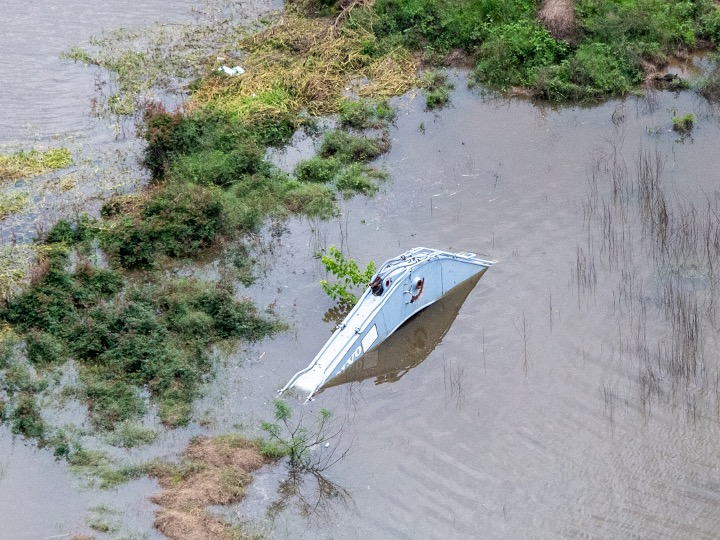
Right now, there are at least six mines on the East and West Forks of the San Jacinto that were left a mess. Such abandoned sand mines are increasingly becoming a blight that imperils water quality in Lake Houston, the source of drinking water for 2 million people.
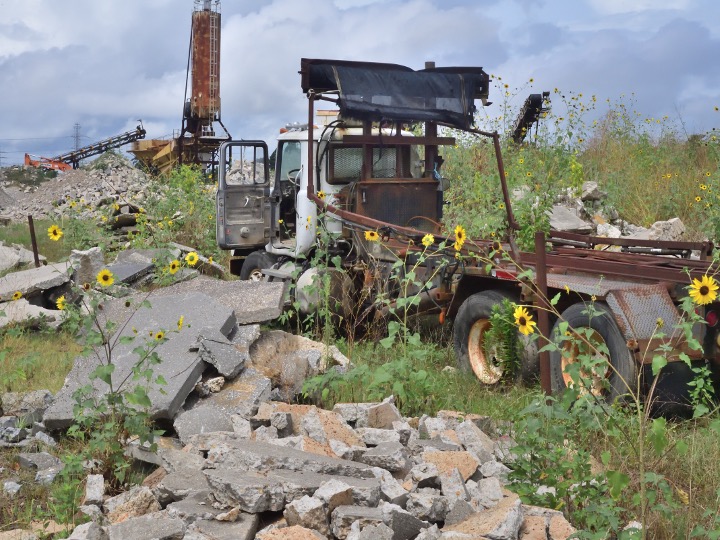
Rusting equipment leaks poisons and poses safety problems.
Un-stabilized soil increases rates of erosion and contributes to flooding.
Steep banks in pits slump away in slabs threatening neighboring properties and businesses.
Blight reduces surrounding property values and business activity
Miners are supposed to remove equipment and structures before they abandon a mine. But not all do. See the pictures below.
Leaking equipment near Riverview Drive in Porter on West Fork. Google Earth images show thisin same location since 2008.Dredge abandoned in Humble mine in 2017.Abandoned excavator in Porter mine on West ForkAbandoned dredge in Plum Grove mine.Abandoned processing equipment in Humble mine.Abandoned processing equipment and vehicle in Humble mine since 2017.
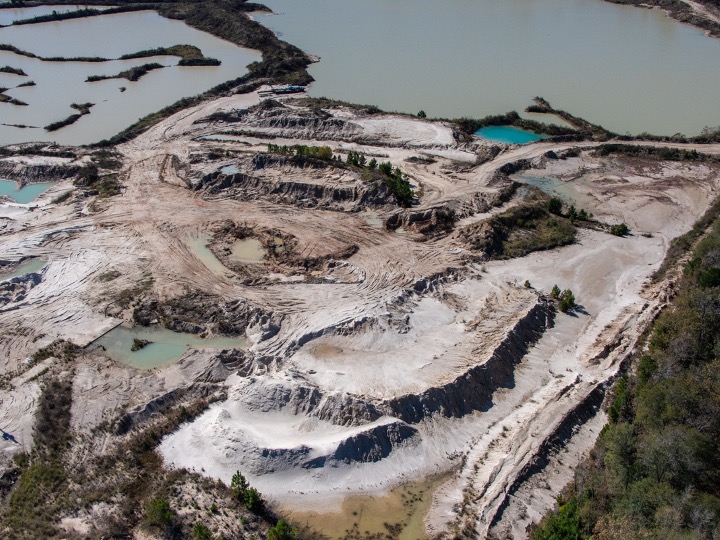
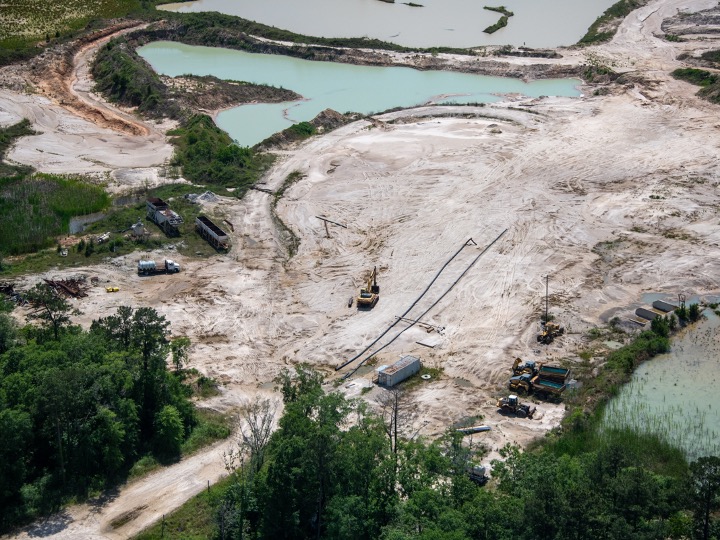
Miners are also obligated to grade and stabilize soil before they leave a mine, then replant vegetation similar to the surrounding area to reduce sediment pollution. But not all do.
Ungraded, un-stabilized soil in East Fork Plum Grove Mine.Ungraded soil and abandoned equipment in East Fork MineA flood later swept through the mine above, sending sediment down the East Fork.Defunct sand pit in Humble. Steep slopes – ungraded and unvegetated – erode and threaten neighboring business.
Community Consequences
Most sand moves during storms. This island appeared after Hurricane Harvey between Humble and Kingwood. It blocked the West Fork by 90%, according to the Army Corps and contributed to the flooding of thousands of homes and businesses.Confluence of the San Jacinto West Fork with Spring Creek. Images taken on different days from different angles, but in each case the dirty water comes from the West Fork, where we have 20 square miles of mines on a 20 mile stretch of the river between I-45 and I-69.
Most responsible miners will clean up on their own. But experience shows, a few bad apples will not. And when they walk away, the cost to the public can be enormous. Dredging costs alone have exceeded $226 million in the Lake Houston area since Harvey.
How You Can Help
Please help reduce this and related cleanup costs in the future. Ensure that sand miners don’t pass their remediation costs on to taxpayers.
Make sure HB1093 at least gets to the House floor for a vote this year.
The committee will likely recommend King’s HB10. It will fund the creation of 7-million acre-feet of new water supplies for rural areas.
Let’s do something that won’t cost taxpayers a penny to protect a water supply we already have. Support HB1093. And please forward this link to all your friends, family and neighbors.
Posted by Bob Rehak on 3/18/23
2027 Days after Hurricane Harvey
The thoughts expressed in this post represent opinions on matters of public concern and safety. They are protected by the First Amendment of the US Constitution and the Anti-SLAPP Statute of the Great State of Texas.
https://i0.wp.com/reduceflooding.com/wp-content/uploads/2023/03/20200306-RJR_9442.jpg?fit=1200%2C800&ssl=18001200adminadmin2023-03-18 09:23:232023-03-18 09:53:52Urgent Request: Support HB1093 to Improve Water Quality, Reduce Flooding, Save Tax Dollars