SRJA Begins Seasonal Lowering of Lake Conroe to Provide Buffer Against Flooding

On April 1, The San Jacinto River Authority (SJRA) began releasing water from Lake Conroe at a slow, controlled rate to help guard against flooding this spring. This is the first of two seasonal lowering periods scheduled this year.

Details of Lowering Policy

  • From April 1 to May 31, SJRA will lower Lake Conroe one foot from 201 to 200 msl (mean feet above sea level).
  • During the peak of hurricane season, from August 1 to September 30th, SJRA will lower the lake two feet to 199 msl.

If the lake level has already dropped to the target elevation due to evaporation, no additional releases would be made.

If a storm enters the forecast while seasonal releases are being made, releases would be stopped until rainfall is out of the forecast to avoid overloading the downstream watershed.

For the complete text of the SJRA’s seasonal lowering policy, click here.

Rationale for Seasonal Lowering

Yesterday, SJRA began releasing water at the rate of about 375 cubic feet per second (cfs). This rate is slow enough that it will not flood downstream communities, yet fast enough that, over time, it will give Lake Conroe extra capacity to absorb heavy, spring rains.

On April 1, the SJRA began lowering the level of Lake Conroe by 345 cubic feet per second.

“We should not forget that the Tax Day and Memorial Day floods both happened in the spring,” said Chuck Gilman, SJR’s Director of Water Resources and Flood Management.

Gilman emphasized that the seasonal lowering strategy is temporary while downstream communities address their own flood mitigation strategies such as dredging and additional gates for Lake Houston. Dredging will help restore conveyance of the San Jacinto river. Gates will increase the release rate of Lake Houston. Increasing the release rate is important for two main reasons:

  • The gates on Lake Houston have one fifteenth the release rate of Lake Conroe’s, creating a bottleneck – 150,000 cfs for Lake Conroe; 10,000 cfs for Lake Houston.
  • Pre-releasing water from Lake Houston in advance of a storm can take days. A storm can easily veer away during that time, resulting in wasted water. The long lead time significantly raises the level of that risk. More gates will enable the Coastal Water Authority to release water faster and reduce that risk.
Gates on the Lake Conroe Dam can release water 15X faster than the small gates on Lake Houston’s Dam.

Pressure Mounting on Board as Board Changes

During last February’s SJRA board meeting, the board voted to continue the lowering policy, which it began in 2018. However, lowering Lake Conroe has encountered pushback from boat owners who complain about the inconvenience. Board member Brenda Cooper voted against the lowering. All other board members who were present voted to continue it.

However, the board has seven directors and the terms of three will expire this year. As pressure mounts on the board and board members change, the seasonal lowering policy could be in jeopardy.

Mitigation Projects Also Pressured

All the more reason to dredge the mouth bar on the West Fork NOW! By the time Phase 1 is completed, it will have taken 15 months. But six months of that was surveying, bidding, and mobilizing the job. If FEMA and the Corps authorized dredging the mouth bar today, it could be completed before next spring. That would reduce the need to lower Lake Conroe again next year.

Stephen Costello, the City of Houston’s Chief Recovery Officer, speaking at a Kingwood Town Hall Meeting on March 21, said it could take 3 years to add 10 additional gates to Lake Houston. That was the best case. Others have previously estimated it could take 10 years.

It’s unlikely that residents of Lake Conroe would tolerate seasonal lowering of their lake for 3 more years, let alone ten. The longer flood mitigation takes, the more pushback we can expect. That’s yet another reason why we need to accelerate mitigation projects.

Posted by Bob Rehak on 4/2/2019

581 Days since Hurricane Harvey

Night of the Intruder: More Reader Submissions

Two weeks ago, when the San Jacinto River Authority reconsidered whether to lower Lake Conroe seasonally again this year, I put out a call for pictures from Harvey. I wanted the people of Lake Conroe to see how much the people of Lake Houston suffered from floodwaters. The community responded with dozens of images. I have just now finished posting the last of them on the Submissions page. If you’ve never been to this page before, check it out. The images speak volumes…silently.

Submissions from Karen Hudak

As I edited Karen Hudak’s pictures, I could almost feel what must have been her panic. Waking up in the dark to see water creeping up. Scrambling to elevate belongings. Pausing to photograph a panicked deer. Peering out a second story window to see how bad things were. Loading up a truck to escape then finding the water was rising too fast to get away.

Night of the Intruder. By Karen Hudak.
Barrington Homes about to be Engulfed as Harvey's Floodwaters Rose. By Karen Hudak.
Barrington Homes about to be Engulfed as Harvey’s Floodwaters Rose. By Karen Hudak.
Sheltering in Attic as Harvey's Floodwaters Rose in Utility Room. By Karen Hudak.
Sheltering in Attic as Harvey’s Floodwaters Rose in Utility Room. By Karen Hudak.
Deer Seeking Shelter During the Storm. By Karen Hudak.
Rescue Truck that Needed Rescuing. Photo by Karen Hudak.
No Go. Photo by Karen Hudak.

Submissions by Diana Aston

Diana Aston also submitted several pictures that captured the overwhelmingness of the event. They capture floodwaters rising outside, engulfing homes, swallowing cars, and her garage. And finally the return to shattered dreams…down the toilet.

16th Hole Marker, Kingwood Country Club Lake Course, As Harvey's Floodwaters Rose. By Diana Aston
16th Hole Marker, Kingwood Country Club Lake Course, As Harvey’s Floodwaters Rose. By Diana Aston
Flooding Cars in the Barrington during Harvey by Diana Aston
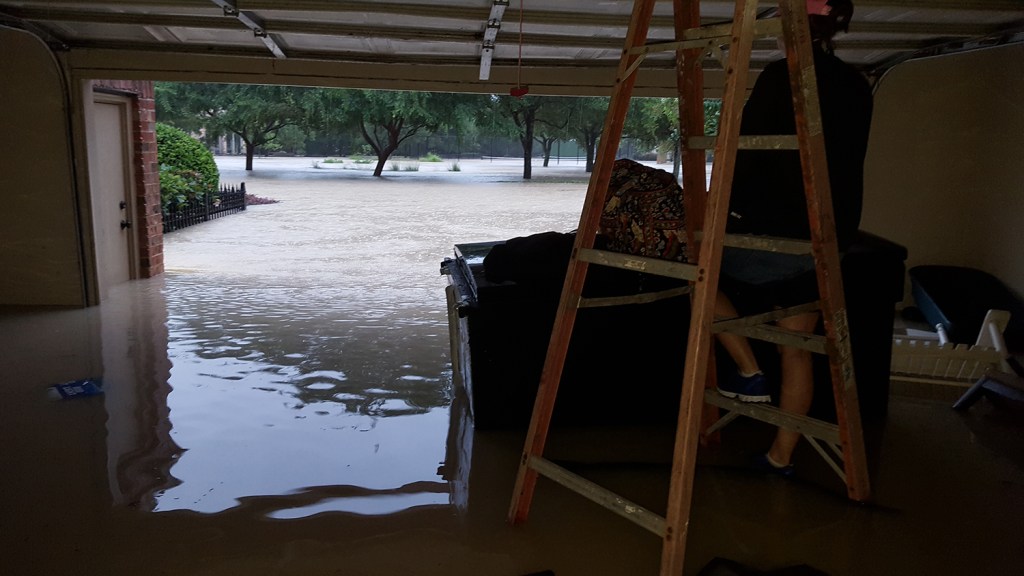
Harvey's Floodwaters Creeping into Barrington Garage by Diana Aston
A Losing Battle. Harvey’s Floodwaters Creeping into Barrington Garage by Diana Aston
Toilet after Harvey Flood. By Diana Aston.

My thanks to Karen and Diana for allowing me to share their pictures with the world.

To see more pictures submitted by others, browse through the gallery on the Submissions page. To share your images with the world, follow the instructions on the page.

Posted by Bob Rehak on 3/9/19 with photos from Karen Hudak and Diana Aston

557 Days since Hurricane Harvey

SJRA Board Votes to Maintain Lake-Lowering Policy for Another Year

At its February 28th meeting, the San Jacinto River Authority voted to maintain its lake-lowering policy for another year. The policy calls for lowering Lake Conroe one foot below normal pool level (from 201 feet to 200) during the wettest months in Spring and two feet during the peak of hurricane season.

Extra Safety from Flooding

Until other mitigation measures can be put in place, the plan gives downstream residents an extra measure of safety from massive releases like those experienced during Hurricane Harvey. Those include dredging and additional flood gates for Lake Houston.

This is good news for the Lake Houston Area where Harvey made approximately 11,000 people homeless overnight.

Complaints from Lake Conroe Association in January Meeting

The Lake Conroe Association set the stage for conflict last month. The Association testified that last year’s lowering had a negative impact on business and home values in the area. They also maintained that the Board had acted unilaterally – without consultation – and that the project was only supposed to last through the end of dredging.

Having been at last year’s meeting where the proposal was discussed, I would disagree with these statements. The board considered dredging and gates for Lake Houston. The board also acted on the report of a consultant hired to review the proposal.

Mark Micheletti, a SJRA board member, said the board had received no complaints from businesses on the lake and that a check with realtors found no negative effect on home prices.

Reportedly, the Lake Conroe Association had also collected signatures on a petition asking for the policy to be reversed. At today’s meeting, the room was crowded with spectators, but I did not see the Association’s president, Mike Bleier. The association presented no petition.

The cataclysmic impacts on Lake Conroe’s economy did not materialize. Because of evaporation, the lowering really only amounted a little more than a foot in the fall.

Speaking for Kingwood

During the public comment section of the meeting, three Kingwood residents, Bill Fowler, Amy Slaughter and I, spoke FOR continuing to lower the lake. So did one Lake Conroe resident who flooded during Harvey.

I pointed out the fact that dredging was NOT yet complete and that the river still had an exaggerated flooding response to moderate rainfalls because of sediment dams. Fowler talked about normal evaporation levels in the lake and how the lowering was not as great as the targets would imply. Slaughter mentioned the impact of flooding on her family and recent Supreme Court rulings on inverse condemnation.

The Lake Conroe resident said he wished the Lake were lowered year round. He flooded during Harvey and thought that the lower levels would actually help Lake Conroe home values.

“But what if there’s a drought?”

When it came time to speak AGAINST the lowering, one man spoke up. He used water conservation as his main argument and posed the specter of drought.

When the board began debating the measure, Jace Houston, SJRA’s general manager, pointed out that many people misunderstood the measure. He said that the SJRA was not going to lower the lake beyond the 1- and 2-foot levels in the policy. If the lake was already down a foot due to evaporation, for instance, the SJRA would release no additional water.

Chuck Gilman, Director or Water Resources and Flood Management, thenshowed a series of slides that led to discussions about:

  • Lake-lowering strategy
  • Progress of the current West Fork dredging and Lake Houston Gates projects
  • Rainfall averages and historical lake levels by month
  • How the lowering and subsequent raising of the lake worked last fall
  • Staff recommendations
Graph presented by Chuck Gilman showed how gradual lowering and natural refilling of Lake Conroe worked last year.
Gilman also showed a slide discussing the status of additional gates for Lake Houston.

To see all the slides in the original high-resolution PDF format, click here.

Brenda Cooper, a new SJRA Board Member, then mentioned that some Lake Conroe residents had approached her to voice their disapproval of the project.

Motion Passes Unanimously

Board President Lloyd Tisdale finally called for a voice vote. “All members present voted FOR the lowering,” said Mark Micheletti, one of the Lake Houston Area’s two members on the SJRA board. “The vote could not have gone better from the Lake Houston area’s perspective.”

The SJRA will continue to lower Lake Conroe seasonally. The measure will come up for discussion again next February.

Community Reaction

Bill Fowler, Vice Chair of the Lake Houston Area Grass Roots Flood Prevention Initiation, said, “I was impressed by the Board’s firm grasp of the importance of lowering Lake Conroe on a seasonal basis for downstream residents. Their willingness to help until permanent solutions can be implemented impressed me.”

Kaaren Cambio, another SJRA board director from the Lake Houston area, said, “I’m happy that the board is balancing the needs of both upstream and downstream communities.

Amy Slaughter, the Kingwood lawyer whose home flooded badly, said, “They did the right thing.”

Posted by Bob Rehak on February 28, 2019

548 Days After Hurricane Harvey

The Night that 11,000 Lake Houston Area People Became Homeless

Eighteen months ago, approximately 11,000 Kingwood, Humble and Atascocita residents went to bed thinking they had escaped the worst of Harvey’s wrath. Hours later, they woke up to find water seeping through their windows, doors and walls in the dark of night. Without any warning. Thanks in part to the release of 80,000 cfs from the Lake Conroe dam.

The Harris County Flood Control Damage Map shows that on the West Fork:

  • 3652 Homes were damaged in Kingwood
  • 366 in Atascocita
  • 466 in Humble
  • Total: 4184 homes flooded in this area partly because of the release of 80,000 cfs from the Lake Conroe dam.

With an average household density of 2.71, that means roughly 11,000 people became homeless that night.

Ironically, Thursday, February 28, the San Jacinto River Authority will vote on whether to continue lowering the level of Lake Conroe seasonally. The measure was designed to help reduce downstream flood risk until mitigation measures can be put in place.

However, rumor has it that one or more members of the board want to present a petition by Lake Conroe boaters to NOT lower the lake level this year. To everyone who signed that petition, I dedicate this photo essay.

Water Sculptures by Julie Yandell. Taken during Harvey.
Water Sculptures by Julie Yandell. Taken during evacuation. Yard decorations take on an ominous feeling in the flood.
Woodland Hills Drive During Harvey by Julie Yandell
The flood cut off Woodland Hills Drive, a major escape route for people in Kingwood Lakes, the Barrington and Kings Cove.
Trash Day in the Barrington after Harvey. Photo by Joy Dominique.
Siding from home washed downstream during Harvey. Photo by Dan Monks.
Water skiing, anyone? Photo by Sidney Nice of Atascocita Point after Harvey.
Sidney Nice's kitchen after Harvey flooded the house to a depth of 63".
Sidney Nice’s kitchen after Harvey flooded the house to a depth of 63″.
Sidney Nice's house in Atascocita Point during Harvey.
Sidney Nice’s house in Atascocita Point during Harvey.
Her home flooded 40 inches above the slab.
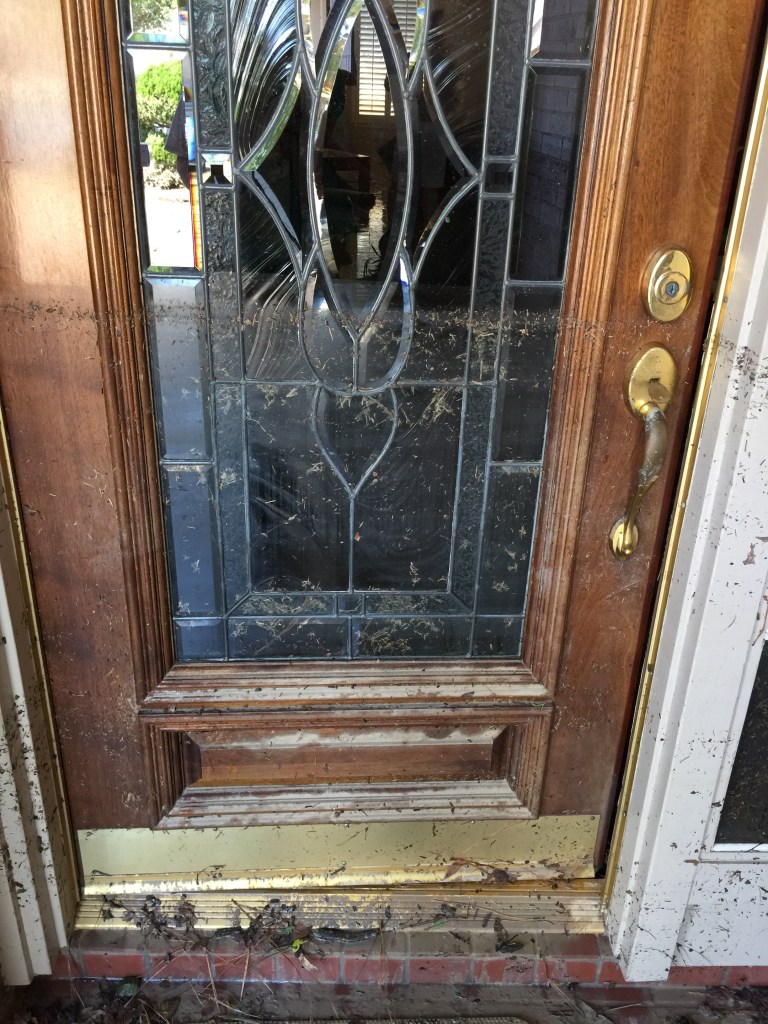
Rebecca Johansen’s front door shows how deep flood waters got in her home … 40 inches.
Townhomes on Marina Drive in Forest Cove. Concrete and steel were less effective at preventing erosion than blades of grass.
Residents trying to escape as Harvey's floodwaters rose
Elderly residents of Kingwood Village Estates trying to escape as Harvey’s floodwaters rose. Twelve residents later died: six as a result of injuries sustained during evacuation and another rise as a result of stress from losing their homes.
Marilyn Davenport: Home Damaged During Harvey
From Ann Crane: "We had over 70 people helping to clear and clean our house. The Kingwood community coming together."
From Ann Crane: “We had over 70 people helping to clear and clean our house. The Kingwood community coming together.”
Jennifer Manning: "What 18 inches of floodwater can do to your home." From Walden on Lake Houston.
Jennifer Manning: “What 18 inches of floodwater can do to your home.” From Walden on Lake Houston.
Jennifer Manning: "We lived in Kingwood from 1992-2012 before buying a house in Walden that was 'built above the '94 flood.' We finished our rehab in June." Ten months!
Jennifer Manning: “We lived in Kingwood from 1992-2012 before buying a house in Walden that was ‘built above the ’94 flood.’ We finished our rehab in June.” Ten months!
The Kelsey Seybold Clinic has also been vacant since Harvey. 44% of all businesses in the Lake Houston Area Chamber were damaged. Some will never return.
Picture by June Ledet of Harvey flooding in Kingwood corner of Kingwood Drive and Forest Garden
Picture by June Ledet of Harvey flooding in Kingwood. Corner of Kingwood Drive and Forest Garden. Flooding here cut off escape routes for thousands more.
Classroom building at Lone Star College/Kingwood flooded during Harvey after SJRA release. Six of nine buildings flooded causing more than $60 million in damage. The College just fully reopened this month.
Milan saunders
Milan Saunders home in Kingwood Lakes
That’s all, folks! Harvey flipped the baby grand piano and broke to legs off the heirloom.
Repairs to IH-69 took about 10 months and $20 million, disrupting all traffic into and out of the City for hours each day.
The mother of all walk in closets…Amy Slaughter’s garage.
Home of a single mother who had just lost her job.
When sewage treatment plants flooded, toilets began flowing in reverse.

So please, Lake Conroe boaters. Let’s keep this in perspective. We understand your inconvenience. Please try to understand ours. Help us recover our lives.

To see more examples of how Harvey affected the lives of Lake Houston Area residents, please see the Submissions Page of this web site. It contains images submitted by residents affected by Harvey. If you have images you would like to share, please send them in via the Submissions Page.

Posted by Bob Rehak on February 28, 2019

548 Days since Hurricane Harvey

Video of Barrington Evacuation During Harvey Makes Case for Lowering Lake Conroe, Nixing High-Rise Development

With barely a spoken word, this video makes an eloquent case for lowering Lake Conroe again this year. It also makes a powerful argument for denying the permit to build 5000 condos and high rises in the surrounding wetlands.

Evacuation from the Barrington during Harvey. Video courtesy of Kenneth and Colleen Ulrich. They moved to Kingwood from New Orleans after Katrina.

Surprise Evacuation

Kenneth Ulrich Jr. shot this video as he and his wife Colleen were forced to evacuate without warning from the Barrington during Harvey.

They share this video on the eve of a key San Jacinto River Authority board meeting. Tomorrow, the board will take up the question of whether to seasonally lower Lake Conroe again this year. The lowering would help provide a margin of safety against flooding like this until other flood mitigation measures can be put in place.

Lake Conroe boaters have complained about the inconvenience of the lower lake levels. The video shows what boating in Kingwood looked like 18 months ago as Harvey’s floodwaters rose.

Many residents escaped with little more than the clothes they wore.

Imagine Evacuating 15,000 People Like This

The video makes another powerful argument. Against the high-rise development proposed for Kingwood. Developers hope to build it around the Barrington which you see here. They want to build 5,000 condos immediately to the north and a string of high rises, including a 50 story hotel, immediately to the south. Kingwood has an average household population density of 2.71. That means this development could add 15,000 people to the area.

Every one of the 283 homes in the Barrington flooded. Imagine trying to evacuate another 15,000 people by boat during the next Harvey.

The developers have planned only one way in and out of this project – Woodland Hills Drive – which will be under water when the next big flood hits.

Clearly, they did not consider evacuation when they planned this development.

How to Register Your Concerns

If you have concerns about the high-rise project, email the US Army Corps of Engineers at: swg_public_notice@usace.army.mil . Make sure you put the project number in the title of the email: SWG-2016-00384 .

To voice your concerns to the SJRA board, attend the board meeting Thursday, Feb. 28 at:

1577 Dam Site Road
Conroe, Texas 77304
936.588.3111

Speakers are limited to three minutes each. Business attire is recommended. To reserve time to speak you must sign in by 7:45. The meeting will be in the tall building.

Allow an hour and fifteen minutes to an hour and a half to get there in rush hour traffic from the Humble/Kingwood area.

As always, these are my opinions on matters of public policy. They are protected by the First Amendment of the U.S. Constitution and the Anti-SLAPP statute of the Great State of Texas.

Posted by Bob Rehak on 2/27/2019

547 Days after Hurricane Harvey


SJRA to Reconsider Lowering of Lake Conroe This Thursday Morning

At its Thursday board meeting, the SJRA will reconsider whether to seasonally lower Lake Conroe again this year. Last year, the board lowered the lake as a way to provide an additional buffer against flooding until flood mitigation projects could be put in place. As part of the motion it approved last year, the board said it would revisit the decision each year. That time is now.

Even though Lake Houston area dredging continues and additional gates for the Lake Houston Dam have not yet been funded, re-approval of the lowering this year is far from automatic. Rumor has it that the Lake Conroe Association may present a petition urging the board to keep the lake at its usual height.

Details of Original Plan

What exactly was the temporary, seasonal lake lowering proposal? SJRA General Manager Jace Houston spelled out the details for the public in Dockline Magazine last year. I pulled these figures from there.As a point of reference, the normal pool level of Lake Conroe is 201’ msl (mean feet above sea level).

During the Spring season – April 1 through May 31 – the SJRA voted to start lowering the lake gradually on April 1 until it reached a level of 200 msl, i.e., one foot below normal. This is the rainiest part of Spring.

Then starting on June 1, the SJRA would begin to capture flows to restore normal lake elevation for June and July.

For the Fall season – August 1 through September 30 – which includes the peak of hurricane season, the SJRA would again reduce the lake gradually. Their target: 200 msl by August 15. That’s when most local schools resume and the summer vacation season starts to tape off.

After August 15, SJRA would continue gradually lowering the level of Lake Conroe until it reached 199 feet msl or two feet below normal pool by August 31.

Starting October 1, SJRA would again begin to capture flows to restore normal lake elevation.

If the lake level has already dropped to the target elevation just due to evaporation, no additional releases would be made.

If a storm enters the forecast while seasonal releases are being made to lower the lake level, such releases would be stopped and the river allowed to drain out until rainfall is out of the forecast.

Purpose for Season Lowering

Jace Houston cited three reasons for seasonal lowering as opposed to pre-releasing water immediately before storms.

  1. Release of water from Lake Conroe prior to a storm would put flows into the San Jacinto River and Lake Houston potentially exacerbating flooding.
  2. Staff from the City of Houston, the Coastal Water Authority, and the Harris County Flood Control District have expressed their desire to not pre-fill the river and Lake Houston prior to a storm with water released from Lake Conroe.
  3. Lake Conroe is located in the upper basin where it makes sense to retain flood waters to the extent possible.

Success of Last Year’s Plan Needs to Be Repeated

The seasonal lowering started last Fall. While we didn’t have any repeats of the monster storms we experienced in 2015, 2016, and 2017, we were reminded by three back to back storms between December 7 last year and January 7 this year how vulnerable we still are to flooding. Minor rains produced out-of-bank floods that left low-lying Forest Cove and Kingwood areas underwater for a nearly a month.

Until dredging is complete, we still need the buffer that lowering Lake Conroe provides.

Speak at Board Meeting

Residents have an opportunity to speak out for and against the seasonal lowering this Thursday morning, Feb. 28, 2019. Speakers are limited to three minutes each. Business attire is recommended. To reserve time to speak you must sign in by 7:45. The meeting will be in the tall building at:

1577 Dam Site Road
Conroe, Texas 77304
936.588.3111

Allow an hour and fifteen minutes to an hour and a half to get there in rush hour traffic.

Hope to see lots of Humble and Kingwood people there. This is very important until we get mitigation measures in place.

If You Can’t Come, But Still Want to Help

Consider sending ReduceFlooding.com some of your most dramatic shots from the flood. See the Submissions page. We need to show the SJRA board how dramatic the flooding really was here. There are new faces on the board this year.

Posted by Bob Rehak on February 26, 2019

546 Days after Hurricane Harvey

West Fork Forecast to Flood up to 54 Feet

The following is the forecast for the San Jacinto River basin including the West and East Forks and the mainstem below Lake Houston, as of about 8:30 p.m. Friday evening. Some forecasters believe rainfall, runoff and flooding could go higher. This post has already been updated once.

West Fork: 

Major flooding forecast. Some uncertainty remains. Forecast could go a few feet higher. Jeff Lindner, Harris County meteorologist warns Northshore, Belleau Woods, Rivercrest, and Forest Cove will likely flood into early next week. Even elevated structures will be cut-off for several days.  

Lake Conroe is currently releasing 2121 cfs as of 7 p.m. Friday. This is a small fraction of the expected flows along the West Fork.

The West Fork reached it’s low point around 4 p.m. this afternoon after the City lowered the Lake to 40.75 feet. Flood gates remain open at the Lake Houston dam. Regardless, the West Fork is now expected to crest at around 54 feet on Monday afternoon and not return to its banks for several days.
Near Real Time Inundation Map from HarrisCountyFWS.org. Check the site periodically for latest updates.

This will be the inundation with a stage of 52.0 ft at US 59

East Fork: 

NWS forecasts minor to moderate flooding along the East Fork at FM 1485. At 62 ft FM 1485 west of the river bridge will be impacted.

Mainstem below Lake Houston: 

A rise to near flood stage is currently expected. A few low lying roads near the river could be flooded.

Overnight Rain Forecast

Lindner says, “Widespread rainfall of 1-2 inches has occurred over much of the area this afternoon with isolated totals of 3-4 inches over southern Walker and extreme northern Montgomery Counties.”

“Surface low is deepening northwest of Harris County and suggests increasing potential for heavier showers and thunderstorms. They will train from WSW and SW to the ENE and NE. Rainfall will continue to pile up at the rate of .5 to 1.5 inches per hour this evening and much of what is now falling is directly running off,” says Lindner.

The National Weather Service and Lindner expect areas along and NW of US 59 will receive the most sustained rainfall this evening.

Impact of Lake Lowering

Luckily for the Humble Kingwood Area, the City of Houston reduced the level of Lake Houston more than the 18″ they originally projected. As of this afternoon, the Lake was down to 40.5. That should give us some cushion against flooding.

Said City Council Member Dave Martin, “The gates at Lake Houston continue to remain open and will be adjusted as needed to allow for even more water to be released should that be necessary. In response to the lowering of Lake Houston, the West Fork of the San Jacinto River near Highway 59 has also lowered by 2 feet providing additional capacity in the river. 

Expected SJRA Release Rates

According to Martin, the SJRA currently estimates that releases from Lake Conroe might peak at 9,000 to 11,000 cfs sometime over the weekend based on current forecasts. These amounts are relatively small in comparison to the rain events that our area saw during July 4, 2018 and Memorial Day 2016.

If you live in a low-lying area, monitor rainfall and water-level trends by visiting these web sites throughout the weekend.  

Posted on 12/7/2018 by Bob Rehak based on info from Harris County & COH

465 Days since Hurricane Harvey.

The Great Escape: Rebecca Johansen’s Hurricane Harvey Experience

Rebecca Johansen is a Kingwood-based CPA, specializing in taxes. Before Hurricane Harvey, using technology and remote capabilities, she was able to work primarily from her home in the Enclave. Almost 15 months later, she’s finally back in her home, but “scared to death” of the possibility of another flood. Her journey since Harvey has been a remarkable blend of heroism and humility. The only constants in her life have been stress, Lysol and sleep deprivation. Now, at age 62, her main goals in life are simply to enjoy the holidays with her family and not see a waterline on her walls. This is the sixth in a series of interviews with Harvey survivors.

Rebecca Johansen today in her kitchen, remodeled for the second time in two years. Her elderly neighbor, Jean, perched on the granite countertop during Harvey, waiting for rescuers.

Rehak: Tell me about the night of the flood.

Johansen: I owned a small generator. I remembered being without electricity during Ike for two weeks and didn’t want to go through that again. I didn’t think we would flood, but I was certain we would lose power.

Helping Elderly Neighbor

After I got my generator started, I went over to my neighbor’s house. She was 85 at the time. Her name is Jean. I said, “Come on. You’re spending the night at my house.” She refused at first, but I didn’t want her to be there by herself in the dark, especially if we flooded. She had almost drowned as a young girl and was deathly afraid of water, so we packed her medications and a change of clothes. I set her up in a spare room with a little lamp and a TV. About 10 p.m., Jean went to sleep.

Shortly after that, things started to go downhill. We started getting water in the garage, so I had to turn off the generator. Then, it was pitch black. I thought we would just get an inch or two, so I started putting stuff up on tables.

Calls for Help Go Unanswered

It was kind of hard to do in the dark. Then about 2 o’clock in the morning, water started coming in the house, too. After a while, I figured I had to get Jean someplace safer, so I put her on my kitchen counter. I told her that as soon as daybreak came, I would try to get us help. But the water was coming up pretty fast. I called 911, but I couldn’t get through.

Desperate Attempts to Attract Rescuers

When daybreak finally came, the water was coming up and up and up. I went out into the street because I could hear helicopters. But we have so many trees. They couldn’t see me. Eventually the water in the street was up to here (gesturing to her chest).

I tried crawling up on the brick wall between our houses, anything to be seen. No luck. I kept going out to find help and back in to check Jean. This went on for a while.

Eventually I made my way down the street, waving a white shirt. Finally, a helicopter saw me. They looped around and lowered a man down on a cable.

I was so worried about Jean. At one point, I went back in to check on her and she saw one of my shoes float by. She said, “Rebecca, I always did like those shoes.” We both laughed.

Rehak: You were rescued by helicopter?

Evacuation and Search for Remaining Residents

Johansen: No, he called for a boat. I can’t say enough about how professional everyone was. He was so kind. Jean was stressed. He reassured her. He said, “Everything’s going to be OK.” Then he took her up in his arms. By that time, a Coast Guard woman had come in and the two of them got her in the boat. They were just stellar.

They asked me if I knew who else on the street needed to be rescued. Then I told them about another neighbor. They went to her house and banged on the front door, but no one answered. They came back and said, “No one’s home, so we’re moving on.” I said, “I can’t believe that she isn’t there. She wouldn’t just leave the two of us here if rescuers came.”

Rescuing More Neighbors

We were about to leave. They had called another boat in to help a lady across the street. Our boat just idled for a minute to make sure they didn’t need assistance when I saw my other neighbor waving in the front window. I said “She’s there! We gotta go back.” So they went back and came out with this large suitcase. Presumably, she had been in the back of her house packing some things when they first knocked and didn’t hear them. She followed them out with another bag and a cat in one of those cat things. Then we left by boat.

“Wearing” Debris on Long, Wet Boat Ride

I had debris all in my hair and clothes. The debris that came through there was just unbelievable.

Rehak: Give me some examples.  Woody?

Johansen: That kind of stuff, plus trash. I didn’t even realize at the time that the floating debris had injured me. You’re just in “fight or flight” mode. This whole arm was black and blue. It looked like someone had just beat me.

Chemical storage tank that washed up in Rebecca Johansen’s yard during Harvey.Note mud line on wall relative to the height of the people on the right.

So, they get her in the boat. We pull out. We’re on our way across Kingwood Drive, through the H-E-B parking lot, It’s pouring rain. They dropped us off by the Park ‘n Ride. We had to walk a fair distance to where you could get a ride.

Volunteers Help Transfer to Creekwood Middle School

Finally, a very nice man with his wife and daughter took us over to Creekwood Middle School in their pickup.

Rehak: Did Creekwood stay dry throughout the ordeal?

Johansen: Yes, but there was no power. Jean has compromised lungs, so I was very worried about her. She got soaked.

I said, “Jean, we have to get you into some dry clothes.” So, we go in the ladies’ room. I had a little flash light. It took her about 20 minutes to change into dry clothes, then I changed. My clothes weren’t dry, but at least they didn’t have twigs in them.

At Creekwood, the community response was overwhelming. Drinks. Water. Snacks. Clothing. Shoes. People brought food and everything you could imagine. It was amazing how quickly people responded. Just amazing.

So Bruised, Doctor Suspected “I was Battered Wife”

The next day I got an infection. Of course, I’d lost my car, so I got a ride to a clinic. I told the doctor I was there for an infection and he looked at me like I was crazy. I think he thought I was a battered wife.  He said, “What in the wide world happened to you?” It was from all the flood debris bumping into me.

Rehak: How long were you in Creekwood?

Johansen: Not long. Jean’s son-in-law and daughter live in Kingwood Lakes. She has another daughter who lives in Atascocita. They were frantic, just beside themselves, worried about Jean. I let them know that she was OK and that I had her at Creekwood. They had flooded too, but had some friends pick us up. Thank God, we didn’t have to worry about that, too!

Sheltered by Strangers

For the first few days, we all stayed with the friends. I didn’t know them, but Jean said, “Stay with me.” She wanted us to be together, so I stayed four or five days, then found somewhere else.

(Johansen chokes up at this point.)

Rehak: How long did it take you to get back to your house after the flood?

Johansen: The water came up fast and went down fast. We got rescued sometime during the morning. Then a couple of days went by. I guess it was on the third day that I got to my house.

The water had drained out. It was just mud, gunk, and a couple of dead fish. It’s amazing how 40 inches of water can move things around your house. The refrigerator turned over. Furniture scattered everywhere. The garage doors buckled from water pushing against them. It was the worst sight you can imagine.

No Warnings to Evacuate

Rehak: Did you get any warnings to evacuate?

Johansen: No.

Rehak: Did you know that they were releasing water from the dam?

Johansen: No. I figured they would have to release something, but nothing like what they released. I was more worried about the power outage than the flood.

Rehak: When you first sensed that water was coming in the house, was it already too late to get your car and evacuate?

Johansen: Yes. No one could get out. Before nightfall, Kingwood Drive was already blocked off.

To not start the dam release earlier and issue proper warnings…someone really dropped the ball. That’s my personal feeling. A week before, we all knew that this storm was going to move slowly and drop a lot of rain, so I’m at a loss as to why there wasn’t an earlier release.

Battling Inexperienced Insurance Adjuster

Rehak: Did you have flood insurance?

Any place can flood. The drain on your street could get plugged with debris and you would flood. I never thought I’d need it, but yes, I had it. Thank God.

Rehak: Did you battle with adjusters and contractors?

Johansen: I think my first adjuster had never done any adjusting before. She was terrible. I ended up being a squeaky wheel. I couldn’t even get her out to the property. Eventually I got through to somebody. My insurance agent, called me. He said, “Rebecca, I don’t know whose cage you rattled, but they are going to call you and offer another adjuster. I got a call within the hour. He showed up at 8 a.m. the next morning.

At that point, I was still pretty sleep deprived. I forgot to discuss some things. So I called him back the next morning. He said, he would proceed quickly and not to worry. After three and a half weeks of hell with the first adjuster, this guy got it done in two days. I guess my perseverance paid off.

Everything was a battle at that time. You have to get a contractor. File insurance claims. Buy a new car. Find a place to live. Fight for attention with millions of other people! All at once.

Lucking Out with Great Contractor

Luckily, I had a great contractor, Randy White, owner of Superior Home Renovations. He had done my kitchen the year before. Unfortunately! (We chuckle at her joke, i.e., how she got to replace her kitchen twice in one year.)

Randy is a very good man. He’s local. He does excellent work. He’s honest. And right after the flood, he showed up to check on me to see if I was OK. Randy White was a godsend. I like him personally and I would recommend him to anyone. He’s been there for me through this whole thing.

Rehak: How long did it take him to get all the work done?

Johansen: Until mid-June. They’re still working on some things. Like I just got the exterior painted last week. But the house is basically complete. They’re just finishing punch-list items. I’m so grateful that I have Randy.

Jean Gets Back in Her Home

Rehak: What happened to Jean?

Johansen: Jean wanted to get back in her house. Kyle and Charlie Campbell, her daughter and son-in-law found a contractor for her. They hadn’t even started on their own house by the time they got Jean back in hers. Right after the flood, she was very ill with pneumonia and was hospitalized. She had a rough time, so she was everyone’s focus.

Kyle and Charlie are now working on their house in Kingwood Lakes while living with Jean.

Enclave Still the Place to Be

Rehak: Tell me about the Enclave.

Johansen: You know before the flood, people were clamoring to get into that neighborhood. Location. Location. Location. Houses were selling quickly … especially if they had updates. Everybody wanted to live in the Enclave. It skewed to retired people because it’s one story, small yards, that kind of thing. But there’s a mixture of people. The location is wonderful; there’s so much that’s walkable. You could live your life and not go much more than a mile in any direction.

I love it; I intend to live the rest of my life there as long as I’m healthy enough. But if I go through another flood again, I won’t rebuild.

Single and Senior: How She Did It

Rehak: You’re single?

Johansen: Yes.

Rehak: That makes it harder.

Johansen: Yep. No back up. Everything is on your shoulders. My livelihood. Everything.

Rehak: How did you do it?

Johansen: “One hour at a time. Also, I ended up staying with a friend who was also a client. Her husband passed away about four years ago. She travels a lot. She doesn’t have any children. And she’s super nice. She said to me, “Rebecca, I’m gone quite a bit. Why don’t you stay at my house? It’s quiet.” She lives in Sand Creek. So I stayed there and am grateful for all that she did for me. I was working seven days a week. You don’t ever do it all by yourself. People help. I was lucky to have my son, daughter, family, and so many friends and colleagues who reached out to help me. I can’t thank them enough.

Best Way to Help: “Just Show Up”

Rehak: Tell me about the help you got.

Johansen: This whole thing taught me something. If something really bad happens, and I am in a position to help, I’m not going to call and say, “What can I do to help?” I’m just going to show up. That’s what you do. You just show up. You look around and you start doing things. The people that did that for me were so special. I will be forever grateful.

Rehak: Before the flood, you worked primarily at home. Did you lose a lot of records?

Johansen: Yes. A lot of equipment was destroyed along with most of my physical files. Luckily, my main computer, laptop and backup hard drive survived.

Ensuring Flooded Files Were Destroyed Properly

Rehak: What did you do with all the files that flooded?

Johansen: That was one of the most stressful parts of the flood. I had fourteen 4-drawer file cabinets locked up in my garage and several inside. Each flooded except for the top drawer. I had to figure out how to destroy all the flooded records. No one would take them wet and you can’t just have somebody haul off records like that. I had to find a safe way to dispose of them.

I pulled all the drawers out and ServePro built a tent over them in the garage. Dehumidifiers and fans ran under the tent for four and a half weeks. When I took the tent off, I found the paper had expanded so much, it buckled the drawers. I couldn’t get anything out!

So one Sunday, we loaded all the drawers up in trucks and drove them a hundred miles north of Houston to some private property. With a hammer, I beat all those file drawers apart and got the files out.

Then we poured diesel fuel over them. It was hard to get them to burn at first. But eventually, they did. It took all day. I got back very late that night.

Late-Night Resurrection of Crucial Files

Once I got that off my plate, there were some files we had to resurrect. They went back under the tent for another week. They came out gnarly looking, let me tell you. Mud and gunk everywhere. When they were all dry, I sprayed them with Lysol and once that dried, I boxed them. Every day, I was up at my new office location till all hours peeling papers, making copies, shredding and reconstructing. A friend called me in December and said, “OK, what letter of the alphabet are you up to now?”

I was working at that seven days a week, 10 to 12 hours a day, just trying to get back to where I could function.

Rehak: Will you ever go back to working at home?

Johansen: The thought of going through that again just scares me to death. I can’t do it.

“I Know This Has Changed Me”

Rehak: What do you want your future to be? (I catch her off guard. There’s a LOOOOOONG pause.)

Johansen: You know I’ve been in recovery mode so long, I’ve just started to think about that.

I want to have a little family reunion with my son and daughter up near Seattle. We’ve arranged a trip to a little Bavarian town in the Cascades called Leavenworth. I just want to be with my kids. (Choking up again.) It’s kind of hard to talk about. I know this has changed me.

Rehak: How so?

Johansen: Well, it’s definitely taken a physical toll. I’ve started to think about what I want to do with the rest of my life and how I want to live it, because all you have is today.  Things can change just like that (snapping fingers).

I’d also like to have a little bit of peaceful time back in my house and not see the water line on the wall.

Rehak: (Joking) Gee, you want it all!

Johansen: (Laughs)


Posted by Bob Rehak on November 15, 2018

443 Days after Hurricane Harvey

Lake Conroe Seasonal Lowering Reaches Target Level at Peak of Hurricane Season

Earlier this year, the San Jacinto River Authority (SJRA) voted to lower the level of Lake Conroe during the peak of hurricane season. The purpose: to provide an additional buffer against flooding for downstream residents until the river could be dredged. The SJRA has now reached its target of 199 mean feet above seal level (MSL).

Temporary Lowering Accommodates Dredging

The SJRA stated, “This was the target elevation established by the San Jacinto River Authority and the City of Houston to create a temporary flood mitigation benefit while dredging activities take place in the lower part of the San Jacinto River.”

The lowering happened gradually during August. To avoid downstream flooding, the  SJRA released water at the rate of 200-300 cubic feet per second. That amounted to  about an inch per day. The exact amount varied due to occasional rain and evaporation.

Lake Conroe Will Return to Normal Level After September

“Now that the target elevation has been reached,” said the SJRA, “Reservoir operators have shut off the release of water from the dam and will operate with the goal of maintaining the current elevation through the end of September. After September, any rainfall flowing into the reservoir will be held, and the reservoir will be allowed to return to the normal elevation of 201 ft-msl.”

Update on Dredging Schedule

As tropical activity heats up, this is good news. The U.S. Army Corps of Engineers is nearing completion of the assembly of the first of two dredges and miles of dredge pipe. The contractor for the Corps’ Emergency West Fork Dredging Project, Great Lakes, is expected to begin dredging on September 6. Dredging will extend from River Grove Park on the west to Chimichurri’s on the east. It’s not clear yet, which end the contractor will begin on. Great Lakes expects to complete the project, weather permitting, by April of next year.

Posted September 1, 2018 by Bob Rehak

368 Days since Hurricane Harvey

Seasonal Lowering of Lake Conroe Begins August 1

On August 1, the City of Houston Public Works Department, the San Jacinto River Authority (SJRA) and the Coastal Water Authority (CWA) plan to begin lowering the level of Lake Conroe as part of a joint operations plan to mitigate flooding threats during the peak of hurricane season. The plan calls for lowering Lake Conroe gradually through small releases – about an inch a day – until the lake level reaches 199 msl (mean feet above sea level).

Intent of gradual lowering of Lake Conroe is to avoid another 79,000 cubic-feet-per-second release rate as we experienced during Harvey. Until normal flow is restored to the West Fork, Lake Conroe will be lowered temporarily and seasonally to mitigate flood risk.

Lake Conroe to Be Lowered 2 Feet Through September

This initial lowering will last through the end of September to create additional storage in Lake Conroe which could delay releases and minimize release rates during a storm, thereby providing a buffer against flooding for residents who live downstream of the dam.

The next lowering would occur during the peak of the spring rainy season – from April 1 – May 31, 2019. However, that lowering would only be by a foot – to 200 msl, because the rain threat is usually lower in spring.

Only Until Dredging Restores River’s Flow

The joint operations plan calls for continuing to lower Lake Conroe seasonally in this manner while the U.S. Army Corps of Engineers dredges the West Fork of the San Jacinto to restore flow.

Hurricane Harvey deposited tremendous amounts of silt in the West Fork which  physically changed the river’s ability to safely pass water during storms. Hence, the dredging.

Phase-One Dredging Has Already Started

Phase one will go from River Grove Park to the West Lake Houston Parkway bridge. Great Lakes, the contractor hired by the Corps, has 269 more days to complete the initial phase.

Phase-Two Still Needs Funding

The total project could take longer. Community leaders are now working furiously to arrange funding to dredge the remainder of the west fork, including the mouth bar.

Mobilization and demobilization comprise 25 percent of the total phase one project costs (approximately $18 million out of almost $70 million). Having phase two ready to start before phase one ends could save that money, creating extra value for taxpayers and enabling even more dredging, say for instance, on the East Fork.

Temporary Lake Conroe Lowering Could Last Up to 3 Years

The City, SJRA, and CWA will continue the seasonal lowerings for up to three three years. They will monitor progress of the dredging and annually re-evaluate the need to lower Lake Conroe. If the river’s flow is restored before three years, the temporary lowering would cease.

Lakes will Operate under Two Different Strategies

LAKE CONROE
Lake Conroe is located upstream from Lake Houston. Large pre-releases immediately before a storm run the risk of pushing water into Lake Houston at a rate that could flood residents. Therefore, the SJRA will release at a much more gradual, controlled rate and maintain the lower level until the largest flood threat passes.

LAKE HOUSTON
Lake Houston, as the lowest lake on the river system, can pre-release more safely. Therefore CWA will pre-release from Lake Houston if the National Weather Service predicts more than 3 inches of rain within the San Jacinto River basin in a 48-hour period. Coastal Water Authority will lower Lake Houston to 41.5 feet from its normal elevation of 42.5 feet.

To track lake levels visit:

  • Lake Conroe – www.sjra.net
  • Lake Houston – www.coastalwaterauthority.org

4 Million People Depend on City for Water

Lake Conroe and Lake Houston comprise two of the largest parts of the City’s drinking water system. More than 4 million Houstonians and residents of the greater Houston region rely on water provided by the City.

Posted by Bob Rehak on July 30, 2018

335 Days since Hurricane Harvey