Four Halls Bayou Detention Ponds Recently Completed; Four More Virtually Done

If you saw the recent front page article in the Houston Chronicle about Halls Bayou, you would think that Harris County Flood Control District (HCFCD) relegated residents in the watershed to “the back of the bus.” Even before the bond, Halls received four floodwater retention projects, three of which are major. HCFCD is trying to expand the fourth of those. And since the flood bond, HCFCD has virtually completed four more floodwater retention projects..

Here’s what I found by simply driving around after consulting the HCFCD website and Google Earth Pro. I wish the Chronicle writer had done the same. There’s just no substitute for laying eyeballs on the job sites before riling up millions of people. Let’s start with the flood-bond projects first. I took all the photos below on 4/25/21 and 4/26/21.

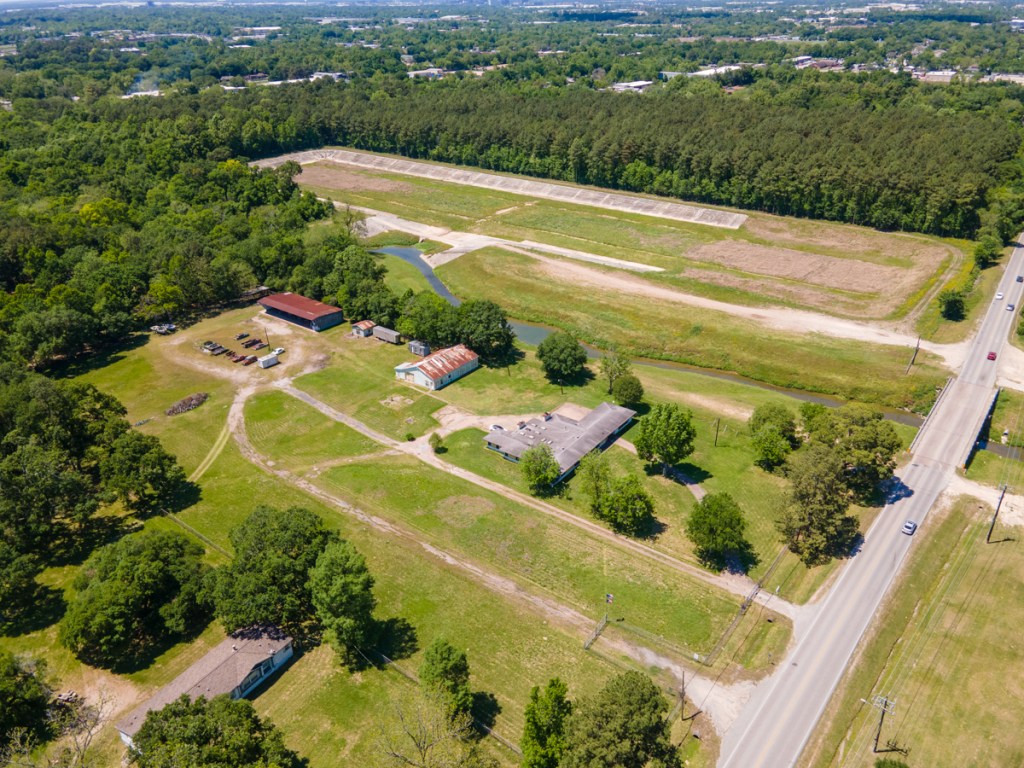
Almost Completed Stormwater Detention Basins in Halls Watershed

Basin on Little York east of US59
New basin at Hopper and US59
Third new basin north of Helms Road east of Airline Drive
Fourth new basin south of Helms Road west of Airline Drive.

Recently Completed in Halls Watershed

Hall Park Stormwater Detention Basin East of US59 at Parker. Google Earth images show this project was substantially completed in 2018.
Bretshire Stormwater Detention Basin West of US59 at Parker. Google Earth images show this project was substantially completed in 2015.
Keith Weiss Park Stormwater Detention Basin on Halls Bayou east of Aldine Westfield. Google Earth images show this project was substantially completed in 2015.
West of Aldine Westfield, there’s a small basin owned by TxDOT. HCFCD hopes to enlarge this basin into the surrounding wooded areas as part of bond project C-25. Google Earth images show the first phase of this project was completed in 2012.

Funding “Shortfall” Not Yet Known

The Chronicle writer also claimed a “funding shortfall” for Halls of $272 million. Curious that he would make this statement just days before the GLO announces the winners of a statewide competition. Harris County could get some, none or all of its requests. To be clear, the competition is stiff; Harvey affected more than 40 counties. Regardless, there’s more than $2 billion up for grabs ($1 billion in this round and $1.144 billion in the next). It seems to me, the Chronicle writer could have waited a few days to publish results rather than rumors.

We Need Real Historical Data on Flood Mitigation Spending

Whether you agree with Rodney Ellis, Adrian Garcia and Lina Hidalgo or not, they have fought tenaciously for their constituents. They succeeded in reordering the priorities in flood-bond spending to serve low-to-moderate income neighborhoods first. For the Chronicle to imply that they failed their constituents is an insult to the Judge and Commissioners.

And to imply that all the money is going to more affluent neighborhoods is simply false. That claim seems designed to inflame racial hatred. Kingwood, for instance, has NEVER received one federally funded capital improvement project from HCFCD. Yet the Chronicle’s readers evidently concluded rich neighborhoods get all the money. Again, there’s no substitute for research.

From the Chronicle writer’s Twitter feed.

Inflaming racial tensions based on false information is the last thing America needs at this time.

In my opinion, we need facts, not fiction. Asserting discrimination is not the same as proving it.

Chronicle Article Also Ignores Tax Issue, Funding Realities

The Chronicle’s “HCFCD-puts-poor-people-at-the-back-of-the-bus” narrative also ignores the mechanics of funding projects. Before the flood bond vote in 2018, I spent an hour with former County Judge Ed Emmett discussing funding needs. A high priority at that point was to make local tax dollars stretch as far as they could by leveraging partner funding.

The need to leverage partner funding was even addressed in the final flood bond language. Paragraph 14 G states “…the commissioners court shall provide a process for the equitable expenditure of funds recognizing that project selection may have been affected in the past and may continue to be affected by eligibility requirements for matching Federal, State and other local government funds.”

Nobody stretches local tax dollars like the US Department of Housing and Urban Development (HUD). HUD is one of the main sources for funding projects in low-to-moderate income neighborhoods. Why?

HUD often offers a 90% match.

But there are two catches. First, you’re only eligible if at least 70% of residents that benefit from a project qualify as “low-to-moderate income” (LMI). Second, HUD is slow. To put “slow” in perspective, the Texas General Land Office just started accepting HUD grant applications from Imelda last Saturday. Imelda happened 586 days ago.

Looking at the flood bond spreadsheet (Page 6 of 10) and the expected partnership share of Halls Bayou Projects, you can see that 90/10 ratio reflected in most of the projected funding for Halls.

It’s unclear whether voters would have approved a flood bond that was 9X higher, especially when everyone, rich and poor alike, expressed concerns about not getting their fair share.

Alternative Sources of Halls Funding More Risky

Had HCFCD tried for FEMA funding instead, the low home values in Halls neighborhoods may have yielded a poor Benefit/Cost Ratio. Commissioner Ellis constantly reminds people about the perils of FEMA funding when applied to LMI neighborhoods.

So really, HCFCD had no choice but to focus on HUD for Halls projects.

  • The neighborhoods qualified.
  • The HUD match was far higher.
  • That minimized a tax increase.
  • It also maximized the number of possible Halls projects.

This was not a “gamble” as the Chronicle headline implied; it was actually the least risky option that seemed to benefit the most people.

Map above taken from HUD CDBG-MIT Draft Grant Application from Halls Bayou Watershed shows that 144,000 people in the watershed qualify as LMI (low to moderate income). That’s 70.6% of the total residents. To see the complete draft, visit this page.

We all need to calm down and wait to see how much money HUD grants the Hall’s Bayou Watershed projects. Brittany Eck of the GLO told me that she expects decisions by the end of this month. That’s this Friday.

Posted by Bob Rehak on 4/27/2021

1337 Days since Hurricane Harvey and 586 since Imelda

The thoughts expressed in this post represent opinions on matters of public concern and safety. They are protected by the First Amendment of the US Constitution and the Anti-SLAPP Statute of the Great State of Texas.

HCFCD Issues Flood Bond Update as of March 30, 2021

In the March 30, 2021 Harris County Commissioner’s Court Meeting, Harris County Flood Control District (HCFCD) gave a Flood Bond update. Here’s where projects in the 2018 Flood Bond program stand.

Overview

In the 30 months since the bond was approved by Harris County voters, the Harris County Flood Control District has used bond funds to:

  • Accept 25 grants totaling approximately $960 million with Bond funds providing around $259 million in local matching funds
  • Execute 326 engineering agreements totaling $241 million
  • Award 39 construction agreements totaling $296 million
  • Procure 19 staff augmentation agreements providing 113 contract staff members
  • Acquire nearly 340 properties at a value over $208 million for construction projects, floodplain preservation, and wetland mitigation banks
  • Make $115 million available to the Office of the County Engineer to manage and construct drainage improvements in nearly 100 subdivisions across Harris County
  • Conduct 140 community engagement meetings with over 11,413 attendees
  • Complete nearly 630 home buyouts at a value over $130 million with over 680 additional in process for a buyout (since Hurricane Harvey)
  • Complete over $125 million repair program to address damages to District infrastructure caused by Hurricane Harvey

19 Projects Completed, 372 Underway

The flood bond update shows that of the 19 projects completed so far, investigations, analyses and studies comprised 15.

Altogether there are 372 individual HCFCD projects in progress related to the Bond Program. The table below shows the stages of those projects.

88% of all projects identified in the flood bond are currently underway and at some state of completion.

Only 21 Projects Not Yet Started

Only 21 Bond projects have not yet started. They are all in the fourth quartile of the bond prioritization framework and will begin between July 2021 and March 2022. Of those, two are in the San Jacinto watershed: CI-61 (East Fork, West Fork, and Lake Houston Dredging) and F-15 (General Drainage Improvements near Atascocita).

Dredging included a $10 million match with estimated partner funds of $40 million.

FEMA/Army Corps, TWDB and City of Houston funds have covered dredging in the river to date.

Status of Lake Houston Area Projects

Other projects in the Lake Houston Area at least partially underway.

Luce Bayou and Huffman

Project underway include right-of-way acquisition, design and construction of general drainage improvements in the Luce Bayou Watershed and near Huffman (total $20 million). Luce Bayou right-of-way acquisition and floodplain preservation ($10 million) has also started.

Gates on Lake Houston Dam

Design and construction of additional gates on Lake Houston ($20 million) is nearing completion of the design phase. The City of Houston has taken the lead on that project but has made no announcements on it recently.

Other Projects Lake Houston Area Partially Underway
  • The San Jacinto Watershed Study ($625,000)
  • Funding for future partnership projects based on the SJR watershed study ($18.75 million)
  • Investigation of potential detention sites around the Glendale Dredge site in Partnership with the City of Houston ($50,000)
  • Conveyance improvements along Panther Creek ($10 million)
  • General drainage improvements east of Lake Houston ($10 million)
  • General Drainage Improvements near Kingwood ($10 million)

One Third of Projects Now Past Design Phase

One third of all projects have already begin work outside.

Ellis Not Content with 40% of Construction Going into Two Bayous in His Precinct

40% of all projects under construction are in Greens and Halls Bayou Watersheds, the two Precinct One Commissioner Rodney Ellis cares most about. He wants to slow down projects in other areas to focus more on projects in his area.

For a discussion of how the meeting went, check back tomorrow.

For the full Flood Bond update, click here. For future reference, this link is also posted on the Reports page under the Harris County Flood Control District, tab.

Posted by Bob Rehak on 3/30/21

1309 Days after Hurricane Harvey

How to Find Active HCFCD District Capital and Maintenance Projects

If you’ve been wondering what Harris County Flood Control District (HCFCD) is up to, check out this interactive GIS Map on HCFCD.org. It shows all active capital and maintenance projects, their exact locations, and budgets. It’s one of several interactive GIS maps that can give you critical information about flood risks, flood maps, mowing schedules, and more.

Active Projects for January 2021

The map below shows active HCFCD projects for January 2021. HCFCD says it updates the maps in the first week of each month. Projects that start after that may not show up until the following month. Active projects include both capital (new construction) and maintenance projects.

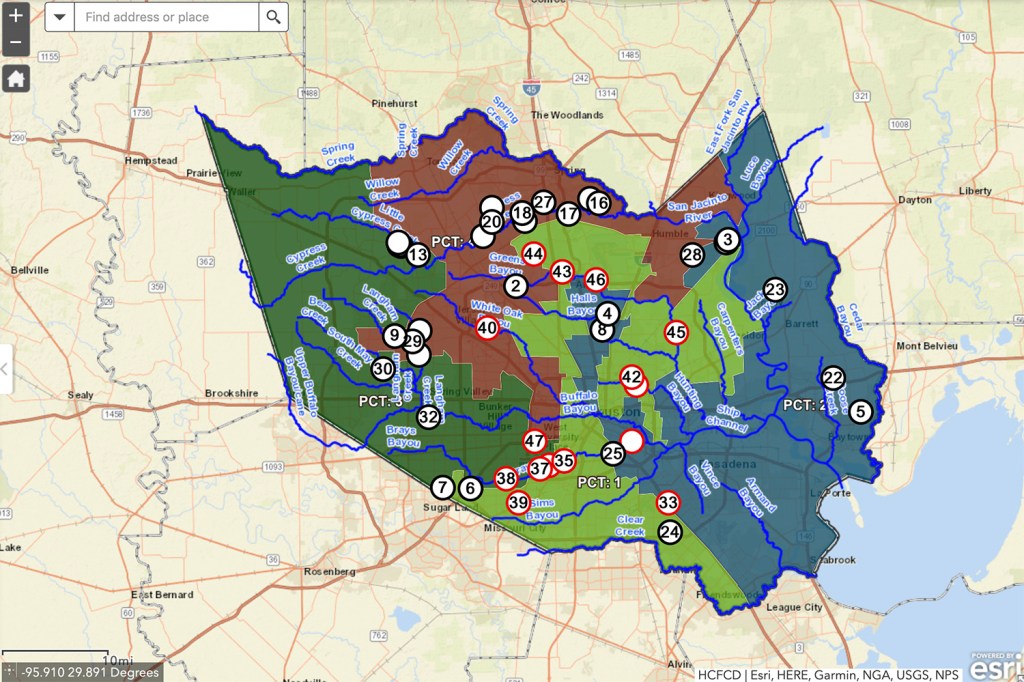
Click on the map to launch the app. Click on any project listed on the left or corresponding number on the map to review project description, budget and location in all Harris County Commissioners Court Precincts.

You will find both the legend and filters in the upper right corner. Red circles represent capital projects and black circles represent maintenance projects. To focus only on one type, click the layer icon in the far upper right. Press one type of project or the other to deselect it.

Active project viewer on HCFCD site. Note: not all of these projects involve flood-bond dollars.

What Capital Projects Include

Capital projects include major projects that reduce flooding risks and damages by:

  • Increasing stormwater conveyance capacity in bayous and drainage channels
  • Excavating stormwater detention basins.

Stormwater detention basins reduce flooding risks and damages during heavy rain events by safely storing excess stormwater and slowly releasing it back to the bayou when the threat of flooding has passed. 

More About Maintenance Projects

Maintenance projects include repair projects aimed at returning flood damage reduction channels and other infrastructure to their original designed level of performance by: 

  • Repairing sinkholes, slope failures and other damage caused by erosion 
  • Removing sediment that can reduce stormwater conveyance capacity. 

Smaller maintenance projects grouped together under one construction contract are often given both individual Project Identification Numbers and an umbrella number that begins with the letter “Z,” since there is often more than one watershed involved in the group. “Z-packages” have numbers such as Z100-00-00-X223. 

What Map Does NOT Include

This map does not include flood damage reduction studies or projects in other preliminary phases; smaller maintenance projects performed by Flood Control District work crews; or completed construction projects.

Equity?

One of the first things that strikes me about the January map is the lack of projects in the northeastern portion of the county. To be fair, two small maintenance projects have started in Kingwood since the map above was compiled. But still, a glance at the map shows that projects are heavily skewed toward the south, central and western sides of the county.

Example: The construction projects now underway on Brays, White Oak, and Hunting Bayous total more than $100 million. But there are ZERO construction projects underway in Kingwood, Humble, Huffman, Atascocita, Spring, Tomball, and Crosby – all areas hard hit by Harvey.

Fairness to all?

Commissioner’s Court has pushed the Flood Control District to start projects in lower income areas first based. A majority of commissioners worry that low income residents are less able to recover from floods. They also worry that money in the flood bond won’t cover all projects identified in the 2018 flood bond. Some have even talked about floating another bond.

Good luck with that if they don’t adopt a more equitable definition of “equity” which the 2018 flood bond promised!

Posted by Bob Rehak on 1/25/2021 based on public information provided by HCFCD

1145 Days since Hurricane Harvey

HCFCD Data Shows Socially Vulnerable Zip Codes Receive 80% of Buyouts

Harris County Judge Lina Hidalgo, Precinct 1 Commissioner Rodney Ellis, and Precinct 2 Commissioner Adrian Garcia are pushing the idea of a Community Resilience Task Force focused on helping socially vulnerable neighborhoods receive a higher percentage of the $2.5 billion flood bond.

However, zip codes that rank in the top 50% of the CDC’s Social Vulnerability Index (SVI) already receive 80% of Harris County Flood Control District buyouts and 79% of the District’s active mitigation projects.

FOIA Request Reveals Emphasis on SVI Index

Data obtained from HCFCD via the Freedom of Information Act shows that in Harris County…

…the two most socially vulnerable quartiles are FOUR TIMES more likely to receive a buyout.

HCFCD Buyouts Favor Socially Vulnerable Population 4:1

As of 7/28/2020. Source: Data obtained from HCFCD via FOIA request. Quartiles 3 and 4 are the most vulnerable on the CDC’s Social Vulnerability Index.

Here’s how that looks as a pie chart.

HCFCD Buyouts by SVI Quartile. The two most socially vulnerable quartiles receive 80% of all buyouts.

This is not surprising. For months, Hidalgo, Ellis and Garcia have pushed the District to incorporate the Social Vulnerability Index into its priorities. It has worked.

Do We Need More Balance?

Socially vulnerable neighborhoods get 80% of HCFCD buyouts and 79% of flood bond projects. Do those seem like fair percentages to you?

Tell the County Judge Your Opinion

The County Judge’s office is inviting the public to share their thoughts and ideas on the proposed draft bylaws of the Community Resilience Task Force that encourages even more spending by social vulnerability guidelines. 

You can register your opinion from now until July 30th, 2020, via one of the following methods:

  • Email CRTF@cjo.hctx.net and submit comments digitally, beginning July 21
  • Join a virtual focus group via Zoom. After registering, participants will receive a confirmation email containing information about joining the meeting.

For More Information

For more information on the “equity bias,” see this series on “Where Flood Mitigation Dollars Have Really Gone.” It was developed a year ago so the focus is on historical spending.

Or this series:

Posted by Bob Rehak on 7/29/2020

1065 Days since Hurricane Harvey

Harris County Changing How It Will Choose Which Flood Projects to Support; Welcome to the “Equity Bias”

Imagine you pull up to a stoplight and two needy people approach you for a handout. You want to help, but have only $1 in your pocket.

Do you give the dollar to the person who has not eaten for the longest time? Or to the person from the zip code with the highest percentage of minorities and lowest average household income?

As you may have guessed, the people at the stoplight are a metaphor for flood victims.

More Needs than Dollars

Harris County doesn’t have enough dollars to build every flood mitigation project that everyone needs. Flood mitigation requires tough choices.

So the County is setting up a supposedly unbiased task force to decide whom to help. But its composition will be biased toward people who believe flood bond money should favor low income, minority neighborhoods, i.e., the constituents of the three politicians pushing the task force (Judge Lina Hidalgo, Precinct 1 Commissioner Rodney Ellis, and Precinct 2 Commissioner Adrian Garcia).

Stacking the Jury

Look at the proposed overview and bylaws for the Community Resilience Task Force. You will see that they embed the concepts of equity, social justice, and social vulnerability into every recommendation the task force will make. For flood mitigation. Housing. Health. Construction. Urban planning. And more. For the next 30 years!

Proposed bylaws for the task force explicitly state that the members MUST demonstrate:

  • An interest in “equitable” flood mitigation.
  • Interest in socioeconomic and demographic factors that affect resilience.

So they are baking “equitable” into the job descriptions.

Difference Between Equitable and Equal

“Equitable” treatment sounds like “equal” treatment. But it’s not.

Treating people equally means treating them identically. Treating people equitably means treating them differently, but fairly.

For instance, handicapped people get to park closer to the door. That’s fair…based on need.

But what happens when you start making flood mitigation decisions on the basis of race, income, and social vulnerability? Is that fair to more affluent communities destroyed by flooding?

Flood Spending Based on Race and Income?

Ms. Hidalgo, Mr. Ellis, and Mr. Garcia define “equitable” so preference goes to the “socially vulnerable.” Their argument goes like so.

Because poor people have a harder time recovering from floods, they should get more protection from flooding. They can’t afford to flood (…as if anyone can).

Hidalgo, Ellis and Garcia all advocate the use of a CDC social-vulnerability index and LMI (low-to-moderate-income) data to prioritize flood projects.

They argue in meeting after meeting that FEMA bases grant decisions on a benefit/cost ratio (BCR) that favors neighborhoods with more expensive homes. That’s true, but…

Socially Vulnerable Neighborhoods Already Receive Preferential Treatment

They never mention that Department of Housing and Urban Development (HUD) Community Development Block Grants for mitigation (CDBG-MIT) and disaster recovery (CDBG-DR) already favor poorer (LMI) neighborhoods.

Nor do they mention that the County has already received a BILLION dollars in CDBG-DR funds. Or that the Texas General Land Office is sitting on top of approximately $4.2 billion in CDBG-MIT funds that it’s trying to distribute. The vast majority of those funds must go toward LMI/socially vulnerable neighborhoods. (The exact percentages vary by storm and type of grant. But they often range up to 70%.)

Problems With Basing Flood-Mitigation Decisions on LMI Data

There are two more problems with basing flood-mitigation decisions on racial and LMI data.

  • First, it ignores need. Shouldn’t projects that help the largest numbers of people or the worst flooding be mitigated first?
  • Second, LMI data only comes by zip code. Zip codes can mask huge disparities in wealth. So even if you feel poor people deserve more flood protection than the middle class, it’s hard to ensure that result with zip code data. Elm Grove, for instance, is an LMI neighborhood embedded within an affluent zip code.

Mr. Ellis argued that his Precinct One constituents, who are 76% African-American and Hispanic, would not get their projects because money they deserved more was being spent in affluent Kingwood.

He did not mention Army Corps of Engineers grants to HCFCD for work on four bayous in his precinct. Nor did he mention that in the entire history of Harris County Flood Control (which dates back to 1937), not one federal dollar has ever been funneled through HCFCD by the Corps for work in the Lake Houston Area.

4 Out of 5 Flood Bond Projects in SVI Neighborhoods

How much have Ellis, Hidalgo and Garcia skewed flood bond spending to date?

During the Commissioners Court meeting on June 30, 2020, Harris County Flood Control was asked to prepare a report to document the status of flood bond risk reduction projects in socially vulnerable neighborhoods. See Item 2E on Tuesday’s Commissioners Court Agenda. It shows a startling fact.

Out of the 145 active bond projects, 79% are located in high or moderately high SVI areas.

Letter from HCFCD to Commissioners Court

The distribution looks like this.

79% of Flood Bond Projects are located in the most socially vulnerable neighborhoods; only 21% in the least socially vulnerable neighborhoods. Source: Memo to Commissioners Court from HCFCD.

If you live in a “socially vulnerable” neighborhood, you’re 4X more likely to have a flood bond project near you.

And those are just the projects based on Flood Bond money. The Flood Control District is also pursuing additional CDBG grants and Army Corps funding to help fund even more projects in socially vulnerable areas. Those projects are not reflected in these percentages.

Rushing Through Public Comment Period

One measure of how much Ellis, Hidalgo and Garcia want to institutionalize their own definitions of equity is that they’re giving only six more days for public comment with little public warning.

You can bet that the commissioners court meeting on the 28th will be packed with surrogate speakers for Ellis, Hidalgo and Garcia who favor the “equity bias.” They’ve shown up in Commissioners Court for months.

Why wouldn’t they? It’s worked. They now have 4 out of every 5 flood bond projects going into their neighborhoods and they could get even more if this task force goes through in its current form.

Meanwhile, the San Jacinto watershed, says the Greater Houston Flood Mitigation Consortium, received 0% of the mitigation budget prior to Harvey, yet had 14% of the region’s damages during Harvey. 

How Do We Decide What’s Fair?

So, should projects go to neighborhoods that:

  • Had the fewest flood mitigation projects?
  • Flooded the worst?
  • Help the greatest number of people for the dollars invested?
  • Are the poorest?

Or should the money be split equally or on some other basis?

Personally, I think decisions like these should be left in the hands of engineers, not partisan politicians.

Register Your Opinion

The County Judge’s office is inviting the public to share their thoughts and ideas on the proposed draft bylaws of the Task Force. You can register your opinion from now until July 30th, 2020, via one of the following methods:

  • Email CRTF@cjo.hctx.net and submit comments digitally, beginning July 21
  • Join a virtual focus group via Zoom. After registering, participants will receive a confirmation email containing information about joining the meeting.
  • Offer input during the July 28th Commissioner’s Court

Posted by Bob Rehak on July 24, 2020

1060 Days since Hurricane Harvey


For more information on the “equity bias,” see this series on “Where Flood Mitigation Dollars Have Really Gone”

Or this series on “The Equity Flap”

Where the Flood Mitigation Dollars Have Really Gone: Part 4

The last three posts on the equity flap have focused on how minority neighborhoods in Precinct 1 already receive more flood mitigation funding than affluent areas like Kingwood. Tonight, I focus on why that is likely to continue for the foreseeable future. But first, a recap for context.

Biggest Beneficiary of Funding Claims Discrimination

Last Tuesday, the equity flap erupted again in Harris County Commissioners Court. Precinct 1 Commissioner Rodney Ellis complained that because of historical discrimination (i.e., slavery, which was abolished more than 150 years ago), he needs to fight for “equity” in the distribution and implementation flood bond projects. Precinct 1 already receives the lion’s share of many types of funding.

What Mr. Ellis does not point out to the Commissioners Court is that Precinct One:

Exploiting Past Wrongs to Perpetuate Inequity

When talking about “historic discrimination,” Commissioner Ellis needs to shift his focus forward in time and look at other areas of the county that receive NO such joint projects and far fewer flood mitigation dollars. Take the San Jacinto Watershed, for instance. It contains Kingwood. Because of Kingwood’s affluence, it’s one of the favorite whipping boys for Commissioner Ellis and his surrogates who argue for equity. They keep bringing equity up every time a Kingwood-related item is on the Flood Control agenda at commissioners court. But the Kingwood/Lake Houston Area has NO such joint projects. Why?

Causes of Inequity

There are two reasons for this inequitable distribution: one obvious, one not so.

First, the obvious: The Houston region has grown from the downtown area outward. Precinct 1, which includes downtown, is older. Flood problems became apparent sooner. Precinct 1 documented problems, identified solutions, and rallied Federal support decades ago.

Commissioner Ellis’ predecessors also started this process decades ago and Precinct 1 enjoys the rewards today. As a consequence…

Buffalo Bayou and all of its tributaries are eligible for Corps support on non-emergency projects; the San Jacinto is not.

The Corps is working on Buffalo Bayou and all of its tributaries thanks to legislation passed years ago. The Cypress Creek watershed actually overflowed into the adjoining watershed during Harvey. For a complete Corps presentation on Buffalo Bayou and its tributaries, see this link.

Even though the problems in the Lake Houston Area have been building for decades, the danger didn’t become apparent until Harvey.

At this point, rallying the kind of Federal support that Precinct 1 has historically enjoyed will involve an act of Congress and Presidential approval. Literally. That’s an uphill battle compared to the battle that Mr. Ellis’ projects face.

Political Challenges for San Jacinto Watershed

A local sponsor, such as the City, would have to file an application for a project. Congressional representatives would have to get the President to build it into the annual budget, then include it in the Water Resources Development Act. Both houses of Congress would have to pass the act. The President would have to sign it. And then the government would have to distribute the money. The distribution usually happens in phases, after approval of each phase of a project, such as:

  • Feasibility study
  • Engineering and design
  • Construction, operation and maintenance
  • Changes after construction authorization
  • Changes after construction

It could easily take three to five years just to get the engineering and design phase on a project, such as additional flood gates for Lake Houston.

A second challenge: Mr. Ellis and his surrogates using unfounded “equity” arguments to further handicap and delay flood mitigation in the Lake Houston Area.

Damages in Lake Houston Area

Unfortunately, the sedimentation and conveyance problems on the San Jacinto only became apparent after decades of additional upstream development. That exacerbates flooding by funneling water to the river faster. In recent years, Conroe was the fastest growing city in America.

Then along came the Tax Day, Memorial Day and Hurricane Harvey floods. They deposited an estimated 5 to 10 million cubic yards of sediment in the East and West Forks. Much of that came from sand mines upstream of Lake Houston, which Lake Conroe inundated when it released 80,000 cubic feet per second at the peak of the storm. This further exacerbated flooding by backing water up in the river and drainage ditches.

As a result, the Lake Houston area suffered billions of dollars worth of damage to schools, bridges, roads, homes, churches and businesses during Hurricane Harvey. At least 13 people in the Kingwood Area died as a result of the flood, 12 in ONE senior living complex.

Two Wrongs Don’t Make a Right

Citing historical discrimination that goes back to pre-Civil-War days, Mr. Ellis argues for equity to increase his precinct’s share of flood mitigation dollars and to accelerate projects in his precinct.

As the data shows, his precinct already has far more than its fair share of mitigation dollars. Now, he threatens other areas, property and lives by delaying and usurping their aid.

If any area is underfunded and fighting discrimination now, it’s the Lake Houston Area. Ironically, the discrimination is coming from the Rodney Ellis’ of the world.

I don’t begrudge Precinct 1 a penny of the flood mitigation funds it has received to date. And I admire Mr. Ellis for fighting so hard for his constituents. However, I despise the way he does it.

Mr. Ellis represents one fourth of the people in the county. Yet he cries “equity” and ignores facts to usurp more than half of flood mitigation funding and put his Bond projects at the front of the construction line. I wish he would acknowledge:

  • The inequality that exists in current funding and that is likely to continue for years.
  • That a Kingwood, Humble, Atascocita or Huffman life is as valuable as a life in Precinct 1.
  • Facts.

Ironically, the Lake Houston Area argued for equity in the bond language to prevent the very kind of reverse discrimination that we are now seeing. We need to work together to mitigate flooding everywhere as quickly as we can. This equity flap is fanning racial flames that divide us, perpetuate distrust, delay mitigation, and threaten lives. It’s time to get on with the hard work at hand. Two wrongs don’t make a right.

Posted by Bob Rehak on 6/28/2019

668 Days since Hurricane Harvey

Where Flood Mitigation Money Really Goes: Part Three

Yesterday, the equity flap continued in Harris County Commissioners Court. Surrogates for Precinct 1 Commissioner Rodney Ellis again took the podium to talk about how affluent neighborhoods deprived low-to-moderate neighborhoods of flood mitigation dollars. The argument they use: FEMA prefers buying out high dollar homes to reduce repetitive flood insurance losses.

Commissioner Ellis describes his district as 78% African-American and Hispanic, with another 6% from other minorities. And according to HUD, Precinct One contains many low-to-moderate-income neighborhoods. See below.

Low-to-moderate-income neighborhoods by precinct in Harris County.

Harris County has four precincts; each has roughly the same number of people. In an equitable world, you would expect roughly 25% of the buyouts to be in each district. If there really is a “buyout bias” against low income neighborhoods, you would expect Precinct 1 to have less than 25%. But it doesn’t.

Precinct 1 Gets More Than Its Fair Share of Buyouts

Under the Freedom of Information Act, I requested the number of buyouts in Precinct 1 and other precincts since 2000. Once again, hard data contradicts the self-serving myth. Since 2000, when buyouts began in Precinct 1, HCFCD bought 955 homes in Precinct 1 and 2,413 homes in other precincts.

Precinct One has slightly more than its fair share of buyouts.

So where’s the discrimination in buyouts?

HCFCD is buying out homes faster than ever. To learn more about their process, visit this page. With FEMA funds from Harvey, HCFCD hopes to buy out 1,100 homes in the next few years. By comparison, the District bought out only 2,075 homes in the 32 years before Harvey.

Precinct 1 Gets More Than Its Fair Share of HCFCD Construction

In part one of this series, we learned that Precinct One gets the lion’s share of Harris County Flood Control District construction spending for flood mitigation.

Precinct One receives almost half of all Flood Control District spending on construction, leaving the other three precincts to divvy up the other half.

Precinct 1 Gets More Than Its Fair Share of Federal Benefits

In part 2 of this series, we also learned that five of the six active federally-funded flood mitigation construction projects in Harris County are on bayous that flow through Precinct One. No other precinct comes close to receiving that kind of support. That means Precinct One receives more benefits from federally funded flood mitigation projects than any other Precinct in Harris County.

Based on total estimated contributions when completed. Data source: Harris County 2018 Federal Report.

If Commissioner Ellis or his surrogates have any data to back up their claims of discrimination in flood mitigation spending, they should share it. In every commissioners court meeting they spout the same half truths to bolster their share of flood mitigation dollars. So far, it appears to be working quite well for them. And not so well for residents in other precincts.

Posted by Bob Rehak on 6/26/2019

666 Days since Hurricane Harvey

Where the Flood Mitigation Money Has Really Gone: Part Two

At Harris County Commissioners Court yesterday, “equity” proponents from low-to-moderate-income (LMI) neighborhoods in Precinct 1 again complained they weren’t getting their fair share of flood mitigation dollars. In crying “foul” over a perceived lack of buyout dollars, they ignore the fact that the bulk of Federal mitigation spending is on construction projects that benefit their precinct.

The Federal Government is contributing $814 million to joint HCFCD/Army Corps projects that benefit Precinct 1. Only one joint project in Harris County does NOT benefit Precinct 1.

Part One of this series focused on Harris County construction spending for flood mitigation. It found that Precinct 1, which is 78% African-American and Hispanic, received 47% of all Harris County Flood Control District (HCFCD) dollars spent on construction. That left three other precincts to divvy up the remaining half. But Federal contributions for construction spending are even more lopsided as the chart above shows.

2018 Federal and Harvey Reports Yield Surprises

In Part Two, I examine Federal construction spending in Harris County on joint Army Corps/HCFCD projects. Some are Corps-led; others County-led. Regardless, they all involve Federal contributions. Close review of the latest Federal Report from HCFCD and other information obtained through the Freedom of Information Act reveals some startling facts.

  • Precinct 1 benefitted from more Federally-backed projects than any other precinct.
  • Only one Federal project did not benefit Precinct 1.
  • Sims Bayou, which lies mostly within Precinct 1, was the only one of six Federal projects completed before Harvey. And it was one of the few bayous in the County that did not widely flood.
  • The Lake Houston Area received no Federal dollars for flood mitigation prior to 2018.

Federal Investments Ignored by Precinct 1 Activists

The only joint project actually completed before Hurricane Harvey was in Precinct One. It involved the widening of Sims Bayou and creating additional detention ponds. Together, these actions almost eliminated flooding during Harvey. A huge benefit to Precinct 1. See map below.

Sims Bayou in Precinct 1 was one of the few bayous in Harris County that did NOT come out of its banks during Harvey. See green arrow. The San Jacinto watershed (red arrow) flooded along its entire length and received NO Federal dollars prior to Harvey.

Sims Completed and Did Not Flood Widely

On page 6 of its Final Harvey Report, HCFCD states, “Sims Bayou was one of the few channels in the entire county that did not suffer widespread and extensive overbank channel flooding largely due to the completion of the federal flood risk reduction project and three HCFCD regional detention basins. Water levels for Harvey were generally below the historical records of Tropical Storm Allison and averaged between a 2.0% (50-yr) and 1.0% (100-yr) level downstream of Martin Luther King Blvd and generally below a 10% (10-yr) annual exceedance probability from Airport Road upstream to the headwaters.”

Sims Project Saved Thousands of Homes from Flooding

Further, Page 19 of the final Final Report on Hurricane Harvey notes,”The recently completed … Federal Project and supplemental detention basins constructed by HCFCD reduced the number of homes flooded by about 6,500 along Sims Bayou.”

“Bottom line – the larger channel carried a lot more stormwater downstream away from subdivisions along the bayou and the large detention basins stored stormwater that would otherwise flow through subdivisions along the bayou.” 

The Harris County Flood Control District Federal Briefing (Page 102) from 2018 also shows that the Sims project removed more than 35,000 homes and 2,000 commercial structures from the 100-year flood plain.

The Sims project received $390 million: $125 million from HCFCD and $265 million from the Army Corps.

In contrast, the Federal Briefing lists $0 in federal funding for the San Jacinto watershed.

Hunting Bayou and Achieving “Social Justice” in Precinct 1

At least one Army Corps project in Precinct One won Corps support because of the presence of LMI neighborhoods. Yet “equity” proponents contend the Federal government discriminates against them.

Page 79 of the Federal Report indicates Hunting Bayou (entirely within Precinct 1) received $98 million from the County and $68 million from the Corps, in part because of social justice factors. That’s another $165 million.

Residents claimed in their plea for funds that:

  • “Residents in the Hunting Bayou watershed deserve the same level of potential flood risk reduction as those who live in other parts of Harris County.
  • “The economically disadvantaged Hunting Bayou residents struggle severely to recover from house and business flooding.”
  • “The Corps’ economic analysis is an important factor in prioritizing competing projects for annual Federal funding, but it is biased against economically disadvantaged communities like in Hunting Bayou.”

Prior to 2018, had Hunting Bayou residents received the same level of support as those in the more affluent Lake Houston Area, they would have received NO support from the Federal government.

Three Other Precinct 1 Watersheds Receive Major Federal Support, Too

Three other watersheds in Precinct 1 have received major federal and county commitments for construction of flood mitigation measures. Because they are in various stages of completion, I show total cost estimates below to facilitate comparison.

  • Brays Bayou which flows through precincts 1, 2 and 3 will receive a total of $480 million; half from the county and half from the Corps. See page 60.
  • White Oak Bayou flows through Precincts 1 and 4. There, the County and Corps are excavating 9.7 million cubic yards of detention basins. That’s more than 5 times the volume of sediment removed from the San Jacinto to date. Estimate: $124 million, $90 million of it at Federal expense. See page 68.
  • Clear Creek flows through Precincts 1 and 2. Estimate: $249 million, $98 from local and $151 million from the Corps. See Page 91.

One Lone Exception

The Federal government partnered with HCFCD on only one project in Harris County that did not directly benefit Precinct One: a detention pond in Precinct 4 on Greens Bayou near 249, Beltway 8 and Cutten Road. This $58 million project received $43 million from the Corps. See Page 97.

The Corps does have other projects in Harris County, such as the Addicks and Barker reservoirs. However, HCFCD plays no active role in those. Likewise for the San Jacinto dredging project. This analysis looks only at joint projects that involve Harris County and the Corps.

Federal Construction Versus Buyout Dollars

Because Mr. Ellis’ surrogates base their arguments on buyouts, we need to put those in perspective.

Buyouts are tiny compared to construction spending. In Harris County, they represent just 6.6% of Federal construction spending for flood mitigation.

Page 120 of the 2018 Federal Brochure deals with buyouts. It shows approximately two dozen buyout projects completed in Precinct One. However, few if any appeared active at the time of publication in 2018.

In the entire county, FEMA was funding only $57.1 million in buyouts.

But the Army Corps contributes 19 times more than that in construction dollars for projects that benefit Precinct 1.

The numbers below represent Federal contributions only:

  • Sims – $265 million (In Precincts 1, 2)
  • Hunting – $68 million (In Precinct 1)
  • Brays – $240 million (In Precincts 1, 2, 3)
  • White Oak – $90 million (In Precincts 1, 4)
  • Clear Creek – $151 million (In Precincts 1, 2)
  • Total Estimated Federal Contribution to Joint Construction Projects that benefitted Precinct 1: $814 million
  • Total Estimated Federal Contribution to Joint Construction Projects NOT benefitting Precinct 1 (Greens): $43 million
  • Total Estimated Federal Contribution to Joint Projects in Lake Houston Area before 2018: $0

And Commissioner Ellis’ surrogates complain about discrimination! Maybe that’s why they get so much money.

Note that HCFCD does not break out spending “by precinct” for bayous that flow across precinct boundaries; they list only project totals. The list of bayous above represented ALL the HCFCD/Corps projects in the 2018 Federal Report.

Note also: Video of the commissioners meeting still had not been posted at the time I posted this story.

Posted by Bob Rehak on 6/26/2019

666 Days since Hurricane Harvey

Where Flood Mitigation Money Has Really Gone: Part One

“Equity” proponents would have you believe that Harris County flood mitigation money is all going to high-income neighborhoods. However, data obtained from Harris County Flood Control under the Freedom of Information Act shows that construction spending for flood mitigation is highly concentrated in Precinct 1, which contains many low-to-moderate-income neighborhoods.

At the last Harris County Commissioner’s Court meeting, the issue of “equity” in the prioritization of bond funds came up again. Commissioner Rodney Ellis from Precinct 1 invited several groups to testify about how Low-to-Moderate Income (LMI) groups suffered at the expense of more affluent areas like Kingwood.

Alleged Bias Against LMI Groups Distorts True Picture

They alleged bias against LMI groups by focusing on only one aspect of flood mitigation: buyouts. They said that high-income areas received preference over low-income areas when buying out flooded homes. That’s because of higher home values and thus higher repetitive losses. However, by focusing on this one issue, and ignoring the big picture of Flood Control construction spending, these groups distort the true picture of where flood mitigation dollars actually go.

Precinct 1 is 76% African-American and Hispanic

Rodney Ellis’ Precinct 1 website contains a description of the ethnic composition of his constituents. “With approximately 1.1 million residents, Harris County … Precinct One’s multi-racial, multi-ethnic population is roughly 39 percent African American, 37 percent Latino, 18 percent Anglo, 5 percent Asian and 1 percent other,” it says.

Large Disparities in Construction Spending Favor Precinct 1

Yet according to historical data on construction spending obtained from Harris County Flood Control District through the Freedom of Information Act…

In the last 21 years, Precinct 1 has received at least four to five times more construction dollars from Harris County Flood Control than Precinct 4 which contains Kingwood.

In fact, Precinct One received the single largest construction project in the history of Harris County Flood Control. The excavation of the Kuykendahl and Glen Forest Stormwater Detention Basins cost $59,840,117.41. In contrast, during the last 21-years, the entire San Jacinto River Watershed (the largest in the county) received only $3,345,976.28 in construction funds – one-eighteenth of what that Precinct 1 detention basin project cost!

The money spent on the San Jacinto also represented just one half of one percent of the $663,894,766.38 spent on all construction by the Flood Control District during that 21-year period.

Rodney Ellis’ Precinct 1 is bright green area in center of picture. Black dots represent maintenance projects; red dots represent capital (construction) projects. Note that almost all of the currently active capital improvement projects fall within Precinct 1.

In contrast, the Brays and Sims Bayous, both of which run through Commissioner Ellis’ district, received almost 100 times that amount. The $330 million spent on those two watersheds alone represented virtually HALF of the entire $663.9 million Flood Control District construction expenses in the last 21 years!

Lopsided Distribution of Flood Mitigation Money

In fairness, note that those watersheds do not lie entirely within Precinct 1. However, Precinct 1 also contains parts of Greens Bayou, White Oak Bayou, Halls Bayou, Hunting Bayou, Buffalo Bayou and Clear Creek (see map above). If you add in even a small portion of $229.4 million spent on those watersheds, the Precinct 1 construction numbers become even more lopsided.

  • Greens received $74.3 million
  • White Oak received $47.8 million
  • Halls received $22.3 million
  • Hunting received $23.7 million
  • Buffalo received $44.3 million
  • Clear Creek received $17 million.

Meanwhile, Kingwood received $0 construction dollars but suffered more than a billion dollars worth of damage during Harvey. Yet Mr. Ellis and his friends imply we hog flood mitigation dollars from poor people. THEY demand EQUITY! It’s time someone called this what it is – BS.

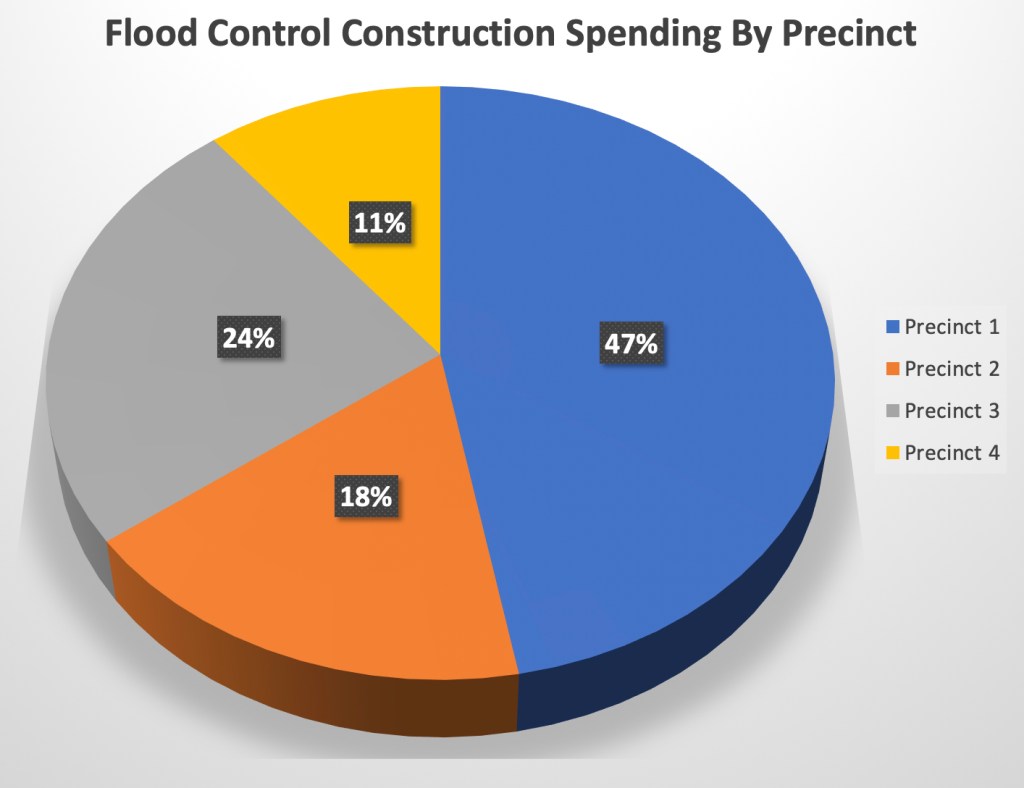
Of the $586 million spent by Flood Control on projects entirely within a single precinct (i.e., projects that did not bridge two or more precincts), Precinct 1 received 47% of all Flood Control District construction spending. Here’s how it breaks down.

Actual Construction Spending by Precinct since 1998

Between 1998 and 2019, Precinct 1 received 47% of all Flood Control District construction funds spent on projects entirely within each precinct. These percentages do NOT include spending on projects that cross districts.
Precinct 1$275,835,964
Precinct 2$103,529,679
Precinct 3$143,873,825
Precinct 4$62,427,867

Precinct Discrimination Disguised as “Equity”?

Precincts are supposed to be roughly equal in population. Yet these figures are so lopsided, one could argue that Mr. Ellis and his friends are deliberately crying discrimination to get a larger share of the pie at the expense of areas like Kingwood. But it’s more complicated than that; Precinct 1 is also taking money from LMI neighborhoods in other precincts.

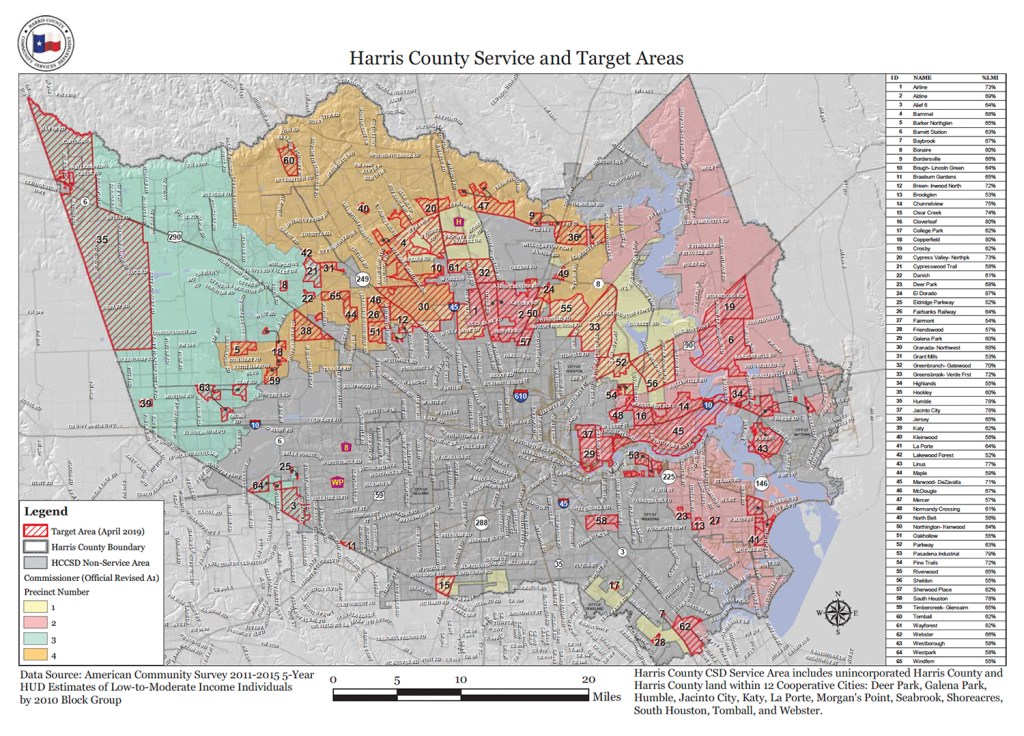
Look at the distribution of LMI neighborhoods throughout Harris County in the map below. It’s based on five years of recent HUD data. You can see a broad, concentrated LMI band across northern and eastern Harris County.

For a high-resolution PDF of this LMI map, click here.

If anything, these numbers demonstrate a consistent pattern of geographic discrimination against residents of other precincts. Rodney Ellis’ Precinct 1 received 47% of construction dollars for flood control, leaving the other three precincts to divvy up the other half. Precinct 4 contains roughly one fourth of the population but received just 11% of construction dollars.

I’m not suggesting that the Precinct 1 projects were not needed or that the money was not spent wisely. I am suggesting that Precinct 1 LMI residents should not paint Kingwood as a villain. To do so is intellectually dishonest. We are not taking construction dollars from LMI neighborhoods. The County’s own data shows the opposite.

Precinct 1 is taking dollars from affluent and LMI neighborhoods alike.

I will cover other aspects of this story in upcoming posts. In the meantime, County Commissioners vote today on approving the vendor for the Kingwood Area Drainage Assessment. See item 2-B-5 on page 9. The approval of the study caused the equity flap at the last meeting. Let’s hope it doesn’t cause another one in this meeting. After all, the Flood Bond was sold to citizens as a tool to correct problems based on need, not income.

Posted by Bob Rehak on 6/25/2019

665 Days since Hurricane Harvey