Tag Archive for: Montgomery County

What Went Wrong, Part III: Perry Homes’ Woodridge Village Detention Pond Catastrophe

Note: This is the third in a five part series about What Went Wrong in Woodridge Village that may have contributed to flooding in Elm Grove and North Kingwood Forest. It focuses on Detention Ponds.

Section 7 of the Montgomery County Drainage Criteria Manual cautions, “The introduction of impervious cover and improved runoff conveyance serves in many cases to increase flood peaks quite dramatically over those for existing conditions.” And that’s exactly what happened in Elm Grove and North Kingwood Forest in May and September of this year. Two subdivisions that had never flooded before were inundated with several feet of water from Woodridge Village.

Perry Homes failed to observe numerous regulations in the Drainage Criteria Manual including provisions for:

  • Erosion control measures such as pond linings, revegetation, backslope swales
  • Maintenance roads
  • Increases in downstream flooding
  • Geotechnical reports for detention ponds
  • Drainage of detention ponds

Critically, they also failed to construct all the detention ponds they promised.

Less than a Quarter of Detention Ponds Built

When listing factors that contributed to the flooding, the absence of several promised detention ponds should rank near the top.

  • Before the May flood, only one of five detention ponds (S1) was substantially complete and it provided only 7% of the promised detention capacity.
  • Before the September flood, contractors substantially completed a second detention pond (S2) that added another 16% of promised detention capacity.
  • Since then, no work has been done on additional excavation to protect against flooding.
While clearcutting ALL of the land, Perry Homes installed only PART of the detention.

According to LJA Engineering, Perry Homes was supposed to develop the project in two phases and clearcut only 30 acres in the northern section during Phase 1. However, something changed. Instead, Perry Homes clearcut the entire northern section. And they still haven’t excavated any of the three detention ponds there.

By May 2019, only S1 was substantially complete. By September, S2 was also substantially complete, but overwhelmed.

Had Perry Homes installed all the detention that it promised, the site should have detained a foot of rainfall. But it didn’t. When Imelda came along, it was like trying to pour 100 gallons of water into a 23 gallon jug. Water spilled out of the development into adjacent streets and homes.

Erosion Control Measures Missing for Detention Ponds

Section 7.2.7 of the Montgomery County Drainage Criteria Manual details Erosion Control Measures for Detention Facilities. It states:

“The erosion potential for a detention basin is similar to that of an open channel. For this reason the same types of erosion protection are necessary, including the use of backslope swales and drainage systems (as outlined In SECTION 6), proper revegetation and pond surface lining where necessary. Proper protection must especially be provided at pipe outfalls into the facility, pond outlet structures and overflow spillways where excessive turbulence and velocities will cause erosion.” (See page page 123 of pdf, numbered 113 in doc.)

Revegetation?
Not much grass in S1 (right of the road) or the area that drains into it. All aerial photos below taken on 11/4/2019.
Not much grass on the slopes of S2 either, although Perry Homes did make an ineffective attempt to hydromulch the south (right) border.
No Protection for Overflow Spillway
Perry Homes quality! This spillway from Taylor Gully (right) was supposed to have a grass lining, but still does not. Picture taken 11/4/2019. As of 11/21/19 work still had not started on the lining. Perry Homes has done virtually no work on this pond for three months. However, they did start lining the channel on the right today.
Backslope Interceptor Swales?
The northern edge of the S2 pond has no backslope interceptor swale. As a consequence, water from Taylor Gully at the top of this frame flows over the edge of the pond and erodes it. This may not be a sustainable solution. In the long run, the Gully could erode its way into the pond from the north (top of the frame).

Maintenance Road Missing at Critical Point

Section 7.2.8 talks about Maintenance of Detention Facilities. It states, “A 30-foot wide access and maintenance easement shall be provided around the entire detention pond.” The most critical place in the entire chain of detention ponds, the final outflow culvert into Taylor Gully, has no room for a maintenance road. That’s because when they installed the required backslope interceptor swale, the only place left for it was the maintenance road. That’s planning for you!

S2 has no maintenance easement or road at final outfall into Taylor Gully. The backslope interceptor swale takes up that space.

No Increase in Downstream Flood Levels Allowed

Section 7.3 talks about DETENTION DESIGN PROCEDURES. It clearly lays out the design goal when it says…

No increase in downstream flow rates or flood levels will be allowed.

Further down in this section, the regulations state: “The maximum 100-year water surface elevation in all detention facilities shall be a minimum of 1 foot below the minimum top of bank elevation of the basin.”

Judging from this video shot by Edy and Ricki Cogdill during the May 7th storm, I would say Perry Homes didn’t meet that objective. It reminds me of that slime show on Nickelodeon, but in this case, the innocent bystanders got slimed.

No Geotechnical Report for Groundwater Level at Pond Sites

Section 7.5 discusses GEOTECHNICAL INVESTIGATIONS. It says, “Before initiating final design of a detention pond, a detailed soils investigation by a geotechnical engineer should be undertaken.” Regulations state that the ground water investigation must be “at the proposed site.” Montgomery County has no record of such an investigation or report.

A company called Terracon prepared a Preliminary Geotechnical Report for Perry that addressed issues pertaining to utilities, road pavement and residential foundations. But it makes no mention of detention ponds.

The company took four widely spaced borings around the perimeter of the site that managed to miss all the detention pond locations. Significantly, they missed all the wetlands, too.

Page 17 of Terracon Report. Red lines added to improve visibility of locations.

MoCo Claims It Has No Further Geotechnical Reports

If Perry Homes did additional investigations into ground water on this site, Montgomery County says it doesn’t have them.

If no further investigations were conducted, this could be a fatal flaw affecting the economics of the entire development. Note the presence of standing water in the photo below.

S2 Pond (left), Taylor Gully (center), and area where N3 pond will go (right) all have standing water that will reduce their rated capacity.

The presence of standing water reduces the rated capacity of detention ponds and channels. Only the area above the standing water counts as capacity. Regulations say that these ponds should drain completely (see below).

Thus, S2 likely has lost a third of its designed capacity. N3, when eventually built, could fare worse. Note how close the water is to the surface in the small pond on the right.

If you can’t go deep to get your detention pond capacity, you have to go wide. And that will mean fewer homesites than the 896 they planned. This site might not even make economic sense for building homes.

Problems with Homes Built Over Wetlands

The presence of wetlands in the northern section, which the Terracon report never mentions, would also significantly reduce the site’s suitability for building homes.

This article describes the problems with homes built on wetlands. The title: “Caution: Building in a Wetland Can Be Hazardous to Your House.” A biologist for the US Fish and Wildlife service who investigated filled wetlands in Pennsylvania warned: “Build your house in a wetland, and you’ve got a hobby for the rest of your life. You will be fighting that water forever.” He discusses cracked foundations and also warns, “When wetlands are filled, the water that made them wet has to go somewhere. … the water likely is leaking into formerly dry homes of downstream property owners.”

I’m sure Perry Homes would divulge the presence of former wetlands to the future buyers of homes on this site. It’s the only ethical thing to do and Kathy Perry Britton, CEO, has standards to maintain.

Incomplete Drainage of Detention Ponds

Section 7.6 of the Drainage Criteria Manual addresses GENERAL REQUIREMENTS FOR DETENTION POND CONSTRUCTION. It states:
“A pilot channel shall be provided in detention facilities to insure that proper and complete drainage of the storage facility will occur.” (Emphasis added.)

Complete drainage will likely never occur in S2 and N3 because of the high water table.

To excavate S2 to the required design depth, contractors had to continuously pump water out of it as they worked. It still retains water to this day.

Photo by Jeff Miller on June 2, three days after contractors started digging to the final depth. No surface linings were ever added to this portion of the pond per Section 7.2.7 of the MoCo Drainage Criteria Manual.
Photo taken on June 3 shows contractors were pumping water out of pond as they continued excavating.

If Perry Homes continues its Woodridge Village venture using its current plans, chances are, the company will never provide enough detention capacity for real world conditions. When modeling, their engineers did NOT use the current Atlas-14 rainfall statistics from NOAA.

The new statistics would require 40% more capacity to ensure downstream safety.

Where Does Perry Homes Go from here?

After ignoring regulations, hundreds of homes flooded. And they will flood again. Owning this site is like hanging a millstone around one’s neck. It could drown the entire company in perpetual litigation and debt.

Future Posts in this series will look at:

  • Contradictions in Perry Homes’ Plans
  • The Dirt on Perry Homes’ Soil Test
  • The Floodplain that Wasn’t

Posted by Bob Rehak on 11/21/2019 with help from Jeff Miller

814 Days since Hurricane Harvey and 63 since Imelda

The thoughts expressed in this post represent opinions on matters of public concern and safety. They are protected by the First Amendment of the US Constitution and the Anti-SLAPP Statute of the Great State of Texas.

What Went Wrong, Part II: Lack of Erosion and Sediment Control Worsen Elm Grove Flooding

On May 7th and September 19th, sediment-laden runoff from Perry Homes’ Woodridge Village development in Montgomery County flooded the streets and homes of Elm Grove Village and North Kingwood Forest. On September 26, the City of Houston wrote a cease and desist letter to Perry Homes, its subsidiaries and contractors. The letter alleged that runoff damaged the City’s sewer system and residents’ homes. It demanded that Perry Homes’ proxies stop sending sediment into the City.

After Imelda, Abel Versa had to grab his car to avoid slipping in ankle-deep sediment on Village Springs. The sediment came from Woodridge Village right behind him.

Sediment Control Measures Not Followed in Subdivision Rules and Regs

If Perry Homes and its contractors had followed all the construction regulations affecting drainage, the flooding of Elm Grove would not have happened and the letter would not have been necessary. So what went wrong? I previously reviewed the sediment control measures in the Montgomery County Subdivision Rules and Regulations. Perry Homes received seven strikes. Among the worst apparent violations:

  • They clearcut 268 acres when the rules say no more than 10.
  • They are supposed to plant temporary vegetation but haven’t.
  • They were supposed to make provisions for increased runoff during construction, but didn’t.

In fact, they have substantially completed only 23% of the permanent detention ponds for the whole subdivision despite clearcutting all 268 acres.

The southern section of Woodridge Village has been cleared, filled and graded since last summer. Grass could have reduced the runoff during Imelda. Photo taken on 11/4/2019.
The northern section has also been mostly cleared for months, though workers are still removing piles of dead trees. This shows the area where they filled wetlands. Because no detention exist for the northern section, runoff from 188 acres is supposed to funnel through a 3′ pipe. That’s not working well in heavy rains. You can see how much loose sediment is exposed to floodwaters.

More Regulations in Drainage Criteria Manual Not Followed

Perry Homes also overlooked many provisions in the Montgomery County Drainage Criteria Manual. Twenty-two of the 175 pages also discuss erosion and sediment control (see Section 6 starting on page 85). Among the more serious omissions:

Channel Slopes Severely Eroding

Section 6.2.1 on Grass Establishment states that: “A good grass cover must be established on all areas within the right-of-way (except the channel bottom) disturbed by channel improvements or by any type of construction. An adequate grass stand on the banks helps stabilize the channel and minimize erosion caused by overbank flow and high velocities in the channel. Establishing a good grass cover requires preparing the seedbed, seeding properly. keeping the seed in place, fertilizing, and watering regularly.

The LJA Engineering report never mentions erosion or sediment control by those words. However, it does mention grass-lined and concrete-lined channels and spillways. Only one problem. The channels are not grass lined and most of the areas designated for concrete lining have yet to be lined.

The banks of detention ponds should be lined with grass. They are not. As a result, sediment is slumping to the bottom of the ponds where it is carried downstream by floodwaters.
This closeup shows how severe the erosion is.

Channel Turns Not Protected

Section 6.2.3 on Minimum Erosion Protection Requirements for Bends specifies that bends in drainage ditches must be protected from erosion by grass, rip-rap, or concrete. The material depends on the radius of the curve, the type of soil, average water velocity and maximum water velocity.

Despite funneling 188 acres of sheet flow into Taylor Gulley, which narrows down into a 3-foot pipe, Perry Homes has done little to increase the channel capacity or detention for that area. Worse, the channel design which may have been adequate for forested wetlands, can no longer handle high volume overland sheet flow.

The most obvious needs are on the eastern side of the development. There, Taylor Gully makes a 120-degree turn, then two quick 90 degree turns and two 45-degree turns, all within two hundred yards. Getting dizzy? The floodwater turns 390 degrees in this area!

At each turn the banks take a beating. The full force of the floodwater slams against the far bank and erodes it.

Photo taken on 11/4/2019 along eastern boundary of the southern section of Woodridge Village. That’s North Kingwood Forest on the right and Elm Grove on the bottom. Little wonder that this was the area hardest hit by flooding in May and September.
Where the channel on the right narrows down into the black 3-foot pipe, contractors built an overflow channel into the detention pond on the left but still have not lined it with concrete. Note the severe erosion. Also note the erosion and sediment coming into the pond on the left just below the flow-constricting device in Taylor Gully. Clearly, there isn’t enough channel capacity to handle the volume of water. Photo taken on 11/4/2019, looking north.

Straight Drop Spillway Not Installed

Section 6.2.5.3 states that a straight-drop spillway should be installed in drainage channels to adjust channel gradients which are too steep for design conditions. 

LJA specifies one between where detention pond N3 will be and the 120-degree turn shown above. However, neither the detention pond, nor the spillway have yet been installed. So water from the north comes barreling down the ditch on the right unchecked. The high velocity increases erosion. Here’s what it looked like after May 7th.

Same area shown above but from ground level and looking south toward Elm Grove. Rain did a lot of the excavating for Perry Homes. But unfortunately, the sediment wound up in flood victims’ homes and the City storm drains.

Yesterday I posted about how Perry Homes was supposed to cut only 30 acres of trees on the northern section but cut 188. Still to come in this “What Went Wrong” Series:

  • More Things Perry Homes Didn’t Do in the Montgomery County Drainage Manual
  • Contradictions in Perry Homes’ Plans
  • The Dirt on Perry Homes’ Soil Test
  • The Floodplain that Wasn’t

Posted by Bob Rehak on 11/20/2019 with help from Jeff Miller

813 Days since Hurricane Harvey and 62 since Imelda

The thoughts expressed in this post represent opinions on matters of public concern and safety. They are protected by the First Amendment of the US Constitution and the Anti-SLAPP Statute of the Great State of Texas.

Perry Homes’ Woodridge Village Investment Could Be Costliest Ever

Usually when you make an investment, the worst thing that could happen is that you lose all your principle. But Perry Homes could loose a hundred times more than they paid for Woodridge Village land. That takes special talent.

Out-of-Pocket Costs

The land that Woodridge Village sits on didn’t cost much; much of it was wetlands and many streams converged there. Regardless, a Perry Homes subsidiary, Figure Four Partners, bought the land. Montgomery County Appraisal District values the two main parcels at less than a million dollars. Together they comprise more than 80% of the 268-acre project. (See screen captures below from Montgomery County Appraisal District website.)

Real Costs Could Be 100X Greater

Now let’s look at the real costs to Perry. Just to screw up the land, they paid for:

  • An engineering study that underestimated drainage needs by at least 40%
  • Clearcutting and grading 268 acres
  • Filling in natural drainage
  • Excavating two detention ponds (out of five they promised)
  • Soil tests and a geotechnical report
  • A mile of pavement to the middle of nowhere
  • Two large box culverts
  • Storm drains

Let’s say that cost another five million.

But all of that contributed to the flooding of approximately 200 homes in May and 350 in September. Let’s assume the damage to each home totaled $100,000. That comes to about $55,000,000.

Furniture, appliances, rugs, window coverings and other contents? Let’s assume an average of $40,000. That would total another $22,000,000.

Let’s also assume that 300 cars flooded. Average cost – $30,000. Bingo. $9 million.

Now let’s estimate the reduced marketability of homes that flooded. To do this, let’s assume an average price of $200,000 per home and a 20% reduction. That would cost homeowners $40,000 each in the market value of their homes. That’s another $22,000,000.

And we haven’t even factored in the legal fees of J. Carey Gray, counselor extraordinaire.

If juries rule in favor of the flood victims, that million dollar investment could add up to more than $100 million in potential liabilities…before any penalties for negligence and/or gross negligence kick in.

Corps Now Investigating Wetland Violations

Perry Homes bought wetlands and must have thought that no one would notice when they filled them in. They didn’t even bother to request a jurisdictional determination from the Corps for the wetlands. That reduced costs even more. It’s a proven formula in business; minimize costs to maximize profits.

But perhaps Perry Homes went too far. People did notice. The wetlands that they conveniently ignored fall under the jurisdiction of the Army Corps. And the Corps is now investigating potential violations of Section 404 of the Clean Water Act. That could get expensive all by itself.

Like Building Homes at the End of a Gunnery Range

It just keeps getting worse for Perry. This was kind of like buying land to build homes at the end of a gunnery range. A little risky.

But it’s too late to rethink that decision. No one will ever want to buy a home on this site. It’s less marketable than swampland near Chernobyl.

There’s another rule of thumb in business. When you find yourself in a hole, stop digging. And that’s exactly what Perry has done. They have stopped work on the site for months. Work on detention ponds that would help protect people downstream from future flooding is going undone.

That means the numbers above could balloon with the next big rain. Or a negligence ruling by a jury. Yep, we’re in double Jeopardy now.

Career-Limiting Moves

Whoever made the decision to develop Woodridge Village definitely made a CLM (career-limiting move). At this point, even Perry Homes employees not associated with the decision must worry about their Christmas turkeys. Few careers or companies survive blunders that become case studies for how not to do something.

Eroding Profit Margins

Because of faulty assumptions and corner cutting, Perry Homes put itself between a rock and a hard place. They’ve managed to turn a million dollar investment into a potential $100 million liability. They can’t develop this property profitably now. And they can’t sell it. Who would want to buy this land and inherit the liability every time a storm cloud floats by?

To protect downstream homes from flooding, they would have to expand the detention ponds by at least 40%. And that would eliminate so many homesites that costs could exceed income. I say “at least” because the issue is not just Atlas-14 compliance. While digging the S2 detention pond, contractors hit water that’s not going away.

The S2 Detention Pond has lost about 20-30% of its capacity. The bottom 3-5 feet have been filled with ground water since contractors started digging to the target depth.

That means they can’t achieve their detention goals by going deeper; they’ll have to go wider. And that will cut into marketable land even more.

Toxic for Perry Homes

Let’s face it. When Perry Homes bought this property, Kathy Perry Britton swallowed a poison pill. Woodridge Village now has a toxic reputation that will infect the rest of Perry Homes. No one will ever be able to trust anything Perry Homes says again.

Just imagine how bad this could get for Perry Homes if Montgomery County and the City of Houston really started scrutinizing their permit applications in the future.

But what to do with this land? If you’re Kathy Perry Britton trying to spit shine the legacy of dear old dad, you can’t keep it. And you can’t sell it. You can’t even give it away. No land conservancy organization would take it until the damage done to wetlands and streams was remediated. That could take decades.

The Real Value of Wetlands

However, there are two pieces of good news in this mess.

  • If Perry Homes implodes, it won’t take a lot of investors with it; the company is private.
  • Perry Homes may serve as a lesson to other developers and teach them that the real value of wetlands is their downstream legal costs.

Time To Be Decisive

Just remember, Ms. Britton. Historically, 85% of Houston floods are non-tropical. So if you think you have eight more months to figure this out, think again.

Posted by Bob Rehak on 11/15/2019

808 Days after Hurricane Harvey and 57 after Imelda

The thoughts expressed in this post represent opinions on matters of public concern and safety. They are protected by the First Amendment of the US Constitution and the Anti-SLAPP Statute of the Great State of Texas.

Provisions for Off-Site Overland Sheet Flow in Montgomery County Drainage Criteria Manual Warned Perry Homes of Dangers to Elm Grove

Section 5.3.5 of the Montgomery County Drainage Criteria Manual (Pages 83-84) specifically address flooding of established subdivisions by land under development. For example when Elm Grove was flooded from clearcut land in Woodridge Village. Had Perry Homes, its subsidiaries and contractors followed the requirements in the Manual, Elm Grove might not have flooded.

Provisions Adequate for Ultimate Development Can Be Severely Deficient for Intermediate Stages

The section on Offsite Overland Flow starts out by saying, “Sheet flow from undeveloped areas into an existing or a proposed subdivision can create a localized flood hazard by overloading street inlets and/or flooding individual lots.” This is exactly what happened to Elm Grove Village and North Kingwood Forest in May and September of this year. City of Houston storm drains already taxed to the max became overloaded when water broke out of Woodridge Village and started flowing down the streets of Elm Grove and North Kingwood Forest.

Streets of Elm Grove during May 7th Flood show danger of not planning for runoff during intermediate stages of development.

The text in the Drainage Manual then continues. “Any drainage plan for a proposed subdlvision submitted for review and approval by the Montgomery County Drainage Administrator must address the drainage of all adjacent lands. Both under undeveloped and fully developed conditions. A plan which may be adequate under conditions of ultimate development can be severely deficient during intermediate conditions of development due to sheet flow from adjacent undeveloped land. Provisions must be made to divert 100-year sheet flows to a channel system or to the secondary street and storm sewer system.” [Emphasis added.]

The LJA Drainage Analysis claimed Woodridge would create “No adverse impacts to neighboring developments or Taylor Gully.” However, the LJA analysis did not:

  • Discuss the drainage of adjacent lands, such as Elm Grove.
  • Discuss intermediate conditions of development; they focus only on fully developed Phase 1 and Phase 2 Conditions.
  • Mention the phrase “sheet flow” once.
  • Make provisions to divert 100-year sheet flows.

No Swales to Redirect Sheet Flow

The next paragraph of the Montgomery County Drainage Criteria Manual starts, “Redirection of the sheet flow can usually be achieved through the use of drainage swales located in temporary drainage easements along the periphery of the subdivision.” Perry Homes built no such swales … at least not adequate ones.

No Berms to Block Sheet Flow

Later in that same paragraph, the Manual talks about building berms between the swales and adjoining neighborhoods to prevent the flow from overrunning the swale. Unfortunately, on May 7th, no such berms existed. They did for Imelda, but they proved inadequate to divert the sheet flow and they had gaps in them.

No Additional Storm Sewer Capacity

The next paragraph talks about building “additional inlet and storm sewer capacity … to prevent prolonged street ponding in the (neighboring) subdivision resulting from flow from the undeveloped area.” That didn’t happen either.

No Planning for Rain Before Detention Ponds Fully Built

Perry Homes took none of these precautions. LJA never planned for them (as far as I can see from publicly available documents). Reading LJA’s drainage analysis, one gets the impression that no one ever even conceived of rainfall before they could build all the detention ponds for Woodridge Village. That turned out to be yet another fatal assumption. Despite all the warnings and mitigation advice in Montgomery County’s Drainage Criteria Manual.

Add this to a long and growing list of other things they ignored, underestimated, or mischaracterized.

Stay Tuned for More

The list goes on and on. I have barely started. This series could last for weeks. The MoCo Drainage Manual goes on for almost 200 pages. And Woodridge Village is far from the only Perry Homes Development.

Perhaps the biggest question in all of this is for the Montgomery County Judge and Commissioners. How do plans like this get approved?

Posted by Bob Rehak on 11/12/2019 with thanks to Jeff Miller

806 Days since Hurricane Harvey and 55 since Imelda

The thoughts expressed in this post represent opinions on matters of public concern and safety. They are protected by the First Amendment of the US Constitution and the Anti-SLAPP Statute of the Great State of Texas.


For those who are interested, I have reprinted verbatim the full text of Section 5.3.5 from the Montgomery County Drainage Criteria Manual below.


Section 5.3.5 Off-Site Overland Flow from the Montgomery County Drainage Criteria Manual (See Pages 83 and 84)

Sheet flow from undeveloped areas into an existing or a proposed subdivision can create a locallzed flood hazard by overloading street inlets and/or flooding individual lots. Any drainage plan for a proposed subdlviston submitted for review and approval by the Montgomery County Drainage Administrator must address the drainage of all adjacent lands. Both under undeveloped and fully developed conditions. A plan which may be adequate under conditions of ultimate development can be severely deficient during intermediate conditions of development due to sheet flow from adjacent undeveloped land. Provisions must be made to divert 100-year sheet flows to a channel system or to the secondary street and storm sewer system.

Redirection of the sheet flow can usually be achieved through the use of drainage swales located in temporary drainage easements along the periphery of the subdivision. As the adjacent area develops to the point at which the street system can effectlvely handle the sheet flow condition, the temporary drainage swales and easements may be abandoned.. The drainage swales should be relatively shallow, with the excavation spoiled continuously along the subdivision side of the swale to prevent flow from overrunnmg the swale. The swale should have sufficient grade to avoid standing water, but not enough to create erosion problems. Generally, a minimum. grade of 0.1% should be maintained with the maximum grade strongly dependent on local soil conditions.

Such temporary drainage swales may be directed to inlets in the storm sewer system or, preferably, to the appropriate primary outfall channel. lf an undeveloped area is to be drained to a storm sewer, additional inlet and storm sewer capacity must be provided to prevent prolonged street ponding In the subdivision resulting from flow from the undeveloped area. Provisions for this flow must also be included in the design of the street drainage overflow system. The design of temporary drainage swales directed to Montgomery County drainage channels must include adequate pro­visions to drop the flow into the channel through an approved structure in order to avoid excessive erosion of the channel banks.

Outfalling the temporary swale into the backslope drainage system for the channel is unacceptable because the backslope drainage interceptor structures are not adequate to convey flow from an off-site swale. A typical approved structure is shown in Figure 6.3, With the exception of the pipe dimension. The pipe must be sized to handle the 100-year flow from the off-site area.


Perry Homes Apparently Violating Montgomery County Development Regulations, Too

On September 26th, the City of Houston fired off a Cease-and-Desist Letter to Perry Homes regarding its Woodridge Village development just north of Elm Grove. The letter warned Perry and its subsidiaries to stop sending sediment into Houston storm drains. Now it appears the Perry gang is violating Montgomery County regulations, too. Let me call your attention to page 28 of the Montgomery County Subdivision Rules and Regulations. The sediment section reads (and I quote verbatim):


“IV. SEDIMENT CONTROL AND SEDIMENTATION PONDS. The subdivider shall provide effective sediment control measures in the planning and construction of subdivisions. Practical combinations of the following technical principles should be applied: 

  1. No more than ten acres of land in road right-of-way shall be exposed at any one time during development, without prior approval of the County Engineer. 
  2. When land is exposed during development, the exposure shall be kept to the shortest practical period of time. 
  3. Temporary vegetation and/or mulching shall be used to protect critical area exposed during development. 
  4. Sediment basins and traps shall be installed and maintained in properly designated places to remove sediment from runoff waters on land undergoing development. 
  5. Provisions shall be made to accommodate the increased runoff caused by changed soil and surface conditions during and after development. 
  6. The permanent final vegetation and structures shall be installed as soon as practical in the development. 
  7. The development plat shall be fitted to the topography and soils so as to create the least erosion potential.”

Let’s compare these principles with Perry’s practices.

Strike One

Shall provide effective sediment control measures in construction?

Photo taken shortly after May 7th flood on southern section of Woodridge Village.

Strike Two

No more than 10 acres of land shall be exposed at any one time?

How about 268 acres?

Strike Three

Land exposed for shortest practical period of time?

Drone footage of Woodridge Village southern section from May 9.
Shot of same area (from different angle) six months later.

Strike Four

Temporary vegetation?

Photo taken 11/4/2019, months after land was clearcut AND after two major floods.

Strike Five

Provisions to accommodate increased runoff?

Block after block of Elm Grove residents dragged their lives to the curb after being inundated by increased runoff from May 7th and Imelda.

Strike 6

Final structures installed as soon as practical? Let’s look at detention ponds…that aren’t there…despite months of ideal construction weather.

The N1 Detention pond should have been installed in the foreground months ago.
The N2 Detention Area (green triangle excavated by MoCo in 2006) was supposed to be expanded, but was not.
The N3 detention pond was to stretch from Taylor Gully in the bottom of the frame, almost to the tree line at the top. But nothing has been done.

Strike 7

Plat fitted to soils to create the least erosion possible?

Wetlands abounded on this property.
But Perry contractors filled in natural wetlands and streams.

Seven Strikes and You’re Out?

Not if you’re Perry Homes. Because when I first complained to the TCEQ about sediment flowing from the site in May, the TCEQ referred the investigation to Montgomery County. Then Montgomery County referred it to LJA Engineering. Perry Homes, of course, hired LJA to do the engineering on this site. So LJA was investigating itself and its client. Surprise, surprise, everyone called the problem fixed after installing some silt fencing in May. But it wasn’t fixed. Five months later, even more people flooded during Imelda than on May 7.

With the exception of some work on detention pond S2 last summer, Perry has not bothered to:

  • Expand detention capacity
  • Plant vegetation
  • Install sediment basins
  • Reduce runoff
  • Compensate for the wetlands and streams they filled in

Perry has done nothing in SEVEN months that reduced flood risk to Elm Grove. The work they did last summer didn’t prevent flooding in September. And they haven’t done anything since.

Yet Kathy Perry Britton, Perry Homes CEO, talks about the value of character, integrity and decisive action. The value of practicing good corporate responsibility. And Perry Homes’ commitment to excellence and distinguished reputation.

News flash, Ms. Britton. Going 0-7 doesn’t show a commitment to excellence. And suing flood victims certainly won’t establish a distinguished reputation. Although it may put you in the Hall of Shame with Montgomery County Commissioners who refuse to enforce their own regulations.

Posted by Bob Rehak on 11/12/2019, with thanks to Jeff Miller

805 Days since Hurricane Harvey and 54 since Imelda

The thoughts expressed in this post represent my opinions on matters of public policy and safety. They are protected by the First Amendment of the US Constitution and the Anti-SLAPP Statute of the Great State of Texas.

Questionable Assumptions by LJA Engineering May Have Compounded Elm Grove Flooding

Questionable assumptions about soil composition, rainfall patterns, wetlands and floodplain status for Perry Homes’ troubled Woodridge Village development may have compounded flooding in Elm Grove and North Kingwood Forest. Previously, I have focused on other more obvious issues, such as missing detention ponds and expected rainfall totals. However, Elm Grove resident Jeff Miller who has been studying the LJA Drainage Report, urged me to explore these additional issues.

Soil Type Closer to Clay than Sandy Loam

The LJA engineers doing the drainage analysis for Perry based their runoff calculations on a soil type called “sandy loam.” Different soil types absorb rainfall at radically different rates. According to 2011 data from Texas A & M Agrilife Extension, water infiltration rates for:

  • Sand = 2″ – 6″ per hour
  • Loam = .6″ – 2″ per hour
  • Clay = .2″ – .6″ per hour

Clay absorbs water very slowly, so rain turns into runoff quickly. Two photos below show what the Woodridge Village construction site looked like ONE WEEK AFTER a 2″ rain. It still had ponding water that did not soak in.

The northeastern portion of Woodridge Village looking southwest. Photo taken on 11/4/2019 one week after a 2″ rain. Note the ponding water that has not yet infiltrated.
A closer shot of the main portion of the north side of the site, also taken on 11/4/2019. Note the ponding water here, too. USGS characterized parts of this portion of the site as WETLANDS.
From the USGS National Wetlands Inventory. Note how the ponding water in the photo aligns with where the wetlands were.
Drone footage of southern section taken two days after May 7th flood. Courtesy of Jim Zura, Zura Productions.

In May, a retired local geologist from a major oil company estimated that the clay content in Woodridge soil was at least 50%, and could be as high as 80%. However, he could not commit to an exact figure.

Going by the A&M infiltration figures above and assuming an infiltration rate of 2″ per hour for a mixture of sand and loam, and contrasting that with the minimum infiltration rate for clay, .2″ per hour, you get a difference of 10X.

What does all this mean?

Based solely on soil type, the LJA Engineering report could err in its runoff calculations by as much as 10X.

Sections 1.1 and 2.1.3 of the LJA report discuss the runoff based on soil type. No matter how sophisticated the calculations, if you base them on the wrong soil type, the result will be inaccurate. “Garbage in, garbage out” as they say in the computer business.

Before clearcutting, there may have been more sandy loam in a thin surface layer. But contractors likely disturbed or buried that when they removed vegetation from the site and regraded the area.

If LJA wishes to challenge this, I will be happy to reprint their response verbatim. I would love to see their soil report.

But I would like to know how they explain the presence of ponding water throughout the entire northern section of Woodridge Village a full week after a two-inch rain. (Note that the northern section is the steepest and largest. It comprises 2/3rds of the Woodridge Village’s acreage.)

I took the aerial shots above at around 2PM on 11/4/2019. Here are the rainfall totals for the previous 7 days. Graph courtesy of Harris County Flood Warning System.

The Presence of Wetlands Should Have Been a Signal

The presence of wetlands should have been a signal to the developer, but the LJA report does not mention the word “wetlands” once.

Many residents who used to hike and bike this area before it was clearcut have told me that they could always find standing water there even in summer. Here’s an interesting article that explains why wetlands stay wet. The authors says, “Wetlands typically form in gently sloping or topographically convergent portions of a landscape, where surface and ground waters meet.” That certainly fits Woodridge Village.

As Miller says, “Drone footage; many photos; and the constant presence of water in the S-2 detention pond and the rectangular pond where N3 should be confirm that the ground is saturated. When the soil is totally wet, water will move over the surface.” And as LJA says in the intro to its report, “The project site naturally drains to Taylor Gully.”

And that’s exactly where so many people flooded when contractors accelerated the runoff through clearcutting and by not providing adequate detention.

Balanced Storm Assumption Rarely Accurate

Section 2.1 of the LJA report says that LJA models assumed a “balanced storm.” “This distribution is constructed such that the depth specified for any duration occurs during the central part of the storm (intensity position = 50%).” [Emphasis added.]

But as Jeff Johnson, the Montgomery County engineer, pointed out, using a “balanced storm” bases calculations on ideal assumptions. He also pointed out that only a small percentage of storms conform with ideal conditions. (Johnson made these remarks at a Montgomery County Commissioners Court meeting at which they discussed closing a loophole in flood regulations.)

According to the US Geological Survey, this graph represents a balanced storm.

In the ideal balanced storm, most of the accumulation happens in the middle of the storm.


But the May 7th and Imelda storms did not follow this pattern. The heavy rainfall was front-loaded in both.

More than half of the total rainfall during the May 7th event fell at the outset, not in the middle of the storm. Thus, it did not conform to the balanced storm model upon which LJA based its calculations.
During the 11 hours of rainfall from Imelda, more than 50% fell in the first three hours, and almost 80% in the first 4 hours. Thus, Imelda was also “front-heavy”.

LJA Assumed Woodridge Was Outside of 100-Year Floodplain

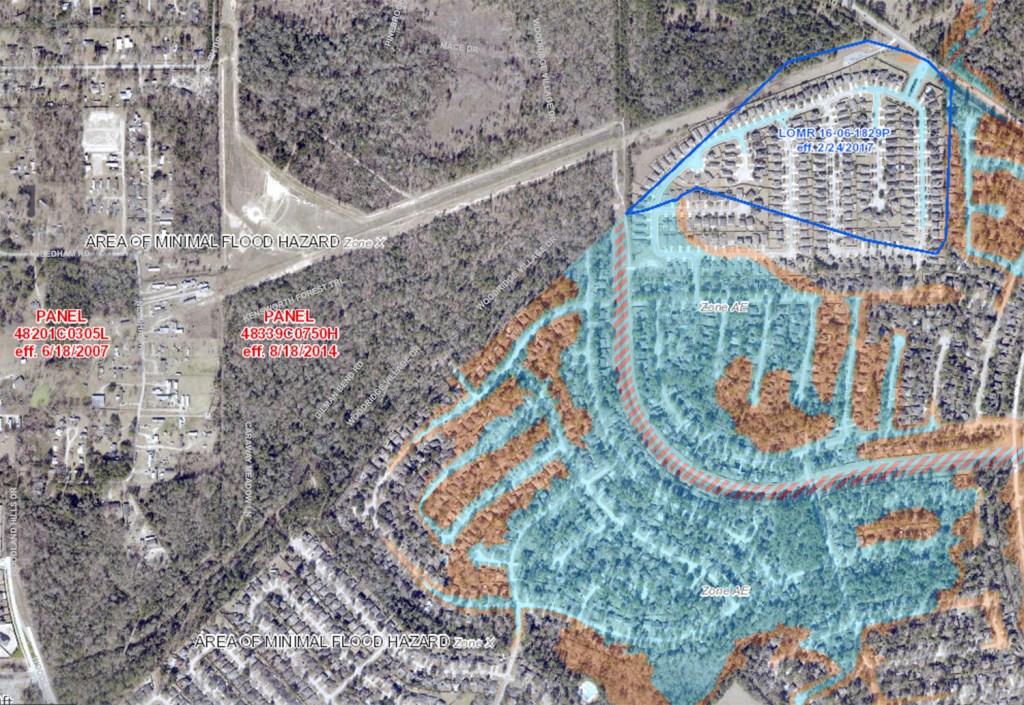
LJA also assumed (see section 1.5 of its report) that Woodridge Village was “outside of the 100-year floodplain.” For permitting purposes, that is technically true. LJA was going by accepted maps. But that area is not shown as flood plain only because FEMA did not model it. Note in the Montgomery County Flood Plain Map shown below how ALL FLOODPLAIN MAPPING STOPS AT THE COUNTY LINE.

That straight diagonal line you see is the Harris-Montgomery County Line.

Any engineer experienced in working with flood plains should know that physical boundaries do not stop abruptly at political boundaries. Any competent engineer should have questioned this.

Engineering Codes of Ethics Discourage Such Conduct

While LJA did what regulations required, they had a higher ethical obligation to protect people as licensed engineers. See the Code of Ethics of the NSPE – the National Society of Professional Engineers. It states:

“…engineers are expected to exhibit the highest standards of honesty and integrity. Engineering has a direct and vital impact on the quality of life for all people. Accordingly, the services provided by engineers require honesty, impartiality, fairness, and equity, and must be dedicated to the protection of the public health, safety, and welfare. Engineers must perform under a standard of professional behavior that requires adherence to the highest principles of ethical conduct.”

Under Fundamental Canons, the Society’s Code of Ethics also requires engineers to “Hold paramount the safety, health, and welfare of the public.”

Also see Professional Conduct and Ethics for Texas Engineers.

The latter states “In order to safeguard, life, health and property, to promote the public welfare, and to establish and maintain a high standard of integrity and practice, the rules relating to professional conduct in this title shall be binding on every person holding a license and on all firms authorized to offer or perform engineering services in Texas.” In this regard, LJA failed the people of Elm Grove and North Kingwood Forest dismally.

Overlooked Ethical Obligations Contribute to Dramatic Miscalculations

Ignoring the missing flood plain information, not mentioning wetlands, and mischaracterizing soil composition all contributed to dramatic miscalculations. Add those problems to ignoring new statistics that showed flood plain maps would need to be redrawn based on NOAA’s new Atlas 14, and that a 100-year storm would include 40% more rainfall.

Sometimes when you’re eager to make a project happen, optimism leads one to make “best-case” assumptions. But in my opinion, engineers should act on “worst-case” assumptions” to product public safety.

Sometimes, the cost of failure is simply unthinkable. This is one of them. Elm Grove flooding wasn’t as spectacular as a dam or a bridge failing, but it likely affected far more people.=

Webster and Spurlock law firms are currently trying to subpoena correspondence between LJA and Perry Homes and its subsidiaries. The Perry Homes gang is trying just as hard to stonewall production. It will be interesting to see what pressure, if any, they put on LJA to ignore these obvious problems…if the documents ever become public.

An even bigger ethical question: With such obvious problems, why did Montgomery County Commissioners and the City of Houston approve permits for this development?

Posted by Bob Rehak on 11/10/2019 with help from Jeff Miller and video from Jim Zura

803 Days after Hurricane Harvey and 51 after Imelda

The thoughts in this post represent my opinions on matters of public concern and safety. They are protected by the First Amendment of the US Constitution and the Anti-SLAPP Statute of the Great State of Texas.

Three Ways to Find Out If You Are In a Floodplain

Here are three quick and easy ways to find out if you are in a mapped floodplain of any kind.

FEMA – National Scope

The first site is FEMA’s National Flood Hazard Layer Viewer. Using this site, you can check any piece of property in the country…including Pike’s Peak or Walden Pond…just in case you want to do a Thoreau.

Another benefit of the FEMA site is that it spans county boundaries, i.e., if you live on the Harris/Montgomery County Line.

FEMA’s National Flood Hazard Layer Viewer can track creeks, etc. across county lines. Please note the big green space in the center of the frame. This is the new Perry Homes development, Woodridge Forest. Neither the FEMA map, nor the MoCo map below contain flood zone information for this area although much of it was wetlands before Perry clear cut it.

Harris County

Harris County operates a site called “Flood Education Mapping Tool.” The Harris County site superimposes drainage ditches, streams, creeks, bayous and rivers and even gives you their names and numbers. Very helpful if you want to report a problem some day, or track up or downstream to see where drainage issues may be originating.

Detail from Harris County map showing only drainage features and major streets in the Lake Houston Area.

Montgomery County

Montgomery County operates a site called “Am I in a Floodplain?” It includes some very helpful interactive tools, topographic maps and more.

People on Killerbee Lane will be pleased to know that they are not in any mapped floodplain.

Benefits of County Sites

According to Diane Cooper, a hydrologist with more than 20 years of experience in forecasting floods, both of the County sites have better imagery and more layers than the FEMA site.

Layers comprise one of the key features of both county sites. Experiment with them. I’m especially fond of the background layers.

They let you see the flood zones superimposed over simple maps, satellite images, historical satellite images, and more. The Montgomery County site even lets you click on streets and information about them pops up. I learned, for instance, that one subdivision in MoCo has a street named Paper Wasp Lane. You really don’t want to mess with the people on that street! It’s not far from Killerbee Lane. Let’s get up a football game between those two streets! I’d pay to see that.

Posted by Bob Rehak on October 10, 2019, with help from Diane Cooper

771 Days since Hurricane Harvey and 20 since Imelda

MoCo Commissioners Leave Loophole Open that Lets Developers Avoid Detention Pond Requirements

Three weeks ago, I posted about a loophole in Montgomery County regulations that lets developers substitute a flood routing study for detention pond requirements. Basically, if developers can show, using outdated and inaccurate information that runoff from their properties can “beat the peak” of a flood, they can avoid detention pond requirements. Fourteen developments currently underway in Montgomery County have used this loophole, according to Montgomery County Engineer Jeff Johnson.

Northpark Woods development in flood plain in Montgomery County

Yesterday, commissioners voted to leave the loophole open…at least until they receive the results of two studies…which have little to do with the loophole.

Here’s a link to a video of the discussion. Click on item 21.

Community Impact Flips Meaning of Testimony

For those short on time, Community Impact summarized the meeting. However, please note, the author of the story misquoted Kingwood resident Jeff Miller. The misquote made it appear as though he spoke AGAINST closing the loophole when he spoke FOR.

Specifically, the article quotes him as saying, “I’ve come to the conclusion lack of retention REDUCES flooding.” He actually said, if you refer to the video, that, “…lack of retention CONTRIBUTES to flooding.” See 5:40 into the video. That one misquote changes the impression you would get of the meeting if you watched the entire video.

She also quotes an engineer as speaking against the loophole when he was actually noncommittal.

Commissioner Claims No Flooding Problem in MoCo

If you watch the entire video, you will see that one commissioner claims Montgomery County doesn’t have a flooding problem.

Toward the end of the 35-minute discussion, the talk turned to where the idea to close the loophole came from. Someone mentions Harris County. At that point, the discussion turned openly hostile.

The Judge and several commissioners felt that Harris County and the City of Houston could have solved their own problems had they added more gates to the Lake Houston Dam and started dredging after the 1994 flood.

One even blamed the lack of action downstream backed water up into Montgomery County.

New Studies Likely Won’t Affect Loophole

Both the County Engineer and the Montgomery County Flood Plain Administrator, Diane Cooper, pointed out that waiting on the results of the two studies would not likely alter the recommendation to close the loophole. For one thing, storm patterns, not just drainage characteristics, affect when peak flows hit an area. Drainage studies do not predict storms.

Commissioners Vote to Wait on Studies

In the end, the commissioners decided to wait for the results of the studies and leave the loophole open. The prevailing sentiment: that closing it now could affect investments in new developments.

Sometimes postponing a decision is a way of affirming the status quo. This was one of those times. I wouldn’t expect any action on closing this loophole for a long time. Maybe until spit freezes in August.

At a minimum, the San Jacinto River Basin Study will take another year. By then, this item will be long forgotten and MoCo developers will be counting their change.

Posted by Bob Rehak on August 28, 2019

729 Days since Hurricane Harvey

The thoughts expressed in this post represent my opinions on matters of public policy and safety. They are protected by the First Amendment of the US Constitution and the Anti-SLAPP statute of the great State of Texas.

Study Suggests Large Cities Like Houston Can Intensify Rainfall and Runoff From Hurricanes

A November 2018 article appearing in the peer-reviewed scientific journal Nature found that urban growth can intensify both rainfall and runoff from hurricanes. Further, urban growth can increase the risk of flooding and shift the location of flooding. The article specifically studied the effects of Hurricane Harvey on Houston and found that urban growth increased the probability of such an extreme flood across the basin by 21X.

A sister publication, Scientific American, reviewed the article the same month and helped explain the findings in Nature.

The Nature study looks at two distinct effects of urbanization. The first is the impact of impervious surface on RUNOFF. The second is the impact of the urban landscape’s surface roughness on RAINFALL.

The Runoff Component

Numerous studies have looked at the relationship between percentage of impervious cover, runoff, and flooding – a well documented phenomenon. Impervious cover accelerates transport of rainfall from neighborhoods to rivers. That raises peak flows rather than spreading them out over time. Dr. William Dupre, professor emeritus from the University of Houston visualized the relationship this way.

Effect of Urbanization on Peak Stream Flows” by Dr. William Dupre, professor emeritus from the University of Houston.

Rainfall Component Much Less Studied

However, the effect of urban growth and a city’s surface topography on RAINFALL from hurricanes is much less studied. The authors say in Nature that, “Urbanization led to an amplification of the total rainfall along with a shift in the location of the maximum rainfall.” (Page 386).

“Much less is known regarding the urban effects on the organized tropical rainfall of a hurricane, in particular during one like hurricane Harvey, which stalled for several days.” They continue, “…experiments (with computer models) clearly show a large increase in rainfall arising from urbanization over the eastern part of the Houston area.”

The authors compared present and past urban landscapes and also modeled a scenario in which the entire region was cropland.

Mechanisms Responsible for Increase Rainfall

To understand the physical mechanisms responsible for the heavier rainfall, they analyzed the vertical convergence of winds and wind fields.

Kingwood Greens Evacuation During Harvey by Jay Muscat
Evacuation During Harvey. Photo courtesy of Jay Muscat.

“The enhanced rainfall … and the shift of rainfall … are tied to the storm system’s drag induced by large surface roughness,” say the authors.

Scientific American explains in more detail. Kerry Emanuel, an atmospheric scientist at Massachusetts Institute of Technology, who did not work on the study said, “We know cyclones are sensitive to characteristics of the surface—mountains, streams, marshland. This new twist is that cities have become big enough to tangibly alter the storm.” Said Gabriele Villarini, an environmental engineer at The University of Iowa and an author on the study, “We removed the urban areas from Houston and replaced them with cropland.”

“The presence of urban areas enhanced all the things you need to get heavy precipitation,” Villarini, one of the study’s authors says. “A stronger drag on the storm winds, associated with a larger surface roughness length” contributed to the increased rainfall.

Emanuel explained, “First, the artificial ruggedness of an urban area slows air down. Whenever air slows in a hurricane, he says, it gets shunted toward the center of the storm and up into the sky. That increases rainfall everywhere [in a metropolitan area].” He added, “A storm moves particularly slowly over downtown areas where buildings are tallest, but the winds bearing down from outside the city are still moving quickly. So, [the storm] is piling up on the city.”

Impact on and Implications for Houston

This increase in urban growth in flat terrain creates problems from a flood perspective, despite mitigation measures already in place.

Urbanization has increased the probability of an event like the flooding associated with Hurricane Harvey by about 21 times, say the authors in Nature on page 388.

The authors make several high-level recommendations.

  • Urban planning must take into account the compounded nature of the risk now recognized.
  • Flood mitigation strategies must recognize the effect of urbanization on hurricanes.
  • Weather and climate models must incorporate the effects of urbanization to increase forecast accuracy on local and regional levels.

“It is critical for the next generations of global climate models to be able to resolve the urban areas and their associated processes,” conclude the authors.

About the Authors and Models

The authors are:

  • Wei Zhang and Gabriele Villarini from the Department of Hydroscience & Engineering, The University of Iowa, Iowa City, IA
  • Gabriel A. Vecchi from the Department of Geosciences, Princeton University and the Princeton Environmental Institute, of Princeton, NJ
  • James A. Smith from the Department of Civil and Environmental Engineering, Princeton University, Princeton, NJ.

This presentation explains the Noah Model that the authors used to calculate air/ground interactions.

Local Questions Raised by Study

To date, the role of a city in altering rainfall during tropical cyclones has received very little attention. Houston has had the largest urban growth and the fifth-largest population growth in the United States in the period from 2001–2011. Much of that growth is now on the periphery of the city. The two fastest growing parts of the region are Fort Bend and Montgomery Counties.

As the city grows, we need mitigation measures that can offset the impact of that growth. That’s why the meeting of the Montgomery County Commissions on August 27th is so important. They will vote on whether to close a loophole that allows developers to avoid building onsite detention ponds. Closing that loophole is important. It will help protect hundreds of thousands of downstream residents as well as those in Montgomery County.

Also, the new NOAA Atlas-14 (rainfall measurements updated after Harvey) does not consider forward-looking urban growth effects. The precipitation frequency data in NOAA Atlas 14 was determined by a statistical analysis of historical rainfall, a key input for FEMA Flood Insurance Rate Map (FIRM) modeling. With all that uncertainty, we need to err on the side of caution in flood planning.

For more about Atlas 14, see this link.

Posted by Bob Rehak on 8/18/2019

618 Days after Hurricane Harvey

FEMA Case Studies Dramatize Value of Detention Ponds in Flood Reduction

On August 27, Montgomery County Commissioners will consider a request to close a loophole that lets developers avoid building detention ponds.

Stormwater detention basins store potentially damaging floodwaters temporarily until channels can safely carry water away. Here’s how they work.

Lack of Detention Ponds Contributes to Flooding

The lack of functioning detention ponds in the new Woodridge Village development contributed to the flooding of at least 196 homes across the southern county line on May 7th earlier this year. Since publishing a series of stories about flooding in Elm Grove, dozens of Montgomery County residents have contacted me about similar complaints.

Woodridge Village had only one of five detention ponds fully functioning when this shot was taken after the May 7th flood. Lack of retention for this clear cut area contributed to damaging 196 homes in Elm Grove and North Kingwood Forest, plus an unknown number of additional homes in Porter. Drone Footage courtesy of Jim Zura, ZuraProductions.com

All the stories follow a similar pattern. “We never flooded. Then a new development came in and we did.” Residents complain that frequently the new developments alter drainage without adding enough detention to mitigate flooding.

As population growth extends northward in Montgomery County, this will become an oft repeated story. It will affect everyone in Montgomery County, not just those in the southern part and Harris County…unless the loophole is closed.

Case Studies Dramatize Value of Detention Ponds

Doubt the value of detention ponds? Consider these three case studies by FEMA. Each deals with severe rain events and explains how a pond helped reduce or eliminate flooding altogether – for homes that previously flood repetitively. Together, they make a pretty powerful case for closing the loophole.

The first talks about how a pond in Smithville, TX, that was under construction at the time of Harvey. It helped reduce the severity of flooding.

The second discusses a municipal pond in Pine Forest, a small town in Orange County, TX, north of Beaumont. After construction of the pond, “The community of roughly 500 residents and those living downstream from the ponds reported none of the flooding they had seen in the past.”

Victoria Project Protected Homes and Tax Base During Harvey

Closer to Houston, the third talks about a project in Victoria, TX. When Harvey hit the city of 68,000 in August 2017, 440 homes avoided flood damage. The City had completed the Lone Tree Creek Channel Improvement and Detention Facility Project there more than a decade earlier.

In 2005, the city recognized that its rapid residential growth created an overwhelmed drainage basin. Leaders began the planning stages of the Lone Tree Creek Project. “This project forced the creek to store water in the detention pond and not in the residential area,” said John Johnson, floodplain manager for Victoria.

Bottom line: “We are not moving the problem and recreating it elsewhere,” said Johnson.

“The quality of life is improved, and property resale is up as a result of this project,” said Johnson. “The tax base remained intact and property ownership stabilized in neighborhoods surrounding the Lone Tree Creek Channel. The quality of life is improved, and property resale is up as a result of this project.”

Learn More about Flood Mitigation Best Practices

For more information about flood mitigation best practices, see FEMA.

If you, or anyone you know, intend to speak at the Montgomery County Commissioners Court meeting on the 27th, use these real-world examples to reinforce the message to close the loophole.

Help Close the Loophole

Closing the loophole is a no brainer, or at least, it should be.  However, if the court on August 27 is packed by developers and not citizens, expect the status quomore flooding.

Posted by Bob Rehak on August 10, 2019 with drone footage from Jim Zura

711 Days since Hurricane Harvey

Thoughts expressed in this post represent my opinions on matters of public policy and safety. They are protected by the First Amendment of the U.S. Constitution and the Anti-SLAPP statute of the great state of Texas.