Tag Archive for: HCFCD

Woodridge Village Excavation and Removal Contract Ends

(Note: Within an hour of posting this, I received additional information from a source familiar with Federal grants and have updated the section on Funding below.) Harris County Flood Control District (HCFCD) and Sprint Sand & Clay have ended their Woodridge Village excavation and removal (E&R) contract. As of Friday afternoon, 11/24/23, Sprint had removed all of its equipment from the worksite, including the construction trailer at the entrance. See photos below.

Empty entrance on Woodland Hills where construction trailer once stood.
Looking NE at extent of excavation for new detention basin.
Same basin, but looking in opposite direction toward SW.

This will pause construction of additional stormwater detention capacity on Woodridge Village property.

Why did the contract end?

Funding Played Role in E&R Contract Termination

The new stormwater detention basin on HCFCD’s Woodridge Village property was part of a much larger project involving improvements to Taylor Gully. The combined Taylor Gully/Woodridge Village project involved funding from multiple sources:

  • U.S. Representative Dan Crenshaw secured federal funding for Taylor Gully improvements in March 2022.
  • The Texas Water Development Board approved additional state funding in May.
  • Last summer, HCFCD also recommended the Taylor Gully/Woodridge project(s) for GLO/U.S. Department of Housing and Urban Development (HUD) CDBG-MIT funding.

The last comes with a firm, tight deadline for spending the money – Jan. 12, 2027 – three years away. It also comes with other “process” restrictions dictated by the CDBG-MIT funding.

Harris County requested a deadline extension. But because of the holiday, it is not clear whether HUD granted it.

Also, since originally posting this, an expert in Federal grants wrote to say, “The excavation and removal at Woodridge had to stop because Federal funds require a process to be followed. The excavation project that will be funded by CDBG mitigation funds has to follow NEPA (the National Environmental Policy Act). It does not allow any activity until NEPA has been cleared. Once the site was officially approved for CDBG mitigation funds, everything had to stop. The agreement with GLO was executed a week or two ago.”

“A similar thing happened to the Sprint excavation and removal at the Dinner Creek Basin,” he added. “It’s one of those sad facts about federal grants. You have to follow their process and everything is done in a linear fashion.”

Flexible E&R Contracts Allow Early Termination

HCFCD’s excavation and removal contracts are very flexible. They let HCFCD get a head start on construction as it worked out financing, design and other project details.

The terms of Sprint’s E&R contract let Sprint excavate up to 500,000 cubic yards of material and sell the dirt on the private market to make a profit. Sprint was meeting its 5,000 cubic-yard/month minimum. They averaged 6,000 to 7,000 cubic yards per month during the last two years.

By the end of October, the company excavated 156,478 cubic yards – about a third of the maximum. However, the additional two-thirds at the current rate would have missed the HUD deadline by at least two years.

If there’s good news here, it’s that:

  • The amount excavated to date already puts the site very close to meeting Atlas-14 requirements. The “head start” worked.
  • Once construction resumes, it could sharply accelerate.

Final HCFCD Recommendations Not Yet Revealed

In December 2022, engineers presented their preliminary plans to the Kingwood community and sought public input on four alternatives. Their recommended alternative included:

  • Expanding a portion of Taylor Gully and lining it with concrete.
  • Building yet another 412 acre-foot stormwater detention basin on Woodridge Village.
  • Replacing the culverts at Rustling Elms with a clear-span bridge.

HCFCD has not yet revealed final construction plans to the community. But it appears that the pot is starting to boil. Stay tuned. More news will follow soon.

Posted by Bob Rehak on 11/26/23

2280 Days since Hurricane Harvey

Commissioners Discuss Colony Ridge, But Take No Position Yet

As the state legislature takes up what to do about Colony Ridge, Harris County Commissioner Tom Ramsey, PE, brought the issue up in the 10/10/23 session of Commissioners Court.

Screen capture of Ramsey starting discussion.

Ramsey Leads Off Discussion with Photos of Dramatic Erosion, Impacts

Ramsey presented dramatic photos of erosion coming from Colony Ridge. He also discussed how rampant erosion impacts areas downstream. He referred to:

Ramsey also reminded everyone that Lake Houston supplies drinking water to roughly 2.2 million people, about half the population of Harris County.

Next, Ramsey introduced a motion to determine how much a study would cost to learn how Colony Ridge drainage has impacted Harris County. Ramsey, an engineer by trade, limited his remarks to drainage and infrastructure issues, even though the state legislature is examining a much broader range of issues.

You can see slides from Ramsey’s presentation here.

Commissioners and HCFCD Director React to Ramsey

Ramsey asked Harris County Flood Control District (HCFCD) to come back to the next Commissioners Court meeting with an outline and cost for a study that would determine the downstream impacts from Colony Ridge.

Dr. Tina Petersen, HCFCD executive director, said they hadn’t studied Colony Ridge but would do everything she could to come back to the next Commissioners Court meeting with a proposal for a study.

Then the scope of the task started expanding. Other commissioners, including Rodney Ellis, pointed out that Liberty County wasn’t the only upstream county impacting Harris County.

Commissioner Adrian Garcia asked whether Director Petersen could expand the scope to consider impacts from other counties. But Petersen said that would be impossible by the next meeting.

Because other upstream areas have similar issues, commissioners felt a regional approach might make more sense and funding might be available from the Texas Water Development Board to study the problem.

So, Commissioner Ellis suggested having Intergovernmental Affairs look into what other counties, including Liberty, are doing.

Judge Hidalgo called the other Colony Ridge issues being investigated by the legislature and Attorney General Ken Paxton “conspiracy theories.”

No Action Taken in Meeting, but Unanimous Agreement to Revisit Issue

In the end, the Commissioners voted to take “no action” on Ramsey’s motion in yesterday’s meeting. However, they also agreed to reconsider it at a future date when Commissioners have more information about the scope and costs of a study.

In the meantime, I’m not sure how much cooperation Harris County will get from upstream counties. In my opinion, other counties sometimes see lax enforcement of regulations as tools to attract development.

See the entire discussion. It lasted about 18.5 minutes from 5:04:25 to 5:23, and ended with unanimous agreement to revisit the issue at an unspecified future date.

If nothing else, this raises the profile of Colony Ridge issues in the state legislature. The bi-partisan nature of the meeting’s outcome and the focus on infrastructure issues may make Colony Ridge’s charges of racism much more difficult for the legislature to ignore.

Posted by Bob Rehak on 10/11/2023

2234 Days since Hurricane Harvey

The thoughts expressed in this post represent opinions on matters of public concern and safety. They are protected by the First Amendment of the US Constitution and the Anti-SLAPP Statute of the Great State of Texas.

Woodridge Village Excavation Slows

During September, Sprint Sand & Clay excavated another 5,698 cubic yards of material from Woodridge Village, down slightly from the previous month. However, that brought the total to date up to 150,724 cubic yards – a nice milestone.

Attempted development of the property contributed to the flooding of neighboring properties twice in 2019 during May and September.

Background of Project

Sprint’s excavation will create a sixth stormwater detention basin on the former Perry Homes property purchased by Harris County Flood Control District (HCFCD) and the City of Houston in 2021.

Sprint began excavation in January of 2022 under an Excavation and Removal Contract (E&R). The E&R contract gives Sprint the right to remove up to 500,000 cubic yards of material for just $1,000. Sprint then makes its money back by selling the dirt at market rates.

Where Things Stand

To date, here’s where things stand in relation to possible goals:

Acre Feet of Stormwater Detention% of Atlas-14 Requirement% of Ultimate
Site Had When Purchased from Perry Homes27170%47%
Has as of 10/3/23364.494.6%62.8%
Atlas 14 Requires385100%66%
If Sprint Excavates All 500K Cubic Yards580150%100%
As of 10/3/23

The rate of excavation slowed in September compared to August. During August Sprint excavated 10,353 cubic yards – almost twice as much.

E&R contracts often fluctuate like this depending on home- and road-building activity nearby. Regardless, Sprint still exceeded its contract’s monthly minimum of 5,000 cubic yards.

Before/After Pictures For September

The first two photos below show the extent of excavation at the beginning and end of September.

Woodridge Village E&R activity
Looking NE from SW Corner. Beginning of September.
End of September 2023

I see no dramatic changes. They did, however, nibble away at the edges in the top left corner, where the tire tracks lead to. Here’s a closeup of that area.

NW limit of excavation as of September 30, 2023
Reverse angle looking SW. Notice removal of surface layer in the lower right.
Entry view, 9/30/23

Rain always slows construction activity and it may have played a role here. The pool of water above was one third this size at the start of the month.

5,698 cubic yards of material for September equals 3.5 acre feet. At that rate, the detention basin will not reach Atlas-14 requirements for another 5-6 months. It appears unlikely at this point that Sprint will meet Atlas-14 requirements by the end of the year – unless Sprint really sprints.

No Engineering Report Yet

At the start of the project, HCFCD planned to go beyond Atlas 14 to accommodate possible future increases in rainfall requirements and upstream growth. That would provide an extra margin of safety for people in the area.

HCFCD still has not released the final engineering report yet for Woodridge Village and Taylor Gully. So we don’t know yet how large this detention basin will be, i.e., beyond Atlas 14.

That final engineering report will also determine the final shape of the basin and its connectivity to other drainage on the site.

Posted by Bob Rehak on 10/3/23

2226 Days since Hurricane Harvey

Woodridge Village Excavation Activity Almost Doubles

Compared to July, Woodridge Village excavation activity almost doubled in August.

As of close of business on September 6, 2023, Harris County Flood Control District (HCFCD) contractor Sprint Sand and Clay has excavated 146,104 cubic yards of material to expand the stormwater detention basin capacity on Woodridge Village.

At the end of July, Sprint had excavated 135, 751 cubic yards. That means the company excavated another 10, 353 cubic yards in August, or 6.4 acre feet.

And that brought the total excavated to date up to 361.6 acre feet, or 94% of the Atlas 14 requirement.

Stepping Up Stormwater Detention Capacity

When Perry Homes sold the site to HCFCD and City of Houston, the site had five detention basins totaling 271 acre feet. The new basin has the potential to more than double that volume.

Think of the expansion of Woodridge Village stormwater-detention-basin capacity in four stages:

  • The starting point, i.e., what the site had when purchased from Perry Homes.
  • An additional amount that Sprint has excavated to date.
  • The Atlas-14 requirement.
  • The contract max (500,000 cubic yards).

Here’s how the various stages look in a table.

Acre Feet of Stormwater Detention% of Atlas-14 Requirement% of Ultimate
Site Had When Purchased from Perry Homes27170%47%
Has as of 9/6/23361.694%62.3%
Atlas 14 Requires385100%66%
If Sprint Excavates All 500K Cubic Feet580150%100%
As of 9/6/23.

I based all calculations on original construction plans, HCFCD monthly reports, Atlas-14 Requirements and Sprint’s contract.

Photos Taken 9/7/2023

Here’s how Woodridge Village excavation activity looks on the ground.

The site was busier today last month. Trucks constantly shuttled in and out.
Looking NE across the new basin and the main part of Woodridge Village
Looking SW toward site entrance, Kingwood Park HS and Woodland Hills Drive
Main thrust of work during August appears to be toward the east.
An excavator loaded several trucks while I watched.

Outline of Excavation

Harris County Commissioners Court approved the contract with Sprint Sand and Clay on July 20, 2021. It obligates Sprint to remove at least 5,000 cubic yards per month. Excavation started on January 27, 2022. 

Woodridge Village Excavation and Removal
Sprint can take material wherever it wants, but must excavate from within the red boundary line.

Sprint will make only $1,000 from its Woodridge Village excavation contract with HCFCD, but will make its profit by selling the dirt at market rates. An engineer familiar with HCFCD operations estimates that if HCFCD had to pay market rates to have that 146,000 cubic yards moved, it would have cost taxpayers between $1.46 million and $2.9 million. He based those numbers on recent bids.

So, the Sprint contract is a good deal for taxpayers, but it carries some uncertainty with it.

If the demand for dirt dries up, excavation could slow or stop.

Next Steps

But simply excavating the dirt isn’t the end of the job. Harris County still needs to slope the sides, plant grass, and tie the new basin into the site’s existing stormwater-detention-basin network. 

HCFCD awarded the engineering project for all that to Halff, based on the company’s qualifications. HCFCD is currently negotiating the scope of the project with Halff.

At the current rate of excavation, Sprint could reach Atlas 14 requirements by the end of the year. But the contractor is still less than a third of the way through its contract maximum of 500,000 cubic yards.

Construction of Taylor Gully conveyance improvements cannot move forward until the appropriate stormwater mitigation on Woodridge Village is in place first. Only one thing is certain at this point. That could still be awhile.

But there is good news. In the meantime, the extra Woodridge Village detention basin capacity will go a long way toward reducing flood risk for people downstream.

Posted by Bob Rehak on 9/7/23

2200 Days since Hurricane Harvey

Colony Ridge Buying Up Floodplain Land in Huffman

Colony Ridge Land, LLC, developer of the world’s largest trailer park in Liberty County, is buying up Harris County property in the floodplain of the East Fork San Jacinto. Since the property in the Cypress Point subdivision was originally platted, flood maps changed in 2001 and are in the process of changing again. Most of the properties face serious flood risk that the current flood maps may not communicate.

Land Remains Uncleared

Development has not yet started. The land is still heavily wooded…so much so, in fact, that dirt roads developed in the 1980s have become overtaken by trees and undergrowth. They are barely passable according to one person I talked to.

Colony Ridge has acquired at least 19 (but not all) properties within red area.
What the partially developed area looked like in 1988. Note unpaved roads nearest river.

Back in the late 1980s, the original developer cleared space for roads and platted the land going down to the East Fork. But today, paved roads stop about a quarter mile short of the river. From the air, those old dirt roads look like a slight indentation in the forest canopy.

Looking NE from over the utility corridor that forms the southern limit of the area. East Fork on right flows toward camera.
Looking NE from farther north. Old roadway appears as a crease in the jungle.
Still looking NE. Note how pavement on Birchwood Drive stops short of entering area.
Reverse angle looking S toward Lake Houston visible as blue streak below horizon in upper left. Lake Houston Park on right.

The Big Question

Why did the original developers stop short of paving roads all the way to the river? The answer likely has something to do with floodplains. Note in the image below how several of the lots border or lay within the floodway. Many more lay within the 100- and 500-year floodplains.

How Bad Could Flooding Be?

But those floodplain maps are outdated and can mislead. High-water marks established by HCFCD and contour maps by the U.S. Geological Survey suggest this property has flooded seriously at least 8 times in the last 20 years.

Elevation profile from USGS National Map

From the East Fork to the end of Oaknoll Drive, the elevation rises from approximately 42.5 feet to 67 feet. The 24.5-foot difference might sound like a lot. But consider this.

In 1994, the flood of record for the East Fork in this area (before Harvey), crested at 76.2 feet. That would have put the highest property near Oaknoll under 9 feet of water. The lowest property near the river would have been under 33.7 feet of water.

Then came Harvey. At the nearest gage, the East Fork crested at 81.2 feet.

That would have put the highest and lowest properties under 14.2 feet and 38.7 feet of water respectively.

All figures were computed using the elevation profile function in the USGS National Map, and cross referencing the results with the Harris County Flood Warning System gage at FM1485.

Even though most of the acquired properties are shown in the 500-year flood plain, most of them have been under water eight times in the 20 years since 1994.

Approximate high water marks from HarrisCountyFWS.org gage at FM1485 and East Fork.

In fact, most of the undeveloped lots likely flooded in an unnamed and already forgotten flood in April of this year.

HarrisCountyFWS.org.

Official Floodplains Expanding

Floodplains change with better understanding of the climate, upstream development, and better measurement technologies, such as LIDAR. Our current flood maps were developed after Tropical Storm Allison in 2001. But we’ve gotten a lot smarter about flood mapping since then.

That’s why Harris County Flood Control District and FEMA are updating flood maps for this area. The floodplains you see above will likely expand by 50% to 100% according to preliminary guidance from Harris County Flood Control. FEMA is in the process of certifying revised maps and should release them later this year or early next for public comment.

From MAAPnext.org.

Are Readings from FM1485 Analogous to Cypress Point?

Give or take few feet, the flood depths cited above are probably in the ballpark. Even if the high-water marks at Cypress Point are a few feet lower, they still represent serious flooding.

HarrisCountyFEMT.org shows that the width of the floodplain at FM1485 and Cypress Point, lower left, does not vary significantly.

One of the region’s leading hydrologists who has studied this area extensively felt the flood heights at FM1485 would translate well to Cypress Point where Colony Ridge is acquiring property. Colony Ridge has purchased at least 19 properties in the affected area. The map below shows where they are.

Note how virtually all purchases happened after Imelda, which would have put even higher properties under almost six feet of water.

Another property valuation report shows how the land value decreased 73% after Imelda in 2019. Colony Ridge purchased most of the properties in 2020. Bargain hunting?

Homes on Stilts Likely Unaffordable for Colony Ridge Target Market

It’s not clear what Colony Ridge plans to build on this property. However, the company has a history of selling land to Hispanic immigrants, then letting them clear their own lots and bring in trailer homes.

Many may not have a firm grasp of English. Few likely understand flood risk, especially the nuances of flood maps in flux. And Colony Ridge typically “owner finances,” meaning buyers don’t go through banks which would require flood studies and flood insurance before making a mortgage loan.

Alleged abuses are so common that whole websites have been set up to chronicle them.

Under today’s guidelines for developing land in floodplains, especially this deep in floodplains, homebuilders would likely have to elevate homes on stilts. And elevating homes 35 feet high would likely make them cost prohibitive for most of Colony Ridge’s primary target market.

Watch this one closely to make sure that no rules get broken.

Posted by Bob Rehak on 8/4/23

2166 Days since Hurricane Harvey

The thoughts expressed in this post represent opinions on matters of public concern and safety. They are protected by the First Amendment of the US Constitution and the Anti-SLAPP Statute of the Great State of Texas.

Woodridge Village Excavation Slows in July

During July 2023, Harris County Flood Control District (HCFCD) contractor Sprint Sand and Clay, LLC, excavated 5,754 cubic yards from a new Woodridge Village stormwater detention basin. That brought Sprints’ grand total up to 135, 751 cubic yards. 

5,764 cubic yards equals another 3.6 acre feet. The previous month, Sprint excavated 5 acre feet. So, excavation during July declined 28%. At the current rate, Sprint would take another 8 months to bring detention volume up to Atlas-14 requirements (see table below). 

At the end of July, excavation had reached 92.6% of Atlas-14 requirements, up slightly from June, when it had reached 92%. 

Why Atlas 14 is Important

Atlas-14 defines the current standard for safely containing a 100-year rainfall. The lack of detention basin capacity contributed to the flooding of hundreds of homes along Taylor Gully twice in 2019, after Perry contractors clearcut the property.

HCFCD and City of Houston purchased the property from Perry in March 2021. Excavation of additional stormwater detention capacity started in January 2022. At the time, it had only 70% of the required detention capacity under Atlas 14.

NOAA is already working on revising Atlas 14. Atlas 15 will incorporate predicted climate-change impacts and feature recurrence intervals up to 1000 years.

However, the good news is that Sprint’s contract could eventually take the site well beyond Atlas-14.

Before/After Photos Show July Progress

I took the first photo below on July 1, 2023.

Woodridge Village E&R as of July 1, 2023
Woodridge Village July 1, 2023, looking NE.

I took the other photos below at the end of July.

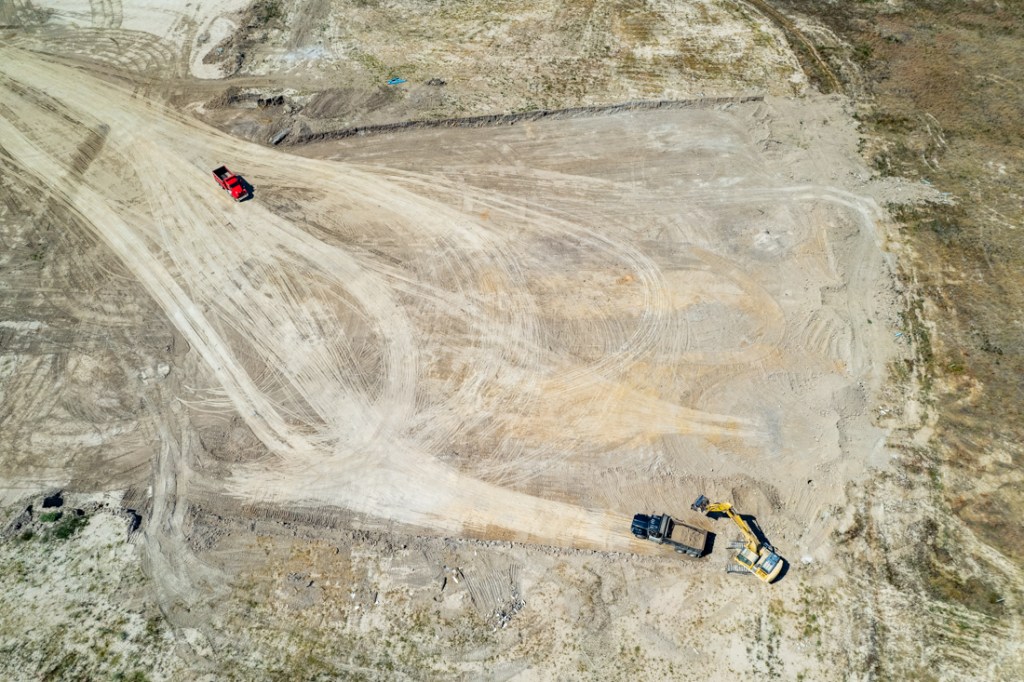
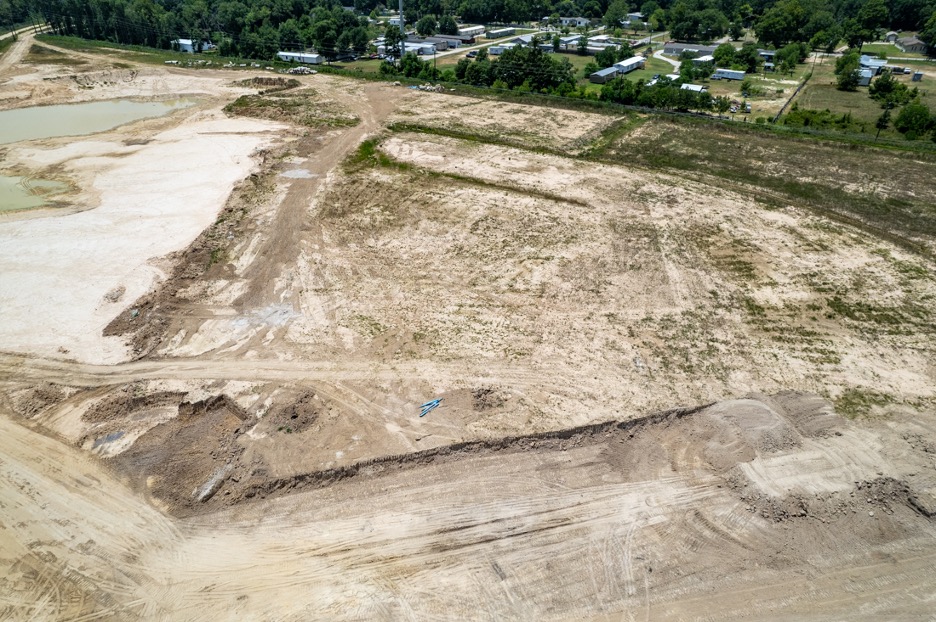
July 29, 2023. The big difference appears to be the area filled with water.

The outline has changed little. But additional water in the absence of rain and the presence of blistering heat suggests excavation may have reached the water table.

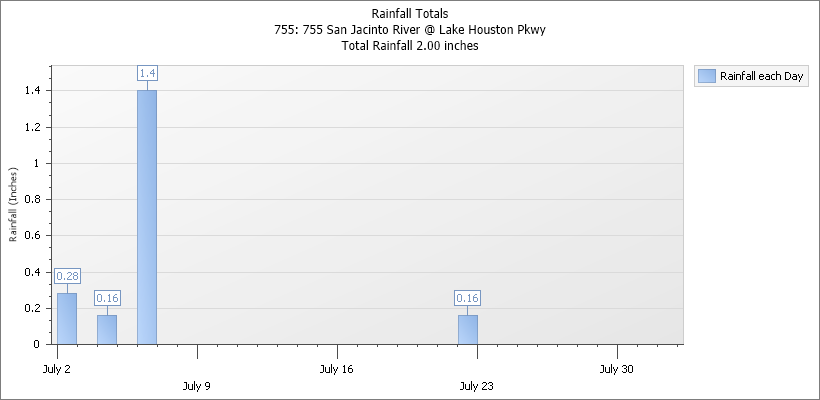
During the month of July, when temperatures pushed a 100 degrees every day, the nearest gage received only 2 inches of rain. And most of that was three weeks before the photo above.

HCFCD often prefers wet bottom retention basins because they reduce mowing costs, but the design of this basin is not yet complete.

Those circular patterns may indicate the use of scrapers to lower the bottom of the new basin gradually.
However, north (right) of the exposed water, contractors still seem to be using excavators to expand the edges of the area.

Under HCFCD Excavation and Removal contracts, contractors are free to excavate where they want within the provided footprint.

Rough layout for new Woodridge basin.
Green area indicates rough outline of new basin.

Where Does Woodridge Village Excavation Go From Here?

HCFCD’s Excavation and Removal contract with Sprint Sand & Clay calls for excavating up to 500,000 cubic yards. Sprint excavated approximately 8,000 cubic yards (5 acre feet) in June. 

Any excavation beyond Atlas-14 needs would create a safety hedge against future needs should they increase. 

NOAA is already working on updating the Atlas 14 requirements and should release Atlas 15 before the end of this decade.

Here’s how the various stages look in a table.

Acre Feet of Stormwater Detention% of Atlas-14 Requirement% of Ultimate
Site Had When Purchased from Perry Homes27170%47%
Has as of 8/1/23356.592.5%61.5%
Atlas 14 Requires385100%66%
If Sprint Excavates All 500K Cubic Feet580150%100%
Calculations based on original construction plans, HCFCD monthly reports, Atlas-14 Requirements and Sprint contract. Sprint could excavate down to or even slightly past the small grove of trees in the top center.

Sprint will make only $1,000 from its Woodridge Village excavation contract with HCFCD, but will make its profit by selling the dirt at market rates. It’s a good deal for taxpayers, but carries some uncertainty with it.

If the demand for dirt dries up, excavation could slow or stop.

But simply excavating the dirt isn’t the end of the job. Harris County still needs to slope the sides, plant grass, and tie the new basin into the site’s existing stormwater-detention-basin network. Engineers are reportedly working on plans for all that, according to HCFCD.

Posted by Bob Rehak on 8/1/2023

2163 Days since Hurricane Harvey

Northpark Drive Expansion Begins in Earnest

Note: This story was updated on 7/26/23 to include more information about phasing of the Northpark Drive expansion project.

After what turned out to be a ceremonial groundbreaking on 4/13/23, the Northpark Drive expansion project appears to have started in earnest on 7/25/2023. Northpark is a vital evacuation route for tens of thousands of Kingwood and Porter residents during floods.

Cones and Culvert Line Northpark Center Ditch

Traffic cones line the center ditch between Russell-Palmer and the Kingwood Diversion Ditch.

Looking west toward Russell-Palmer Road

Contractors have also stacked what looks like six-foot reinforced-concrete pipe on the edge of the Northpark Drive ditch where it enters the Kingwood Diversion Ditch.

Looking SE across Northpark from Fireworks Stand parking lot to Flowers of Kingwood.

They have also begun excavating the Northpark center ditch.

Looking E to Kingwood and City Limit (Green sign).

Project Partners

Project partners include:

  • Lake Houston Redevelopment Authority
  • City of Houston District E
  • Montgomery County Precinct 4
  • Texas Dept. of Transportation
  • Harris County Flood Control

Plan Vs. Execution

In general, the project partners plan to widen Northpark by a lane in each direction (toward the middle). But instead of taking land and parking from merchants, the project partners plan to replace the center ditch with culvert then pave over it.

Early plans indicated that the area between US59 and Russell-Palmer would be Phase One and that Russell-Palmer to the Diversion Ditch and eventually beyond Woodland Hills would follow.

However, Ralph Deleon, a TIRZ engineer/project manager indicated that contractors are taking pieces of the phases out of order. Why? Contractors are ready to go. But not all the right-of-way and utility issues have been resolved.

So they’re approaching drainage first and starting at the downstream end – a best practice. In coming days, we should see additional activity on other portions of Northpark Drive. But Deleon emphasized that the public should have two lanes of traffic in both directions at all times.

The Lake Houston Redevelopment Authority (TIRZ 10) website contains a number of videos and construction docs that detail the ultimate vision for the project as well as next steps.

Will Culvert Convey as Much as Ditch?

The first thing that popped into my mind when I looked at the size of the culvert and the size of the ditch was that the culvert could not possibly convey all the water that the ditch used to.

Google Earth shows width of v-shaped ditch is 50 feet. Circular pipe is 6 feet.

Then I read this letter from Harris County Flood Control to the engineering company. It states, “The proposed improvement includes enlarging the proposed storm sewer system to provide inline detention and modeling the restrictors needed to meet allowable outflow requirements for both outfalls.”

The pipes shown above would definitely act as restrictors. I sure hope they don’t back water up into the street.

Having worked near Northpark for 22 years, I’ve seen the ditch overflow on multiple occasions. I’ve seen cars plunge to the bottom, emergency rescues, and stalled vehicles.

Here is the engineering company’s drainage impact analysis. And this presentation provides a project overview for the pre–bid conference for the western portion of the project. It shows a 32-month construction schedule for the western portion alone – even with a six day work week.

More Info to Follow

The TIRZ docs for the eastern portion of the project (Russell-Palmer to Diversion Ditch, Woodland Hills and beyond) are less comprehensive.

I’m meeting with the engineers and contractors tomorrow to learn more. Check back for more news and analysis.

Posted by Bob Rehak on 7/25/2023 and updated on 7/26/23

2156 Days since Hurricane Harvey

Poor-Farm-Ditch Renovation Funding Finally Secured

On 6/28/23, civic leaders from all levels of government gathered to celebrate the acquisition of enough funding to finally begin renovating Poor-Farm Ditch.

Poor-Farm Ditch runs from Greenway Plaza on the north to Brays Bayou on the south between West University Place and South Side Place. Harris County Flood Control District started studying ditch improvements more than 20 years ago. The 70-year-old, crumbling concrete ditch carries stormwater runoff from 1,330 highly developed acres.

Numerous Problems Associated with Poor-Farm Ditch

Poor-Farm Ditch has several problems:

  • Pieces of the crumbling concrete periodically collapse into the ditch and block it, exacerbating flooding.
  • Erosion threatens homes and businesses, which crowd the ditch on either side.
  • Adjacent properties have been built up as much as five feet. The existing channel walls were not designed to support that much weight.
  • Railroad ties and other earth-retaining features (used to stabilize the extra fill) have failed and fallen into the ditch, reducing its hydraulic capacity by 50% in places.
  • The channel’s width varies along its length, creating choke points in some places. Parts can handle a 100-year rain with room to spare while others can only handle a 10-year rain.
  • Encroachments have been constructed within the Harris County Flood Control District’s (HCFCD) right of way.

Press Conference Celebrates Funding Success At Long Last

U.S. Congresswoman Lizzie Fletcher who secured $9.9 million for the $30+ million project kicked off today’s press conference by thanking all the officials and staff members present.

Left to right: West University Place Mayor Susan Sample, U.S. Representative Lizzie Fletcher, Harris County Precinct 1 Commissioner Rodney Ellis (speaking), Southside Place Mayor Andy Chan, District 134 State Rep. Ann Johnson, HCFCD Exec. Director Dr. Tina Petersen 

Goals of Renovation

According to the funding request filed by Congresswoman Fletcher, the primary goal of the project is to avoid a failure of the existing channel by constructing an entirely new channel structure in its place.

Channel rehabilitation will reduce flood risk by improving hydraulic capacity. It will also improve HCFCD’s ability to provide maintenance.

The construction project will include maintenance access ramps for HCFCD, and reinforced pavement for inspection and “maintenance by foot” on top of the channel banks.

Geographic scope of project. Source: Harris County Flood Control District

In total, the project will benefit 523 structures and 1,036 people.

On-Again, Off-Again Project Finally Finds Funding

As you can see from the pictures below, buildings on the banks of the ditch leave little room for expansion. The project was actually put on hold for two years by Harris County Commissioners Court given lack of funding and lack of consensus support for the improvements among local leaders and residents.

At the time, HCFCD said it would continue to perform spot repairs and debris clearing as needed.

Then in 2021, the project regained momentum. An engineering study concluded it would be necessary to mitigate the impacts of the proposed Poor-Farm Ditch improvements on Brays Bayou by providing 43 acre feet of stormwater detention along Brays Bayou. 

The pictures below illustrate just some of these problems. HCFCD started studying the ditch in 2002. But it has taken until 2023 to raise enough money to address these issues.

Note how close homes and businesses are to the ditch. This turned out to be THE key design constraint. As both Southside and West U policemen told me today, “No one wanted to give up property to improve the ditch.
Foliage over the ditch frequently forms log dams that can make flooding worse if not cleared promptly.
Aging concrete requires frequent repair but access is poor.

Funding Will Come from Five Different Sources

Funding breaks down as follows:

  • $5.7 million from the Harris County Flood Control District
  • $150,000 from the City of Southside Place
  • $150,000 from the City of West University Place
  • $16.9 million from State of Texas
  • $9.9 million from Federal government

That puts the total secured funding at $32.8 million, enough to begin final design, bidding and construction.

Congresswoman Lizzie Fletcher secured a huge win in Fiscal Year 2023 when she obtained a $9.9 million earmark.

But according to inside sources, Southside Mayor Chan, working with State Representative Ann Johnson and State Senator Joan Huffman secured the final funding needed for the project – another $16.9 million. Remarkably, the state earmark wasn’t even in the original budget bill this year, but was added during the conference committee phase!  

Construction will not likely start until at least next year at the earliest according to Mayor Chan.

During the press conference, participants used the phrase “dogged determination” numerous times. To pull off a project like this requires committed partners to coordinate efforts and pursue funding relentlessly from municipal, county, state and federal governments.

Civic leaders from other areas could learn from this team.

How Ditch Got Its Name

The ditch gets its name from a Poor Farm established by Harris County Commissioners in 1894 in what is now West University Place.

Posted by Bob Rehak on 6/28/23

2129 Days since Hurricane Harvey

Harris County Approves $825 Million Flood-Mitigation Project List For HUD/GLO Funds

On June 6, 2023, Harris County Flood Control District (HCFCD) recommended to Commissioners Court a flood-mitigation and disaster-relief project list totaling $825 million. The U.S. Department of Housing and Urban Development (HUD) allocated the funds to Harris County via the Texas General Land Office (GLO). The projects will require another $145 million in local-match funds from the 2018 Flood Bond. Thus, the projects are worth close to a billion dollars.

Commissioners Court unanimously approved the project list with little discussion. Each precinct will receive a relatively equal amount of projects and funding, according to Commissioner Ramsey.

Two Buckets of Money

The money comes in two buckets: Community Development Block Grant Disaster Recovery funds totaling $322.5 million and hazard mitigation funds totaling $502.5 million. HCFCD intends to use both primarily for channel improvements and stormwater-detention-basin projects.

Further, HCFCD has divided its project list into primary and backup recommendations.

Factors Used to Determine Recommendations

HCFCD developed the project list with the following factors in mind:

HUD normally gives priority to projects that help minority and low-income areas. However, the two major buckets have different LMI requirements. They also have different deadlines.

HCFCD must spend 100% of the Disaster-Relief (DR) funds by August 2026. And they must benefit areas where 70% of the residents qualify as LMI (below the average income for the region).

The Mitigation funds have more time and a 50% LMI requirement. No less than 50% of the $750,000,000 – from which the $502.5 is carved – must be expended by January 12, 2027, with the full balance expended by January 12, 2032.

So the DR funds have more urgency attached to them and that list includes projects closest to “construction ready.”

Reason for Backup Projects

According to HCFCD, the project list will likely evolve based on review by GLO, project schedules and project costs. Budgets are estimates based upon today’s dollars. They will change as projects advance. 

Fatal flaws may also become visible as projects advance toward construction. So, HCFCD requested and received permission to substitute alternate projects as needed if the intended projects become non-viable.  

1 Recommended, 1 Alternate Project in Lake Houston Area

The “recommended” list includes one primary project in the Lake Houston Area: Taylor Gully Improvements.

It also includes one project on the alternate list: the Woodridge Village Stormwater Detention Basin, part of which is already under construction.

Locations of HCFCD Mitigation and Disaster-Relief project recommendations

9 Upstream Projects

HCFCD is also recommending nine upstream projects on tributaries that feed into Lake Houston.

Primary recommendations include:

  • Upper Cypress Creek Floodplain Preservation
  • Part 3 of the Kluge Stormwater Detention Basin on Little Cypress Creek
  • Rehabilitation of the Kickerillo Mischer Preserve Channel on Cypress Creek
  • Boudreaux Stormwater Detention Basin Part 1 on Willow Creek
  • Channel Rehabilitation, Batch 5 on the Main Stem of Cypress Creek
  • East and West TC Jester Detention Basins on the Main Stem of Cypress Creek
  • Detention for Channel Rehabilitation on the Main Stem of Cypress Creek, Batch 5

Alternate recommendations include:

  • Boudreaux Stormwater Detention Basin Phase II on Willow Creek
  • Mercer Stormwater Detention Basin on Cypress Creek

Click here to see the full list of projects.

Project-Specific Data Available Soon

The project list does not include information on how much these projects would contribute to flood reduction – either locally or downstream. However, HCFCD expects to post that information to its website before the projects go to the GLO for approval in the coming months.

Partnership-Funding Gap Affected

Likewise, HCFCD did not include with this list an estimate of how much it would affect the partner-funding gap.

Some time ago, HCFCD projected that it could finish all the projects in the flood bond using a combination of:

  • Taxpayer approved funds
  • Partner funds already committed
  • Harris County Toll Road Authority money allocated to the Flood Resilience Trust.

But to finish all the projects in the Flood Bond, HCFCD “phased” some projects. It knew it wouldn’t have enough money to complete 100% of some large projects. So, several phases might have been included and others deferred.

It appears that several projects on today’s list include some deferred phases. So the “partner-funding gap” may not be reduced as much as originally thought. Net: HCFCD may or may not have to look for additional funds. The District expects it will know more after GLO approves the list.

HCFCD must also come back to Commissioners Court by July 18 with an estimate for ongoing maintenance and land management costs for all the projects.

Posted by Bob Rehak on 6/6/2023

2107 Days since Hurricane Harvey

In May, Woodridge Village Excavation Total Reached Almost 124,000 Cubic Yards


Harris County Flood Control District’s (HCFCD) Woodridge Village Excavation and Removal contract for 500,000 cubic yards with Sprint Sand & Clay is almost one-quarter complete. Sprint excavated approximately another 9,000 cubic yards in May (5.8 acre feet). That’s almost double the monthly minimum and brings the total up to 123,882 cubic yards.

Stormwater from Woodridge Village flooded hundreds of homes twice in 2019. The excavation will provide additional stormwater detention capacity to reduce flood risk downstream in the future.

May/June Photos Show Progress

The first two photos below were taken at the beginning of May and June 2023.

Sprint Sand and Clay Excavation and Removal Contract work at Woodridge Village
Looking ENE. Extent of excavation on May 2, 2023
Looking ENE. Extent of Excavation on June 4, 2023

Up until now, Sprint has been excavating from west to east. Now, they seem to be excavating primarily from south to north.

HCFCD spokesperson Amy Crouser said that, “Essentially, the contractor is free to excavate where they want within the provided footprint.”

Looking east across new focus of excavation.

Where Does Woodridge Village Excavation Go From Here?

Sprint has excavated 76.8 acre feet so far. That brings the current detention capacity (old plus new) to 348 acre feet. That’s 90% of what Woodridge Village needs to meet Atlas-14 requirements.

If Sprint keeps excavating at the current rate, it could reach Atlas-14 requirements before the end of the year.

Here’s how all that looks in a table.

Acre Feet of Stormwater Detention% of Ultimate
Site Had When Purchased from Perry Homes27147%
Has as of 6/4/2334860%
Atlas 14 Requires38566%
If Sprint Excavates All 500K Cubic Feet580100%
Calculations based on original construction plans, HCFCD monthly reports, Atlas-14 Requirements and Sprint contract.

Sprint’s contract calls for excavating UP TO 500,000 cubic yards. Any excavation beyond Atlas-14 needs would create a safety hedge against future needs should they increase. 

Sprint will make only $1,000 from its Woodridge Village excavation contract, but will make its profit by selling the dirt at market rates. It’s a good deal for taxpayers, but carries some uncertainty with it.

A lot of flexibility exists for both parties in an E&R contract. If the demand for dirt dries up and excavation slows, HCFCD and Sprint could modify the E&R contract to complete a smaller detention basin sooner. But I assume it would still meet Atlas 14 requirements at a minimum.

But simply excavating the dirt isn’t the end of the job. Harris County still needs to slope the sides, plant grass, and tie the new basin into the site’s existing stormwater-detention-basin network. 

HCFCD and Harris County Purchasing are currently evaluating consultants’ bids to draw up the final construction plans.

Posted by Bob Rehak on 6/5/2023

2106 Days since Hurricane Harvey