Tag Archive for: glo

GLO Letters to HUD, Green, Garcia Tell Another Side of Mitigation Funding Story

Two letters from Texas General Land Office (GLO) – one to the US Department of Housing and Urban Development (HUD) and the other to US Representatives Al Green and Sylvia Garcia – explain the GLO’s awards in a recent competition for $1.1 billion in Harvey mitigation funding.

GLO Commissioner George P. Bush sent the first letter to HUD on May 27, shortly after the GLO “snubbed” (according to Mayor Sylvester Turner) Houston and Harris County. Outraged politicians at City Hall and the County Courthouse organized a protest campaign targeted at the HUD and the GLO. These two letters lay out a slightly different mitigation funding story than the one peddled to Houston media outlets by the City and County. Most media coverage trumpeted how Houston and Harris County got “zero” out of competition because of political warfare between Republicans in Austin and Democrats here.

The facts in these two letters got very little play in Houston media.

Bush Letter to HUD Requests $750 Million Direct Allocation for Harris County

Bush’s letter explains to HUD how the GLO organized and scored grant applications in the competition. The letter also explains how:

  • GLO received more than $6.5 billion in grant requests for $1.1 billion during floods in 2015, 2016, and 2017.
  • Money was awarded based on a numeric scoring system approved by HUD
  • Harris County was one of dozens of counties affected by the three storms
  • Harris County and Harris County communities were awarded $90.4 million and $26.7 million for a total of $117,213,863.96 in the first round of mitigation competition.
  • He (Bush) is submitting a “new action plan amendment” to that will direct $750 million to Harris County.
  • GLO recognizes the great need for mitigation funding in Harris County.
  • GLO supports a direct allocation to Harris County (non-competitive)
  • He (Bush) requests speedy approval of the action plan amendment/direct allocation.

Hmmmmm. $117 million is a little more than zero. However, the point to remember here is that Harris County Flood Control got zero. The $117 went to cities within Harris County to improve resilience.

Havens’ Letter Cites HUD Restrictions, Slow Rate of Drawdown for Previous Programs

Deputy GLO Land Commissioner Mark Havens penned the second letter to Green and Garcia on June 10, 2021. It begins by making some of the same points about $6.5 billion in applications, HUD-approved rules, etc. But then, in regard to the rules he adds something new in the debate.

HUD did not allow damage from Hurricane Harvey to be used as a metric for allocating CDBG-MIT (Community Development Block Grant Mitigation) funding!

Mark Havens, Deputy land commissioner

Deputy Commissioner Havens also points out that:

  • The previous HUD secretary was adamant that a direct allocation didn’t go to Houston and Harris County, and that all counties should be eligible for funds.
  • If you add the $117 million mentioned above to the $750 million direct allocation requested by Bush, Harris County would actually get $867 million which the County could then share with the City of Houston as it saw fit.
  • Harris County also set aside $120 million in infrastructure funding out of the original $2.5 billion allocated to the County and City in the first round of Hurricane Harvey funding.
  • The City also received a direct allocation of $61,884,000 in mitigation funding out of the original $2.5 billion.
  • Out of the $2.5 billion, only $91,225,206 – or 3.6% of the total has been drawn down to date.
  • If the City and County don’t dramatically speed up the distribution of these funds, the funds will be returned to HUD.
  • HUD not yet responded to the request for the $750 million direct allocation.

For More Information

For the full text of:

To see the full text of other documents relating to this issue, see the links this post.

Flood mitigation should be non-partisan. This is about helping people whose lives were destroyed by flooding, not finger pointing. I’m not taking sides. I’m just trying to help give you the information you need about mitigation funding to intelligently question the officials you elected to serve you.

Posted by Bob Rehak on 6/15/2021

1386 Days since Hurricane Harvey

GLO’s Bush Requests Direct Funding from HUD for Harris County Flood Mitigation

5/26/21 – Tonight, Texas General Land Office (GLO) announced that it would support a direct allocation to Harris County from HUD Mitigation funds for $750 million.

On May 21, the GLO announced winners of US Department of Housing and Urban Development (HUD) grants totaling more than a billion dollars for Hurricane Harvey flood mitigation. Only problem: little went to Harris County Flood Control or the City of Houston despite the fact that we experienced half of the statewide damage in Harvey. Only $90.4 million went to small cities in Harris County. (See below)

Harvey at Peak Intensity

Ever since GLO’s announcement, Harris County Commissioners have been scrambling, trying to figure out how to fill a funding shortfall. That’s because they were counting on attracting matching grants that didn’t materialize. Without the grants, some of the projects could be delayed – especially those in low-to-moderate income neighborhoods, which HUD targets – until alternative sources of funding can be identified.

Yesterday’s Harris County Commissioner’s Court Meeting spent more than four hours on the dilemma. Commissioners arranged for angry residents to call in and each testify for 3 minutes. At the end of their allotted time, they were thanked and asked to call the Texas General Land Office (GLO).

The phones must have rung off the hook at the GLO today, because by the end of the day, GLO Commissioner George P. Bush punted the decision for the next round of funding to HUD.

Below is the full text of a GLO press release sent out at 6:28 PM this evening.


GLO Press Release

“Today, Texas Land Commissioner George P. Bush announced his request to the U.S. Department of Housing and Urban Development (HUD) for Harris County to receive a direct allocation of $750 million for mitigation efforts.”   

“I have heard the overwhelming concerns of Harris County regarding the mitigation funding competition,” said Commissioner Bush. “The federal government’s red tape requirements and complex regulations are a hallmark of President Biden’s administration. I am no stranger to standing with the people of Texas as we fight against the federal government. As such, I have directed the GLO to work around the federal government’s regulations and allocate $750 million for mitigation efforts in Harris County.”  

“An amendment to the state action plan regarding the administration of Community Development Block Grants for Mitigation (CDBG-MIT) in the State of Texas will be submitted to HUD by the General Land Office to implement these changes. A final mitigation competition will be held for the other 48 eligible counties at a later date.”  

“Although Hurricane Harvey made landfall in August 2017 and Congress appropriated these mitigation funds several months thereafter, the GLO’s hands were tied waiting for HUD to publish the rules regulating the use of these funds until they were published in a Federal Register notice, which did not happen until August 30, 2019 – two years after the storm and 19 months after the appropriation. The scoring criterion required by HUD to be included in the state action plan for distribution of the funds was approved by HUD on March 27, 2020.”


Flood Mitigation Should be Non-Partisan

I don’t want to get in the middle of the cross-fire on this. One of my biggest concerns is that flood mitigation remain non-partisan.

So rather than speculate about people’s motives and try to decipher where things went awry, I will simply post the following documents:

Regarding the last item, the copy is from a draft circulated before the meeting. However, reportedly, Commissioners made no changes. They approved it (or something very close to it) unanimously.

Before the end of the meeting, Commissioners had also resolved to meet with the Governor, HUD, President Biden, Congressmen, Senators and the tooth fairy. One thing is certain. Harris County is not taking this lying down.

One strange thing that several people have commented on: approximately a quarter of all the grants awarded went to improve water and sewage treatment plants – not flood mitigation projects. As one Congressional aid said today, “Separate grants are available for those. That took a lot of money out of circulation.”

Projects Awarded within Harris County but Not to HCFCD

In fact, three of the four projects awarded to cities in Harris County fell into that category.

  • City of Pasadena: Flood Mitigation Project – $47,278,951.21 LMI Percentage: 65.37%
  • Jacinto City: Wastewater Treatment Plant Improvements Project – $5,319,717 LMI Percentage: 78.45%
  • City of Baytown: East District Wastewater Treatment Plant Phase II – $32,394,113.86 LMI Percentage: 52.29%
  • City of Galena Park: Water Plant Improvements Project – $5,482,123 LMI Percentage: 60.22%

Almost as much is going to water and wastewater plant improvements as flood mitigation.

Posted by Bob Rehak on May 26, 2021

1366 days after Hurricane Harvey

“We Must Streamline Disaster Recovery Before the Next Disaster”

By George P. Bush

George P. Bush is Commissioner for the Texas General Land Office (GLO), the state agency tasked with leading the disaster recovery process after Hurricane Harvey, the second most destructive storm in American history. This guest editorial is a response to yesterday’s post about disaster recovery taking more time than it took to win World War II. In it, Mr. Bush suggests specific ways to accelerate disaster recovery.


As June 1st rapidly approaches, Texas coastal communities are wondering what the 2021 Hurricane Season will hold. Will thousands of Texas families be spared, or will they endure hurricane-force winds and flooding with years of recovery ahead of them? 

Hurricane Harvey at its peak intensity as it hit Texas in August 2017. Photo courtesy of National Hurricane Center.

We cannot stop natural disasters from happening, but we can certainly speed recovery efforts. The Texas General Land Office (GLO) has administered recovery programs for seven of the 18 major declared disasters the State of Texas has experienced in the last 15 years. We know firsthand how exhausting and lengthy this process can be. After flood waters have abated and the debris has been cleared, communities face the next hurdle – navigating the arduous and overly burdensome bureaucracy shackling speedy recovery efforts. 

Cutting Red Tape

My GLO team and I recognize the importance of following procedures to safeguard federal funds, but also understand bureaucracy is an obstruction to recovery and mitigation. Community Development Block Grants for Disaster Recovery (CDBG-DR) appropriated by the U.S. Department of Housing and Urban Development (HUD) take years to reach disaster survivors. One of the most frequent concerns we hear—from survivors, county and local officials, and other stakeholders—is that CDBG-DR funds do not flow quickly enough to communities in need.

These dollars should be deployed as quickly and flexibly as possible to support recovery with as few additional regulations as possible. 

First, we must ensure effective and efficient disaster recovery by providing the framework for programs and activities that provide disaster relief; resiliency; long-term recovery; restoration of infrastructure and housing; economic revitalization; and mitigation in areas impacted by Presidentially declared disasters. This begins with codification of CDBG-DR program rules and regulations. 

Reducing Upfront Delays

For every new allocation, a new series of rules are written and published in the Federal Register. In Texas we are currently implementing CDBG supplemental funding for 8 events governed by 22 separate Federal Registers (rule books for how funding allocations may be used). A good amount of those rules, such as the national objectives imposed and the range of eligible activities, remain largely the same each time, but others are entirely new. Based on our experience, it takes between nine to sixteen months for a Federal Register Notice to be published for allocations of recovery funding after the major disaster declaration takes place. These allocations must first be granted to a state or other grantee following a special appropriation from Congress. 

The Federal Register for the CDBG-MIT funds was posted two years to the day after Hurricane Harvey made its final landfall on the coast of western Louisiana. 

Inspector General Recommends Codifying Rules

HUD going back to the drawing board for each appropriation consumes critical time that could be spent setting up programs at the state and local levels if the rules were codified. In July 2018, the HUD Office of Inspector General (HUD OIG) issued a report that identified 59 common rules HUD issues when drafting Federal Registers. The same report recommended HUD work to codify the CDBG-DR program.  

Fund deployment speed can also be enhanced by:

  • Streamlining processes at the federal level and at HUD
  • Retaining and developing in-house knowledge
  • Empowering grantees to move with a purpose. 

Five Specific Recommendations to Expedite Process

There are several steps the federal government can take to expedite this process. Here are the five I consider to be the most impactful:

  1. Create Office of Disaster Relief and Recovery – HUD currently has several offices with jurisdiction over CDBG-DR funds. This creates a tangled web of bureaucracy when HUD drafts a Federal Register, approves an Action Plan, or a grantee must seek a waiver or other change to program, vastly delaying the distribution of funds. A distinct disaster recovery division headed by an Assistant Secretary with discretion over disaster recovery funds would limit stove-piped information, reduce redundancies, and expedite decision-making authority within HUD. This change alone would vastly reduce delays in program progress.  
  • Facilitate capacity building – HUD should provide grantees an initial amount of administrative funds prior to approval of the action plan and grant agreement. This would enable grantees to hire staff to provide technical assistance for drafting the action plan and begin to build programs while the action plan is being developed so recovery efforts would not be delayed 6+ months while the process concludes. Many grantees lack the resources to essentially operate on credit until these funds are made available.
  • Standardize programs and only post changes – Congress should pass legislation standardizing rules so the Federal Register only includes what you cannot do versus everything you can. This would lessen the time waiting for the rules to be written and allow grantees to begin working on the general premise of what the program cannot do.
  • Codify data coordination between FEMA and HUD – The federal government must build a capable national data system to coordinate data sharing between federal, state, and local agencies. FEMA collects a tremendous amount of data following every disaster. This data is used to inform HUD allocations as well as to develop needs assessments by grantees. However, there is not a system in place that enables this data sharing to happen quickly, safely and effectively. 
  • Codify allocation timeline – HUD is not currently restricted in how long it takes to allocate special appropriations of CDBG-DR and CDBG-Mitigation to grantees. Additionally, grantees cannot begin drafting hundreds of pages of state and local action plans until HUD issues the rules for use of funds in the Federal Register. 

Example of Delays in Current System

For example, Congress appropriated nearly $28 billion to help disaster-affected states rebuild on February 9, 2018. Two months later, HUD allocated $4.383 billion to Texas. At the time, HUD also stated it “will issue administrative guidelines shortly for use of the funds to address grantees’ long-term recovery needs.” However, this did not happen for nearly a year and a half.

On August 30, 2019, HUD finally published the Federal Register notice enabling the State of Texas to proceed in drafting an action plan for the CDBG-MIT funds. The Federal Register required a robust public outreach component. The GLO went above and beyond HUD’s mandates by extending the required 45-day public-comment period to 50 days and surpassed HUD requirements by hosting eight public hearings – three public hearings prior to the completion of the draft plan and five following publication of the draft plan. Prior to finalizing the draft of the action plan, the GLO responded to thousands of comments collected from 117 meetings and 936 individuals

While the GLO waited 16 months for rules for the action plan, it only took the GLO approximately five months to draft the nearly 500 page document, conduct a historic public outreach effort, respond to comments, make revisions, and submit the plan to HUD for approval. It then took nearly two months before the GLO received approval from HUD.

The turnaround time for announcing rules should be substantially reduced to expedite the use of disaster recovery funding for those in urgent need of assistance.

Reducing Redundancies, Implementing Common-Sense Reforms

Since 2011, the GLO has worked with hundreds of communities and several thousand families to repair homes; reimburse out-of-pocket home repairs; conduct buyouts and acquire flood-prone properties; strengthen infrastructure; and conduct major planning studies to support local government mitigation efforts. The success of our programs can be attributed in part to our staff of dedicated experts as well as our streamlined grant administration.

No additional regulations or rules are added to our programs beyond what the federal government requires. 

George P. Bush

The GLO has proven that you can expedite recovery by eliminating unnecessary regulations, pre-positioning resources and putting contracts in place before a disaster. Disaster survivors shouldn’t have to wait years for assistance. It is plain and simple – we can and should lessen the burden on families and communities by reducing redundancies and implementing common-sense reforms. 

Guest Editorial by Texas General Land Office Commissioner George P. Bush on May 8, 2021

1348 Days after Hurricane Harvey

GLO Announces Homeowner Assistance, Reimbursement Programs for Imelda

The Texas General Land Office will begin taking applications this Saturday, April 24, for Imelda assistance. $71,604,000 is available for Chambers, Harris, Liberty, Jefferson, Montgomery, Orange and San Jacinto Counties.

.Land Commissioner George P. Bush has announced locations of regional Homeowner Assistance and Reimbursement Programs (HARP) offices in advance of the 24th. 

Applicants will be able to schedule an appointment in person in advance for the same day that applications will be available online.

Money Can Be Used For…

The money will cover repair or reconstruction of owner-occupied single-family homes and reimbursement up to $50,000 for certain out-of-pocket expenses incurred for reconstruction, rehabilitation, or mitigation.

Repayment of SBA loans is also eligible for reimbursement.

Car submerged during Imelda in Elm Grove. Photo courtesy of Allyssa Harris.

Appointments Required for In-Person Assistance

“Thousands of homes in Southeast Texas were damaged during during Imelda, devastating the livelihoods of countless Texans,” said Commissioner Bush. “In advance of the Homeowner Assistance and Reimbursement Programs application being released, the GLO is announcing locations of offices to provide residents with help applying for assistance.

Evacuation from Elm Grove during Imelda. Photo courtesy of Keith Stewart.

Where to Get Help

All applicants must make an appointment before visiting an office location.

Appointments will ensure proper capacity under COVID-19 restrictions. Applicants may request additional hours.

Harris County
Location: St. Mark’s United Methodist Church
3811 N Main St, Baytown, TX 77521-3305 

Montgomery County
Location: North Montgomery County Community Center
600 Gerald St, Willis, TX 77378-3477 

Chambers County
Location: Chambers County Municipal Building
211 Broadway, Winnie, TX 77665-7781 

San Jacinto County
Location: Coldspring Area Public Library
14221 State Hwy 150 West, Coldspring, TX 77331 

Jefferson County
Location: First City Building 505 Orleans Street, Beaumont, TX 77701
Hours: By appointment only: Monday – Friday 8:00am – 5:00pm
By appointment only: Saturday 8:00am – 12:00pm         

Orange County
Location: Orange County Convention and Expo Center
11475 FM 1442, Orange, TX 77630-5227 

Pop-up Intake Locations
Hours: All by appointment only
Phone Number: 844-484-4277 (844-484-HARP)     

Main Regional Office:
Phone Number: 844-484-4277 (844-484-HARP) 

Liberty County residents are eligible. An office in Liberty County may be announced in the future. For now, work through the main regional office above (in Beaumont).

Online, Email, Phone Assistance

Interested homeowners may also visit http://recovery.texas.gov/harp to apply online or download a printable version of the application.

Additionally, applicants may email the GLO at cdr@recovery.texas.gov or call 1-844-893-8937 to get help applying.” Up to date office locations and additional information are available at http://recovery.texas.gov/harp

Before You Apply, Understand These Things

A single application can be submitted for reimbursement AND repair assistance.

However, an application must be submitted along WITH required documents for consideration.

HARP is “first-come, first-served,” and all homeowners are encouraged to apply immediately.

Households applying for reimbursement that do not meet the low-to moderate-income (LMI) threshold will be processed after the first six months from application opening, but may receive construction assistance prior to then, based on their application date.

HARP is only available for the homeowner’s primary residence.  

Documents You Need Before Applying

Potential applicants should review the Homeowner Assistance and Reimbursement Programs Checklist to have all applicable documents ready prior to applying.

Potential applicants can also find in-person assistance at regional HARP offices serving their area. In addition to a main office in each region, each county will have at least one application drop off location or satellite office. Additional satellite offices and application intake locations may be announced in the future and will be viewable at http://recovery.texas.gov/harp.

Posted by Bob Rehak on 4/21/21 based on information provided by the Texas General Land Office

1331 Days since Hurricane Harvey and 580 since Imelda

Harvey Repair, Rebuild Assistance Still Available for Harris County Residents

Assistance is still available for those who live in Harris County if you have not yet repaired or rebuilt your home damaged in Hurricane Harvey. Applications are NOT for reimbursement.

They are for repairs and rehab handled through U.S. Department of Housing and Urban Development (HUD) contractors, that meet HUD specs. So forget about marble floors and countertops, adding garages or extra bedrooms, or upgrading to top-of-the-line appliances.

As long as you live in Harris County and you meet the requirements, you can still submit an application. However, understand that Harris County (compared to the City) has far more funding available than applications in its pipeline. Also understand that you can apply through the Texas General Land Office (GLO), which now handles applications for HUD; you don’t need to go through the City or County directly.

Lloyd Nelms and family receive the keys to a rebuilt home.

Types of Help Available

The GLO can provide homeowner assistance through:

  • Repairing and rehabilitating homes
  • Reconstruction
  • Improving a damaged home so that it is more resilient against natural disasters
  • Elevating homes above flood level

How to Apply

How and where to apply depends on whether you live inside the City of Houston or out.

If you live in Harris County but OUTSIDE the City of Houston:
  1. Apply online here.
  2. Download and complete a paper application below. Applications can be submitted by email at harriscounty.glo@recovery.texas.gov or mail to Homeowner Assistance Program 2100 Space Park Drive, Suite 104, Houston, TX 77058. 
  3. Call 346-222-4686 or 1-866-317-1998 (toll free) and a regional office team member will assist with the application process.
If you live in Harris and are INSIDE the City of Houston:

This page explains all the necessary steps and documents: https://recovery.texas.gov/hap/houston. You also have three easy options.

  1. Apply online here.
  2. Download and complete a paper application below. Applications can be submitted by email at houston.glo@recovery.texas.gov or mail to Homeowner Assistance Program 2100 Space Park Drive, Suite 104, Houston, TX 77058. 
  3. Call 346-222-4686 or 1-866-317-1998 (toll free) and a regional office team member will assist with the application process.

All Documents Necessary Before Apps Will Be Processed

Applications, including all necessary documentation, must be completed and submitted BEFORE the GLO and its partners will begin processing it for eligibility. Each application submitted must be individually evaluated to determine eligibility. Please use this checklist for reference whether you live inside or outside of the City.

Without enough qualified applicants, GLO will be forced to send the money back to Washington. So hurry, before the money goes away or runs out.

What to Expect

Potential applicants can watch this video about What to Expect.

The GLO created this video about homeowners who received assistance through this program. Here’s another showing a homeowner who just received keys to a rebuilt home.

Posted by Bob Rehak on 3/15/2021

1295 Days since Hurricane Harvey

Why Does Flood-Mitigation Funding Take So Long?

On Tuesday this week, Harris County Commissioners Court erupted into heated discussion over flood-mitigation funding for Halls and Greens Bayous. Construction delays had to do with the length of time for awarding grants from the U.S. Department of Housing and Urban Development (HUD). Then, in a cosmic coincidence, yesterday, the Texas General Land Office (GLO) sent out a press release announcing $135 million in HUD flood mitigation grants – for 2016 floods that happened under President Obama.

Ironically, the GLO press release pointed out that 2016 grants were for repetitively damaged areas. And in the five years since the 2016 floods, we’ve also had Hurricane Harvey, Tropical Storm Imelda, and a record-setting 2020 hurricane season.

Reading the release felt like getting hit by three buses while waiting for the ambulance to arrive. That prompted a call to the GLO, which administers HUD grants in Texas. I asked a simple question.

“What Takes So Long?”

When I asked the GLO “Why does flood-mitigation funding take so long”, they referred me to this page. Key takeaways include:

  • Congress didn’t appropriate money for Disaster Declarations in 2015, 2016 and 2017 until February 9, 2018.
  • Texas received $4.3 billion from the U.S. Department of Housing and Urban Development for all those years.
  • Before the GLO could distribute those funds, it had to wait for HUD to develop and publish rules in the Federal Register governing the distribution of those funds. That took 1.5 years.
  • Then the GLO had to develop a state action plan. That required developing another set of rules, holding public meetings around the state, soliciting public comments, responding to the comments, and getting HUD approval of the plan. HUD finally approved the state action plan on March 31, 2020.
  • Then GLO had to translate the plan into Spanish, Chinese, Arabic, Vietnamese, and Korean before publishing it.
  • To be fair to everyone across the state, GLO then holds a “competition” to find the most worthy projects. The criteria for “worthiness” include multiple factors. But the biggest in HUD grants are: percentage of low-to-moderate income families being helped, how economically distressed an area is, and total expected benefits for dollars invested. For instance, when comparing applications for a $10 million grant that will help 1,000 families to a grant for the same amount that will help a 100,000 families, the latter would win.
  • But to determine that kind of information, applicants need to conduct preliminary engineering studies before they can even file applications.
  • The GLO must wait for all applications to be submitted, evaluate the applications, rank order them, and see how many will fit within available funding. In the case of the grants just announced, the GLO received requests for almost TWICE as much funding as they had available. The average over the years exceeds 3X. For Harvey, it was 5X.
  • HUD must then review and approve the grants.
  • GLO distributes the money.
  • Finally, mitigation projects can begin.

Are All These Steps Necessary?

When you look at the list above, each step sounds reasonable. But there may be ways to collapse steps and speed up the flood-mitigation funding process. Why, for instance, do you need 1.5 years to publish rules specific to these floods in the Federal Register? Why not have a generic set of rules for all floods and adapt the boilerplate as needed?

I also asked if a way existed to shorten the process by eliminating the competition. After all, its easier to approve one application than compare it to hundreds. Their reply: “Competitions are the only fair way to do it.”

Should We Go Back to Earmarks?

The current competition system replaced an earmark system whereby Congress directly allocated funds to certain projects in certain districts. Earmarks sped up construction, but had many problems of their own. For instance, unnecessary projects often went to the districts of congressional leaders. That sometimes deprived other areas with greater needs.

However, the competition system for flood-mitigation funding has obvious problems, too. It has spawned whole industries of grant writers, project managers and people who know how to navigate traps in the convoluted application process.

I talked to one project manager today who told me about a grant that cost more to apply for than the grant was worth.

Hopefully, that doesn’t happen often. But when it does, we have proof that bureaucracy has become more important than the taxpayers it serves.

More about GLO/HUD Grants Announced This Week

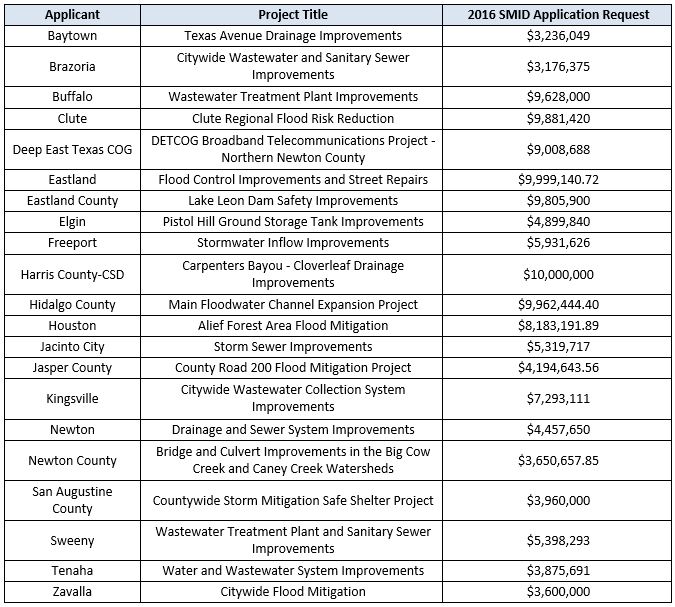
For the record, out of the $135 million in grants announced yesterday, Harris County received $10 million for cloverleaf drainage improvements in Carpenters Bayou. City of Houston received $8.2 million for flood mitigation in the Alief Forest Area. Baytown, Freeport, Sweeny, and Jacinto City also received grants.

This table shows where the money went.

For descriptions of individual projects, please click here.
Texas Counties Affected by 2016 Floods. MID stands for Most Impacted and Distressed Areas.

Hurricane Harvey Competition Results Not Yet Announced

Winners of the first round of the Hurricane Harvey Mitigation Competition are expected to be announced in late spring or early summer. The GLO received 220 extensive applications totaling more than $5 billion in requests for the $1 billion in available funding (Round 1).

The Hurricane Harvey State Mitigation Competition for flood-mitigation funding is open to cities, counties, COGs, state entities, and special purpose districts. Examples of projects include flood control and drainage improvements, infrastructure improvements, green infrastructure, public facilities, and buyouts. Each proposed project must have a total proposed cost between $3 million to $100 million.

What We Need

Getting disaster relief 5-10 years after the fact is the largest disaster of all. We need Congress to reform the process to speed up the delivery of flood mitigation funding. How many homes and businesses that flooded in 2015, flooded again in 2016, 2017, 2019 and 2020? And what were the associated costs? Did repeat-flooding damages for these years due to funding delays cost more than the amount of mitigation funds appropriated by Congress? Somebody, somewhere has that information.

Posted by Bob Rehak on 3/12/2021

1291 Days since Hurricane Harvey

GLO Reimbursement Program Helped Rebuild 2961 Homes While Houston’s Helped Only 119

The Texas General Land Office (GLO) announced last week that it has successfully completed its Reimbursement Program from Hurricane Harvey. It was a first-of-its-kind program and concluded after providing nearly $86 million to almost 3,000 Texas homeowners. The GLO also announced that it had reconstructed its 2,500th home under its Harvey Homeowner Assistance Program.

Two Major Milestones Reached in Same Week

The two GLO disaster recovery programs are helping Texans across 48 counties (outside of Harris County and the city of Houston) whose homes were damaged or destroyed by Hurricane Harvey. The two programs have now helped nearly 5,500 Texas homeowners recover from Harvey.

The GLO’s reimbursement program concluded after assisting 2,961 Texans with a total of $85,989,042 in reimbursements for out-of-pocket home repair expenses. In the same week, the GLO reached another milestone – reconstruction of 2,500 homes damaged during Harvey.

Texas General Land Office

“Every day at the General Land Office we work to help improve the lives of Texans,” said Commissioner Bush. “The GLO is proud to be setting a record pace in disaster recovery while helping thousands of Texas families rebuild their lives and their homes. The GLO continues to leverage federal dollars efficiently and effectively to help Texas families and communities rebuild and mitigate against future storms.”

Click for video

Details of Reimbursement Program

This week the Texas General Land Office completed its Homeowner Reimbursement Program (HRP) when it approved the final reimbursements for eligible homeowners.

The HRP program provided reimbursements up to $50,000 for Hurricane Harvey-impacted homeowners who used their life savings or other personal funds to pay out-of-pocket for disaster recovery repairs. The program’s efficiency yielded an additional $3 million in costs savings, which enabled the program to provide reimbursements for all applicants eligible under U.S. Department of Housing and Urban Development’s (HUD) rules for the available Community Development Block Grant for Disaster Recovery (CDBG-DR) funding.

Homeowner Assistance Program Details

In the same week that the GLO successfully completed its Reimbursement Program, the GLO handed keys to a fully rebuilt home to the 2,500th Homeowner Assistance Program (HOAP) recipient. So far, approximately 4,300 HOAP applicants have been approved for assistance by the GLO. Of those, about 1,400 applications are in pre-construction (awaiting applicant approval of final design plans and permits). Four hundred more homes are currently under construction in addition to those already completed.

Before the HOAP program concludes, GLO anticipates that it will help rebuild more than 6,000 homes. It will do so using more than $1.3 billion in available Community Development Block Grants for Disaster Recovery (CDBG-DR). The GLO will also use an additional $500 million in Community Development Block Grants for Mitigation (CDBG-MIT) funds from the U.S. Department of Housing and Urban Development (HUD).

Results Invite Comparison to City of Houston’s

The City of Houston Housing and Community Development Department updates its comparable statistics weekly.

City of Houston Housing and Community Development Department statistics as of 1.20.21

During the period that the GLO reimbursed 2961 homeowners, Houston reimbursed 119. And while the GLO reconstructed 2500 homes, the City reconstructed only 117.

Thus, the GLO was 20-25X more effective in finding and helping applicants than the City of Houston. And the GLO covered a 48-county area.

Possible Reasons for Huge Disparity

The GLO reviews City applications before forwarding them to HUD for final approval and funding. In trying to explain possible reasons for the disparity in results, a GLO spokesperson pointed to the needlessly complex structure of the City’s program.

The GLO also pointed out that many of the applications submitted by the City were incomplete and that the City’s data formatting was inconsistent.

When the GLO sent a team to Houston to help train City employees handling applications, GLO helpers were not allowed to enter City offices.

Harvey damaged more than 96,000 homes in Houston.

The City of Houston’s Housing and Community Development Department still has not responded to multiple requests for comment.

Posted by Bob Rehak on 1/24/2021 based on data published by the Texas GLO and Houston Housing and Community Development

1244 Days after Hurricane Harvey

City of Houston Couldn’t Even Give Away Harvey Aid Due to Bureaucratic Bungling

As a December 31st deadline expired, approximately $162 million – allocated by HUD to reimburse homeowners in the City of Houston for repairs they made after Harvey – remained unused. The City had worked on the reimbursement program for TWO years. Yet in all that time, the City’s Department of Housing and Community Development successfully processed only 120 applications for reimbursement of repairs. Grants awarded to those 120 families totaled a mere $2,024,000 out of the $164 million allocated – just 1.2% of available funds.

Desperate Families Needlessly Left Empty Handed

Meanwhile, flooded families:

  • Never received applications, despite repeated calls and emails from potential applicants
  • Received an application only hours before the deadline expired on the New Year’s weekend
  • Received incomplete and misleading information.

Regarding the last point, an email sent to residents at the 11th hour failed to inform them that they just needed to start the application and sign it before January 1st. Instead, residents were told that they needed to complete the application before December 31 (i.e., before the end of the day on December 30).

A two-step application process, engineered by the City, complicated and delayed aid. Residents first had to fill out a survey to qualify to fill out an application. The City then tried to sort the survey respondents into priority groups. This increased the workload, created management complexity, and delayed the filing of formal applications for years while the deadline passed.

Had everyone just been invited to fill out an application early on, no one would have missed the deadline.

Help From GLO Refused

Worse yet, after missing one interim deadline after another, the City refused to let the Texas General Land Office (GLO) help. The GLO oversees HUD funds distributed in Texas. It had sent a team to Houston to help train City employees. However, the City refused to allow the GLO team into the Housing and Community Development offices.

As the final deadline loomed, it became apparent that the City wasn’t coming close to meeting its performance goals and that aid would not reach people who needed it. As a last resort to help flood victims, the GLO tried to terminate its contract with the City and take over the City’s Harvey-aid program. But the City sued the GLO to prevent the takeover. That cost even more precious time.

Before the final deadline, the GLO notified the City that it should alert all potential applicants and the media so that they, in turn, could spread the word about the impending deadline. The GLO even provided a sample press release that the City could tweak for local media. Instead, the City posted a notice on Twitter and social media. That severely limited the reach of the message.

Confusion Reigned

To this day, lawsuit settlement talks between the City and GLO continue. Meanwhile, the GLO provided the City of Houston with funds for the Homeowner Assistance Program (HoAP), which included its reimbursement program.

But according to Jennifer Coulter, a would-be applicant who called the City, the City swore the GLO had taken control. The resident then called the GLO. GLO correctly said, “No, the City has it.” The back-and-forth continued until she was told the deadline passed.

The Coulter family lived in a trailer in their driveway for almost two years as they repaired their home.

Resident Chris Johnsen flooded 4 feet during Harvey. After waiting 3.5 years for help, he received an email from Housing and Community Development minutes before the close of business on December 30. It erroneously told him he needed to complete and sign the application before December 31.

He was out of town when the application arrived at 4:08 PM on December 30th, but submitted it after he returned. The City rejected his application. When he complained, the City told him, “Unfortunately we are not able to accept the application because it is past the deadline of 12/31/2020.”

Adding Insult to Injury

Being flooded during Harvey and financially devastated during reconstruction were bad enough. But being denied aid through the City’s bureaucratic bungling added insult to injury. Ironically, the City requested and received a nearly $30 million increase in the amount of aid available for reimbursements part way through the program…and didn’t make a dent in it. The amount increased from $135,691,299 to $164,117,633.

Meanwhile, people are moving on with their lives and giving up. But maybe that’s the City’s intention.

The Big Question: Why?

The Department of Housing and Community Development’s avowed goal with Harvey relief is to focus on those “most in need and most at risk.” People who can afford to repair their own homes and then seek reimbursement generally do not fall into that category. By law, at least 70% of HUD reimbursement funds must go to LMI (low-to-moderate income) households.

However, the 70% requirement does not apply to each individual program within Houston’s total aid allocation. It’s an average requirement across all programs. So the entire $164 million allocated for reimbursements could have gone to non-LMI households without jeopardizing the City’s LMI requirement.

This has all the hallmarks of a conscious decision to limit reimbursement aid after requesting more. Why?

One observer suggested that spending less on reimbursements will let the City funnel those funds into multifamily housing instead.

Death of Hope

96,410 homes flooded in Houston during Harvey (see page 15) and could theoretically have been eligible for reimbursements. But only 120 received reimbursement checks by the end of 2020 – again, about 1.2%. See below.

In contrast, the GLO started its own reimbursement program (for the 48 counties in which it is administering the program) on February 28, 2019, and has already completed the program with nearly 3,000 reimbursements approved for more than $85 million.

This brings to a sad, sorry end one of the darkest chapters in Houston’s history. The end of the program means the death of hope for families desperate for assistance. Many cashed in retirement savings and their children’s college funds to rebuild their homes after Harvey.

The City claims hundreds of additional families filed applications before the end of the year for reimbursements. But the GLO has not yet confirmed those.

The City is allowed to process applications received before January 1. But the City can no longer accept applications.

Reimbursements: A Small Part of a Much Bigger Problem

On January 4, the City updated its HUD-compliance website. It showed that out of approximately $1.28 billion dollars that HUD set aside for City of Houston residents, the City still had not submitted applications for almost $800 million dollars (62.5% of the total). Said another way, the City could not achieve almost two thirds of its aid-distribution goals in two years.

The City has not returned calls, texts and emails from ReduceFlooding.com requesting comment and the City’s perspective.

Posted by Bob Rehak on 1/13/2021

1233 Days since Hurricane Harvey

Flood Notes: Highlights of Current Happenings

Welcome to Flood Notes. So much has been happening lately on the flood front, it’s hard to keep up with it all. So this post will be a digest of things that affect flooding on the local, state and national fronts.

TCEQ Sand Mine Rule Making

The Texas Commission on Environmental Quality (TCEQ) held a stakeholder meeting yesterday about sand mines in the San Jacinto River watershed. TCEQ intends to post video of the meeting as well as stakeholder presentations here, but they have not yet done so. In the meantime, those who wish to see a summary of the meeting can find one here. And those who wish to make public comments can do so by emailing Outreach@tceq.texas.gov.

Humble ISD North Transportation Center Construction Update

We have had ideal construction weather in the last month and contractors at HISD’s north transportation center on Ford Road in Porter had made a lot of progress. They have completed the detention pond. More than half the remaining site is covered with concrete parking lots. And it looks as if the foundation for a building has also been poured. Humble ISD anticipates shorter routes for half the district will save taxpayers $2 million per year. The District hopes to open the Center in 2021.

Humble ISD North Transportation Center 11.7 acre site. Photo taken 11/07/2020.

Colony Ridge

This massive development in Liberty County has turned into the world’s largest trailer park. The developer of Colony Ridge keeps expanding at a record clip. Perhaps he’s anticipating a sales boom when the Grand Parkway creates better access. At the moment, he appears to be cutting and burning another 3000 acres. Nearby Plum Grove residents have complained about the smoke.

Colony Ridge expansion. Photo taken 11/1/2020.
Colony Ridge expansion. Photo taken 11/1/2020 after a long period without rain. Notice the wet areas covered up with fill. Wetlands once criss-crossed this area.

Chlorine Creek

Plum Grove residents who live next to Colony Ridge also report the strong smell of sewage and chlorine coming from a new sewage treatment facility along Maple Branch a quarter to a half mile away. TCEQ fined the company that provides these services not long ago for the illegal discharge of 48,000 gallons of raw sewage into the same creek from a lift station.

Sewage treatment plant creating strong odors for Plum Grove residents as well as those in Colony Ridge itself.
Wastewater from this plant is apparently discharged into Maple Branch just inside the tree line at the top of the frame.
The discharged water has a heavy chlorine smell to it. All life in the creek seems to have died according to residents. That includes, fish, tadpoles, minnows, etc.

Michael Shrader, a Plum Grove resident who lives adjacent to Maple Branch, has affectionately renamed it Chlorine Creek.

HUD Approves New GLO Plans for Disaster Funding

On 11/4, Texas Land Commissioner George P. Bush announced that the US Department of Housing and Urban Development (HUD) approved two state action plans detailing the distribution and eligible uses of more than $285 million. The Community Development Block Grant Disaster Recovery (CDBG-DR) funds will assist in long-term recovery efforts following severe flooding in 2018 and 2019 in South and Southeast Texas. To view the action plans, please visit recovery.texas.gov/action-plans. To expedite the recovery process, the GLO will directly administer and oversee the funds.

TWDB Accepting FEMA Flood Mitigation Assistance Grant Requests

This one affects government officials in Cities, Counties, Special Districts, etc.. FEMA’s Flood Mitigation Assistance (FMA) grant program provides federal funding to help communities pay for cost-effective ways to reduce or eliminate the long-term risk of flood damage to flood prone structures that are insured under the National Flood Insurance Program. FMA program funds can be used for planning and projects. The deadline to apply to the Texas Water Development Board is December 1, 2020. For more information, please visit www.twdb.texas.gov/flood/grant/fma.asp

FEMA Program Helps Enforce Building Codes, Floodplain Management

FEMA announced the release of a policy to provide communities with resources to enforce building codes and floodplain management following a major disaster declaration. The “Building Code and Floodplain Management Administration and Enforcement” policy can provide funding for the first 180 days following a major declaration for:

  • Costs associated with extra hires or contracted support
  • Reviewing and processing building permits and occupancy and compliance certificates
  • Conducting building inspections and initial substantial damage field surveys
  • Reviewing disaster-related development in the floodplain
  • Providing educational services to the public on floodplain requirements.

The policy is a result of the Disaster Recovery Reform Act of 2018, Section 1206. This policy applies to all major disaster declarations declared on or after August 1, 2017.

Climatologist Explains La Niña’s Impact on Texas

This interesting article in the TWDBs Texas Water Newsroom explains how La Niña can bring both droughts and hurricanes to Texas. It’s a fascinating, well written article.

Texas Coastal Study

Remember to sign up for one of the Army Corps presentations on the Texas Coastal Study virtual public meetings. Even if you live inland, the region’s economy depends on protecting the infrastructure ringing Galveston Bay.

Goodbye to Eta

CBS aired a chilling story tonight about the floods brought by Hurricane Eta. The storm dumped up to 7 inches of rain on the Carolinas. It washed out roads and bridges. In fact, a reporter was standing on one bridge when pieces of it started to fall into the raging floodwater. Very dramatic footage if you missed it.

Eta nearly tied Gordon for the longest hurricane on record. Jeff Lindner, Harris County Meteorologist, says that had the storm lasted until tomorrow, it would have taken the longevity record.

Posted by Bob Rehak on 11/12/2020

1171 Days since Hurricane Harvey

The thoughts expressed in this post represent opinions on matters of public concern and safety. They are protected by the First Amendment of the US Constitution and the Anti-SLAPP Statute of the Great State of Texas.

GLO, City of Houston Agree to 30-Day Extension While They Work Out New Contract for Harvey Relief

George P. Bush, Commissioner of the Texas General Land Office (GLO), announced a 30-day extension of a deadline for renegotiating its contract with the City of Houston for a variety of Harvey Recovery Programs. The new contract would let the City keep some of the programs it had been working on while returning others to the GLO.

By tag-teaming remaining work, GLO hopes to expend all available funds before HUD pulls back unspent money out of the $1.3 billion it allocated for aid within the City.

Origin of Conflict Affecting Aid Recipients

Houston and GLO have fought for months over the speed of the City’s handling of aid applications.

  • GLO worries about the slow rate of City’s progress and whether the City can meet HUD deadlines.
  • The City, on the other hand, keeps insisting it is about to speed up as it falls farther behind.

When HUD attempted to pull the programs away from the City, the City filed a lawsuit to prevent that. At stake: millions in management fees for the City and hundreds of millions in aid for Harvey victims.

Last month, Mayor Pro Tem Dave Martin hinted that changes could be in the wind, but refused to release details until HUD and the GLO approved them.

Homeowners Worry About Cloud Over Programs

Meanwhile the cloud hanging over the programs worries thousands of homeowners who:

  • Qualified for aid but were not invited to submit an application
  • Have not been notified of their application’s status
  • Can’t get phone calls or emails returned from the City.

As of November 3, 2020, the City reports $776 million in available funds not yet committed for projects.

Note gray bar on left of circle. The City kicked off this program in January of 2019. From City of Houston Transparency site.

Only 82 Reimbursement Checks Written Since Harvey

Three years after Harvey, the City reports it has issued only 82 reimbursement checks to homeowners for a total of $1.4 million. Either that number has not changed or the City has not updated it since October 23rd when I last posted on this subject. Neither has City updated the number of applications in its “pipeline” since August 31, 2020.

The GLO/CoH contract extension will let both sides work out a new plan that doesn’t leave disaster victims in limbo.

Statement from GLO Commissioner Bush

Commissioner Bush said: “The GLO has preliminarily agreed on the framework of an agreement with the City of Houston in the effort to help Houstonians recover from the worst natural disaster in our state’s history. The GLO has agreed to extend the current deadline for termination of the existing contract to better facilitate completion of this new agreement.” 

Bush added, “The GLO’s focus continues to be making significant progress in putting federal dollars to work for the people of Houston. The GLO remains committed to helping Houston residents who are still in need of assistance with repair or reconstruction as well as moving other programs forward to successful completion within HUD’s mandatory timeline.”

GLO Still Taking Applications for Homeowner Assistance Program

In the meantime, the GLO will continue to operate the Homeowner Assistance Program to rebuild single family homes for Houston homeowners still needing assistance related to damage from Hurricane Harvey. Houston homeowners with a remaining Hurricane Harvey Housing need may find more information and apply at recovery.texas.gov/hap/houston.

Photo by Camille Pagel. Her children helped gut the kitchen instead of going to school after the Harvey flood.

GLO established the site above to help Harvey victims who have not yet submitted applications. Those who previously submitted applications which have become lost in space should call the numbers listed on the GLO site to determine their best course of action.

Note: the extension above affects contract negotiations between the City and GLO. It does not affect program deadlines.

Full Text of Interim Operations Agreement Between City, GLO

Neither Houston Mayor Sylvester Turner, nor Mayor Pro Tem Martin, has yet released a statement on this subject. But ReduceFlooding.com has obtained a copy of the interim operations agreement signed by Mayor Turner and Deputy Land Commissioner Mark A. Havens. This determines how both sides will move forward in the next month.

Overview: Who’s Doing What in Next Month

During the Extension Period which ends on December 6, 2020, the GLO will let the City continue administering funds under the:

  • Homeowner Assistance Program on applications approved by the GLO on or before October 6, 2020
  • Multifamily Rental Program and Public Service Program for projects approved on or before October 6, 2020

During the Extension Period, the GLO will also let the City:

  • Operate the Homebuyer Assistance Program
  • Spend project delivery funds under the Single-Family Development Program, Small Rental Program, Buyout Program, and Economic Revitalization Program.
  • Use $15 million for Administration

Other Terms of Interim Agreement

As part of the settlement, the City must:

  • Provide the GLO with copies of all program information in its possession including applicant data and project files.
  • Dismiss its lawsuit with prejudice, including all related appeals.

Dismissing a lawsuit with prejudice would forbid the City from refiling its suit in the future. For other terms and conditions, see the full text of the proposed agreement.

Posted by Bob Rehak on November 3, 2020

1163 Days after Hurricane Harvey