Tag Archive for: glo

Disaster Recovery Disaster: Part 1

After Harvey, the US Department of Housing and Urban Development (HUD) made $1.3 billion in disaster recovery funds available for housing assistance to the City of Houston through the Texas General Land Office (GLO). The City kicked off several disaster recovery programs with great fanfare in January of 2019. However, in almost two years, the City has only helped 1.4% of eligible applicants for assistance and an estimated 0.5% of those who flooded without insurance. The second figure includes flooded homeowners who could have applied, but didn’t.

City of Houston Housing and Community Development on January 14, 2019. Mayor Turner said, “Thousands of Houstonians who were affected by Hurricane Harvey have been waiting for this day.” Most are still waiting.

Programs Announced in January 2019 Quickly Fall Behind Schedule

The programs were primarily designed to repair and reconstruct single- and multi-family homes, and to reimburse owners for repairs they made. However, almost from the outset, the program failed to reach its own goals and has fallen progressively farther behind.

A HUD audit in November of 2019 panned the City for failure to staff the program adequately. It also expressed concerns about the City’s lack of transparency, not posting plan documents online, not bidding contracts competitively, failure to follow HUD rules, and failure to meet objectives.

GLO Attempts to Help Rebuffed by City

The GLO, which is responsible for overseeing the program and ultimately for the money itself, sent a “strike force” to assist the City, train employees and get the programs back on track. However, the Director of the City’s Housing and Community Development Department, which conducts these programs, told the GLO’s strike team they were not welcome and told them to leave the Department’s office, according to Brittany Eck, a GLO spokesperson.

As the City fell further behind schedule in 2020, the GLO tried to take over some of the programs. Eck says GLO wanted to help the City focus on those where it had more success. However, the City also rebuffed those efforts. The City filed a lawsuit to prevent the GLO from taking back the programs. Ultimately, HUD stepped in and approved an “Action Plan Amendment” that resulted in cancelation of the City’s contract.

The City still pushed back. The Mayor claimed the program was on track to achieve its objectives, despite a rapidly approaching December 31, 2020 deadline for the reimbursement program.

Other programs for reconstruction, repair and rehab expire in 2024. But it takes time to design, permit, bid and construct homes. And it takes even more time to get approvals through the City, GLO and HUD. So…

According to the GLO, even the 2024 deadline is in jeopardy at this time.

Reimbursement Program May Come Back to City

The GLO reportedly may give the reimbursement program back to the City. With only two months left before the deadline, GLO doesn’t have time to get program changes approved through HUD, transfer files, and still reimburse flood victims who paid out of pocket for reconstruction.

But it’s unclear whether the City will commit to meeting all of the GLO’s performance benchmarks and deadlines. No one at the City will comment publicly. Eck said no commitments had yet been made, but might come as early as the end of today.

Reasons for Clawback of Some Programs

We’ve all heard the news reports about the City’s performance or lack thereof. But aside from the small number of homes completed, reports don’t go into much detail. Eck, the GLO’s spokesperson, spent hours explaining the complexities behind published numbers.

First, let me say, it’s difficult to compare the State’s numbers with the City’s. The two entities refer to programs differently. And they sometimes reflect different time periods or different stages of completion.

Plus, the City generally reports numbers for itself that are higher than the GLO’s numbers for the City. However, the differences are so small in the grand scheme of things that they get lost in rounding. So to eliminate charges of political bias, I have simply accepted the City’s numbers in almost all cases for the analysis below, except where the City does not supply numbers.

High-Level Findings

The deeper you dig, the more several things become clear:

Let’s address the first point and cover the others in later posts.

Application Process Started with Pre-qualification Survey

First, you need to understand the two-step application process. First, the City conducted a survey to screen applicants. Second, those who appeared to qualify were invited to apply for aid.

21,156 households took the survey. Of those, the City estimated 16,651 qualified for some kind of aid. See the screen capture below taken from the City’s website.

Many Still Waiting for Invite to Submit Application

Many families who qualified are still waiting to be invited to submit an application. The last “situation and pipeline” report posted on the City’s website shows 6,541 households “Pending invitation” as of 8/31/2020 (see page 6).

City’s Self-Reported Results

The City claims that it reimbursed 82 households a total of $1.455 million. That works out to $18,903 per household. Neither the total nor the household numbers seem large for a program almost 2 years old and a disaster as large as Harvey. $1.5 million is less than a third of the $5 million that the City is paying vendor ICF for “Outreach , Intake and Case Management Services.”

On the right side of the diagram above, the City also says that it sent out “Notices to Proceed with Construction” for another 149 homeowners. Those notices covered almost another $32 million. Those average $214,765 per household. But construction has not yet finished on all of those.

How Grants to Date Compare With Need

Here’s a link to Harris County Flood Control’s final report on Hurricane Harvey. On Page 13, it says:

  • 154,170 homes flooded in the county
  • 64% did not have flood insurance
  • So that’s roughly 100,000 homes without flood insurance (a major qualification for HUD grants). 

The City has half the population of the county. So, let’s assume that approximately 50,000 households flooded in the City that could have theoretically applied for assistance. But according to the City graphic above, only 21,000 households took the survey. And the City says 16,651 of those were eligible (about a third of flooded homes without insurance). 

But regardless, if you accept the City numbers, they have helped 231 families so far (82 + 149) out of 16,651 eligible survey respondents. And that doesn’t even include another 30,000 families that didn’t take the survey!

So, in almost two years, the City has only helped 1.4% of eligible survey respondents. And roughly 0.5% of those who flooded without insurance.

Calculated from data supplied by City of Houston and Harris County Flood Control District

$800 Million in Disaster Relief Remains Uncommitted At This Point

When you add in the number of projects in the pipeline (identified and under contract), the percentages look somewhat better. However, that cannot obscure the fact that the reimbursement program will expire in two months, and almost $800 million remains uncommitted (see circle diagram below). Now the City did not allocate all of that for reimbursing people who fixed their own homes. But they did allocate more than $400 million for homeowner assistance (see table on right below).

This PDF shows a summary status report dated 10/15/2020. It provides additional insight into the various types of programs on the right.

City Has Awarded Less than 10% of Projections It Made 16 Months Ago

HUD approved the GLO’s third-amended state-action plan on June 13, 2019.

By the City’s own projections at the time, it should have expended $261 million by now ($1.275 billion minus $1.014 billion). However, the GLO says the City has only drawn down $24.6 million, according to Eck. That’s less than 10% of the projection the City made 16 months ago.

STATE ACTION PLAN, PAGE 254

The GLO says that the City has pushed deadlines back month after month, always using the excuse that they’re right on the cusp of turning over a large number of applications for approval.

Future Aid At Stake

Sources familiar with how HUD works indicate that non-performance on this contract could jeopardize future HUD aid to the City.

Meanwhile, I know one applicant for reimbursement who completed the City’s survey the very first day it was available. Her application still has not been processed. But, she says, the City hopes to work on it soon! That’s better than the 6,541 people still waiting for the City to invite them to submit an application.

Posted by Bob Rehak on 10/23/2020

1151 Days after Hurricane Harvey

The thoughts expressed in this post represent opinions on matters of public concern and safety. They are protected by the First Amendment of the US Constitution and the Anti-SLAPP Statute of the Great State of Texas.

HUD Orders State to Take Over CoH’s Harvey Relief Funds

With Hurricane Delta behind us, now we face a political storm. KPRC Channel 2 News reported earlier this week that the US Department of Housing and Urban Development (HUD) is putting the State of Texas back in charge of the City of Houston’s $1.3 billion Harvey relief dollars. That wouldn’t happen unless something was seriously wrong with City’s program.

Home destroyed by Harvey and rebuilt by owners/friends. No insurance. And no government help so far.

HUD Eliminates Direct Funding to City

According to KPRC, Acting HUD Assistant Secretary John Gibbs said this “… eliminates direct allocation funding to the City of Houston. The City’s sub-recipient agreement will be terminated, and the funding used for State-run programs to support recovery efforts within the City. The General Land Office (GLO) will administer homeowner assistance, rental, and economic revitalization programs to serve eligible City of Houston residents.”

The switch will not affect whether the $1.3 billion dollars allocated to the City will be distributed, just who will distribute it.

One Home per Week

The state said the City has only been able to address 163 homes to date that Harvey damaged. That’s exactly one per week since the storm. Even considering that the City didn’t get the money immediately, the rate still averages less than two per week.

3+ Years in a Black Hole then a Start Over

I know one family – neighbors – who applied for a grant to help rebuild their home after Harvey. They waited more than 18 months for a call back. When one didn’t come, they called the State’s General Land office, the agency taking over the funds. With a nudge from the GLO, the City finally returned the family’s calls. The City requested more information which the family supplied. Then came another long wait. The case fell into another black hole. The neighbor called two or three times a day, then learned that the lady managing the case was no longer in her job. They had to start over with another case worker. Now it appears they will have to “start over” again – three years after Harvey.

The lengthy wait for help has been doubly disappointing for my neighbors.

Not only were their lives destroyed; now their hopes are dashed.

The family cashed in their kids’ college funds and 401Ks to rebuild their home when help never materialized. Those kids will soon be in high school. And how the family will pay for their college is another source of worry.

The family is still waiting with a shoebox full of receipts and photographs of the damage – for a call that may take years to come.

Unanswered Questions

In trying to figure out why this happened, I talked to several sources familiar with City government. The answers I usually got involved “complex process,” “under-qualified staff,” “set up in a hurry,” and “inadequate supervision,” “contractor issues,” and “lack of accountability.”

One went so far as to predict, “Most of this money will never get to recipients. It will get ground up in overhead.” Meanwhile…

“Many poor families don’t have college funds to tap. Many still live in mold-infested homes without wallboard. Or they’ve just abandoned their homes.”

As I said in 2018 – 276 Days after Harvey – there’s definitely an opportunity for business-process re-engineering here. Simplifying the process will help more people.

Posted by Bob Rehak on 10/10/2020

1138 Days since Hurricane Harvey

70 Percent of HUD Grants in Texas for 2019 Floods Going to Low-to-Moderate Income Households, Neighborhoods

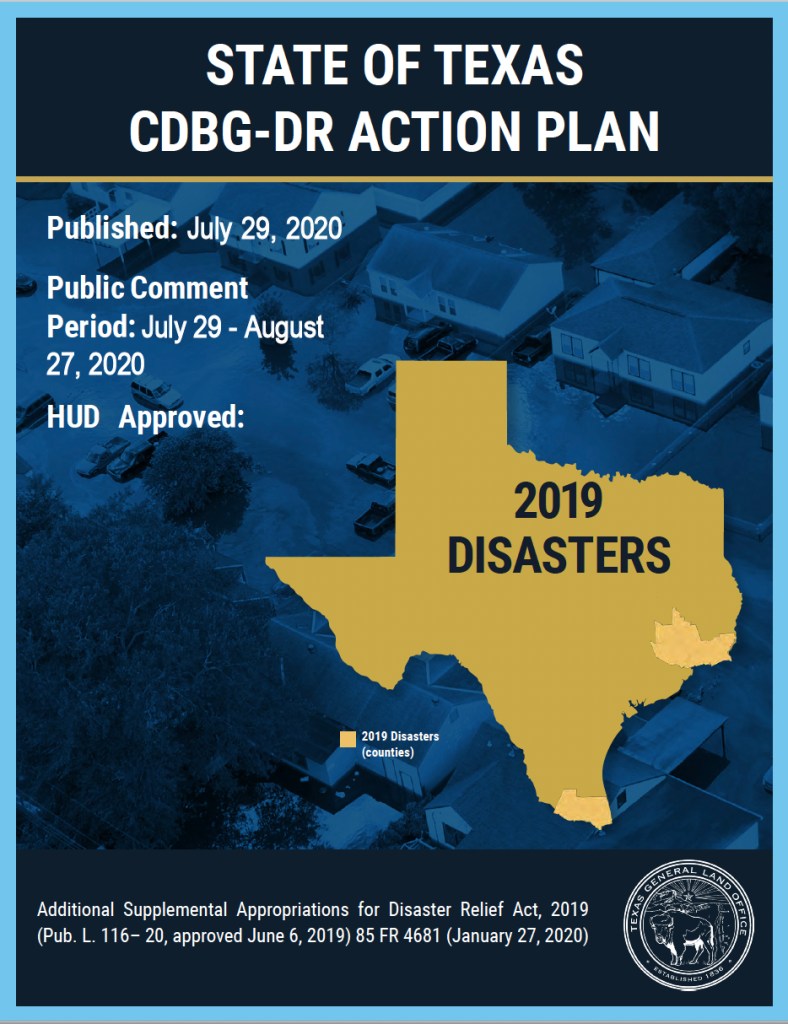
The Texas General Land Office (GLO) published its proposed Community Development Block Grant – Disaster Relief (CDBG-DR) Action Plan last week for floods in Texas during 2019. This 136-page document is available for public review and comment through August 27, 2020. It describes rules that the GLO will use to distribute $212,714 million in CDBG-DR grants from the US Department of Housing and Urban Development (HUD).

As matters of national policy, HUD has required grantees to spend at least 80 percent of the allocation on unmet needs in HUD identified most impacted and distressed (MID) areas; the remaining 20 percent will address unmet needs in other eligible counties. Also 70% of the funds must go to meet the needs of Low-to-Moderate Income persons.

Proposed GLO rules for HUD CDBG-DR grants in Texas for floods occurring in 2019

Eligible Counties Where Damage Occurred

The GLO is in charge of distributing money in Texas (through municipal and county governments) to people and areas affected by disasters declared as federal emergencies. In Texas in 2019 that meant ten counties in the Lower Rio Grand Valley and southeast Texas.

Eligible counties where damage occurred

From June 24 to June 25, 2019, high rain totals within Cameron, Hidalgo, and Willacy Counties in the Rio Grand Valley led to street flooding and road closures; nearly 1,200 homes destroyed or in need of major repair; and over 100 people evacuated. Rainfall totals ranged from 12 and 18 inches in some locations.

In September, Tropical Storm Imelda caused $8 billion worth of damage in Chambers, Harris, Jefferson, Liberty, Montgomery, San Jacinto and Orange Counties. Imelda, the seventh wettest storm in US history, dropped 40+ inches of rain in Chambers, Jefferson, and Liberty Counties. The highest total was in Fannett in Jefferson County where 44.29 inches fell.

How Money Will Be Distributed

HUD wants its money to increase the resiliency of homes and communities. Of the $212.714 million:

  • 70% will go to improving housing resiliency
  • 30% will go to improving infrastructure resiliency

Here’s the breakdown by by location and program in dollars and percentages. For a complete description of each program, see the Plan.

Allocation by location and program in dollars and percentages.

Eligible Single-Family Home Improvements

Single-family home resiliency solutions may include:

  • Elevating the first floor of habitable area;
  • Breakaway ground floor walls;
  • Reinforced roofs;
  • Storm shutters;
  • Use of ENERGY STAR appliances and fixtures;
  • Mold and mildew resistant products.

Eligible Multifamily Solutions

Multifamily resiliency solutions include:

  • Elevation;
  • Retention basins;
  • Fire-safe landscaping;
  • Firewalls;
  • Landscaped floodwalls

Eligible Infrastructure Solutions

Eligible infrastructure solutions include:

  • Elevating critical systems, facilities, and roadways above base flood elevation;
  • Installing backup power generators for critical systems (water, sewer, etc.);
  • Avoiding an increase in impervious cover by keeping projects in their original footprint and encouraging the use of building practices that allow for more pervious coverage;
  • Replanting with only native vegetation to preserve the natural environment;
  • Storm water management including installing retention basins, larger culverts and debris guards, and erosion control solutions; and
  • Supporting local community efforts to enhance building codes and regulations.

Limitations on Studies

Studies funded with this money may include, but are not limited to, flood control, resilient housing solutions, homelessness, or other efforts to mitigate future housing and residential damages.

Not for Feint of Heart

Warning: these 136-pages are intended for government experts and grant writers who deal with such programs all day every day. The information and its organization will prove difficult for average citizens. Think about the brain freeze you get with the giant DQ Blizzard. Now you have the picture.

Regardless, the persistent reader will be rewarded with a wealth of data about who was impacted when, where and how. Even the homeless.

The persistent reader will also get a good feeling for what’s allowed and not allowed under these rules. For instance, in 2019 disasters, victims can use grants to pay off loans. That was not allowed in Harvey.

Keep in mind that the dollars mentioned here are just for 2019 disasters, not Harvey, which follows similar, but not identical guidelines.

Posted by Bob Rehak on 8/3/2020

1070 Days after Hurricane Harvey and 319 after Imelda

Bruce Sprague’s Hurricane Harvey Story, Part VI

I have known Bruce Sprague for 30 years. He has always been a contributor. He flew cargo planes in Vietnam back in the 1970s and was honorably discharged from the Air Force as a Major. Then he captained commercial planes for Continental Airlines. Most recently, he taught military pilots how to transition to commercial aircraft. Like most pilots who live to the age of 73, Bruce follows procedures religiously and always has backup plans to his backup plans. But lately, life has dealt him a series of blows that have left him flying on fumes with only one engine.

While in the US Air Force and USAF Reserves from 1970 thru 1984, Sprague flew C5s all over the world.
Bruce Sprague flew for Continental Airlines from 1978 thru 2006.  Here is his most famous passenger in 2001, right after the terrorist attacks. Bruce is the pilot standing next to George Bush.

In 2006, at age 60, FAA regulations forced him to retire from flying. Then in 2008, the financial crisis wiped out a large part of his retirement savings. Next, in 2017, he flooded from Hurricane Harvey. Then the Texas General Land Office (GLO) denied him a grant under the Homeowner Assistance Program (HoAP) because he had already taken out an SBA loan. And most recently, he lost his teaching gig when the airline industry went into a tailspin due to the corona virus; no new pilots needed!

So now, Bruce is trying to regain altitude by appealing the grant rejection, but the GLO is still stalling him.

This is the story of a man who has been 1) forced out, 2) wiped out, 3) flooded out, 4) ruled out and 5) “virused” out.

Despite all that, Bruce has maintained a positive attitude. I’m writing this because he symbolizes, according to a GLO estimate, a thousand other Texans caught in a similar bind.


Waking Up on August 29, 2017, to a Changed Life

Rehak: What happened to you and your home during Harvey?

Sprague: Like most people, we went to bed on the night of August 28th thinking we were safe. But on the morning of the 29th we woke up to find an army of insects marching in front of a what felt like a tidal wave headed toward our house. Soon, the water started creeping in. It eventually reached 25 inches in the house and 30 inches in the garage.

The Sprague Kitchen on the morning of August 29, 2017 during Harvey

Rehak: Did you have flood insurance?

Sprague: No. We are in the 500-year flood plain.

Rehak: What happened next?

Reconstruction, Loans and Grant: Start of Even Bigger Problem

Sprague: Luckily, our son in law is in a business that regularly uses lots of contractors. He got people repairing our home right away. And they only charged us cost. No markup. That was the good news. But because of financial losses in 2008, we still had a mortgage and less in our retirement fund than I planned. So we applied for an SBA loan. And they loaned us about $90,000. We also got about $30,000 of individual assistance from FEMA. But the repairs cost $130,000 and that didn’t include contents and replacement of two cars. At any rate, we were able to get back in our house by Christmas, which was close to a record.

Tearing out wallboard, insulation, cabinets and flooring.

Rehak: Some time later, HUD Homeowner Assistance grants became available and you applied for one. Did you see anything in the fine print to cause you concern?

Sprague: Yes, there was a clause called “Duplication of Benefits.” It said that if we had taken an SBA loan, we would not be eligible for the grant.

Rehak: Did you ask about that?

Sprague: Yes, the person at the City who processed our application for the General Land Office said that would not be a problem. “Not to worry about it,” she said.

Rehak: So you applied?

Sprague: Yes. We went thru a year long process to fill out forms. We made multiple visits to the HoAP offices, and many, many phone calls and emails.

Loan With Interest Classified Like Grant

Rehak: What happened?

Sprague: They denied us.

Rehak: Why?

Sprague: Duplication of benefits.

Rehak: How is a loan that you have to pay back with interest a “benefit”?

Sprague: Those are their rules. But that wasn’t our only problem. Even though we had receipts totaling $130,000 for repairs, and even though most other people in the neighborhood paid more than $200,000 to repair their homes, the City inspector estimated we only had about $105,000 worth of damage. That reduced the amount of any potential grant.

Not Following Katrina Model

Rehak: When people hear the words “duplication of benefits,” it conjures up images of double dipping and fraud.

Sprague: Right. Had we applied for GRANTS that totaled more than we paid, I would agree with that. But a loan is not a grant. You have to pay it back…with interest. So you’re not defrauding the government unless you default on the loan. Look at it this way.

We had way more in repair costs than the total of our loans and grant. And they’re not even considering a homeowner assistance grant.

That’s just not fair. A lot of people think that, not just me. After Katrina, they allowed people in New Orleans to pay down their SBA loans with homeowner assistance grants. It was NOT considered a duplication of benefits then!

Rehak: So, what did you do next? You’ve worked in and around government for decades.

Crenshaw Rallies Support in Congress and With Trump

Sprague: I went to Congressman Dan Crenshaw. He and his staff have been terrific. He got ten other members of Congress to send a letter to President Trump explaining that SBA loans should not be considered a duplication of benefits. That was not Congress’ intent. Trump agreed and had HUD-leader Ben Carson publish new guidance for duplication of benefits for Harvey. [See Section VB2 on page 28841 of Federal Register.]

But the Texas General Land Office, which was overseeing the distribution of these funds in Texas, still has not changed their rules. They said the new guidance came “too late.” They also said they didn’t have enough money to make grants to people who also had loans. So, Crenshaw pushed an additional $45 million appropriation through Congress.

Rehak: Where does that stand now?

The belongings of a lifetime on the curb for looters and garbage men to take. Sprague lives in a one-story house.

Appropriations Bill Stalled In Senate Due to Virus

Sprague: It stalled in the Senate because everyone is focusing on corona virus now. The GLO has not changed its position. They say that even though Congress and the President have clarified their position, “the rules came too late.”

Rehak: That leaves you in limbo. And you’re dealing with two disasters now: Harvey and the virus.

Sprague: I understand that people are just doing their jobs, that they have rules to deal with, and they’re trying to prevent fraud. But it sure is frustrating when the President tells someone in his chain of command, “This is how I and Congress want this to work,” and then people down the line don’t follow instructions.

Rehak: Are you holding out much hope for a grant at this point?

Sprague: No time soon. It’s been more than two and a half years since Harvey. When natural disasters destroy people’s lives and homes, they need help right away, not three or four years later.

Hoping Appeals Last Long Enough

Rehak: Have you appealed?

Sprague: Yes. We’re on our second appeal. Three appeals are possible. We’re hoping we can keep this going long enough for Crenshaw’s appropriations bill to get some traction in the Senate and for the GLO to revise its rules.

Rehak: Is there any hope in the Senate? Have you approached Cruz or Cornyn?

Sprague: I’ve gotten some nice form letters back from them saying they are “working for all Texans.”

Rehak: What do you hope for at this point?

Sprague: I just hope we survive corona so our heirs don’t inherit a mountain of debt with our house. Until now, I’ve never asked anything from my government. I hope just this once they come through.

Posted by Bob Rehak on 4/4/2020

949 days after Hurricane Harvey

Note: This report for the Congressional Research Service describes issues with the Duplication of Benefits provision.

Clarification and $2.8 Billion Worth of Good News Regarding Senate Bill 500 and Harvey Funding

I previously reported that Senate Bill 500, an omnibus appropriations bill passed unanimously by the House this week, deleted all funding for the Texas Infrastructure Resiliency Fund (TIRF). However, I should also have clarified that it did NOT delete ALL funding related to Harvey and flooding.

The House deleted the portion of funding related to flood-mitigation while it considers House Bill 13 with its own infrastructure fund. The House DID leave IN approximately $2.8 billion for items not related to flood-mitigation infrastructure improvements, but related to Harvey repairs, reimbursement for extraordinary Harvey expenses, flood health care, and more itemized below. Unless noted otherwise, all expenditures are for fiscal year 2019. These Harvey-related appropriations include the following:

TDEM Matching Funds for FEMA

  • $273,000,000 to the Texas Division of Emergency Management (TDEM) for matching funds for projects sponsored by political subdivisions and approved for the Hazard Mitigation Grant program administered by FEMA 
  • $400 million to TDEM for matching funds for projects sponsored by political subdivisions and approved for the Public Assistance grant program administered by FEMA. 

Health & Human Services and Education

  • $110,000,000 to Health and Human Services for children’s Medicaid expenses
  • $271,300,000 to the Texas Education Agency (TEA) for increased student costs, reduction in school district property values and the reduction of the amount owed by school districts to achieve an equalized wealth level due to disaster remediation costs
  • $634,200,000 to the TEA for adjustment of school district property values and reimbursement to school districts for disaster remediation costs
  • $636,000,000 to TEA for the 2020 state fiscal year
  • $20,288,883 to the University of Houston
  • $4,000,000 to the University of Houston Downtown; 
  • $1,703,828 to the University of Houston – Victoria
  • $83,668 to the University of Houston – Clear Lake
  • $13,100,000 to the Lone Star College System
  • $2,458,239.76 to the Texas A&M Forest Service
  • $1,418,585 to Lamar University;
  • $1,312,657 to Lamar Institute of Technology
  • $6,319,458 to Lamar State College – Port Arthur
  • $406,112 to Lamar State College – Orange
  • $10,200,000 to UT Austin for storm damage

Criminal Justice and DPS

  • $38,6000,000 to the Department of Criminal Justice
  • $34,954,409 to Dept. of Public Safety (DPS) for Strategy A.1.1., Organized Crime; 
  • $60,000,000 to DPS for Strategy C.1.1., Traffic Enforcement
  • $2,000,000 to DPS for Strategy G.1.3., Information Technology

General Land Office

  • $696,921 to the General Land Office (GLO). for Strategy A.2.1., Asset Management
  • $20,459,797 to GLO for Strategy B.1.1., Coastal Management
  • $430,000 to GLO for Strategy B.1.2., Coastal Erosion Control Grant
  • $2,047,454 for Strategy B.2.1., Oil Spill Response
  • $4,217,510 to the GLO for full-time equivalent employees contingent on non-renewal of FEMA funding
  • $2,000,000 from the coastal protection account to the GLO for removal of abandoned vessels

Teas Parks & Wildlife and Workforce Commission

  • $17,000,000 to Parks and Wildlife to repair structures and equipment
  • $8,931,385 to Texas Workforce Commission for vocational rehabilitation services expenses

For More Information

Most of these expenditures will come from the Economic Stabilization (Rainy Day) Fund. For those who wish to learn more and review the exact wording of the House Committee Substitute version of SB500:

Here is the House version of CSSB500.

Here is the House Research Organization’s analysis of the bill.

Here is the House Appropriation Committee’s report on the bill.

Posted by Bob Rehak on March 30, 2019

578 Days since Hurricane Harvey