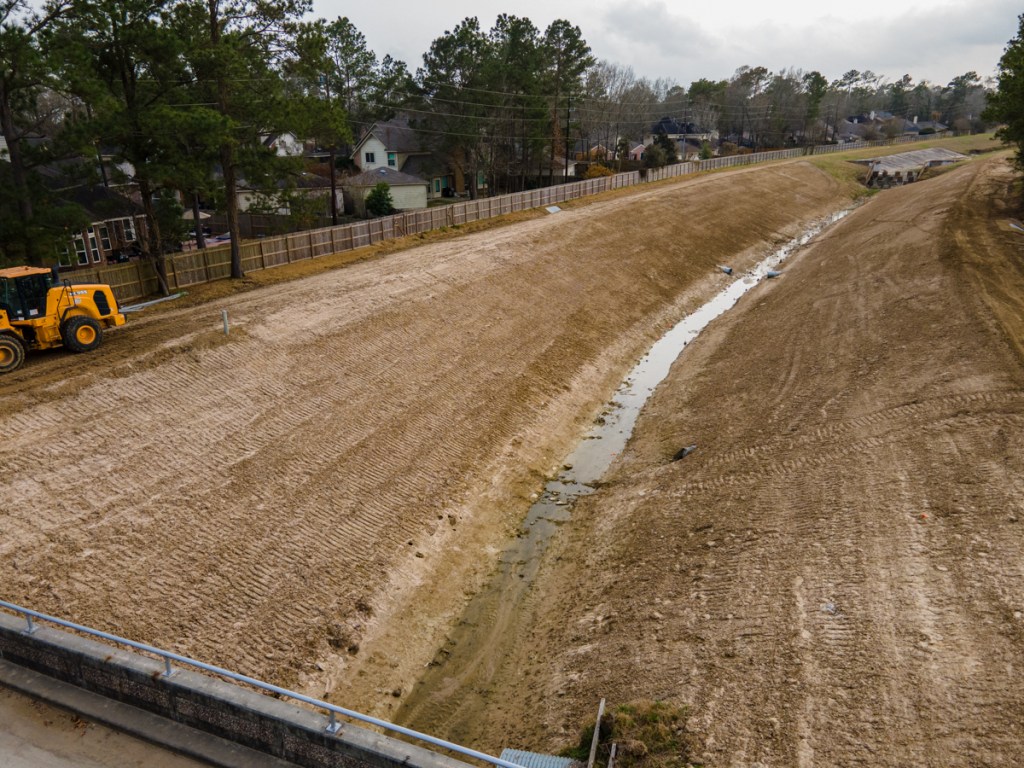
When Humble ISD began clearing land for its new ag science and north transportation centers in Porter near Woodridge Village, flood-wary residents expressed concern. Woodridge Village had contributed to flooding Elm Grove and North Kingwood Forest twice in 2019 and residents feared additional clearing of forests would add to their problems. However, the contractors successfully built detention ponds and installed drainage before any major storms hit. No one has flooded yet due to these projects. A flyover of both facilities on 3/3/2021 showed the state of construction progress on both sites.
Ag Science Center
Humble ISD broke ground for its new seven-acre northern ag science facility last November. The contractor quickly finished clearing the site and building a detention pond. Now, work has started on the underground portion of the project – utilities, plumbing and drainage. Aerial photos taken last week show large amounts of pipe stockpiled near Ford Road. Photos also show concrete forms being staked out for building foundations. Humble ISD says the target opening for the new ag science center is still 2021.
Photo looking west shows relationship between Humble ISD Ag Science Center (foreground), Ford Road, North Kingwood Forest (left) and Woodridge Village (background). Note pipe being stockpiled near road.Looking NNW, you can see trenches for pipe and forms for concrete.
When complete, this site will replace the ag barn facility at Deer Ridge Park in Kingwood. It flooded multiple times. Each time, students had to move their animals to safety. And one of the barns sustained structural damage. The purpose of this site: to improve safety.
Contractors have poured the most of the concrete for building pads and parking lots. A large retention pond has partially filled with standing water. Two buildings have gone up and roofs are being put on. But the contractors have not yet “dried in” the buildings. They still have to install windows and doors before interior finish-work can begin.
Looking NE at Humble ISD North Transportation Center Construction Progress as of 3/3/2021.Looking south at same site. Note the ag science center in the background at the top of the frame.Ford Road on right.
Target opening for this facility is also the 2021 school year. Humble ISD says the new transportation center will save $2 million per year in operating costs due to shorter routes. Currently, one transportation center in Humble serves the entire district. The center should also improve response times.
1286 Days since Hurricane Harvey and 535 since Imelda
https://i0.wp.com/reduceflooding.com/wp-content/uploads/2021/03/20210303-RJR_6288.jpg?fit=1200%2C800&ssl=18001200adminadmin2021-03-07 12:50:562021-03-07 13:16:43March Update on Humble ISD Ag Science, North Transportation Center Construction
“Backslope interceptors” help prevent erosion that can clog drainage ditches and contribute to flooding. Most people have probably seen them, but never paid much attention to them. Nor do they understand can reduce ditch maintenance costs by lengthening maintenance intervals. This photo essay shows what a difference they can make. All three counties in the Lake Houston Area require them, but Liberty County doesn’t enforce its own regulations. So the visual differences are dramatic.
What Are They? How Do They Work?
We’ve all observed water flowing through drainage ditches. But how does it get into the ditch? Broadly speaking, it can get into the ditch by a) flowing down the banks or b) through pipes. Option A increases erosion. Option B decreases it. B also reduces flood risk and the long-term cost of ditch maintenance.
What is a backslope interceptor? Imagine a small ditch (or swale) parallel to but offset from the main ditch. The swale captures runoff and overland sheet flow before it gets to the main ditch. The swale then funnels the flow into pipes that run under the banks of the main ditch. Keeping large volumes of water off those banks reduces erosion which could otherwise quickly fill the ditch with dirt and reduce its carrying capacity. If erosion reduces carrying capacity enough, water can flood nearby homes and businesses. The illustration below shows how backslope interceptors work.
Real-Life Examples
On 3/3/2021, I flew over three counties: Harris, Montgomery and Liberty. The “with/without” photos below illustrate the difference that properly constructed backslope interceptors can make. I shot the first one over the new Artavia development in southern Montgomery County. Note how the backslope interceptors let the developer establish grass on the banks of the ditch despite construction still in progress.
Ditches WITH Backslope Interceptors
Artavia ditch in Montgomery County. Note series of backslope interceptors behind the maintenance roads that flank the ditch.
Drainage ditch in Atascocita in Harris County. Again, backslope interceptors let grass establish on the sides of ditches, reducing erosion.
Wider shot along same ditch.
Ditches WITHOUT Backslope Interceptors
The rest of these examples came from Colony Ridge in Liberty County.
Lack of backslope interceptors has led to severe erosion. Runoff goes straight down the banks of ditch and into the East Fork San Jacinto.
Close up of same Colony Ridge ditch.
Role in Establishing Grass
The next two photos show the role of backslope interceptors in establishing grass. By preventing bank erosion from sheet flow, the interceptors give grass time to establish and grow, reducing erosion even more.
Ditch in Artavia, a still-developing area in Montgomery County, where developer has recently hydromulched to establish grass.
Liberty County ditch in newly developing part of Colony Ridge, also recently hydromulched. Without backslope interceptors, hydromulch has washed into bottom of ditch and will eventually wash away, leading to more severe erosion.
How Enforcing Regulations Can Reduce Costs, Flooding
Ironically, Liberty County drainage regulations updated in 2019 require developers to install backslope interceptors and plant grass on the banks of drainage ditches.
Page 100 states: “Erosion Control: All drainage facilities must be designed and maintained in a manner which minimizes the potential for damage due to erosion. No bare earthen slopes will be allowed. [Emphasis added] Various slope treatments, including turf establishment, concrete slope paving, and rip- rap, are accepted. Flow velocities should be kept below permissible values for each type of slope treatment. Interceptor structures and backslope swale systemsare required [Emphasis added] to prevent sheet flows from eroding the side slopes of open channels and detention facilities.”
Unfortunately, Liberty County does not enforce its own regulations.
When the developer eventually tries to turn Colony Ridge over to Liberty County, the county will inherit as massive maintenance burden because of non-compliance with these regulations. But even before then, the developer is creating rivers of mud that reduce the conveyance of ditches, and thus contribute to flooding nearby residents in Plum Grove.
This Colony Ridge drainage ditch in Liberty County is rapidly filling in. Residents use it for joy-riding in their ATVs, which further contributes to erosion.
The sediment also contributes to dredging and water purification costs for people downstream in Harris County.
Posted by Bob Rehak on 3/6/2021
1285 Days since Hurricane Harvey and 534 since Imelda
The thoughts expressed in this post represent opinions on matters of public concern and safety. They are protected by the First Amendment of the US Constitution and the Anti-SLAPP Statute of the Great State of Texas.
Those who watched recent Lone Star Groundwater Conservation District (LSGCD) and Groundwater Management Area 14 (GMA-14) meetings were treated to some jaw-dropping, head-spinning doublespeak on the subject of subsidence. On January 20, 2021, at a GMA-14 meeting, LSGCD rejected any mention of subsidence in their Desired Future Conditions (DFCs). Then on 2/9/2021, three presenters told the Lone Star board that they were still considering subsidence. Then on 2/24/2021, the same three presenters told GMA-14 they still rejected subsidence.
Pardon My Whiplash!
As if that wasn’t enough, during the three-hour 2/24 GMA-14 meeting, they also:
Claimed that their groundwater withdrawal plan won’t create subsidence, but insisted on removing subsidence as a measure of their performance.
Believe they are entitled to their fair share of subsidence.
Insisted they should be measured on nine factors (which included subsidence), but then argued to take subsidence out of the mix.
Their main point? In essence, “We reject subsidence as a measure of our performance.”
Why? Samantha Reiter, LSGWCD General Manager, listed four reasons in a six-page, 3716-word letter which she read to GMA-14. I have summarized her arguments below for readability and to make concise responses possible.
Argument #1: Modeling
Modeling shows that projected water draw-downs won’t create subsidence in excess of one foot on average across Montgomery County, so why worry?
Response: Subsidence models have not yet been validated for the aquifer from which Montgomery County would predominantly pump – the Jasper. Moreover, while aquifers can rebound from overpumping, subsidence cannot. Without a subsidence metric as a check, private water utilities, such as Quadvest, could merrily pump as much water as they wanted for 40 years and claim they would make it up in the last ten. But the subsidence damage at that point would be permanent.
Much of the groundwater in Montgomery County used for human consumption is pumped from the Jasper aquifer which also affects Harris and Galveston Counties. However, models predicting subsidence from the Jasper have not been validated as they have for the Chicot and Evangeline Aquifers. Source Harris-Galveston Subsidence District.
Argument #2: Can’t Control Harris County
LSGCD can’t control Harris County pumping which affects subsidence in MoCo.
Response: True, but MoCo has already shown that surface water can dramatically reduce subsidence, even where subsidence is worst – in the heavily populated, southern part of the county. Moreover, SJRA’s surface water treatment plant has space to quadruple its capacity. While MoCo is arguing to increase its reliance on groundwater, Harris County is desperately trying to reduce its.
When The Woodlands began using more surface water in 2016 after completion of a surface water pipeline, the rate of subsidence dropped 75%.
See more below under “More on Argument #2.”
Argument #3: Unfairness
It’s unfair to limit subsidence in MoCo to an amount less than Harris County experienced.
Response: Is LSGCD really arguing to make the same mistakes Harris County did? Is it really worth damaging peoples’ foundations, walls, doors, cabinets, ceilings, roofs and driveways to make a philosophical point about fairness?
These front steps in The Woodlands dropped almost 10 inches due to subsidence before conversion to more surface water. Photo courtesy of Mark Meinwrath.
Argument #4: Measurable Goals
Goals must be measurable and LSGCD does not have enough monitoring sites or equipment to measure subsidence throughout Montgomery County.
Mike Turco, head of the Harris-Galveston Subsidence District answered this in the GMA-14 meeting. You can monitor subsidence with GPS, LIDAR and other readily available technologies for much less than the cost of a network of extensometers.
Of the four arguments posed above, #2 seems strongest. Excessive pumping in either Harris or Montgomery County can produce subsidence across the county line. So how do you determine who’s causing how much in each location?
This is a question for scientists to answer. However, it seems to me that if one county is reducing its reliance on groundwater and the other is increasing its, any increase in the rate of subsidence should be easy to trace.
And this is precisely the scenario we face. Harris is reducing its dependence on groundwater; Montgomery is arguing to increase its.
In my opinion, verbose, rambling, repetitive 3-hour meetings filled with doublespeak have been designed to cloud tradeoffs, not find the best balance. It shouldn’t take smart people three hours to articulate a problem. And until we can get at what the real problem is, we will never find a real solution.
Posted by Bob Rehak on 3/5/2021
1284 Days since Hurricane Harvey
The thoughts expressed in this post represent opinions on matters of public concern and safety. They are protected by the First Amendment of the US Constitution and the Anti-SLAPP Statute of the Great State of Texas.
https://i0.wp.com/reduceflooding.com/wp-content/uploads/2018/11/6-Aquifers-e1541284612604.jpg?fit=1500%2C1130&ssl=111301500adminadmin2021-03-05 15:11:002021-03-06 08:35:41Doublespeak Continues to Cloud MoCo Subsidence Debate
Today, almost two years after Perry Homes’ Woodridge Village development first contributed to flooding Elm Grove Village and North Kingwood Forest in Kingwood, Harris County and the City of Houston finally purchased the aborted, ill-conceived development.
Current plans are for the City of Houston to build a wastewater treatment plant on the northern portion. Harris County Flood Control District will use the southern portion to build a regional floodwater detention center. The latter should alleviate flooding problems adjacent to the development as well as other areas farther downstream on Taylor Gully.
Exact Plans for Additional Detention Capacity Not Yet Developed
A press release issued today by Harris County Flood Control said, “The next step is to undergo an engineering analysis to maximize stormwater detention volume, quantify the benefit to the community and determine project cost and funding. Additional community engagement will be scheduled to gather input from area residents on the proposed project and to present project alternatives.”
History of Flooding
The flooding problems began on May 7, 2019 when approximately 200 homes flooded from sheet flow coming from the development. Two to three times that number of homes flooded on September 19th, 2019 during Imelda.
Eventually, Perry Homes, its subsidiaries and contractors managed to build five detention ponds, but their capacity still fell about 40% short of Atlas-14 requirements. Thus, the development would have posed a risk forever after had Harris County and the City not stepped in.
Photos of Property Just Purchased
Here are pictures of Woodridge Village taken on 3/3/2021 from several different angles.
Woodridge Village looking SW from the NE corner of the property in Montgomery County. The diagonal near the top of the frame and the detention pond is the Harris/Montgomery County line. Ford Road is on left.
Looking SE from the NW corner over Webb Street in Porter. The land slopes from the corner in the foreground to the detention pond in the background. Taylor Gully starts just beyond the detention pond.
Looking west along the northern boundary. The City portion of the property will border the tree line on the left and extend into the small area at the top.
Looking east along the southern border.Camera position was over Kingwood Park High School.
Looking NE from the southern border over Sherwood Trails Village in Kingwood.
Looking north up Village Springs Drive in Elm Grove. Taylor Gully starts on the right at the county line just below the concrete junction.
Looking NW from over North Kingwood Forest. Taylor Gully is on bottom right. The land slopes toward the camera position.
More About the Sale
All of the 267.35 cleared acres fall within Montgomery County. But a provision within the 2018 Flood Bond allows Harris County to purchase land in other counties if it helps control flooding in Harris.
The Harris County Flood Control District and the City of Houston jointly purchased the property for approximately $14 million. The Flood Control District is using funds from the 2018 Bond Program (Bond ID Z-02) to acquire the land. The City of Houston contributed approximately $3.8 million dollars for the use and ownership of 73 acres on the northern part of the property.
Reaction from Government Officials
“This is a great example of government doing what government is supposed to do – listening to the people who live in those neighborhoods and working to protect them from future flooding,” said Harris County Precinct 4 Commissioner R. Jack Cagle, who pushed this project through against opposition in Commissioner’s Court.
Houston Mayor Pro Tem Dave Martin also worked tirelessly to make the deal happen. It involved trading City land to the County for flood control projects and getting the City to adopt the County’s flood control standards. “This purchase is integral for investment in the future of the Kingwood area as well as many homes along the county line. Collaboration like this is essential in providing a sense of security to residents who have endured so much uncertainty these last few years,” said Mayor Pro Tem Dave Martin.
Congressman Dan Crenshaw lauded Cagle, Martin, and community support. “This is an important step forward in building a more resilient community,” he said.
State Senator Brandon Creighton said, “This type of partnership and investment will make Kingwood and surrounding areas better protected.”
State Representative Dan Huberty complimented the City and County for working together. “This is a great example of different areas of government working together to achieve the best outcomes for local residents,” he said.
Additional detention ponds are not yet built, but this is a huge step forward. A big “thank you” and “whew” to all involved.
Posted by Bob Rehak on 3/3/2021
1283 Days since Hurricane Harvey and 532 since Imelda
https://i0.wp.com/reduceflooding.com/wp-content/uploads/2021/03/20210303-RJR_6236.jpg?fit=1200%2C800&ssl=18001200adminadmin2021-03-04 13:06:272021-03-04 13:11:27Harris County, City of Houston Finally Close on Purchase of Woodridge Village Property
After 3.5 years since Harvey and dozens of helicopter flights up and down the West Fork of the San Jacinto, it never ceases to amaze me. Despite sediment gage readings that say more silt is coming from Spring and Cypress Creeks than the West Fork, the West Fork appears siltier the vast majority of the time.
Misleading Data Used to Kill Meaningful Legislation
Here’s what the West Fork looked like today. Definitely siltier.
West Fork comes down from top of frame, Spring and Cypress Creeks from right. Photo taken 3/3/2021 from near US59 bridge, looking north.
I’ve even heard miners testify on multiple occasions in the state legislature to that effect. That’s how they managed to kill best-practices legislation and minimum setbacks in the legislature in 2019.
When Brown & Root, the SJRA, City of Houston, Montgomery County, and Harris County Flood Control all cite the same misleading statistics, what’s an ordinary citizen to do?
Only a Sediment Gage Below Sand Mines Will Tell Whether This is Serious
To be fair, the engineers and hydrologists point out that the silt you see above and below may float out into Galveston Bay.
But I would also point out that:
The giant sand bar above didn’t exist before Harvey.
The point is: we will never really know what’s going on here until we get a gage downstream from the sand mines.
Photos of same location taken from different angles in previous months.In each case, the West Fork is siltier.
Time Of Essence
When I pointed out the data error caused by a misrepresentative gage location, the partners in the San Jacinto River Basin Master Drainage Study promised to re-evaluate claims they made based on the gage. The originally found, as did Brown & Root, that the vast majority of the sediment is coming from Spring and Cypress Creeks – based on the gage upstream of the sand mines. They also promised to consider installing a new gage downstream from the mines. But nothing has happened yet. And we’re already well into this legislative session.
Until changes are actually made to the study and a new gage is added, I fear the same miners may again repeat the same self-serving and misleading statistics in the legislature. That’s how they have killed bills that could help clean up our water more than once.
We’re now into the third month of the legislative session. And until the San Jacinto Master Drainage Plan consultants modify their findings, we’re all at risk. People will likely reference that study for another two decades, just as they have referenced Brown & Root’s. So this is important. Tick tock.
Posted by Bob Rehak on 3/3/2021
1282 Days since Hurricane Harvey
https://i0.wp.com/reduceflooding.com/wp-content/uploads/2021/03/20210303-RJR_5459.jpg?fit=1200%2C800&ssl=18001200adminadmin2021-03-03 20:36:292021-03-03 20:36:32West Fork Still Running Siltier Than Spring Creek
State Representative Dan Huberty filed HB2525 on March 1, 2021 to create a dredging district to perform ongoing maintenance dredging on Lake Houston. However, the boundaries of the District will be the boundaries of Harris County. As of March 2, Huberty’s bill does not yet have a senate sponsor, nor has it yet been referred to a committee.
Need for Maintenance Dredging Recognized Decades Ago
Back in 2000, the Brown & Root Report, which came out of the 1994 flood, recommending maintenance dredging to prevent the kind of sediment buildups that contributed to Harvey flooding. But nothing was ever done until after thousands of homes and businesses flooded during Harvey.
Meanwhile, more sediment comes downstream with each flood. And that 2019 money won’t last forever. So ever since the last legislative session, Huberty has sought a permanent solution.
Create a special purpose dredging and maintenance district whose operations are limited to Harris County and Lake Houston (including East Fork, West Fork and mouths of tributaries such as Rogers Gully, Luce Bayou and Ben’s Branch.
Maintenance will consist of the removal of floating debris, such as trees that clogged the waterways after Harvey.
The district will be governed by a board of seven.
Harris County Commissioners will appoint three directors.
Houston City Council will appoint three.
The County Judge and Mayor will jointly name the board’s presiding officer.
The District may:
Form interlocal agreements with other political subdivisions and corporate entities or persons to perform the work.
Seek grants of money, equipment or other resources to assist in its operations.
It may not:
Finance, develop or maintain a recreational facility.
Exercise eminent domain.
Perform the same functions as an overlapping conservation or reclamation district.
Financial Provisions
In addition to raising money from grants, HB2525 gives the District power to issue revenue bonds, but it may NOT levy a tax.
In formulating this bill, financing District operations received considerable discussion. Casey Christman, Huberty’s assistant, said, “We will have a committee substitute on this bill that makes several changes. But this bill would let the Lake Houston Dredging and Maintenance District (LHDMD) create individual interlocal agreements with each entity that purchases water, which at last count was about 68 organizations.”
“The terms of each agreement may differ (i.e. commercial vs. residential) but will outline how and where the fees are assessed. Also, LHDMD would be eligible to apply for grants or funds from other governmental entities, like FEMA or TWDB. Lastly, the new language will permit LHDMD to sell any materials collected. All options could help pay down bonds,” said Christman.
Thanks to Representative Dan Huberty for his persistence and leadership on this issue.
Posted by Bob Rehak on 3/2/2021
1281 Days since Hurricane Harvey
https://i0.wp.com/reduceflooding.com/wp-content/uploads/2021/03/20210228-DJI_0253.jpg?fit=1200%2C900&ssl=19001200adminadmin2021-03-02 18:41:152021-03-02 18:42:33Huberty Files HB2525 to Create Lake Houston Dredging and Maintenance District
Harris County Commissioners Court unanimously approved two items on today’s agenda that could eventually benefit the Humble/Kingwood Area.
#60 Recommendation to execute a Partnership Agreement with TXDoT for preliminary engineering and environmental review for a railroad grade separation on Hamblen Road, from Loop 494 to Laurel Springs Lane.
#83 Authorization to negotiate an interlocal agreement for a partnership project with the SJRA, Humble, and five utility districts for a feasibility study and conceptual design on the Spring Creek Watershed Flood Control Reservoirs.
Consideration of the projects was originally scheduled for last Friday. But visits by President Biden and Governor Abbott delayed that part of the meeting until today.
More About the Projects
The first item will formally establish a partnership with TXDoT to study the feasibility of rerouting Hamblen Road north to meet up with a bridge over US59 at Sorters-McClellan Road. The project, is key to managing traffic in Harris County’s new 90-acre Precinct 4 Edgewater Park. The preliminary engineering study will also look at building a bridge over the Union Pacific Railroad tracks. The latter is important because UP has announced its intention to start running longer trains. If one derailed, it could theoretically block every exit to Kingwood.
Site of Precinct 4’s new Edgewater Park. Hamblen Road (center) could be re-routed north to connect with the bridge over 59 at Sorters-McClellan road (top center). The project could also create a railroad bridge over the Union Pacific tracks (right).
The second item will further explore the feasibility of one or more Flood Control Reservoirs upstream from the Lake Houston Area along Spring Creek. This could reduce the amount of inbound water during future floods. In that regard, it is worth noting that the amount of water coming down Spring Creek during Harvey almost exactly equaled the amount of the SJRA’s release from Lake Conroe. Thus, such a project could partially offset future Lake Conroe releases during floods.
Where Water Came From During Harvey. Source: SJRA.
Next Steps
Neither of these projects involves approval to begin construction. They simply will study the feasibility, locations, costs, and nature of construction. Commissioners would have to approve construction after studying the results of the studies. But first the engineering department and Flood Control District must solicit bidders to conduct the studies.
Posted by Bob Rehak on 3/1/2021
1280 Days since Hurricane Harvey
https://i0.wp.com/reduceflooding.com/wp-content/uploads/2018/04/Estimated-Peak-Flows-Hurricane-Harvey-Aug-25-29-e1555953215907.jpg?fit=1500%2C971&ssl=19711500adminadmin2021-03-01 17:55:382021-03-04 08:46:41Harris County Commissioners Approve Two Projects That Could Benefit Humble-Kingwood Area
Shortly after Imelda, I posted about Lovett Commercial’s Kingwood Docks development. At the time, Lovett said it would be ready for occupancy in fall of 2019. A year and a half later, two 14,000 square foot buildings still sit empty. Certainly, this has to be one of the more bizarre retail developments around. I’ve never seen a detention pond comprise a higher percentage of a property, although I’m sure one must exist somewhere. Regardless, don’t park here in a flood.
Massive Detention Pond Occupies Approximately Three Fourths of Property
If all developments devoted this much area to detention, we probably wouldn’t have a flooding problem. That said, we do have a flooding problem and the commercial developments to the east, anchored by Memorial Hermann and H-E-B, are both higher than this.
During Harvey, many people who lived between Kingwood Drive and the West Fork parked their cars in the H-E-B and Memorial Hermann lots thinking they would be safe. They weren’t. Hundreds of vehicles flooded.
Lovett Commercial’s Kingwood Docks development is dwarfed by its detention pond. Note the manholes sticking up far above the level of the property.
Everything in the background flooded during Harvey. Memorial Hermann facility is in upper right.
Looking west from the Kingwood Docks detention pond. Memorial Hermann and its parking lot sit on much higher ground than the Docks project.
It’s unclear whether the Kingwood Docks buildings sit high enough to survive another Harvey. The water reached 7 feet in Torchy’s just a few hundred feet to the east. And Torchy’s sits on higher ground. But it is clear that your car won’t survive if you park it here during the next big flood. The entire property sits in the 100-year flood plain.
Aqua = 100-year floodplain. Tan = 500-year. Docks proper is the pie-shaped wedge under the City of Houston lettering.
Posted by Bob Rehak on 3/1/2021
1280 Days since Hurricane Harvey
The thoughts expressed in this post represent opinions on matters of public concern and safety. They are protected by the First Amendment of the US Constitution and the Anti-SLAPP Statute of the Great State of Texas.
Reverse angle, looking downstream from start of repairs toward Maple Bend Bridge.
Look at the size of that new storm drain. That should get water to the ditch in a hurry.
There’s another new, huge pipe downstream from the bridge. Compare the size of the old one on the opposite side of the creek.
Purpose of Project
The purpose of the project: to repair erosion and side-slope failures; repair or replace outfalls; rectify flowlines; and rehabilitate existing backslope swale systems.
Erosion repairs include the placement of fill material, placement of 3″x5″ granular fill and the placement of grade #1 riprap.
Channel cross sections will be restored to the original design where feasible.
The oldest recorded drawing on file is for the proposed channels from Elm Grove Village to White Oak Creek completed in March 1982. Record drawings typically show a 6-foot wide channel bottom with 3:1 side slopes.
Separate From Preliminary Engineering Study Approved on 2/5
Before HCFCD leaves a project, they will establish grass on the side slopes to prevent erosion and more downstream sedimentation.
This project is separate from a Taylor Gully preliminary engineering study for capital improvements that was approved by Harris County Commissioner’s Court at its last meeting. The capital improvements could include more upstream detention on the Perry Homes Woodridge Village Property, which is still pending purchase 1.5 years after Imelda.
https://i0.wp.com/reduceflooding.com/wp-content/uploads/2021/02/20210228-DJI_0258.jpg?fit=1200%2C900&ssl=19001200adminadmin2021-02-28 18:52:002021-02-28 18:53:18HCFCD Taylor Gully Repair Project Approximately One-Third Complete
An angry Houstonian wrote me earlier this week about a new RV park. It lies mostly in the floodway of Luce Bayou next to Huffman/Cleveland Road – near rotting shells of abandoned homes, repeatedly flooded. This is inside the City of Houston. So the City permitted it, not Harris County.
“The Retreat” Will Debut This Year
The developer bills it as an RV and camping resort called The Retreat. Copy says, “The premier destination is planned to include RV camping sites, cabins, tiny homes, wagons, and elevated yurts. Families, couples, and groups of all ages can enjoy fishing, kayaking, paddle boarding, walking trails, boating, outdoor games, lounging at the pool, and more!” Sounds idyllic until you drive around in the surrounding neighborhoods and see all the flood wreckage.
Is This Type of Development Safe for This Location?
I’m sure the developer will argue that:
The RVs are technically vehicles that can be moved out of harm’s way when floods come up.
Any permanent structures are built on higher ground in the 500-year floodplain.
A retention pond will offset any increase in runoff.
But do these arguments really hold water?
Will owners have time to evacuate everyone?
Will the ground be high enough after floodplain maps are redrawn?
How much water will the detention pond hold back if the river exceeds its banks?
During Harvey, people up and down the West Fork woke up in the middle of the night with water coming into their homes.
An architect who designs RV resorts told me it can easily take a novice half an hour to lower the trailer; disconnect electricity, water and septic lines; and hitch up a truck – in ideal conditions.
Now imagine you’re doing it during an intense rainfall and moving to the exit with a hundred other campers…at night…onto a two lane blacktop road…as the bridge goes under water…and the kids are crying.
How High is High Enough?
According to the Weather Channel, just two feet of water is enough to carry away most vehicles. They also say that water levels in flash floods can rise a foot in just five minutes. Six inches of water will reach the bottom of most passenger cars, causing loss of control and potential stalling. Finally, they say that water flowing at just 7 mph has as much force per unit area as wind in an EF5 tornado.
During Imelda, Archie Savage and Rosemary Fain, who live upstream, documented water bridging from the East Fork San Jacinto to Luce Bayou. If that happened again, campers could find themselves potentially cut off from escape routes.
Worse, flood maps have not yet been updated from Harvey and Imelda. The new 100-year flood is based on roughly 30-40% more rainfall. So floodways and floodplains in updated maps will soon expand beyond those shown below.
This image shows the location of the developer’s property between Luce Bayou and Huffman-Cleveland Road. The inter-basin transfer canal cuts across the bottom of the frame and FM2100 cuts diagonally through the upper right.Lake Houston is out of frame at the bottom.
FEMA’s National Flood Hazard Layer Viewer shows the extent to which the floodway and floodplains of Luce Bayou infringe on the property.All but the northwest corner near the letter “I’ is currently in a floodplain or floodway. That could soon change when flood maps are updated from Harvey.
FEMA’s base flood elevation viewer shows that in a 100-year flood, about three quarters of the property would go under 5 or more feet of water.Another 10-20% would go under 1-4 feet. Again, these maps are based on pre-Atlas 14 data.
The Retreat RV Resort and Campground
The lower part of the property is just a few feet about the river level.
Looking south toward the Huffman-Cleveland Road Bridge over Luce Bayou.
The detention pond actually appears to be several feet lower than the bayou. That won’t hold back much water in a flood. Note the green color.
No Prohibition, But Plenty of Warnings
Evidently, no laws or regulations prohibit this type of development. Chapter 19 of the City Code of Ordinances contains floodplain regulations but does not address recreational vehicles. Chapter 29 addresses recreational vehicles but does not address floodplains.
However, a website called RVParkUniversity.com which advises RV Park investors says, “RVs do float – but they’re not designed to. Floodplain and RVs do not get along well. So if you’re looking at buying an RV park that has “floodplain” shown on the survey, it cannot be taken lightly. Flood plains destroy your ability to obtain a loan, find a future buyer, and create huge liability for you with your customers.”
Also, the Texas Water Development Board advises people camping near water to ask the park operator about flood warnings and evacuation plans. The State does have regs that govern RV parks in floodplains. The problem is, the rules are easily circumvented. For instance, people can not leave campers in the same location for more than 180 days. But nothing prevents owners from getting around that by moving them to the next pad. In this way, temporary recreational amenities become permanent residences.
Up and down the East Fork, developers are building more such facilities.
Yesterday, I posted about how we often sow the seeds of our own disasters. This could be one of those cases in the making. Are we putting people in harm’s way without anticipating the speed or magnitude of the next big flood?
Posted by Bob Rehak on February 26, 2021
1277 Days since Hurricane Harvey and 526 since Imelda
The thoughts expressed in this post represent opinions on matters of public concern and safety. They are protected by the First Amendment of the US Constitution and the Anti-SLAPP Statute of the Great State of Texas.
https://i0.wp.com/reduceflooding.com/wp-content/uploads/2021/02/RV-Resort-Outline.jpg?fit=1200%2C827&ssl=18271200adminadmin2021-02-26 19:53:172021-02-27 09:21:22RV Park Being Built in Luce Bayou Floodway, Floodplain