If you live in the City of Houston or within its extra-territorial jurisdiction (ETJ), the City provides an easy way for you to track the progress of new developments near you.
Step One: Go To the Plat-Tracker Map
The City provides an interactive map based on geographic information system (GIS) technology. In your browser, go to a website called Houston Plat Tracker Plats. GIS maps translate database information into a familiar map format.
Houston Plat Tracker Map as of 3/17/2021. Look at the size of those two proposed subdivisions northeast of Lake Houston!
After navigating to the site, scroll and zoom to your area of interest.
Select a base map to suit your taste. Choose from satellite views, street maps, topographic maps and more. Do this by clicking on the four squares in the upper left hand corner.
Turn on the layers that interest you. Choose from City Limits, Council Districts, Management Districts, TIRZs (tax increment reinvestment zones), ETJ, historical districts, and more. Do this by clicking on the layers icon next to the base map icon.
With the tools in the upper right corner, you can draw on the map, measure distance and direction, print, bookmark and share.
By now, the map should be populated with a mass of color-coded outlines.
Click on any colored area to find background information about it, such as the developer and the application number. At the bottom of the informational pop-up box, there’s an interactive link to the City’s Planning Department website where you can learn more about the project.
Step Two: Look Up More on the City Planning Department Website
The City Planning Department website offers much more information about projects that may concern you, especially if they are coming up for a vote in the Planning Commission. Here you’ll find interactive and PDF spreadsheets that list which projects will be considered in the next meeting of the Planning Commission. The site also lists the:
Subdivision plat name
Application Number
When the developer submitted files
Subdivision Plat type
Whether a variance request exists
The location of the issue on the agenda
County, City, Council District, Precinct
Key Map code
Census Tract
Zip Code
School District
Address of the development.
TIRZ, Management District, Historic Districts if applicable
Super Neighborhood Council
Park Sector
Proposed Land Use
Property Size
Number of Lots
Appraisal District ID
Developer
Applicant Company
Applicant’s Name
Applicants Phone
Subdivision Plat with flood zones, if any, superimposed
The Houston Plat Tracker Plats website contains future and past agendas, the planning commission calendar, and development regulations. It also contains a design manual and a host of other tools in case you feel something is amiss.
Finally, it lets you set up an account so you can get notifications of what future meetings will consider.
Possible Step 3
If you find something disturbing, sign up to express your concerns at the Planning Commission, or call your city council person’s office.
You can also request copies of the drainage analysis and construction plans at a certain point in the project.
Informed citizens keep everyone conscientious. No one cares about your home like you! So keep your eyes open for new projects in your neighborhood or upstream.
To learn more about 15 other GIS maps that the City makes available online, visit this start page. You can find fascinating information about land use, demographics, flood hazards and more. Good luck.
Posted by Bob Rehak on 3/17/2021
1296 Days since Hurricane Harvey
https://i0.wp.com/reduceflooding.com/wp-content/uploads/2021/03/Screen-Shot-2021-03-17-at-1.29.44-PM.jpg?fit=1200%2C669&ssl=16691200adminadmin2021-03-17 19:55:452021-03-17 20:05:53Easy Way to Track New Developments Near You
Assistance is still available for those who live in Harris County if you have not yet repaired or rebuilt your home damaged in Hurricane Harvey. Applications are NOT for reimbursement.
They are for repairs and rehab handled through U.S. Department of Housing and Urban Development (HUD) contractors, that meet HUD specs. So forget about marble floors and countertops, adding garages or extra bedrooms, or upgrading to top-of-the-line appliances.
As long as you live in Harris County and you meet the requirements, you can still submit an application. However, understand that Harris County (compared to the City) has far more funding available than applications in its pipeline. Also understand that you can apply through the Texas General Land Office (GLO), which now handles applications for HUD; you don’t need to go through the City or County directly.
Download and complete a paper application below. Applications can be submitted by email at harriscounty.glo@recovery.texas.gov or mail to Homeowner Assistance Program 2100 Space Park Drive, Suite 104, Houston, TX 77058.
Call 346-222-4686 or 1-866-317-1998 (toll free) and a regional office team member will assist with the application process.
If you live in Harris and are INSIDE the City of Houston:
Download and complete a paper application below. Applications can be submitted by email at houston.glo@recovery.texas.gov or mail to Homeowner Assistance Program 2100 Space Park Drive, Suite 104, Houston, TX 77058.
Call 346-222-4686 or 1-866-317-1998 (toll free) and a regional office team member will assist with the application process.
All Documents Necessary Before Apps Will Be Processed
Applications, including all necessary documentation, must be completed and submitted BEFORE the GLO and its partners will begin processing it for eligibility. Each application submitted must be individually evaluated to determine eligibility. Please use this checklist for reference whether you live inside or outside of the City.
Without enough qualified applicants, GLO will be forced to send the money back to Washington. So hurry, before the money goes away or runs out.
What to Expect
Potential applicants can watch this video about What to Expect.
The GLO created this video about homeowners who received assistance through this program. Here’s another showing a homeowner who just received keys to a rebuilt home.
Posted by Bob Rehak on 3/15/2021
1295 Days since Hurricane Harvey
https://i0.wp.com/reduceflooding.com/wp-content/uploads/2021/03/Screen-Shot-2021-03-15-at-3.58.22-PM.jpg?fit=1200%2C769&ssl=17691200adminadmin2021-03-15 16:10:272021-03-15 18:48:50Harvey Repair, Rebuild Assistance Still Available for Harris County Residents
According to Jose Pedraza who works for Stuart Consulting, the contractor began work at the upstream/Rocky Woods Drive end of the site and is moving downstream. So far, they have completed about 1500 linear feet of work on both sides of the stream.
At the start of the project, surveyors found that accumulated sediment had severely constricted the conveyance of the channel.
Ben’s Branch at start of project in January. The area between the red lines filled with sediment since Friendswood first constructed the ditch in the 1970s.Looking south from between Rocky Woods and Valley Way Drive.This is how the section above looks today from a drone.Photo taken 3/13/2021.Note Kingwood High School in upper right.Farther downstream, looking east toward Kingwood Town Center in background. Contractors have just started working on this reach of the stream.Looking back upstream toward the west and Kingwood High School, you can see same reach from the opposite direction.
Work to Date Has Included…
So far, the contractor has:
Conducted excavation and off-site disposal
Installed import fill, 3×5 granular fill, and grade 1 riprap
Graded channel side slopes on both sides of the channel for 1500 linear feet.
Expected Completion by July 4 or Earlier
Due to weather and other small delays, projected duration of the job increased from 150 to 168 days. Expected completion was extended to July 4, 2021. However, based on recent on-site inspection reports, work is now moving faster. So, with luck, the finish date may be pushed forward into June once more.
Preserving Property, Tax Dollars
Homes on both sides of this stream flooded during Harvey. So did Kingwood High School. The building flooded to the second floor. It suffered $67 million dollars in damages and lost another $10 million in contents.
Hopefully, this project will reduce flood risk. Conveyance of the channel had been reduced from a 100-year level of service to a 2-year level in some places. A 2-year level of service means that the creek will flood in a 2-year rain. The goal of this project is to restore the channel to its original conveyance capacity. That includes straightening, widening and deepening clogged parts of the channel.
Posted by Bob Rehak on 3/15/2021
1294 Days after Hurricane Harvey
https://i0.wp.com/reduceflooding.com/wp-content/uploads/2021/03/20210313-DJI_0295.jpg?fit=1200%2C900&ssl=19001200adminadmin2021-03-15 12:34:582021-03-15 12:43:32Bens Branch Clean-out North of Kingwood Drive Already 40% Complete
The reason for the low risk has to do with a below-average rainfall pattern across much of Texas. The Texas Water Development board posted two stories in the Texas Water Newsroom last week about the potential for drought. Large parts of the state are already severely behind on rainfall for the year and the pattern is expected to continue through May when weakening La Niña conditions could return us to normal.
The map above shows that most of the Houston area has received about 90% of expected rainfall year to date. But large parts of the state have received less than 20%. TWDB predicts those dark areas on the map will expand at least through May. At that point, TWDB predicts only the extreme eastern part of the state will not be in some kind of drought condition.
Says Dr. Mark Wentzel, Texas Water Development Board Hydrologist, “The National Weather Service anticipates drought expansion across all but the eastern edge of the state by the end of May. Looking a little farther out there is some good news. La Niña conditions, that are at least partially responsible for drought in Texas, are expected to dissipate after April.”
So, the river flooding outlook could be very different by Hurricane season this year.
Did snow in February not help? Not really. Wentzel points out that snow is mostly air. It takes up to a foot of snow to equal and inch of rain.
Posted by Bob Rehak on 3/14/2021
1293 Days since Hurricane Harvey
https://i0.wp.com/reduceflooding.com/wp-content/uploads/2021/03/Screen-Shot-2021-03-14-at-3.57.49-PM.jpg?fit=1200%2C780&ssl=17801200adminadmin2021-03-14 16:54:292021-03-18 22:10:43NWS Says Chance of San Jacinto River Flooding in Next Three Months is Minor
Yesterday was the last day for lawmakers to file bills for the 87th Texas legislative session. Eight bills have been introduced to curb abuses of aggregate production operations, which include sand mines. Five address reclamation of mines in various ways.
Huberty’s HB4478: Reclamation and Performance Bonds
Dan Huberty from the Lake Houston Area introduced HB4478 which addresses abandonment of sand mines. Many miners simply walk away from mines leaving abandoned, rusting equipment in place and dangerous conditions. Huberty’s bill would require mines to file a reclamation plan before they start mining and also post a bond ensuring they actually execute the plan. Currently, mines are required to file a plan, but there is no requirement in Texas to execute it. Miners can simply walk away from mines after they extract the last ounce of sand. That can leave scars on the landscape, degrade water quality, and threaten public safety.
Huberty’s HB767: Best Practices
Huberty also introduced HB767, a bill that would require the Texas Commission on Environmental Quality to establish and publish best management practices for sand mining. However, it does not require sand mines to follow the practices. While that’s disappointing, it could bring heat to operations that don’t follow the guidelines.
Biederman’s HB4341: Changes Responsibility for Oversight
Representative Kyle Biederman from Fredericksburg introduced HB4341, a bill that would transfer regulation of aggregate production operations from the Texas Commission on Environmental Quality (TCEQ) to the Texas Railroad Commission (TRRC). The bill gives the Railroad Commission the right to conduct unannounced inspections to ensure compliance with water and air quality regulations. Biederman’s bill also mandates reclamation of mines, but includes more specifics than Huberty’s. Finally, it provides criminal penalties for people who knowingly and willfully violate conditions of their permits. The big news: transfer of oversight responsibility from the TCEQ to TRRC. If it passes, it will be a resounding vote of “no confidence” in the job that the TCEQ has been doing in regulating sand mines.
Zwiener’s HB2422: Limiting Location of Mines
Representative Erin Zwiener from Kyle introduced HB2422. Her bill applies to counties with a population of 500,000 or more. It would allow county commissioners to prohibit the construction or expansion of an aggregate production operation at a location less than one mile from a residence, school, place of worship, hospital, or land platted for residential development. The bill would also allow commissioners to establish conditions for the construction or expansion of mines elsewhere in the county.
Murr’s HB291: Reclamation and Performance Bonds
Representative Andrew Murr from Kerrville introduced HB291. It also focuses on reclamation of mines. It would require the grading of banks, revegetation, and removal of equipment upon completion of mining. The bill would also require operators to reclaim mines in stages as extraction activities on different parts cease. It would give miners a deadline for reclamation, too: six months. Finally, it would require a performance bond equal to $2,500 for each acre affected by extraction activities. Upon completion of reclamation activities, the TCEQ would release the performance bond. Cities and counties would have the right to waive the reclamation requirement if reclamation conflicts with proposed future uses of the land.
Abandoned dredge left at abandoned Texas Concrete Sand & Gravel Mine in Plum Grove on San Jacinto East Fork.Photographed 3/3/2021
Guillen’s HB1544: APO Taxation
Representative Ryan Guillen from Rio Grande City introduced HB1544. It addresses the tax classification of land used for sand mining. The language is confusing and an analysis of the bill has not yet been submitted. However, it appears to state that sand mine, once it meets requirements for reclamation, may revert to a property tax rate associated with open space, such as agriculture. The bill lays out some unique requirements for reclamation not discussed in the other bills here. While this seems to give sand miners a positive incentive to restore land, I’m not sure how much. In Montgomery County, the tax appraiser routinely grants ag exemptions to land used for sand mining.
State Senator Charles Schwertner from Bryan introduced SB1209. It is an identical companion bill to HB1912. Companion bills increase the chance of passage by broadening the base of support in both houses.
https://i0.wp.com/reduceflooding.com/wp-content/uploads/2021/03/20210303-RJR_5616.jpg?fit=1200%2C800&ssl=18001200adminadmin2021-03-13 14:08:362021-03-13 14:08:39Eight Bills Introduced in Texas Legislature This Year Affect Sand Mines
Ironically, the GLO press release pointed out that 2016 grants were for repetitively damaged areas. And in the five years since the 2016 floods, we’ve also had Hurricane Harvey, Tropical Storm Imelda, and a record-setting 2020 hurricane season.
Reading the release felt like getting hit by three buses while waiting for the ambulance to arrive. That prompted a call to the GLO, which administers HUD grants in Texas. I asked a simple question.
“What Takes So Long?”
When I asked the GLO “Why does flood-mitigation funding take so long”, they referred me to this page. Key takeaways include:
Congress didn’t appropriate money for Disaster Declarations in 2015, 2016 and 2017 until February 9, 2018.
Texas received $4.3 billion from the U.S. Department of Housing and Urban Development for all those years.
Before the GLO could distribute those funds, it had to wait for HUD to develop and publish rules in the Federal Register governing the distribution of those funds. That took 1.5 years.
Then the GLO had to develop a state action plan. That required developing another set of rules, holding public meetings around the state, soliciting public comments, responding to the comments, and getting HUD approval of the plan. HUD finally approved the state action plan on March 31, 2020.
Then GLO had to translate the plan into Spanish, Chinese, Arabic, Vietnamese, and Korean before publishing it.
To be fair to everyone across the state, GLO then holds a “competition” to find the most worthy projects. The criteria for “worthiness” include multiple factors. But the biggest in HUD grants are: percentage of low-to-moderate income families being helped, how economically distressed an area is, and total expected benefits for dollars invested. For instance, when comparing applications for a $10 million grant that will help 1,000 families to a grant for the same amount that will help a 100,000 families, the latter would win.
But to determine that kind of information, applicants need to conduct preliminary engineering studies before they can even file applications.
The GLO must wait for all applications to be submitted, evaluate the applications, rank order them, and see how many will fit within available funding. In the case of the grants just announced, the GLO received requests for almost TWICE as much funding as they had available. The average over the years exceeds 3X. For Harvey, it was 5X.
HUD must then review and approve the grants.
GLO distributes the money.
Finally, mitigation projects can begin.
Are All These Steps Necessary?
When you look at the list above, each step sounds reasonable. But there may be ways to collapse steps and speed up the flood-mitigation funding process. Why, for instance, do you need 1.5 years to publish rules specific to these floods in the Federal Register? Why not have a generic set of rules for all floods and adapt the boilerplate as needed?
I also asked if a way existed to shorten the process by eliminating the competition. After all, its easier to approve one application than compare it to hundreds. Their reply: “Competitions are the only fair way to do it.”
Should We Go Back to Earmarks?
The current competition system replaced an earmark system whereby Congress directly allocated funds to certain projects in certain districts. Earmarks sped up construction, but had many problems of their own. For instance, unnecessary projects often went to the districts of congressional leaders. That sometimes deprived other areas with greater needs.
However, the competition system for flood-mitigation funding has obvious problems, too. It has spawned whole industries of grant writers, project managers and people who know how to navigate traps in the convoluted application process.
I talked to one project manager today who told me about a grant that cost more to apply for than the grant was worth.
Hopefully, that doesn’t happen often. But when it does, we have proof that bureaucracy has become more important than the taxpayers it serves.
More about GLO/HUD Grants Announced This Week
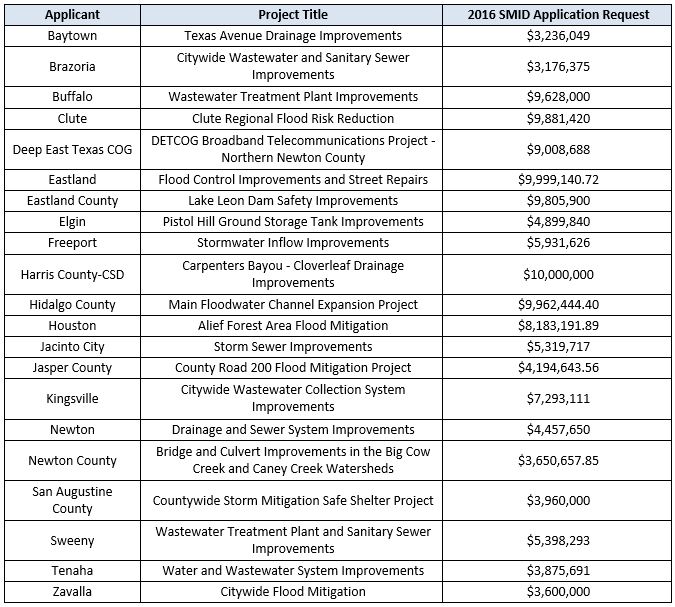
For the record, out of the $135 million in grants announced yesterday, Harris County received $10 million for cloverleaf drainage improvements in Carpenters Bayou. City of Houston received $8.2 million for flood mitigation in the Alief Forest Area. Baytown, Freeport, Sweeny, and Jacinto City also received grants.
This table shows where the money went.
For descriptions of individual projects, pleaseclick here.
Texas Counties Affected by 2016 Floods. MID stands for Most Impacted and Distressed Areas.
Hurricane Harvey Competition Results Not Yet Announced
Winners of the first round of the Hurricane Harvey Mitigation Competition are expected to be announced in late spring or early summer. The GLO received 220 extensive applications totaling more than $5 billion in requests for the $1 billion in available funding (Round 1).
The Hurricane Harvey State Mitigation Competition for flood-mitigation funding is open to cities, counties, COGs, state entities, and special purpose districts. Examples of projects include flood control and drainage improvements, infrastructure improvements, green infrastructure, public facilities, and buyouts. Each proposed project must have a total proposed cost between $3 million to $100 million.
What We Need
Getting disaster relief 5-10 years after the fact is the largest disaster of all. We need Congress to reform the process to speed up the delivery of flood mitigation funding. How many homes and businesses that flooded in 2015, flooded again in 2016, 2017, 2019 and 2020? And what were the associated costs? Did repeat-flooding damages for these years due to funding delays cost more than the amount of mitigation funds appropriated by Congress? Somebody, somewhere has that information.
Posted by Bob Rehak on 3/12/2021
1291 Days since Hurricane Harvey
https://i0.wp.com/reduceflooding.com/wp-content/uploads/2021/03/image.jpeg?fit=1200%2C752&ssl=17521200adminadmin2021-03-12 18:09:502021-03-12 21:22:56Why Does Flood-Mitigation Funding Take So Long?
When Harris County and the City of Houston closed on the purchase of Woodridge Village, flood victims in Elm Grove, North Kingwood Forest and along Taylor Gully were elated. Harris County purchased the land to create a regional floodwater detention basin. That immediately raised questions about what comes next and when?
The first will occur early in the development of the Preliminary Engineering Report (PER). The goals: to inform the community of each project’s purpose and receive community input during preliminary engineering.
A second meeting will occur once the final draft of the preliminary engineering report is complete. Its purpose: to present the results to community.
HCFCD will also communicate with local groups such as homeowner associations and the Kingwood Service Association in regularly scheduled virtual meetings as needed. Those will provide project updates and information about other Flood Control District efforts (e.g., buyouts, maintenance projects, smaller capital projects) in the Kingwood area throughout the PER process.
The Flood Control District will also identify opportunities to participate in regularly scheduled meetings and develop project-specific presentations to convey project information and proposed project features.
First Engineering Firm Already Selected
The engineering firm elected to develop the Preliminary Engineering Report for Taylor Gully improvements, IDCUS, will also consider Woodridge Village within its scope of work. IDCUS will consider what detention volume can be achieved on the Woodridge Village property and how that would affect the Taylor Gully project.
The Flood Control District plans to set up a separate project with a different consultant team to provide the detailed design services for the proposed detention basin.
Role of Rustling Elms Bridge in Flooding to Be Examined
Many residents have observed that the bridge over Taylor Gully at Rustling Elms seems to be a choke point that backs water up into surrounding homes. HCFCD will examine the role of the bridge in flooding. But, said Matt Zeve, Deputy Executive Director of HCFCD, “I cannot guarantee that the recommended plan will include any modifications to Rustling Elms.”
Looking downstream at the Rustling Elms Bridge over Taylor Gully during peak of May 7, 2019 flood. Note how water downstream from the bridge is within banks, but water upstream is overflowing.
The different heights of water above and below the bridge relate its design. See below.
Looking upstream at same bridge at later date, you can see how the twin-culvert design severely restricts flow.
However, retaining more water upstream might eliminate the need to make any costly changes to the bridge. Everything works together. It’s just too early to tell.
Other Changes Being Considered
The Flood Control District is considering a regional stormwater detention basin for the Woodridge Village site. A portion of the property will be owned by the City of Houston for a future wastewater treatment plant.
Looking south across the main portion of Woodridge Village toward homes that flooded twice in 2019. HCFCD will have the southern two thirds of this property (toward the top of the photo) to use for a regional detention basin.
Other amenities could be considered for the site, but would require a partner to construct and maintain those amenities. “The Flood Control District does not design, construct, or maintain amenities such as dog parks, trails, playgrounds, or sports fields,” said Zeve. However, HCFCD expressed a willingness to meet and work with community groups to discuss potential partnerships and make sure that input is included in design considerations.
Atlas 14 Will Form Basis of Design
Perry Homes sized detention ponds currently on the site to meet pre-Atlas-14 requirements. That means their detention capacity will fall about 30-40% short of Atlas-14 requirements. Montgomery County’s Atlas-14 requirements are lower than Harris County’s. When asked about this, Zeve responded, “HCFCD will use Atlas 14 rainfall rates for our designs even if the watershed area is not in Harris County.” That should provide some extra capacity that provides a buffer against additional upstream growth in the watershed.
Could Excavation Start Before Hurricane Season?
The Flood Control District will sometimes starts excavation on sites before final design plans are completed. HCFCD uses this program frequently to get a head start on excavation for large stormwater detention basins. “The District may not have enough time to get that program up and running by June 1, 2021, but we can certainly provide updates on this effort via our website,” said Zeve.
Posted by Bob Rehak on 3/11/2021
1290 Days since Hurricane Harvey
https://i0.wp.com/reduceflooding.com/wp-content/uploads/2019/05/Taylor-Gully-at-Peak-e1728600738227.jpg?fit=1100%2C327&ssl=13271100adminadmin2021-03-11 14:38:492021-03-11 14:38:55What Next for Woodridge Village, Taylor Gully
The 3/9/2021 meeting of Harris County Commissioners Court started with a presentation by the Harris County Budget Management Director David Berry on the County’s Capital Improvement Plan. Mr. Berry asserted early in the meeting that the County had a shortfall of approximately $900 million to $1.35 billion needed to complete projects in the Flood Bond passed by voters in 2018. Is there really a shortfall? It depends on the exact way you phrase any number of possible questions.
Confusing, Unexplained Map Triggers Almost 2 Hours of Discussion
Near the start of the meeting, Mr. Berry put up a very confusing map (below) that frequently heated the next 100 minutes of discussion to the boiling point. The discussion made every front page in town and many of the TV news shows.
The map showed the projected funding shortfalls by watershed as a percentage of the total funding allocated to each in the 2018 flood bond.
The stories featured sensational quotes by Precinct One Commissioner Rodney Ellis (We will have blood on our hands if this stands.) and Precinct 2 Commissioner Garcia (I feel like someone hit me across the back with a baseball bat.)
The map implied that construction had started on projects that the County did not have enough money to finish, especially the ones in yellow and red below.
Map from Page 16 of Harris County CIP Budget for Fiscal Year 2021/2022.
Was Flood Control Not Following Equity Guidelines?
To add more context to this discussion, understand that Halls and Greens Bayous rank among the poorest in the county. That they seemed so far behind more affluent watersheds in funding rankled Ellis and Garcia. The two had argued to prioritize flood bond spending by a “social equity” formula that addressed the poorest neighborhoods first. To say that the map above was like waving a red flag in front of two bulls would understate its effect.
So What’s Really Going on Here?
Did prices of flood-bond projects suddenly escalate, causing the shortfall? No.
Did Flood Control underestimate costs? No.
The reason has to do with the delayed arrival of long-awaited federal matching funds.
But Berry did not make that apparent in his setup. Commissioners Garcia and Ellis then peppered Russ Poppe, head of the Flood Control District, with angry, accusatory questions for more than 40 minutes. At one point, they asked 11 questions in a row before they gave Poppe a chance to answer one.
Poppe then explained that Flood Control relies on matching funds from the U.S. Department of Housing and Urban Development (HUD) for low-income areas. Why? Unlike FEMA which requires a positive benefit/cost ratio, HUD does not. Flood Control is currently waiting for answers on HUD grant applications totaling almost half a billion dollars for mitigation work in the Halls and Greens Bayou watersheds.
Commissioners Court then spent another 40 minutes trying to understand the chances of getting those grants. They also crafted a motion directing the Flood Control District to develop a backup plan in case grant money didn’t arrive by June 30.
Text Of Motion
The motion reads as follows: “To direct the Flood Control District to work with Budget Management in developing a plan by June 30, 2021 to address the funding gap in flood mitigation projects under the 2018 bond while maintaining an equitable approach to the expenditure of funds, including plans to lobby federal, state, and local partners for funding, identification of alternative funding options, a description of projects that are currently stalled due to incomplete funding and how that affects timing of project completion, and a potential timeline for a future potential bond election regarding the funding of current and future flood control projects. If the County is unable to secure funding to complete all proposed projects, the plan should address how the County should prioritize the investment of existing resources to ensure equitable flood protection and comply with the prioritization framework adopted by Harris County.”
The motion eventually passed unanimously at 1 hour and 32 minutes into the meeting.
Answers to Questions About “Underfunding”
Is construction money in Halls or Greens Bayous invested so far at risk?
No. Money spent so far, according to Poppe, has only been for land acquisition and preliminary engineering studies. The County will need both regardless of how it pays for construction. So the County didn’t waste a penny of flood-bond money invested to date. Construction can start later when a path to funding becomes clear.
Did Flood Control try to hide a shortfall?
No. The partial reliance on partner funding now characterized as a “shortfall” was shown in the Bond Program from Day One. The projected shortfall was never greater than on the day voters approved the flood bond. At that point we had secured no partnership funding for those watersheds or any others. We still haven’t for Halls and Greens.
Have we found partnership funding faster in other watersheds?
Yes. Especially in watersheds where the U.S. Army Corps of Engineers plays a leadership role in construction or where partners could demonstrate a positive benefit/cost ratio for FEMA. In 2018, Poppe estimated Harris County Flood Control could find $2.3 to $2.4 billion in matching funds based on $872 million allocated for seed money in the Flood Bond. But Berry estimates the budget shortfall at $900 million to $1.35 billion. Subtracting one estimate from the other indicates Flood Control has already found a billion dollars or more in matching funds for other watersheds. That’s great work. And that accounts for the differences in colors on the map.
Can Harris County count on the HUD money?
No. The Texas General Land Office (GLO) is still reviewing Flood Control’s grant applications to HUD. We could get some, all, or none of the requested grants.
When will we know how much HUD money, if any, we get?
Initial indications were that we would get answers by late April or early May. Today, I learned from an independent source who requested anonymity that the answer may not come until October.
If the money doesn’t come from HUD, where will it come from?
It depends. Commissioners floated several ideas in the meeting. They included self-funding with another Flood Bond and shifting money from existing sources within Harris County, such as the Toll Road Authority. They could have mentioned Texas Senate Bill 7 (from 2019), but didn’t. Among other things, SB7 provided partial reimbursement for local matching funds for federal grants. The motion approved by Commissioners Court today requires Flood Control and the Budget office to explore all the possibilities and lay out options for consideration.
Another flood bond? Seriously?
Yes and no. According to former Judge Ed Emmett, the $2.5 billion approved by voters in 2018 was always pitched as a “down payment.” Even with partnership funding potentially doubling the size of that, it still would not be likely to solve all of Harris County’s flood woes. So what’s the real total? During the meeting, the Judge and Commissioners tossed out figures ranging from $10-$40 billion. But no one believes another bond is politically feasible. Especially at this time. First, COVID has siphoned off valuable funds. And some of the commissioners have seen fit to redefine equity in the bond language in a way that benefits their constituents at the expense of all others. Now, they may not be able to deliver for their constituents. And they’ve managed to honk off everyone else. Everyone believes the likelihood of passing another bond is zero at this point.
Why is HUD taking so long?
It depends (on whom you talk to). Reportedly, the GLO and HUD have had concerns about the City of Houston and Harris County administering flood-disaster-relief funds to homeowners (separate from mitigation money for flood control projects). Even though Harris County Flood Control wasn’t involved in that program, HUD decided to have the Texas General Land Office (GLO) administer/oversee a giant pot of mitigation money for the entire state instead of sending a portion of it directly to Harris County. That created an extra step. And Harris County must compete with the rest of the state, a process that has inevitably delayed announcements.
Is it worth waiting for a half billion dollars?
Again, it depends. On whom you ask. If your home is flooding and you can get someone else to foot the bill, hell no. If your home is not flooding and there’s still a chance that HUD could come through, why hurry?
Partnership funding maximizes the amount of projects Flood Control can develop, but it can also delay some projects. This is a glass-half-full debate.
Shouldn’t we be captains of our own fate?
It depends on when you ask. When the flood bond passed in 2018, Flood Control was applauded for aggressively chasing all of the Federal funding it could. Yet during Tuesday’s Court meeting, some commissioners criticized Flood Control for going after any partner funds – a complete 180 from just two and a half years ago.
Will funding shortfalls discussed above affect additional gates for the Lake Houston Dam?
https://i0.wp.com/reduceflooding.com/wp-content/uploads/2021/03/Page-16-Budget-Shortfall.jpg?fit=1200%2C901&ssl=19011200adminadmin2021-03-10 20:20:512021-03-12 13:19:17Is There a Shortfall in Harris County Flood Bond Money? Yes. No. Maybe. It Depends.
At the 3/9/2021 meeting, Harris County Commissioners Court approved the final members and a coordinator for the Community Flood Resilience Task Force. Commissioners established the Task Force last October to ensure “equity” in flood bond spending after months of debate. At the time, Harris County Judge Lina Hidalgo and the four commissioners each appointed one member. Those five members then advertised the twelve remaining positions on the task force. More than 120 applications poured in during November and December. During January, the five core members reviewed applications and extended invitations to new members.
Resilience and ingenuity in the face of flooding.Photo courtesy of Denise Faulkner.
The pool of candidates was exceptionally strong and diverse, making selection difficult. The five core members debated candidates for weeks. They moved candidates in and out of the final group based on credentials, geography, and whom they represented. Ensuring gender, racial, and professional diversity was also a top priority.
Inaugural Task Force Members
Below is a list of the 17 inaugural Task Force representatives approved today in commissioner’s court. Commissioners unanimously approved them. In alphabetical order, including the original five:
Marissa Aho
As the City of Houston representative on the CFRTF, Marissa Aho is the Chief Resilience Officer (CRO) for the City of Houston. She leads the city’s partnership with 100 Resilient Cities, as well as city-wide resilience-building efforts to help Houston prepare for, withstand, and bounce back from the “shocks” –catastrophic events like hurricanes, floods, and cyberattacks – and “stresses” – slow-moving disasters like aging infrastructure, homelessness, and economic inequality, which are increasingly part of 21st century life.
Michael Bloom
Michael F. Bloom, P.E., ENV SP, CFM, directs the sustainability practice of R. G. Miller Engineers, Inc. and is Vice President – Technical of the Houston Branch of the American Society of Civil Engineers. He is a nationally recognized expert in resilient and sustainable infrastructure planning and design with 29 years of professional experience.
Bill Callegari
Bill Callegari is a long-time citizen of Harris County, including 40 years residence on the Katy Prairie. He is a Licensed Professional Engineer, and also served as the Texas State Representative representing Katy and Cypress for fourteen years, from 2001 to 2015.
Dr. Joseph Colaco
Dr. Joseph Colaco holds a Ph.D. in Engineering from the University of Illinois, Urbana-Champaign and is President of Colaco Engineers and Professor of Architecture at the University of Houston. Dr. Colaco brings over 50 years of engineering experience related to flood resilience and mitigation and was a founding member of the Hurricane Research Center at Texas A&M. Most recently he served as an expert panelist for the webinar on Hurricanes and Tornadoes through Florida International University.
Yasmeen Dávila
Yasmeen Dávila is a multi-diciplinary non-binary queer artist and organizer in Houston, Texas. Having lived through various hurricanes that passed through Houston, they have set their pursuits to advocate for the neglected neighborhoods that experience floods and chemical exposures before, during, and after hurricane season.
Iris Gonzalez
Iris Gonzalez is the founding Coalition Director for The Coalition for Environment, Equity and Resilience (CEER), an advocacy collaborative working on environmental justice policy solutions in the greater Houston region. She has over 10 years experience in program development, program management, coalition building, grant-making, fundraising, and community engagement.
Lisa Gonzalez
Lisa Gonzalez is President of the Houston Advanced Research Center (HARC), a nonprofit sustainability research organization. Lisa is a longtime resident of East Harris County and as a coastal scientist, focuses on climate resilience and intersections between natural ecosystems and the built environment.
Billy Guevara
Billy Guevara is a member of the Northeast Action Collective, a community organizer, and twice-over flood survivor. He is totally blind and represents the interests of the neighborhoods in Northeast Houston.
Denae King
Dr. Denae King is a native Houstonian and an environmental justice researcher at Texas Southern University. She earned a Ph.D. in environmental science/toxicology from the University of Texas Health Science Center – Houston, School of Public Health and works on environmental health projects in Houston’s underserved communities plagued with cumulative environmental exposures and recurring flooding.
Elaine Morales-Díaz
Elaine Morales-Díaz is a Community Development Officer at LISC Houston, where she manages the GO Neighborhoods and Capacity Building Programs. With a background in Architecture and Community Design, Elaine has worked on equity building initiatives that address affordable housing, disaster recovery and community development issues through participatory design and planning.
Jimmy Morales
Jimmy Morale has long lived in North Harris County. He has worked in the insurance industry for over 10 years, handling a variety of insurance policies which includes flood insurance. He has earned a Bachelor of Business Administration degree with a concentration in Insurance and Risk Management from the University of Houston-Downtown.
Earthea Nance
Dr. Earthea Nance is a published author, scholar, registered civil engineer, and certified floodplain manager with over 30 years of experience. She earned her PhD from Stanford University, and after Hurricane Harvey she served on the Greater Houston Flood Mitigation Consortium.
Mary Anne Piacentini
Mary Anne Piacentini, President and CEO, Katy Prairie Conservancy, coordinates its land protection programs and conservation assistance to landowners, establishes community partnerships and relationships with diverse stakeholders, and oversees the operations and programs of the agency. She has a master’s degree in planning from Harvard University and is currently a board member of the Partnership for Gulf Coast Land Conservation, a member of the steering committee of the Coalition for Environment, Equity and Resilience,a member of the Land Trust Alliance’s Leadership Council, the chairperson of the Stream Corridor Restoration Committee of the Bayou Preservation Association, and previously served on the steering committee for Harris County Flood Control District’s Cypress Creek Overflow Management Plan.
Bob Rehak
Bob Rehak has more than 50 years of experience in communications. After seeing thousands in his area flooded during Harvey, he launched ReduceFlooding.com, a website dedicated to helping people understand the causes of flooding as well as mitigation possibilities.
Tracy Stephens
Tracy Stephens is the President of Sunnyside Civic Club, Gulfgate TIRZ Board Vice Chairman, Infrastructure Rehab and Development Chairman for South Park Community, ACTS Board Research Coordinator, and worked for the City of Houston Public Works and Engineering Specialized Maintenance District Supervisor for Streets, Drainage Construction and Rehab.
Adriana Tamez
Adriana Tamez is a Houston Community College Trustee, and President and CEO for the Tejano Center for Community Concerns (TCCC) providing overall management of the non-profit organization and its nine service programs. Essential to this work has been nurturing and creating partnerships at all levels to meet the needs of our most vulnerable populations in our county.
Kenneth Williams
Ken Williams is a founding director of the Northeast Houston Redevelopment Council, Vice-President of Super Neighborhood 48 Trinity-Houston Gardens, and a community servant/activist/resident.
Congratulations to all. Now the hard work begins.
Task Force Coordinator Also Approved
Commissioner’s Court also unanimously approved the appointment of Holloway Environmental and Communications Services as the task force facilitator. Holloway is a frequent contractor with Harris County Flood Control and helped develop the massive San Jacinto River Basin Master Drainage Study. The facilitator’s responsibilities will include coordination of the task force and public outreach.
The Guiding Values developed by the first five members of the Task Force include:
Diverse Collaboration
Holistic Solutions
Paradigm Shifting
Inclusive Community Engagement
Ethical Foundation
Commitment and Accountability
Social Understanding
Nature and Environment
Emphasis on Action and Momentum
Posted by Bob Rehak on March 10, 2021
1289 Days since Hurricane Harvey
https://i0.wp.com/reduceflooding.com/wp-content/uploads/2021/03/Screen-Shot-2021-03-09-at-6.53.11-PM-e1615337931914.jpg?fit=1200%2C800&ssl=18001200adminadmin2021-03-09 19:15:432021-03-09 19:19:46Harris County Commissioners Approve Final Members and Coordinator for Community Flood Resilience Task Force
11) Receive information from District’s technical consultants regarding subsidence studies and/or discussion regarding the same – Samantha Stried Reiter and/or District’s technical consultant(s)
a) Discussion, consideration, and possible action to approve Subsidence Study Phase 2 Scope of Work.’
12) Groundwater Management Area 14 – update the board on the issues related to joint planning activities and development of desired future conditions in GMA 14 –Samantha Reiter and/or District’s technical consultant(s)
a) Discussion, consideration, and possible action on any items related to Lone Star GCD’s proposal(s) to and/or participation in GMA 14.
The Hollywood talent scouts should be tuning in tonight. Acting just doesn’t get much better than this. After all, these are the people who promised to “restore affordable water” but in three years have yet to reduce rates.
John Yoars, a Woodlands resident submitted a three-page letter in tonight’s board packet that is so plain-spoken and common sense that the talent scouts will probably ignore him. But you shouldn’t. See pages 23-25.
Mr. Yoars begins by challenging the board to “own your problems.” Specifically, he defines the B-52 sized fly-in-the-ointment as, “How will the Board control subsidence in southeast Montgomery County?”
Map showing projected subsidence in Southern MOCO if LSGCD pumps 115,000 acre-feet per year of groundwater.
Plain-Spoken Recommendations from Woodlands Resident
Yoars advocates:
Acknowledging that 2-3 feet of subsidence in southeast MoCo is not acceptable. It’s an average across the entire county. The average includes 0 subsidence in the northern parts and more than 3 feet in the south. There’s no way to justify the latter.
Dividing southern Montgomery County into three segments to isolate the problem.
From Magnolia west, there’s no problem, he says.
The south-central Conroe/Woodlands corridor already has access to surface water and has shown they can acceptably manage subsidence with it … when they aren’t at war with the SJRA.
Southeast MoCo is where the real problem is. He advocates working with the Porter Special Utility District to bring East Fork San Jacinto River water into their system to reduce the projected 3-3.75 feet of subsidence there.
Pumping groundwater only in the less populated areas where subsidence will not really be an issue in the foreseeable future.
Starting to talk about solutions instead of arguing about irrelevant issues.
That’s the kind of thinking that could help Texans win back their reputation for straight talk. Even if you don’t buy every one of Yoar’s points, his hypothesis is testable and could get us further down the trail than the current crew has.
Porter probably doesn’t not have enough money to build its own surface water treatment plant. Extending the SJRA pipeline from the Woodlands to Porter might be more cost effective. But again, engineers can easily estimate those tradeoffs.
Participate Via Zoom: https://us02web.zoom.us/webinar/register/WN_oqaz9Z_5SJyQRd_9dynxwQ Register beforehand. You will then receive a confirmation email with a password. Use the password to join the webinar. You WILL have the opportunity to provide live comments during the designated portion of the hearings or meeting.
Dial in: Call +1 346 248 7799; enter the meeting ID: 854 2178 5781#. You will then be prompted to enter a participation code or press #. Press #. You do not need a participation code.
Posted by Bob Rehak on 3/9/2021
1288 Days since Hurricane Harvey
The thoughts expressed in this post represent opinions on matters of public concern and safety. They are protected by the First Amendment of the US Constitution and the Anti-SLAPP Statute of the Great State of Texas.
https://i0.wp.com/reduceflooding.com/wp-content/uploads/2020/11/Screen-Shot-2020-11-20-at-10.43.20-AM.png?fit=1318%2C920&ssl=19201318adminadmin2021-03-09 17:29:132021-03-09 18:43:42LSGCD to Discuss Issue of Subsidence Tonight