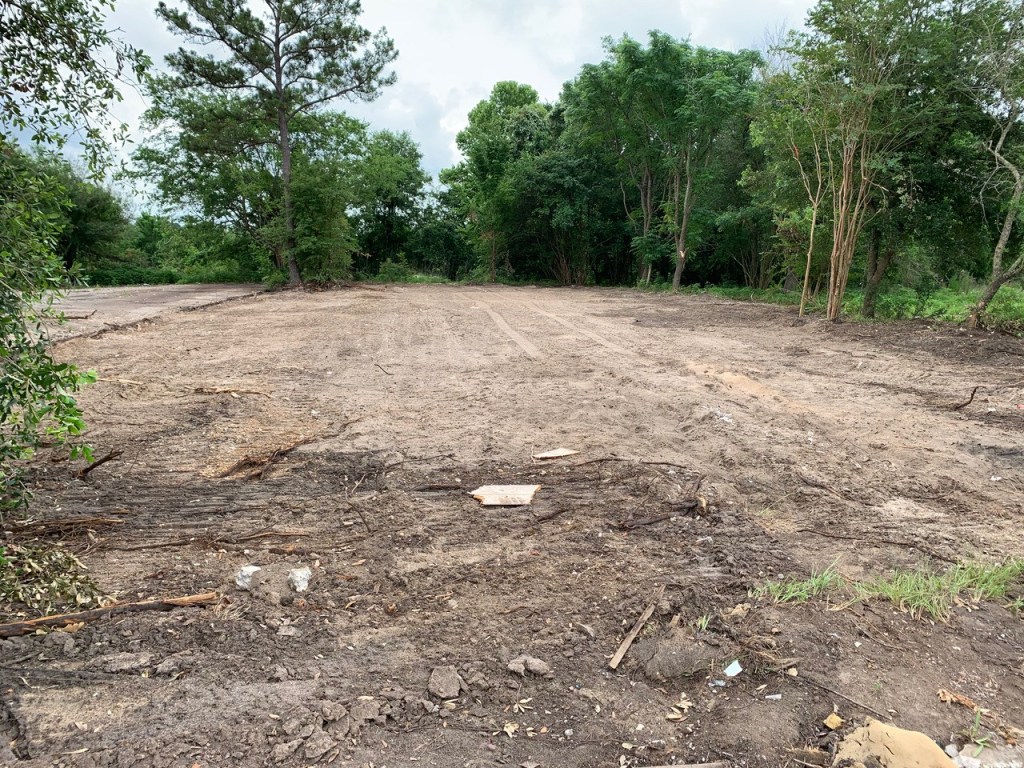
Cleanup of Leaking Oil Tanks on Noxxe Lease by Forest Cove Little League Fields Complete

The Texas Railroad Commission has finished the cleanup of leaking oil storage tanks on the Noxxe Oil & Gas lease by the Forest Cove Little League fields. Several tanks remain, but they are empty and not leaking. According to a Railroad Commission spokesperson, another individual wants to take over the lease. That person intends to use the remaining tanks to help operate one or two wells that can still produce.

However, regarding a new producer, Gilbert Herrera, a spokesman for the Railroad Commission said, “I haven’t seen any P4 (transfer of wells) come through on the Noxxe wells in Harris County, so far.”

Before/After Pictures of Two Worst Areas

Worst Area
Worst portion of lease on 1/20/2021 as cleanup started.
Same area 11 days later on 1/31/2021. Tanks on right have been left intentionally for now and are empty.
Second Worst Area
Second worst area on 1/1/2020.
Same area on 1/31/2021 after cleanup. Note that five storage tanks are gone.

Industrial Litter Still Clutters Site

A drilling rig, travel trailers, trucks, drill pipe and more still remain on the site. Peter Fisher, District Director for the Railroad Commission said the Commission planned to salvage/auction those items. However, he could make no promises. “Sometimes we’re successful and sometimes we’re not,” said Fisher. It depends on the market.

Abandoned pipe and more still remains on Noxxe site.

Abandoned Wells Still Not Plugged

Abandoned wells on this site have not yet been plugged. Neither have wells on the western portion of the site near Marina Drive and Aqua Vista. The Railroad Commission says that “depending on well prioritization, approvals, rig scheduling, and so on, we have an estimated time of 14 to 19 weeks” for plugging.

Note oil sheen on ponding water next to San Jacinto West Fork, upper right.
Again, note the oily sheen on the water next to these abandoned wells. The San Jacinto West Fork/Lake Houston (lower left) provide water for 2 million people.

Much Work Still Yet to Do

“All eligible orphan wells for plugging will be submitted to Austin for approval. From there and dependent on the factors mentioned before, we will plug as many of the wells as possible in that area,” said Gilbert Herrera of the Railroad Commission. 

You can view all the “orphan wells” in that area on the Railroad Commission’s GIS map. An orphan well is one left behind by a bankrupt company.

Harvey forced Noxxe out of business. The company could not afford the cleanup. However, the Pew Foundation found that “So-called “orphan” oil and gas wells, which have been abandoned by defunct companies that cannot pay to plug them, are a growing problem in many states thanks to a recent slump in energy prices that has forced marginal operators out of business.”

“Nobody knows how many orphan and abandoned drilling sites litter farms, forests and backyards nationwide. The U.S. Environmental Protection Agency estimates there are more than a million of them. Unplugged wells can leak methane, an explosive gas, into neighborhoods and leach toxins into groundwater,” said Pew.

How many wells are there around the Humble salt dome? Hundreds, if not thousands. See below.

Screen capture of Railroad Commission GIS database showing oil and gas wells in the Humble/Kingwood area. Note the circular outline that matches the shape of the Humble salt dome.

The Railroad Commission GIS database lets you toggle software switches to see which wells are active, dry, plugged, orphaned, etc. Hovering your cursor over a dot shows the current status of the well.

Drillers frequently find oil and gas around salt domes. Salt, which is buoyant within the earth, fractures surrounding rock. Oil and gas seep into those fractures where it collects in commercial quantities. Is there any doubt why this area was so attractive to oil companies over the years? Here’s a history of the Humble Oil field which was discovered in 1904.

Once again, thanks to State Representative Dan Huberty for working with the Railroad Commission to accelerate cleanup of this area once the problems became known.

Posted by Bob Rehak on 2/3/2021

1254 Days after Hurricane Harvey

Mobilization Begins for Next Phase of Ben’s Branch Restoration

Last week, Harris County Flood Control District (HCFCD) began mobilizing for the restoration of the Ben’s Branch drainage ditch between Kingwood Drive and Rocky Woods. The work will involve removing accumulated sediment that has diminished the conveyance capacity of the ditch.

Engineers measure conveyance in terms of “level of service.” A 100-year level of service means that a ditch will convey a 100-year rain without overflowing. The Kingwood Drainage Analysis performed last year by HCFCD revealed that sediment had reduced the conveyance of Ben’s Branch to a 2-year level of service in places. This project will restore the ditch to its original contours.

Looking north toward Rocky Woods. Most of the land between the two roads on either side of the ditch will be removed. Photo taken January 31, 2021.
Looking WSW toward intersection of Kingwood Drive and West Lake Houston Parkway. Trucks will exit Ben’s Branch by the cell tower behind the old H-E-B. Note the orange walls of the new H-E-B in the upper left. Also note the new CVS still under construction in the upper right (yellow walls). Photo taken Jan. 3, 2021.
How trucks will exist the project. Looking northwest across two temporary bridges where the two parts of Ben’s Branch come together. Work will focus on the main part on the left. Photo taken Jan. 31, 2021.
Temporary crossing for trucks coming down the west side of Ben’s Branch toward the exit on the east side by by old H-E-B. Photo taken January 31, 2021.

Importance of Project

Along Ben’s Branch, as a result of flooding during Harvey:

  • Kingwood High School immediately to the west of this project flooded badly. The building suffered $67 million in damages. The school lost another $10 million in contents. Four thousand students had to be bused to another school for seven months.
  • Homes along both sides of the ditch flooded.
  • All four shopping centers in Kingwood’s Town Center flooded. Many businesses still have not returned.
  • Thirteen people died, included twelve seniors at Kingwood Village Estates. Six died from injuries sustained during evacuation and six from stress-related illnesses after returning and finding their homes destroyed.
Looking south from northern end of project. Kingwood High School in upper right.

History of Previous Ben’s Branch Projects since Harvey

Previously, HCFCD cleaned out the portion of Ben’s Branch from the YMCA on West Lake Houston Parkway north to Kingwood Drive. This is an extension of that project. HCFCD also cleaned out the portion from Northpark Drive to Kids in Action on Woodland Hills Drive. Flood Control could not obtain permission to excavate anything in the natural portion of Ben’s Branch between St. Martha’s Catholic School and Rocky Woods. However, HCFCD did clean out underbrush to let water flow faster through that area.

Scope of Current Work

For the current work between Kingwood Drive and Rocky Woods, HCFCD will start at the downstream end and work its way north. The work should take about five months. It involves removing more than 22,000 cubic yards of sediment, restoring the original banks of the ditch, and replacing a number of outfall pipes that have become blocked or damaged over time.

Once the work begins in earnest, HCFCD contractors will enter the northern side of the project at the end of Cedar Knolls and move south toward Kingwood Drive. There, they will exit the project behind the old H-E-B store. Crews will work around Kingwood High School start/stop times to reduce traffic snarls.

HCFCD considers this a maintenance project, not a capital-improvement project.

Related Projects in Kingwood

The Kingwood Drainage Analysis identified two much-needed capital improvement projects in Kingwood:

  • Expansion of the Diversion Ditch that runs from the new St. Martha Church down to Deer Ridge and River Grove Parks where it eventually enters the West Fork. The purpose of the Diversion Ditch project: to further reduce the flow of water into Ben’s Branch.
  • A project to reduce flooding along Taylor Gully. Two options have been discussed:
    • Widening and deepening Taylor Gully itself
    • Establishing a regional detention pond on the land owned by Perry Homes’ subsidiary Figure Four Partners.

HCFCD has not announced a timetable yet for either of those projects. Any work on Taylor Gully would depend on whether Harris County and the City are able to negotiate the purchase of Woodridge Village from Perry. Woodridge Village is the aborted development that twice flooded Elm Grove and North Kingwood Forest Villages in 2019.

Posted by Bob Rehak on 2/3/2021

1253 Days since Hurricane Harvey

Kingwood Drive Closed at Loop 494 from February 4-6

This is off-topic but it affects thousands of readers who may be delayed on their way to work or medical appointments this week. Kingwood Drive will shut down in both directions at Loop 494 from 9 a.m. on Thursday, February 4 to 7 p.m. on February 6. North-South traffic on Loop 494 will remain open.

Purpose to Widen KWD and Add Sidewalk

TXDoT and Union Pacific Railroad have agreed on the closure to accommodate roadway widening and new sidewalk. The railroad track crossing at Kingwood will also have to be widened and replaced. TxDOT can stop all train traffic to perform the work during that window.

Detours

To detour the closure, consider Northpark Drive or Hamblen Road.

Closures Subject to Change Depending on Weather

All closures are subject to change due to inclement weather. TXDOT is asking drivers to be cautious in the construction area.
For more information, contact Emily Black at (713) 802-5022.

Colony Ridge Developer Sues Critics For More Than Million Dollars Based on Questionable Allegations

(Updated 2/2/2021 at 8PM) In the “lawsuits-are-stranger-than-fiction department,” Colony Ridge developer Trey Harris has filed yet another lawsuit against the Plum Grove City Council and Plum Grove’s former Mayor Leann Walker. This time, Harris wants more than a million dollars. Among other things, the suit alleges that by hiring Wayne Dolcefino, they attempted to smear Harris. But in the next sentence, Harris trumpets “Their smear tactic was not successful.” So where was the damage?

More Questionable Allegations

Dig a little deeper and you’ll find several more equally questionable allegations. For instance, he alleges that elected officials acting in their official capacity can be sued as private citizens. To support this assertion, Harris alleges that council members had personal vendettas against him when they tried to defend residents from road damage, flooding and more.

Harris also alleges that:

  • The City Council doesn’t represent the public’s interest. Yet Colony Ridge issues have been front and center in multiple elections during the last decade.
  • Harris is a citizen of Plum Grove although he reportedly lives in Huntsville.
  • Defendants “trespassed” on his property, presumably by driving on a public road.
  • The Council refused Harris’ offer to help repair roads when, in fact, they accepted his $25,000.
  • Stopping road damage and flooding has “nothing to do with what is in the best interest of the public.”
  • Defendants do not like Harris.

Geez! When does a City Council have an obligation to like someone who they believe has destroyed the homes, roads and safety of City residents?

History of Disputes with Multiple Parties Contradicts Vendetta Claim

A long history of legal and political disputes between Colony Ridge and Plum Grove under different councils and mayors contradicts Harris’ claim that current criticisms are “personal vendettas.”

Harris previously sued Walker and lost in 2015. The judge ordered Harris to pay Walker’s legal fees. Harris also sued the City, which was under a different mayor at the time, and reportedly settled.

Numerous Plum Grove residents have complained about Colony Ridge to Liberty County officials for years. Resident’s concerns have included destruction of wetlands, inadequate detention pond capacity, damage to roads, public safety issues, violation of county regulations, plat irregularities and more.

Downstream residents in neighboring counties have also expressed concerns about flooding and road damage related to Colony Ridge construction practices.

TCEQ has repeatedly investigated Colony Ridge contractors and found multiple sewage leaks and substandard construction practices that jeopardize human health. Erosion caused by piling dirt next to ditches has clogged Plum Grove creeks with sediment and contributed to repeated flooding.

Colony Ridge Drainage Ditch Photographed on January 1, 2021, months after the TCEQ warned that such practices could adversely affect human health.
Sediment coming down the East Fork (right) from Colony Ridge on Jan. 1, 2021.

Rumor also has it that the Army Corps in Galveston has an open investigation into wetland mitigation issues in Colony Ridge.

Finally, last year, Plum Grove sued Colony Ridge to get the developer to repair roads his trucks have damaged. Could Harris’ recent suit simply be a countersuit designed to intimidate Plum Grove into dropping its suit? Possibly. But there’s something else going on, too.

Enter Wayne Dolcefino, Investigative Journalist

Having found no way to get Liberty County to enforce its own regulations in Colony Ridge, last October, Walker and the City Council hired Wayne Dolcefino, one of the country’s leading investigative journalists. They hired him to help shine a light on problems there. And for the first time ever, Liberty County started paying attention.

In January, Dolcefino’s reports forced Liberty County officials to investigate irregularities related to engineering reports that may have been falsified and alleged violations of County drainage/development regulations.

A short while later, Harris filed his latest lawsuit.

Intimidating People into Silence

Harris seeks more than a million dollars from the tiny city of Plum Grove. On Page 4 of the suit, Harris alleges, “This action [the hiring of Dolcefino] was not taken with the public’s best interest in mind. It was taken as a calculated and vindictive action in an attempt to harm Plaintiff.” But in the very next sentence, Harris also claims, “Their smear tactic was not successful.” So if he wasn’t damaged, why is he suing? To intimidate people into silence?

I’m not a lawyer and this is not legal advice, but the State’s Anti-SLAPP statute (AKA, the Texas Citizens Participation Act) may help Walker and the council members as individuals without governmental immunity. The act protects free speech on matters of public concern. If a legal claim is dismissed under the Texas Anti-SLAPP statute, the Court must award attorneys’ fees and may sanction plaintiffs from bringing improper lawsuits in the future.

But like the boxer he was, Harris has come out swinging. Things will soon get interesting.

Posted by Bob Rehak on 2/1/2021 and updated on 2/2

1252 Days after Hurricane Harvey and 490 Days since Imelda

The thoughts expressed in this post represent opinions on matters of public concern and safety. They are protected by the First Amendment of the US Constitution and the Anti-SLAPP Statute of the Great State of Texas.

Based on new information obtained on 2/2/2021, mention of the Texas Municipal League paying for legal costs was deleted.

Scientists Quantify Flood-Damage-Reduction Benefit of Texas Wetlands

A study by Samuel D. Brody, Sammy Zahran, Wesley E. Highfield, Himanshu Grover, and Arnold Vedlitz called “Identifying the impact of the built environment on flood damage in Texas” quantifies the flood reduction benefits of wetlands along the Gulf coast. The authors studied property damage in 423 floods between 1997 and 2001. They identified the effect of several built-environment issues, including wetland alteration, impervious surface and dams on reported property damage while controlling for biophysical and socio-economic characteristics.

Their statistical results suggest that naturally occurring wetlands play a particularly important role in mitigating flood damage. But how much? The results vary by location, of course, but in one county, they discovered that a 3.4X increase in wetland alteration permits correlated to a 10X increase in flood damage.

Wetlands adjacent to San Jacinto East Fork upstream from Lake Houston

Importance of Understanding Causes of Flooding

Floods damage more property than any other type of natural disaster in America – billions of dollars every year. However, the author’s say, there is lack of research on the relationship between the built environment and flood impacts in the eastern portion of Texas. Say the authors, “Such information is critical given the continued development of coastal areas and the increasing vulnerability of human populations to inland coastal flooding.”

What Study Correlated and How

The authors correlated flood property damage (total dollar loss adjusted by the consumer price index) to variables such as:

  • Precipitation (day of flood)
  • Precipitation (day before flood)
  • Percentage of county in 100-year floodplains
  • Duration of flood
  • Dams
  • Percent impervious surface
  • Wetland alteration
  • FEMA Community Rating System
  • Median Household Income

They measured everything by counties. Watershed data would have been better for floods, but damage is not often aggregated by watersheds.

Researchers measured “wetland alterations” by counting wetland permits issued by the US Army Corps of Engineers in Galveston under Section 404 of the Clean Water Act. They simply counted the number of permits issued up to the day of any given flood. This enabled them to measure the cumulative impact of wetland alterations over time.

FEMA’s Community Rating System encourages city and county leaders to promote responsible development over time. The more an area reduces flood damage through regulations, mapping and 18 flood mitigation measures, the higher the discounts that residents earn on flood insurance.

The researchers used multivariate regression analyses to find which factors most influenced the degree of flood damage in eastern Texas. Multivariate regression identifies the degree of influence that multiple variables have over each other. It measures correlation, not causation.

Major Findings

Specific characteristics of the human-built environment in eastern Texas have an important influence on property damage resulting from floods, even when controlling for biophysical and socio-economic factors. Below are four major findings from the study.

First. the amount and duration of precipitation associated with a given storm flood largely governs flood damage.

When looking at biophysical variables, timing of precipitation is particularly important. “Heavy precipitation the day before the actual flood event is by far the strongest predictor of total property damage,” say the authors. This may be because of the delay in the rise of water or the saturation of soil. “It is important for decision-makers and the public to understand that heavy precipitation followed by sunny skies can still result in significant flood damage the next day.”

Second, the most important built-environment indicator of flood damage is the the alteration of naturally occurring wetlands.

“Impervious surfaces have long been criticised for their contribution to increased flooding and associated damage. However, the most significant impact may not depend solely on the total amount of imperviousness in a watershed or drainage basin, but rather on where exactly these built surfaces are placed. Altering or removing a wetland to construct car parks, roads and rooftops, for instance, effectively eliminates its ability to capture, hold and store water run-off.”

For example, comparing two identical rainfalls four years apart in De Witt County showed a 10X increase in damage. During that time, the number of wetland permits granted increased from 5 to 17 – 3.4X.

Similarly, comparing two 1.5 inch rainfalls in Wharton County, damage doubled while the number of wetland-alteration permits increased from 17 to 26.

Incredibly, Galveston County experienced a 20X increase in flood damage based on two 0.09 inch rainfalls three years apart. During that time, the number of wetland permits increased from 546 to 921.

“Developments initially believed to be safe from flood threats become an unexpected target of expensive flood damage over time,” say the authors. “The planning goal in this situation is to allow development to proceed without reducing the hydrological function and value of wetland systems.”

The authors suggest that achieving this objective will involve identifying and protecting wetlands through local land use policies. They include zoning restrictions, land acquisition programs, clustered development, density bonuses and more. Net economic benefits to a locality may result by reducing costs related to repair of damaged structures and mitigation solutions.

Third, wetlands may be more effective than dams in mitigating property loss over time.

Dams are extremely costly mitigation alternatives. And they can encourage development in flood-prone areas out of a false sense of security. See more below.

Fourth, FEMA’s Community Rating System reduces property damage.

Communities ranked high by FEMA for mitigation measures experience significantly lower amounts of flood-related property damage. “In fact, CRS participation appears to reduce community-wide flood damage more than dams, which are far more costly,” the study claims.

Economic Tradeoffs

In comparing the relative effects of various variables on flood damage, the authors also assessed economic tradeoffs of various mitigation measures.

For instance, they compared the cost in property damage in a flood to the price of wetland permits and dams. They found that 129 wetland alteration permits cost as much property damage per flood as one dam saved.

“Given the expense of building dams, their negative environmental ramifications, and the possibility of structural failure, protecting naturally occurring wetlands may be a more rational policy alternative,” says the study.

Posted by Bob Rehak on 1/30/21 based on a study by Samuel Brody, et. al.

1250 Days since Hurricane Harvey


Texans for Responsible Aggregate Mining Release Video Showing Statewide Nature of Problems

Texans for Responsible Aggregate Mining (TRAM) released a new video today demonstrating statewide issues with aggregate production operators (APOs). Just in time for the 2021 legislative session, the 12-minute video calls the concerns non-partisan, but says they requiring bi-partisan support. Their goal: to find the right balance between economic growth, public health, environmental preservation and regulation.

The group’s research found that Texas is one of seven states without comprehensive APO regulations. That leaves APOs in Texas largely unchecked and out-of-control.

Video Examines Six Major Concerns

Excessive sedimentation that leads to flooding is not the only issue associated with aggregate mining as practiced in Texas. The video shows APO operations across the state and addresses six major concerns:

  1. Air particulate emissions
  2. Water quality and availability
  3. Surface and groundwater contamination, and flooding
  4. Rapid development of APOs with adequate regulatory oversight
  5. Truck traffic, safety, and road repairs plus their costs
  6. Nuisance issues such as noise and light pollution, plus blasting

This vividly demonstrates some of the issues discussed in the House Interim Committee’s Report on Aggregate Production Operations released earlier this week.

Screen capture courtesy of TRAM. Click to play video.

Packed with Fascinating Factoids about Aggregate Mining

The video is packed with eye-opening factoids. Did you know, for instance, that:

  • One 80,000 pound truck creates the wear and tear of 9600 cars?
  • Texans subsidize truck damage to roads to the tune of $.23 cents per mile driven for every fully loaded commercial vehicle?
  • APO contract vehicles typically operate on a per-load basis, often leading them to push the safety envelope to carry more loads?
  • APOs can reduce property values by 5% up to 3 miles away and more than 25% within a quarter mile?

Screen Capture Courtesy of TRAM. Click to play video.

Relationship Between Regulation and Growth

In case you want to do your own econometric analysis on the relationship between growth and aggregate regulation, TRAM offers a good starting point. This link shows a state-by-state breakdown of regulations. Who has comprehensive mining regulations, who has partial and who has none?

Of the ten fastest growing states, three have no comprehensive mining regulations; six do, and one has partial regulation. Net: the proposition that lax regulation of APOs creates fast growth is dubious.

Posted by Bob Rehak on 1/29/2021

1249 Days since Hurricane Harvey

The thoughts expressed in this post represent opinions on matters of public concern and safety. They are protected by the First Amendment of the US Constitution and the Anti-SLAPP Statute of the Great State of Texas.

San Jacinto Master Drainage Plan Uses Gage UPSTREAM from Sand Mines to Estimate West Fork Sedimentation

Appendix F of the San Jacinto River Basin Master Drainage Plan discusses the sediment contribution to Lake Houston of various tributaries. It asserts that Cypress Creek, Spring Creek, and West Fork sub-watersheds are the highest contributors of suspended sediment to Lake Houston, contributing an estimated 38.7 percent, 26.8 percent, and 13.0 percent of the total sediment load, respectively.

However, to measure sediment on the West Fork, the study team used a gage at I-45 – UPSTREAM from virtually all West Fork sand mines. This explains a huge disparity between measured data and visual observations. But the report never even acknowledges the visual observations.

I have previously posted about the 3600-page master plan. In many respects, it is a masterpiece that contains good and valuable information that will help mitigate flooding throughout the watershed. The comments in this post relate ONLY to Appendix F on sedimentation, which in my opinion contains a serious flaw.

Misleading Impressions

The problem with using the gage at I-45: it rules out certain contributions to sedimentation that the report barely acknowledges.

Cypress Creek and Spring Creek combine before merging with the West Fork. Thus, you would expect five times more sediment coming from Spring and Cypress Creeks than the West Fork, based on their findings. Yet almost every time I photograph the confluence of the West Fork and Spring Creek, I see more sediment coming from the West Fork, despite the fact that Lake Conroe blocks sediment coming from the upper part of the watershed. See below.

Confluence of Spring Creek and West Fork San Jacinto. Each shot taken in a different month and from a different angle. But the siltier stream in each case is the West Fork where virtually all the sand mines are.

Location of West Fork Gage Never Fully Specified in Report

The West Fork gage number is listed on page 114 of Appendix F. But the description says only, “W Fk San Jacinto Rv nr Conroe Tx, Gage #08068000.” At another point (page 115), it lists the gage near Lake Conroe. To find the exact location of the gage, one must go outside the report to a USGS site. Then to see where the gage sits relative to West Fork sand mines, one must back up to page 61 of Appendix F. Most readers will just assume, given the scientific nature of the report, that the authors used a gage at a representative location, not one that ruled out sediment from sand mines.

Even a careful reader of the report could conclude that the contribution of sand mines to sedimentation is minor in the grand scheme of things. TACA would welcome such a conclusion.

The report ignored thousands of photos posted on ReduceFlooding.com as well as TCEQ reports citing sand mines for non-compliance.

The implications of measuring sediment upstream from sand mines, overlooking visual evidence, and ignoring official reports calls into question some of the report’s recommendations. For instance, #2 suggests using “existing [emphasis added] stream gage data” … to “inform where higher suspended sediment is originating within each sub-watershed.”

Sorry, you can’t get there from I-45. And if sand mines are an issue, neither can you get there from LIDAR surveys taken every several years, which the report also recommends. Sand mine discharges happen frequently and sporadically, often under the cover of darkness.

Sand Mining Not Seriously Considered as Possible Source of Sedimentation

The report, for the most part, blames sedimentation on new development and stream bank erosion. It does not consider:

Intentional pumping over dikes
Pipes buried under dikes
Breaches and pumping into surrounding wetlands that drain into the West Fork
Breaches in abandoned mines
Breaches into drainage channels just a few yards upstream from the West Fork
Intentional breaches. Note the backhoe tracks and sharp edges to the breach in this video.

Sedimentation Report Needs More Gages

You can’t document the volume of such breaches and illegal pumping from a helicopter. However, you can’t overlook such practices either.

What we really need is a sediment gage downstream from the sand mines just before the West Fork joins Spring Creek. A gage at that location would go a long way toward calculating the volume of sediment escaping from sand mines.

Report Also Needs Revision Before Legislative Committees Meet on Sand Mining

The authors also need to amend this report quickly. The amendments should highlight the location of the West Fork gage, the implications of that, and limitations on the use of the data – especially by the legislature.

My biggest fear is that sand miners will attempt to use this report to defeat reasonable legislative reforms of the industry. They have used similar reports in the past to do exactly that. I have personally testified in four House and Senate committee hearings about sand mines only to have TACA trot out figures from the 2000 Brown and Root Study. B&R drew similar conclusions because it used the same West Fork gage at I-45.

To protect the scientific integrity of its report and the validity of its recommendations, the authors need to act quickly. The legislature is considering new sand mining regulations at this instant. Such regulations could protect downstream residents from excess man-made sedimentation, huge dredging costs and potential flooding.

The Master Drainage Plan, including Appendix F on sedimentation, is intended to guide flood mitigation efforts for the next 50 years and help inform the expenditure of potentially billions of dollars during that time. The larger report has many good points. But Appendix F is seriously flawed. I hope the partners – City of Houston, SJRA, Montgomery County, HCFCD and their consultants – fix it before lasting damage is done.

Posted by Bob Rehak on 1/28/2021

1248 Days since Hurricane Harvey

The thoughts expressed in this post represent opinions on matters of public concern and safety. They are protected by the First Amendment of the US Constitution and the Anti-SLAPP Statute of the Great State of Texas.

HGAC Honors Bayou Land Conservancy with Award for Strategic Conservation Plan

Since 1996, Bayou Land Conservancy (BLC) has been a land and water conservation leader. In 2019, BLC developed a Strategic Conservation Plan to continue that tradition for the next twenty years. This plan identified lands with the greatest positive impact on flood control, water quality, and wildlife habitat in the region. 

About the HGAC Awards

H-GAC selected the Plan for recognition in its annual Parks and Natural Areas Award Program, which began in 2006 to highlight best practices and innovative approaches to parks planning and implementation.

H-GAC honors projects in the categories of Projects Over $500,000, Projects Under $500,000, Planning Process, and Policy Tools. BLC received special recognition in the Planning Category. Projects recognized by this awards program are selected by a panel of expert judges and industry professionals.

Photo courtesy of Bayou Land Conservancy

About Bayou Land Conservancy

Bayou Land Conservancy’s mission is to preserve land along streams for flood control, clean water, and wildlife. They envision a protected network of green spaces that connect people and nature. Although a small organization, BLC aims to have a large impact on land conservation, stewardship, and community engagement. Strategic planning is critical to achieving these goals.

Becky Martinez, BLC Conservation Director, explains, “We developed a strategic conservation plan to better prioritize our land conservation projects. The plan is a great tool to direct BLC’s community supported conservation projects. Though Houston feels very urban, there are many beautiful and beneficial natural places around us.”

The goals of the SCP were to identify and describe important areas for BLC to protect and create a plan of action toward their conservation.

Having reviewed the entire plan, I must say that the rigor and discipline used by BLC matches the organization’s dedication and enthusiasm. There’s a reason BLC has thrived for more than 25 years while other groups have come and gone. BLC currently preserves more than 14,000 acres across six counties from Houston to Huntsville.

The Hundred Thousand Acre Opportunity

BLC’s land preservation improves the quality of life for over five million people living in the greater Houston area. The strategic conservation plan identified approximately 100,000 acres of very high priority lands where preservation will have the greatest positive impact on flood resiliency, water quality, and wildlife habitat.

“When floodplains are left in their natural state or undeveloped, they can mitigate flooding by absorbing stormwater before it can inundate houses and businesses,” said Martinez. “Natural corridors along streams also filter runoff and rainwater, safeguarding our drinking water supply. By strategically focusing on these areas, BLC is able to maximize the benefits of land preservation and increase the community’s feeling of safety.”

The SCP also prioritizes land ideal for recreation and environmental education opportunities adjacent to existing parks and other protected spaces and trails.

But without the support of conservation-minded people, a plan is just a plan. Help put it into action. Support the Bayou Land Conservancy.

In the 1247 Days since Hurricane Harvey, I’ve posted hundreds of articles about threats to sensitive areas that could help reduce flooding. Here’s an easy way to help preserve those areas and enjoy them at the same time.

Learn More

Bayou Land Conservancy and other winners will be honored during an online celebration at 9 a.m. February 5, 2021. The event is free and open to the public. Registration is required at https://zoom.us/meeting/register/tJEsfuqvrT4pHdK8RmnQPh01-XzROD0yEY98

For more information about The Strategic Conservation Plan visit https://www.bayoulandconservancy.org/strategic-conservation-plan. Or click here to review the entire plan.

For more information about H-GAC’s Parks and Natural Area Awards, visit http://www.h-gac.com/parks-and-natural-areas/awards.aspx

Posted by Bob Rehak on January 27, 2021

1247 Days since Hurricane Harvey

House Committee Releases Report on Sand Mining

A House Interim Committee on Aggregate Production Operations (APOs, which include sand mining) just released a 77-page report focusing on the Hill Country and San Jacinto River Basin. The report validates many of the concerns ReduceFlooding.com has raised about sand mining for years.

One of multiple breaches at the Triple PG mine in Porter left open for months until the Attorney General sued the mine.

Purpose: To Balance Priorities While Addressing Concerns

Texas House Speaker Dennis Bonnen created the committee to help balance public protection, regulation and economic growth. Bonnen tasked the Committee with reviewing complaints about APOs and making recommendations to the 87th Texas Legislature. Issues include:

  1. Nuisance issues relating to noise and light
  2. Transportation safety and road repairs
  3. Air quality
  4. Blasting
  5. Reclamation
  6. Distance from adjoining properties
  7. Disruption of groundwater
  8. Water quality
  9. Sedimentation and flooding
  10. Municipal ordinances.

The report begins with a description of the balancing act regulators face. Sand and gravel used in concrete support economic growth. But they also impact surrounding property values, impact the health of neighbors, and lower quality of life when they cut corners and operate outside of industry best practices to lower production costs.

A number of bills in the last legislative session sought to resolve these conflicts and many, such as “best practices” will be reintroduced during the session which started this month. Pages 7-10 describe the legislation attempted in the last session.

Below, I summarize each issue listed above in order.

Noise Pollution

The main sources of noise from APOs come from the machinery used to move earth, process raw material and move product. Blasting is also a major consideration in the Hill Country.

The U.S. Mining Health and Safety Administration (MSHA) characterizes noise and one of the most pervasive health hazards in mining. Prolonged exposure to hazardous sound levels over a period of years can cause permanent, irreversible damage to hearing. Hearing loss may occur rapidly under prolonged exposure to high sound levels, or gradually when levels are lower and exposures less frequent.

Ways to reduce noise from moving equipment include use of strobes, alarms, camera systems and motion sensors that can trigger backup beepers as needed.

To mitigate noise from processing equipment, the report suggests chute liners and screens made of rubber or urethane to dampen the sound of the rock hitting the sides of the conveyors. Acoustical enclosures such as walls, berms and natural vegetation can also help protect neighbors.

APOs should monitor the noise exposure at their property line, keeping the noise level at their property line below 65 dB if the property line is within 880 yards of a residential area, school, or house of worship, and 70 dB if not.

Report Recommendation

Light Pollution

APOs create light pollution when the dust they generate scatters light and creates haze. Those that operate at night may require light for safety that keeps neighbors up.

APOs should be held to IDA and IES standards for outdoor industrial lighting, and fined when they don’t.

Report Recommendation

These standards provide operator safety yet shield neighbors from the most annoying effects of light pollution.

Transportation

The high volume of heavy trucks used to move product creates traffic safety issues near APOs and damages roads. TxDOT allows APOs to build 90-degree driveways. These are less expensive, but more dangerous than acceleration and deceleration lanes which provide massive safety benefits.

Dust and small rocks coming off of trucks cause windshield damage and obscure vision of nearby drivers. Placement of roadway bumps leading up to acceleration lanes would help shake off the dust and smaller rocks from the trucks before they make their way onto the highway.

Studies have also shown that the level of damage to the integrity of roads by heavy commercial vehicles far outpaces the funding they contribute through gas taxes. Such vehicles pay $.03 per mile, but cost $.26 per mile.

Recommendations:

  • Change TxDOT protocols to allow for an agreed upon change to a driveway should traffic conditions change.
  • Require that new APOs have enough right of way purchased to construct acceleration or decelerations lanes.
  • Commission a study to establish a Pricing Model for Pavement

Air Quality

Suffice it to say that the health risks of breathing APO dust are voluminous.

Short-term exposure can result in coughing, shortness of breath, tightness in the chest and irritation of the eyes.

Long-term exposure can result in reduced lung function, and respiratory diseases such as asthma, chronic obstructive pulmonary disease (COPD), diabetes, emphysema, impairment of brain development, low birth weight, lung cancer, stroke, aggravation of existing lung disease, and death.

OSHA, MSHA and other agencies responsible for worker health continue to reduce allowable exposure levels for labor; these same reduced exposure levels should be applied to the general population as well, says the report.

Testimony from those living near APOs who have been affected by the decline in air quality demonstrates that regular regional air-quality monitoring is insufficient. So, TCEQ does not know what the actual, real-time particulate concentrations are in the air near APOs.

Recommendations:
  • Require APOs to set up onsite monitoring.
  • Commission a study to determine cumulative effects of adjacent mines, each outputting a compliant level.
  • Modify the TCEQ permitting process to include county commissioners, municipal authorities and others.

Blasting

This is a bigger problem in the Hill County than Houston. So I will skip it here.

Reclamation

APO’s can suddenly cease operation for a number of reasons: bankruptcy, depleted assets, decline in demand, etc. While sites can never be returned to their original condition, they CAN be restored for safe, alternative uses.

At a minimum, this means removing hazardous materials and industrial equipment, and sloping walls to avoid leaving dangerous collapses.

Recommendations:
  • Require APO to file a reclamation/restoration plan.
  • Require operators to post a Surety Bond to cover all reclamation costs in the event the operator fails to reclaim disturbed lands.
  • Address all potential future safety and environmental problems (fugitive dust, erosion, etc.) in reclamation plans.

Distance from Adjoining Property

Current regulations depend on the type of facility and the type of equipment in use. This makes regulations complex and difficult to interpret.

Recommendations:
  • Revise permits to define setbacks by the distance from the APO property line rather than the specific piece of equipment.
  • Require a setback of 880 yards for concrete batch plants.
  • Establish setback rules for all APOs that treat platted subdivisions as residential areas.

Groundwater Disruption

The committee found inconsistent groundwater conservation rules around the state. Many counties did not even have Groundwater Conservation Districts, or if they did, they could not assess the cumulative regional impact of APOs on water supply. Historic APO water use data is not readily available to the public.

Recommendations:
  • The Texas Water Development Board should complete an in-depth assessment of APO water use.
  • Study future water supply, especially for the Houston area, where sedimentation threatens Lake Houston.
  • Require APOs to recirculate groundwater to conserve groundwater resources.

Water Quality

The committee found that TCEQ regulations for APOs are less rigorous than for other types of surface mining enforced by the Railroad Commission.

APOs construct ponds based on their preferred ‘best management practice,’ often without rigorous engineering or regulatory inspection. Testimony from neighbors indicated sediment-laden discharge damaged property. TCEQ found that nearly half (42%) of APO enforcement actions (not related to registration) were due to noncompliance with water-quality rules.

Groundwater pollution by APOs is also a legitimate concern.

Recommendations:
  • Require Texas APOs to comply with requirements for Texas coal and uranium mines.
  • Improve rules and regulatory processes to provide a higher level of protection from pollution by APOs.
  • Provide more robust and frequent groundwater inspections.
  • Perform dye-trace studies to determine groundwater flow-paths in areas close to major water wells.

Sedimentation and Flooding

The committee found sand mining along the San Jacinto River to be one of the contributors of excess sedimentation. It also aggravated flooding issues in Montgomery and Harris Counties during and after Hurricane Harvey.

Also, “The result of partitioning large areas of the floodway from rising floodwaters by levees and dikes can result in increased flooding of adjacent areas. Flood-induced breaches in levees can also add to the problems of flooding and sedimentation downstream.”

Unfortunately, breaches and unauthorized discharges are sometimes left unreported and unrepaired unless citizens file reports to the TCEQ. Even when violations have been documented by the TCEQ, fines have been minimal, averaging ~$800/violation from 2013-2017. Worse, the TCEQ inspects mines only once every two years for the first six years, and then once every three years thereafter.

The committee also found that in-river mining has continued along the West Fork of the San Jacinto even though no permits have been granted by TPWD. TPWD enforcement appears to be lax. “Thus, it is likely regulations will have little or no effect on in-river mining.”

Recommendations:

Municipal Ordinances

The report found that municipalities (as opposed to counties) already have the power to require minimum buffers in Public Health and Safety requirements and nuisance abatement ordinances. The committee specifically cited the City of Houston. But much mining remains outside of municipalities. So it recommended granting authority to counties to establish setbacks between incompatible land uses and to regulate water wells to avoid possible groundwater contamination.

Lack of Industry Cooperation

This report began by acknowledging the need for balance. However, it ended by complaining about the lack of industry cooperation.

For instance, TACA claimed that pushing facilities father from where products are needed will “add a tremendous amount of cost.” When the committee tried to investigate such economic claims, TACA refused to document them. The committee then reached out to trade groups in other states to substantiate TACA’s claims. However, all those groups refused to respond or simply ignored the requests.

That led to one final recommendation. Should concerns about the potential economic consequences become substantiated by reputable data, the legislature should institute a “Best Practices Compliance Incentive Program.”

It would require TCEQ to certify that all APOs trying to do business with the state comply with industry best practices.

To read the entire report, click here.

Posted by Bob Rehak on 1/26/2021

1246 Days since Hurricane Harvey

The thoughts expressed in this post represent opinions on matters of public concern and safety. They are protected by the First Amendment of the US Constitution and the Anti-SLAPP Statute of the Great State of Texas.

How to Find Active HCFCD District Capital and Maintenance Projects

If you’ve been wondering what Harris County Flood Control District (HCFCD) is up to, check out this interactive GIS Map on HCFCD.org. It shows all active capital and maintenance projects, their exact locations, and budgets. It’s one of several interactive GIS maps that can give you critical information about flood risks, flood maps, mowing schedules, and more.

Active Projects for January 2021

The map below shows active HCFCD projects for January 2021. HCFCD says it updates the maps in the first week of each month. Projects that start after that may not show up until the following month. Active projects include both capital (new construction) and maintenance projects.

Click on the map to launch the app. Click on any project listed on the left or corresponding number on the map to review project description, budget and location in all Harris County Commissioners Court Precincts.

You will find both the legend and filters in the upper right corner. Red circles represent capital projects and black circles represent maintenance projects. To focus only on one type, click the layer icon in the far upper right. Press one type of project or the other to deselect it.

Active project viewer on HCFCD site. Note: not all of these projects involve flood-bond dollars.

What Capital Projects Include

Capital projects include major projects that reduce flooding risks and damages by:

  • Increasing stormwater conveyance capacity in bayous and drainage channels
  • Excavating stormwater detention basins.

Stormwater detention basins reduce flooding risks and damages during heavy rain events by safely storing excess stormwater and slowly releasing it back to the bayou when the threat of flooding has passed. 

More About Maintenance Projects

Maintenance projects include repair projects aimed at returning flood damage reduction channels and other infrastructure to their original designed level of performance by: 

  • Repairing sinkholes, slope failures and other damage caused by erosion 
  • Removing sediment that can reduce stormwater conveyance capacity. 

Smaller maintenance projects grouped together under one construction contract are often given both individual Project Identification Numbers and an umbrella number that begins with the letter “Z,” since there is often more than one watershed involved in the group. “Z-packages” have numbers such as Z100-00-00-X223. 

What Map Does NOT Include

This map does not include flood damage reduction studies or projects in other preliminary phases; smaller maintenance projects performed by Flood Control District work crews; or completed construction projects.

Equity?

One of the first things that strikes me about the January map is the lack of projects in the northeastern portion of the county. To be fair, two small maintenance projects have started in Kingwood since the map above was compiled. But still, a glance at the map shows that projects are heavily skewed toward the south, central and western sides of the county.

Example: The construction projects now underway on Brays, White Oak, and Hunting Bayous total more than $100 million. But there are ZERO construction projects underway in Kingwood, Humble, Huffman, Atascocita, Spring, Tomball, and Crosby – all areas hard hit by Harvey.

Fairness to all?

Commissioner’s Court has pushed the Flood Control District to start projects in lower income areas first based. A majority of commissioners worry that low income residents are less able to recover from floods. They also worry that money in the flood bond won’t cover all projects identified in the 2018 flood bond. Some have even talked about floating another bond.

Good luck with that if they don’t adopt a more equitable definition of “equity” which the 2018 flood bond promised!

Posted by Bob Rehak on 1/25/2021 based on public information provided by HCFCD

1145 Days since Hurricane Harvey