Funding Announced for Massive Detention-Basin Complex on Cypress Creek

9/25/23 – Approximately 425,000 people live in the 204 square mile Cypress Creek watershed which has severe repetitive flooding. At a press conference this morning, County, State and Federal officials announced $50 million in funding for a massive complex of stormwater detention basins on Cypress Creek at T.C. Jester Blvd. to help protect those people.

The basins will span approximately 150 acres on both sides of T.C. Jester and include 1200-acre feet of planned stormwater detention capacity, wet bottoms, and recreational trails.

Approximate boundaries of three detention basins – one will go west of TC Jester and two more east. White area is existing basin.

Altogether, the stormwater detention capacity in this area will increase approximately 75X.

Google Earth calculation of existing and planned ponds

The existing pond covers approximately 2 acres and the new areas will cover more than 150.

Looking E over T.C. Jester. Existing 2-acre basin in foreground was site of press conference. Wooded area beyond will become two new detention basins.

Thanks to County, State and Federal Governments

The $50 million will come from three primary sources:

Harris County Flood Control District Executive Director Tina Petersen also reminded everyone of the money designated for Cypress Creek in the Flood Bond, which was considerable.

The GLO/HUD money has been requested but not yet confirmed although all indications are positive at this time. GLO Commissioner Dawn Buckingham has committed to making sure that people in all parts of Harris County benefit from the $750 million.

Timetable and Project Scope

HCFCD Director Dr. Petersen addressed the next steps in the projects. “A portion of the projects on the east side of T.C. Jester will start construction in the next 6 to 9 months. The remainder should go into construction no later than the end of 2024. So we’re going to see these projects move quickly. This type of progress would not have been possible without the critical funding that our Congressman and Representative secured “

The overall project includes three stormwater detention basins within a broader footprint. Two basin compartments are on the east side of T.C. Jester Boulevard and another is on the west side.

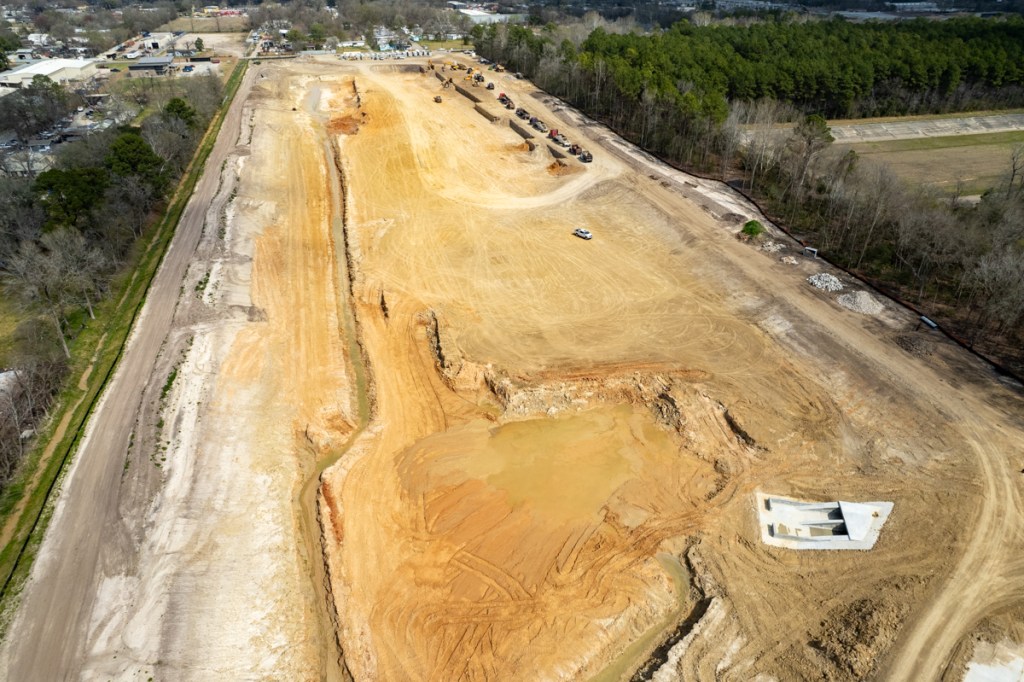
Excavation of the west side basin (see below) has already begun under an E&R (Excavation and Removal) Contract. A private contractor is removing the dirt, almost free of charge, then selling it at market rates to recoup costs and make a profit. An estimated 120,000 cubic yards of material has already been excavated to date.

Work to date on basin west of T.C. Jester. Looking N toward Cypresswood Drive.

The contractor began removing dirt in the general area to get a head start on construction, even before final design of the basin. The final design will begin soon.

Each basin will have a wet-bottom with maintenance berms, side slopes and high banks along the outside.

Construction for all basins should begin no later than Q4 2024. They have estimated 8-month construction timelines.

Extent of Benefits

The three stormwater detention basins will work together – taking stormwater from the main stem of Cypress Creek and holding it until water levels recede on the main stem.

The projects will also have recreational benefits such as hike and bike trails.

Director Petersen stated that the projects will primarily benefit the local area, i.e., benefits will not extend very far downstream. The 1200 acre feet will likely take several thousand homes out of the floodplain.

Even though those homes will be in the Cypress Creek area, 1200 acre feet being held back upstream is 1200 acre feet that won’t be in the living rooms of Lake Houston Area residents during the next big flood.

More to Come

Ramsey also pointed to more projects to come, though he didn’t elaborate. He said, “This is $50 million of the $100 million that will be spent over the coming months in the Cypress watershed. So hold on. We’re getting started. This isn’t the end. This is the beginning.”

Speakers at T.C. Jester Detention Basin Press Conference included U.S. Representative Dan Crenshaw, State Representative Sam Harless, Harris County Precinct 3 Commissioner Tom Ramsey P.E., and HCFCD Executive Director Dr. Tina Petersen.

Posted by Bob Rehak on 9/25/2023

2218 Days since Hurricane Harvey

Harris County Proposes 11.5% Budget Increase

Harris County’s Office of Management and Budget proposed an 11.5% budget increase during the Commissioners Court special meeting held on September 12, 2023. See below.

Proposed on 9/12/2023, but not yet approved.

Flood Control Maintenance Increase

If adopted, Harris County Flood Control District (HCFCD) would receive an $11.8 million increase from tax revenue for Maintenance and Operations spending – up 10.4% from FY2022.

Given the number of new capital projects, such as stormwater detention basins that Flood Control has created in the last year, that increase seems reasonable. The number of acres that HCFCD needs to maintain steadily increases as it builds new assets.

Acres of infrastructure needing maintenance has almost doubled since 2000. Source: HCFCD Asset Management Presentation

HCFCD now manages 2,500 miles of channels, more than 260 detention basins, 2 levee systems, 3 mitigation banks, and more than 3,200 buyout lots.

Two-thirds of Flood Control’s infrastructure was constructed before 1984 and much of it needs rehabilitation. The District has identified 160 assets with defects, 117 with blockages or conveyance issues, and 215 where vegetation requires serious attention.

As with anything, deferring maintenance too long can lead to failure. Then reconstruction costs can greatly exceed repair costs.

Flood Control Debt-Service Increase

Flood Control also shows an increase in its proposed tax rate to handle debt service – 8.2%. This makes sense as we keep borrowing more and more money against the $2.5 billion bond that voters authorized in 2018.

It could take decades to pay off the interest on money borrowed this year. And next year, we’ll borrow more. The total interest payments increase over time as borrowing accumulates. High interest rates like we have now can increase the total need even more.

Partner Contributions Help Offset Debt-Service, But Are Dropping

The $2.5 billion bond actually identified $5 billion worth of projects. A portion of the original $2.5 B was designated as local-match money to attract partner funding. So for every project, roughly half of the total cost was supposed to be local dollars (tax revenue and/or borrowing). The other half was supposed to have come from partners, such as FEMA, HUD, and the State.

That said, partner funding never has come close to 50%. Q2 of 2020 came the closest at 41%. But the percentage has also dipped as low as 14% recently. Since the start of the bond, partner dollars have comprised 30% of all spending.

Partner spending in recent quarters has declined significantly. Through 22Q1, partner spending averaged $28.4 million per quarter. Since then, the quarterly total has averaged only $11.5 million. That’s a 59% decrease.

Through 22Q1, partner funding ranged between $20-45 million. Since then it hasn’t exceeded $20 million.

To make up for the lack of projected partner funds, HCFCD has had to spend more County/Bond dollars to keep projects moving. And it has done so in a period of high interest rates.

Note how drops in partner spending often trigger spikes in County spending.

As partner funds have fallen off in recent months, so has the overall level of HCFCD spending.

Data for this and all tables/graphs obtained from HCFCD via multiple FOIA requests.

Here’s the data which these graphs reflect. This particular series starts with the approval of the flood bond in late 2018.

Is It a Fair Budget Increase?

That depends on whether you see any flood-mitigation efforts that benefit you. If your area is getting projects, the answer is yes. But if not, you probably wouldn’t be happy with a 1% increase. And out of the $1.5 billion spent to date, precious little has been spent in the San Jacinto watershed.

Regardless, when setting budgets, we must consider dozens of different factors, not the least of which is partner funding. It can extend bond dollars. And consider this.

The $750 million in HUD funds recently received by the County come with “use-it-or-lose-it” deadlines attached. HCFCD had a giant meeting with contractors last week to discuss such issues.

If we can use the HUD money to accelerate construction and preserve bond dollars, we might have enough money to complete all the projects in the bond.

Conversely, with a shortfall in the partnership percentage, more county dollars will go toward projects in low income neighborhoods. That may leave no money for projects in affluent neighborhoods before we burn through the bond funds.

At the very least, I say we need to beef up the HCFCD staff applying for grants. I’ll bet we can all agree on that.

Posted by Bob Rehak on 9/14/2023

2207 Days since Hurricane Harvey.

HCFCD Spending Shows Slight Rebound

After a sharp decline in the first quarter of 2023, Harris County Flood Control District (HCFCD) spending rebounded slightly in the second quarter. Second quarter spending did not recover to recent peaks, but at least exceeded pre-2018 Flood Bond levels.

Data obtained via FOIA Request from HCFCD on 8/14/23

One Third of Bond Money Spent in Half the Projected Time

However, HCFCD is still behind schedule with mitigation related to the 2018 flood bond. HCFCD has not issued a flood-bond update since last December. But you can calculate progress yourself by looking at the charts in this post.

Six years after Harvey and five years after the flood bond, HCFCD and its partners have spent approximately $1.6 billion to improve Harris County drainage.

Taxpayers approved $2.5 billion in the 2018 flood bond. Approximately a third of that was designated for matching funds to attract another $2.5 billion from Federal, State and local sources.

That means five years after the bond (and six years after Harvey) we are are roughly one third of the way through the bond, which was intended to be a ten-year program. And that one third is likely overstated due to inflation.

Spending Inequities

The County has not spent the money to benefit all people equally, thanks to the so-called Equity Plan approved by Commissioners Ellis, Garcia, and Judge Hidalgo. They argue that people with low incomes should enjoy a higher level of flood protection because they are less able to fix their homes after disasters.

Harris County tracks spending by watershed. Eight watersheds have a populations where Low-to-Moderate Income (LMI) residents comprise a majority of the population. Those same watersheds also tend to have high social vulnerability indexes based on the CDC’s ranking criteria.

The eight LMI watersheds include:

  • Halls (72.5% LMI)
  • Hunting (67.8%)
  • Vince (64.9%)
  • Sims (60.8%)
  • Greens (59.8%)
  • Goose Creek (56.9%)
  • White Oak (51.9%)
  • Brays (51%).

HCFCD updated those LMI percentages at the end of 2022 to reflect the latest census data.

Actual Flood Damage No Longer Considered

Harris County no longer weighs damage in ranking flood-mitigation priorities.

Here’s how LMI-majority watersheds line up versus the county’s 15 other watersheds in terms of the money received since Hurricane Harvey.

Data obtained via FOIA Request from HCFCD on 8/14/23

Here’s how all watersheds ranked last quarter.

Data obtained via FOIA Request from HCFCD on 8/14/23

The San Jacinto declined a place in spending among the watersheds last quarter compared to “Since Harvey” (14th vs 13th). For the exact amounts each watershed received last quarter, see the table below.

Data obtained via FOIA Request from HCFCD on 8/14/23

Some readers might notice slight changes in the totals from past time periods. That has to do with ongoing transition of project and invoice coding in the county’s accounting systems. But they affect only about $2 million out of $1.6 billion. And most of those have to do with first quarter invoices received after my first quarter FOIA Request.

For those unfamiliar with the locations of various watersheds, see the map below.

watershed map of Harris County
From HCFCD 2019 Federal Briefing

Now compare spending to the actual flood damage during the last 44 years.

This map from MAAPnext, totals damage since 1979. Dark areas represent more damage. Compare the spending priorities above with actual damage in your watershed.

Flood control money used to flow to damage. But that’s no longer always the case.

Come back soon for more analysis of the latest data.

Posted by Bob Rehak on 8/15/23

2177 Days since Hurricane Harvey

More People Live in Texas Floodplains than Live in 30 States

According to Texas Water Development Board data compiled for the first state flood plan, 5.9 million Texans live in 100- or 500-year floodplains. That means more people live in Texas floodplains than live in 30 states. Yep. Thirty entire states have populations smaller than that of Texas floodplains.

Other key observations also emerge from the data:

  • One in five Texans lives in a floodplain
  • 42% of those live in the San Jacinto watershed.
  • The number of floodplain dwellers in the San Jacinto watershed alone exceeds the population of 15 states and the District of Columbia.

Where Biggest Problems Are

No other watershed comes close to 42%. To understand where the most people live with the most flood risk, see the table below. I compiled it from reports by the 15 regional flood planning groups in Texas.

Column 3 shows people living in 100-year floodplain (1% annual chance) and Column 4 shows the 500-year (.2% annual chance) floodplain population.

When looking at all people living in floodplains, Texas has almost 5.9 million. The last column shows where the largest concentrations of those people reside:

  • Only two other watersheds, the Trinity and Lower Rio Grande, reported double-digit percentages.
  • Trinity had 11.7%. 
  • Lower Rio Grande had 17%. 
  • No other watershed even made it over 5% of the floodplain dwellers.

The pie chart below really drives home the lopsided percentage of the state’s flood-plain dwellers living in the San Jacinto basin. San Jacinto is the large green area.

Compiled from data reported by each of Texas’ Regional Flood Planning Groups.

The San Jacinto basin has more people living in floodplains than the next five watersheds put together.

Possible Reasons for San Jacinto Issues

The TWDB report does not explain why. Likely, a number of factors contribute to the high percentage: 

  • The state’s largest concentration of people, jobs, industry
  • Rapid growth and lax enforcement of development regulations
  • Insufficient upstream mitigation
  • Proximity to coast, tropical storms/hurricanes
  • High rainfall rates
  • Low, flat terrain

Floodplain Dwellers as Percent of State’s Total Population

The U.S. Census Bureau now estimates that 30,029,572 people live in Texas. With almost 5.9 million of them living in a 100- or 500-year floodplain, that means a whopping one in five live in floodplains.

Of the 20% of Texans who live in floodplains:

  • 8% live in a 100-year (1% annual chance) floodplain
  • 12% live in a 500-year (0.2% annual chance) floodplain.

So, statewide, more people prefer to live in the less risky floodplains. But that’s not the case in every watershed. See the San Antonio watershed in the table above. Three times more people live in the riskier, 100-year floodplain than the 500-year.

Coastline Concentrations

The numbers also show concentrations of floodplain dwellers near other parts of the Texas coastline. 

  • The lower Rio Grande has 13 times more people living in a floodplain than the upper Rio Grande.
  • The lower Colorado has twice as many people living in a floodplain than the upper Colorado.
  • The lower Brazos has 2.5 times more people living in a floodplain than the upper Brazos.
  • The San Jacinto, which is one of the state’s shorter rivers and mostly near the coastline has the highest number of people in floodplains by far.

This 2014 NOAA study showed that 40% of the U.S. population lives in coastal counties. Density is far higher in coastal counties compared to inland areas. Coastal counties have 40% of the population but only 10% of the land. 

Coastal areas also face different issues than inland communities. According to NOAA, “These include increased risks from high-tide flooding, hurricanes, sea level rise, erosion, and climate change.”

Cost of Making People Safe 

The San Jacinto Regional Flood Planning Group recommended $46 billion worth of studies and mitigation projects in its regional plan. And the San Jacinto is just one of 15 watersheds in the state!

In sharp contrast to the magnitude of mitigation needs, the legislature voted only approximately $1 billion for flood prevention projects this year.

If I’ve learned one thing about flood prevention, it’s that nothing moves quickly.

Need for More Awareness 

And that gives me a sinking feeling – especially knowing how few people have flood insurance and how many more need it.

The floodplains in our area are huge. We have a lot of people. And thus, the scary numbers for the San Jacinto watershed. And also consider this. The numbers above are likely understated, because they only reflect riverine flooding and not street flooding from poorly maintained ditches.

With few affordable structural solutions in sight, TWDB should spend some of their funds on public awareness and education while we wait for projects to happen. Few people understand how much flood risk they live with…until they flood.

For the entire 63-page report, see TWDB Board Agenda/Item #8 from their July 25th meeting. (Caution: 33 meg download.)

Posted by Bob Rehak on 7/29/23

2160 Days since Hurricane Har vey

GLO Suggests Plan to Streamline Flood Mitigation in Harris County

Citing the urgent need to spend half of a billion flood-mitigation dollars quickly, the Texas General Land Office (GLO) has made a common-sense suggestion to streamline flood mitigation in Harris County. It recommended making Harris County Flood Control District a “direct recipient” (rather than a “sub-recipient”) of the half billion dollars carved out of $750 million awarded to the County in 2021.

Harris County Commissioners put Community Services, not Flood Control, in charge of managing the $750 million award. But Flood Control is spending two thirds of the money.

The GLO suggestion would streamline working relationships, speed up mitigation, and give Harris County a fighting chance to spend the money before the deadline.

Following the Money

In May 2021, the GLO recommended allocating $750 million of U.S. Department of Housing and Urban Development (HUD) money to Harris County for Harvey mitigation and recovery. In March 2022, HUD approved the recommendation.

Later that year, Harris County Commissioners Court decided to have its Community Services Department (CSD) administer the funds rather than Harris County Flood Control District (HCFCD).

Since then, CSD recommended giving two-thirds of the money to HCFCD and distributing the rest to various entities within the county. But so far, CSD has only received one application from a potential partner. And six years after Harvey, none of the money has yet been spent moving dirt to reduce flood risk for Harris County residents.

Meanwhile, the county is under HUD deadlines to use the money quickly or lose it.

So, on June 20, 2023, Mark Havens, Deputy Commissioner of the GLO, asked County Judge Lina Hidalgo to make HCFCD a direct recipient. Hidalgo reportedly did not reply to the letter.

The change would shorten lines of communication and reduce layers of administration while speeding up mitigation, protecting residents, and hopefully beating the imminent HUD “use it or lose it” deadlines.

Going into the third year since the announcement of the $750 million flood-mitigation award, none of the money has yet been spent.

Commissioners Court Will Discuss Issue on Tuesday

After more than six months of deliberation, CSD eventually allocated $502.5 million to HCFCD from the $750 million. CSD was then going to allocate most of the rest to unspecified sub-recipients within the county after soliciting applications from potential partners.

However, on next Tuesday’s Commissioner Court agenda, Item 401 reveals…

CSD has found only one entity interested in applying for any of the remaining money in more than six months.

Backup to Harris County Commissioners Court Agenda Item 401

The July 18 Commissioners Court agenda also contains a motion by Precinct 2 Commissioner Adrian Garcia to approve the GLO proposal. See Item 331.

The County is under two “use it or lose it” deadlines for the funds. And GLO is under pressure from HUD.

How NOT to Advertise for Applications

As of this morning, 7/16/23, CSD’s web page that solicits applications has not been updated for two months. It still talks about a May 4th meeting in the future tense.

Screen Capture from solicitation announcement page on 7/16/23.

It also contains some hysterical typos in the first line above. “Applicant’s Conference” singular? “Question” singular? They expected to have only one attendee and one question!?

Worse, it takes a lot of work to find the application web page. CSD’s home page has no direct link. The architecture of CSD’s site revolves around consumer issues such as rent relief and bus ridership, not applicants for mitigation projects.

To get to the $250 million pot of gold at the end of this rainbow from the CSD Home Page, one must click on:

  • Links
  • Harris Recovery (a separate web site)
  • CDBG-MIT

Not very intuitive! CSD blames the lack of response on a $20 million funding limit. That may be so. But the first rule of sales is, “Make it easy for the customer.” And that certainly didn’t happen here.

Projects Put on Hold While $250 Million Sits on Table

Management turnover has also plagued CSD. Under Lina Hidalgo, the department has had six different directors in 4.5 years.

To make matters worse, under Hidalgo, HCFCD has had four leaders in the last TWO years.

Meanwhile HCFCD is still looking for money to complete projects in low-to-moderate income neighborhoods. Moreover, Harris County Engineering is putting subdivision drainage projects on hold for lack of funding. And all this is happening while a quarter of a billion dollars is still sitting on the table.

I hope Judge Hidalgo, Commissioner Garcia and Commissioner Ellis can connect those dots and streamline flood mitigation quickly.

Posted by Bob Rehak on 7/16/23

2147 Days since Hurricane Harvey

The thoughts expressed in this post represent opinions on matters of public concern and safety. They are protected by the First Amendment of the US Constitution and the Anti-SLAPP Statute of the Great State of Texas.

HUD Clouds Future of Flood-Mitigation Funding in Texas

The U.S. Department of Housing and Urban Development (HUD) has clouded the future of dozens of Texas flood-mitigation projects worth billions of dollars.

HUD has alleged racial discrimination by the Texas General Land Office (GLO), which distributes HUD money in Texas. HUD based its finding of discrimination on complaints by two advocacy groups. The complaints stem from a statewide competition – the first of several rounds of HUD awards relating to Hurricane Harvey.

Now, deadlines for actually spending the money are fast approaching. But the uncertainty created by the racial discrimination allegations is causing entities that won HUD grants to question whether HUD will revoke funding and leave half-completed projects in limbo.

The GLO vehemently denies all allegations of discrimination and points out that:

  • HUD imposed the key rule governing competition for grants now in dispute
  • HUD approved the competition’s scoring criteria
  • More than two thirds of the beneficiaries of the funds are Black and Hispanic
  • 100% of the mitigation projects benefitted communities with a majority of low-to-moderate income (LMI) residents, when only 50% was required
  • GLO and HUD ultimately awarded Houston-area entities about $1.5 billion.

Allegations by Texas Housers and Northeast Action Collective

According to the Houston Chronicle, two advocacy groups (Texas Housers and the Northeast Action Collective) filed charges of racial discrimination after the first round of Harvey grant awards in 2021. They allege that the Houston area got zero dollars and are standing by their accusations, despite all the money the area received at the time and since then. (See amounts in timeline below.)

When developing the competition for Harvey grants, HUD insisted that the GLO could not base awards on actual flood damage. Regardless, Texas Housers and the Northeast Action Collective complained that rural areas received the majority of funding even though Houston and Harris County had the majority of flood damage.

After results of the competition became apparent, GLO attempted to remedy the rural/urban disparity by recommending to HUD that $750 million in remaining Harvey competition funds should go to Harris County – without a second competition. HUD approved.

GLO also recommended increasing the amount going to the Houston-Galveston Area Council (H-GAC) from the Regional Mitigation Program. H-GAC’s allocation more than doubled from $209 million to $488 million – again without a second competition. And again, HUD approved.

Regardless, HUD’s “finding” of discrimination based on allegations by the two advocacy groups still stands. Moreover, HUD issued administrative subpoenas to depose GLO executives, even though the Department of Justice (DOJ) already reviewed the racial discrimination complaints and declined to pursue them.

This mess is like throwing trip wires in front of exhausted marathon contestants.

While GLO defended its actions with more than 1,000 pages of documentation, HUD has reportedly produced only a four-page letter laying out vague generalizations.

HUD has not responded to requests from the GLO or ReduceFlooding.com for specifics regarding the allegations.

Uncertainty, Fear of Clawbacks Slow Progress

After spending years and millions of dollars to win HUD grants, the award winners now face the specter of not having enough money to finish their projects should Texas Housers and the Northeast Action Collective succeed.

Imagine your bank rescinding a mortgage commitment after you bought a lot and began building a new home.

Worse, HUD could try to claw back the money that grantees have already spent. According to GLO, many of the smaller communities awarded grants don’t have the funds to pay back HUD should that happen.

Faced with that kind of uncertainty, some awardees are reluctant to start construction on their projects – even though they face two looming “use it or lose it” deadlines. The first is only three years away – barely enough time to complete many projects.

As a result, the GLO issued a scathing press release last week, accusing HUD of “destabilizing vital funding.”

Timeline: Who Got What, When?

Is all that chaos necessary? Not if you look at the final score as opposed to the first inning. Houston and Harris County received far more than “zero dollars.” See below.

2017: Harvey

Hurricane Harvey strikes Texas. Presidential disaster declaration.

2018: Congressional Action

On February 9, 2018, Congress approves mitigation funds for 2015 and 2016 floods as well as Harvey-eligible areas. Two months later, HUD allocated money to Texas.

2019: Federal Register Notice

On August 30, 2019, HUD finally published the Federal Register notice enabling the State of Texas to proceed in drafting an action plan for the CDBG-MIT funds. GLO then conducted a public outreach campaign and collected thousands of comments from 117 meetings and 936 individuals. 

2020: HUD Approves Action Plan

HUD finally approved the GLO action plan which called for conducting a statewide competition for funding. The scoring criterion included in the state action plan for distribution of the funds was approved by HUD on March 27, 2020.

May 21, 2021: First Awards

The first $1.1 billion was awarded in the statewide competition:

  • Harris County municipalities received $117 million, not “zero” as the Chronicle article and certain local politicians claimed.
  • More than two thirds of the funding went to Black and Hispanic communities, according to the GLO.
  • 100% of the mitigation projects benefitted communities with a majority of low-to-moderate income (LMI) residents.
May 26, 2021: Second Awards

A mere five days later, GLO requested a direct allocation of $1.2 billion without a competition for Harris County and H-GAC. That included:

  • $488 million for H-GAC to distribute to municipalities throughout the region
  • $750 million for Harris County.
March 18, 2022

HUD approves GLO request for second batch of awards. From its $750 million, Harris County will spend:

  • $97.5 million for administration and planning
  • $502.5 million for 2018 Flood Control Bond Projects
  • $100 million for Partnership Projects, i.e., with City of Houston
  • $50 million for Other County Flood Mitigation Projects.
June 6, 2023: Third Award

GLO recently reallocated $322.5 million in unspent disaster relief funds from Harvey to Harris County Flood Control for mitigation projects. This is in addition to $222,519,672 Harris County received in infrastructure funding from the initial CDBG-DR allocation. 

Still, the Chronicle article alleges that the GLO somehow ran afoul of of the Civil Rights Act and Fair Housing laws by giving the Houston area “zero.”

The DOJ took less than 48 hours to review and dismiss the claim. But the continued legal harassment by HUD is distracting the GLO from its vital mission as deadlines loom.

Could this be politically inspired? Two Houston-based politicians running for election next year have close ties to the groups making the claims. More on that in a future post.

Baseless Racial Discrimination Accusations Have Backfired

Despite the vast majority of Harris County flood-control spending since 2000 already going to LMI areas, the baseless charges of racial discrimination seem to have backfired on Texas Housers and Northeast Action Collective.

In one notable instance, the Northeast Action Collective brought more than a hundred members to a Commissioners Court meeting. They pushed the meeting into the wee hours of the next day, repeatedly demanding the resignations of key Harris County Flood Control executives. Since their resignations in 2021 and January 2022, flood control spending has steadily declined – exposing the constituents that the groups represent to more flood risk.

HCFCD Spending by Year since 2000
Data obtained from HCFCD via FOIA request. Covers 1/1/2000 through 3/31/2023.

And the effects are across Harris County. For instance, in the first quarter of this year compared to the fourth quarter of last year, spending was down in two thirds of the county’s 23 watersheds.

watershed spending increases/decreases between 4Q22 and 1Q23
Data obtained from HCFCD via FOIA Request. Only significant increase was in Greens Bayou watershed.

The HUD/Houser/Collective accusations could produce a similar outcome across Texas – backfiring again.

HUD refuses to discuss its allegations of racial discrimination. HUD did not respond to a ReduceFlooding request for an interview, nor would it meet with GLO Commissioner Dawn Buckingham MD.

Posted by Bob Rehak on 7/8/23

2139 Days since Hurricane Harvey

The thoughts expressed in this post represent opinions on matters of public concern and safety. They are protected by the First Amendment of the US Constitution and the Anti-SLAPP Statute of the Great State of Texas.

Poor-Farm-Ditch Renovation Funding Finally Secured

On 6/28/23, civic leaders from all levels of government gathered to celebrate the acquisition of enough funding to finally begin renovating Poor-Farm Ditch.

Poor-Farm Ditch runs from Greenway Plaza on the north to Brays Bayou on the south between West University Place and South Side Place. Harris County Flood Control District started studying ditch improvements more than 20 years ago. The 70-year-old, crumbling concrete ditch carries stormwater runoff from 1,330 highly developed acres.

Numerous Problems Associated with Poor-Farm Ditch

Poor-Farm Ditch has several problems:

  • Pieces of the crumbling concrete periodically collapse into the ditch and block it, exacerbating flooding.
  • Erosion threatens homes and businesses, which crowd the ditch on either side.
  • Adjacent properties have been built up as much as five feet. The existing channel walls were not designed to support that much weight.
  • Railroad ties and other earth-retaining features (used to stabilize the extra fill) have failed and fallen into the ditch, reducing its hydraulic capacity by 50% in places.
  • The channel’s width varies along its length, creating choke points in some places. Parts can handle a 100-year rain with room to spare while others can only handle a 10-year rain.
  • Encroachments have been constructed within the Harris County Flood Control District’s (HCFCD) right of way.

Press Conference Celebrates Funding Success At Long Last

U.S. Congresswoman Lizzie Fletcher who secured $9.9 million for the $30+ million project kicked off today’s press conference by thanking all the officials and staff members present.

Left to right: West University Place Mayor Susan Sample, U.S. Representative Lizzie Fletcher, Harris County Precinct 1 Commissioner Rodney Ellis (speaking), Southside Place Mayor Andy Chan, District 134 State Rep. Ann Johnson, HCFCD Exec. Director Dr. Tina Petersen 

Goals of Renovation

According to the funding request filed by Congresswoman Fletcher, the primary goal of the project is to avoid a failure of the existing channel by constructing an entirely new channel structure in its place.

Channel rehabilitation will reduce flood risk by improving hydraulic capacity. It will also improve HCFCD’s ability to provide maintenance.

The construction project will include maintenance access ramps for HCFCD, and reinforced pavement for inspection and “maintenance by foot” on top of the channel banks.

Geographic scope of project. Source: Harris County Flood Control District

In total, the project will benefit 523 structures and 1,036 people.

On-Again, Off-Again Project Finally Finds Funding

As you can see from the pictures below, buildings on the banks of the ditch leave little room for expansion. The project was actually put on hold for two years by Harris County Commissioners Court given lack of funding and lack of consensus support for the improvements among local leaders and residents.

At the time, HCFCD said it would continue to perform spot repairs and debris clearing as needed.

Then in 2021, the project regained momentum. An engineering study concluded it would be necessary to mitigate the impacts of the proposed Poor-Farm Ditch improvements on Brays Bayou by providing 43 acre feet of stormwater detention along Brays Bayou. 

The pictures below illustrate just some of these problems. HCFCD started studying the ditch in 2002. But it has taken until 2023 to raise enough money to address these issues.

Note how close homes and businesses are to the ditch. This turned out to be THE key design constraint. As both Southside and West U policemen told me today, “No one wanted to give up property to improve the ditch.
Foliage over the ditch frequently forms log dams that can make flooding worse if not cleared promptly.
Aging concrete requires frequent repair but access is poor.

Funding Will Come from Five Different Sources

Funding breaks down as follows:

  • $5.7 million from the Harris County Flood Control District
  • $150,000 from the City of Southside Place
  • $150,000 from the City of West University Place
  • $16.9 million from State of Texas
  • $9.9 million from Federal government

That puts the total secured funding at $32.8 million, enough to begin final design, bidding and construction.

Congresswoman Lizzie Fletcher secured a huge win in Fiscal Year 2023 when she obtained a $9.9 million earmark.

But according to inside sources, Southside Mayor Chan, working with State Representative Ann Johnson and State Senator Joan Huffman secured the final funding needed for the project – another $16.9 million. Remarkably, the state earmark wasn’t even in the original budget bill this year, but was added during the conference committee phase!  

Construction will not likely start until at least next year at the earliest according to Mayor Chan.

During the press conference, participants used the phrase “dogged determination” numerous times. To pull off a project like this requires committed partners to coordinate efforts and pursue funding relentlessly from municipal, county, state and federal governments.

Civic leaders from other areas could learn from this team.

How Ditch Got Its Name

The ditch gets its name from a Poor Farm established by Harris County Commissioners in 1894 in what is now West University Place.

Posted by Bob Rehak on 6/28/23

2129 Days since Hurricane Harvey

Some Projects in Flood Bond Likely Won’t Get Done While Others Not in Bond Will

While speaking to a public meeting of the Harris County Community Flood Resilience Task Force, Scott Elmer, the Flood Control District’s new Chief Partnership and Programs Officer, predicted that some projects in the 2018 flood bond likely will not get done because of a funding gap.

Elmer made this remark while discussing a list of projects proposed by Harris County Flood Control District (HCFCD) for funding from grants totaling $825 million from the U.S. Department of Housing and Urban Development (HUD) and the Texas General Land Office (GLO).

The $825 million is the last large pot of money still sitting on the sidelines from Harvey. But it likely won’t stretch far enough to complete all the projects in the bond.

Despite a partner funding gap of approximately $800 million (published in 2021), the $825 million would only reduce the gap by approximately an estimated $420 million. How could that possibly be? For one thing…

Not all projects proposed to GLO were in the flood bond.

Origins of Funding Gap

To understand the funding gap, one needs to start with the structure of the 2018 flood bond. It contained a list of projects totaling almost $5 billion, but voters approved borrowing only half of that. The other half was supposed to come from partners, such as FEMA, HUD, local governments and the Texas Water Development Board.

Then COVID and inflation struck. Supply chain issues and labor shortages drove up the cost of projects approximately 20-30%, according to Elmer.

Meanwhile, not all of the hoped-for partner funding materialized. For instance, Harris County Flood Control District (HCFCD) was hoping for a billion dollars from HUD, added Elmer, but received only $825 million. (The County siphoned off almost a quarter billion dollars for Harris County Engineering and Community Services Departments.)

Some Projects Expand While Others May Be Excluded

Complicating the squeeze between the upward pressure of price inflation and less-than-hoped-for funding, HCFCD added (in some cases) to the scope of projects listed in the bond.

  • For instance, HCFCD originally budgeted the Greens Bayou Mid-Reach Project for $20 million in the bond. But HCFCD lists it at $90 million in the proposed GLO list – a 4.5X increase. The first figure reportedly includes the original phases of the project. The second includes those PLUS others which had been deferred for a subsequent bond.
  • Another example: The Arbor Oaks Stormwater Detention Basin in the White Oak Bayou watershed started out as a $13.3 million project in the bond, but now weighs in at $42.3 million. Its price more than tripled.

A person familiar with the Arbor Oaks project said it could easily be phased, but that it appears some phases (which had initially been deferred) were now recommended for immediate construction.

Lower part of Arbor Oaks area on bottom left. Bridge is on West Little York. Looking SE toward downtown.
Lower part of Arbor Oaks area on bottom left. Bridge is on West Little York. Looking SE toward downtown.

Those two projects alone account for an additional $100 million in scope.

“Use It or Lose It” Deadlines Place Emphasis on Shovel-Ready Projects

The projects recommended on the GLO list largely came from projects which had already been extensively studied and which are near shovel ready. That’s primarily because of two factors:

  • The county took 2-years between GLO’s announcement of a $750 million allocation for Harris County and the County’s submission of a plan for spending the money.
  • Meanwhile, the original HUD deadlines placed on using the money have not slipped. So, HCFCD now has its back up against a “use it or lose it deadline” wall.

If money isn’t spent before HUD deadlines, HUD will take the money back – not just unspent funds, but all funds allocated to incomplete projects. So, say for instance, HCFCD spent $50 million on a project, but had $10 million to go when the deadline arrived. HCFCD would have to give back the $50 million it already spent.

Obviously, the specter of having already-spent funds clawed back by the federal government made “construction readiness” a huge factor in project selection that wasn’t there almost six years ago when Harvey struck.

This means projects given priority by the Equity Prioritization Framework were closer to shovel ready. Presumably, they also helped meet Low-to-Moderate Income (LMI) requirements placed on the HUD funds.

No other large pots of aid dedicated to Harvey remain out there. So, annual programs, such as FEMA’s Flood Mitigation Assistance (FMA) and Building Resilient Infrastructure and Communities (BRIC) represent HCFCD’s best hope to make up the rest of the funding gap.

But the competition for those grants is nationwide. They include all states, territories, the District of Columbia and tribal lands. And Texas applications are handicapped because Texas has not updated its building codes in almost a decade to qualify for BRIC funding – despite an 11-to-1 payback.

Updating Project Cost Estimates to Recalculate Funding Gap

Elmer says he cannot calculate an exact funding gap at this time. “We’re still working on updating all project costs with the inflation estimates,” he said.

Elmer hopes to have a firmer estimate by August when the Flood Control District expects to issue its second flood-bond update this year.

I personally hope that the District’s recent reorganization can help it track such financing issues better in the future. It appears that after years of promising residents that all projects in the bond would be completed, now some may not be…while others that were not in the bond will be.

And I suspect I know whose won’t be.

Posted by Bob Rehak on 6/24/23

2125 Days since Hurricane Harvey

The thoughts expressed in this post represent opinions on matters of public concern and safety. They are protected by the First Amendment of the US Constitution and the Anti-SLAPP Statute of the Great State of Texas.

GLO Announces Regional Mitigation-Project Approvals Totaling $128 Million

Two pieces of good news came out of the Texas General Land Office (GLO) in two days! Yesterday, the GLO announced that both Houston and Harris County met their respective expenditure goals for Harvey disaster-relief funds. Today, Commissioner Dawn Buckingham M.D. announced the approval of more than another $128 million worth of flood-mitigation projects in the region.

This batch of funds includes several major projects in the north Houston region:

  • City of Dayton received $1.45 million for sewer rehabilitation.
  • Liberty County received $21.27 million to develop a master-drainage plan and make drainage improvements.
  • Waller County received $6.7 million for drainage improvements and another $2 million for Prairie View Water Improvements and a Planning study.

Of these, the Liberty County batch stands out for its sheer size. And Liberty County will need it. That’s because of the recently completed Grand Parkway. It cuts a wide arc through the county’s farms and fields. Thousands of acres are currently under development thanks to improved transportation. And they will stress local watersheds, such as the San Jacinto East Fork and Luce Bayou.

Intersection of State Highway 99 (Grand Parkway) and FM1960 shortly before grand opening last year.
Just north of the Grand Parkway, Colony Ridge is doubling in size.

Another Liberty County example.

FM2090 at East Fork of the San Jacinto in Liberty County on May 3, 2021. New development has flooded Plum Grove and areas farther south along the East Fork.

And another.

FM 1010
Also in Plum Grove, FM1010 washed out at Rocky Branch during Harvey and has yet to be repaired.

Scope of HUD/GLO Awards

The GLO awarded the U.S. Department of Housing and Urban Development funds to improve street, water and drainage facilities in Brazoria, Fort Bend, Galveston, Jefferson, Liberty, Matagorda, Nueces, Polk, San Jacinto, and Waller Counties.

This is a separate tranche of money from the Houston and Harris County disaster-relief funds discussed in yesterday’s post.

$128,208,664 will benefit 19 federally eligible infrastructure projects to improve streets as well as water and drainage facilities. The cities of Aransas Pass, Coldspring, Corrigan, Dayton, Freeport, Hitchcock, Iowa Colony, Katy, La Marque, Palacios, Pearland, Richwood, Rosenberg, Shepherd, Texas City, and the counties of Jefferson, Liberty, and Waller will all receive the mitigation dollars.

Difference Between Disaster Relief and Flood Mitigation

Disaster relief dollars help individuals recover from past floods. Mitigation dollars, on the other hand, help strengthen infrastructure against future floods.

According to the GLO, HUD defines mitigation as “Activities that increase resilience to disasters and reduce or eliminate the long-term risk of loss of life, injury, damage to and loss of property, and suffering and hardship, by lessening the impact of future disasters.”

Locally-Led Methods of Distribution

The approvals announced today will filter down to cities and counties through regional councils of governments (COGs), such as the Houston-Galveston Area Council (HGAC).

Through its Regional Mitigation Program, the GLO enabled local prioritization. This local prioritization will have a tremendous impact across multiple regions, according to Commissioner Buckingham.

“Locally-led prioritization of mitigation projects is important because it strengthens critical infrastructure and protects communities against the impacts of natural disasters,” said Buckingham. “At the Texas General Land Office, we are not only helping those in need, but also supporting our communities as they grow.”

Who Will Get What

The table below shows a high-level description and the award amount for each of the 19 projects. For detailed descriptions of each project, click the caption below the table.

For project descriptions, click here.

How the Money Got from D.C. to Texas Projects on the Ground

The Texas General Land Office (GLO) allocated $1,166,997,000 in Community Development Block Grant Mitigation (CDBG-MIT) funds from the U.S. Department of Housing and Urban Development (HUD) for the Regional Mitigation Program. The program aims to reduce the risks and impacts of future natural disasters.

Each Council of Government (COG) with HUD-designated eligible counties developed a method of distribution (MOD) for allocation of funds to units of local governments. Each COG developed its MOD through extensive public participation.

HUD requires that at least 50% of total funds must be used for activities benefiting low- to moderate-income (LMI) persons.

For more information, please visit recovery.texas.gov/mitigation.

Posted by Bob Rehak on 6/20/23

2121 Days since Hurricane Harvey

A First: Houston, Harris County Both Meet HUD/GLO Disaster-Relief Benchmarks in Same Time Period

The Texas General Land Office (GLO) announced today that for the first time ever since Hurricane Harvey, both Houston and Harris County have each met their benchmarks for expending disaster relief funds – in the SAME time period. They may have individually met performance benchmarks before, but never together in the same review period.

Both Harris County and Houston have semiannual expenditure benchmarks in their Community Development Block Grant Disaster Relief funding contracts with the GLO, per HUD guidance. “These milestones were set by the City and County and approved by the GLO to ensure all programs will be completed as timely as possible,” said a GLO spokesperson.

A New Era of Cooperation Yielding Results Already

Dawn Buckingham, M.D., the new GLO Commissioner credits open communications and focused cooperation. “The GLO is dedicated to helping Harris County and the City of Houston put these vital funds to good use.”

GLO Commissioner Dawn Buckingham, M.D., speaking at a joint press conference in March. Others L to R: Harris County Community Services Interim Exec Director Thao Costis, HCFCD Exec Director Dr. Tina Petersen, P4 Commissioner Lesley Briones, P2 Commissioner Adrian Garcia, P3 Commissioner Tom Ramsey PE, P1 Commissioner Rodney Ellis, County Attorney Christian Menefee.

This is good news. In years past, the relationship between Houston, Harris County, GLO and HUD foundered over performance benchmarks, cooperation and communication. But now, new players are in place. And 5+ years after Harvey, the City, County and State all face “use it or lose it” deadlines from HUD.

More Money Hangs in Balance

While the performance benchmarks in question have to do only with unexpended, Harvey-related, disaster-relief funds, much more money hangs in the balance.

The success of the relationship will also affect $750 million in CDBG-mitigation funds and another $322 million in unspent funds that the GLO shifted from expiring projects to Harris County Flood Control District (HCFCD).

Earlier this month, HCFCD presented Commissioners Court with a proposed project list for those funds. HCFCD is reportedly still trying to define the areas benefited by each of those projects before final approval. However, HUD and the GLO seem pleased with both the progress and the collaborative working relationships that have developed.

Everyone seems to respond positively to Dr. Buckingham’s working style – described as “supportive,” yet “results oriented.”

  • Commissioner Adrian Garcia stated publicly, “I want to give a shout out to the GLO and Commissioner Buckingham for her support of Harris County and giving us a degree of trust.”
  • Commissioner Tom Ramsey complimented the fairness of project list, noting that it worked out to about 25% for each precinct. He stated, “job well done by the whole.” 
  • Commissioner Lesley Briones said, “This is so wonderful that we were able to hit reset and really focus on the progress going forward.” 

Nature Provides Its Own Deadlines

It can’t happen soon enough for Harris County residents who live under constant threat of floods. Monday afternoon, Tropical Storm Brett formed in the Atlantic. Another storm with an 80% chance of formation in the next 7 days follows closely behind. That’s up from 50% yesterday afternoon.

National Hurricane Center update as of 10:45AM EDT Tuesday, June 20, 2023

It’s too early to tell with any reliability where/whether/when either of these disturbances will make landfall.

Posted by Bob Rehak on 6/19/2023

2120 Days since Hurricane Harvey and Updated on 6/20/2023 with new storm information and photo.