Tag Archive for: equity

Ellis Equity Cuts Likely Violate Bond Language Approved by Voters

In Harris County Commissioners Court on June 26, 2025, Democrats voted 4:1 along party lines to reallocate all remaining money in the 2018 Flood Bond to projects that scored in the top quartile of Commissioner Rodney Ellis’ Equity Prioritization Framework.

That will defund all but a handful of projects that voters approved. Is that legal?

Examination of bond language that voters approved shows Ellis and his colleagues likely violated six provisions: 14 A, B, C, D, F, and G. Let’s examine each, starting with G.

Basis for Prioritization Distorted

Paragraph 14(G) specifies an “equitable” distribution of funds. Ellis “reminds” people constantly that bond language gives commissioners the right to prioritize projects. But he never mentions how he redefined the basis specified for prioritization.

Ellis uses a self-serving definition of “equity” instead of “equitable.” His race-based formula prioritizes social vulnerability instead of flood-risk and flood-damage reduction.

Open any dictionary and you will see that equitable means fair and impartial. That’s not Ellis. His self-serving formula penalizes areas that have higher flood risk than his and that have received no or little help from HCFCD.

Funds Not Used for Purposes Described

Paragraph 14(A) says that funds must be used only for purposes described.

Yet the bond came packaged with a heavily promoted list of projects, many of which are being defunded to pay for items that were not on the list.

Due to a lack of transparency and questionable accounting, it is unclear what the bond proceeds are being spent on.  That may also violate 14(A).

Not Providing Benefits Throughout the County

Paragraph 14(B) says that projects will provide benefits throughout the county. Defunding all but the highest ranked “equity” projects will effectively create “funding deserts.” Remaining projects will not benefit taxpayers throughout the county.

Commissioner Tom Ramsey said, “This decision puts voter-approved funding of over $220 million in Precinct 3 at risk. It also threatens partnerships and matching funds from local, state, and federal agencies worth another $206 million. But the court voted to do just that, thus violating 14(B).

Bait-and-Switch

Paragraph 14(C) says that projects will include those described in the bond. But Ellis’ defunding will effectively kill many. Meanwhile, Ellis plans to fund others not in the bond. Promising one thing and delivering another is called bait-and-switch advertising.

The language in 14(C) was intended to focus HCFCD on delivering promised projects, not commissioners’ pet projects. But now, we are getting Ellis’ pet projects.

Rights of Way Endangered

Paragraph 14(D) says bond money will be used to purchase rights of way for the construction of future detention basins and channel improvements. The original bond list contained money to acquire land in the Little Cypress and Cedar Bayou watersheds.

But those projects fall below the cutoff in Ellis’ gerrymandering Equity formula. In the future, it may be impossible to purchase those rights of way. And without them, growth in those watersheds may doom another generation to flooding.

Slow-Motion Project Delivery

Paragraph 14(F) specifies that projects will be undertaken in an expeditious manner. But execution of the bond program has slowed dramatically under HCFCD’s current leadership.

Declining graph
Under the previous management team, HCFCD projects were launched quickly. Not so much anymore! 

HCFCD bid only three projects in 2024.

Slow execution has resulted in inflation undermining the bond’s purchasing power. It is unconscionable given the project output under previous HCFCD management. But Ellis doesn’t seem concerned about the slowdown or impact of inflation, either.

In fact, faced with tight Federal deadlines on HUD projects, he gave HCFCD Director Dr. Tina Petersen another 2.5 months to figure out how his equity cuts would affect projects.

Fine Print vs. Voter “Takeaway”

There may be fine print in the bond language that gives Ellis a technical “out” on some of these points. But generally, fine print does not legally excuse advertisers from creating a false or misleading impression. And this bond was heavily advertised.

In advertising law, especially under Federal and Texas consumer-protection laws:

  • Overall Impressions Matter:
    Courts look at the net impression an advertisement conveys to a reasonable consumer. If the overall impression is misleading, disclaimers buried in fine print generally won’t cure it.
  • FTC Standards:
    The Federal Trade Commission explicitly states that disclosures must be clear and conspicuous. Disclaimers that consumers are unlikely to notice or understand do not meet FTC standards.
  • Texas Deceptive Trade Practices
    If overall impressions mislead consumers, disclaimers hidden in fine print typically won’t absolve liability. The Texas Attorney General’s office has a clear standard: fine print does not cure deception.
  • Courts Generally Do Not Accept Fine Print as a Shield:
    Judges typically base rulings on the takeaway of an average consumer at first glance, not careful study of fine print.

Fine print can clarify net impressions, but it does not excuse deception.

The Ballot Box Cure

On balance, I feel misled. But rather than sue, I plan to use my voice and vote in the upcoming election. That will likely produce results faster than the courts.

Posted by Bob Rehak on 7/5/2025

2867 Days since Hurricane Harvey

The thoughts expressed in this post represent opinions on matters of public concern and safety. They are protected by the First Amendment of the US Constitution and the Anti-SLAPP Statute of the Great State of Texas.
Remaining Flood-Bond Funds Going Only to Equity Projects

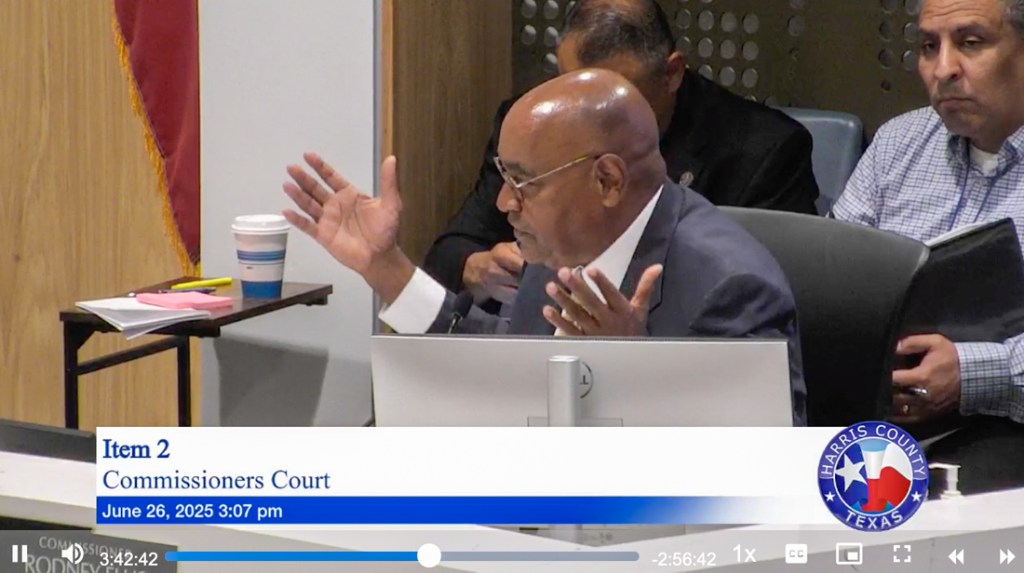
6/27/25 4PM – In a marathon discussion yesterday that stretched for hours, Harris County Commissioners Court struggled with how to plug a $1.3 billion shortfall in 2018 Flood-Bond funding. In the end, they voted 4-1 along party lines to apply all remaining flood-bond money exclusively to projects that ranked in the top quartile on Rodney Ellis’ Equity Prioritization Index.

Precinct 1 Commissioner Rodney Ellis arguing that remaining flood-bond funds be directed only to projects with a high “equity” component.

This will effectively defund all projects that fall into the second, third and fourth quartiles on Ellis’ Equity Prioritization Framework.

The Motion

Commissioners voted 4:1 to use all available flood-bond funds:

“To fully fund all current and future needs for projects in Quartile One, according to the 2022 Prioritization Framework, and direct the Harris County Flood Control District to work with court officers and report to Commissioners Court a project schedule by September 18th, 2025, on all future projects with a recommendation.”

Impact of Cuts

Precinct 3 Commissioner Tom Ramsey, the dissenting Republican, said, “It was like a bunker-busting bomb exploding yesterday. They blew up the 2018 bond program.” The decision will eliminate funding for 44 of the 48 bond projects that Ramsey had in his precinct.

“There’s no longer any money for them,” said Ramsey.

Ramsey will lose $424 million of flood-bond funding. He added, “Projects in the top quartile eat up every remaining available dollar in the bond. Every bit of it. There’s none left. Not a single dime.”

Want to see whether a project near you was killed? Here is a list of Flood-Bond Projects divided into Commissioner Rodney Ellis’ Equity Quartiles.

Only those marked with a #1 in the Quartile Column will be pursued at this point. The rest are effectively dead unless funding can be found elsewhere.

No Projects Left in Lake Houston Area

All HCFCD flood-bond projects in the Lake Houston Area fell below Ellis’ Equity Quartile #1 into the second, third, or fourth quartiles.

Following the Democratic plan will eliminate $20 million for Lake Houston Floodgates See Project G-103-Gates.

It will also eliminate any help for the Kingwood Diversion Ditch. The Kingwood Area Drainage Analysis called that the most important project in the area. And Kingwood experienced the highest flooding in the county during Harvey.

worst first
Chart showing feet above flood stage of 33 gages of misc. bayous in Harris County during Harvey. Gage on far left is Kingwood.

This doesn’t mean those projects will automatically die. But it is a setback.

It means project leaders will have to seek funding elsewhere for money that HCFCD had already committed years ago and that voters approved.

In that regard, Houston City Council Member Fred Flickinger had this to say about the Commissioner Court’s decision.

“Obviously the County’s handling of the flood bonds has been a concern for several years. Commissioner Ramsey is continuing to fight for our area to complete the necessary flood mitigation projects.

“However, regardless of the outcome at the County level, I have full confidence that the schedule I laid out in last year’s town hall meeting will in fact be held with the support of Representative Cunningham, Senator Creighton and Mayor Whitmire.”

Commissioner Ramsey also described the Gate project as his “Rubicon,” a reference to a Roman battle that represents a point of no return, i.e., a battle that must be won at all costs.

Uncertainty Surrounds 95 Active Projects

Ninety-five projects that fall into quartiles 2, 3 and 4 are listed as “Active.” HCFCD says it will move forward with any projects already in progress. But it’s unclear whether future stages will be implemented, i.e., moving from engineering to construction. We may know more in September.

HUD Project Deadlines Tightened Even More

Yesterday’s decision could affect U.S. Department of Housing and Urban Development (HUD) CDBG-MIT and CDBG-DR grants under review by the Texas General Land Office (GLO). Harris County Flood Control applied for 29 such grants.

HCFCD says they are moving forward with all HUD projects.

But GLO stressed the tightness of a February 28, 2027 deadline for 11 CDBG-DR projects valued at roughly $320 million. With only 20 months remaining to complete the projects, County Commissioners voted yesterday to take another three months to schedule projects.

For that group of projects, deadlines may be a bigger threat than funding. Think 17 months is plenty of time? It’s taken Harris County four years to get to this point with these projects! More uncertainty won’t speed things up.

Before the meeting, GLO Commissioner Dawn Buckingham warned county leaders to use the HUD funds “as quickly as possible.”

How Meeting Unfolded

Precinct 1 Commissioner Rodney Ellis, a master of political theater, packed the first two hours of Commissioners Court with surrogates during the public-comment portion of the meeting. The same people and groups that Ellis used to tarnish previous Harris County Flood Control District administrators showed up again. They even carried similar signs.

Over and over and over again, they complained about the lack of bond-program:

  • Equity
  • Results
  • Transparency

Dr. Tina Petersen, executive director of HCFCD, then led off the discussion with a PowerPoint presentation that she had been working to compile since February. The last slide shows how her team explored five different scenarios for maximizing available funding. (See her entire detailed report here.)

That set the stage for Precinct 1 Commissioner Rodney Ellis’ 20-minute boilerplate rant about historical discrimination against poor neighborhoods and how rich neighborhoods get all the money.

Disconnect between Ellis Rant and Reality

But there’s a basic disconnect between the rant and reality. Note that of all HCFCD spending since 2000, money has gone disproportionately to watersheds with a majority low-to-moderate-income (LMI) population. Between 2000 and 2022, 61% went to the one third of watersheds with an LMI-majority population. So, poor watersheds already receive the lion’s share of funding – almost twice as much as middle and upper income areas.

Busting the Myth: In Harris county, poor, not rich neighborhoods have gotten the lion's share of flood mitigation dollars since 2000.
Busting the Myth: Between 2000 and 2022, in Harris county, poor, not rich neighborhoods have gotten the lion’s share of flood mitigation dollars since 2000.

Regardless, Ellis was on a roll. And by the time he was done, three of his Democratic colleagues (Hidalgo, Garcia and Briones) were demanding more equity.

They voted to ignore all five of the scenarios that Petersen spent months working on and focus only on projects that ranked high on Ellis’ equity scale.

When Ramsey pointed out that one of the poorest neighborhoods in Precinct 3, Barrett Station, was defunded, Ellis shot back that his equity formula was “agnostic” to politics. But the numbers tell a different story.

Little wonder that the county released no information on this issue before the vote yesterday. Opposition to Ellis’ ringers might have had time to organize.

Expect frequent updates on this in coming months as the situation evolves.

To view video of the discussion, look for Item 2 here. Public appearances come before Item Two, and there are several breaks during the discussion.

Posted by Bob Rehak on 6/27/25 at 4PM

2859 Days since Hurricane Harvey

HCFCD Kicking Off Study to Make Half of Harris County SAFER

1/5/2025 – At a Community Resilience Flood Task Force Meeting in December last year, the Harris County Flood Control District (HCFCD) announced that it would be kicking off a new feasibility study in Q1 2025 designed to make half of Harris County SAFER from flooding.

SAFER stands for Solutions for Advancing Flood Mitigation, Equity, and Resilience. The study area includes 11 of Harris County’s 23 watersheds.

HCFCD issued this statement about the study.


Overview of Study from HCFCD

The SAFER Study has the potential to address one of the most impactful threats to the Houston/Harris County region: severe storm events that cause catastrophic flooding. 

This study will look broadly across the county and consider not only the effectiveness of large-scale flood mitigation projects within strategic locations, but also how they will function collectively as a system to provide flood mitigation, and the associated benefits, across broad regions of the county.

With the SAFER Study, the Flood Control District will be seeking to:

  1. Identify substantial, wide-ranging flood mitigation across the region rather than depending solely on smaller, incremental projects that address the needs slowly.
  2. Conduct the study in a way that allows the Flood Control District to identify flood risk reduction projects that could be cost-shared with the Federal government and constructed in partnership with the U.S. Army Corps of Engineers (USACE).
  3. Identify project recommendations based on comprehensive benefits, which include social effects and environmental quality, as well as regional and national economic impacts.
  4. Identify opportunities to integrate nature-based solutions.

The study area spans across eleven (11) watersheds within Harris County, including:

  • Brays Bayou
  • Buffalo Bayou
  • Clear Creek
  • Cypress Creek
  • Greens Bayou
  • Halls Bayou
  • Hunting Bayou
  • Little Cypress Creek
  • Sims Bayou
  • White Oak Bayou
  • Vince Bayou

The goals of this study effort are to reduce flood risks and strengthen resiliency within Harris County, to be grounded in the principles of equity, to pursue larger transformational solutions with broad benefits, and to better prepare the region to withstand both the flood risks of today and those of the foreseeable future.  

The SAFER Study will evaluate traditional flood mitigation measures, such as increasing channel capacity and construction of new stormwater detention basins, as well as new options including large-scale stormwater tunnels, and non-structural measures.  

The study will consider social, economic, and environmental benefits and impacts while evaluating flood mitigation effectiveness.

While the Flood Control District will be leading the study, we will be following federal laws, regulations, and guidance applicable for feasibility studies of water resources development projects, such as the SAFER Study.

We will be working with USACE for input throughout the study process to ensure recommendations are developed that follow USACE policy and guidelines.

We anticipate initiating the SAFER Study during the first quarter of 2025.


Saving the Worst Flooding for Last

Twelve watersheds are not included in the study. Among them are two that had the worst flooding in the county during Hurricane Harvey: the San Jacinto and Spring Creek Watersheds.

worst first
Chart showing feet above flood stage of 33 gages of misc. bayous in Harris County during Harvey.

So much for the oft repeated promise to fix the worst flooding first. HCFCD did not explain why it is including only half the watersheds.

From Hurricane Harvey through Q3 2024, HCFCD spent $1,444,838,886 on mitigation and maintenance in all of the county’s 23 watersheds, excluding county-wide projects.

Of that total, the 11 watersheds included in the SAFER study have received $1,132,471,139. That’s 78% of the total.

The 12 watersheds excluded from the SAFER study have received only 22% of all HCFCD spending.

Data supplied to ReduceFlooding.com in response to a FOIA request.

Here’s how the forgotten majority looks in a pie chart.

More than half of the watersheds have received less than a quarter of all HCFCD spending since Harvey.

Posted by Bob Rehak on 1/5/25

2686 Days since Hurricane Harvey

The thoughts expressed in this post represent opinions on matters of public concern and safety. They are protected by the First Amendment of the US Constitution and the Anti-SLAPP Statute of the Great State of Texas.

Harris County’s New Definition of Equity

8/26/24 – On Thursday night, 8/22/24, Doctor Arelia Johnson addressed the Harris County Community Flood Resilience Task Force about Harris County’s new definition of equity. Dr. Johnson is the County’s new Chief Equity Officer and has been in her job only three weeks. She has a PhD in sociology and criminology from Howard University. You can watch the video of her talk on YouTube. It begins at five minutes and ten seconds into the meeting. Below is a transcript of her talk up to the point where she started taking questions from the audience.

Arelia Johnson Intro slide
Introductory slide from Dr. Johnson’s talk.

Host: Whenever you’re ready Doctor Johnson, just let me know and I’ll help you advance through your slides.

Johnson: Thank you so much Amanda. This is Doctor Arelia Johnson. My pronouns are she, her, hers. And I am the chief equity officer for Harris County. And so, we’re going to talk about equity and where we are in this process of creating this foundational work and analysis. 

Racism, Sexism Declared Public Health Crisis

In June, 2020, Commissioners Court declared racism and sexism a public health crisis, and they then began to move towards creating a space for chief equity officer in 2021. The county then created its initial guidelines and definition for equity, and then more recently, we were able to update a definition that was more in alignment with the strategic planning that we’re doing. 

Current Definition of Equity

This particular definition feeds into our framework, which is three parts of the model. And we’ll talk about that shortly. But our definition as it stands right now is…

“Equity is the actionable pursuit of recognizing that there are groups who have disproportionately benefited from inequities, and others who have had the burden of solving the problems that have been created by inequities.” 

In other words…

“Equity is the actionable commitment to significantly reduce the disparity in the distribution of benefits and the actionable commitment in reducing the burdens of aligning and embedding goals, objectives, and outcomes related to inclusivity and accessibility to the historically marginalized.” 

Benefiting From or Being Hurt Disproportionally

Now, what does that mean? I’m glad you all asked. When we’re talking about equity, we have historically talked about equity in very vague, abstract ways. We have these huge aspirational goals, as if we can undo 250 years’ worth of work institutionalizing disparity.

However, we have to take a step back. And so, that’s what we’ve done as a county. We are taking a step back to figure out what can we do to recognize that there have been groups, multiple groups, who have benefited from disproportionality.

And then there have been multiple groups who have not benefited from disproportionality and who have been tasked with the burden, whether it’s the emotional labor, the physical labor, the social-political labor of solving the problems that inequity has caused and that has resulted in disparate treatment and what those consequences are. 

Equity is a conscious practice. It’s something that we are grounding in research, and it is informed by data that actively engages and addresses the historical, cultural and institutional dynamics and structures that privilege some and disadvantaged others.

Mitigating History

So, when you’re thinking about being a task force that wants to mitigate some of the flooding issues that we’re having, how do you then ground what you’re doing in research? How do you actively address the historical, cultural, institutional and structural dynamics?

And how do you know that you’re doing that? One of the tools that you can use is by actively engaging committees like this one, to where you can have a myriad of lenses and lived experiences at the table, to where you can hear from all of those different perspectives. 

There are three ways that we are looking at equity structurally, which is achieved when we take all of those dynamics that I just talked about into consideration. 

  • What is the historical context? How have certain groups been ignored or underserved or underprivileged? 
  • What are the cultural contexts? Are there biases or perspectives that are involved with dealing with the historically marginalized? 
  • What are the institutional dynamics that have traditionally privileged some and disadvantaged others?

Structural Equity

Now you’re talking about systems and systematic oppression, which does happen. It has structural consequences, especially when you’re talking about which areas are being served and which areas are going to be the hardest hit. 

Those are some of the things that we need to consider from a structural perspective. 

Structural equity also seeks to rectify underlying structures, frameworks and policies and practices. 

Procedural Equity

Procedural equity is more about the development and implementation of equitable distribution and sustainability. We want to look at standard operating procedures. 

What are those practices? How do we then create impact within those communities, not just in word but also in deed, and making sure that those populations are groups that are not otherwise considered:

  • One, have a seat at the table so they can have consideration, 
  • Two, they can also help with these efforts instead of those efforts being done for them. 

Socio-Emotionally-Intelligent Equity

And then you have socio-emotionally-intelligent equity. I think this is probably one of the things that we have to work hard because we have all been socialized and conditioned to some extent. 

This form of equity helps us to increase the capacity to recognize, understand and address and then mitigate the impacts of interpersonal, individual, structural, systemic and institutional racism and sexism on the well-being of others.

Aligning with Commissioner’s Court Priorities

We think this is really important as a county, because we want to be in alignment with all of the resolutions that are coming out of commissioner’s court. But then, we also want to be able to take a step back and be introspective and reflective when having interactions with others. 

Must Work on Unconscious Biases

Sometimes our implicit biases are our unconscious biases seep into interactions. It’s not because we intend on being harmful. Sometimes we are completely unaware that we are being harmful. 

And so, this is something that we really have to work on. And it has to be very intentional and conscious. 

Socio-emotionally intelligent equity is locational or context specific, which means that you have to recognize where you are, your generational context, your historical context, your social context, your political context, and recognize it and recognize that sometimes we assume things to the detriment of progress. 

What you may be experiencing with someone, if it looks like anger, may not actually be anger, it may be frustration or disappointment. 

And so doing all of those things, what it does for us, it helps promote a uniform starting place, which means that then we go into this place of what training looks like, what a shared language looks like, what commonality looks like. 

So, those are the three components of our equity framework and our definition. 

Posted by Bob Rehak on 8/26/24

2554 Days since Hurricane Harvey

2024 Flood-Bond Update Shows Changed, Changing Priorities

July 21, 2024 – Last week, Harris County Flood Control District (HCFCD) quietly shared this year’s flood-bond update with Commissioners Court. The update came during widespread power and internet outages from Hurricane Beryl that limited its visibility.

The flood-bond update details progress on the 2018 Flood Bond for the first time since the last update last October.

Combining the data in this flood-bond update with data from other sources reveals the impact of the County’s political divide and Equity Prioritization Indices. Both have affected projects in the Lake Houston area and Precinct 3 negatively.

But first some good news.

More Partner Funds Now Secured than Required by Original Bond

The total of secured funding now exceeds $5.2 billion. That includes the $2.5 billion approved by voters in 2018 plus $2.7 billion in other funding secured since then.

The additional funds include grants and matching funds from city, state and federal governments plus other local organizations, such as municipal utility districts. It also includes $87 million in Bond ID Z-07 – the Bond Program Reserve, formerly known as the Flood Resilience Trust.

Commissioners Court allocated this money to backstop bond funding before a massive infusion of funds from the General Land Office and the U.S. Department of Housing and Urban Development in 2022.

The total amount now available exceeds total project costs in both the original bond estimate and a slightly revised project list released in a 2021 flood-bond update.

HCFCD says it is working on revising costs to reflect inflation and the rising cost of property acquisition since then. However, it appears that HCFCD did not include inflation-adjusted project estimates in the current update.

Dollars Spent vs Dollars Secured

Regardless, we are now at a point in the bond where available cash covers the original estimates. So looking at dollars spent vs. dollars secured gives us a reasonable feel for how close we are to completing flood-bond projects in various watersheds. See the bar graph below.

Compiled by combining 2024 Bond Update Appendix B on Page 10 with spending data obtained separately via FOIA request. See data in table below.

Brays and Greens are more than 80% complete. Five others are more than 50%.

Meanwhile, 15 others are less than 50%. And of those, 10 are less than 25%. The county’s largest watershed, the San Jacinto, is only 19% complete (“spent”).

The graph above does not include Carpenters Bayou. It was an anomaly at 1762%. The 2021 bond update included only half a million dollars for a study there. But HCFCD has spent almost $9 million so far. Including Carpenters in the bar graph distorted the scale and obscured the differences between the other watersheds. However, I did include it in the table below.

Compiled by combining Bond Update Appendix B on Page 10 with spending data obtained via FOIA request. County-wide projects not included.

Next month will mark the sixth anniversary of flood-bond approval. The bond was originally intended to be a 10-year program. So, totaling all these figures, we are about 40% done in 60% of the time. There’s certainly room for improvement on that front.

Projects in some watersheds are stalled while projects in others near completion. Take, for instance, the Kingwood Diversion Ditch and Taylor Gully Projects in the San Jacinto Watershed. The Kingwood Area Drainage Analysis identified them as the top two projects in Kingwood back in 2020.

But not a shovel full of dirt has been turned yet on the Diversion Ditch project. And a $1,000 excavation and removal contract on the Woodridge/Taylor Gully project was terminated last November when only one third complete.

Partisan Changes Negatively Impact Precinct 3

Another thing to look at: changes to projects (Dollar Increases or Decreases; Project Deletions or Additions). While a certain amount of changes are normal when dealing with rough, early estimates, in this case, the changes also reflect a partisan bias.

When calculating the differences, I compared projects by Bond ID in the 2024 flood-bond update to the original bond allocations in 2018.

Harris County has three Democratic commissioners and one Republican – Tom Ramsey in Precinct 3.

  • Thirty projects affecting the three Democratic Precincts increased by $162.6 million – $54.2 million per precinct on average. But projects in the lone Republican precinct increased only $27 million. Thus, the three Democrats each benefited twice as much from additions as the lone Republican.
  • Likewise, 12 projects in the three Democratic Precincts decreased by a total of $92.6 million or $30.6 million per precinct on average. But Ramsey’s precinct lost $40.5 million.
  • Ramsey lost $13.5 million more than he gained.
  • Ellis, Garcia and Briones each gained about $8 million more than they lost.

When watersheds crossed precinct boundaries, I split dollars evenly among them. For example, if a project increased in value by $10 million and benefited one Republican and one Democratic precinct, I allocated $5 million to each. While that may not be precisely accurate in all cases, more precise data is not readily available.

To see the evolution of the bond fund through various iterations during the last six years, see the Harris County Flood Control District tab on the ReduceFlooding Reports page.

Other Items of Note

I did not include Countywide Expenditures in the calculations above even though they took a large hit. Their decrease shows up in corresponding increases for watershed projects. And I was more interested in how those were skewed.

However, one item definitely deserves future exploration: the $50 million decrease in “Federal Grant Funded Volunteer Home Buyouts.” Typically, the Federal Government grants funds for specific purposes. Where did this money go? The 2024 flood-bond update does not say.

Also of note: HCFCD currently has 20 projects in construction or turnover. The District has spent more than $2 billion in bond and partnership funds out of the $5.2 billion now available.

The latest bond update points out that of 181 original projects, 42 have been completed and closed out.

Equity Being Redefined Again

Separate from the bond update, Commissioners approved an expansion of equity guidelines last week. Item 18 on the agenda discusses an expanded definition of “equity” that will be used to allocate future flood mitigation dollars. It includes three components:

  • Structural Equity – righting historical wrongs
  • Procedural Equity – implementing procedures, policies and programs for groups previously not considered.
  • Socio-emotionally Intelligent Equity – mitigates the impacts of interpersonal, individual, structural, systemic, and institutional racism and sexism.

More news to follow when I figure out how all that will affect flood-control-mitigation dollars which have historically correlated to flood damage more than sexism.

At the very least, the imposition of new metrics on projects will slow down project scoring and implementation. It’s additional overhead burden on already complex processes. But my real fear? More and more of the San Jacinto watershed budget will slip away to other watersheds.

Posted by Bob Rehak on 7/21/2024

2518 Days since Hurricane Harvey

HCFCD Grappling with Inflation’s Impact on Flood-Bond Purchasing Power

Inflation has reduced the 2018 Flood Bond’s purchasing power. The general rate of inflation during the last five years adds up to 20%. That could potentially eliminate one fifth of the projects in the flood bond.

It’s a serious concern for the people whose mitigation projects have been put at the end of the line by the County’s Equity Prioritization Framework. Some residents may never see any benefit from their tax dollars, which are going to other areas.

Here’s how Harris County Flood Control District (HCFCD) will look at projects that now have an uncertain future.

Local Costs Consistent with General Rate of Inflation

In a presentation to the Harris County Community Flood Resilience Task Force, Jesal Shah PE, the new Chief Project Delivery Officer for HCFCD, discussed the issue of inflation. Shah, a Houston native, has been in his job since May, 2023. He previously led flood-risk reduction planning, design, engineering, and construction efforts for the government of British Columbia.

Shah cited 15-20% increases in construction, material, and right-of-way acquisition costs for Harris County flood-mitigation projects.

This and other screen captures below are from Shah’s presentation to Flood Task Force on 12/14/23.

Summary of 2018 Flood-Bond Funding To Date

The 2018 flood bond contained $2.5 billion in funding for approximately $5 billion worth of projects. Partnership funding, i.e., grants, were supposed to make up the difference.

And at this point, all of the partnership funding has been secured thanks to an infusion of $825 million in Community Development Block Grant funding from the U.S. Department of Housing and Urban Development (HUD) and the Texas General Land Office (GLO).

“Anticipated” should now be removed from this slide.

That’s very good news.

63% of Bonds Sold Already

Shah says that the County has sold $1.575 billion worth of bonds to date, almost two thirds of the original $2.5 billion.

Of the two thirds, about half the money has been spent or “encumbered.” Encumbered means the money is committed to projects and difficult to move. For instance, a project may be in construction, but not yet completed.

The other half has been committed to projects, but not yet encumbered. For instance, bonds may have been sold, but the construction job may not have been awarded yet.

See below.

Securing the partner funding is huge good news. But the impact of inflation is worrisome. To help deal with that, the County is re-evaluating all projects associated with the flood bond.

How Projects are Being Re-evaluated

Shah cited three types of projects listed in the original bond. Those with:

  • Well defined scope and accurate estimates.
  • Clear scope but inaccurate estimates. For instance, the Lauder basin has almost tripled its original cost estimate.
  • Vague scope and unreliable estimates.

See examples below.

To complicate matters, some backstop funding from the Flood Resilience Trust is no longer available because of new “guidance” from Commissioners Court. That will eliminate $343 million in funding flexibility.

And keep this in mind. The bond program is far from complete. We could easily see another 15-20% of inflation before its over. So what to do?

Sharpening the Pencil

Shah’s team is dividing the remaining bond projects into two piles.

  • Those with clear scope and funding will be completed.
  • Those without clear scope or funding will be re-evaluated.

Shah hopes to present an updated project list to Commissioners Court sometime during the second quarter of 2024.

Shah has already taken a first pass at re-evaluating the bond’s project list. Of the 181 projects identified in the bond:

  • 30 have already been completed or eliminated.
  • 63 will continue moving forward.
  • 88 (almost half) will need more funding or more clarity (i.e., more engineering studies/tighter estimates) to move forward.

The slide below shows the guiding principles for evaluating the 88 projects that need more funding or clarity.

Lack of Balance Could Jeopardize Future Bond Offerings

One possible way to mitigate the toll of inflation involves phasing projects in areas that have already received large amounts of funding so that projects in areas that received little funding could move forward.

For instance, in a project that involves multiple stormwater detention basins, one or more of the basins could be delayed until the next bond. Meanwhile, delaying that basin could free up money for a basin in a different watershed.

However, during Q&A, Shah said he has no plans to phase projects.

A lack of equitable distribution could jeopardize future bond offerings.

And many areas have received little funding from this bond.

More than a 100 to 1 difference exists between projects on the left and right.

In the future, voters who saw no benefit from the 2018 flood bond might, once again, feel victimized by bait-and-switch tactics.

Selling future bonds will require restoring faith in the fairness of government. And that will require spreading bond funds around so that everyone – in all parts of the county – sees some benefit from them. That’s my humble opinion.

When HCFCD presents its updated project list to Commissioners Court in the second quarter of 2024, it will be interesting to see whether Commissioners and the County Judge agree with it.

John Whitmire’s landslide election in the Houston Mayor’s race may send a message to them. Whitmire is a Democrat who campaigned across the aisle and received heavy Republican support.

Posted by Bob Rehak on 12/16/2023

2300 Days since Hurricane Harvey

Differences in Ways County, State Propose Ranking Flood Projects

The Texas Water Development Board is seeking public comment on its plan to allocate $375 million in funding from the State’s flood infrastructure fund for the 2024-25 state fiscal year.

That prompted me to compare the TWDB and Harris County plans for ranking flood projects. The differences remind me of how the scoring systems favor certain projects in some areas and not others.

Harris County and the Texas Water Development Board (TWDB) use distinctly different priorities when considering which flood-mitigation projects to fund.

The biggest differences have to do with the weights given to severity of flooding, protection of infrastructure, social vulnerability and maintenance costs.

The state also uses “benefit/cost ratios” much like the federal government. The county, however, uses a measure called “project efficiency,” which is related but slightly different.

Differences in Ranking Projects

Here is the most recent prioritization framework that Harris County adopted in 2022 and again in 2023. And here is the draft “intended use plan” for the State of Texas 2024-25 Flood Infrastructure Fund.

Let’s look more closely at each plan and then examine their differences.

Harris County Prioritization Framework

Harris County examines:

  • Project Efficiency…
    • Using People Benefitted
    • Using Structures Benefitted
  • Existing Conditions
  • Social Vulnerability Index
  • Long Term Maintenance Costs
  • Environmental Impacts
  • Potential for Multiple Benefits

Each project is assigned a score for each criterion below ranging from 0 to 10. A score of “10” indicates the project fully met the criterion and a score of “0” indicates that it did not.

Summary of ranking matrix from page 4 of Harris County Framework. For explanations of scoring on each measure, see full document.

Proposed TWDB Matrix

The TWDB scoring matrix measures more factors and gives them different weights.

For larger, high res version and detailed explanation, see full plan.

The first thing you notice is that the table above is much wider and deeper than the County’s matrix. That’s because it lists evaluation criteria for different categories. And criteria sometimes change depending on the category.

Comparison of Differences

Social Vulnerability

Harris County gives 20% of all projects’ weights to social vulnerability. But the TWDB only gives it 5% weight. TWDB also uses social vulnerability as a tie breaker (see page 22).

Equity

Harris County has organized its flood-mitigation priorities since 2019 around equity. The proposed TWDB plan does not mention the word.

Efficiency

Harris County measures the efficiency of removing people and structures from the 100-year floodplain. The County defines efficiency as the cost of the project divided by the number of people or structures benefited. It gives them 45% weight within the final score.

TWDB also measures the number of people and structures removed from the 100-year floodplain. But unlike the county, it factors in critical facilities, the number of low water crossings, and miles of roads removed from the 100-year floodplain. Combined, they represent 55% of the weight. TWDB does not weigh cost against these measures at this point in its scoring matrix. However, it separately gives 2.5% weight to benefit/cost ratios.

Flood Risk

Harris County does not directly incorporate flood risk in its evaluations. It uses a proxy called “Existing Conditions” and gives it 20% weight. Existing Conditions measures the level of service provided by a detention basin or a channel. For instance, one with a 2-year level of service floods in a 2-year storm. One with a 25-year level of service floods in a 25-year storm, etc.

TWDB does not directly measure flood risk either. Rather it measures the number of structures, people, critical facilities, low-water crossings and road miles inside the 100-year floodplain. It’s a measure of what is “at risk.” These measures collectively add up to 100% of the score for a flood-management evaluation and 60% of the score for a flood-management strategy.

Severity

Harris County gives no weight to the severity of flooding. TWDB does. TWDB measures both the average depth of flooding in a 100-year storm and the percentage of a community’s population exposed to a 100-year flood. Together, they can account for 10% of a project’s total score.

Critical Facilities

Harris County does not differentiate among structures removed from a 100-year floodplain. But TWDB recognizes critical facilities. Such facilities could include sewage and water treatment plants; bridges; schools; hospitals; police and fire stations; and more. These affect entire communities, not just individuals.

Maintenance Costs

Harris County projects maintenance costs and gives them 5% of the weight. TWDB does NOT consider costs associated with current or future operations and maintenance activities.

No Right or Wrong Way

Neither the TWDB plan, nor the County’s plan is right or wrong. Their weights reflect the needs of different people and different organizations in different places. For instance, the state is not involved in maintenance, but maintenance historically has consumed as much as 50% of Harris County Flood Control District’s budget. So it makes sense for the county to prioritize low maintenance costs.

However, I would observe that Harris County could borrow some ideas from the state, such as incorporating measures for severity of flooding, protection of life, and protection of critical facilities. The areas that had the deepest flooding and the highest loss of life during Harvey have received little flood-mitigation assistance from Harris County compared to poor areas.

What happens when 240,000 cubic feet per second, 20-foot-high floodwaters tear through your home.
4000 Students at Kingwood High School
When sewage-contaminated floodwater invaded Kingwood High School to the third floor, 4,000 students had to study in shifts at another high school an hour away for a year.

What Do You Think?

TWDB seeks public comment on its proposed plan by January 1, 2024. What do you think? Based on your flood experience, do you think TWDB could do something better? Let them know.

Their plan includes more information than shown above. For instance, it also includes information on eligibility, minimum standards, program timeline, and financial assistance categories.

If you wish to comment email FIF@twdb.texas.gov and specify in the subject line “FIF IUP Comments.” Should you have any questions, please contact the TWDB by emailing the same address.

Posted by Bob Rehak on 12/11/23

2295 Days since Hurricane Harvey

Third-Quarter Flood-Mitigation Spending Trends, Surprises

10/15/23 – Third quarter flood-mitigation spending data is now available for Harris County Flood Control District and its partners. In some ways, the data shows a continuation of previous trends. But the data also contained some surprises. The major findings:

  • Spending continued to dip. Slower project delivery means inflation will claim an increasingly large percentage of taxpayer dollars and may force cancellation of some bond projects.
  • If the last quarter of this year is anything like the first three, we could see less than half the activity in 2023 than we saw in 2020.
  • The trend toward investing more heavily in minority areas continued and even accelerated. But there was one notable exception – Cypress Creek and its tributaries.
  • An unusual $9.7 million real-estate transaction for a stormwater detention basin near the Mercer Arboretum skewed the Cypress Creek total. That was 16.5% of all HCFCD spending for the quarter.
  • Without it, many of the numbers below would also have been skewed. For instance, total spending and average spending per watershed would vary dramatically.
  • The focus on so-called “equity” spending and the Cypress Creek watershed meant 15 watersheds saw less than a million dollars in activity during the quarter. And five of those received less than $100,000.

Let’s look at each and the implications. Everything below INCLUDES the unusual real estate transaction near Mercer. In several places, I note how things would have changed without Mercer.

Overall, Slowdown Magnifies Inflation Concerns

Overall, flood-mitigation spending dipped about 5% in the third quarter compared to the previous quarter. It declined by a little more than $3 million to $58.8 million. That may not sound like much, but it continues a 3-year downward trend and creates delays that expose residents to more flood risk.

As projects are delayed, their costs also escalate due to inflation, raising concerns about whether there will be enough money in the bond to finish all the projects promised to voters.

Spending this year will likely be a hundred million dollars less than the first full year of the 2018 flood bond – when projects were ramping up. See chart below.

Annualized estimate for 2023. 23Q4 data estimated based on average of first 3 quarters. Without Mercer, the 2023 estimate would be below $200 million.

Moreover, spending will be $200 million less than the peak year of 2020 – about half of what it was then.

Halfway through the 2018 10-year flood bond, HCFCD has spent only about a third of the funds approved by voters – $1.65 billion. However, if the present slowdown continues, this will be the third straight year of decline.

The slowdown in project delivery means inflation will increasingly raise costs and undermine the purchasing power of the dollars authorized by voters.

HCFCD acknowledges the serious impact of inflation in its latest bond update to Commissioners Court, and hopes toll-road money remaining in the Flood Resilience Trust will cover any shortfall.

Average Spending in LMI Areas Growing

Data also reveals that with one exception (Cypress Creek and its tributaries), the trend of preferentially allocating funds to Low-to-Moderate-Income (LMI) areas continued and even accelerated when measured by average spending per watershed.

On average during Q3, watersheds with a majority of LMI residents (hereinafter called “LMI watersheds”) received 2.5X more funding than more affluent watersheds – $3.1 million each vs. $1.2 million. That’s up from 1.7X over the longer period since Harvey. So, the gap is widening.

Without the Mercer real-estate transaction, the average for more affluent watersheds would have been cut in half to $600,000. That would have almost doubled the ratio. The recomputed average would created a 4.7X ratio between LMI and all other watersheds for the third quarter.

That trend will likely continue for some time as projects funded by HUD through the Texas General Land Office get approved and start construction. That pot of money will spread across the income spectrum, but projects in lower income areas will likely start first.

Cypress Creek Spending Explodes

In fifteen Harris County watersheds, more than 50% of residents make above the average income for the region.

As a group, those 15 received $18.6 million last quarter – $2 million more than the $16.6 million received by the eight LMI watersheds.

However, the first group is twice the size of the second. And looking deeper within the more affluent watersheds, we can see that Cypress Creek and its tributaries (Willow and Little Cypress) received 79% of that $18.6 million last quarter.

The three Cypress watersheds received almost 4X more funding than the 12 other watersheds in the more affluent category put together.

Cypress Creek and its tributaries consumed 79% of all HCFCD/Partner spending last quarter among watersheds without a majority of LMI residents.

Here’s how that same spending looks in a bar graph.

Only the first three watersheds on the left received more than a million dollars in Q3. The twelve on right received less than $1 million each.

The 12 other watersheds divvied up $3.8 million; they averaged just $348 thousand each.

FOIA request. Data supplied by HCFCD.

$348,000 is one ninth of the $3.1 million average for LMI watersheds. And we know that some of those, such as the San Jacinto, have huge, unmet needs.

Cypress Knocks Brays Out of First Place

Now, let’s look at ALL watersheds in both categories. When looking only at the third quarter, Cypress Creek surged into first place. It nudged out Greens, White Oak, Brays and Sims, all of which have LMI populations greater than 50%.

HCFCD and Partner spending by watershed
Includes all 23 watersheds during 23Q3.

HCFCD finished Project Brays 15 months ago, but still managed to spend $3.8 million there last quarter. That was almost 10X more than it spent during the third quarter in the San Jacinto watershed, the county’s largest, and where the flooding was deepest. HCFCD spent only $400 thousand in the entire San Jacinto watershed last quarter.

worst first
Comparison of 33 gages in Harris County during Harvey showed San Jacinto had worst flooding.

Brays Still Ranks #1 in Total Spending Since Harvey

Since Hurricane Harvey (not just last quarter), Brays still ranks #1. But Cypress now ranks second. If you added its Little Cypress and Willow Creek tributaries in the graph below to the Cypress Creek total, they would rank #1 by more than a $100 million.

Includes all 23 watersheds since Harvey

Brays even managed to increase in the last quarter by $1.5 million while the San Jacinto decreased by $55,000.

Granted, some watersheds have smaller needs than others, but the ratio between the highest and lowest spending exceeds 300X.

Impact of Equity Formula

The spending priorities shown in this post reflect the Equity formula adopted and periodically revised by Harris County Commissioners Court.

Ironically, the language approved by voters in the flood bond never mentions the word “equity.” Paragraph 14G does say that Commissioners Court shall provide for an “equitable expenditure of funds.”

However, most dictionaries define “equitable” as “nondiscriminatory.” Yet the current formula prioritizes projects largely on the racial composition of neighborhoods as described in the CDC’s social vulnerability index.

The theory is that poor people are financially less able to fix their homes after a flood. I accept that.

But some commissioners are using that to push the idea of fixing 500-year flooding in poor neighborhoods before fixing 2-year flooding in more affluent communities.

Therefore, I ask:

  • At what point do we do we say enough money has gone into an LMI watershed and start spending elsewhere to reduce greater flood risk?
  • Why isn’t HCFCD publishing updated flood risk maps as it completes mitigation projects so we can make objective comparisons and see what our tax dollars bought?
  • Why does Harris County’s formula for allocating flood-mitigation funds NOT consider:
    • Flood damage to homes, businesses and retirement communities?
    • Damage to infrastructure, such as bridges, schools, hospitals, grocery stores, traffic arteries, water and sewage treatment plants, etc.?
    • Height of floodwaters, i.e., the severity of flooding?
    • Deaths caused by floods?
  • Is a poor person’s carpet worth more than a rich person’s life?
  • Will there be enough money in the flood bond and flood resilience trust to finish all projects in the bond given inflation?

So many questions. So few answers. Perhaps this explains why trust in government has reached a 70-year low.

Only 20% of Americans now say they trust government “just about always or most of the time.” That’s something to think about as we near the next election.

Posted by Bob Rehak on 10/15/23 and updated 10/16/23 with additional info on Cypress Creek

2238 days since Hurricane Harvey

The thoughts expressed in this post represent opinions on matters of public concern and safety. They are protected by the First Amendment of the US Constitution and the Anti-SLAPP Statute of the Great State of Texas.

Where Flood-Mitigation Dollars Have Really Gone

An analysis of Harris County Flood Control District (HCFCD) and partner spending since 2000 reveals striking contrasts between watersheds in terms of where flood-mitigation dollars have gone.

Watersheds vary as much as 130 to 1 since 2000 and almost as much since Harvey. Most watersheds remained relatively constant in the rankings during the different time periods. However, a few have shifted up or down a few positions as land was acquired for projects or construction kicked off.

Data below includes spending by HCFCD and its partners from 1/1/2000 to 6/30/2023.

Main Takeaways from the Data

The big stories:

  • Since 2000, the top four watersheds received more flood-mitigation dollars than all 19 others put together. The top four include: Brays, Greens, and White Oak Bayous, and Cypress Creek.
  • Since Harvey the top four received 48%.
  • The distribution of funds continues to show the impact of Harris County’s Equity Prioritization framework.

Harris County’s Equity Prioritization gives weight to race and low-income areas, but not flood damage, the severity of flooding, or protection of infrastructure.

San Jacinto Gets Above Average Damage, Below Average Funding

The San Jacinto ranks below the averages (before 2000 and since Harvey) for flood-mitigation dollars – despite ranking 8th in damaged structures among all 23 watersheds. Damage totals include five major storms (Allison, Memorial Day, Tax Day, Harvey and Imelda).

Compiled from HCFCD Federal Reports

Watersheds Ranked by Funding Since 2000

Here’s how the funding looks in graphs and tables. All data was obtained from HCFCD via FOIA requests.

Data obtained from HCFCD via FOIA requests. Includes Harris County and partner spending.

Here’s the actual data if you want to see exactly how much your watershed received.

From 1/1/2000 through 6/30/23

Watersheds Ranked by Funding Since Harvey

Now let’s look at the how spending shifted after Harvey. Not much, at least relatively speaking.

Includes Harris County and partner spending. San Jacinto climbed two spots, but it is still barely above the median and far below the average.

Here are the actual totals for each watershed shown in the graph above.

Spending from 17Q3 to 23Q2 inclusive.

Feet above Flood Stage

Now let’s look at the severity of flooding. The chart below measures feet above flood stage at different Harris County gages.

Flood Stage is the level at which a river, stream or channel comes out of its banks.

I compiled this chart from data in the Harris County Flood Warning System website.

That 20+ feet above flood stage at the San Jacinto West Fork and US59 was the highest I found in the county.

Damage to Infrastructure

That 20+ feet destroyed Kingwood College, Kingwood High School, all of the businesses in Kingwood Town Center and Kings Harbor, the southbound lanes of US59, the Union Pacific Railroad Bridge, Memorial Hermann’s new Convenient Care Center, sewage treatment plants, and a senior housing complex.

Lone Star College
Harvey flooded 6 of 9 buildings at Lone Star College/Kingwood. Repairs cost a total of $60 million.
I-69 damage and repairs
I-69 Bridge replacement after Harvey. Repairs took 11 months creating massive delays and detours.
UP Bridge
Union Pacific Railroad Bridge that parallels US59 was destroyed and required complete replacement.
Alspaugh’s Hardware during Harvey
New HEB shopping center 1.5 miles from the San Jacinto West Fork was under more than 7 feet of water during Harvey.

Six years after Harvey, many of the commercial areas in Kingwood still haven’t fully recovered. Anchor stores remain empty in three of five shopping centers on Kingwood Drive between Town Center and US59.

Achieving True Equity

While I’m sympathetic to the plight of poorer neighborhoods, I cringe at the self-serving definition of equity used by a Democratic-dominated Commissioners Court to deny funding to the hardest hit area in the county.

We need a system that’s fair to all, not just some. Anything less will perpetuate racial distrust. This is a public safety issue and public safety should not be politicized.

Posted by Bob Rehak on 9/30/23

2223 Days since Hurricane Harvey

The thoughts expressed in this post represent opinions on matters of public concern and safety. They are protected by the First Amendment of the US Constitution and the Anti-SLAPP Statute of the Great State of Texas.

HCFCD Spending Shows Slight Rebound

After a sharp decline in the first quarter of 2023, Harris County Flood Control District (HCFCD) spending rebounded slightly in the second quarter. Second quarter spending did not recover to recent peaks, but at least exceeded pre-2018 Flood Bond levels.

Data obtained via FOIA Request from HCFCD on 8/14/23

One Third of Bond Money Spent in Half the Projected Time

However, HCFCD is still behind schedule with mitigation related to the 2018 flood bond. HCFCD has not issued a flood-bond update since last December. But you can calculate progress yourself by looking at the charts in this post.

Six years after Harvey and five years after the flood bond, HCFCD and its partners have spent approximately $1.6 billion to improve Harris County drainage.

Taxpayers approved $2.5 billion in the 2018 flood bond. Approximately a third of that was designated for matching funds to attract another $2.5 billion from Federal, State and local sources.

That means five years after the bond (and six years after Harvey) we are are roughly one third of the way through the bond, which was intended to be a ten-year program. And that one third is likely overstated due to inflation.

Spending Inequities

The County has not spent the money to benefit all people equally, thanks to the so-called Equity Plan approved by Commissioners Ellis, Garcia, and Judge Hidalgo. They argue that people with low incomes should enjoy a higher level of flood protection because they are less able to fix their homes after disasters.

Harris County tracks spending by watershed. Eight watersheds have a populations where Low-to-Moderate Income (LMI) residents comprise a majority of the population. Those same watersheds also tend to have high social vulnerability indexes based on the CDC’s ranking criteria.

The eight LMI watersheds include:

  • Halls (72.5% LMI)
  • Hunting (67.8%)
  • Vince (64.9%)
  • Sims (60.8%)
  • Greens (59.8%)
  • Goose Creek (56.9%)
  • White Oak (51.9%)
  • Brays (51%).

HCFCD updated those LMI percentages at the end of 2022 to reflect the latest census data.

Actual Flood Damage No Longer Considered

Harris County no longer weighs damage in ranking flood-mitigation priorities.

Here’s how LMI-majority watersheds line up versus the county’s 15 other watersheds in terms of the money received since Hurricane Harvey.

Data obtained via FOIA Request from HCFCD on 8/14/23

Here’s how all watersheds ranked last quarter.

Data obtained via FOIA Request from HCFCD on 8/14/23

The San Jacinto declined a place in spending among the watersheds last quarter compared to “Since Harvey” (14th vs 13th). For the exact amounts each watershed received last quarter, see the table below.

Data obtained via FOIA Request from HCFCD on 8/14/23

Some readers might notice slight changes in the totals from past time periods. That has to do with ongoing transition of project and invoice coding in the county’s accounting systems. But they affect only about $2 million out of $1.6 billion. And most of those have to do with first quarter invoices received after my first quarter FOIA Request.

For those unfamiliar with the locations of various watersheds, see the map below.

watershed map of Harris County
From HCFCD 2019 Federal Briefing

Now compare spending to the actual flood damage during the last 44 years.

This map from MAAPnext, totals damage since 1979. Dark areas represent more damage. Compare the spending priorities above with actual damage in your watershed.

Flood control money used to flow to damage. But that’s no longer always the case.

Come back soon for more analysis of the latest data.

Posted by Bob Rehak on 8/15/23

2177 Days since Hurricane Harvey