Tag Archive for: equity

Where the Flood Mitigation Dollars Have Really Gone: Part 4

The last three posts on the equity flap have focused on how minority neighborhoods in Precinct 1 already receive more flood mitigation funding than affluent areas like Kingwood. Tonight, I focus on why that is likely to continue for the foreseeable future. But first, a recap for context.

Biggest Beneficiary of Funding Claims Discrimination

Last Tuesday, the equity flap erupted again in Harris County Commissioners Court. Precinct 1 Commissioner Rodney Ellis complained that because of historical discrimination (i.e., slavery, which was abolished more than 150 years ago), he needs to fight for “equity” in the distribution and implementation flood bond projects. Precinct 1 already receives the lion’s share of many types of funding.
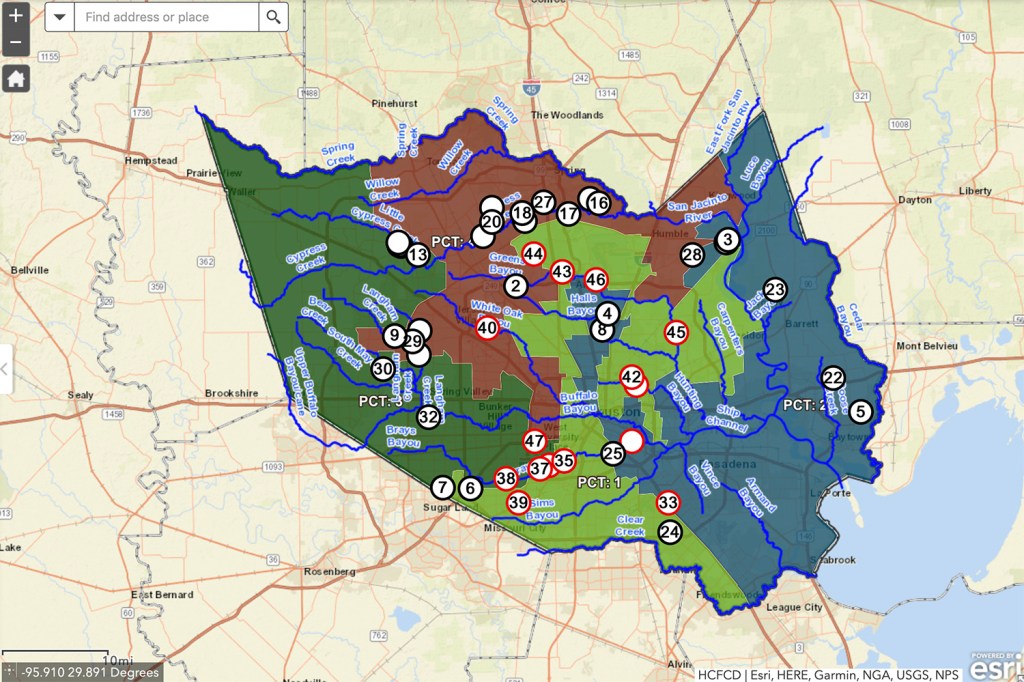
What Mr. Ellis does not point out to the Commissioners Court is that Precinct One:

Exploiting Past Wrongs to Perpetuate Inequity

When talking about “historic discrimination,” Commissioner Ellis needs to shift his focus forward in time and look at other areas of the county that receive NO such joint projects and far fewer flood mitigation dollars. Take the San Jacinto Watershed, for instance. It contains Kingwood. Because of Kingwood’s affluence, it’s one of the favorite whipping boys for Commissioner Ellis and his surrogates who argue for equity. They keep bringing equity up every time a Kingwood-related item is on the Flood Control agenda at commissioners court. But the Kingwood/Lake Houston Area has NO such joint projects. Why?

Causes of Inequity

There are two reasons for this inequitable distribution: one obvious, one not so.

First, the obvious: The Houston region has grown from the downtown area outward. Precinct 1, which includes downtown, is older. Flood problems became apparent sooner. Precinct 1 documented problems, identified solutions, and rallied Federal support decades ago.

Commissioner Ellis’ predecessors also started this process decades ago and Precinct 1 enjoys the rewards today. As a consequence…

Buffalo Bayou and all of its tributaries are eligible for Corps support on non-emergency projects; the San Jacinto is not.

The Corps is working on Buffalo Bayou and all of its tributaries thanks to legislation passed years ago. The Cypress Creek watershed actually overflowed into the adjoining watershed during Harvey. For a complete Corps presentation on Buffalo Bayou and its tributaries, see this link.

Even though the problems in the Lake Houston Area have been building for decades, the danger didn’t become apparent until Harvey.

At this point, rallying the kind of Federal support that Precinct 1 has historically enjoyed will involve an act of Congress and Presidential approval. Literally. That’s an uphill battle compared to the battle that Mr. Ellis’ projects face.

Political Challenges for San Jacinto Watershed

A local sponsor, such as the City, would have to file an application for a project. Congressional representatives would have to get the President to build it into the annual budget, then include it in the Water Resources Development Act. Both houses of Congress would have to pass the act. The President would have to sign it. And then the government would have to distribute the money. The distribution usually happens in phases, after approval of each phase of a project, such as:

  • Feasibility study
  • Engineering and design
  • Construction, operation and maintenance
  • Changes after construction authorization
  • Changes after construction

It could easily take three to five years just to get the engineering and design phase on a project, such as additional flood gates for Lake Houston.

A second challenge: Mr. Ellis and his surrogates using unfounded “equity” arguments to further handicap and delay flood mitigation in the Lake Houston Area.

Damages in Lake Houston Area

Unfortunately, the sedimentation and conveyance problems on the San Jacinto only became apparent after decades of additional upstream development. That exacerbates flooding by funneling water to the river faster. In recent years, Conroe was the fastest growing city in America.

Then along came the Tax Day, Memorial Day and Hurricane Harvey floods. They deposited an estimated 5 to 10 million cubic yards of sediment in the East and West Forks. Much of that came from sand mines upstream of Lake Houston, which Lake Conroe inundated when it released 80,000 cubic feet per second at the peak of the storm. This further exacerbated flooding by backing water up in the river and drainage ditches.

As a result, the Lake Houston area suffered billions of dollars worth of damage to schools, bridges, roads, homes, churches and businesses during Hurricane Harvey. At least 13 people in the Kingwood Area died as a result of the flood, 12 in ONE senior living complex.

Two Wrongs Don’t Make a Right

Citing historical discrimination that goes back to pre-Civil-War days, Mr. Ellis argues for equity to increase his precinct’s share of flood mitigation dollars and to accelerate projects in his precinct.

As the data shows, his precinct already has far more than its fair share of mitigation dollars. Now, he threatens other areas, property and lives by delaying and usurping their aid.

If any area is underfunded and fighting discrimination now, it’s the Lake Houston Area. Ironically, the discrimination is coming from the Rodney Ellis’ of the world.

I don’t begrudge Precinct 1 a penny of the flood mitigation funds it has received to date. And I admire Mr. Ellis for fighting so hard for his constituents. However, I despise the way he does it.

Mr. Ellis represents one fourth of the people in the county. Yet he cries “equity” and ignores facts to usurp more than half of flood mitigation funding and put his Bond projects at the front of the construction line. I wish he would acknowledge:

  • The inequality that exists in current funding and that is likely to continue for years.
  • That a Kingwood, Humble, Atascocita or Huffman life is as valuable as a life in Precinct 1.
  • Facts.

Ironically, the Lake Houston Area argued for equity in the bond language to prevent the very kind of reverse discrimination that we are now seeing. We need to work together to mitigate flooding everywhere as quickly as we can. This equity flap is fanning racial flames that divide us, perpetuate distrust, delay mitigation, and threaten lives. It’s time to get on with the hard work at hand. Two wrongs don’t make a right.

Posted by Bob Rehak on 6/28/2019

668 Days since Hurricane Harvey

Where Flood Mitigation Money Really Goes: Part Three

Yesterday, the equity flap continued in Harris County Commissioners Court. Surrogates for Precinct 1 Commissioner Rodney Ellis again took the podium to talk about how affluent neighborhoods deprived low-to-moderate neighborhoods of flood mitigation dollars. The argument they use: FEMA prefers buying out high dollar homes to reduce repetitive flood insurance losses.

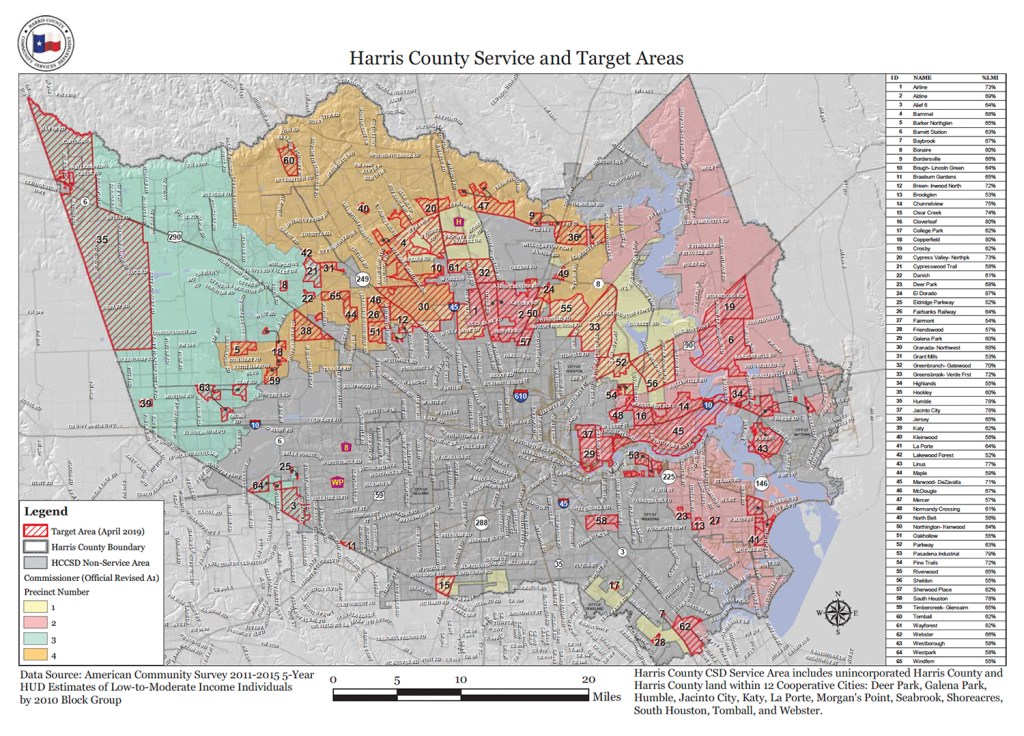
Commissioner Ellis describes his district as 78% African-American and Hispanic, with another 6% from other minorities. And according to HUD, Precinct One contains many low-to-moderate-income neighborhoods. See below.

Low-to-moderate-income neighborhoods by precinct in Harris County.

Harris County has four precincts; each has roughly the same number of people. In an equitable world, you would expect roughly 25% of the buyouts to be in each district. If there really is a “buyout bias” against low income neighborhoods, you would expect Precinct 1 to have less than 25%. But it doesn’t.

Precinct 1 Gets More Than Its Fair Share of Buyouts

Under the Freedom of Information Act, I requested the number of buyouts in Precinct 1 and other precincts since 2000. Once again, hard data contradicts the self-serving myth. Since 2000, when buyouts began in Precinct 1, HCFCD bought 955 homes in Precinct 1 and 2,413 homes in other precincts.

Precinct One has slightly more than its fair share of buyouts.

So where’s the discrimination in buyouts?

HCFCD is buying out homes faster than ever. To learn more about their process, visit this page. With FEMA funds from Harvey, HCFCD hopes to buy out 1,100 homes in the next few years. By comparison, the District bought out only 2,075 homes in the 32 years before Harvey.

Precinct 1 Gets More Than Its Fair Share of HCFCD Construction

In part one of this series, we learned that Precinct One gets the lion’s share of Harris County Flood Control District construction spending for flood mitigation.

Precinct One receives almost half of all Flood Control District spending on construction, leaving the other three precincts to divvy up the other half.

Precinct 1 Gets More Than Its Fair Share of Federal Benefits

In part 2 of this series, we also learned that five of the six active federally-funded flood mitigation construction projects in Harris County are on bayous that flow through Precinct One. No other precinct comes close to receiving that kind of support. That means Precinct One receives more benefits from federally funded flood mitigation projects than any other Precinct in Harris County.

Based on total estimated contributions when completed. Data source: Harris County 2018 Federal Report.

If Commissioner Ellis or his surrogates have any data to back up their claims of discrimination in flood mitigation spending, they should share it. In every commissioners court meeting they spout the same half truths to bolster their share of flood mitigation dollars. So far, it appears to be working quite well for them. And not so well for residents in other precincts.

Posted by Bob Rehak on 6/26/2019

666 Days since Hurricane Harvey

Where Flood Mitigation Money Has Really Gone: Part One

“Equity” proponents would have you believe that Harris County flood mitigation money is all going to high-income neighborhoods. However, data obtained from Harris County Flood Control under the Freedom of Information Act shows that construction spending for flood mitigation is highly concentrated in Precinct 1, which contains many low-to-moderate-income neighborhoods.

At the last Harris County Commissioner’s Court meeting, the issue of “equity” in the prioritization of bond funds came up again. Commissioner Rodney Ellis from Precinct 1 invited several groups to testify about how Low-to-Moderate Income (LMI) groups suffered at the expense of more affluent areas like Kingwood.

Alleged Bias Against LMI Groups Distorts True Picture

They alleged bias against LMI groups by focusing on only one aspect of flood mitigation: buyouts. They said that high-income areas received preference over low-income areas when buying out flooded homes. That’s because of higher home values and thus higher repetitive losses. However, by focusing on this one issue, and ignoring the big picture of Flood Control construction spending, these groups distort the true picture of where flood mitigation dollars actually go.

Precinct 1 is 76% African-American and Hispanic

Rodney Ellis’ Precinct 1 website contains a description of the ethnic composition of his constituents. “With approximately 1.1 million residents, Harris County … Precinct One’s multi-racial, multi-ethnic population is roughly 39 percent African American, 37 percent Latino, 18 percent Anglo, 5 percent Asian and 1 percent other,” it says.

Large Disparities in Construction Spending Favor Precinct 1

Yet according to historical data on construction spending obtained from Harris County Flood Control District through the Freedom of Information Act…

In the last 21 years, Precinct 1 has received at least four to five times more construction dollars from Harris County Flood Control than Precinct 4 which contains Kingwood.

In fact, Precinct One received the single largest construction project in the history of Harris County Flood Control. The excavation of the Kuykendahl and Glen Forest Stormwater Detention Basins cost $59,840,117.41. In contrast, during the last 21-years, the entire San Jacinto River Watershed (the largest in the county) received only $3,345,976.28 in construction funds – one-eighteenth of what that Precinct 1 detention basin project cost!

The money spent on the San Jacinto also represented just one half of one percent of the $663,894,766.38 spent on all construction by the Flood Control District during that 21-year period.

Rodney Ellis’ Precinct 1 is bright green area in center of picture. Black dots represent maintenance projects; red dots represent capital (construction) projects. Note that almost all of the currently active capital improvement projects fall within Precinct 1.

In contrast, the Brays and Sims Bayous, both of which run through Commissioner Ellis’ district, received almost 100 times that amount. The $330 million spent on those two watersheds alone represented virtually HALF of the entire $663.9 million Flood Control District construction expenses in the last 21 years!

Lopsided Distribution of Flood Mitigation Money

In fairness, note that those watersheds do not lie entirely within Precinct 1. However, Precinct 1 also contains parts of Greens Bayou, White Oak Bayou, Halls Bayou, Hunting Bayou, Buffalo Bayou and Clear Creek (see map above). If you add in even a small portion of $229.4 million spent on those watersheds, the Precinct 1 construction numbers become even more lopsided.

  • Greens received $74.3 million
  • White Oak received $47.8 million
  • Halls received $22.3 million
  • Hunting received $23.7 million
  • Buffalo received $44.3 million
  • Clear Creek received $17 million.

Meanwhile, Kingwood received $0 construction dollars but suffered more than a billion dollars worth of damage during Harvey. Yet Mr. Ellis and his friends imply we hog flood mitigation dollars from poor people. THEY demand EQUITY! It’s time someone called this what it is – BS.

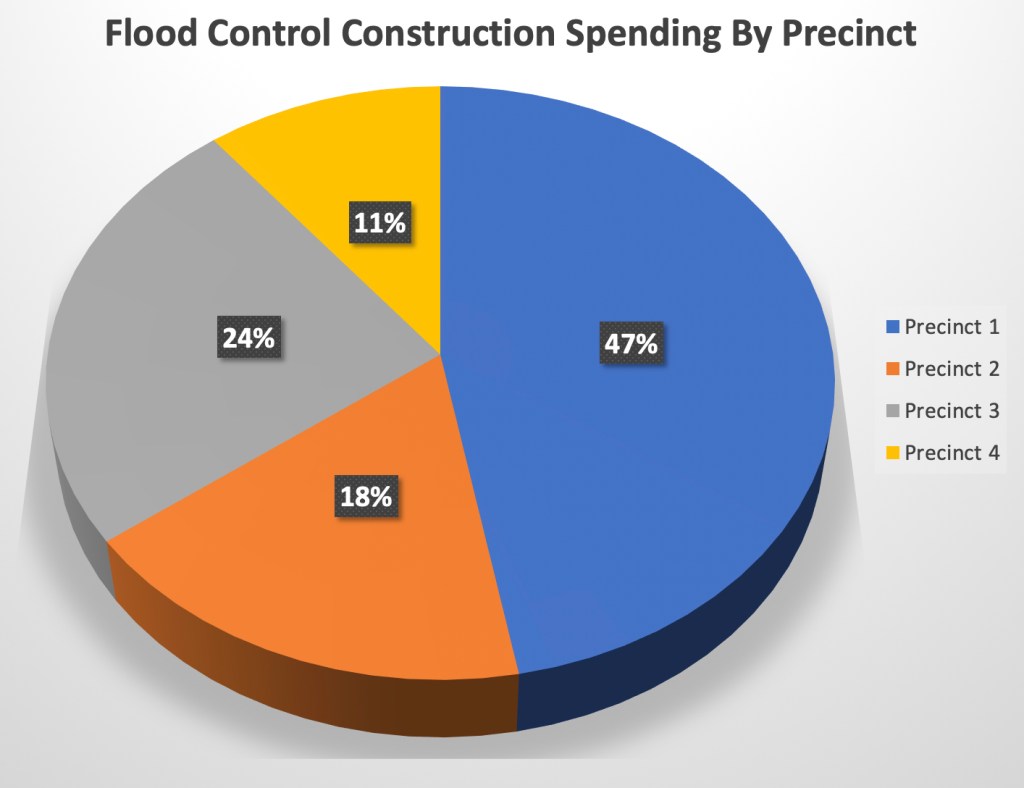
Of the $586 million spent by Flood Control on projects entirely within a single precinct (i.e., projects that did not bridge two or more precincts), Precinct 1 received 47% of all Flood Control District construction spending. Here’s how it breaks down.

Actual Construction Spending by Precinct since 1998

Between 1998 and 2019, Precinct 1 received 47% of all Flood Control District construction funds spent on projects entirely within each precinct. These percentages do NOT include spending on projects that cross districts.
Precinct 1$275,835,964
Precinct 2$103,529,679
Precinct 3$143,873,825
Precinct 4$62,427,867

Precinct Discrimination Disguised as “Equity”?

Precincts are supposed to be roughly equal in population. Yet these figures are so lopsided, one could argue that Mr. Ellis and his friends are deliberately crying discrimination to get a larger share of the pie at the expense of areas like Kingwood. But it’s more complicated than that; Precinct 1 is also taking money from LMI neighborhoods in other precincts.

Look at the distribution of LMI neighborhoods throughout Harris County in the map below. It’s based on five years of recent HUD data. You can see a broad, concentrated LMI band across northern and eastern Harris County.

For a high-resolution PDF of this LMI map, click here.

If anything, these numbers demonstrate a consistent pattern of geographic discrimination against residents of other precincts. Rodney Ellis’ Precinct 1 received 47% of construction dollars for flood control, leaving the other three precincts to divvy up the other half. Precinct 4 contains roughly one fourth of the population but received just 11% of construction dollars.

I’m not suggesting that the Precinct 1 projects were not needed or that the money was not spent wisely. I am suggesting that Precinct 1 LMI residents should not paint Kingwood as a villain. To do so is intellectually dishonest. We are not taking construction dollars from LMI neighborhoods. The County’s own data shows the opposite.

Precinct 1 is taking dollars from affluent and LMI neighborhoods alike.

I will cover other aspects of this story in upcoming posts. In the meantime, County Commissioners vote today on approving the vendor for the Kingwood Area Drainage Assessment. See item 2-B-5 on page 9. The approval of the study caused the equity flap at the last meeting. Let’s hope it doesn’t cause another one in this meeting. After all, the Flood Bond was sold to citizens as a tool to correct problems based on need, not income.

Posted by Bob Rehak on 6/25/2019

665 Days since Hurricane Harvey

Harris County Commissioners Approve Kingwood Drainage Assessment, But Not Without Battle Over Equity

Harris County commissioners approved a Kingwood Drainage Assessment Project Tuesday, but not before a 50-minute discussion of equity that had commissioners shaking fists at each other at one point.

Cagle Versus Ellis with Kingwood in Middle

The battle involved Precinct 4 Commissioner Jack Cagle and Precinct 1 Commissioner Rodney Ellis. The flashpoint concerned Item 2a14 on the agenda. It read:

The Lake Houston Redevelopment Authority and TIRZ #10 wanted to PAY Harris County Flood Control $100,000 to manage and conduct a study of Kingwood drainage capacity. The study would have supplemented a Flood Control District study approved as part of last year’s flood bond. The objective of Item 14: to determine possible improvements to channels and mitigation basins to reduce flooding potential. Click here to read the scope document that Flood Control asked Commissioners to approve.

Illustration showing some of the ditches/streams included in the study including the reach of Taylor Gulley, along which Chris Kalman reported many blockages last week.

Commissioner Ellis invited four “equity coalition” representatives to the meeting. Each gave speeches, using the drainage assessment project as an example to show how poorer parts of the county were being discriminated against. During and after the speakers, Commissioner Cagle, whose Precinct 4 includes Kingwood, got into heated exchanges with Ellis.

The Equity Flap Revisited

The equity flap first surfaced in February. It concerned prioritization of projects in the 2018 bond proposal.

Section 14 (g) of the approved bond language states: “Since flooding issues do not respect jurisdictional or political boundaries, the Commissioners Court shall provide a process for the equitable expenditure of funds, recognizing that project selection may have been affected in the past and may continue to be affected by eligibility requirements for matching Federal, State, and other local government funds.”

Kingwood was among the hardest hit areas in Harris County. As the flood bond language was being finalized, Lake Houston area leaders argued to include language that said all areas would receive their fair share of funds to prevent reverse discrimination. Historically, the Lake Houston area had received no flood mitigation dollars.

Greater Houston Flood Mitigation Report Misrepresented

The following figures and chart are taken from the Greater Houston Flood Mitigation Consortium’s April, 2018 report on Hurricane Harvey. Ironically, one of the activists speaking for Ellis used this report to suggest that poorer neighborhoods have suffered historical discrimination. The report does not support her argument relative to Kingwood at least, as the figures below show.

From the Greater Houston Flood Mitigation Consortiums April, 2018 report on Hurricane Harvey

The San Jacinto watershed, says the Consortium, contains 3% of the region’s population, gets 0% of the mitigation budget, and had 14% of the region’s damages.

Contrast that with Sims Bayou and Braes Bayou, both of which run through Commissioner Ellis’ Precinct 1. Those watersheds have 20% of the region’s population, get 42% of the mitigation budget, and had about 20% of the damages.

The Flood Control District’s own Federal report from March of 2018, shows a map of Harris County with Federal partnership projects everywhere … except the Lake Houston area.

Of the three other speakers, one evidently did not think Kingwood had apartments. Another complained that his community was still recovering (as if we weren’t).

So much for equity! The fact-defying arguments of Mr. Ellis and his surrogates do no one any good; they serve only to drive wedges between people who should be working together to triage a battlefield.

See the Video for Yourself: Blow by Blow

To see the video of the meeting, go to this Commissioner’s Court page, select Item 1, Part 2 of 2 from the menu, then fast forward to 30 minutes. That’s where this discussion starts with the first speaker. If you don’t have an hour, see these other key time markers:

  • 34 minutes: In response to the first speaker, Cagle and Ellis debate who has really gotten the lion’s share of spending.
  • 38 minutes: The second activist begins talking.
  • 42 minutes: Another activist complains that his community still has not recovered and therefore should go first.
  • 48 minutes: A fourth activist quotes the Greater Houston Flood Mitigation Consortium Harvey report. She overlooks the fact that Kingwood is part of the San Jacinto Watershed, which historically has received ZERO mitigation dollars.
  • 51 minutes: She complains that by counting structures, not people, the government discriminates against neighborhoods with multi-family housing. She ignores the fact that at least five major apartment complexes flooded in Kingwood.
  • 1:04:40: Commissioner Cagle complains to Ellis that the discussion is rubbing him raw.
  • 1:06:00: Cagle and Ellis shake fists at each other and nearly come out of their chairs.
  • 1:25:00: Discussion wraps up on this agenda item and the meeting then moves on.

Motion Finally Passed, Next Steps

Luckily and thankfully, when it came time to vote on the measure, it passed.

Matt Zeve, Deputy Executive Director of Harris County Flood Control, said of the plan approved today, “This is not the full scope of the project, just what HCFCD and the TIRZ are partnering on. The full scope will be determined once we have a consultant selected.”

Zeve continued. “The project will involve developing detailed hydrologic and hydraulic models to determine the current “drainage level of service” on open channels in the Kingwood area. Once those are determined, alternatives will be developed to increase the level of service for channels deemed to be undersized.”

“These alternatives,” concluded Zeve, “will be shared with the public in a community meeting. Final recommendations for future projects will be provided. Once Commissioners Court approves the final report, preliminary engineering for the recommended alternatives will begin.”

Zeve expects the assessment work to begin before the end of the summer.

Need for Vigilance and Balance

Today’s meeting underscores the fact that the Equity Flap has not gone away. Lake Houston area residents need to remain vigilant and fight for our fair share of dollars as this and every Lake Houston area project moves forward. We need several Kingwood residents to speak at the next commissioners court meeting to provide balance.

Posted by Bob Rehak on 6/04/2019

644 Days since Hurricane Harvey

San Jacinto River Watershed: Underfunded, Overdamaged

When I go to various flood mitigation meetings around town, I often hear – with some jealously and resentment – that the San Jacinto River Watershed seems to be getting the lion’s share of flood mitigation funding. This is not true, but it’s a popular misperception. Those who believe they are underfunded tell me constantly how unfair they think it is.

Flood Damage and Mitigation Funding Varies Greatly by Watershed

So I’ve done some research on this subject and would like to call your attention to two reports. The first is a regional report by the Greater Houston Flood Mitigation Consortium called Strategies for Flood Mitigation. It examines equity in funding between different watersheds. It found that the San Jacinto River Watershed has 3% of the region’s population, historically has received 0% of the region’s flood mitigation funding, and yet sustained 14% of the region’s damages during Harvey. That would seem to suggest that San Jacinto River Watershed residents suffered almost five times more damage per capita than other watersheds.

I wondered if there could be a correlation between underfunding of flood mitigation projects and excessive damage. That led me to another report that lists spending by watersheds in dollars: Harris County Flood Control District’s (HCFCD) annual federal briefing. It’s Flood Control’s annual report to the Federal Government about how Federal funds are being spent here. The link above is to the 2018 version, published last March. That was just BEFORE the U.S. Army Corps of Engineers started its West Fork dredging project. Note also, it was BEFORE Harris County passed its $2.5 billion flood bond in August. So what follows is a snapshot of the way things were BEFORE Harvey, not now.

SJR Flood Mitigation Projects Underfunded Until Recently

A re-reading of that Federal Briefing confirmed my suspicions and the findings of the Greater Houston Flood Mitigation Consortium. The San Jacinto River watershed is by far the biggest in Harris County. With the exception of a few buyouts and flood gages, until now, it has received NO federal dollars for flood mitigation projects (at least through the County).

Source: Harris County Flood Control 2018 Federal Briefing. Harris County has 22 watersheds. The San Jacinto appears to be the largest.

By far, the vast majority of the money spent goes to capital improvement projects such as channelization and detention. Virtually all of that money is spent in six areas according to the Active Federal Projects Summary in the HCFCD Federal Briefing. They are:

  • Sims Bayou
  • Clear Creek & Tributaries
  • Greens Bayou
  • Brays Bayou
  • Hunting Bayou
  • White Oak Bayou

Previously, projects were completed for the Addicks and Barker Reservoirs, Halls Bayou, Buffalo Bayou, Vince Bayou, Little Vince Bayou, and Cypress Creek. There are no capital projects listed for the San Jacinto River Watershed, past or present.

Higher Percentages of Budget than Damage

So how did the watersheds fare that are receiving federal funding? According to pages 24 and 25 of the Greater Houston Flood Mitigation Consortium  report:

  • Sims Bayou had 19% of the budget and 2% of the damage.
  • Clear Creek had 13% of the budget and 7% of the damage.
  • Greens Bayou had 8% of the budget and 7% of the damage.
  • Brays Bayou had 23% of the budget and 18% of the damage.
  • Hunting Bayou had 8% of the budget and 1% of the damage.
  • White Oak Bayou had 14% of the budget and 3% of the damage.

With No Budget, SJR Tied for Third Highest Amount of Damage

Compared to the six creeks and bayous above, the San Jacinto River had 0% of the budget and 14% of the damage. Here’s how it looks in graph form, taken from the Flood Mitigation Consortium report.

The Greater Houston Flood Mitigation Consortium Report dramatizes the need for equity in funding throughout the region. For a complete breakdown of all watersheds, see the table on page 25 of the report.

What can we deduce from this?

Flood mitigation spending, without a doubt, reduces damage.

The San Jacinto River watershed is by far the most underfunded compared to others.

Vigilance Needed

People in the Lake Houston Area need to fight future underfunding. We have been too quiet and therefore neglected for far too long. We must remain vigilant in coming years to ensure that the projects we have been promised (additional dredging, detention and floodgates, plus better ditch maintenance) are in fact delivered.

Harris County and the federal government together are spending $1.342 billion dollars on capital projects for Sims Bayou, Clear Creek, Greens Bayou, Brays Bayou, Hunting Bayou and White Oak Bayou. The San Jacinto currently gets only one twentieth of that due to the current Corps dredging project.

Before you call Judge Emmett and your county commissioners, I would like to point out that they have already committed to a more equitable distribution of project dollars from the $2.5 billion flood bond passed in August and that the Lake Houston area should get its fair share in the future. Phone calls at this moment are not necessary. Vigilance is. We can’t change the past, but together we can change the future.

Posted by Bob Rehak on October 24, 2018

421 Days since Hurricane Harvey