Tag Archive for: SJRA

SJRA To Hold Meeting Thursday at 6 p.m. To Discuss New Flood Forecasting Tool

The San Jacinto River Authority (SJRA) will hold an initial public meeting tomorrow night to discuss its Flood Forecasting and Reservoir Operations Tool project.

  • Date: Thursday, October 24, 2019
  • Time: 6:00 p.m.
  • Place: SJRA General and Administrative Building Board Room, 1577 Dam Site Road, Conroe, Texas, 77304

Objectives of Forecasting Tool

The SJRA hopes to develop a tool that can:

  • Predict peak release rates of storm water from Lake Conroe
  • Anticipate peak water levels in Lake Conroe during rainfall events based on weather forecasts, observed rainfall, lake levels, and other data
  • Improve communication with Offices of Emergency Management and the public during storms. 

Need for Faster, Better Information

“Getting information out as early as possible is essential during potential floods,” said Chuck Gilman, Director of Water Resources and Flood Management for the SJRA.  

“The Flood Forecasting and Reservoir Operations Tool will take data from across the region and analyze it utilizing a model of the Lake Conroe Watershed to make predictions regarding flood threats. That will help us provide timely, accurate information for people to make decisions to protect themselves, their families, and property,” he added.

The gates at Lake Conroe can release water at up too 150,000 CFS. During Harvey they released almost 80,000 CFS.

During Hurricane Harvey, many people lost vehicles and valuables that could easily have been saved by driving them to higher ground if they had had more warning time. This project should help with that.

Available by Fall 2020

The Project will complete in fall 2020. A written technical memorandum will summarize recommendations for the tool. 

The Texas Water Development Board (TWDB) and SJRA will jointly fund the project. TWDB offers grants to political subdivisions in Texas for evaluation of structural and nonstructural solutions to flooding problems and flood protection planning. 

To Offer Input

Anyone interested may attend the meeting to express their views with respect to the project.  

Questions or requests for additional information may be directed to:

  • Matt Barrett, P.E.
  • Division Engineer
  • SJRA
  • 1577 Dam Site Road
  • Conroe, Texas 77304
  • Telephone (936) 588-3111

If you plan to speak, contact Matt Barrett either in writing or by telephone in advance of the meeting. If you cannot attend but have views you would like to share, contact Barrett today.

For additional information on SJRA, visit www.sjra.net.

Posted by Bob Rehak on 10/23/2019

785 Days after Hurricane Harvey

SJRA Update, Upcoming Sunset Review and Enabling Legislation

Since Harvey, the Lake Houston Area has seen some huge changes for the better in the San Jacinto River Authority (SJRA). When the Governor visited Kingwood and took a helicopter tour of the San Jacinto River basin after Harvey, he directed the SJRA to establish a flood mitigation division. He also appointed two directors from the Lake Houston area to ensure downstream representation on the SJRA board.

Many Improvements Since March 2018

Since then, Kaaren Cambio and Mark Micheletti, the two new directors from the Lake Houston area, have led the charge to lower Lake Conroe seasonally. This ensures a greater buffer against floods.

The effort paid off this year when heavy back-to-back-to-back rains in early May would have forced a large release from Lake Conroe had it not already been lowered. That release, added to already swollen tributaries, would almost certainly have threatened low lying homes and businesses.

The SJRA will again lower Lake Conroe during the peak of Hurricane season. Starting August 1, it will take Lake Conroe down one foot. Beginning August 15, they will take it down another foot until October 1.

The SJRA is also working with Harris County Flood Control to install more upstream gages and turn the Harris County Flood Warning System into a Regional Flood Warning System with customizable alerts. The goals: create more awareness of upstream dangers to give people more time to evacuate and save valuables in the event of a flood. Said another way, avoid middle-of-the-night surprises like we had during Harvey.

Finally, the SJRA is leading a joint river basin study that hopefully will lay the groundwork for additional upstream detention, more flood gates for Lake Houston, and an ongoing maintenance dredging program. So, many good things are happening.

Cambio’s Term Expiring

However, Cambio’s term on the board expires this year. She wants to stay in the position and I hope she does. Cambio has worked tirelessly to mitigate flooding on so many levels. Her position as a key staffer for Congressman Dan Crenshaw also makes her uniquely qualified to help coordinate efforts from Federal, State and local agencies. She deserves reappointment.

A reader asked whether there’s an opportunity to increase downstream representation on the SJRA board with more representatives like Cambio and Micheletti.

The answer is, “In the short term, no.” Cambio’s seat on the board is the only one up for renewal this year.

SJRA Sunset Review Coming Up

However, in two years, the entire SJRA will come under close scrutiny as part of a sunset review. A sunset review is an evaluation of the need for the continued existence of a program or an agency. It assesses their effectiveness and performance, and recommends either retaining, modifying, or terminating them.

The SJRA comes up for sunset review in the 2020-2021 cycle. Section 325.025 of the Texas Sunset Act mandates a review by September 1, 2021, and every twelfth year thereafter. See page 34 of the this PDF.

No one expects the SJRA to be terminated. But many other river authorities that have gone through the sunset review process, have had a complete overhaul, said one source who spoke on condition of anonymity.

The Sunset Commission has been brutal at times. For instance, between 2016 and 2017, the Commission reviewed four river authorities and noted:

  • “Sulpher River Basin Authority Board has not built the trust needed to effectively carry out its mission.”
  • “Central Colorado River Authority no longer serves a necessary public purpose.”
  • “Upper Colorado River Authority has not set priorities to ensure its operations meet changing local watershed needs.”
  • “Palo Duro River Authority of Texas lacks flexibility to adapt to changed local circumstances.”

Their report makes fascinating reading. One thing that became clear in scanning it is that, like most good performance reviews, the Commission judges performance against objectives. In the case of these Authorities, enabling legislation spells out the objectives.

Enabling Legislation Established SJRA Goals

That prompted me to review the enabling legislation for the SJRA. The sections discussing goals begin on page 2 of this PDF. I have summarized them below.

The state created the SJRA (originally called the San Jacinto River Conservation and Reclamation District) to “conserve, control, and utilize to beneficial service the storm and flood waters of the rivers and streams of the State.” Section 2 of the enabling legislation mentions floodwaters three times.

Section 3 starting on page 3 of the same PDF lays out additional goals. For instance, to:

  • Prevent the devastation of land from recurrent overflows.
  • Protect life and property.
  • Regulate the waters of the San Jacinto River and its tributaries.
  • Build dams and distribution networks that provide waters for cities, towns, irrigation, agriculture, commercial, industrial, mining and other beneficial uses.
  • Develop drainage systems that enable profitable agricultural production.
  • Conserve “soils against destructive erosion and thereby preventing the increased flood menace incident thereto.”
  • Forest and reforest the watershed to aid in the prevention of soil erosion and floods.
  • Encourage, aid, and protect navigation and harbor improvements.
  • Acquire land for parks and recreation, and to build park and recreational facilities thereon.
  • Dispose of sewage and industrial waste.
  • Construct, improve, maintain, operate and repair water and sewage plants and distribution networks.

How Would You Rate Performance against These Goals?

It seems to me that the SJRA does a great job at its basic mission. And they’re improving at flood mitigation. However, for decades, the SJRA ignored other crucial parts of its job description, including flood and erosion prevention; reforestation; parks and recreation; and navigation protection. In fairness, the Legislature never funded those mandates. The SJRA’s only income comes from the sale of water which it impounds.

Still, you would think somebody could pick up a phone and call the TCEQ for help with some of these things. For instance, sand mines along the banks of the river dump effluent and sediment directly into the drinking water supply for millions of people. It will be interesting to see what kind of changes the Texas Sunset Commission recommends when the SJRA comes up for review.

For an interesting history of the SJRA, see Chapter 4 of this doctoral dissertation by Andrew C. Baker at Rice University. It paints a fascinating picture of the problems the SJRA had in originally fulfilling its basic mission and how the SJRA overcame them with help from the City of Houston.

Note: For future reference, the SJRA enabling legislation has been added to the Reports page under the SJRA tab.

Posted by Bob Rehak on 6/23/2019

663 Days after Hurricane Harvey

Partners Outline Goals and Scope of San Jacinto Regional Watershed Master Drainage Plan

Earlier this year, I posted about FEMA funding approval of the San Jacinto River Basin Study. The four partners in the project, Harris County Flood Control, SJRA, Montgomery County and City of Houston, have released a fact sheet that outlines the objectives and scope of their study.

The study will cover 3000 square miles from the upper reaches of the San Jacinto River watershed in Walker, San Jacinto and Grimes Counties in the north to I-10 on the south.

Map of 3000 square-mile study area

Now called the “San Jacinto Regional Watershed Master Drainage Plan,” goals include:

  • Identifying the region’s vulnerabilities to flood hazards using Atlas 14 rainfall totals
  • Developing approaches to enhance public information and flood-level assessment capabilities during a flood
  • Evaluating flood mitigation strategies to improve community resilience
  • Providing a comprehensive Flood Mitigation Plan that supports the needs and objectives of each regional partner.

Download the PDF to learn more. This is not a detailed discussion, just a two-page, high-level overview. To read the entire detailed document that FEMA approved, click here.

Consultants should complete the plan/study by about April of next year. For more information about the project, see the Harris County Flood Control District Web Site.

Flood control also has a useful page dedicated to updating Kingwood residents on the status of projects affecting the Lake Houston area.

Posted by Bob Rehak on 5/29/2019

638 Days since Hurricane Harvey

One Less Thing to Worry About in Latest Storm: How Seasonal Lowering of Lake Conroe Helped

Storms during the last two days were traumatic for virtually everyone in the Kingwood area. Tragically, one person lost her life when her car hit a downed tree.

  • Others lost vehicles, trees, and sleep.
  • Torrential rains for a brief period – at the rate of 4-5 inches in an hour – flooded streets and vehicles.
  • They also brought water near or into homes.
  • Parents picking children up from school waited in rising waters as their students sheltered in place.
  • A small tornado may have briefly touched down near Town Center.
  • Kingwood Drive was shut down for hours during the Friday afternoon rush hour.
  • People traumatized by Harvey were re-traumatized.
  • People without power waited and wondered for hours about what was going on around them.

Lake Conroe: One Less Worry This Time

Despite all that, we did NOT have to worry about one thing: Lake Conroe opening its flood gates again during this storm. The seasonal lowering policy established last year worked.

The SJRA board voted to lower the lake’s level one foot to 200 mean feet above sea level (MSL) from April 1 to May 31.

That action may have saved the Lake Houston area from additional flooding in the last round of storms.

Releasing Water Continuously At Low Rate Created Extra Capacity

Lake Conroe had released water continuously since April 1 at a slow, controlled rate of 350 to 550 cubic feet per second. However, because of spring rains, Lake Conroe had only dropped about a half foot from 201 to 200.66 feet MSL. Had the releases not happened, the lake would have been an estimated 1-1.5 feet higher, according to Mark Micheletti, an SJRA board member from Kingwood. That means the lake level would have been approaching 202 feet, the level at which the SJRA automatically begins releasing water, when the storm hit. That would have forced the SJRA to release water at a higher rate that could have overloaded the downstream watershed.

Buffer Against Downstream Flooding Worked

In other words, the policy worked. The seasonal lowering provided a buffer against downstream flooding. NOAA shows a double crest on the San Jacinto West Fork at US59 during the last two days that coincided with two waves of storms. At peak flow, the river came within about two feet of going out of its banks.

An additional foot of water released from Lake Conroe would have added two feet to Lake Houston and created flooding.

About a mile downstream at River Grove Park, the water was up, but still within its banks.

Despite torrential rains last night and early this morning, the West Fork remained in its banks. The river was up, but no homes flooded from the river.

Success: No Rivers or Streams Out of Banks

At this hour, neither NOAA, the SJRA, nor Harris County Flood Control, predicts any flooding from yesterday’s storms. In fact, all streams and bayous seem to be receding at this time. That’s one less thing to worry about as we clean up from the latest storm. The SJRA’s seasonal lowering DID help.

Remember, Lake Conroe is almost twice as big as Lake Houston (33 sq. mi. vs 18.5 sq. mi.). So one foot released there translates into almost two feet here. And two feet would likely have forced the San Jacinto out of its banks for the fifth time in a year.

Kudos to the SJRA board, the City of Houston, and the TCEQ for enabling this policy. That, in conjunction with the City’s pre-release policy for Lake Houston, have made a difference.

Posted by Bob Rehak on 5/5/2019

614 Days since Hurricane Harvey

SJRA Responds to Post about SB 2126 Opening Door to River Mining

Letter to the Editor

RE: “Caution: SB 2126 Opens Door to Sand Mining in Rivers”

Bob,

Thank you for your work with Reduce Flooding to raise awareness about flooding and flood-related issues since Hurricane Harvey.  You have done a tremendous job of helping to educate the public on the causes of flooding and providing status updates on current and future flood-related projects and initiatives. Regarding your April 25 post titled ““Caution: SB 2126 Opens Door to Sand Mining in Rivers,” I want to clarify what SB 2126 is and what it is not.  

Chuck Gilman, the author of this post, is
Director of Water Resources and Flood Management for the
San Jacinto River Authority

The concept behind SB 2126 is to create a proactive approach toward removing sediment from the river before it is deposited in Lake Houston.  If you’ll recall the KBR report from 2000 noted “For long-term sediment management consideration, sedimentation basins, either on-channel or off-channel, are the most effective approach to minimizing sediment buildups and maintain the life of the channel conveyance.”  That is what we are attempting to accomplish with this program. 

The strategies and programs that could be implemented if SB 2126 is approved would not be river mining or dredging.  Any kind of dredging (either hydraulic or mechanic) would be very limited in scope, allowing conservation and reclamation districts to restore conveyance in the rivers in a strategic location through small-scale, periodic, targeted removal of sediment in the river.  This could be as large-scale as the current dredging project currently in progress, or as simple as the construction of sand traps that are dredged annually.  Regardless, your point about oversight and management is well noted, and is a requirement for this program to be a success.  

The San Jacinto River Authority has secured the support from the sand mining industry through the Texas Aggregates and Concrete Association to explore options to remove sand, gravel, shell, and other aggregates from the river—all without a cost to taxpayers.  Ideally, the SJRA would be the public agency overseeing and managing the program, conducting the necessary studies, and coordinating with the appropriate state and federal agencies to determine where and how much material should be removed. Partners from the private sector could then remove the material as directed by SJRA.  

After Hurricane Harvey, Governor Abbott tasked all of us with flood control and flood management. SB 2126 creates opportunities for public-private partnerships to help preserve the channel conveyance capacity of the San Jacinto River.  As we know in the Lake Houston area, this sediment impedes the flow of storm water where the West Fork converges with Lake Houston.  

Senator Creighton has led the effort to develop a flood resiliency funding bill in the Senate this legislative session (SB 7), and continues to seek other options to help create a regional flood management effort in the San Jacinto Basin.  This bill would simply create another tool in our toolbox to help reduce potential flooding in the future.  

As stewards of the San Jacinto River and its water supply, the SJRA supports Senator Creighton’s proactive approach to managing sediment in the river. We are trusted partners with the State of Texas, Harris County Flood Control District, and FEMA to execute $2.5B in flood control bond projects like the comprehensive San Jacinto Watershed Master Drainage Plan.  We value our role as a community partner and appreciate the opportunity to further reduce the risk of flooding by providing oversight and management of this plan.

Chuck Gilman
Director of Water Resources and Flood Management
San Jacinto River Authority

For additional information on SJRA visit our website at www.sjra.netor like SJRA on Facebook 
@SanJacintoRiverAuthority

Posted verbatim from SJRA letter by Chuck Gilman on 4/23/2019

602 Days since Hurricane Harvey

The Night that 11,000 Lake Houston Area People Became Homeless

Eighteen months ago, approximately 11,000 Kingwood, Humble and Atascocita residents went to bed thinking they had escaped the worst of Harvey’s wrath. Hours later, they woke up to find water seeping through their windows, doors and walls in the dark of night. Without any warning. Thanks in part to the release of 80,000 cfs from the Lake Conroe dam.

The Harris County Flood Control Damage Map shows that on the West Fork:

  • 3652 Homes were damaged in Kingwood
  • 366 in Atascocita
  • 466 in Humble
  • Total: 4184 homes flooded in this area partly because of the release of 80,000 cfs from the Lake Conroe dam.

With an average household density of 2.71, that means roughly 11,000 people became homeless that night.

Ironically, Thursday, February 28, the San Jacinto River Authority will vote on whether to continue lowering the level of Lake Conroe seasonally. The measure was designed to help reduce downstream flood risk until mitigation measures can be put in place.

However, rumor has it that one or more members of the board want to present a petition by Lake Conroe boaters to NOT lower the lake level this year. To everyone who signed that petition, I dedicate this photo essay.

Water Sculptures by Julie Yandell. Taken during Harvey.
Water Sculptures by Julie Yandell. Taken during evacuation. Yard decorations take on an ominous feeling in the flood.
Woodland Hills Drive During Harvey by Julie Yandell
The flood cut off Woodland Hills Drive, a major escape route for people in Kingwood Lakes, the Barrington and Kings Cove.
Trash Day in the Barrington after Harvey. Photo by Joy Dominique.
Siding from home washed downstream during Harvey. Photo by Dan Monks.
Water skiing, anyone? Photo by Sidney Nice of Atascocita Point after Harvey.
Sidney Nice's kitchen after Harvey flooded the house to a depth of 63".
Sidney Nice’s kitchen after Harvey flooded the house to a depth of 63″.
Sidney Nice's house in Atascocita Point during Harvey.
Sidney Nice’s house in Atascocita Point during Harvey.
Her home flooded 40 inches above the slab.
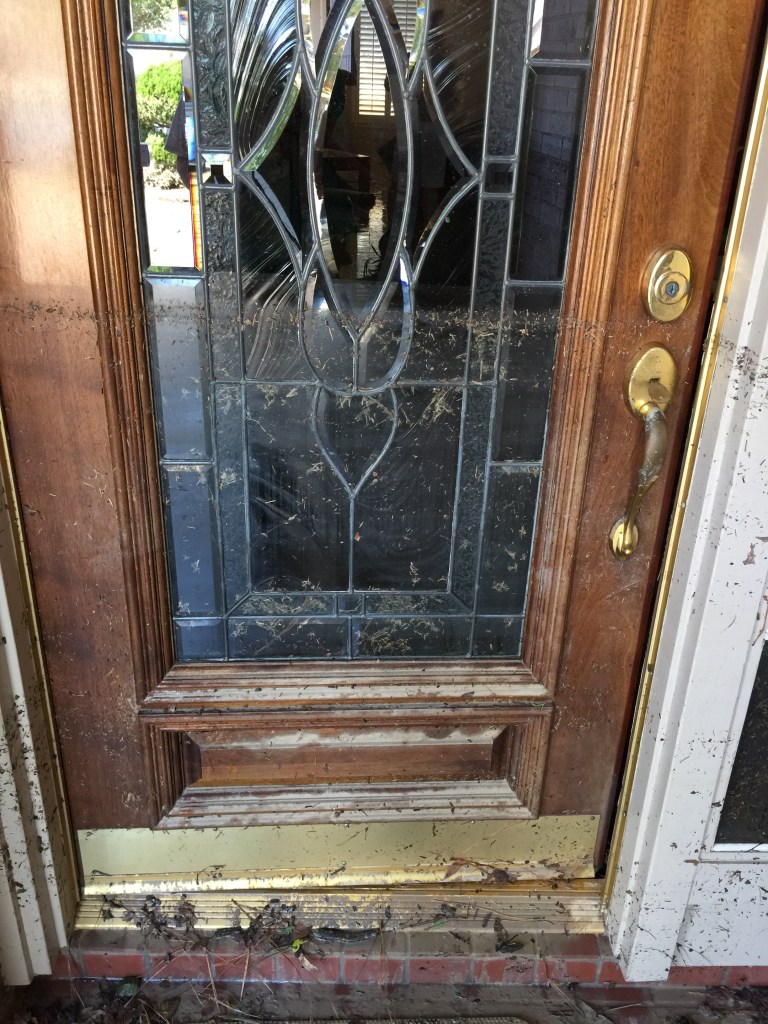
Rebecca Johansen’s front door shows how deep flood waters got in her home … 40 inches.
Townhomes on Marina Drive in Forest Cove. Concrete and steel were less effective at preventing erosion than blades of grass.
Residents trying to escape as Harvey's floodwaters rose
Elderly residents of Kingwood Village Estates trying to escape as Harvey’s floodwaters rose. Twelve residents later died: six as a result of injuries sustained during evacuation and another rise as a result of stress from losing their homes.
Marilyn Davenport: Home Damaged During Harvey
From Ann Crane: "We had over 70 people helping to clear and clean our house. The Kingwood community coming together."
From Ann Crane: “We had over 70 people helping to clear and clean our house. The Kingwood community coming together.”
Jennifer Manning: "What 18 inches of floodwater can do to your home." From Walden on Lake Houston.
Jennifer Manning: “What 18 inches of floodwater can do to your home.” From Walden on Lake Houston.
Jennifer Manning: "We lived in Kingwood from 1992-2012 before buying a house in Walden that was 'built above the '94 flood.' We finished our rehab in June." Ten months!
Jennifer Manning: “We lived in Kingwood from 1992-2012 before buying a house in Walden that was ‘built above the ’94 flood.’ We finished our rehab in June.” Ten months!
The Kelsey Seybold Clinic has also been vacant since Harvey. 44% of all businesses in the Lake Houston Area Chamber were damaged. Some will never return.
Picture by June Ledet of Harvey flooding in Kingwood corner of Kingwood Drive and Forest Garden
Picture by June Ledet of Harvey flooding in Kingwood. Corner of Kingwood Drive and Forest Garden. Flooding here cut off escape routes for thousands more.
Classroom building at Lone Star College/Kingwood flooded during Harvey after SJRA release. Six of nine buildings flooded causing more than $60 million in damage. The College just fully reopened this month.
Milan saunders
Milan Saunders home in Kingwood Lakes
That’s all, folks! Harvey flipped the baby grand piano and broke to legs off the heirloom.
Repairs to IH-69 took about 10 months and $20 million, disrupting all traffic into and out of the City for hours each day.
The mother of all walk in closets…Amy Slaughter’s garage.
Home of a single mother who had just lost her job.
When sewage treatment plants flooded, toilets began flowing in reverse.

So please, Lake Conroe boaters. Let’s keep this in perspective. We understand your inconvenience. Please try to understand ours. Help us recover our lives.

To see more examples of how Harvey affected the lives of Lake Houston Area residents, please see the Submissions Page of this web site. It contains images submitted by residents affected by Harvey. If you have images you would like to share, please send them in via the Submissions Page.

Posted by Bob Rehak on February 28, 2019

548 Days since Hurricane Harvey

SJRA Has Released Water Continuously since December 7

Last night after posting the third flash flood warning in less than a month, several flood-weary people on FaceBook flashed back to Harvey. They questioned why the SJRA wasn’t releasing water in advance of the storm. I quickly went to SJRA.net and looked at their dashboard. They WERE releasing water. The discussion then morphed into another SJRA bloodletting, borne of fear and frustration over a month of near-continuous flood risk and a year and a half of expensive flood repairs.

I’m not here to defend the SJRA. But I suspected perception and reality were currently out of sync. So I emailed a reader’s comments to Jace Houston, general manager of the SJRA, and asked what they were doing to address his concerns.

Update from Jace Houston of SJRA on Recent Releases

Here is the response I got today. I’m reprinting it word for word.

“As you know, there’s a big information gap between what we do during storm events and what the public perceives.  We’re working on some significant items to begin closing that gap.”

“We have an information piece that will go out this afternoon regarding the current rainfall event, but I thought I would mention a couple of items to you just in case you get more inquiries.”

“We’ve been releasing water non-stop since the December 7th rainfall.  It takes quite a while to safely lower the lake after its risen a couple of feet above normal level.  Obviously the level jumped back up from the Christmas rainfall.  Releases went back up to around 7000 cfs, and we’re still at over 3000 cfs.  Rainfall has been in the forecast pretty much constantly the last 30 days, so we’re in the mode of trying to safely move it out of the lake before the next storm hits.”  

“The forecast for this event is not too bad.  Approximately two to three inches across our watershed.  We’re only a few inches over 201’, so we should be able to manage this one similarly to the Christmas event.”

Mark Micheletti emailed this PDF to me last week. Micheletti is one of Kingwood’s two SJRA board members. The letter explains in more detail how they set the level of releases and coordinate with other agencies.

I hope this settles some nerves and reassures people.

Update on Current Conditions and Releases

At approximately 9 p.m. on January 2, the SJRA is releasing 3198 cfs. Harris County’s Flood Warning System shows the largest rainfalls so far during this event are less than 2 inches.

Jeff Lindner of Harris County Flood Control issued this update re: current rains at 7 p.m. tonight:

“A band of heavy rainfall with rainfall rates of 1.0-1.5 inches per hour is moving NNE over much of Harris County currently extending along the US 59 corridor. HCFCD gages show rainfall amounts of .75-1.5 inches with this band in an hour or less and this will likely result in some street flooding. Rises on area watersheds are likely, but creeks and bayous will be able to handle this round of rainfall.”

“Additional activity to the SW will likely move into the county over the next few hours.”

Hope that helps! Stay tuned to the National Weather Service, NOAA or your favorite source of weather information.

Here are the latest predictions from NOAA for the area around US59 and rainfall in the last 24 hours for Harris County.

Posted by Bob Rehak on January 2, 2019

491 Days after Hurricane Harvey

Whew! Luck and Aggressive Action Avert Major Flooding

Good to have the Pearl Harbor Day flooding in the rear-view mirror. And good that the worst predictions did not come true. So what happened? Did we just get lucky? Or did something go right for a change? It might have been a little of both.

Here’s what I know at 8 p.m. on Saturday night, about when the flood was expected to crest and flood multiple neighborhoods.

Lake Conroe Releases Have Peaked

According to Jace Houston, General Manager of the SJRA, releases from the Lake Conroe dam have likely peaked. The current release rate of 8181 cfs falls far short of previous floods and short of 9,000 to 11,000 cfs release rates predicted earlier.

Less Rain than Expected

That’s because we got less rainfall than predicted. Most of the area, including Lake Houston and upstream from Lake Conroe, received about 4.5 inches or less instead of the 8 to 10 predicted earlier.  And rain was fairly spread out over time. The heaviest rainfall seems to have happened in The Woodlands with some gages approaching 6 inches.

Aggressive Pre-Release by City

Finally, the City of Houston started releasing water from the Lake Houston Dam two days in advance of the storm. They took the lake level down two feet before the storm and kept releasing water during the storm. Had it not been for that, homes along the shoreline would almost certainly have flooded.

Looking across the flood-swollen San Jacinto at the US Army Corps of Engineers’ Command Site. Had the City not pre-released more than 2 feet of water from Lake Houston, this site would have been inundated.

Trending Steady or Down

At this moment, every stream gage that the SJRA reports upstream from the Lake Houston area is trending down. The peak has passed.

Harris County Flood Control shows that the gages at US59, West Lake Houston Parkway and FM1960 also appear to have peaked.

A photographic tour of the Kingwood area this afternoon showed that the river came out of its banks at River Grove Park and US59 and was on the verge of coming out in many other places. Surprisingly, I saw no flooded homes, not even on Marina Drive in Forest Cove. However, I did hear of many affected by street flooding, especially upstream in Montgomery County.

Still Much Mitigation Work to Do

Ben’s Branch by the Enclave and Kingwood Library had standing water. That should be a reminder that the County needs to make cleaning out this stream a high priority. 

One final point. Late this afternoon, I noticed a huge difference between the gages upstream and downstream from the dredging.

At 59, the West Fork exceeded its banks and peaked at 52 feet.
At West Lake Houston Parkway, the river was well within its banks and peaking around 45 feet.
At FM1960 the river was still well within banks and peaking at 44 feet.

Normally, these gages all read the same elevation. One can partially attribute the differences to spreading of the river. However one must also consider the huge blockages in the river that the Corps has not yet removed. At the moment, one of the biggest is just downstream from River Grove Park. Another, the mouth bar, blocks the river between Kings Point and Atascocita Point.

Even during a flood, the mouth bar (in the middle of this picture) stands out of the water by several feet and blocks the mouth of the West Fork. Water must make its way past this blockage through narrow passages on either side of it. It backs water up throughout the Humble/Kingwood area.
Here’s what the mouth bar looks like from the air, right after Harvey, before grass started growing on it. The area around it averages 1-3 feet deep. The deepest parts of the narrow channel reach 5 feet deep.

The Lake Houston Area lucked out this time due to aggressive action by City officials, a conservative release rate by the SJRA and the kindness of Mother Nature. I hope we don’t press our luck and assume that these blockages make no difference. They do. We need to remove them.

Posted by Bob Rehak on 12/8/2018

466 Days since Hurricane Harvey

Conditions in Atlantic Becoming More Favorable for Tropical Development

I just received an email from Jeff Lindner, Director of Hydrologic Operations Division/Meteorologist for Harris County Flood Control District about a potential tropical development.

Linder says, “There has been little mention of the Atlantic tropics thus far this hurricane season…even though we are already on our “E” storm. Most of the storms have been focused in the sub-tropical north Atlantic away from the generally hostile conditions in the deep tropics and far removed from any land interaction.”

National Hurricane Center Five Day Graphical Tropical Weather Outlook gives this tropical disturbance a 20% chance of tropical formation over the next five days.

Conditions in Tropics Becoming More Favorable for Tropical Development

“However conditions are starting to slowly change and as is usual for mid-August, conditions are becoming more favorable for tropical development in the deep tropics or that region between Africa and the Caribbean Sea,” said Lindner.

Tropical Wave 99L

Lindner continued: “A tropical wave roughly 850 miles east of the southern Windward Islands has shown an increase in deep convection today. This convection (thunderstorms) remains fairly disorganized at this time. Significant amounts of Saharan Air (dusty air from the deserts of N Africa) have been generally keeping the formation of convection to a minimum for the last 2 months, but 99L has found itself far to the south (near 8N) and mainly south of the dusty air across the mid Atlantic. This system has also found itself near/under a building ridge of high pressure aloft and removed from the anomalous strong wind shear thus far this year across the Caribbean Sea and Atlantic.”

“Conditions appear at least marginally favorable for some slow development of this feature as it moves W to WNW over the next 48-72 hours.”

“There is little to no model support for this feature to develop, but we shall see what the 00Z and 12Z models suggest. At the 800pm this evening, the Hurricane Center is giving this system a 20% chance of tropical development over the next 5 days as it moves generally toward the eastern Caribbean Sea.”

Lindner Cautions Against Looking Too Far into Future

“Reminder: it is important as we move into the heart of hurricane season to get information from trusted sources – especially on social media. Posts showing where a storm could be 7-9 days from now and at some level of intensity should not be believed and it is important to refrain from sharing such posts without proper context,” cautioned Lindner.

Peak of Hurricane Season is September 10

The statistical peak of hurricane season for this area is September 10, so we are still almost a month away. Nevertheless, be prepared. Check your your hurricane kit now. Don’t leave important matters for the last minute.

SJRA Still Lowering Lake Conroe

The San Jacinto River Authority (SJRA) has been steadily lowering Lake Conroe by 275 cubic feet per second to create extra capacity in the lake.  From a normal level of 201 mean feet above sea level (MSL), the goal was to reduce the lake to 199 MSL by August 15 and maintain that level until the end of September. This is to create an additional buffer against downstream flooding until the Army Corps can restore the carrying capacity of the West Fork.

However, recent rains have been refilling the lake almost as fast as the SJRA is lowering it. At the time of this post, the level was at 200.01 MSL. Visit SJRA.net to see the current level and release rate.

I am sure they will increase the discharge rate if this or any other storm approaches to get to their target of 199 MSL.

In short, nothing to worry about now. But keep your antenna up.

Posted by Bob Rehak on August 15, 2018

351 Days since Hurricane Harvey.

Seasonal Lowering of Lake Conroe Begins August 1

On August 1, the City of Houston Public Works Department, the San Jacinto River Authority (SJRA) and the Coastal Water Authority (CWA) plan to begin lowering the level of Lake Conroe as part of a joint operations plan to mitigate flooding threats during the peak of hurricane season. The plan calls for lowering Lake Conroe gradually through small releases – about an inch a day – until the lake level reaches 199 msl (mean feet above sea level).

Intent of gradual lowering of Lake Conroe is to avoid another 79,000 cubic-feet-per-second release rate as we experienced during Harvey. Until normal flow is restored to the West Fork, Lake Conroe will be lowered temporarily and seasonally to mitigate flood risk.

Lake Conroe to Be Lowered 2 Feet Through September

This initial lowering will last through the end of September to create additional storage in Lake Conroe which could delay releases and minimize release rates during a storm, thereby providing a buffer against flooding for residents who live downstream of the dam.

The next lowering would occur during the peak of the spring rainy season – from April 1 – May 31, 2019. However, that lowering would only be by a foot – to 200 msl, because the rain threat is usually lower in spring.

Only Until Dredging Restores River’s Flow

The joint operations plan calls for continuing to lower Lake Conroe seasonally in this manner while the U.S. Army Corps of Engineers dredges the West Fork of the San Jacinto to restore flow.

Hurricane Harvey deposited tremendous amounts of silt in the West Fork which  physically changed the river’s ability to safely pass water during storms. Hence, the dredging.

Phase-One Dredging Has Already Started

Phase one will go from River Grove Park to the West Lake Houston Parkway bridge. Great Lakes, the contractor hired by the Corps, has 269 more days to complete the initial phase.

Phase-Two Still Needs Funding

The total project could take longer. Community leaders are now working furiously to arrange funding to dredge the remainder of the west fork, including the mouth bar.

Mobilization and demobilization comprise 25 percent of the total phase one project costs (approximately $18 million out of almost $70 million). Having phase two ready to start before phase one ends could save that money, creating extra value for taxpayers and enabling even more dredging, say for instance, on the East Fork.

Temporary Lake Conroe Lowering Could Last Up to 3 Years

The City, SJRA, and CWA will continue the seasonal lowerings for up to three three years. They will monitor progress of the dredging and annually re-evaluate the need to lower Lake Conroe. If the river’s flow is restored before three years, the temporary lowering would cease.

Lakes will Operate under Two Different Strategies

LAKE CONROE
Lake Conroe is located upstream from Lake Houston. Large pre-releases immediately before a storm run the risk of pushing water into Lake Houston at a rate that could flood residents. Therefore, the SJRA will release at a much more gradual, controlled rate and maintain the lower level until the largest flood threat passes.

LAKE HOUSTON
Lake Houston, as the lowest lake on the river system, can pre-release more safely. Therefore CWA will pre-release from Lake Houston if the National Weather Service predicts more than 3 inches of rain within the San Jacinto River basin in a 48-hour period. Coastal Water Authority will lower Lake Houston to 41.5 feet from its normal elevation of 42.5 feet.

To track lake levels visit:

  • Lake Conroe – www.sjra.net
  • Lake Houston – www.coastalwaterauthority.org

4 Million People Depend on City for Water

Lake Conroe and Lake Houston comprise two of the largest parts of the City’s drinking water system. More than 4 million Houstonians and residents of the greater Houston region rely on water provided by the City.

Posted by Bob Rehak on July 30, 2018

335 Days since Hurricane Harvey