4/4/26 – States, counties and communities across the U.S. prioritize flood mitigation over flood prevention, despite FEMA studies that have found prevention costs up to 5-6X less than correction. What types of costs?
Examples of Mitigation Costs
Examples of mitigation costs include:
Post-flood buyouts: Government often buys and demolishes homes after repeated flooding.
Levees/dams/detention basins/channel improvements: Expensive to build and maintain — and they can fail.
Flood insurance subsidies: Taxpayers often foot the bill via programs like the U.S. National Flood Insurance Program (NFIP), which is deeply in debt.
Examples of Prevention Costs/Strategies
Examples of much more cost-effective Prevention Strategies include:
Zoning restrictions to keep development out of high-risk zones.
Green infrastructure like wetlands that absorb floodwaters.
Elevated buildings or flood-resistant designs where development is unavoidable.
Parks,buying out land, and conservation easements before development occurs.
Kingwood’s East End Park provides habitat and recreation while improving the value of neighboring homes and distancing them from flooding.
While development in floodplains may seem cheaper at first, the long-term economic, environmental, and social costs almost always outweigh the initial savings.
National Subsidies Distort Local Priorities
So, why do the inverted priorities persist? The developer reaps the profit, but taxpayers bear the costs. Economists call it an “externality problem” when the production or consumption of a good, such as housing, imposes unintended costs or benefits on third parties not involved in the transaction.
In this case, the availability of cheap, nationally subsidized flood insurance distorted the market for floodplain properties by insulating buyers and lenders from the true costs of flooding.
And when flooding did happen, FEMA and HUD were there to help bail out local communities with hundreds of billions of dollars of flood mitigation grants.
As a result…
The U.S. chronically underinvests in mitigation and over-relies on post-disaster funding.
We see this economic and policy pattern across the U.S. and locally.
Scarborough Example
For instance, in the Lake Houston Area, residents are fighting a 5,300+ acre development upstream from the I-69 bridge where the San Jacinto West Fork, Spring Creek, Cypress Creek and Turkey Creek all converge. It is one of the most flood-prone parcels in south Texas and large parts of it have just been reclassified as “floodway.”
Unbelievably, the Texas General Land Office (GLO) is helping bankroll the development. The GLO is also responsible for distributing billions of dollars of federal flood-mitigation aid in Texas. (Somebody needs to write President Trump!)
For More Information
To learn more about the cost of prevention versus correction, see:
For more on other causes of flooding, see the Lessons page of ReduceFlooding.
Posted by Bob Rehak on 4/4/26
3140 Days since Hurricane Harvey
The thoughts expressed in this post represent opinions on matters of public concern and safety. They are protected by the First Amendment of the US Constitution and the Anti-SLAPP Statute of the Great State of Texas.
https://i0.wp.com/reduceflooding.com/wp-content/uploads/2018/11/SJR_704_048-e1612057029212.jpg?fit=1200%2C811&ssl=18111200adminadmin2026-04-04 17:34:192026-04-04 17:41:52How U.S. Prioritizes Flood Mitigation Over Flood Prevention
4/1/26 – In my quest to summarize the most important “lessons learned” since Hurricane Harvey, here’s Lesson #3: Floodplain Encroachment. Floodplain encroachment is consistently rated one of the most important drivers of flooding worldwide. Think about it. If people didn’t build in floodplains, no one would flood. But that’s only part of the story. Floodplain development also changes flood assumptions for communities downstream.
Why People Build in Floodplains
Despite the risks, people worldwide build in floodplains. The land usually costs less. And it can yield extraordinary profits to developers lucky or persistent enough to obtain building permits.
After all, people pay premiums to live near water. Water views are prestigious, beautiful and soothing. Plus, historically, living near water translated to “security.” Water sustains life. The need for water is hard-wired into our DNA, our culture, and even our economy.
Once a thriving community. Destruction on Bolivar Peninsula in 2008. Storm surge 15 feet high during Hurricane Ike washed away homes and ripped storm sewers right out of the ground.
Yet during Hurricane Ike in 2008, storm surge reached 30 miles inland in places. And despite being leveled, within 10 years, homes on the vulnerable Bolivar Peninsula had built back.
While I have focused primarily on the Houston Area, floodplain encroachment is a global problem. Nearly all growing metro areas encroach on floodplains – coastal or riverine.
Loss of Natural Storage Can Increase Downstream Flood Elevations
The problem isn’t just “putting people in harm’s way.” It’s also about the loss of natural floodplain storage. In riverine systems, floodplains function as temporary storage reservoirs during overbank flows.
Insufficiently mitigated development can remove that storage volume or prevent it from being accessed.
Apartments and commercial development along Houston’s Brays Bayou
That’s why after Harvey, Houston and Harris County changed floodplain regulations so developers couldn’t bring fill into floodplains. Fill displaces water. Nature compensates for the fill by increasing water surface elevations elsewhere.
Floodplain development can also reduce the duration of floodplain storage, resulting in faster, higher peaks downstream.
See examples below.
Mississippi Floodplain Development
Historically, the Mississippi River occupied a broad alluvial valley tens of miles across in places. It inundated seasonally . Floodplains functioned as massive, temporary storage reservoirs.
Encroachment occurred primarily through federal levee construction under the U.S. Army Corps of Engineers and urban/industrial development that occurred later behind the levees.
As a result, floodplain width narrowed dramatically. The levees confined the river’s flow into a narrower channel where floods moved higher and faster, often breaking through levees with devastating consequences.
Levee failure also played a major role in the inundation of New Orleans during Hurricane Katrina in 2005.
Floodplain encroachment can turn into a vicious feedback loop. Levees reduce frequent flooding. That attracts more investment and development behind the levees. But as the consequences of levee failure increase, there’s more pressure to build higher, stronger levees.
West Fork San Jacinto/Spring Creek Confluence
Closer to home for most of my readers, developers have recently been trying to figure out ways to develop 5,300 acres between the West Fork San Jacinto River and Spring Creek. Virtually the entire area is in floodplain or floodway. Though current flood maps don’t fully reflect the danger, FEMA’s new draft flood maps for the area show part of the property. See below.
Dark blue/gray = floodway. Dark green = 100-year floodplain. Light green = 500-year floodplain.From HCFCD MAAPnext.
A leading hydrologist in the area told me that developing this area would be like “aiming a fire hose at the Humble/Kingwood Area.”
It’s not clear yet what the developer has planned for the site. Both the Texas General Land Office (GLO) and the Texas Attorney General have denied FOIA requests for the plans.
An “externality problem” occurs when the production or consumption of a good, such as housing, imposes unintended costs or benefits on third parties not involved in the transaction. In economic terms, this leads to market inefficiencies. It is a form of market failure. Private costs/benefits differ from social costs/benefits.
For instance, sand mines help produce a raw material needed for concrete. It generates profit for producers. But in their zeal to maximize their profit, they mine too close to rivers and in a manner that exacerbates erosion and sedimentation.
It’s the same way with flooding. Developers profit from building in floodplains. And the vast majority try to do it safely.
Regardless, in 2023, the Joint Economic Committee of Congress estimates that each year flooding costs Americans between $179.8 and $496.0 billion. The total depends on the types of damage included, i.e., structural, lost economic output, infrastructure repairs, insurance losses, decreased tax revenues, transit, deaths, etc.
Assuming the higher flood-damage estimate of nearly half of a trillion dollars, that represents 7% of last year’s entire federal budget. I’d sure like a 7% tax cut. April 15th is two weeks away!
For More Information
For more “lessons learned” about flooding since Harvey, see this website’s Lessons Page.
Posted by Bob Rehak on 4/1/2026
3137 Days since Hurricane Harvey
The thoughts expressed in this post represent opinions on matters of public concern and safety. They are protected by the First Amendment of the US Constitution and the Anti-SLAPP Statute of the Great State of Texas.
https://i0.wp.com/reduceflooding.com/wp-content/uploads/2020/11/Hurricane-Ike-363.jpg?fit=1500%2C993&ssl=19931500adminadmin2026-04-01 19:10:362026-04-02 08:47:26Floodplain Encroachment: Another Consistent Driver of Flooding Worldwide
3/16/26 – If you’ve ever requested public records via the Texas Public Information Act, you know how difficult obtaining them can be. Your success depends, to a large degree, on how embarrassing they could potentially be to a public official.
Want to know how the School Land Board, a group within the Texas General Land Office, got involved in a deal to develop 5300+ acres on some of the most flood-prone land in Southeast Texas that was owned by Scarborough Development? Good luck with that!
How Do They Explain This One?
I initially asked the GLO’s press office about it and was told the land wasn’t in the floodplain. After I showed them flood maps, the GLO “went dark,” as they say in the media business.
Scarborough Land in center from FEMA’s Flood Hazard Layer Viewer: Cross-hatched = Floodway. Aqua = 100-year floodplain, Brown = 500-year. Map dated 2014, pre-Harvey. New draft maps show even worse flooding.
This land lies at the confluence of four major waters: the San Jacinto West Fork, Spring Creek, Cypress Creek and Turkey Creek.
So, it’s not surprising that new flood maps recently updated by FEMA show dramatic expansion of both the floodway and floodplains.
Montgomery County Precinct 3 took a road through the proposed development off of its 2025 Road Bond.
MoCo Engineering demanded a second way into and out of the development, which a bridge across Spring Creek would have provided. But Harris County Flood Control did NOT approve building a bridge across Spring Creek.
One of the most respected hydrologists in the region has said that if the land gets developed, “it would be like aiming a firehose at Humble and Kingwood.”
At least two state reps have tried to get to the bottom of this with little success.
Nearby neighbors who got wind of the deal and fear flooding from it have been trying since 2025 to understand why the state got involved and what the extent of the state’s involvement is?
Stop Sign at the End of the Information Superhighway
The GLO did not produce the requested records for the neighbors. Instead, GLO asked the Texas Attorney General whether it had to release the records.
This morning, the neighbors received a letter from the AG’s office to Ms. Hadassah Schloss, Director of Open Government at the GLO. The letter to Ms. Schloss by Michelle Garza, Assistant Attorney General in the Open Records Division, says GLO does NOT have to produce the requested records.
So, at this point we don’t know:
Whether the deal is on or off
How much the state invested
If the investment is wise
Whether the state can back out without incurring a penalty
What options the GLO and developer are considering
Why the state contended the land was not in a floodplain even though FEMA Maps clearly show it is
Why a state agency charged with flood mitigation is investing in a development likely to make flooding worse.
I’ve never met Ms. Schloss. I’m sure she’s a nice person. But I couldn’t help noticing the irony in her name. In German, “Schloss” means a fortified castle with high walls, often surrounded by a moat to help fend off invading forces. Schloss can also mean “a lock,” as in “locked” doors. And yet, Ms. Schloss is the Director of Open Government for the GLO. But I digress.
Basically, we have government by secrecy.
Bob Rehak
We do know, however, that two executives of Scarborough Lane Development (Ryan Burkhardt and James R. Feagin), the Dallas-based developer behind the deal, made substantial contributions to the re-election campaigns of both Land Commissioner Dawn Buckingham and Governor Greg Abbott.
But hey! The secrecy police did their job.
Posted by Bob Rehak on 3/16/26
3121 Days since Hurricane Harvey
The thoughts expressed in this post represent opinions on matters of public concern and safety. They are protected by the First Amendment of the US Constitution and the Anti-SLAPP Statute of the Great State of Texas.
https://i0.wp.com/reduceflooding.com/wp-content/uploads/2025/05/Ryko-Floodplains-Streams.jpg?fit=1100%2C723&ssl=17231100adminadmin2026-03-16 19:06:132026-03-16 19:08:44Editorial: The Secrecy Police and Flood Risk
1/25/26 – One in every five Texans lives in a floodplain, according to the first Texas State Flood Plan. We have the second highest number of repetitive loss properties in the country, according to the Insurance Journal. And 30 states have populations smaller than the number of people living in Texas floodplains.
The number of floodplain dwellers in the San Jacinto watershed alone exceeds the entire populations of 15 states and the District of Columbia. And it’s not all because of rainfall, flat land, or our proximity to the Gulf. Government secrecy compounds those issues.
Purpose of FOIA and TPIA
While governments at all levels pay lip service to transparency, the reality can be quite different. Journalists and concerned citizens frequently have their Freedom of Information Act (FOIA) and Texas Public Information Act (TPIA) requests denied. Usually, the denials occur when they might embarrass someone in government. Yet that’s exactly why those two acts were passed decades ago. And that’s why we need to rededicate ourselves to openness.
State, County, Municipal Examples
Let me give you three recent examples.
Scarborough Land West of Kingwood
A Dallas-based company called Scarborough bought 5,300 acres at the confluence of Spring, Cypress and Turkey Creeks where they join the San Jacinto West Fork. Virtually all the land is in floodplains or floodways. The developer says the State of Texas is his partner.
Land purchased by Scarborough last year. All but the dark gray areas within the red are in floodplains or the floodway.
The Texas School Land Board invested an undisclosed amount of money for undisclosed terms in the development of the property.
The state has rebuffed attempts to discover why it is investing in the development of such dangerous property.
The Texas General Land Office oversees the School Land Board but has refused to clarify media requests and repeatedly appealed FOIA requests to Attorney General Ken Paxton. Paxton keeps finding reasons to avoid compliance with the spirit of the law.
The state even refused a request from a Texas representative. They demanded the lawmaker sign a non-disclosure agreement. The lawmaker found it so onerous, he said he refused to sign it.
Paxton has announced his intention to run for the U.S. Senate. And Dawn Buckingham, GLO Commissioner is running for re-election.
Harris County Flood Maps
The term “caveat emptor” (buyer beware) goes back 2,000 years to Roman times and became firmly embedded in English Common Law during the Middle Ages.
For people to know whether they’re buying land in a floodplain, they need access to current flood maps based on the best available information. But 8.5 years after Hurricane Harvey, Harris County Flood Control District has not released updated flood maps – effectively keeping buyers in the dark about their flood risk.
HCFCD has repeatedly ignored media requests for the new flood maps. The cover story is that their contract with FEMA prohibits release of the flood maps before FEMA vets them. But the County refuses to produce the contract. And other counties throughout Texas routinely publish “draft” maps, with the understanding that they are subject to revision by FEMA.
Romerica Land in Kingwood
Several years ago, Romerica bought more than 300 acres between Kingwood Lake and the San Jacinto West Fork. Virtually all of it lies in floodplains or floodways.
Yet the company has persisted in trying to develop it.
First, they wanted to build 25- to 50-story high rises around a marina that would hold boats too big to float on the West Fork.
Then, they wanted to build luxury homes on stilts, even though homes built on 25 foot stilts had already flooded.
Recently, they announced plans to build a 500,000 square foot, two-hotel complex surrounded by 125 luxury, 8,600 square foot villas.
Even though the most recent plan is on Romerica’s highest ground, the swampland still floods badly and repeatedly.
Location of Romerica’s proposed new development in May of 2024
When Sylvester Turner was Mayor, he reportedly instructed Public Works not to approve any building permits for the property. Turner had personally seen how badly that area flooded.
But now Houston Public Works has approved a preliminary drainage survey for the two hotels (including a Fairmont) and 125 massive villas.
Refusing my FOIA request was hilarious. In their letter to the AG, an assistant City Attorney cited information I didn’t even request to enhance her chances of keeping the study secret. Public Works even refused to supply a copy of the drainage analysis to Houston City Council Member Fred Flickinger.
I have obtained similar drainage studies from Harris, Montgomery and Liberty Counties without such objections.
Illusion of Transparency
Usually, when people have nothing to hide, they quickly volunteer information. When they withhold information, they might have a valid reason. More likely, in my experience, they may have something to hide.
FOIA was passed in 1966 to shift the presumption of government information from secrecy to disclosure. Its core purpose was to give citizens, journalists, and Congress a legal mechanism to see how the government actually operates—rather than relying on voluntary or selective releases.
Before FOIA, government information was disclosed at agency discretion. After FOIA, disclosure became the default.
FOIA passed because Congress concluded that a rapidly expanding federal bureaucracy had become too secretive, too insulated, and too powerful—and that democracy required legally enforceable transparency, not voluntary disclosure.
Newspapers across Texas demanded reform. Voters were openly angry. Lawmakers feared losing office. Reform candidates surged in the 1973 elections. But according to many journalists and activist groups, transparency laws were imposed on a system that never truly wanted them.
Texas recently required creation of a searchable database of letter rulings under House Bill 3033, but as of January 23, 2026, Paxton’s office had only gotten up to 2023. None of the PDFs would open. And HTML files were unavailable.
Screen capture from Rulings website. Site froze when I tried to open first PDF.
According to his office, Paxton received 40,000 appeals of open records requests in 2023 alone. So, there’s no way to determine whether Paxton’s office exhibits a systematic bias for or against TPIA requests. However, 40,000 is a shocking number. It shows how frequently local and county jurisdictions want to keep matters secret.
Why This Matters for Floodplain Development Issues
Texas adopted transparency laws in 1973 for the same reason they matter today:
Decisions affecting land, money, and power tend to drift toward secrecy without legal force.
In floodplain development, appeals of FOIA and TPIA requests commonly cite the privacy of developer studies as the reason for not releasing them. But in my humble opinion once a government official stamps such a study “approved,” the public should have the right to see the basis for the approval. Anything less is government by secrecy.
In the case of flood safety, such secrecy can destroy lives, homes, and life savings. And the statistics in the first two paragraphs of this post prove it.
Posted by Bob Rehak on 1/25/2026
3071 Days since Hurricane Harvey
The thoughts expressed in this post represent opinions on matters of public concern and safety. They are protected by the First Amendment of the US Constitution and the Anti-SLAPP Statute of the Great State of Texas.
https://i0.wp.com/reduceflooding.com/wp-content/uploads/2018/07/HumbleFloodFromHCFCD-e1761946748900.jpg?fit=1100%2C821&ssl=18211100adminadmin2026-01-25 19:49:152026-01-29 06:39:39How Government Secrecy Contributes to Flooding
1/6/2026 – The Texas General Land Office (GLO) which manages more than $14 billion of flood mitigation funds has invested in the development of flood-prone land. But it won’t explain why, even as the agency proclaims “transparency above everything.”
Partnership with Developer of Flood-Prone Land
Since 2020, I have posted more than 40 articles about the 5,000+ flood-prone acres west of Kingwood, virtually all of it in the floodways and floodplains of Spring and Cypress Creeks where they join the San Jacinto West Fork. For many years, the property was owned by a Syrian developer called Ryko and its sister company, Pacific Indio Properties. They wanted to build 7,000 homes on it.
What wasn’t clear at the time was that the Texas General Land Office (GLO) and a state board it oversees, the School Land Board (SLB), partnered with the buyers to purchase the flood-prone land and develop it. That’s significant because the GLO also administers more than $14 billion of flood-mitigation funds for the U.S. Department of Housing and Urban Development (HUD) – an apparent conflict of interest.
As word leaked out, the GLO stonewalled public-information requests. They appealed Freedom of Information Act requests to Texas Attorney General Ken Paxton’s office. Paxton’s office upheld the GLO’s right to conceal the nature and extent of the GLO/SLB involvement.
I could find no mention of the State Land Board partnership with Scarborough in meeting minutes or agendas posted online. However, I did find one reference in an unaudited financial report. It said…
“Scarborough Lane Development and the School Land Board entered into a partnership in August 2025 for the development of a master planned community. The partnership acquired approximately 5,317 acres in Montgomery County.”
Page 71 of unaudited GLO Financial Annual Report dated August 31, 2025, two weeks after the purchase.
That’s it…32 words about an investment reportedly totaling close to $140 million.
So, I started digging. I wanted to know how the GLO reconciled the apparent conflict between:
Managing more than $14 billion of federal and state flood-mitigation dollars
Investing in the development of flood-prone properties.
But the deeper I dug, the deeper the GLO seemed to dig in.
Initial Response
On 12/19/25, the GLO issued this statement.
“This investment was approved by the School Land Board (SLB) pursuant to Chapter 51 of the Texas Natural Resources Code (TNRC). The GLO’s investment in this project through the SLB as a limited partner was contingent upon Montgomery County’s approval of the drainage study, which was successfully completed in July 2025. As Land Commissioner, I am committed to preventing future flooding. We are meeting with stakeholders and have heard the local concerns regarding this project. Our agency is dedicated to serving the best interests of the community.” Commissioner Dawn Buckingham, MD
However, I learned via FOIA requests to Montgomery County that the county did NOT actually approve a full drainage study in July 2025. The county engineer’s letter listed three pages of things Ryko would have to do to get approval. At the time, the new owners were relying on a preliminary drainage study provided by the previous owners.
It had gaps, to say the least. Either no one at the SLB read the letter or they didn’t know I had it. So, I sent them the letter and asked how they could call that “successfully completed.” They never directly answered that concern.
Nor did they explain why they invested in the project! When I asked…
Second Response
On 12/30/25, I received a second statement from the GLO. It read:
“Recognizing how important Montgomery County is to Texas, the School Land Board (SLB) wanted to bring economic development and opportunity to the area with this project. The board was confident we could mitigate flooding risks. However, we have heard and want to be sensitive to the public’s concern over flooding. At this time, we have decided not to move forward with the development as planned.” — Commissioner Dawn Buckingham, MD
So…we went from “successfully completed” a drainage study (past tense) to “confident we COULD mitigate flooding risks” (future conditional tense).
But there’s another problem. The response seemed to conclude on a positive note. “We have decided not to move forward with the development…” Then I noticed “as planned.”
So, I asked what Buckingham meant by “as planned.” I specifically asked whether the GLO was pulling out of the development or modifying it to find a compromise between economic development and flood mitigation. So I asked.
Third Response
The GLO press office next emailed a statement on 1/5/26. Their legal counsel said this:
“As a limited partner, the GLO cannot halt this project altogether. The agency is in discussions with our partners to evaluate all available future options for this tract to address the raised concerns.” – NamelessGLO lawyer
Three problems:
Note the “S” on partner, making it plural. From this, I deduce that the GLO is now discussing options with Scarborough and at least one other partner. Who? Montgomery County? HUD? The Texas Water Development Board? Texas Parks & Wildlife? Someone else?
Whose concerns? The unnamed partners’ concerns? Or the public’s?
It’s unclear what kind of options are on the table.
However, it is clear the project has not been cancelled yet as the previous statement implied.
Transparency Issue
At this point, we know that a state agency charged with administering billions of dollars in flood mitigation funds has helped purchase flood-prone land for the purposes of development.
But, there’s a huge transparency issue. We still don’t know:
Whose money they used to help purchase the land
How much they invested
Why
What commitments the GLO made
What the plans are
What happens to the investment if the project fails?
Ignoring issues like these undermines trust in government. If this is such a good deal, why isn’t Commissioner Dawn Buckingham holding a press conference about it?
Why the Fuss?
I talked to one retired, highly respected developer who looked at this land decades ago. He said “development just doesn’t make economic sense.” The area is one of the most flood-prone in the region.
Ryko and its sister company, Pacific Indio Properties, tried to develop the property below for years without luck.
Within the red outline, only dark gray areas are elevated above floodplains.But blue and lighter gray areas are in floodplains or floodways.
Those floodplains and floodways will expand significantly – likely by 50% to100% – when FEMA adopts new maps based on Atlas-14 data. See FEMA’s old map below.
From FEMA’s Flood Hazard Layer Viewer. Map dated 2014. Scarborough land in center. Brown = 500-year floodplain, Aqua = 100-year, Cross-hatched = Floodway.
In addition to floodplain and floodway issues, the property has wetland issues.
From the National Wetlands Inventory. Note solid green areas – the wetlands – as well as numerous ponds and streams within the property. All raise development uncertainty and costs.
“Like Aiming a Firehose at Kingwood and Humble”
One of the most respected hydrologists in the region said that “if this property ever got developed, it would be like aiming a firehose at Kingwood and Humble.”
You would think that would be a concern for an area where floodwaters rose 27 feet and killed 15 people. But unlike officials in neighboring areas, the GLO has never publicly discouraged development of this land. Instead, they’re investing in the development of it!
Concerns Expressed by Neighboring Officials
In addition to the physical challenges, Scarborough and the GLO face many political challenges.
Harris County unanimously approved a resolution urging Montgomery County to apply stricter Harris County floodplain standards to the development.
Houston City Council unanimously approved a strongly worded resolution OPPOSING the Scarborough Development.
Precinct 3 Commissioner Ritch Wheeler took an extension of Townsen Blvd off the 2025 Montgomery County Road Bond to make development more difficult.
The Montgomery County Engineer is demanding an alternative evacuation route.
Harris County will not permit a bridge across Spring Creek that the developer needs as an alternative evacuation route.
Even people who normally support Commissioner Dawn Buckingham are scratching their heads over this deal and the GLO’s concealment of information that should be public.
Posted by Bob Rehak on 1/6/2026
3052 Days since Hurricane Harvey
The thoughts expressed in this post represent opinions on matters of public concern and safety. They are protected by the First Amendment of the US Constitution and the Anti-SLAPP Statute of the Great State of Texas.
12/22/25 – The Texas General Land Office (GLO), which manages state and federal money for flood mitigation, has invested an undisclosed sum of money in a flood-prone development at the confluence of Spring Creek, Cypress Creek and the San Jacinto West Fork. See below.
From FEMA’s Flood Hazard Layer Viewer. Brown = 500-year floodplain, Aqua = 100-year, Cross-hatched = Floodway. Map dated 2014.Floodplains will likely expand 50-100% in updated maps based on Atlas 14.
On the surface, the GLO investment appears to be a conflict of interest. Dig deeper and two separate mandates for the GLO emerge that are not reconciled in state law:
Subsequent efforts to verify the GLO involvement in this project revealed that the School Land Board, a group within the GLO, invested in the property. However, the GLO refused to reveal the amount of the investment (and did not say that the investment had been revoked as Toth’s press release claimed).
GLO Statement Admits Involvement, But Sheds Little Light
The terse GLO statement below raises more questions than it answers.
“This investment was approved by the School Land Board (SLB) pursuant to Chapter 51 of the Texas Natural Resources Code (TNRC). The GLO’s investment in this project through the SLB as a limited partner was contingent upon Montgomery County’s approval of the drainage study, which was successfully completed in July 2025. As Land Commissioner, I am committed to preventing future flooding. We are meeting with stakeholders and have heard the local concerns regarding this project. Our agency is dedicated to serving the best interests of the community.” Commissioner Dawn Buckingham, M.D.
Conflicting Mandates
More exploration revealed that the GLO wears two hats. It simultaneously manages flood-mitigation programs and invests School Land Board capital – sometimes in flood-prone land – under conflicting statutory obligations and fiduciary standards.
Those functions report to the same elected official – Dawn Buckingham, M.D. They are:
Flood-Mitigation
Under various statutes and federal requirements, the GLO:
Administers U.S. Department of Housing and Urban Development Community Development Block Grant funds for Disaster Relief and Flood Mitigation (HUD CDBG-DR and CDBG-MIT)
Manages large-scale flood mitigation and buyout programs
Works with local entities such as Harris County Flood Control District, to reduce flooding
Evaluates flood risk, vulnerability, and benefit-cost ratios.
In this role, the GLO must:
Reduce flood risk
Avoid repetitive loss
Comply with federal mitigation standards
Justify investments of tax dollars based on public safety and resilience.
School Finance
Separately, under the Texas Constitution and Natural Resources Code Chapter 51, the GLO (through the School Land Board) must:
Manage land and money as a trust
Maximize long-term returns
Avoid sacrificing value for unrelated policy goals.
The real conflict here may be competing, internal statutory silos.
Texas law reportedly does not require the GLO’s flood-mitigation knowledge, data, or policy goals to constrain its school-investment decisions.
There seems to be NO:
Statutory cross-check
Internal requirement preventing such conflict
Duty to reconcile flood-risk mitigation goals with land monetization.
The same agency can therefore:
Fund buyouts downstream while…
Profiting upstream from development pressure that increases downstream risk…
…without violating any explicit statute.
Three Potential Conflicts
From a governance perspective, this arrangement creates at least three tensions:
First, the GLO:
Possesses detailed flood-risk data in its mitigation role.
But it is not legally required to make investment decisions that consider that data.
Second, the State can:
Invest capital in flood-prone land at a discount
Benefit from development-driven appreciation
Later deploy flood-mitigation grants funded by taxpayers to address resulting impacts.
Third, the conflict creates the appearance of policy incoherence. The State appears to be:
Subsidizing flood risk on one side of the balance sheet
Funding mitigation on the other.
Why This Remains Legal
According to ChatGPT, this dual role persists because “the Texas Constitution elevates school-fund fiduciary duties to near-absolute status.”
Absent a statute saying, “School fund investments shall be consistent with state flood-mitigation objectives,” the GLO operates in parallel lanes and pursues investments with the highest rates of return.
This case makes a powerful example of conflicts of interest. However, I have another concern: transparency. Two state legislators and multiple residents have requested information about the state’s involvement with little luck.
Both Toth and State Representative Charles Cunningham have reached out to the GLO on behalf of downstream constituents. But so far, neither legislator has received an explanation.
Even worse, residents’ FOIA requests (going back to October) have been denied and appealed to the State Attorney General’s office, which denied them also. Three months of inquiry have resulted only in the one terse statement printed above.
This is an absolute PR disaster fraught with multiple potential conflicts of interest. The GLO is creating the appearance of a coverup even if none exists.
Bob Rehak
Need for Full Disclosure Now
The State and GLO should insist on full disclosure now. That includes any political contributions made by the land owners or sellers (directly, or indirectly through family members, employees or PACs) to state officials, especially those connected to the School Land Board.
We also need to verify whether the developer really received approval of its drainage impact analysis in July of 2025, as claimed in the GLO statement above. The so-called “approval” letter I have from the Montgomery County engineer dated July 2025 (when Ryko still owned the land) is best characterized as preliminary. It says, “Here are three pages of issues you need to address to get approval.” It does NOT give full, final approval.
One issue MoCo raises is adequate emergency access during 500-year, Atlas-14 flood events. But a Townsend Blvd. extension across Spring Creek was taken off Montgomery County’s 2025 road bond to help deter development of Scarborough’s property.
To continue backing this Scarborough deal may make better financial sense than public policy. As one public official told me, “Typical government…trying to fix problems it creates!”
Posted by Bob Rehak on 12/22/25
3037 Days since Hurricane Harvey
The thoughts expressed in this post represent opinions on matters of public concern and safety. They are protected by the First Amendment of the US Constitution and the Anti-SLAPP Statute of the Great State of Texas.
https://i0.wp.com/reduceflooding.com/wp-content/uploads/2020/04/Ryko-Flood-Hazards.jpg?fit=1200%2C773&ssl=17731200adminadmin2025-12-22 17:02:012025-12-22 19:40:05State Agency Responsible for Flood Mitigation Invests in Flood-Prone Development
12/19/25 – Despite substantial hurdles, floodplain development can be very profitable for patient developers with deep pockets, even if only a small percentage of their land is developed.
For instance, Scarborough Lane Development/San Jacinto Preserve LP has purchased more than 5,000 acres of land in floodplains and floodways near the confluence of four waterways. They include the San Jacinto West Fork, Spring Creek, Cypress Creek, and Turkey Creek.
Base map from seller’s preliminary drainage analysis. Scarborough/San Jacinto Preserve property outlined in red.Shades of blue represent floodways and floodplains on property.
Buyer Says It Paid $140 Million for Property Appraised at Less Than $1 Million
Scarborough claims it paid close to $140 million for the property – 8X higher than the Montgomery County Appraisal District (MCAD) places the market value of the land and 175X higher than the appraised value. See below.
Even more stunning, Ryko, the company that sold the property to Scarborough/SJP, produced a preliminary engineering study that suggested only 38% of the land was developable because it has such high flood risk.
So, in what galaxy does this make economic sense?
Actually, it makes perfect sense – if you understand how the game is played.
Spread Makes Bread
Said another way, buy low; sell high.
The exceedingly low appraised value of floodplain land helps developers acquire and hold the land, sometimes for decades – at a very low tax cost while they work out regulatory issues. And when they do, the step change in value is so great, that if only 20% of the land is developable, they likely still make money.
This is according to ChatGPT, which costed out details of several development scenarios for me. One was even profitable with only 10% developable land.
A wide spread between acquisition costs and potential land sales after all permits and mitigation costs are accounted for is one of the main reasons why developers target floodplain land.
The dynamic is well understood in land economics and is particularly visible in fast-growing regions like Montgomery County.
Floodplain land often sells at a steep discount relative to nearby uplands because of:
Regulatory limits (floodway vs. floodplain)
Engineering costs (fill, detention, bridges)
Uncertainty (permitting, litigation, political risk)
Time value (increased holding costs because of longer periods before land becomes salable).
With steep, discounted prices in mind, even modest success—e.g., making 20–30% of a tract buildable — can make the entire investment profitable. Anything above that is gravy.
Why Floodplain Land Produces Unusually Large Spreads
Floodplain land tends to be priced as “mostly unusable.” Once permits are secured, the buildable portion prices like normal land. But the remainder can still be monetized as detention, mitigation, or open space.
Better yet for the developer, some of the land designated as green space may even be developed years later as the pain of flooding dims and political winds shift.
This can create huge “step” changes in land value.
Factors that Amplify Spread
In Texas, several factors amplify this spread. Consider, for instance:
Timber Exemptions that Lower Carrying Costs:
Developers pay only a few dollars in taxes per acre per year. On the five parcels above, taxes average $148 per acre per year. That makes patience very cheap. A well capitalized developer can afford to wait years while working out permitting issues.
Timber exemptions also mask speculative intent. On paper, the land looks like a passive forestry holding, not a development play.
Reliance on Post-Development Mitigation at Public Expense:
Some developers shift part of their mitigation costs onto the public. For example, some developers in Montgomery County have avoided building detention basins by using questionable flood routing studies. Even the former Montgomery County engineer criticized the practice. As flood peaks build over time, downstream residents clamor for mitigation. But it comes at public expense. So the developer has effectively externalized some of its costs.
Permissive Local Drainage Rules and Lax Enforcement:
This is especially true in counties that surround fast growing metropolitan areas. Some counties around Houston still use drainage criteria from the 1980s to help attract development.
Sometimes gaps in regulations cause flooding as Elm Grove discovered twice in 2019. Many floodplain developers tend to exploit such gaps in regulations and then claim they are complying with all applicable regulations.
Risk/Reward Ratio Attracts Only Certain Types of Developers
Floodplain land tends to attract well-capitalized, patient developers with a 10–20 year horizon. For those with deep pockets and powerful partners, economics may work even if 90% of the land never becomes buildable.
This is not accidental; it is a rational, well-understood land-banking strategy.
However, the spread only turns into profit ifrisk converts to permission. It collapses if floodway limits are strictly enforced, mitigation costs surge, public opposition blocks approvals, or political sentiment hardens after major floods.
In such cases, floodplain land can become a capital trap, not a bargain. But still…
The large spread between low purchase cost and high potential value is a major magnet for developers.
Courageous reporting, such as hers, makes flood risk highly visible and politically salient. And that makes the spread harder to monetize. Witness recent resolutions by Harris County Precinct 3 and the City of Houston. It will be interesting to see Scarborough’s next moves.
Next Up
I am working on a series of posts about floodplain development. Next, I’ll examine the seductive promise of green space. Floodplain developers often promote abundant, recreational green space to early buyers in a development.
But just as often, they try to monetize that green space during the latter stages of a development – green space they promised early buyers would remain green forever. Check out the warning-sign checklists in my next post before you buy property to see if your green space could someday vanish.
Scarborough property near US59 bridge west of Kingwood. San Jacinto West Fork on right.During Harvey, water was 27 feet above the level you see here.
Posted by Bob Rehak on 12/19/2025
3034 Days since Hurricane Harvey
The thoughts expressed in this post represent opinions on matters of public concern and safety. They are protected by the First Amendment of the US Constitution and the Anti-SLAPP Statute of the Great State of Texas.
https://i0.wp.com/reduceflooding.com/wp-content/uploads/2025/12/20250622-DSC_2635.jpg?fit=1100%2C733&ssl=17331100adminadmin2025-12-19 10:41:562025-12-19 11:00:13The Profit in Floodplain Development Explained
12/17/25 – This morning, Houston City Council unanimously passed a motion opposing development on 5,000 acres owned by Scarborough Lane Development/San Jacinto Preserve immediately west of Kingwood at the confluence of Spring Creek, Cypress Creek and the San Jacinto West Fork.
In opposing the development, the resolution cited:
“Catastrophic flooding rendering the tract unmistakably unfit for residential development”
“Potential liability associated with placing future residents in an area of heightened risk for property damage, personal injury, and loss of life”
The need to build homes to higher standards than Montgomery County (MoCo) currently requires
Substantially increased flood risks for existing residents of both Montgomery and Harris Counties.
The resolution, proposed by District E Council Member Fred Flickinger, also said “the highest and best use of this property should be evaluated for flood-mitigation” and “public park purposes.”
Today’s resolution closely matches one adopted unanimously by Harris County Commissioners Court on 12/11/25. However, neither resolution effectively kills the development. But they do send a strong message that may lead to a better outcome for nearby and downstream residents. See more below.
Scarborough’s Position
Scarborough claims that they would develop the property responsibly and observe all local floodplain regulations and development standards.
I asked their president, Ryan Burkhardt, whether they would observe the highest standards (referring to Harris County standards versus MoCo’s). He said several times that they would observe local regulations.
Harris County prohibits fill in the 500-year floodplain; Montgomery County allows it.
Harris County sets the height of living space at the 500-year flood level; Montgomery County sets it at one foot above the 100-year floodplain.
Burkhardt did say that his development plans are based on Atlas 14 statistics. But he also said that they are still at least a couple years away from detailed plans that show exactly where they plan to build houses relative to those floodplains.
Burkhardt also asked me to communicate to readers that his company plans to leave 52% of their acreage as green space. He objected to the characterization of the development as a 5,000 acre development and repeatedly said that they plan only to develop a subset of those 5,000 acres.
Detail from presentation to Houston District E and Harris County Precinct 3
Given the fact that homes nearby on higher ground have already flooded, it will be difficult to develop new homes safely at lower elevations. I asked a hydrologist who has studied development in flood-prone areas whether there was any way to develop this property safely.
He replied that the only way to do that would be to elevate the homes on stilts. That way, when floods rise, water can safely pass underneath the homes without obstruction.
But that may be difficult for large homes. Burkhardt said he plans to build large homes on large lots similar to those that are already in Bender’s Landing Estates. HAR.com shows that the median living area for homes in Benders Landing Estates is approximately 4,522 square feet.
Typical homes in Bender’s Landing Estates
Listings in the area commonly show homes ranging from about 4,000 to 9,900+ square feet in size, with many properties built at 4,000–6,000+ square feet.
Green-Space Guarantees?
In our discussion, Burkhardt repeatedly came back to the 52% of the property that he says he would leave as green space.
That’s a selling point. We have certainly seen developers throughout the region say similar things. Living next to natural areas is a strong inducement for buyers looking at expensive homes.
But often, after developers sell the homes on higher ground, they start looking for ways to monetize the green space that they promised would remain green forever.
I’m not saying Scarborough would do that. But it’s a common practice. In fact, it’s already happened to several homeowners I talked to in Benders Landing Estates. It’s also happening to people at The Commons of Lake Houston. There, the developer fought the City of Houston for ten years (all the way to the Texas Supreme Court) for the right to build on floodplain land that he promised would remain recreational forever.
Two common strategies to guarantee land remains green forever are:
To put conservation easements on it through a group such as the Bayou Land Conservancy.
Turn it into public parks by deeding it to the City, County or State for that purpose.
However, Burkhardt was not willing to commit to either alternative.
$140 Million Mystery: Who is the Joint Venture Partner?
In my conversation with Burkhardt, he said that his project was a “joint venture.” However, he refused to tell me who the partner was.
I have learned from three other sources that the Texas General Land Office (GLO) may have something to do with the project. One other knowledgeable source said it may have something to do with a fund managed by the Governor, which the GLO administers.
Several sources told me that $140 million tax dollars were at stake. However, Burkhardt repeatedly denied that and said his company paid “close to” $140 million for the property. Hmmmm.
If this was such a good deal and if the GLO was involved, you think they would trumpet their investment. However, nearby residents who would be affected by the development had to file a FOIA request to see what the GLO’s involvement was.
As of this afternoon, neither the Attorney General, nor the GLO have responded with any records. I guess they must be embarrassing to someone.
If the state has no involvement, why don’t they just say so?
But they’re not saying “We are not involved.” They’re saying, “We have the right to keep our involvement secret.”
GLO Press Office Also Non-Responsive
Meanwhile, I couldn’t obtain any records either. I personally contacted the GLO press office for information. And the press office did not respond to the request. They said they needed “more time to research it.” However, the person responsible has since stopped taking phone calls or responding to emails re: the status. So, at this time, several serious questions remain:
What roles do the GLO and the Governor’s offices play in this “joint venture,” if any?
Is “joint venture” a fair characterization of the relationship, if any?
If the state is involved, is the involvement purely financial?
If so, how much money is involved?
Where does the money come from?
Are any federal dollars involved?
Did the state legislature appropriate the money or is it part of an official’s discretionary budget?
What happens to any money committed if the developer cannot secure the necessary permits?
Why would an agency that manages disaster relief/flood mitigation for the state and federal government support floodplain development?
Floodplain map of Scarborough/San Jacinto Preserve property
If the state invested $140 million in this property, I say we should convert it to a park and put this issue to rest in perpetuity.
Posted by Bob Rehak on 12/17/25
3032 Days since Hurricane Harvey
The thoughts expressed in this post represent opinions on matters of public concern and safety. They are protected by the First Amendment of the US Constitution and the Anti-SLAPP Statute of the Great State of Texas.
https://i0.wp.com/reduceflooding.com/wp-content/uploads/2025/12/20251211-DJI_20251211085941_0651_D.jpg?fit=1100%2C619&ssl=16191100adminadmin2025-12-17 18:28:112025-12-18 09:17:45Houston City Council Unanimously Passes Resolution Opposing Scarborough Development
Resolution Highlights Potential Liability to Developer
The resolution, proposed by District E Council Member Fred Flickinger, also warns the developer about “potential liability associated with placing future residents in an area of heightened risk for property damage, personal injury, and loss of life.”
While the proposed development lies wholly within Montgomery County, it also lies wholly within Houston’s city limits and extra-territorial jurisdiction.
The resolution largely parallels a similar motion adopted unanimously on 12/11/2025 by Harris County Commissioners Court.
Other Key Provisions of Resolution
Among other things, the resolution urges Montgomery County to:
Apply Harris County drainage standards when evaluating the developer’s plans
Evaluate the property for flood-mitigation, flood-preservation, and public park purposes
Implement flood-mitigation protections while restoring wetlands, replenishing groundwater, and safeguarding the future of surrounding communities.
A RESOLUTION OF HOUSTON CITY COUNCIL OPPOSING THE PROPOSED SCARBOROUGH LANE DEVELOPMENT IN MONTGOMERY COUNTY, LOCATED IN THE EXTRATERRITORIAL JURISDICTION OF THE CITY OF HOUSTON, TEXAS AND A PORTION IN AN AREA ANNEXED BY THE CITY OF HOUSTON, TEXAS FOR LIMITED PURPOSES; CONTAINING VARIOUS FINDINGS AND OTHER PROVISIONS RELATING TO THE FOREGOING SUBJECT.
* * * * *
WHEREAS, The City of Houston and Harris County lead the nation in flood-prevention investments, with more than $3.5 billion committed to flood-mitigation projects over the coming years, and urges Montgomery County leadership to adopt, at minimum, the drainage criteria previously approved by the Harris County Commissioners Court; and
WHEREAS, the land proposed for the Scarborough Lane Project in Montgomery County rests at the vulnerable confluence of Spring Creek, Cypress Creek, and the West Fork of the San Jacinto River, an area repeatedly marked by catastrophic flooding, rendering the tract unmistakably unfit for residential development; and
WHEREAS, any further construction within this well-documented flood zone would inevitably heighten flood dangers, placing the residents of Montgomery and Harris Counties at greater risk and compounding the devastation they have already endured; and
WHEREAS, this resolution serves as notice to the developer regarding potential liability associated with placing future residents in an area of heightened risk for property damage, personal injury, and loss of life; and
WHEREAS, the highest and best use of this property should be evaluated for flood-mitigation, flood-preservation, and public park purposes; and
WHEREAS, any development of this parcel must rigorously meet or exceed Harris County standards, including the elevation of finished floors, and any proposed mitigation ponds must be located entirely outside the current 100-year floodplain and completely beyond the floodway, ensuring no increased risk to surrounding communities; and
WHEREAS, all mitigation efforts should prioritize detaining stormwater as early as possible during rainfall events; and
WHEREAS, this tract stands as a rare and extraordinary opportunity to transform a hazardous flood zone into a steadfast shield against disaster, delivering vital flood-mitigation protections while restoring wetlands, replenishing groundwater, and safeguarding the future of surrounding communities;
NOW, THERFORE, BE IT RESOLVED BY THE CITY COUNCIL OF THE CITY OF HOUSTON, TEXAS:
Section 1. That the findings contained in the preamble of this Resolution are determined to be true and correct and are hereby adopted as part of this Resolution.
Section 2. That the City Council respectfully calls upon the leadership of Montgomery County to reconsider the currently proposed Scarborough Lane development and any future development on this property, as it poses unacceptable hazards to future residents of Montgomery County and will substantially increase flood risks for existing residents of both Montgomery and Harris Counties.
Section 3. That this Resolution shall take effect immediately upon its passage and approval by the Mayor; however, in the event that the Mayor fails to sign this Resolution within five days after its passage and adoption, it shall take effect in accordance with Article VI, Section 6, Houston City Charter.
[Signatures]
HCFCD/MoCo Both Tried to Buy Property for Flood Mitigation
Harris County Flood Control District tried to buy the property after passage of the 2018 flood bond. But reportedly, the property owner at the time wanted much more than the appraised value of the property.
A person familiar with the negotiations at the time told me that, “If that property ever gets developed, it would be like aiming a fire hose at Kingwood and Humble.
A press release by Wheeler, dated 12/11/25, states that he believes “preserving this land for public use and for future generations remains a shared goal across our community.”
“If successful,” Wheeler said, “the effort would allow the land to be protected for regional detention, parks, trails, and natural green spaces, ensuring it remains an environmental and recreational asset for Montgomery County residents.”
Base map from seller’s preliminary drainage analysis. Scarborough/San Jacinto Preserve property outlined in red.
For More Background Information
See these previous posts about Ryko, Scarborough and the San Jacinto Preserve.
The thoughts expressed in this post represent opinions on matters of public concern and safety. They are protected by the First Amendment of the US Constitution and the Anti-SLAPP Statute of the Great State of Texas.
https://i0.wp.com/reduceflooding.com/wp-content/uploads/2025/04/20250417-Ryko-property-copy-1.jpg?fit=1100%2C659&ssl=16591100adminadmin2025-12-14 19:10:082025-12-17 11:24:11City Council to Vote on Development in Area with Catastrophic Flooding
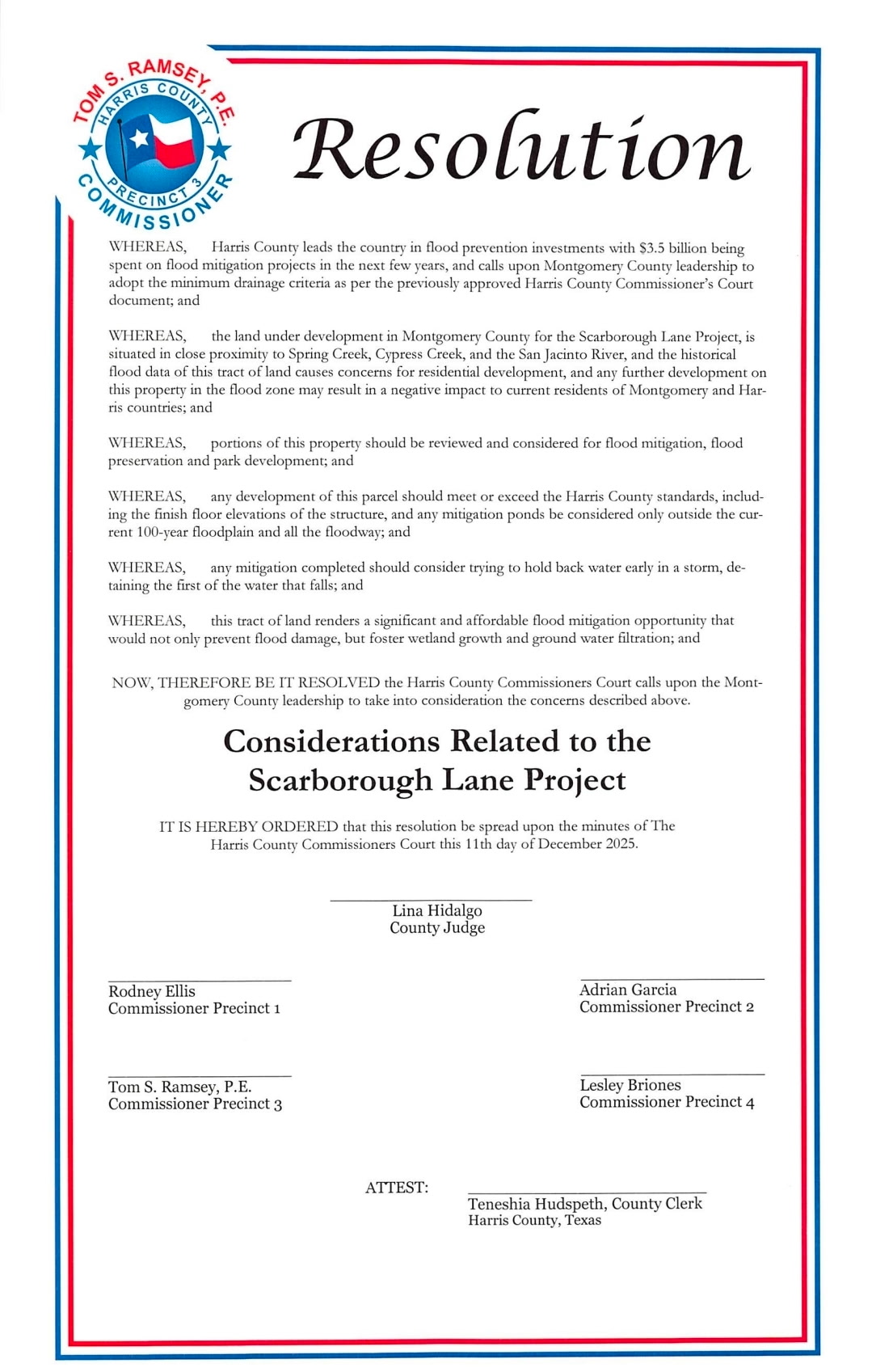
12/13/25 – On 12/11/25, Precinct 3 Commissioner Tom Ramsey, PE, introduced a resolution in Harris County Commissioners Court that urges Montgomery County (MoCo) to impose certain conditions on the proposed 5,300-acre Scarborough Development west of Kingwood. Harris County Flood Control tried to buy the property after Hurricane Harvey because they feared that if it got developed, “it would be like aiming a fire hose at Kingwood and Humble.” Ryko, the property owner at the time, quoted a price far over market value. So, the deal fell through. But those fears still exist.
While Harris County can’t force MoCo to do anything, the proposed conditions include:
Recognizing the extreme flood risk of development for current residents in both counties
Using portions of the property for flood mitigation and parks
Ensuring development meets or exceeds Harris County standards including:
Finished floor elevations
Placing mitigation ponds outside the 100-year floodplain and floodway
Fostering growth of wetlands and water filtration.
Scarborough bought most of the land you see in this picture between Spring Creek (l) and San Jacinto West Fork (r). Base flood elevation at the confluence is 25.1 feet above ground levelusing old, pre-Harvey flood maps.
Ramsey’s resolution is high-level; most resolutions are. But it makes good points. For instance, while MoCo’s new Drainage Criteria Manual is a vast improvement over their previous one, it still falls short of Harris County’s on several key criteria including finished floor elevations and placing fill in the 500-year floodplain. Those concerns are expressed in the text below.
Exact Text of Harris County Resolution
WHEREAS, Harris County leads the country in flood prevention investments with $3.5 billion being spent on flood mitigation projects in the next few years, and calls upon Montgomery County leadership to adopt the minimum drainage criteria as per the previously approved Harris County Commissioner’s Court document; and
WHEREAS, the land under development in Montgomery County for the Scarborough Lane Project, is situated in close proximity to Spring Creek, Cypress Creek, and the San Jacinto River, and the historical flood data of this tract of land causes concerns for residential development, and any further development on this property in the flood zone may result in a negative impact to current residents of Montgomery and Harris counties; and
WHEREAS, portions of this property should be reviewed and considered for flood mitigation, flood preservation and park development; and
WHEREAS, any development of this parcel should meet or exceed the Harris County standards, including the finish floor elevations of the structure, and any mitigation ponds be considered only outside the current 100-year floodplain and all the floodway; and
WHEREAS, any mitigation completed should consider trying to hold back water early in a storm, detaining the first of the water that falls; and
WHEREAS, this tract of land renders a significant and affordable flood mitigation opportunity that would not only prevent flood damage, but foster wetland growth and ground water filtration; and
NOW, THEREFORE BE IT RESOLVED the Harris County Commissioners Court calls upon the Montgomery County leadership to take into consideration the concerns described above.
Considerations Related to the Scarborough Lane Project
IT IS HEREBY ORDERED that this resolution be spread upon the minutes of The Harris County Commissioners Court this 11th day of December 2025.
Ramsey’s Motion Passed Unanimously; Next Up CoH
County Judge Lina Hidalgo, Ramsey and all three other commissioners voted for Ramsey’s resolution. It passed 5-0.
Houston City Council will reportedly consider a similar resolution on Wednesday. District E Council Member Fred Flickinger says he is optimistic that he has the votes to get it approved.
Note that the City actually has a bigger stick in this fight because most of the land lies within the City limits or the City’s Extra Territorial Jurisdiction (ETJ). ETJ helps cities plan and regulate development in unincorporated areas near their borders, influencing growth before annexation.
On October 30, Scarborough and its engineers met with the City and Harris County to discuss their plans. At the time, they presented some high-level documents claiming that half the land would be preserved as green space. That’s certainly a step in the right direction. But is it enough? We will be in a better position to tell when we’ve reviewed their complete plans. And when Harris County Flood Control and FEMA release updated flood maps.
In the meantime, I’ll be watching to see what City Council does next Wednesday.
Posted by Bob Rehak on 12/13/25
3028 Days since Hurricane Harvey
The thoughts expressed in this post represent opinions on matters of public concern and safety. They are protected by the First Amendment of the US Constitution and the Anti-SLAPP Statute of the Great State of Texas.
https://i0.wp.com/reduceflooding.com/wp-content/uploads/2025/12/20251211-DJI_20251211085941_0651_D.jpg?fit=1100%2C619&ssl=16191100adminadmin2025-12-13 17:29:072025-12-13 20:14:54Harris County Passes Ramsey Resolution on Scarborough Development In MoCo