In tomorrow’s Harris County Commissioners’ Court meeting, county leaders will discuss, in executive session, the possibility of purchasing Woodridge Village land from Perry Homes. The idea: to build a large detention basin with sufficient capacity to keep Elm Grove from flooding again.
Then Elm Grove flooded twice in five months, on May 7th and September 19th, 2019. Approximately two hundred homes flooded in May. Two or three times that number flooded in September.
The flooding was not due to normal street flooding or overflow from Taylor Gully. Overland sheet flow from Woodridge Village caused it.
Clearcutting increased the amount and rate of runoff in both storms so that it accumulated at the county line culvert quickly and overflowed into Elm Grove streets.
Even that capacity is undersized by approximately 40% because Perry contractors used pre-Atlas 14 rainfall statistics in their computer modeling.
The water table is much higher than Perry anticipated. Their 15-foot deep detention basin is constantly about one-third filled with water, reducing detention capacity even more.
About a quarter to a third of the site was previously wetlands. Standing water there has not evaporated for months.
If Harris County doesn’t buy it and convert it into a detention basin, Elm Grove is likely to flood again.
The recurrent flooding and uncertainty have caused many families to flee the affected area already. Homes are selling for 50 cents on the dollar. Many homes remain vacant and rotting. Many who are left can’t afford to move.
It’s becoming a public-health and mental-health issue at this point. People are reluctant to repair their homes until they are certain of mitigation that has a chance to succeed.
Hints
Be positive. Harris County didn’t cause this problem.
Don’t flame. Honey attracts more bees than vinegar.
Don’t demand. They have many problems to solve.
Specify that this relates to Item IV on the agenda for 4/07/20. It relates to a request by Commissioner Cagle to discuss the purchase of real property in the Elm Grove area needed for flood control purposes.
Of the four other votes on the Court, Cagle needs commitments from two to make this happen. Steve Radack, Precinct 3 Commissioner; Lina Hidalgo, County Judge; and Adrian Garcia, Precinct 2 Commissioner are the most likely supporters.
951 Days after Hurricane Harvey and 200 since Imelda
https://i0.wp.com/reduceflooding.com/wp-content/uploads/2020/04/Harris-County-Logo.jpg?fit=800%2C800&ssl=1800800adminadmin2020-04-06 15:29:312020-04-06 15:43:51Last Chance to Ask County Leaders to Help Prevent Elm Grove Flooding
Harris County Precinct 4 Commissioner Jack Cagle has placed an item on next Tuesday’s Commissioners’ Court Meeting that will affect the future of Kingwood. It’s to discuss the possibility of Harris County Flood Control spending $10 million to buy the Perry Home’s Woodridge Village property. It contributed to flooding hundreds of homes in Elm Grove and North Kingwood Forest TWICE last year.
Where Will Two More Votes Come From?
Cagle needs at least two more votes on Commissioners Court in addition to his own to approve the effort. Reportedly, Judge Lina Hidalgo, Commissioner Adrian Garcia in Precinct 2 and Commissioner Steve Radack in Precinct 3 are the most “gettable.”
Here’s how you can help. Email or call these officials today. Urge them to support Cagle’s motion. Do it NOW. I’ve listed their contact info below.
At Stake: The Future of Kingwood
Ten flooded homes in a row, all vacated. Photo taken in North Kingwood Forest in December 2019. All homes back up to Woodridge Village.
Without help, Elm Grove and North Kingwood Forest could drag down the reputation of the entire Kingwood community.
Additional flooding could devastate remaining homeowners. Many were already struggling to pay repair bills from two floods. Now corona-virus layoffs make that even more difficult.
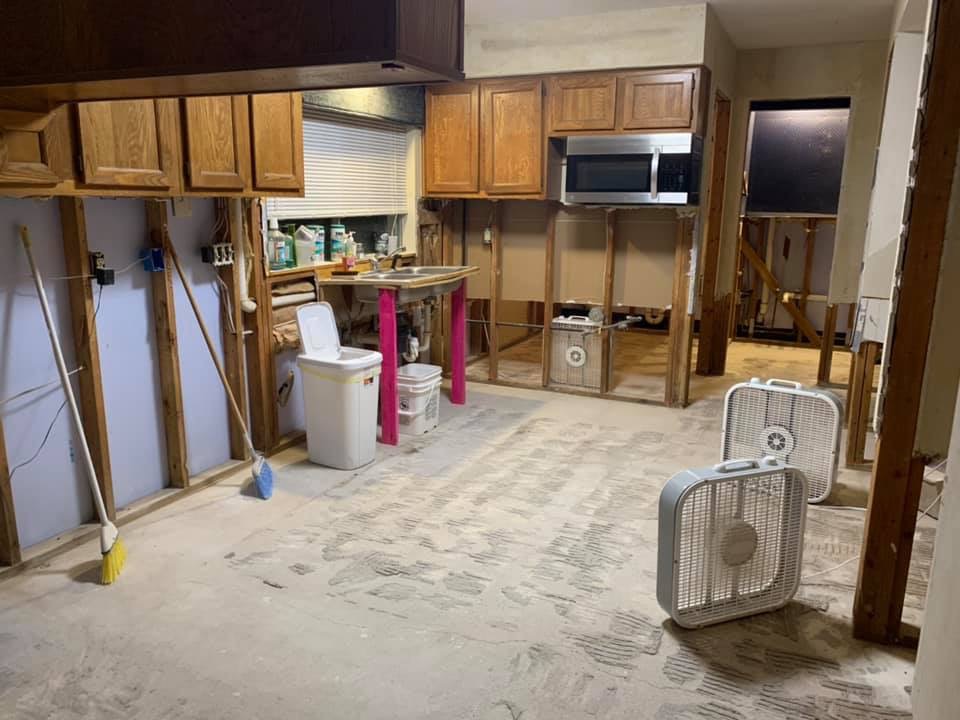
Elm Grove kitchen home five months after being flooded a second time.
These are working class neighborhoods. As much so as any in Harris County. People simply can’t afford to flood again.
Language in last year’s flood bond allows Harris County Flood Control District to buy property in neighboring counties for the purpose of building upstream detention. The lack of detention on Perry Homes’ property is the primary reason hundreds of homes in Kingwood flooded. Two years after clearing the property, Perry Homes still has constructed only 23% of the needed detention.
No Other Good Alternatives At This Time
Harris County Flood Control reportedly can start work on expanding detention capacity as soon as Commissioners reach a deal.
If they can’t, Perry has said it will sell Woodridge Village to another developer or continue to develop the property itself. However, if that happens, the detention ponds on the property would still likely be undersized by 40%. That’s because Perry Homes rushed to get their plans approved before the new, higher Atlas-14 rainfall standards went into effect.
Help Now! Here’s How
To contact Judge Hidalgo, Commissioner Garcia or Commissioner Radack:
Remind them that Harris County receives drainage from at least FIVE surrounding counties. This problem is a county-wide problem, not just a Precinct 4 problem.
Please call or write now if you live in the Kingwood, Huffman, Humble or Atascocita areas. Even if you did not flood, flooding from Woodridge Village affects you and your home value. No one in this area can afford to let this sore fester any longer.
Posted by Bob Rehak on 4/1/2020
946 Days after Hurricane Harveyand 195 since Imelda
https://i0.wp.com/reduceflooding.com/wp-content/uploads/2019/09/Elm-Grove-9.19_68.jpg?fit=1500%2C1000&ssl=110001500adminadmin2020-04-01 16:09:432020-04-01 18:46:07What You Can Do Right Now to Encourage HCFCD to Buy Woodridge Village Property
LJA’s drainage design forces floodwater to make six turns within the space of about 200 yards. The areas at the left and top of the frame flooded during May and September last year when water overflowed.
Hints of Defense Strategy
However, in answering the allegations, LJA’s lawyers did hint at their defense strategy. In addition to their general denial, they claim that:
Plaintiffs’ damages were solely caused by the negligence of third parties over whom LJA has no control.
Plaintiffs did not hire LJA and therefore LJA owed no duty to the plaintiffs.
Intervening and superseding conduct on the part of third parties or other parties, persons or entities, acts as a total bar to plaintiffs’ claims.
The incident in question was an Act of God.
Here is their entire answer to the plaintiffs’ claims. LJA’s lawyers filed it with the Harris County District Clerk on 3/16/2020.
Opinions of Claims
Third parties in the case include several contractors, AND Figure Four Partners, a Perry Homes’ subsidiary of another subsidiary. Engineers, in my experience, often blame problems on contractors that didn’t follow plans. In this case, according to the drainage impact analysis submitted by LJA to Montgomery County, contractor(s) should have cleared only 30 acres on the northern portion of the site and 58 acres on the southern portion during Phase 1. See page 1, paragraph 2 of LJA’s Drainage Impact Analysis. However, Google Earth shows that about half of the 182-acre northern section and all of the 86-acre southern section were cleared by February 23, 2019. That was six weeks before the May 7th flood. Images taken of the northern portion of the site shortly after the May 7th flood show it was virtually clear except for piles of uprooted trees. Helicopter images show that substantially all of the northern section was cleared about the time of the Imelda flood. Construction documents also show that an engineer should have been supervising construction.
I’m not sure what they mean by “intervening” conduct. It sounds like interference from above. Hmmmm. Could they be pointing a finger at Perry Homes’ Figure Four Partners or Perry Homes itself? It will be interesting to see what happens with this one.
The District Clerk’s website shows no other activity on the case since LJA filed this document. Harris County Civil Courts will operate on a restricted schedule until further notice due to the corona virus. Hours of operation are from 7 a.m. to 6 p.m. Monday through Thursday. They are closed Friday through Sunday.
Judge Lauren Reeder months ago set a trial date of 7/13/2020, at 08:30 a.m. However, the corona virus could delay the start of any trial in this case.
New Discovery in MoCo Drainage Criteria Manual
In the meantime, I discovered one other interesting potential violation of the Montgomery County Drainage Criteria Manual. Section 9.1.2 Flood Plain Development Guidelines and Procedures says that when planning a development within the 100-year flood plain, construction within the floodway is limited to structures which will not obstruct the 100-year flood flowunless fully offsetting conveyance capacity is provided.
“Where such a potential exists, offsetting conveyance capacity must be provided to eliminate the increased potential for flood damage.”
The potential violation? The twin culverts shown in the photo above. They were built when only one of five detention ponds was even partially complete. And they’re right at the county line. LJA’s own maps show these culverts to be within feet of the Taylor Gully floodway and floodplain on the Harris County side of the county line.
If LJA intends to argue that May 7th or September 19th were greater-than-100-year rains, it then seems to me that they should have halted construction of the culverts until fully offsetting detention was in place. To this date, only 23% of the intended detention capacity has been constructed.
Posted by Bob Rehak on 3/28/2020
942 Days since Hurricane Harvey and 191 since Imelda
The thoughts expressed in this post represent opinions on matters of public concern and safety. They are protected by the First Amendment of the US Constitution and the Anti-SLAPP Statute of the Great State of Texas.
https://i0.wp.com/reduceflooding.com/wp-content/uploads/2020/03/20200306-RJR_0183.jpg?fit=1200%2C800&ssl=18001200adminadmin2020-03-28 20:14:022020-03-28 21:41:46LJA Denies Responsibility for Elm Grove Flooding; Says They Owed No Duty to Victims
Mark Mooney, PE, the long-time Montgomery County Engineer whose office approved LJA plans for Woodridge Village and Artavia, and whose office oversaw LJA’s investigation of itself, has joined LJA Engineering as a “business development representative.” (Usually that means “sales.”)
A February 17, 2020, press release about Mr. Mooney’s appointment appears on LJA’s Facebook page. According to insiders, Mr. Mooney actually started working part time with LJA shortly after his retirement from MoCo. That happened after the May floods in 2019. However, the release now implies the relationship is full time. It appeared just days before LJA was named as an additional defendant in the Elm Grove flooding case. Below is the entire release verbatim:
MARK MOONEY, PE JOINS LJA AS BUSINESS DEVELOPMENT REPRESENTATIVE
After 34 years with Montgomery County, during which most of the time he served as the County Engineer, Mark Mooney, PE has joined LJA Engineering.
During his tenure, he had oversight of all major road initiatives through numerous bond elections; provided advice, direction, and consultation to 5 different County Judges and 17 different County Commissioners; oversaw the review and approval of over 3500 residential and commercial subdivision plats; oversaw the review, approval and inspection of over 1300 miles of road construction; and, provided daily services to a population that grew from 160,000 residents to over 600,000 residents in the 34-year span.
“I have known and respected Mark for many, many years. When the opportunity presented itself, I knew he was a perfect fit for LJA. We have four offices within Montgomery County and are personally and professionally vested in the growth and success of our employee-owners and clients there. Mark has dedicated his career to this community, and we want him to keep doing what he does best, serving Montgomery County,” said Jeff Cannon, Senior Vice President.
Mark was a Member of the City of Houston planning commission from February 1998 to May 2019. He is a Member of the Texas Association of County Engineers and Road Administrators (TACERA) since 1998; having served as President from 2005-2006, and he has been a Member of the National Association of County Engineers (NACE) since 1998.
Joining LJA, Mark explained, “It was the confidence that I felt between myself and Calvin Ladner (LJA President), that began when we were both a lot younger back in the mid-eighties, that sealed the deal. My responsibilities as the Montgomery County Engineer were made much easier by the honesty I had with Calvin initially and then with so many of the staff at LJA throughout the years. In my 34 years in this business, it always came down to trust as being the most important aspect as a public official. At LJA, I am ready to further develop my industry relationships utilizing the same playbook that worked for me for so many years as Montgomery County’s engineer.”
End of Release
Revolving Door Between Government and Business
[Rehak here again.] Before retirement, I frequently saw how the revolving door worked between government and business. I knew a man who went to Washington and worked for the EPA in a high level position “to get his ticket stamped.” Those were his words, not mine. After working in D.C. for several years, he returned to private industry where he made considerably more money, thanks to the insights he gave clients about how the EPA worked.
Personal connections provide knowledge of agency priorities; understanding of personal hot buttons; insights into procedures; and relationships with decision makers. They all prove valuable to companies whose sales depend on public-sector approval.
Fine Line Between Harmless and Harmful
There’s nothing illegal or immoral about this per se. On the innocent side, sometimes, if projects get bogged down, a call to an old friend can:
Move plans from the bottom of a pile to the top in an emergency.
Determine what the agency’s concerns about a set of plans might be so the concerns can be addressed quickly.
Speed up slow approval processes that run up costs.
Cases like these harm no one. They represent a form of social engineering or influence peddling that has been around as long as governments. However, what is normal and accepted in principle can sometimes turn sourin practice.
For instance, private-sector engineers/consultants might urge decision makers who are old friends on the government side to:
Rubber stamp questionable plans without looking too closely at them. (“Trust me.”)
Look only at the conclusion of a report without scrutinizing the assumptions, methodologies, underlying calculations and support.
Between these two extremes, between legal and illegal, infinite shades of gray exist.
Public’s Presumption of Oversight
Cases like those in the latter category can mislead the public and have devastating consequences. The public presumes the government is overseeing development (or at least the permitting of plans). In fact, government may not be. Those plans and stamps and dazzling arrays of figures may create the appearance of professional oversight when none exists.
Families may invest their life savings in homes based on the presumption of government oversight. Officials are supposed to ensure that there is no adverse downstream impact from a new development. But as we’ve seen in Elm Grove and elsewhere, that’s often not the case.
Bad Optics for Ethics
Exerting influence can sometimes cross moral, ethical and legal lines. I’m not saying it happened with Mr. Mooney. I have no evidence to even lead me to suspect such a thing. By all accounts, Mr. Mooney is honest and reputable.
Apparent Conflict of Interest In Elm Grove Investigation
However, it was on Mr. Mooney’s watch as County Engineer that the TCEQ referred a complaint about Woodridge Village involving LJA to Montgomery County for investigation.
To inspire public confidence in the outcome of the investigation, you would think that LJA would have recused itself or the county engineer would have hired another company for this particular investigation. Neither thing happened.
Certifying No Need for Detention Ponds in 2,200-Acre Development
Mooney’s department also vetted the LJA Drainage Impact Analysis for Artavia. It certified no detention ponds were necessary for the 2,200 acre development because it would have no impact on the West Fork San Jacinto. However, the report did not examine the impact on:
Surrounding homes whose drainage has been blocked
The impact on downstream flooding, i.e., loading Lake Houston before floodwaters arrive.
Approving Dead-End Drainage
Artavia’s Drainage Ditch stops before reaching the San Jacinto West Fork. The company hopes to work out some environmental and drainage easement issues that would allow the ditch to cross the LMI mine in the background.
LMI also blames Artavia’s alleged overflow for flooding a deep pit where they are doing dry mining. A large part of the pit remains flooded; disrupting LMI’s normal operations, according to a company spokesperson. (More on this in a future post.)
Supposedly dry pit that LMI says was flooded by Artavia drainage ditch overflow.
Meanwhile, Artavia is building homes and the developments drainage ditch still does not reach the river.
Certifying “No Adverse Impact” for Woodridge Village Right Before 400 Homes Flood
Under Mooney’s watch, county engineers certified that LJA plans would have no adverse impact on Elm Grove…right before 400 homes in Elm Grove flooded.
MoCo Engineers office certified “No adverse impact” for Elm Grove where hundreds of homes flooded twice in five months last year.
Accepting Job With LJA Right Before LJA Sued by Flooded Elm Grove Residents
The optics of these incidents sure don’t inspire trust and confidence in LJA, Mr. Mooney, or Montgomery County developers. In future posts I will dig into more of the details behind these incidents.
Calls to LJA’s project manager for Artavia went unanswered for days before this post. If LJA wishes to submit a response to this post, I will publish it verbatim.
Posted by Bob Rehak on 3/19/2020
934 Days after Hurricane Harvey
The thoughts expressed in this post represent opinions on matters of public concern and safety. They are protected by the First Amendment of the US Constitution and the Anti-SLAPP Statute of the Great State of Texas.
https://i0.wp.com/reduceflooding.com/wp-content/uploads/2019/05/Rescue-Truck-1.jpg?fit=1500%2C729&ssl=17291500adminadmin2020-03-19 21:02:222020-03-19 21:45:08Right Before LJA Sued, LJA Employs County Engineer Who Approved LJA Plans
Today, the U.S. Army Corps of Engineers released the findings of its investigation into the wetlands on Perry Homes’ Woodridge Village property. The Corps said that the wetlands do NOT fall under its jurisdiction. Therefore, there was no violation of Section 404 of the Clean Water Act when Perry wiped out wetlands without first seeking the Corps’ permission.
Congressman Dan Crenshaw’s office released this text of an email the Corps sent to them today.
Text of Corps Email to Congressman Crenshaw
“This e-mail is in response to your request (on the behalf of Congressman Crenshaw) to be updated on our investigation into activities on the Figure Four properties located in Porter, Montgomery County, Texas. (Investigation file SWG-2019-00745).” [Editor’s note: Figure Four is the development arm of Perry Homes.]
“As discussed on the phone earlier today, the Corps of Engineers has finalized our investigation into this matter and did NOT find a violation of Section 404 of the Clean Water Act (Section 404).”
“We did confirm the presence of uplands and wetlands on the tract. Some of the wetlands had fill material placed into them. Based on the facts associated with this specific location and per federal regulation these wetlands were determined to “isolated.” They lacked any known nexus to interstate commerce. As such, they are not “waters of the United States” and are not subject to federal jurisdiction under Section 404. In accordance with federal regulation the jurisdictional status (determination) of these wetlands was coordinated with the Environmental Protection Agency prior to finalizing.”
“The property owner has been notified of the federal government’s findings and the investigation closed.”
Wetlands Question Now Moot from Legal Point of View
Normally, in cases where a question exists, developers consult the Corps before destroying the wetlands. When I asked the Corps last August whether Perry had sought a “jurisdictional determination,” the Corps answered that Perry had not.
Perry later claimed that it had hired a private consultant to determine whether the wetlands were jurisdictional. However, to my knowledge, Perry never publicly released the results of the survey. Today’s ruling by the Corps makes that whole controversy moot.
Regardless of the Corps’ rulings on the jurisdictional question, the fact remains that the Corps found wetlands on the property and they found Perry Homes had attempted to fill them in.
Wetlands Question Still Explosive from Business Point of View
Let’s see how well that worked out for Perry and its subsidiaries.
The land has become a toxic asset that will scare potential buyers.
If Perry Homes tries to build on the land after all the publicity surrounding this case, any homeowner whose foundation cracks would have a ready-made court case.
Woodridge Village “wetlands” on March 6, 2020. Water has ponded there for months.
This land appears to be unsafe, unstable, unbuildable, unsaleable, and a menace to downstream homeowners in its current state.
Plaintiff’s Engineer Points to High Hurdles for Perry to Clear
Seriously underestimated the amount of runoff from this property.
Used outdated rainfall statistics that led to underestimating the amount of detention capacity needed.
Constructed the overflow spillway between Taylor Gulley and detention pond S2 at a height that would cause North Kingwood Forest to flood.
When You’re In a Hole, Stop Digging. Literally.
It may be possible to fix some of these problems. But at what cost? Will the development ultimately be economic when residential lots are used to increase the size of detention ponds?
How Perry Could Exit Without a Loss, Mitigate Flooding, Limit Long-Term Liability
A Houston Chronicle article quotes Houston Mayor Pro Tem Dave Martin as saying that Perry quoted a price for the land that covered their acquisition cost PLUS the labor they have into it. That led Harris County to ask CoH to share the cost.
When CoH refused, Perry dropped the price to $14 million (the alleged purchase price) from $23 million, according to Community Impact newspaper. The Montgomery County Appraisal District values the land at only a little more than $1 million.
It will be very hard for Perry to sell the land and even harder to develop it. So why doesn’t Perry just donate the land to Harris County Flood Control to help them mitigate flooding?
According to a national real estate tax expert that I talked to, Perry could then write off the value of the land PLUS the value of the labor they have in it. For a billion dollar company, the tax deduction could easily EQUAL or come close to the price they are currently asking for the land.
It would also:
Give Perry a chance to recoup some shred of its once proud image.
Let Harris County Flood Control move forward quickly with a detention project that could truly mitigate flooding.
Help protect Perry from additional future flooding claims.
Posted by Bob Rehak on 5/10/2020
924 Days since Hurricane Harvey and 173 since Imelda
The thoughts expressed in this post represent opinions on matters of public concern and safety. They are protected by the First Amendment of the US Constitution and the Anti-SLAPP Statute of the Great State of Texas.
https://i0.wp.com/reduceflooding.com/wp-content/uploads/2020/03/20200306-RJR_0101.jpg?fit=1200%2C592&ssl=15921200adminadmin2020-03-10 17:59:432020-03-11 06:45:57Army Corps Finds Wetlands on Perry Homes Woodridge Village Property Did Not Fall Under Corps’ Jurisdiction; What Next?
Fourteen documents filed with the Harris County District Clerk’s office on February 27, 2020, lay out the case of plaintiffs in the Elm Grove flooding case against LJA Engineering, Inc. Lawyers for the plaintiffs named LJA as an additional defendant in their most recent amended petition. Other defendants include Perry Homes’ subsidiaries and contractors: Figure Four Partners, LTD.; PSWA, Inc.; Rebel Contractors, Inc. (which recently changed its name); Double Oak Construction Inc.; and Texasite LLC.
Accusations Specific to LJA
The amended petition alleges LJA:
a. Failed to follow the correct drainage guidelines in Montgomery County;
b. Failed to provide adequate drainage in the Development;
c. Failed to adequately model the Development;
d. Failed to adequately report the modeling;
e. Removed drainage channels;
f. Caused post-development discharges and water surface elevation to increase downstream of the Development;
g. Failed to design detention ponds with adequate capabilities for rain events;
h. Failed to use the correct hydrology method;
i. Failed to design emergency overflows for the detention ponds;
j. Failed to notify the Developer Defendants and Contractor Defendants of the importance of the existing levee; and,
k. May be liable in other ways described in the consulting engineer’s report.
Consulting Engineer Says LJA Used Outdated Drainage Criteria Manual
The defendants’ consulting engineer, L. David Givler, MSCE, PE, provides the details that back up these claims. Givler is president of Givler Engineering, Inc. Givler’s firm is licensed in Texas to design drainage projects similar to Woodridge Village, which was designed by LJA. A “Certificate of Merit” filed with the court states Givler’s credentials and conclusions. Givler also provides thirteen more exhibits as part of his affidavit. (See links at bottom of post.)
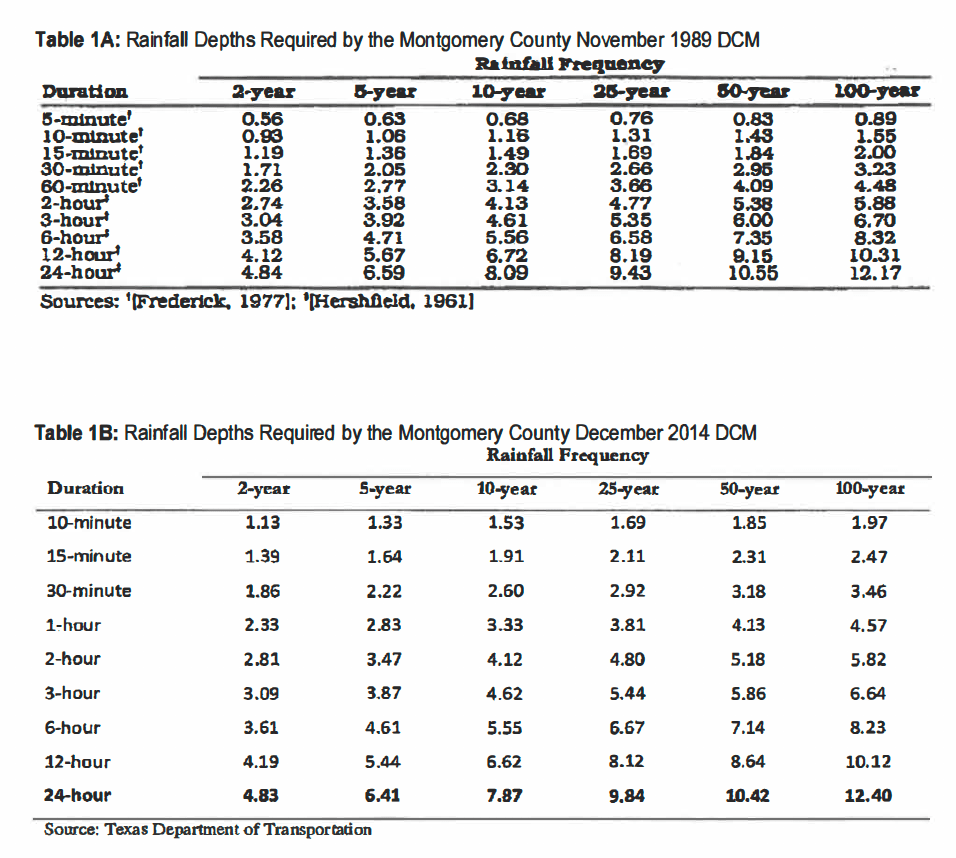
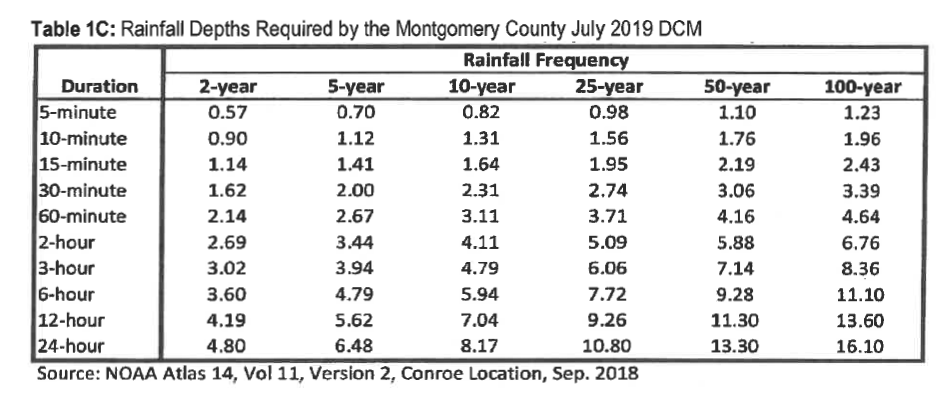
Perhaps Givler’s most explosive finding: LJA based all of its conclusions on an outdated version of the Montgomery County Drainage Criteria Manual (DCM) developed in 1989. MoCo has since updated its DCM twice – in December 2014 and July 2019. Givler asserts that LJA should have used the 2014 version when it submitted its drainage analysis in 2018. The rainfall that MoCo requires engineering firms to design detention basins for have increased since 1989 (see below).
Givler asserts that the increases, along with other other errors and omissions outlined below critically skew modeling results. Ponds that might not overflow based on the 1989 rainfall depths do overflow with 2014 and 2019 rainfall statistics.
Critical Levee Removed, But LJA Did Not Model Effect of That
Givler says in his testimony that grading associated with the construction project removed a levee that had been constructed along the south side of Taylor Gully. “Prior to being removed, the levee had successfully protected the Elm Grove Village Subdivision from flooding,” said Givler. “However, removal of the levee increased the probability for Taylor Gully to overflow southward and to flood the Elm Grove Village Subdivision.”
Givler asserts that the levee successfully protected Elm Grove from flooding in previous extreme events such as Hurricane Harvey, which he characterized as a 330-year storm.
LJA Did Not Use MoCo’s Recommended Method For Modeling Runoff
Mr. Givler also found that LJA did not use Montgomery County’s recommended method for modeling runoff. LJA used something called the Clark’s Unit Hydrograph Method instead of the NRCS Hydrograph Method specified in the 2014 version of the County’s Drainage Criteria Manual. The latter shows significantly higher peak runoff rates, according to Givler. “LJA’s selection of an alternative method (The Clark Method) caused the underestimation of peak runoff rates,” said Givler. “LJA also used low, outdated rainfall depths in its model, which exacerbated the underestimating of the peak runoff rates.”
Givler modeled whether LJA’s designs for the Woodridge Detention Ponds would have successfully held the runoff from the updated drainage criteria manual.
He found that the design for the ponds was “inadequate.” They overflowed. Significantly, Givler also found that LJA underestimated the volume of runoff sent downstream to Taylor Gully.
After May, Protection Not Implemented Against September Storm
“Even after the May 2019 flood, adequate measures had not been implemented to restore the pre-development level of protection or to prevent a recurrence,” said Givler. “Under Woodrige Village pre-development conditions, the Elm Grove Village subdivision was safe from flooding during the 330-year Hurricane Harvey rainfall. However, under construction conditions at Woodrige Village, Elm Grove Village was vulnerable to flooding in the 19-year and 92-year rainfall events.”
LJA Did Not Model Effect of Overflow Channel
Givler also noted that LJA’s plan claimed that the 100-year peak stage for the S2 detention pond would be 73.21. That would be high enough to cause water to backup into the grass-lined channel (bottom elevation 68.50) located at the northeast corner of the pond. “Since the highest adjoining ground elevation south and east of the grass-lined channel is approximately 72,” said Givler, “the peak 100-year stage would discharge to Taylor Gully downstream of the project and to the neighborhood east of pond S-2 [North Kingwood Forest]. Such discharges would increase flooding to the residential lots to the east…”
Figure 4 from Page 12 of Givler’s affidavit shows 100-year runoff overflowing Pond S-2 through the Grass-Lined Channel.The grass-lined overflow spillway in the center of this photo is designed to funnel water from Taylor Gulley into the kite-shaped detention pond (S2) if the concrete channel overflows. But Givler says LJA did not model the opposite. In May and September 2019, water flowed from the gulley into the homes at the bottom left of the frame, as well as homes opposite them on the far side of the gully.
Emergency Overflow System Not Provided
Another problem that Givler found: Section 7.3.13 of the Montgomery County Drainage Criteria Manual (2014 version) requires an emergency overflow system shall be provided “…designed to carry the 100-year allowable detention basin discharge at full-bank conditions… The emergency overflow system shall direct flows into an outfall channel and prevent flow in the direction of developed areas.” (as quoted by Givler).
Even today, the project does not include such an overflow system.
Runoff During Construction More Severe than Ultimate Buildout Conditions
Givler modeled actual construction conditions after the May storm. He found that “…with the project site cleared and stripped of vegetation, runoff conditions were more severe than even the ultimate buildout condition. LJA’s analysis does not address this condition,” he says. His analysis showed that under construction conditions, LJA’s partially-constructed detention ponds were inadequate, unable to contain the May 2019 runoff and the 100-year runoff.”
The temporary construction conditions he says, “caused the ponds to overflow and to discharge runoff to the Elm Grove Village subdivision at a peak rate of approximately 2,110 cubic feet per second.”
Water running through North Kingwood Forest into Elm Grove (background) during Imelda as Keith Stewart evacuates his family.
“LJA Failed to Act as a Reasonably Prudent Engineering Firm”
In his conclusions, Givler alleges that “LJA failed to act as a reasonably prudent engineering firm.” He added, “…three professional engineers and the engineering firm were negligent in the provision of professional services that they rendered, and they committed various actions, errors, or omissions in providing professional services by violating standards required by Montgomery County.”
In Givler’s opinion, LJA failed to comply with Montgomery County standards by:
a. Using an alternate (Clark) hydrology method rather than the NRCS method recommended by Montgomery County, resulting in the underestimation of the amount of runoff that the watershed would discharge to the detention ponds.
b. Using rainfall depths in the hydrology models which are smaller than what was required by the applicable county standard (2014 DCM) and that are much smaller than recently adopted values (2019 DCM).
c. Designing detention ponds, which are too small to contain and too small to detain or attenuate the 100-year design flood.
d. Failing to design adequate freeboard for the detention ponds.
e. Failing to design adequate emergency overflows for the detention ponds.
f. Designing a project, which diverts runoff to properties of others in a harmful and detrimental manner.
g. Allowing peak runoff discharges downstream of the project to increase due to the impact of the project and due to the limited effectiveness of the detention ponds.
h. Allowing water surface elevations downstream of the project to increase due to the impact of the project and due to the limited effectiveness of the detention ponds.
i. Erroneously representing that the project had no impact on downstream areas.
j. Failing to notify the contractor of the importance of the existing levee.
k. Failing to guide the contractor in a logical construction sequence that would reduce the flood risk during construction.
Violation of Professional Standards and Ethics Also Alleged
Mr. Givler also alleges that LJA and three of its employees violated standards established by the State of Texas and the Texas Board of Professional Engineers in the Texas Engineering Practice Act. “This negligence caused and/or contributed to the endangerment of lives, health, safety, property and welfare of hundreds of people near the project,” he says. They did this, he asserts, “by issuing misleading reports, which failed to indicate the increase in flood potential.”
Questions Remain
“I recognize that additional documents may be produced,” said Givler, “which I will be asked to review and, therefore, reserve the right to add to or to modify this affidavit based on information that may be provided to me at a later time.”
Except for general denials, neither LJA, nor any of the other defendants in this case have responded publicly yet to Givler’s specific allegations.
When LJA and the other defendants make their positions public, I shall review them and give them “equal time.”
The big questions I have at this time are:
Why would a firm with LJA’s substantial reputation make the blunders that Givler asserts? Were they pressured into producing a favorable report that made the economics of the project “work”?
Five previous developers owned this land and, after studying it, decided not to develop it. That certainly should have raised red flags for LJA and Perry, and caused them to review this closely. There must have been scuttlebutt circulating among local professionals. One engineer I consulted said Friendswood walked away from this property decades ago because it would have been too hard to develop. However, Perry decided to move forward based on dubious studies and incomplete data. Why?
Check out the original text of Mr. Givler’s affidavit and exhibits for yourself to ensure I summarized them fairly. His affidavit includes his findings, professional opinions, conclusions and Exhibit 1, his resume.
Exhibit 2 includes the list of documents Givler reviewed in developing his affidavit.
Exhibit 3 includes topographic mapping for construction and pre-construction conditions.
Exhibit 4 includes a topographic map showing the location of the former levee.
Exhibit 5 includes the approval letter by Montgomery County.
Exhibit 6 includes the rainfall values used by LJA.
Exhibit 8 includes reported locations of flooded properties.
Exhibit 9 includes the drainage impact analysis submitted by LJA on March 26, of 2018.
Exhibit 10 includes the drainage impact analysis submitted by LJA on August 28, of 2018.
Exhibit 11 includes Givler’s hydrology model for pre-development conditions.
Exhibit 12 includes Givler’s hydrology model for construction conditions.
Exhibit 13 includes Givler’s hydrology model for post-development conditions.
Exhibit 14 includes LJA’s design for detention pond S2, the one north of Village Springs.
Posted by Bob Rehak on March 8, 2020 based on testimony from David Givler PE
922 Days since Hurricane Harvey and 171 since Imelda
The thoughts expressed in this post represent opinions on matters of public concern and safety. They are protected by the First Amendment of the US Constitution and the Anti-SLAPP Statute of the Great State of Texas.
https://i0.wp.com/reduceflooding.com/wp-content/uploads/2019/10/Stewart-Evac-9.19.19-e1619020734162.jpg?fit=999%2C739&ssl=1739999adminadmin2020-03-08 14:18:022020-03-08 14:18:22Plaintiffs’ Engineer Alleges LJA Issued Misleading Studies, Followed Wrong Guidelines in Elm Grove Flooding Case
The land in Woodridge Village naturally slopes from north to south and west to east. That means it forms a funnel pointed at Taylor Gulley in the southeast portion of the development. During heavy rains, as we saw last May and September, that funnel turns into a water cannon aimed at Elm Grove and North Kingwood Forest. These new aerial photos show where the water is aimed.
Looking toward southeast, you can see how all the land in Woodridge Village slopes toward the far corner.North Kingwood Forest is the group of houses you can see in front of the water tower. Elm Grove is behind those and also the far tree line right of those.
When the land above was wooded and populated only by forest and wetlands, water percolated through the area slowly. Now that the Perry Homes’ gang clearcut the entire 268 acres, water shoots through it like the barrel of a water cannon.
“What Happens If We Cross The Streams?”
LJA Engineers designed the drainage for this development so that virtually all water would converge in the kite-shaped detention pond below before flowing into Taylor Gulley.
Looking west from the southeastern corner of Woodridge Village. North Kingwood Forest is at the bottom of the frame and Elm Grove is tucked into the trees in the upper left and beyond. Virtually all water from the development flows to the pond in the center of this photo. Then it flows through the twin culverts into Taylor Gully on the left.
When the pond fills and water starts to back up, channel starts flowing through the backwards of the homes at the bottom of the photo above.
Looking southwest. Water flows from top to bottom and right to left. Water from Taylor Gulley, the channel that forms a V above, must either squeak through a 3 foot pipe at the end of the concrete section on the left, or make a double U-turn into the detention pond and then back into the gulley on the left.That’s like forcing traffic make a U turn in the center of a busy intersection.
Egon: Don’t cross the streams. Peter: Why? Egon: It would be bad. Peter: I’m fuzzy on the whole good/bad thing. What do you mean “bad”? Egon: Try to imagine all life as you know it stopping instantaneously and every molecule in your body exploding at the speed of light. Raymond: Total protonic reversal. Peter: That’s bad. Okay. Alright, important safety tip, thanks Egon.
Obviously, the LJA Engineers who designed this drainage either didn’t see the movie or didn’t take it seriously.
Dumping Overflow into Surrounding Streets and Homes
In the photo below, you can see where the water goes when the streams cross during heavy rains. The pond and the stream (Taylor Gulley) leading to it become water cannons when they overflow. Water shoots into the homes in North Kingwood Forest (right). It also shoots down the streets of Elm Grove (bottom left).
Looking north up Village Springs Drive toward Woodridge Village. Virtually all water from the development converges in the kite-shaped detention pond. During floods, overflows shoots down Village Springs or into North Kingwood Forest (right).
Below are links to two videos that show water overflowing from the detention pond into Village Springs Drive and the homes there.
Of course, part of the problem with crossing these streams is that Perry Homes still has only installed 23% of the detention. There’s just no way that 23% can do the job of 100%. The rest of that water has to go somewhere else. Like living rooms, kitchens, and bedrooms.
Posted by Bob Rehak on 3/7/2020 with thanks to Dan Aykroyd, Harold Ramis, Alyssa Harris and Edy Cogdill
921 Days since Hurricane Harvey and 170 since Imelda
The thoughts expressed in this post represent opinions on matters of public concern and safety. They are protected by the First Amendment of the US Constitution and the Anti-SLAPP Statute of the Great State of Texas.
https://i0.wp.com/reduceflooding.com/wp-content/uploads/2020/03/20200306-RJR_0180.jpg?fit=1200%2C800&ssl=18001200adminadmin2020-03-07 16:48:322020-03-07 16:48:42Staring Down the Barrel of a 268-Acre Water Cannon
Court documents filed with the Harris County District Clerk show that the tempo of the Elm Grove lawsuits against Perry Homes, its subsidiaries and contractors is increasing. Litigants have filed 20 new documents in the last three weeks. The judge has set a trial date for July 13, 2020. That’s about three months from now.
Plaintiffs allege that LJA, when designing the drainage for Woodridge Village, used an outdated Montgomery County Drainage Criteria Manual. LJA went by the 1989 version when an updated 2014 version existed. Since then, MoCo has revised the documents yet again. A 2019 version now exists that took effect before Imelda last year. (Note: the link above leads to the updated manual, however, MoCo did not update the date on the cover page. So this gets very confusing.)
List of Charges Expands
Plaintiffs’ lawyers have added negligent retention and negligent supervision to the list of charges. They now accuse defendants of:
a. Removing drainage from the Development;
b. Removing a levee from the Development site;
c. Blocking the drainage channels;
d. Filling in existing drainage channels;
e. Failing to properly install box culverts;
f. Failing to create temporary drainage channels;
g. Failing to allow adequate drainage after construction;
h. Failing to install silt barriers;
i. Allowing the Development to force rainfall toward Plaintiffs’ homes;
j. Failing to pay proper attention
Plaintiffs argue that “the Contractor Defendants had actual, subjective awareness of the risk involved, but nevertheless proceeded with conscious indifference to the rights, safety, or welfare of others.”
The streets of Elm Grove are still littered with trash from reconstruction of their homes after Imelda – the second flood in 2019.This image was taken on Village Springs in Februaryof 2020.
Accusations Specific to LJA
The amended petition also lists charges specific to LJA.
a. Failing to follow the correct drainage guidelines in Montgomery County;
b. Failing to provide adequate drainage in the Development;
c. Failing to adequately model the Development;
d. Failing to adequately report the modeling;
e. Removing drainage channels;
f. Causing post-development discharges and water surface elevation to increase downstream of the Development;
g. Failing to design detention ponds with adequate capabilities for rain events;
h. Failing to use the correct hydrology method;
i. Failing to design emergency overflows for the detention ponds;
j. Failing to notify the Developer Defendants and Contractor Defendants of the importance of the existing levee; and,
k. Other ways described the consulting engineer’s report.
Plaintiffs Seek Exemplary Damages and Mandatory Injunction
The plaintiffs now seek exemplary damages and a mandatory injunction that forces defendants to return the property to its prior condition, wherein the surface water runoff properly flows into the drainage ditch.
Defendants also filed the reports of two expert witnesses: an engineer from Pennsylvania, who examined LJA’s performance, and another expert, who will testify about the magnitude of rainfalls on May 7th and September 19th. More on those in a future post.
No Response Yet from Defendants to Specific Charges
We still have yet to see the defendants’ specific responses to any of these charges except for the general denials they made last year.
Posted by Bob Rehak on 3/6/2020
920 Days after Hurricane Harvey and 169 since Imelda
https://i0.wp.com/reduceflooding.com/wp-content/uploads/2020/02/20200125-RJR_7513.jpg?fit=1200%2C800&ssl=18001200adminadmin2020-03-06 17:46:012020-03-08 09:39:48Elm Grove Lawsuits: New Defendant, New Charges, Amended Petition and More
Three generations of the Giles family live together under the same roof in Elm Grove. Jerry Happ, Catrina Giles father, and Evonne Happ, plus Catrina’s children CJ, Dallas and Maverick. They had never flooded, not even in Harvey, until Perry Homes clear-cut 268 acres a block north of them without installing promised detention ponds. Then on May 7th and September 19th of 2019, they flooded twice. This is the story of how those floods affected a family and tore a neighborhood apart. As I drive up to their home on Shady Garden Drive for the interview, the first thing I noticed is that the foundation of their home is raised well above street level. In fact, it appears to be level with the top of my Chevy Tahoe. This is not an isolated case of a low-lying home.
Water Flows Down Street from Direction of Woodridge Village
Rehak: You said you wanted to make sure that Perry Homes knew about the damage that they inflicted on your community. Tell me what happened on May 7. Let’s start there. Where was the water coming from?
View from Giles front porch during Imelda
CJ (Catrina’s Oldest Son): It started off in the garage and my grandparents’ bedroom, which are on the north side of the house. Then it came in the back door and under the kitchen cabinets. And then it was just everywhere.
Rehak: It came in from the north? (The direction of Perry Homes’ development)
CJ: Yes.
Rehak: How high did it eventually get?
C. Giles: (Pointing to an electrical plug) Just under the outlets.
Gasoline, Paint, Paint Thinner Mixed with Floodwaters
Rehak: Tell me about the damage it caused.
CJ: We had a lot of personal items in boxes in the garage. It completely destroyed everything under two feet. All our tools got really messed up. There were a lot of things floating around in the garage. Paint. Gasoline. Paint thinner was mixed in with the water. So, it was a pretty big mess.
J. Happ: It came in, like CJ said, from the north. We had a bedroom set downstairs here…
E. Happ: My sister gave it to us before she passed away. Now it’s gone.
Current Felt Inside the House
J. Happ: The water was so powerful! The pressure of the water was so intense that it caused boxes underneath the bed to move around.
E. Happ: It broke my grandmother’s dishes that we stored under there!
CJ: We had an entire tote filled with family pictures. The lid popped off from hitting the sides so hard. The pictures are all gone now.
Family Heirlooms Destroyed
Rehak: You talked about your grandmother’s china. How old would that have been?
E. Happ: I’m 62. (pausing to calculate then giving up) It was old. They don’t make that kind of crystal anymore.
J. Happ: It was very old. Maybe late 1800’s.
E. Happ: And my bedroom furniture. I mean, no amount of money could ever replace that.
J. Happ: So, it was very devastating. A lot of personal items were in that room, and in the garage being stored at the time. They’re all gone now.
Rehak: I’m curious. You say the water pressure moved things around. It almost sounds like there was a current.
J. Happ: Oh, absolutely. Yes.
C. Giles: Everything in the lower cabinets was all destroyed.
It wasn’t, you know, water just coming in and oozing up. There was a current. Stuff was moving, even inside the cabinets.
Catrina Giles
Swing Set Picked Up by Flood and Moved
E. Happ: See that swing set back there by the big tree? The current picked it up and moved it against the shed.
Force of flood moved swing set and slide against shed (right)
J. Happ: When that water started coming in, we did the best we could. But we couldn’t move things fast enough. All of the furniture and appliances downstairs got damaged and had to be thrown out.
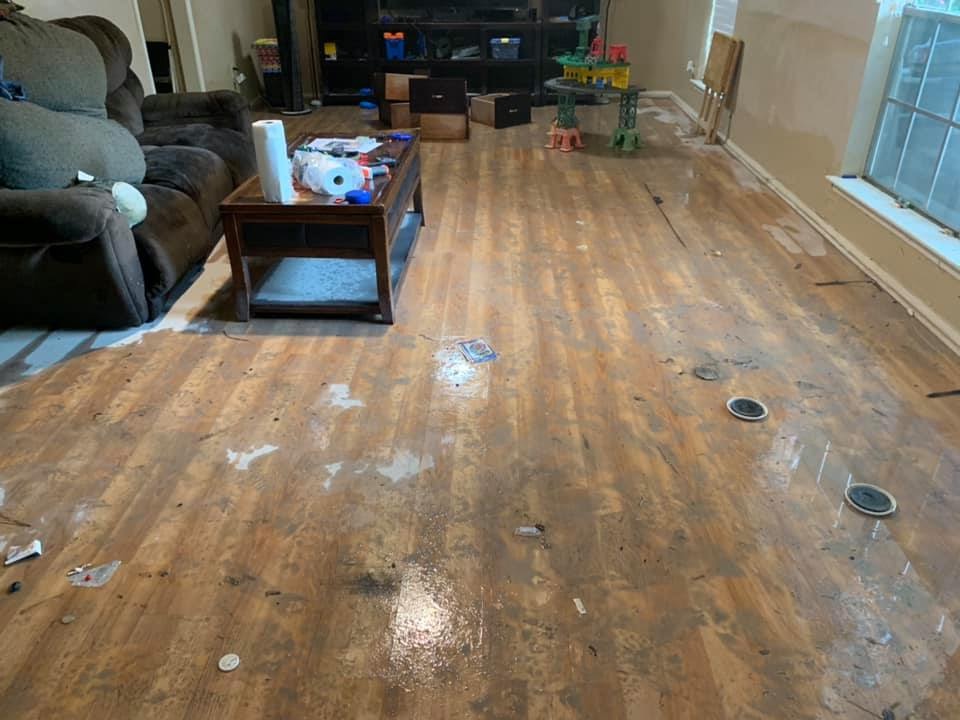
May flood took entire kitchen including appliances, plus washer/drier in utility room.
Refuse to Evacuate to Save Seven Animals
C. Giles: They asked us if we wanted to evacuate. Thank God we had the upstairs. Because they would only allow us to take one animal. And at the time we had seven.
We all have post traumatic stress now.
Evonne Happ
C. Giles: Yeah, It even affected our animals. They all lost weight. And two of them have died. One died shortly after the first flood from a snake bite. And the other just died from the stress. She had undergone her annual checkup, but her body just gave up at Christmas. We had to put her to sleep.
E. Happ: My dog’s scared to go out when it’s raining, even on the front porch. He used to sit on the front porch all the time with me. He won’t do it now if it’s raining, even if it’s just drizzling. He hides under the table. He’s scared of the rain because he KNOWS we’ll flood again. We. Could. Not. Control. Anything. And we got double the water the second time.
Second Flood Twice as Worse as First
J. Happ: Twenty-seven inches in the garage.
Rehak: You got about a foot of water in the May flood and double that in the second?
CJ: Twenty-two inches IN the house.
Rehak: Tell me about life BETWEEN the two floods.
C. Giles: It was very stressful because my husband was working in Pittsburgh for the first flood and Finland for the second. We are just trying to manage. Although we did have insurance for the house, we didn’t have it for the contents.
CJ: And we’re one of the few here with flood insurance to begin with.
“Just Not Comfortable Living Here Anymore”
C. Giles: Eventually we are going to hopefully try to sell. We’re just not comfortable living here anymore.
Rehak: And you had to pull out tile, cabinets?
J. Happ: Yes. We had to get two new sets of the cabinets, appliances, furniture, everythng. We were still paying on the first ones that were in the trash. When “Oh my God.” Yeah. “The second ones are apparently flooding.”
Effects on Family
Rehak: How did the rebuild affect you as a family?
J. Happ: We all lived upstairs in cramped quarters for the better part of a year. All our appliances were gone. We had no way to cook. So, we either had to eat out or bring it in.
We struggled as a family. It was a real hardship.
Jerry Happ, Catrina Giles father
All day long you have to listen to them hammer and saw. We had to go through all kinds of inspections for mildew. And before we could even get that, we had to get the driers, dehumidifiers and fans in here. We had that loud noise for, well, a month, before we could finally shut them down. There were a lot of different things going on at the time that caused a lot of real hardship.
C. Giles: That said, we basically have a brand-new home. We even have a new roof.
Rehak: How did the roof get involved?
C. Giles: In May, we had hail damage.
Rehak: Was Imelda just a repeat in September? Were you all still living upstairs and going through all the noise, construction and havoc?
Group: Yeah. Uh-huh.
Finished First Rebuild Two Weeks Before Second Flood
C. Giles: We had just finished our rebuild two weeks before Imelda.
Floodwater in Giles living room during Imelda. When family saw water coming up during second flood, they immediately started moving furniture upstairs.
Rehak: And you’re done now with the second rebuild?
C. Giles: We have the windows and doors that need to be replaced. The front door and the sliding glass doors must be taken out. And these windows, because the muddy water came through them.
When water receded, a thick layer of mud covered everything. So much sediment could only have come from one place: Woodridge Village.
Rehak: You’re considering selling the house?
Impact of Floods on Neighborhood
C. Giles: We know it’s NOT going to be a fast turnaround. Realtors said that we have to have several big storms and NOT flood for people to have confidence that this is going to be a safe neighborhood again. Meanwhile, the majority of our neighbors have already left.
Rehak: How many people on the block?
C. Giles: On our corner, we’ve lost all four families. It’s like a ghost town here. In the cul de sac, they’re all gone, too.
Picture of neighbors house. Water still had not receded well after dark
E. Happ: At least 20 families here are gone. I sit on the porch all day because I smoke, so I see things and keep count.
Rehak: How far down the block did homes flood?
C. Giles: On our street, only two or three houses didn’t get affected by the first flood, but everybody got affected in the second. It was more…devastating.
Home Values Under Water
J. Happ: The house across the street, around the corner, they finished remodeling the whole inside just before the May flood. And they were getting ready to sell it. The day before the flood, their realtor was going to put up a sign, but he decided to hold off. Then we had the flood. Well, they had the house up for $220,000. They only sold it for $115,000. They lost $100,000.
E. Happ: People in here had to just walk away from their homes.
Rehak: Really?
Group: Yeah. Yes.
E. Happ: Houses are still sitting there.
CJ: There’s a house…they never gutted it from the first flood. They just up and left.
Rehak: How is that affecting you? Are there squatters or animals moving in?
Crime Up
C. Giles: Well, crime has picked up. We have all kinds of homes being broken into now. I mean, people are still living in campers and stuff and their houses are getting broken into. It’s just sad.
E. Happ: Contractors have left their vehicles in the neighborhood overnight. They’ve got broken into and all their equipment stolen. Luckily, that has not happened to our contractors.
C. Giles: The thieves don’t realize or care that people still live here. They think we’re all gone.
Rehak: Where do you go from here?
Post Traumatic Stress and Spinning in Circles
C. Giles: We are just taking it one day at a time and finally finding some normalcy. But then, the other night when it rained, I just sat there, you know, praying, “Please watch over my house.” Even my little autistic one, Maverick, who drew the picture of the house crying, could not go to sleep till like midnight.
Picture of house crying, by seven-year-old autistic Maverick Giles. The black part is tears, says Maverick. He says it represents him missing his home.
CJ: None of us sleep.
E. Happ: Maverick was so nervous. All he could do when he came in the house was spin in circles.
That’s how Maverick dealt with the house being all topsy-turvy. He’d just spin in circles.
Evonne Happ
C. Giles: It would be hard to move now. People are losing money on their houses and we’re just not in a place where we can afford that. So, we’re just trying to hang in there.
From Left to Right: Jerry Happ, Evonne Happ, CJ and Catrina Giles in front of their home on Shady Gardens in Elm Grove, now almost restored a second time.
E. Happ: We’ve been living here for the past five years. We’re gonna be leaving in the summertime, probably by August. I’ll go back to South Carolina. I can deal with those damn hurricanes; you can get out of their way. This! It just happened so fast. Each time.
Long-Distance Help
Rehak (to Catrina): What does your husband do?
C. Giles: He’s a quality manager working on a large project in Finland now.
Rehak: So, you’re restoring all this by yourself without your husband’s help?
C. Giles: He helped coordinate the insurance, inspections and contractors, but for the rip-out and rebuilding of our home…he hasn’t been able to be a part of that because of his work.
Two Wrongs Don’t Make a Right
Rehak: What do you feel about Perry Homes at this point?
C. Giles: Well…there’s anger. They just really need to be held accountable for what happened.
J. Happ: These houses were built more than 35 years ago. They’ve gone through hurricanes. You know, large rainstorms, whatever. NEVER been flooded. All of this happened since they started building that development.
C. Giles: Right. Our street flooded during Harvey. But the water never came up in the yard even. Perry just needs to know that they not only affected adults. They affected animals. They affected children.
Some children have a Ziploc bag of their clothes right beside their bed. That’s so if they flood again, they have a change of clothes.
Catrina Giles
Rehak: If you had Kathy Perry Britton sitting right here across the table from you, what would you say to her?
C. Giles: Well. (long pause) I’d be nice. Two wrongs don’t make a right. So, we would pray for her and hope that she made the right decision and fixed that (pointing to development). Because too many people have been affected by this. Our community has been tarnished.
https://i0.wp.com/reduceflooding.com/wp-content/uploads/2020/02/Catrina-Giles6.jpeg?fit=960%2C720&ssl=1720960adminadmin2020-02-08 12:50:452020-02-08 12:56:56Giles Family Struggles to Overcome Two Floods; Prays for Perry Homes to Do Right Thing
Last week, according to the Houston Chronicle, Harris County Commissioners discussed in executive session a deal to purchase the Woodridge Village development in Montgomery County. Woodridge Village has contributed to repeated flooding of Elm Grove and North Kingwood Forest. At issue: the possibility of turning the land into a regional detention facility that could help the affected communities and others on the East Fork of the San Jacinto.
Bizarrely, the article implied that Harris County Commissioners would be letting developers “off the hook.” What hook? Yes, Perry Homes is being sued by hundreds of homeowners. But Commissioners have nothing to do with the lawsuits and can’t influence them. The lawsuits are moving forward independently, as the article points out later.
The article claimed the parcel being considered for purchase is inside city limits. It is NOT. It is, however, within the City of Houston’s extra-territorial jurisdiction.
Another inaccuracy: The article said “Elm Grove” sits inside the 100- and 500-year flood plains. Only a portion of it does.
Getting to the Heart of the Mystery
The article claims that the new development also sits in floodplains. I agree. But now we’re getting to the crux of the flooding issue and the mystery surrounding these floods. This is where the Chronicle could have won a Pulitzer.
More than a year and a half after Perry Homes clear-cut this land and Elm Grove flooded twice, Perry Homes still has not even completed a quarter of the required detention pond capacity.
A glance at the construction plans and drainage analysis would have shown that Perry Homes did not build what was on paper. They failed to follow the permitted plans.
Perry obtained permits by saying it intended to develop only 30 of approximately 188 acreson the northern portion of the site in Phase 1. They then cleared the entire site, including the “non-existent” wetlands.
To add insult to inaccuracy, the article then goes on to claim that portions of Kingwood have flooded repeatedly in the last five years, as if that explains Perry’s problems. But those areas are not even in the same watershed as Elm Grove! They have separate issues; those other areas were built in the floodway of the San Jacinto river. Elm Grove, on the other hand, never flooded before Perry clear-cut 268 acres immediately upstream from them and then filled existing streams.
Dubious Slant Could Rile Up Voters, Torpedo Deal
Whether intentional, unintentional or both, the article’s omissions, inaccuracies, and mischaracterizations could rile up voters who may fear their tax dollars are being wasted by the “bailout” of a billion-dollar company that they don’t especially like. That kind of publicity often scares authorities who fear blowback. And that, in turn, could torpedo any land purchase and doom desperate people to more flooding. I sincerely hope not.
Advice for Houston Chronicle
If the Chronicle wants to write about this issue, I suggest they research it. Don’t just call both sides and think you have done a good job of balanced reporting. Get to the damn truth. Then maybe more people would buy subscriptions. Why:
People’s lives, homes, lifesavings, and sanity are at stake. I sincerely hope the Houston Chronicle starts digging for answers, instead of shoveling bull.
Posted by Bob Rehak on 2/4/2020
889 Days since Hurricane Harvey
The thoughts expressed in this post represent opinions on matters of public concern and safety. They are protected by the First Amendment of the US Constitution and the Anti-SLAPP Statute of the Great State of Texas.
https://i0.wp.com/reduceflooding.com/wp-content/uploads/2020/02/20200125-RJR_7493-2.jpg?fit=1200%2C800&ssl=18001200adminadmin2020-02-04 15:55:172020-02-05 10:09:46Would Purchase of Perry Homes’ Woodridge Village by HCFCD be a “Bailout”?