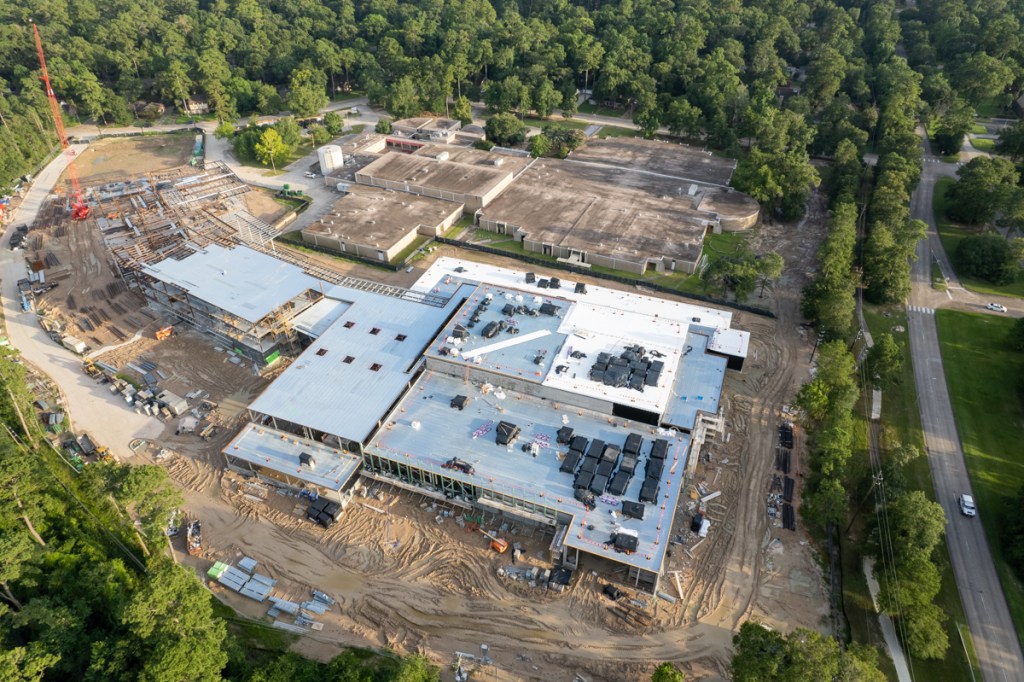
While far from complete, Humble ISD contractors have made steady progress with the construction of the new Kingwood Middle School (KMS), despite heavy and steady rains in May, June and July. Back in late March, I reported that steel was going up. Since then, the contractors have finished erecting steel on 80-90% of the new KMS building.
I took all the photos below on 7/10/2021.
Overview of campus, looking south. Woodland Hills Blvd on right. The white area in the foreground appears to be roofing.
The new KMS is being built on the site of the old athletic fields. When complete, the old school will be demolished and the athletic fields will be relocated there.
A prominent feature of the new construction is a temporary detention pond (foreground) to reduce flood risk for neighbors. Looking NNW. Note the concrete slab between the detention pond and the crane, where contractors have not yet started erecting steel.The new building will be much taller and “airier” than the old one which had solid brick walls over most of the exterior.Portions will be 3-stories tall, letting more students learn on a smaller footprint. Looking north across old KMS campus toward new construction shows the variation in the respective footprints.
When demolition of the old KMS has finished, the temporary detention pond will reportedly turn into a permanent one near the location of the semi-circular drop off zone above.
https://i0.wp.com/reduceflooding.com/wp-content/uploads/2021/07/20210710-DJI_0038.jpg?fit=1200%2C799&ssl=17991200adminadmin2021-07-10 20:33:522021-07-10 20:33:56Contractors Almost Finished with Framing New KMS, Starting on Roof
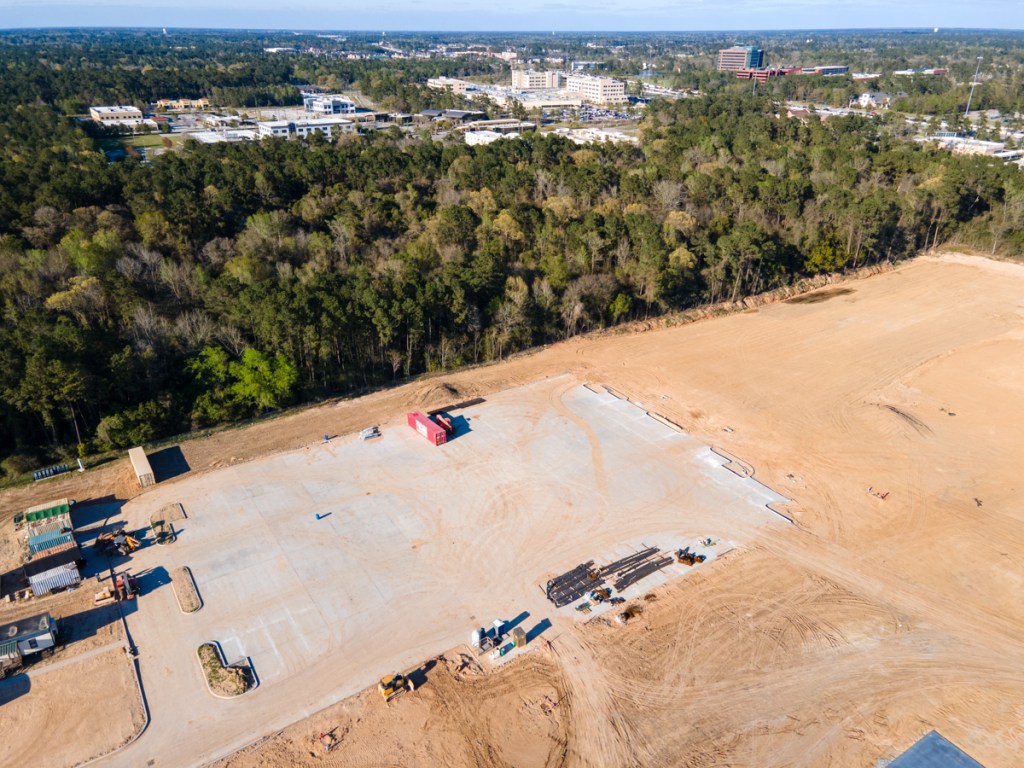
South of Kingwood’s HCA Medical Center, contractors have made slow but steady progress on the site for New Caney High School #3 between Sorters-McClellan Road and US59. I reported last November that they were pouring concrete. They still are. But there’s a lot more of it on the ground of the 80+ acre site. About half of the site is now covered with gray concrete. However, the most striking feature is the intensely green detention pond. The grass lining it looks more like a thick blanket of neon green faux fur.
Photos Taken on 3/19/2021
Looking east across the southern part of the site at the large detention pond. Grass in such ponds reduces erosion. The erosion can clog ditches, streams and rivers; and contribute to flooding.US59 cuts through the top of the frame. For orientation, note the Lowes Store in the upper left.Looking south toward the San Jacinto River, which is out of sight above the top of the frame. Sorters-McClellan Road cuts through the upper right of the frame. Approximately half the site is now covered in concrete. Playing fields will eventually occupy the area to the left.Looking NE from the northernmost part of the site. US59 cuts diagonally through the upper right of the frame. Note HCA Medical Center and Insperity in the distance at Kingwood Drive.Artists rendering of New Caney High School #3, looking east. The main entrance of the school will face Sorters-McClellan Road; the playing fields will face US59.General plan for New Caney High School #3. North is to the left.
New Caney ISD’s enrollment grew 31 percent between 2011 and 2016. That ranked NCISD first in the greater Houston area and fourth in the state for percentage enrollment growth. Eventually, the high school will hold 2,250 students. However, the school will open with only 1,350.
https://i0.wp.com/reduceflooding.com/wp-content/uploads/2021/03/20210319-DJI_0344.jpg?fit=1200%2C900&ssl=19001200adminadmin2021-03-25 14:12:262021-03-25 14:12:31Construction Update: New Caney High School #3 Site Going Green and Gray
In 2018, Humble ISD voters approved a $575 million bond referendum. One of the projects involves a complete rebuild of Kingwood Middle School with an open, airy feeling; much larger classrooms; and unlike the old school, a large detention pond. Three years later, it’s starting to look real. I took all photos below on March 21, 2021.
Framing of a new building with steel. This is when you can see plans on paper start to come to life for the first time.Looking west toward Woodland Hills Drive.Looking north toward the middle part of the new site. Construction is moving in this direction. Those green boxes are where concrete piers will eventually support steel columns that, in turn, support the weight of the building.At the southeast end of the site, a temporary detention pond holds runoff from the construction site. Eventually, contractors will replace it with a permanent detention pond farther to the west.This Google Earth photo taken months ago, shows the new middle school going in where the playing fields used to be north of the existing school. When the new building is complete, it will be torn down and the playing fields will be relocated where the existing building is now.
The new middle school’s design incorporates the concept of Kingwood’s “Livable Forest,” using ample amounts of natural light to combine interior and exterior spaces into a cohesive learning environment. There will be more space for collaboration, integrated physical activity and movement. Classrooms will be about 200 square feet larger. Car and bus drop-off and pick-up have also been optimized to relieve traffic on the neighboring streets.
Computer rendering of new school.
Target opening: start of the 2022 school year. So we still have another year of construction. But I’m sure the result will be well worth any inconvenience.
Posted by Bob Rehak on 3/22/2021
1301 Days since Hurricane Harvey
https://i0.wp.com/reduceflooding.com/wp-content/uploads/2021/03/20210321-DJI_0356.jpg?fit=1200%2C900&ssl=19001200adminadmin2021-03-22 13:09:142021-03-22 13:17:22Construction Update: Steel Going up for New Kingwood Middle School
Camcorp Management is building a new high-density development in Montgomery County called Brooklyn Trails on a tributary of Ben’s Branch upstream from Kingwood. The development’s detention pond is apparently 30% smaller than new Atlas-14 regulations would require for this area.
Most of Brooklyn Trails is still vacant...…but time is running out to do something. High density homes are going up quickly.
Even though plans were discussed, reviewed and revised after Atlas 14 went into effect, in Montgomery County the submission date determines which rainfall statistics apply.
Ben’s Branch cuts diagonally through Kingwood. It goes through three commercial areas: Northpark, Town Center and Kings Harbor. Bear Branch Elementary, Kingwood High School and the Humble ISD instructional center all border Ben’s Branch, not to mention hundreds of homes and St. Martha Catholic Church.
Rainfall rates that A&S used to design drainage for Brooklyn Trails vary substantially from MoCo’s new rate and Atlas-14 rates for the Lake Houston Area.
Montgomery County bases its 100-year/24-hour rainfall rate on Conroe (the County seat). Despite variations within the county from north to south, adopting the Conroe rate makes it easier for developers to calculate detention requirements. Some parts of the county have no gages. However, the uniform rate also understates the detention needed for new developments in the fast growing southern part of the county, which receives more rain.
Differences Between Three Rates
The three different rates referenced above for the 24-hour 100-year rain break down as follows:
17.3 inches = Rate for 100-year/24-hour rain for Lake Houston Area by NOAA (see below)
That means Brooklyn Trails is 25% short of MoCo’s new requirements and 30% short of NOAA’s.
NOAA Atlas 14 Rainfall Totals for the Lake Houston Area. Brooklyn Trails is 3 miles from Lake Houston but 20 miles from Conroe.
In fact, the rate A&S used (12.17 inches) corresponds to a 10- to 25-year rain by NOAA’s new standards, not a 100-year rain.
A&S Engineers Certify No Adverse Impact
A&S concluded on page 10 of its analysis that “…the proposed excavation/fill will cause no increase to the base flood elevation, and the proposed excavation/fill will have no adverse impact to the drainage on, from, or through adjacent properties.”
That may be true if you base all your calculations on rainfall that’s 30% less than NOAA’s best available statistics. Or even the new MoCo numbers. But, in fact, we get more rain.
Both Montgomery County and City of Houston signed off on the A&S plans. The City signed in January before the Elm Grove floods. Montgomery County signed after the Elm Grove floods – on 10/1/19.
There’s time to fix this before the development is built out. But that window is rapidly closing.
Posted by Bob Rehak on 10/12/2020
1140 Days since Hurricane Harvey and 389 since Imelda
The thoughts expressed in this post represent opinions on matters of public concern and safety. They are protected by the First Amendment of the US Constitution and the Anti-SLAPP Statute of the Great State of Texas.
https://i0.wp.com/reduceflooding.com/wp-content/uploads/2019/10/NOAA-Atlas-14-Rainfall-Rates-for-Kingwood.png?fit=976%2C828&ssl=1828976adminadmin2020-10-12 22:12:262020-10-12 22:49:24MoCo Development on Ben’s Branch Understates Current Detention Pond Requirement by 30%
For the last few months, New Caney ISD has been clearing an approximately 60-acre site between Sorters-McClellan Road and US59 south of the Kingwood Medical Center. But only now have they started work on the detention pond. The site, formerly a par-3 golf course, will become home to the School District’s third high school.
Detention Pond Work Finally Underway
In the last few days, contractors have finally started excavating a planned detention pond at the southern end of the site. They appear to be using the dirt to build up the northern part of the site where the high school and playing fields will go. This two-part operation is a procedure called “cut and fill” in the industry.
Neighboring residents feared a repeat of Woodridge Village, as contractors clearcut the site without installing detention.
A storm, such as Imelda last year, could have accelerated sheet flow from the site and flooded them. However, so far, no major storms have hit the area this year. Everyone has lucked out to date.
However, clearing a site of this size and excavating the detention last increases risk. That increased risk argues for the City to adopt building code regulations that minimize the time between clearing and excavation of detention ponds.
It can be done. Some builders excavate ponds immediately and store the dirt in huge piles to redistribute after the rest of the site is cleared.
Pictures from 4 Corners of Site
Here are some pictures taken Friday, September 11. They show the operation in progress from the four corners of the site.
Looking west. South is to the left. The big pit being excavated in the middle of the picture will be the retention pond for the high school complex.Note the loaded truck heading off to the right (north).Looking south from the northeastern corner of the site toward the San Jacinto River, Humble and Deerbook Mall in the background.Looking SE from the NW corner of the site, you can see how dramatically this site slopes toward the upper right. That’s Sorters Road on the right.From the SW corner of the site looking NE toward Insperity and the Kingwood Medical Center, you can see excavated dirt being hauled to the upper portions of the site to build it up. US59 cuts diagonally through the upper right of the frame.
Project Scope
To put the size of this site in perspective, the New Caney ISD high school #3 is approximately:
Twice as big as the HCA Kingwood Medical Center site
Three times larger than Insperity’s complex
Six times larger than the Lowes site across US59.
It will contain the school, athletic fields, parking lots and the detention pond.
General plan for New Caney High School #3
The area west of the site along Sorters Road will be expanded to accommodate traffic. Even though the site is in Montgomery County, it sits entirely within the City of Houston. The City has handled all permitting for the project.
The District’s 2018 Bond Fund will pay for the project so it should not affect taxes, according to a Houston Chronicle article.
Posted by Bob Rehak on 9/14/2020
1112 Days since Hurricane Harvey and 361 since Imelda
https://i0.wp.com/reduceflooding.com/wp-content/uploads/2020/09/20200911-RJR_0914.jpg?fit=1200%2C800&ssl=18001200adminadmin2020-09-14 14:38:032020-09-14 14:44:35Development Watch: Detention Pond for New Caney ISD High School Number 3 Finally Started
New Caney ISD is planning to build a new comprehensive high school on a roughly 50-acre site between US59 and Sorters-McClellan Road, where a par-3 golf course used to be. The land is south of HCA Kingwood Medical Center and behind several car dealerships that face US59.
New Caney ISD High School #3, still unnamed, will be built where the par 3 golf course used to be in the center of the image above.
Photos of Site and Layout
The site for this high school is roughly 5-acres larger than Kingwood High School’s site. Clearing and grading of the land has already started. See pictures below.
Looking NE. Land for Future New Caney ISD High School #3Looking East. Looking South. Detention pond will go at the far end of this part of the site.
Importance of Detention Pond
A Bid Bulletin described the total project as a 337,000 square-foot, 3-story building with tilt-wall construction and a detention pond.
A building that large, with parking lots, and rubber grass on its playing fields would make make detention ponds critical.
Site Plan for New Caney HS #3 shows detention pond on south side of property (right) and taking up approximately 10% of the property.For a higher resolution PDF, click here.
Plans show that the retention pond will be located along the southern border of the property. The land naturally slopes to there.
Although width and length are not noted on this drawing, it appears to take up about ten percent of the site and have a depth of 6.66 feet. If those are accurate assumptions, that would mean the pond provides 33.3 acre feet of detention for a 50 acre site.
That equals .666 acre feet of detention per acre. The City of Houston requires .5 feet per acre for sites of this size.
But a white paper by the Greater Houston Flood Mitigation Consortium points out that many factors can influence the amount of detention needed to offset development. Those factors include the amount of impervious cover, the soil type and more. They can change the rate needed for protection of downstream residents more than 10X. There is not one-size-fits-all.
Until we learn more about the specifics of this site and project, we can’t know whether this plan provides enough detention. But this certainly is an encouraging start.
Community Impact newspaper reported earlier this year that the high school will open in August, 2022. The project will be built in two phases.
Artists renderings of the campus show a sleek, modern, open, light-filled design.
Aerial image shows high school will be built around an open courtyard giving more classrooms access to more sunlight.Rendering from New Caney ISD.
Artists rendering of lobby of New Caney HS #3 from New Caney ISD.
Front Elevation of the new high school from New Caney ISD.
For those new to the area, two independent school districts serve the Kingwood area. The Humble ISD serves the vast majority of the area. The New Caney ISD serves the parts outside of Harris County on the north and west.
Posted by Bob Rehak on 6/17/2020
1023 Days after Hurricane Harvey
https://i0.wp.com/reduceflooding.com/wp-content/uploads/2020/06/Screen-Shot-2020-06-17-at-4.02.13-PM.jpg?fit=1200%2C946&ssl=19461200adminadmin2020-06-17 18:04:412020-06-17 18:04:53Development Watchlist: New Caney ISD Prepping Land for High School #3 in Kingwood
Perry Home’s new contractors have excavated the vast majority of virtually all three detention ponds on the north section of Woodridge Village. That means they have almost completed 77% of the detention pond capacity for the whole site in two months. The previous contractors completed only 23% in approximately twenty months.
That represents approximately a 30x increase in productivity.
Overview of Woodridge Village Detention Pond Capacity
The pie chart below shows how that capacity breaks down. And the map shows where it is.
Percentage of detention pond capacity in acre feet for each of the five Woodridge Village ponds.Source: LJA Drainage Addendum.General layout of detention ponds on Perry Homes’ property.
Cristobal has the potential to create massive erosion and set the work schedule back. The aerial photos below taken on 6/2/2020 show the current “pre-storm” status of construction for the three northern detention ponds. The two southern detention ponds were completed earlier this year.
N1 Nearing Completion of Excavation
N1 Starts at the northern boundary of the site and runs halfway down the western edge to Mace Street.
Looking north at N1 from Mace Street in Porter to the northern boundary. The area between the culverts will eventually become an extension of Mace Street (top of photo) which will traverse the entire subdivision to Ford Road on the eastern side.While some contractors continue excavating, others work on installing concrete pilot channels. Shown here, the pilot channel near Ivy Ridge in Porter.The northern part of N1 is not yet complete. Contractors still use the Webb Street entrance (upper left as their main access point to the site.Note how height of road dwarfs excavator in pit.
Still Widening and Deepening N2 Pond
The area left of the diagonal road is the expansion of N2. The area near the diagonal embankment is deep enough to conceal trucks and excavators. However, the grassy triangle in the middle left was a previous detention pond constructed my Montgomery County in the early 2000s. Contractors are deepening the MoCo pond a small amount to create additional storage capacity.The dirt is being used to build up other portions of the site.Looking north along the western boundary from the southern part of the grassy triangle. Much work remains to extend the N1 channel south to N2. Jeff Miller reported today that contractors started working on thisthis morning.On 6.3.20, contractors were removing dirt from the northward extention of N2 with three dump trucks running in a relay fashion. Photo courtesy of Jeff Miller.Twin culverts installed in Taylor Gully will control outflow rates from N1 and N2.
N3 All Excavated
N3 cuts down the eastern side of Woodridge Village and joins Taylor Gully right above S2.
Looking north. Excavation of N3 appears complete although few of the finishing touches have yet been installed.Looking south at the main body of N3. N3 widens out about halfway down the eastern border.Then it narrows down again to help control outflow speedas it approaches the junction with Taylor Gully.Water from the entire site converges here. Erosion patterns, fence damage and grass matting show this is where the overflow started that contributed to the flooding of Elm Grove (right) and North Kingwood Forest (left) twice last year.
The pile of dirt in the picture above could be shoved into the connecting channel in the event that Cristobal should strike Houston. That would then help retain water in N3 until after the storm.
All the runoff from the approximately 200-acre northern portion of the site converges here and tries to make its way through a 3-foot culvert at the end of the concrete channel.
Uncertain Still Surrounds Corner of Chaos
Some Elm Grove and North Kingwood Forest residents have called the complex flow patterns in the photo above “The Corner of Chaos.”
Overflow from the concrete lined channel is supposed to go into the kite-shaped S2 pond, and then through the twin culverts into Taylor Gully. However, a hydrology consultant for the plaintiffs in flooding lawsuits contends that floodwaters went the other way.They escaped out of the inflow channel, he says. He further claims that LJA Engineering failed to model the performance of that connecting channel.
If the design of the flow at this “Corner of Chaos” is flawed, there’s little contractors can do to fix that at this point without some major re-engineering.
In that regard, we should also remember that LJA designed these ponds before Atlas 14, so they will only hold approximately 60% of a 100-year rainfall as defined by Atlas 14 standards adopted in Harris County.
How Contractors are Temporarily Funneling Water into Ponds
Because storm drains are not yet installed, contractors are relying on temporary channels to intercept runoff and direct it to detention ponds.
Small ditches like one on right catch runoff and direct it to ponds for the time being.
Next Steps in Completing Detention Ponds
A modest amount of excavation remains to complete the full detention pond capacity.
But the capacity already in place should reduce flood risk compared to last year by more than 3X for storms equivalent to May 7 and September 19, 2019.
As some crews focus on completing excavation, others are putting the finishing touches on ponds. Those include concrete pilot channels, backslope interceptor swales, drain pipes, and culverts to control the rate of outflow.
Posted by Bob Rehak on 6/4/2020with thanks to Jeff Miller
1010 Days after Hurricane Harvey and 258 since Imelda
The thoughts expressed in this post represent opinions on matters of public concern and safety. They are protected by the First Amendment of the US Constitution and the Anti-SLAPP Statute of the Great State of Texas.
https://i0.wp.com/reduceflooding.com/wp-content/uploads/2020/06/20200602-DJI_0058.jpg?fit=1200%2C900&ssl=19001200adminadmin2020-06-03 22:02:292020-06-04 09:07:38Woodridge Village Pre-Cristobal Detention Pond Update
Mayor Pro Tem Dave Martin shocked a meeting of Kingwood residents at a town hall meeting on February 25, 2020. He he said the City would not participate in a much-rumored buyout of the Perry Homes’ Woodridge Village property that contributed to the flooding of Elm Grove Village twice last year. The rumors first went public in a Houston Chronicle story on January 27th this year. In that story the Chronicle characterized the plan as a bailout, not a buyout, but later retracted that in an editorial board statement.
The plan was to purchase all or part of the land and build a giant detention pond on it that would prevent Elm Grove from flooding again.
Silence After Executive Session in Commissioner’s Court Meeting
The Chronicle story appeared one day before a Harris County Commissioner’s Court meeting. Commissioners were to consider the purchase of the property at that meeting in executive session. But there was no public announcement after the meeting of what they decided. We later learned the reason why.
County Asked City to Pay for Half of Purchase
Harris County, according to Martin at the town hall meeting, decided to ask the City to put up half the money for the purchase of the land. Martin initially supported the purchase “at the right price,” according to the Chronicle story.
However, something happened between the Commissioner’s Court Meeting and the Town Hall Meeting to make Martin change his mind about participating in the deal. At the Town Hall meeting, Martin never mentioned the purchase price as an objection.
Martin Claims We Pay Taxes to County So County Should Pay 100%
Instead, Martin launched into a discussion of his tax bill. He said that out of his total tax bill he paid:
56.4% to Humble ISD
18.8% to the City of Houston (of course, that didn’t include fees, such as those for drainage)
14.4% to Harris County.
That adds up to 89.6%, but Mr. Martin did not explain what happened to the missing 10.4%.
Who Is Doing What
He simply said that dramatized the need to get “… Harris County to do more work in Kingwood.” (Editor’s note: at a previous town hall meeting Martin explained that the county was already taking over all work on ditches and streams in Kingwood, but then he quickly added that if the County purchased the Woodridge property, it would let the CITY do more work on ditches and streams. Martin never addressed that apparent contradiction).
Why City Refuses to Participate
Martin then explained that Kingwood overwhelmingly supported the $2.5 billion Harris County Flood Bond in 2018. He also pointed out that the language in the flood bond lets Harris County purchase land in other upstream counties for the purpose of floodwater detention – exactly like the proposal for Perry Homes’ Woodridge Village property.
According to Martin, County Precinct 4 Commissioner Jack Cagle wants the City of Houston to contribute half of the money.
“Quite frankly,” said Martin, “I’m not going to ask the Mayor to contribute half. Because they (Harris County) should contribute 100% of it because we gave them our tax dollars and they specified what these tax dollars are to be used for. So they need to come up with 100%.”
Martin then talked about berating Harris County Judge Lina Hildago on the subject before urging residents to contact their county officials. He closed by demanding that the County should put up 100% of the money for Perry Homes’ land because “WE are that close to making this happen.” (Emphasis NOT added.) Martin also asserted that if the County took sole responsibility for the deal, it would somehow help flooding problems in other unrelated areas such as North Woodland Hills.
Listen to Audio Clip of Discussion at Town Hall
To listen to a four-minute audio recording of this segment of the meeting, click the key frame of Mayor Pro Tem Dave Martin below.
Segment of 2/25/2020 Kingwood Town Hall Meeting in which Houston Mayor Pro Tem Dave Martin discusses the buyout of Perry Homes’ Woodridge Village land to construct a detention pond and why Harris County Should Pay for 100% of the deal.
Mr. Martin never explained why the taxing entity we pay the least to should assume exclusive responsibility for the entire project. Nor did he address why drainage fees paid to the City, could not be used for the project.
Meanwhile, the county has been silent on whether it will pick up 100% of the tab for the detention work. And Elm Grove residents still spend sleepless nights every time it rains.
Posted by Bob Rehak on 3/1/2020
915 Days after Hurricane Harvey and 164 after Imelda
The thoughts expressed in this post represent opinions on matters of public concern and safety. They are protected by the First Amendment of the US Constitution and the Anti-SLAPP Statute of the Great State of Texas.
https://i0.wp.com/reduceflooding.com/wp-content/uploads/2020/03/20200225-RJR_8720.jpg?fit=1200%2C800&ssl=18001200adminadmin2020-03-01 13:28:522020-03-02 23:46:11City Decides Not to Participate in Elm Grove Rescue; Says County Should Pay 100%
Q: When is a detention pond not a detention pond? A: When it’s just a wide spot on a stream.
The defining characteristic of a detention pond is an “outfall” smaller than the inlet. The pond holds back rain in a storm and releases it later at an acceptable rate. This reduces downstream flooding.
From the Montgomery County Drainage Criterial Manual
That’s the theory, at least. In practice, sometimes things don’t always work out that way. It often depends on maintenance.
This week, I discovered that a second pond immediately upstream also apparently has an unrestricted outfall.
Two tributaries of Ben’s Branch come together in the foreground pond. The pond also collects runoff from surrounding commercial and residential areas.Photo taken 2/13/2020.Water flows toward exit in upper right.Photo taken 2/13/2020.Note height and width of exit.Photo taken 2/13/2020.
The low area in the picture above measures more than 200 feet wide in Google Earth. That’s far wider than the combined inlets. Net: this pond provides little if any detention capability.
Same Problem with Second Pond
Neither does pond beyond it that I highlighted last week provide much detention capacity.
Note how Ben’s Branch flows both through and around the next pond. Direction of flow is from bottom to top of frame.Photo taken 2/13/2020.Reverse angle looking NW. Direction of flow is now toward camera.Note how the outfall (foreground) is larger than the inlet. Also note how runoff from residential streets (upper right) is channeled outside the pond. Photo taken 2/13/2020.
Both Ponds Provide Little Detention Benefit, If Any
Both of these ponds provide little detention benefit, if any.
Neither pond has a maintenance road around it, even though Section 7.2.8 of the Montgomery County Drainage Criteria Manual specifies that “A 30-foot wide access and maintenance easement shall be provided around the entire detention pond.”
Sometimes, what looks like a detention pond is really just a pond. Or a wide spot in a stream.
Recent Surge in Downstream Flooding
During the May 7th and Imelda floods in 2019, water flowing through these ponds then flowed over Northpark Drive and flooded homes in North Woodland Hills. It also flooded numerous homes and businesses downstream on Ben’s Branch between Woodland Hills Drive and the San Jacinto River West Fork.
One wonders whether those damages could have been averted if the ponds had detained water.
As Harris County Flood Control conducts the Kingwood Area Drainage Study, engineers must consider the possibility that this area may be dumping more water downstream than planned.
The Woodridge Municipal Utility District apparently is responsible for these ponds.
Posted by Bob Rehak on 2/16/2020
901 Days after Hurricane Harvey and 150 after Imelda
The thoughts expressed in this post represent opinions on matters of public concern and safety. They are protected by the First Amendment of the US Constitution and the Anti-SLAPP Statute of the Great State of Texas.
https://i0.wp.com/reduceflooding.com/wp-content/uploads/2020/02/20200213-RJR_8533.jpg?fit=1200%2C800&ssl=18001200adminadmin2020-02-16 05:49:322020-02-16 10:57:58Part II: When Is A Detention Pond Not A Detention Pond?
On a flyover of the Harris/Montgomery county line last month, I spotted something unusual: a detention pond with an outlet bigger than its inlet. And it was in Woodridge FOREST. You may remember that after Imelda, Woodridge Forest advertised homes that did not flood on signs posted in nearby intersections…around downstream homes that did flood!
Detention Pond that Isn’t
Wide shot, looking east toward St. Martha’s Catholic Church and Kingwood Park High School. Photo taken 1/20/2020.
Below is a closeup of the suspect pond cropped from the image above.
Water flows from bottom left to upper right in this image. During Harvey, the outlet for this detention pond blew out. Imelda enlarged it even more. No one has repaired it, meaning it retains no water in a flood. Water from this part of the subdivision does not even go through the pond.Note the location of this outlet in the photos above and below.Satellite image shows clearer comparison. Detention pond has bigger outlet than inlet and a creek that runs around it.
Detention ponds usually work by capturing water coming in a fast rate, storing it, and releasing it at a slower rate that minimizes downstream flooding.
This pond provides very little, if any detention capacity. In fact, Ben’s Branch runs BOTH around and through it!
The berm that forms the north side of the pond in the image above does little more than take up valuable space in the flood plain.
On its way from 59 to Woodland Hills, Ben’s Branch goes through a series of “detention ponds” along the southern edge of Woodridge Forest. What purpose does of this one serve? And are the others doing their job?
The pond should also have a 30-foot wide maintenance road around it (also section 7.2.8), but does not. The developer built the pond in 2016, but no one seems to have noticed the absence of the maintenance road yet. That missing maintenance road might have helped in the repair of the pond after Harvey.
And the “Rub-Your-Nose-In-It” Award Goes To…
Who knows how much this pond could have helped reduce flooding on May 7th and September 19th last year?
The truly appalling thing about this: shortly after Imelda, Woodridge Forest posted signs in the area informing buyers, “We don’t flood.” Well, when you’re not retaining all the water you should…
Montgomery County is on an unsustainable path. Every week, I get complaints from Montgomery County residents about flooding there. MoCo is already starting to reap what it has sown. Someday, MoCo, too, will be downstream from another rapidly growing county. And then the tragic precedent MoCo has set will make payback inevitable.
Posted by Bob Rehak on 2/13/2020
898 Days since Hurricane Harvey and 147 since Imelda
The thoughts expressed in this post represent opinions on matters of public concern and safety. They are protected by the First Amendment of the US Constitution and the Anti-SLAPP Statute of the Great State of Texas.
https://i0.wp.com/reduceflooding.com/wp-content/uploads/2020/02/image002.jpg?fit=1200%2C726&ssl=17261200adminadmin2020-02-12 21:24:492020-02-12 21:26:03When Is a Detention Pond Not a Detention Pond?