How Corps Will Evaluate High-Rise Permit Application

Romerica Investments, LLC has applied for a permit to build a high-rise development in the floodplain of the San Jacinto River. They call the proposed development the Kingwood Marina Project. Because it involves adding 12 feet of fill material to the floodplain of the San Jacinto River, the Army Corps of Engineers has become involved. The Corps rules on any permit application that involves “discharge” of fill into “waters of the United States.”

Proposed layout for the Kingwood Marina Project.

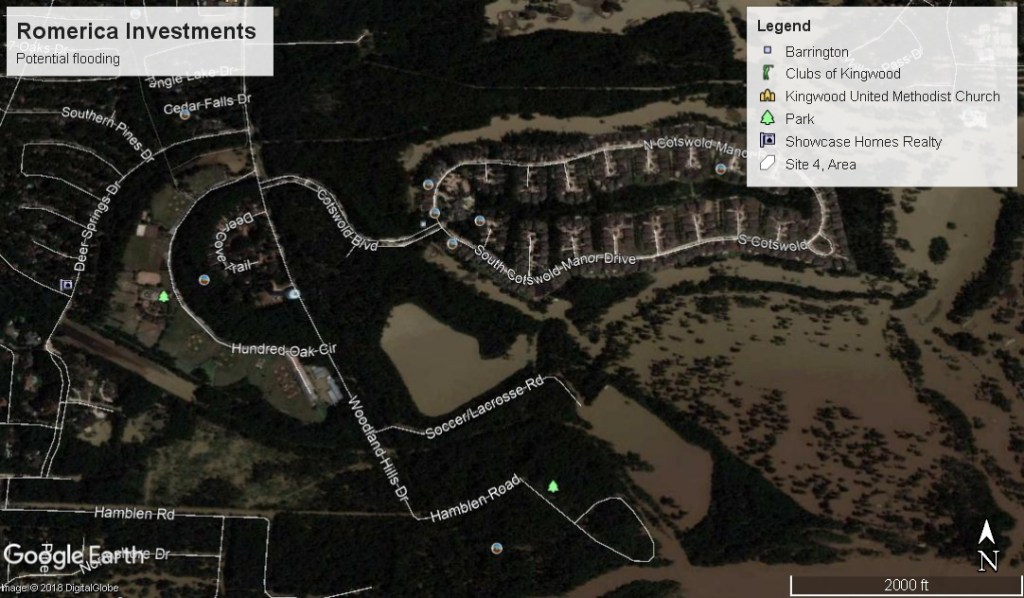
The fill would stretch approximately three quarters of a mile from north to south along Woodland Hills Drive and approximately .85 miles from east to west on both sides of the Barrington. If you want to know what the Corps considers when making such rulings, or why and how the TCEQ interprets “water quality” for them, read on.

Public Interest Review

As a result of several recent laws and judicial decisions, the Corps’ permitting process has evolved to include consideration of the full public interest by balancing favorable impacts against detrimental impacts. This is known as the ‘‘public interest review.’’ We are at that stage now.

The Corps’ main criteria for evaluating applications includes four high-level considerations:

  • Need for the project
  • Extent and permanence of detrimental effects
  • Effect on wetlands
  • Relative weight of various additional factors

The additional factors below also apply to the proposed High-Rise Kingwood Marina Project:

  • Conservation
  • Economics
  • Aesthetics
  • General environmental concerns
  • Historic, cultural, scenic, and recreational values.
  • Fish and wildlife values
  • Flood hazards
  • Floodplain management
  • Land use
  • Navigation
  • Shore erosion and accretion
  • Recreation
  • Water supply and conservation
  • Water quality
  • Safety
  • Considerations of property ownership
  • Needs and welfare of the people

Public Interest Described in More Detail

“All factors which may be relevant to the proposal must be considered,” says the intro to Corps regulations on page 398. The regulations (33 CFR 320-332) then go into more detail on many of these factors. The regs elaborate on dozens of things that the law requires the Corps to evaluate.

Here’s my summary and interpretation of those that likely apply. Keep in mind that I’m looking at these with the proposed Kingwood Marina high-rise project in mind. So I have omitted some items that do not apply, such those for coastal developments. For the exact text of each, consult this Department of the Army legal document. I am not a lawyer and do not offer legal advice.

The regulations start with a discussion of four high-level, over-riding factors. 

The first thing reviewers look at is the “need for the project.” If needed, they then consider the extent and permanence of any detrimental effects relative to any benefits that the project provides.

In that regard, wetlands play a major role and get special mention. But the Corps also reviews the 17 other factors listed above that have to do with “the public interest.” Then they weigh them all – pros and cons. Something that’s very important on one project may carry no weight on another. The reviewers have wide latitude to use their own judgment.

What Does the Army Corps Consider Value of Wetlands to Be?

Section 320.4 B (2) I-iviii on page 398 states: Wetlands perform functions important to the public interest, such as:

  • Providing nesting, spawning, and rearing space for animals, birds and fish
  • Moderating natural drainage, sedimentation, salinity, flushing, and other environmental benefits
  • Shielding other areas from erosion or storm damage 
  • Storing storm and flood waters
  • Purifying water 
  • Providing unique natural value to a local area

Further section B (3) recognizes that although a particular alteration of a wetland may constitute a minor change, the cumulative effect of numerous piecemeal changes can result in major impairment of wetland resources. This section seems to say, “We can afford to lose some wetlands, but at a certain point, “Enough is enough!”

The Corps looks at each wetland as part of a complete and interrelated wetland environment. 

Corps Consults Others on Wetlands

The district engineer may undertake, where appropriate, reviews of particular wetland areas in consultation with the:

  • Regional Director of the U. S. Fish and Wildlife Service
  • Regional Director of the National Marine Fisheries Service of the National Oceanic and Atmospheric Administration
  • Regional Administrator of the Environmental Protection Agency
  • Local representative of the Soil Conservation Service of the Department of Agriculture
  • Head of the appropriate state agency to assess the cumulativeeffect of activities in such areas (TCEQ and/or TPWD).

The district engineer may conclude that the benefits of a project outweigh the damage to wetlands. However, when evaluating whether wetlands can be filled, the engineer must consider the guidelines in the Clean Water Act (Section 404(b)(1) guidelines (40 CFR part 230.10(a) (1), (2), (3)).

In addition, state regulatory laws or programs for classification and protection of wetlands must be considered.

Fish and Wildlife Considerations

In accordance with the Fish and Wildlife Coordination Act (paragraph 320.3(e) of this section) district engineers must consult with:

  • The Regional Director, U.S. Fish and Wildlife Service
  • The head of the Texas Parks and Wildlife. 

The engineer must consider conservation of wildlife resources and preventing harm to them due to proposed permit activity. The Army must give full consideration to the views of those agencies when deciding whether to issue, deny or condition permits.

Water-Quality Considerations

Applications for permits for activities which may adversely affect the quality of waters of the United States will be evaluated for compliance with applicable effluent limitations and water quality standards, during the construction and subsequent operation of the proposed activity. The evaluation should include the consideration of both point and non-point sources of pollution. The Clean Water Act assigns responsibility for control of non-point sources of pollution to the states. In our case, that’s the TCEQ.

Scenic and Recreational Values

Full evaluation of the general public interest requires that due consideration be given to the effect which the proposed structure or activity may have on values such as those associated with scenic rivers.

Consideration of Property Ownership

Authorization of work or structures by the Corps does not convey a property right. Nor does it authorize any injury to property or invasion of others’ rights.

An inherent aspect of property ownership is a right to reasonable private use. However, this right is subject to the rights and interests of the public in the navigable and other waters of the United States. It includes environmental protection.

Because a landowner has the general right to protect property from erosion, applications to erect protective structures will usually receive favorable consideration. However, if the protective structure may cause damage to the property of others, adversely affect public health and safety, adversely impact floodplain or wetland values, or otherwise appears contrary to the public interest, the district engineer will so advise the applicant and inform him of possible alternative methods of protecting his property. 

A landowner’s general right of access to navigable waters may not create undue interference with access to, or use of, navigable waters by others. If it does, the authorization will generally be denied.

The applicant’s signature on an application is an affirmation that the applicant possesses or will possess the requisite property interest to undertake the activity proposed in the application

In the absence of overriding public-interest factors that may be revealed during the evaluation of the permit application, a permit will generally be issued. But first, the engineer must receive favorable state determination. That state determination must take into account:

Similarly, a permit will generally be issued for Federal and Federally-authorized activities; another federal agency’s determination to proceed is entitled to substantial considerationin the Corps’ public interest review.

Threatened Species

The Endangered Species Act (16 U.S.C. 1531 et seq.) declares the intention of the Congress to conserve threatened and endangered species and the ecosystems on which those species depend. The Act requires that federal agencies, in consultation with the U.S. Fish and Wildlife Service and the National Marine Fisheries Service, use their authorities in furtherance of its purposes by carrying out programs for the conservation of threatened species, (editorial comment: such as the bald eagle which nests and feeds near this property).

Floodplain Management

Floodplains possess significant natural values and carry out numerous functions important to the public interest. These include:

  • Water-resources value (natural moderation of floods, water quality maintenance, and groundwater recharge);
  • Living-resource values (fish, wildlife, and plant resources);
  • Cultural-resource values (open space, natural beauty, scientific study, outdoor education, and recreation); and
  • Cultivated-resource values (agriculture, aquaculture, and forestry).

Although a particular alteration to a floodplain may constitute a minor change, the cumulative impact of such changes may result in a significant degradation of floodplain values and functions and in increased potential for harm to upstream and downstream activities.

Executive Order 11988 and Floodplains

In accordance with the requirements of Executive Order 11988, district engineers, as part of their public interest review, should avoid to the extent practicable, long and short term significant adverse impacts associated with the occupancy and modification of floodplains, as well as the direct and indirect support of floodplain development whenever there is a practicable alternative. For those activities which in the public interest must occur in or impact upon floodplains, the district engineer shall ensure, to the maximum extent practicable, that the impacts of potential flooding on human health, safety, and welfare are minimized, the risks of flood losses are minimized, and, whenever practicable the natural and beneficial values served by floodplains are restored and preserved.

In accordance with Executive Order 11988, the district engineer should avoid authorizing floodplain developments whenever practicable alternatives exist outside the floodplain.If there are no such practicable alternatives, the district engineer shall consider, as a means of mitigation, alternatives within the floodplain which will lessen any significant adverse impact to the floodplain.

Water Supply and Conservation

Water is an essential resource, basic to human survival, economic growth, and the natural environment. Water conservation requires the efficient use of water resources in all actions which involve the significant use of water or that significantly affect the availability of water for alternative uses including opportunities to reduce demand and improve efficiency in order to minimize new supply requirements. Actions affecting water quantities are subject to Congressional policy as stated in section 101(g) of the Clean Water Act which provides that the authority of states to allocate water quantities shall not be superseded, abrogated, or otherwise impaired.

Navigation

Protection of navigation in all navigable waters of the United States continues to be a primary concern of the federal government.

District engineers should protect navigational and anchorage interests in connection with the NPDES (National Pollutant Discharge Elimination System) program by recommending to EPA or to the state, if the program has been delegated, that a permit be denied unless appropriate conditions can be included to avoid any substantial impairment of navigation and anchorage.

The NPDES permit program addresses water pollution by regulating point sources that discharge pollutants into waters of the United States.

Environmental Benefits

Some activities that require Department of the Army permits result in beneficial effects to the quality of the environment. The district engineer will weigh these benefits as well as environmental detriments along with other factors of the public interest.

Economics

When private enterprise makes application for a permit, it will generally be assumed that appropriate economic evaluations have been completed, the proposal is economically viable, and is needed in the market place.However, the district engineer in appropriate cases, may make an independent review of the need for the project from the perspective of the overall public interest. The economic benefits of many projects are important to the local community and contribute to needed improvements in the local economic base, affecting such factors as employment, tax revenues, community cohesion, community services, and property values. Many projects also contribute to the National Economic Development (NED), (i.e., the increase in the net value of the national output of goods and services

Deadline for Comments Extended to March 1

Because of the prolonged government shutdown, the Army Corps has extended the deadline for public comments on the proposed Kingwood Marina high-rise development.

Comments and requests for additional information should reference USACE file number, SWG-2016-00384, and should be submitted to:

ARMY CORPS

Evaluation Branch, North Unit
Regulatory Division, CESWG-RD-E
U.S. Army Corps of Engineers
P.O. Box 1229
Galveston, Texas 77553-1229
409-766-3869 Phone
409-766-6301 Fax
swg_public_notice@usace.army.mil

TCEQ

The TCEQ will evaluate water quality issues for the Corps. You can email water quality comments to  401certs@tceq.texas.gov.  Please ensure that all comments reference USACE permit application no. SWG-2016-00384.

Rehak Comments To Follow

As I have studied the Corps’ and TCEQ’s decision-making processes and criteria, I have also studied possible impacts of the proposed high-rise project. I intend to send my comments to the Corps, TCEQ, Texas Parks and Wildlife, the US Fish and Wildlife Service and the EPA. I will publish those when complete – hopefully by the end of this week.

As always, these represent my opinions on matters of public policy. They are protected by the First Amendment of the U.S. Constitution and the Anti-SLAPP statute of the Great State of Texas.

Posted by Bob Rehak on 1/31/2019

520 Days since Hurricane Harvey

Galveston Bay Foundation Hopes to Turn Tide Against High-Rise Development

I received this high-rise protest letter by the Galveston Bay Foundation yesterday. The power of their logic, so well articulated, struck me like lightning. Hopefully they will help turn the tide against this ill-advised project in Kingwood. Their letter makes compelling points in a concise fashion. The text below has been reformatted for the web. Follow this link or the one at the bottom of the page to see or download a PDF of original letter.

Wetlands adjacent to Woodland Hills Drive that would be filled with 12 feet of dirt to elevate the proposed high-rise Kingwood Marina Resort. (Note: this photo was not part of the Galveston Bay Foundations’ letter. I have added it here to help illustrate some of their points.)

 January 29, 2019 
Evaluation Branch, North Unit 
Regulatory Division, CESWG-RD-E 
U.S. Army Corps of Engineers 
P.O. Box 1229 
Galveston, Texas 77553-1229 

RE: Public Notice SWG-2016-00384 

To Whom It May Concern: 

The applicant, Romerica Investments, LLC, proposes to discharge 68,323 cubic yards of fill material into 42.35 acres of wetlands and an estimated 285 cubic yards of fill material into 771 linear feet of streams adjacent to the West Fork San Jacinto River during the development of a marina/resort district, a commercial district, a residential district, and roadway expansion. 

The project is located in waters and wetlands adjacent to the West Fork of the San Jacinto River, in Kingwood, in Harris County, Texas. The aquatic features onsite include open water, forested wetlands, emergent wetlands, and streams. The subject wetlands and waters are located in the Bens Branch-Frontal Lake Houston watershed (United States Geological Survey (USGS) Hydrologic Unit Code (HUC) 12040101) which flows into the West Fork of the San Jacinto River and Lake Houston. The project can be located on the U.S.G.S. quadrangle map entitled: Moonshine Hill, Texas at latitude 30.036463° North; longitude 95.215438° West, and contains the following elements: 

Marina/Resort District (107.41 acres) 

The applicant proposes to discharge 19,690.7 cubic yards of fill material into a total of 12.21 acres of wetlands to construct the marina/resort district. The applicant proposes to expand the existing 15-acre lake associated with the West Fork San Jacinto River into an 80-acre marina with a maximum capacity for 640 boats. The applicant proposes to construct a new navigation channel to the south of the proposed marina and expand the existing channel on the east for better connectivity between the proposed marina and the West Fork San Jacinto River. The applicant proposes to develop the 25 acres north of the proposed marina into a resort district. The resort district will consist of a resort hotel, commercial, and residential space. The excavated fill material would be used to raise the elevation of the resort district from 45 feet to 57 feet above base flood elevation, to raise the proposed structures above the Federal Emergency Management Agency (FEMA) 100-year floodplain of the West Fork San Jacinto River. 

Commercial District (64.41 acres) 

The applicant proposes to discharge 959.6 cubic yards of fill material into a total of 0.59 acres of wetlands and 110 linear feet of streams to construct the commercial district. The applicant proposes to construct, within 47 acres, retail, residential, and office space. The applicant proposes to discharge fill material to raise the elevation of the commercial district from 45 feet to 57 feet over base flood elevation, to raise the proposed structures over the FEMA 100-year floodplain of the West Fork San Jacinto. The applicant proposes to expand an existing 16.25-acre lake to a 19.25-acre size to create a smaller marina area for personal watercraft parking. The applicant proposes to create a 125-foot wide interconnecting channel between the 80-acre marina and the 19.25-acre marina to provide navigable access between the two marinas and the marina/resort district and the commercial district. 

Residential District (136.93 acres) 

The applicant proposes to discharge 46,213.9 cubic yards of fill material into a total of 28.60 acres of wetlands and 404 linear feet of streams to construct the residential district. The applicant proposes to construct, within 64 acres, condominium structures on pier and beam foundation. The applicant will construct the pier and beam condominium structures at a height of 58.5 feet, above the FEMA 100-year floodplain of the West Fork San Jacinto River. The applicant also proposes to construct, within 6 acres of the southern portion of the residential district, 25-story condominiums with parking garages. The applicant will discharge fill material within the southern portion of the residential district to raise the proposed structures and elevations to 57 feet above the FEMA 100-year floodplain of the West Fork San Jacinto River. The applicant proposes to construct four lakes at a total of 6.75 acres throughout the western portion of the residential district. The applicant proposes to construct 1.95 miles of 41-feet-wide roadways with 60-foot-wide right-of-way throughout the residential district beginning at Woodland Hills Drive. The applicant proposes to construct 4-foot and 8-foot wide trails, with a 20-foot-wide easement, around the perimeter of the residential district using bridges over all stream and channels. The applicant proposes to avoid trees and construct the trails of natural materials. The applicant proposes to relocate the existing utility easement within the proposed 20-foot proposed pedestrian trail easement. 

Woodland Hills Road Expansion (22.7 acres) 

The applicant proposes to discharge 1,743.8 cubic yards of fill material into a total of 0.960 acres of wetlands and 257 linear feet of streams to construct the Woodland Hills Roadway expansion. The applicant proposes to expand Woodland Hills Drive within the existing right-of-way from two lanes to four lanes. 

The applicant has stated that they have avoided and minimized the environmental impacts by configuring the location of the proposed structures and reducing the size of the proposed lakes within each district. The applicant proposed to mitigate for the proposed impacts by developing a permittee responsible mitigation site and/or purchasing credits from an approved mitigation bank within the Galveston District boundaries. 

GBF Recommendation

The Galveston Bay Foundation (GBF) has reviewed Public Notice SWG-2016-00384. We are opposed to U.S. Army Corps of Engineers’ (Corps’) approval of this permit application as currently proposed for the following reasons: 

Point #1

Water dependency, impact avoidance, indirect and secondary impacts through induced flooding and pollutant loading: The proposed resort/commercial/residential development is not a water dependent activity. However, the application materials do not include a discussion of alternatives/alternatives analysis consistent with Section 404 (b)(1) guidelines found at 40 CFR 230. Other than a one sentence description indicating that the applicant “avoided and minimized the environmental impacts by configuring the location of the proposed structures and reducing the size of the proposed lakes within each district”, we are provided no information as to how the applicant avoided and minimized impacts to the Waters of the U.S. open water, forested wetlands, emergent wetlands, and streams contained in the 331.45 acres of undeveloped woodlands including open water, forested wetlands, emergent wetlands, and streams, all of which provide for critical habitat and water quality functions. 

We further note that the area is historically subject to severe flooding impacts, which could result in pollutant loading from these developed areas to the West Fork of the San Jacinto River and thus to Lake Houston, the major drinking water supply to the Houston Metro Area. Pollutants can include toxicants and nutrients contained in household cleansers, pesticides, fertilizers, and petroleum products that may be released in flood events. 

From our review, it appears that most of this development is located in the 100-year floodplain, and that floodway is in the footprint of the southern marina and in portions of the resort, commercial, and residential districts’ footprint. This development will result in increased impervious cover to areas located in floodway and floodplain, which can lead to flooding of adjacent residential and commercial areas. As such, the applicant should perform hydrological analysis to ensure the design will not induce flooding to surrounding developments, which in turn can further increase risks of pollutant loading to the waterways. 

Based on prior history of flooding events in this particular area, we recommend that a site more suitable for a resort/commercial/residential development, or at the least a reduced floodplain project footprint in the floodplain be sought. For the reasons listed in this section, the applicant should not be allowed to develop in any floodways. 

Point #2

Assessment of impacts to Waters of the U.S. and proposed mitigation: The application materials provide no assessment of the impacts to functions and services provided by the open water, forested wetlands, emergent wetlands, and streams to be impacted, nor an assessment of the functional lift to be provided by any permittee-responsible mitigation plan. The applicant must assess the impacts to the functions and services provided by the impacted wetlands and other waters of the U.S., as required in the 2008 Final Rule for Compensatory Mitigation for Losses of Aquatic Resources, as well as that of the proposed mitigation. 

Point #3

Absence of mitigation plan: The application materials do not include an acceptable mitigation plan, as required by the 2008 Final Rule for Compensatory Mitigation for Losses of Aquatic Resources, including all twelve required elements. Since the applicant has indicated that permittee-responsible mitigation is contemplated, a mitigation acceptable plan must be provided for the application to be complete. In addition, the applicant should provide information on the suitability and credit availability of potential mitigation banks for public review and comment. This will allow GBF and the public to make informed comments as to chosen plan’s chances of success. 

Point #4

Potential impacts to threatened and endangered species, eagles, and other migratory birds: The application indicates that “bald eagles and their potential habitat were observed within the project area; however, no nests were found.” The applicant should be required to produce a survey of threatened and endangered species, as well as bald eagles and other migratory birds, for public review and comment. 

Point #5

Impacts to existing conservation easement: The applicant indicates that a 17.59-acre conservation easement exists in the commercial and residential district as compensatory mitigation in Corps’ permit “SWG-99-26-012.” The applicant appears to propose mitigating for the destruction of this mitigation site through placing “21.90 acres (12.19 acres of wetlands and 8.99 acres of upland buffer) into a conservation easement.” We believe that this existing mitigation site should instead be protected in perpetuity, as was agreed upon in the original permit action. Therefore, the applicant should be required to avoid impacts to this easement from either direct or indirect impacts. Should the Corps consider approving this aspect of the application, the applicant must be required to provide a functional assessment of the impacted mitigation site and the 12.19 acres of wetlands that are intended to serve as new mitigation and show that adequate functional lift is provided. 

Point #6

Marina water quality and sedimentation impacts: The applicant proposes a 640-boat capacity marina on a major tributary to Houston’s main drinking water source. Marinas have been shown to be a source of pollutants to waterways, including nutrients, bacteria and other human pathogens contained untreated boater sewage, toxicants in boat cleaners, and petroleum and heavy metals contained in fuels and bilge water. As marina water bodies usually have poor circulation, water quality problems can result. To help reduce such impacts, we highly recommend that the applicant apply and complete the steps necessary to become a certified Clean Texas Marina should the Corps grant the permit application. 

In addition, maintenance dredging will need to be performed periodically. The applicant should provide a description of the dredging methods to be used and the best management practices that will be employed to prevent offsite migration of sediment and pollutants disturbed during these operations. 

Point #7

Storm water runoff: The development project would result in significantly more impervious surface area within the watershed. We appreciate that the applicant has included a storm water detention basin in the proposed plan, but we are concerned it may be undersized to adequately treat the volumes of polluted runoff that will result. Research has repeatedly indicated that urban/suburban development along riparian corridors and adjacent to water bodies has a well-correlated, negative effect on instream water quality, biodiversity, and aquatic habitat. 1,2,3,4,5,6 

These negative effects are often tied to increased impervious surface cover and subsequent frequent and intense disturbance of instream primary producers from increased water volumes and velocities.5 These effects are usually not temporary and persist so long as the noted land use patterns exist unless steps are taken to buffer these impacts.5,6

Deposition of herbicides and pesticides associated with developed land management can also have long lasting, complex effects within adjacent aquatic communities.7,8 Maintaining good water quality is particularly important given the continued increase in development in the watershed. As a part of the application process, we recommend that storm water volumes, handling, and quality measures be reevaluated to be certain that secondary impacts to the receiving streams will not result from increased runoff associated with increased impervious surface cover within the development footprint. 

We believe that Low Impact Development best management practices need to be incorporated into the project, such as utilizing existing wetlands for water quality and quantity functions. These practices would help to maintain water quality and storm water quantity functions on site, which are vital considering the loss of wetlands adjacent to a waterway. 

For example, lots should be sloped away from the canal to prevent direct runoff into these features; runoff should be controlled, minimized, and routed away from the canals and into water quality improvement features such as treatment wetlands, vegetated swales, or similar features. 

8. Cumulative impacts: Considerable development is evident when reviewing the historical aerial photography of the San Jacinto River Watershed which is one of two major tributaries to Galveston Bay; impacts from past, present, and reasonably foreseeable future actions could have a substantial effect on water quality and aquatic resources in the region; cumulative impacts/effects should be carefully considered during evaluation of projects in this area. One of the greatest threats to habitat in the Houston-Galveston area is currently urbanization and residential development.9,10 

Wetlands in Harris and surrounding Houston Metro Area counties have been shown to be quickly declining as a result of urban and rural development.10 The Galveston Bay Plan recognizes habitat destruction and its effect on fish and wildlife populations as the “single greatest environmental problem affecting the Galveston Bay System”.11 Unfortunately, much of the area is under substantial development pressure. The proposed impacts associated with this project could, when viewed in light of the total number of projects completed and/or reasonably foreseeable, have a significant impact on aquatic resources. 

Prior to approval of this project, GBF recommends that the Corps and/or USEPA consider cumulative impacts to the aquatic resources of this region thoroughly. This consideration may require preparation of either an environmental impact statement (EIS) for the project, or a regional EIS examining cumulative impacts to this area as a whole; this would be consistent with the federal regulations and subsequent case law regarding cumulative impacts and identifying the requirements to trigger the preparation of an EIS. 12,13,14,15 

Given the concerns above, Galveston Bay Foundation recommends that the Corps deny the application as currently proposed. We strongly encourage the applicant to revise the permit application to address the items noted above and resubmit it to the Corps for issuance of a revised public notice for public review and comment. 

Given the potential impacts to the receiving waters, including the Lake Houston drinking water source, from runoff pollution and potential impacts to area residents and businesses from induced flooding, we also request that the Corps conduct a public hearing on this project. 

Thank you for the opportunity to comment. Please contact me at (281) 332-3381 x209 or sjones@galvbay.org if you have any questions. 

Footnotes:

1 Jones, E.B. Dale III, Helfman, Gene S., Harper, Joshua O., and Paul V. Bolstad. “Effects of Riparian Forest Removal on Fish Assemblages in Southern Appalachian Streams.” Conservation Biology. Vol. 13, No. 6, pp. 1454-1465. December 1999. 

2 Semlitsch, Raymond D., and J. Russell Bodie. “Biological Criteria for Buffer Zones around Wetlands and Riparian Habitats for Amphibians and Reptiles.” Conservation Biology. Vol. 17, No. 5, pp. 1219-1228. October 2003. 

3 Lerberg, Scott B, Holland, A. Frederick, and Denise Sanger. “Responses of Tidal Creek Macrobenthic Communities to the Effects of Watershed Development.” Estuaries. Vol. 23, No. 6, December 2000, pp 838-853. 

4 The State of the Bay- A Characterization of the Galveston Bay Ecosystem, 2nd Ed. Galveston Bay Estuary Program Publication GBEP T-7. Lester and Gonzalez, Eds., 2002, 162 pages. 

5 Moore, Aaron A., and Margaret A. Palmer. “Invertebrate Biodiversity in Agriculture and Urban Headwater Streams: Implications for Conservation and Management.” Ecological Applications. Vol. 15, No. 4, pp. 1169-1177. August 2005. 

6 Dodson, Stanley I., Lillie, Richard A., and Susan Will-Wolf. “Land Use, Water Chemistry, Aquatic Vegetation, and Zooplankton Community Structure of Shallow Lakes.” Ecological Applications. Vol. 15, No. 4, pp. 1191-1198. August 2005. 

7 Rohr, Jason R. and Patrick W. Crumrine. “Effects of an Herbicide and an Insecticide on Pond Community Structure and Processes.” Ecological Applications. Vol. 15, No. 4, pp. 1135-1147. August 2005. 

8 Relyea, Rick A. “The Lethal Impact of Roundup on Aquatic and Terrestrial Amphibians.” Ecological Applications. Vol. 15, No. 4, pp. 1118-1124. August 2005. 

9 Moulton, Daniel W. and John S. Jacob. Texas Coastal Wetlands Guidebook. Texas Sea Grant. 2000. Page 16 of 66 pages. 

10 Moulton, D.W., T.E. Dahl, and D.M. Dahl. Texas Coastal Wetlands: Status and Trends, Mid-1950’s to Early 1990’s. U.S. Dept. of the Interior. March, 1997. Page 14 of 32 pages. 

11 Galveston Bay Estuary Program Publication GBNEP-49, The Galveston Bay Plan; The Comprehensive Conservation and Management Plan for the Galveston Bay System, 1994, 457 pages 

Sincerely, 
(Signed)
Scott A. Jones 
Director of Advocacy 
The Galveston Bay Foundation 

cc:
TCEQ – 401 Program 
TPWD 
USEPA 
USFWS 

For the full text of the letter with its original formatting, click here.

This letter has also been posted with others on the high-rise page of this web site for your convenience.

Posted by Bob Rehak on January 30, 2019

519 Days since Hurricane Harvey

Proposed New High-Rise Development Seems to Violate TPWD Guidelines for Bald Eagle Habitat Protection

A review of Texas Parks and Wildlife Departments’ guidelines for eagle habitat protection reveals that the proposed Kingwood Marina and high-rise development appears to have some permit issues circling overhead.

No Environmental Impact Statement Prepared by Developer

Developers of the proposed massive high-rise complex claim they found no bald eagle nests on their property. Therefore, they claimed, there was no need to conduct and environmental impact survey. However, I photographed this bald eagle nest approximately 500 feet from their property. GPS data is encoded in the image.

Bald eagle nest approximately 500 feet from developers’ property. Photographed by Bob Rehak with GPS data embedded in image.

Texas Parks and Wildlife considers bald eagles, a threatened species. Bald eagles were taken off the endangered list in 2007, but still enjoy many protections as a threatened species.

Bald Eagles Still Threatened, Habitat Protected

The Bald and Golden Eagle Protection Act (16 U.S.C. 668-668d) prohibits activities that interfere with eagles’ shelter, breeding and feeding. It provides criminal penalties ranging from fines up to $5,000 and up to one year in prison.

Texas Parks and Wildlife Habitat Management Guidelines for Bald Eagles in Texas elaborate on what that interference means.

Activities Discouraged within Management Zones

The guidelines state the following under: “Primary Management Zone For Nest Sites.” “This zone includes an area extending 750 to 1,500 feet outward in all directions from the nest site. It is recommended that the following activities not occur within this zone: 

  • “Habitat alteration or change in land use, such as would result from residential, commercial, or industrial development; construction projects; or mining operations.” 
  • “Tree cutting, logging, or removal of trees, either living or dead.” 
  • “Human presence within this zone should be minimized during the nesting season…” 

The same TPWD guidelines also stipulate a “Secondary Management Zone For Nest Sites.

  • “This zone encompasses an area extending outward from the primary zone an additional 750 feet to 1 mile. Recommended restrictions in this zone are intended to protect the integrity of the primary zone and to protect important feeding areas, including the eagle’s access to these areas. The following activities are likely to be detrimental to Bald Eagles at any time, and in most cases should be avoided within the secondary zone:” 
  • Development of new commercial or industrial sites.” 
  • “Construction of multi-story buildings or high-density housing developments between the nest and the eagle’s feeding area.” 
  • “Use of chemicals labeled as toxic to wildlife.” 

How Management Zones Overlay Development Plans

Here’s how the radii of the management zones overlay the outline of the proposed high-rise development and marina areas. The nest is at the center of the red lines.

The vast majority of the proposed high rise development falls within eagle habitate management zones defined by Texas Parks and Wildlife.

To see the proposed development within the white outlines follow this link to the architect’s web site. It features a 3D fly-though video of a computer-rendered animation.

Impact on Eagle Nesting and Feeding

My first impression: Massive. From my point of view, the proposed development clearly does not meet TPWD guidelines.

  • Virtually the entire development would fall within management and secondary management zones.
  • High-rises and high-density housing would be built between the nest and Lake Kingwood where residents often report eagles fishing.
  • Marina operations for 700 boats and 200 jet skis would almost certainly leak chemicals during refueling and maintenance. That could poison both eagles and fish.
  • Trees would be removed from most of the area.

Emily Murphy has also photographed eagles flying over the developers’ property and adjacent river.

Eagle flying from River Grove Park to proposed site for high-rises. Photo Courtesy of Emily Murphy.
Eagle photographed by Kingwood Lakes resident near Lake Kingwood. Eagles fish in lake. Photo courtesy of Clark McCollough.

One of Many Factors Being Considered

The Corps will review the developers’ application in accordance with 33 CFR 320-322, from which the Corps derives its regulatory authority. The decision whether to approve the permit will be based on “an evaluation of the probable impacts, including the cumulative impacts of the proposed activity on the public interest.”

The permit could be denied based on wildlife impact concerns alone. However, eagles are just one of the problems this proposal has. I hope that when all factors are weighed, pro and con, that the cons will vastly outnumber the pros.

So keep sending those letters to the Corps. Encourage your friends and relatives to send them also, even if they live outside of Kingwood. You might also want to copy TPWD and U.S. Fish and Wildlife Service.

Posted by Bob Rehak on 1/27/2019

516 Days since Hurricane Harvey

West Fork Migrating Toward Proposed High-Rise Marina Project at 20 Feet Per Year

Steady northward migration of the San Jacinto West Fork could threaten the proposed new high-rise Kingwood Marina development – within the lifetime of many residents.

An analysis of satellite and aerial imagery in Google Earth shows that the river channel has shifted 758 feet north in 40 years – almost 20 feet per year – toward the site of proposed 25-50 story high rises. The proposed Kingwood Marina site is on the cutbank side of the West Fork. And the West Fork is definitely cutting.

Measuring River Migration Rate

These three images tell the story.

The white line shows where the original north shore of the river was in 1978. Image also shows location of proposed high rises relative to the river as it existed then.
This shows the river in 2017 after Harvey. The line shows the original location of the north shore in 1978. The river has shifted north by its entire width.
The measuring tool in Google Earth shows that the shift was 758 feet (length of the yellow line).

The migration of the river toward the high rises should continue. The river appears to be moving back toward one of its old meanders. The developer plans to build the high-rises in the old river bed. That’s a dangerous practice, because during floods, as residents all over Harris County discovered after Harvey, water seeks to return to old channels.

Floodway Shifting, Too

As the river moves closer to the high-rises, so will the floodway. Right now, the high-rises are built on the edge of the floodway that was mapped after Tropical Storm Allison in 2001. However, I believe that upstream development, river migration, and sedimentation are causing the floodway to expand and shift north. If current plans are approved “as is,” structures, people’s lives, and investor’s money will all be at risk.

Already at Greater Risk than Town Center

Harvey inundated Kingwood’s Town Center area. That’s a mile further from the river and on higher ground. About a year and a half later, approximately 25% of the businesses in Town Center still have not returned. That would certainly affect the economics of this development if it ever floods.

The proposed high rise development would sit on the edge of the cross-hatched area which represents the old floodway. These floods zones became effective in 2007, but are in the process of being updated in light of new data from three so-called 500-year storms in 2015, 2016 and 2017.

50 Years or Bust

At the current rate of northward migration, the river could reach the marina in about 50 years; it’s currently about a 1000 feet away. If the river “captures” the marina (just as it captures sand pits), we could expect to see a rapid shift in river migration toward the high rises. See the demonstration in the video below.

How rivers can suddenly jump when they get near big open areas like sand pits…or a marina.

Of course, before that happened, someone would try to prevent it. The owners would push to “shore up” the development with bulkheads or levees.

Futile Struggle to Combat Nature

Bulkheads didn’t work very well for these people on Marina Drive in Forest Cove.

Empty townhomes stand a mute witness to the destructive power of 240,000 CFS/second.

Levees have their own set of problems. And anyway, how do you put a level around a marina? Seems like building this close to the river is just asking for trouble.

Planned Construction Level Likely to Flood Every 4-10 Years

The developer wants to build the foundations up to 57 feet. That’s asking for trouble, too.

If you go back and analyze the crest data for the West Fork for the last 90 years, you will see that the river has crested higher than 57 feet nine times – once a decade. But you will also see that it has crested higher than 57 feet six times in the 25 years since 1994 – about once every FOUR YEARS!

Rivers! Look pretty. Get ugly.

Sometimes rivers remind me of that classic 1983 teen flick called War Games staring Mathew Broderick and Ally Sheedy. The duo hacks into a Department of Defense Computer and starts playing what they think is a game. It’s called “Global Thermonuclear War.” They quickly discover it isn’t a game; they’ve triggered the real thing. In the end, they discover that “the only winning move is not to play.”

That’s certainly the case with the West Fork.

As always, these are my opinions on matters of public policy. They are protected by the First Amendment of the United States Constitution and the Anti-SLAPP statute of the Great State of Texas.

Posted by Bob Rehak on 1/26/19

515 Days since Hurricane Harvey
Life Out of Balance

In addition to monitoring sand mining legislation, I have spent the last several days drafting and redrafting my own letter to the Army Corps and TCEQ about the proposed new high-rise development for Kingwood.

I’m not done with my letter yet. I keep discovering alarming facts. They raise questions about the wisdom of such a development in a fragile, wetlands environment.

Surprising Discoveries

A marina to hold 640 yachts could fill the the entire West Fork. Lined up bow to stern, they would stretch at least 16,000 feet – the entire distance from the marina to the mouth bar. Talk about traffic jams and impacts on navigation! (Hint: Navigation is one of the things that the Corps considers.)

Then I started to think about the population increase and the water supply. Five thousand condos at 2.71 people per household (Kingwood average) PLUS a 50 story hotel, would add about 15,000 people to Kingwood’s population – about a 20 percent increase.

Kingwood is on well water drawn from the Evangeline Aquifer. USGS shows that the water level in the aquifer is decreasing at the rate of 1.7 feet per year, but only recharging at one-tenth of one inch per year, We’re using up the aquifer 200 times faster than the recharge rate! A twenty percent increase would kick that rate up to 240X. (Hint: the Corps also considers impacts on the water supply.)

Depletion rate of the Evangeline aquifer near the site of the proposed high-rise development in Kingwood is unsustainable.

Think maybe this could have to do with increasing rates of subsidence and your foundation problems? Check out this AP article that shows what subsidence is doing in Tehran. (Hint: the Corps considers environmental impacts, safety, economics, and the welfare of the public, too.)

Wrong Number and a Hang Up

With that pleasant thought, I decided to call the developer to see if we could talk about some of my concerns. Surprise! The developer does not answer the phone number listed in the Public Notice. The people who answer the phone tell me I have the “Wrong number” and hang up. So I sent a certified letter requesting a public meeting to discuss these issues. We shall see if he responds. Many of the phone numbers for the developers’ other companies are not live. It kind of makes you wonder who you’re dealing with.

Putting it All into Perspective

The deeper I dig, the more concerned I become about connections between the high-rise development, sand mining and legislation. Are we encouraging unsustainable practices? Stay with me for a second.

It all reminds me of a classic 1952 science fiction book called The Space Merchants by Pohl and Kornbluth.  I read it decades ago.

In a vastly overpopulated near-future world, businesses have taken the place of governments and now hold all political power. The public is constantly deluded into thinking that all the products on the market improve quality of life.

The book illustrates how production/consumption cycles thrive. On a small scale, think about movie theaters putting more salt on popcorn, so you’ll buy a $5 soft drink that costs a penny to make.

On a grander scale think about sand mining in the flood plain to get cheap sand. So that these developers can build high rises in the flood plain. And sell them thanks to below-cost government flood insurance. That you and I pay for with our taxes. When all we really wanted to do was take a walk by the river and enjoy the serenity … that’s being destroyed.

Nesting pair of great egrets seconds after their first egg hatched. I call this shot, “Proud Parents.” By Bob Rehak.

It also reminded me of a movie called Koyaanisqatsi released in 1982. Francis Ford Coppola executive-produced it. It’s 90 minutes of world-class cinematography. The visual tempo increases from languid when we see nature photography in the beginning – to frenetic at the end when we see nature being overpowered by man and technology. Imagine time-lapse photography applied to evolution that accelerates at a dizzying pace.

The title, a Navajo phrase meaning “life out of balance”, is revealed at the end. The movie makes its point without speaking a word. It created an impression that’s still vivid after 35 years. I highly recommend it if you want to feel what’s happening to the San Jacinto in your bones.

You can buy or rent the movie through the iTunes Store or Amazon Prime Video. It’s a classic in the documentary genre.

Connecting the Dots

The book, the movie, the high-rise development and the sand mines make you want to scream “Enough already.” We need to restore balance. Live life in harmony with nature. Isn’t that what we wanted for our children when we decided to buy homes in Kingwood?

I’m sure that someone will say, “But we need the tax revenues.” To which I will say, “If we weren’t destroying our own environment maybe we wouldn’t need such high taxes.

A couple hundred million tax dollars to dredge!? Maybe that sand isn’t so cheap after all. I know emotion won’t sway the Corps and TCEQ, but dammit, “Enough already!”

Posted by Bob Rehak on January 25, 2019

514 Days since Hurricane Harvey

As always, these represent my opinions on matters of public police. They are protected by the First Amendment of the United States Constitution and the Anti-SLAPP statute of the Great State of Texas.

Two Top Geologists Protest High-Rise Development in Floodplain with Letter to Corps and TCEQ

Two top retired geologists for one of the world’s largest oil companies have sent letters to the US Army Corps of Engineers and TCEQ protesting the new high-rise development in Kingwood. They raise some excellent points from a technical perspective that other letter writers have not yet addressed.

Wetlands on the site of the proposed high-rise development retain and filter water. They help protect this area from flooding and improve water quality. The proposed development would fill in wetlands like this and purchase “mitigation credits” elsewhere.

Tim Garfield and RD Kissling, who led the fight to raise awareness of the mouth bar, wrote this letter. They have kindly given me permission to share their concerns with other residents in the Lake Houston Area.

Text of Letter

January 22, 2019 

Evaluation Branch, North Unit Regulatory Division  
CESWG-RD-E Galveston District, U.S. Army Corps of Engineers
P.O. Box 1229, Galveston, Texas 77553-1229 

Texas Commission on Environmental Quality 
401 Coordinator MSC-150 
P.O. Box 13087, Austin, Texas 78711-3087

RE:  Permit Application No. SWG-2016-00384,  Romerica Investments, LLC

U.S.A.C.o.E.  and TCEQ,

We are writing to: 

  • Provide feedback on Permit Application No. SWG-2016-00384
  • Request a Public Hearing be held before any decisions are made on this permit application. 

We, and other Kingwood residents we have talked to have observed that the Project associated with Permit Application No. SWG-2016-00384, is so ill conceived in so many ways, that it “just doesn’t smell right”. 

What we and other Kingwood residents absolutely don’t want is for this ill-conceived Project to go forward to the point where earth moving and tree removal takes place, then (following even a minor flooding event or economic turn) for the whole Project to fold (like adjacent Barrington development has done multiple times) leaving the San Jacinto River with another giant scar in what used to be a landmark Riparian Forest.

Re: Public Notice for Permit Application SWG-2016-00384

The USACoE states in Public Notice for Permit Application SWG-2016-00384issued on December 27, 2018, that their evaluation shall include all factors which may be relevant to the proposed Project under evaluation.  Among these are: conservation, economics, aesthetics, general environmental concerns, wetlands, historic properties, fish and wildlife values, flood hazards, floodplain values, land use, navigation, shore erosion and accretion, recreation, water supply and conservation, water quality, energy needs, safety, food and fiber production, mineral needs and, in general, the needs and welfare of the people. They also state that the benefits, which reasonably may be expected to accrue from the proposal, must be balanced against its reasonably foreseeable detriments.

Following our review of the proposed Project it is very clear to us that the foreseeable detriments of this project far out way any perceivable benefits as indicated by the factors listed below. These identified factors should be fully evaluated by TCEQ and the USACoE, be subject to Public Hearing and used by TCEQ and the USACoE as a basis for permit denial:  

Conservation

The Project proposes to fill numerous acres of pine and hardwood riverine wetlands, home to a diverse biota, and replace that with multiple residential high rises, parking lots, commercial buildings, a high-density marina and related amenities.  These proposed activities are the antithesis of conservation of a unique and increasingly rare ecosystem. 

Economics

We believe there is no conceivable financial viability to the proposed Project for multiple reasons, including those detailed below: 

 – The “marina”, even if dredged to the depth needed to support larger boats, would feed to an un- navigable water body (The West Fork , San Jacinto River; NW Lake Houston) that contains numerous shoal areas with as little as 1-2’ of draft.  The proposed marina would accrue limited benefit to the project unless the builders also committed to extensive and ongoing dredging.  At normal lake/river stage (42.5′) there is now very limited access for most types of recreational boats to navigate from Lake Houston to the proposed marina area due to river sediment that has accumulated within and at the mouth of the river (stream mouth bar/SMB). To remove the stream mouth bar sediment and do maintenance dredging on the West Fork of the San Jacinto River from the proposed marina down to Lake Houston would incur dredging costs that could exceed $100M. Is the Developer willing to consider this as a cost of business needed to make the Project viable? If removal of the stream mouth bar downstream of this development is not addressed then there can be no foreseeable economically viable outcome for this Project.  

– Data over the last 3 years has shown increasing frequency of flooding in this area with only moderate rainfall.  Hurricane Harvey showed the economically calamitous impact of a major rain event. The SMB blocking the flow of water from the river to the lake is a significant cause of upstream flooding, and that flow barrier continues to grow. While the Developer may be able to elevate some of the development areas by infill above the (current) 100- year flood stage, the marina area – at lake level – will be subject to damage by nearly every storm that comes into the San Jacinto River Basin (e.g. adjacent River Grove Park and FFA regularly flood and still hold standing water). Can the project economics remain viable when incorporating costs of continuous flood reclamation?  What client would ever purchase or take a lease on any of these facilities if they did any due diligence regarding these circumstances?   If yet another major flood event hits that area either during construction or after completion (look at impact of Harvey on the new HEB development in Kingwood) – the costs of recovery would fully erode any conceivable economic viability. 

– Water quality in this area is always turbid/muddy, in part due to the effects of the mines upstream which contribute sand and mud to the water and may also introduce additional toxins. That won’t likely change in the near future and is not consistent with the image or the name the developers have attached to the proposed marina basin – “Emerald Lake”. Given the difference between the true nature of this muddy water body with the artist’s renderings – what potential customers would not feel deceived upon visiting the site.

-They are building around an area – Barrington – that was built on 6+ ft of fill.  Houses there had as much as 6’  of water during Harvey.  To exceed most recent local flood heights in an area that appears to be in the heart of the current floodway, they would need over 12 ‘ of fill which would create two potential problems:

         1) Fill and associated buildings in the floodplains would create islands,  impacting flood drainage patterns and likely contribute to flooding in adjacent areas during high water. An extensive drainage and flood impact study would be needed to address this.

         2) Structural integrity? The area is underlain by soft recent flood-plain sediment. Adding twelve plus additional ft of fill and building 50 story high rises on top raises questions about how deep and extensive the foundation pilings would have to go to safely carry that load and at what cost?

– Road access in/out, particularly getting to 59 – would the Developer bear the significant additional road construction costs to provide direct access to the freeway or are the plans to tie into existing already congested roadways? If the latter is the case will the Developer provide traffic flow studies that show that impact on current Kingwood residents will be minimal?

– An Indoor shopping mall is advertised in the project prospectus. Such malls are going out of business all over the country, as are movie theaters, another advertised amenity. These elements are not likely to draw customers, and they seem both dated and indicative of how old and poorly researched this promotional material is.

Aesthetics

The proposed structures and activities are the opposite of the aesthetics of the Kingwood area since its inception (“The Liveable Forest”). This aesthetic is very important to the citizens of Kingwood, and should be given full consideration in reviewing and evaluating the permit application. 

General Environmental Concerns, Fish and Wildlife Values

With development rapidly encroaching Kingwood from all directions, relatively wild lands such as those proposed for development are becoming increasingly rare and valuable. To replace them with such a development would erode all beneficial aspects of this Riparian wetland for plants, animals and humans.  

Wetlands

The applicant is requesting to fill or flood riverine wetlands and minimize impacts by only partially filling some various small wetland areas scattered through the site.  This “minimization step” will not replace the functions and values of the filed wetlands. The Developer is also proposing to buy “offset” conversation grants to make up for the damage they are going to do to Kingwoods wetlands.  This is unacceptable.

Flood Hazards and Floodplain Values 

We understand that the Developer “has not applied for a Harris County Flood Control Permit”.  Is the Developer going to provide studies (vetted by outside experts) that show that this development will not adversely impact an already very bad flooding situation?  Can they produce hard data that would show how this development could have anything but a negative impact on future flooding events (i.e. by dredging, significant retention ponds etc)?   Our concern is that the extensive wetlands that are adjacent to the West Fork of the San Jacinto River are the conveyance route for almost all of the rivers overbank flow.  If the wetlands, a natural water sink, are filled in and built up the developments will both displace ground water and become obstructions to flow by diverting and pushing floodwaters into adjacent areas and further up into Kingwood than before.

In the Developer’s proposal there are estimates of how much fill dirt will be required in each area.  They state that they want to elevate above the 100 year flood plain (56-58′ elevation) which is approximately 12′ above current topographic elevation.When examining their estimates of fill volume however it appears that they are assuming an average fill depth of only 1′ per designated acre.This is either a gross miscalculation or, as one of their elevation cross sections suggests, only the high-rise buildings will be elevated to this +12′ level and everything else will be left at current grade.  In the first case this means that they will require significantly more fill dirt in the wetlands (i.e.12x current estimate) than proposed – with significant cost and project viability implications.  In the second case, it means they have a non-viable development because during future floods they will have their tall buildings stranded as islands while everything else is at or below the 100 year flood level (i.e. commercial buildings, parking garages, marina, access roads, sewage treatment plant etc.) and subject to significant damage.  Which is it and at what cost?

Land Use

Part of the proposal is that they will be using fill dirt to “fill existing streams”.  Those small streams exist because they move water out of upstream areas (i.e. Kingwood) into the San Jacinto River.  Has the developer modeled the impact of filling in these streams on overall drainage in Kingwood?  

Water Supply and Conservation

What are waste water treatment plans for this proposed project?  A development of this size cannot simply force it’s way into existing infrastructure.  Part of the Development Plan must include a full, on-site waste water treatment facility.  Where will this be located and will it be above the 100 year flood stage level?  How about the 500 year flood stage level?  What are the impacts if this treatment facility is breached by floods and discharges into the City of Houston’s primary water supply?  What mitigation plans does the Developer propose? At what cost?

Water Quality

The applicant proposed to convert ground now supporting native vegetation, forested uplands and bottomland hardwood wetlands into concrete pavement. The applicant’s proposed structures and paved surfaces are designed to shed runoff as quickly as possible.  The proposal will also add 1000’s of additional vehicles in the proposed development area with associated petroleum residue added to runoff.  The additional fertilizer and animal feces introduced into runoff from the proposed “green space” areas, will further degrade already poor existing water quality parameters.   Has the Developer submitted the proper documentation to show how they plan to mitigate these impacts? Lake Houston is the primary water supply for Houston which is growing at unprecedented rates.  Are we willing to jeopardize the  water supply for 2+ million people by allowing a poorly planned development to add to the stress on Houston’s water supply?

Safety

We are concerned that the proposed development will have significant negative impacts on public safety in the area. These include negative impacts of higher future flood levels and potential hazards to human health and public safety due to the significant increase in road traffic.  We are concerned how drainage runoff from elevated project areas to adjacent properties and associated increased flooding risk to those properties is going to be managed?  This is an issue during every rain event and one that the City of Houston has failed to manage within Loop 610 (i.e. The Heights Area).  In the Heights, developers build up lots 2-3′ higher than adjacent lots and fill the lot with impermeable surfaces with no mitigation for the impact of runoff on to the adjacent lots.  The Barrington neighborhood, which will be surrounded by this Development, could become the retention pond for the Development during flood events, depending on how they handle grade elevation and drainage.

Needs and Welfare of the People

Most residents of Kingwood have chosen to live in this area for its natural beauty and to escape the road congestion, high population density and high-rise building environment of the inner city. These environmental preferences are enshrined in the deed restrictions issued for every other developed area in Kingwood since its inception. These esthetic considerations that are so important to the health and welfare of the citizens of Kingwood should be given full consideration. 

Conclusion: Deny

We hope in the coming months, that our concerns about these factors will be carefully evaluated by U.S.A.C.o.E.  and TCEQand that a Public Hearingbe held before any decisions are made on this permit application.Without any detailed information concerning the viability of the project – including dredging costs, environmental impacts, costs of elevated future flood levels, sewage disposal plans and water quality impacts and potential hazards to human health due and public safety concerns attributed to flooding and increased traffic loads; it is our opinion that the permit application should be denied by the USACE and TCEQ upon completion of the Public Notice review period.  It is also requested that any revisions and supplements to this proposed Project by this applicant or any others which involve this Project be placed on a full 30-day Public Notice in order to allow all stakeholders an opportunity to provide additional comments to USACE and TCEQ.

Respectfully,

Randal Kissling
Sr. Technical Geologist
Major oil company – retired
Crosby  Tx.  77532    

Tim Garfield 
Chief Geologist
Major oil company – retired
Kingwood, 77345

The thoughts in this letter represent opinions on matters of public policy. The opinions, the authors of the letter, and this website are protected by the First Amendment of the US Constitution and Anti-SLAPP statutes of the Great State of Texas.

Posted by Bob Rehak on 1/24,2019

513 Days since Hurricane Harvey

High-Rise Protest Letter from Former EPA Scientist Suggests Unique Approach

Letters to the Army Corps and TCEQ keep pouring in. Without exception, they protest the permitting of the proposed high-rise development near River Grove in the flood plain and floodway of the West Fork.

If researching ideas for your own letters, consult the high-rises page of this web site, specifically the right hand column. It explains the controversy and how you can protest the permitting if you wish.

I have posted many of the letters, both from groups and individuals, to help give people ideas for how this process works. Today, I received a letter from an environmental scientist who spent almost three decades with the EPA. His name is Ken Teague and his letter impressed me – for the points it made. the succinct way he made them and a unique twist.

Mr. Teague suggested trying to get the EPA to elevate consideration of the permit by asking to have the West Fork considered as an Aquatic Resource of National Importance. He gave me permission to reprint his letter. See it below.

Text of Letter from Former EPA Employee

To: swg_public_ notice@usace.army.mil; 401certs@tceq.texas.gov; Kaspar.Paul@epa.gov; Martinez.maria@epa.gov; david_hoth@fws.gov; Rusty.Swafford@noaa.gov

Subject: SWG-2016-00384

Dear Sir/Ms: I have reviewed the subject PN and have the following comments:

  • I suggest that the wetlands proposed to be destroyed by this project may be Aquatic Resources of National Importance, and if so, I recommend the U.S. EPA elevate review of this permit application under EPA/USACE procedures.
  • The applicant has not met the Clean Water Act Section 404(b)(1) Guidelines.  The information provided with the PN does not support that the applicant has conducted an appropriate alternatives analysis, or demonstrated efforts to avoid and minimize impacts to aquatic habitats.  I strongly recommend USACE require the applicant to demonstrate they have met the requirements of the Guidelines.
  • Most of the components of the proposed project are not water dependent.  The one component that is water dependent, the marina, has not been demonstrated to be needed. The USACE must review the proposed project for its water dependency.  Non water-dependent projects should not  be permitted if they impact aquatic habitats. Water dependent projects should only be permitted if they are demonstrated to be needed.
  • The applicant stated an existing 17.59-acre conservation easement exists within the commercial and residential district which is associated with a compensatory mitigation area for Department of the Army Permit SWG-99-26-012 verified on 25 May 1999. This permit was conditioned to place 21.90 acres (12.19 acres of wetlands and 8.99 acres of upland buffer) into a conservation easement. It is not clear what this means, but if it means the applicant is proposing to destroy aquatic habitats that were previously preserved as compensatory mitigation as compensation for previous destruction of aquatic habitats, such impacts to such mitigation absolutely must not be permitted.
  • The site is subject to flooding (see attached image).  I assert that it is not in the public interest for the USACE to permit development in flood prone areas, so USACE should not permit the proposed actions. The applicant proposes to greatly elevate the areas it proposes to develop using soil from an undisclosed location.  This elevation will change hydrology in surrounding areas, guaranteeing that nearby low elevation properties will flood much more frequently, for a longer duration, and greater depth, than is currently the case.  This will almost certainly negatively impact nearby infrastructure and habitats.  Permitting such changes would clearly not be in the public interest.
  • The applicant has not proposed mitigation, other than to say that they will either conduct permittee responsible mitigation or purchase credits from a mitigation bank.  The USACE must provide the public the opportunity to review and comment on proposed mitigation. This does not meet the requirement.
  • Do not permit the proposed activity.

Sincerely,

(Signed) Kenneth G. Teague, PWS, Certified Senior Ecologist

Aquatic Resource of National Importance?

I’m not sure if the specific 47 acres of wetlands are an Aquatic Resource of National Importance. But I have no doubt that the West Fork of the San Jacinto is. And these wetlands help protect that resource, by holding and filtering water before it reaches Lake Houston.

Why is it so important? Five reasons come to mind:

  1. This reach of the West Fork connects two lakes that provide water for two million people.
  2. It provides industrial process water for a large portion of America’s refining and petrochemical plants.
  3. Bald eagles, a threatened and protected species, live up and down the West Fork. Hundreds of other species of birds use the river and the forests that surround it as a migration corridor.
  4. The shores of the river contain many bottomland hardwoods, bogs, marshes and wetlands that are all integral parts of a unique connected environment.
  5. It’s a rare and beautiful natural resource that’s easily accessible to millions of people.

Long Shot, But Worth a Try

Lake Houston communities have proved for decades that low-impact development like we now have can co-exist with this unique environment without disturbing the wildlife that make it so special. But I doubt it could survive the kind of high-rise, high-density development that Romerica Investments has in mind.

As always, these are my opinions on matters of public policy. They are protected by the first Amendment of the U.S. Constitution and the Anti-SLAPP statutes of the great state of Texas.

Posted by Bob Rehak on January 21, 2019

510 Days after Hurricane Harvey

KSA Adds to Growing Chorus of Concerns Over Proposed New High-Rise Development

Thursday night, the Kingwood Service Association (KSA) added its voice to the growing chorus concerned about a proposed high-rise development in the floodplain near River Grove Park. KSA is the largest private group in the Kingwood area. It represents more than 30 community associations, which comprise more than 70,000 residents. It also manages the five private parks in the Kingwood area including two adjacent to the proposed development along Woodland Hills Drive.

The letter addresses concerns that BOTH the TCEQ and Army Corps will consider during the permit evaluation process. TCEQ rules on water quality issues (Clean Water Act Section 401) for the Corps. The Corps rules on Section 404 concerns.

The applicant, Romerica Investments, LLC must respond to every concern submitted by residents. So email them now or forever hold your peace.

Here is the text of KSA’s letter, which is also linked on the High Rise Page in the right hand column. I inserted the pictures and captions into KSA’s letter; they are not part of the original. I put them there to help illustrate the concerns for people who may not be familiar with all of the issues surrounding this controversial development.

Text of KSA Letter

Evaluation Branch, North Unit
Regulatory Division, CESWG-RD-E
Galveston District
U.S. Army Corps of Engineers
P.O. Box 1229
Galveston, Texas 77553-1229

Texas Commission on Environmental Quality
401 Coordinator
MSC-150
P.O. Box 13087
Austin, Texas 78711-3087

Re: Permit Application No. SWG-2016-00384, Romerica Investments, LLC

Dear Corps and TCEQ,

Enclosed are the comments of the Kingwood Service Association, regarding the U.S.Army Corps of Engineers (Corps) Galveston District, Section 10/404 proposed Permit Application No. SWG-2016-00384, Romerica Investments, LLC, located in waters of the United States (U.S.) and wetlands adjacent to the West Fork of the San Jacinto River, Kingwood, Harris County, Texas.

The Kingwood Service Association (KSA) is a Kingwood-wide homeowners association representing thirty-two (32) residential and commercial associations in the Kingwood area. The following comments are being made on behalf of Kingwood residents concerned about the impact of the proposed development on the Kingwood community.

KSA owns and operates two parks adjacent to the proposed permit area, River Grove Park and Deer Ridge Park. During Hurricane Harvey, both of these parks flooded with 10 to 20 feet of water. River Grove Park is located on the West Fork of the San Jacinto River between the river and the proposed commercial and residential areas. This park was covered by 20 feet of water. As the flood waters receded, it left 6 feet of sand covering half of the park area. River Grove Park has flooded at least 6 times in the past 12 months. This experience raises serious concerns about the environmental impact of a development that calls for adding fill material to approximately 330 acres located north and east of River Grove Park, and which would raise the grade level of the area 12 feet from 45 feet to 57 feet.

We are very concerned about the overall impact of this development on the community because it would be built where Hurricane Harvey created some of the worst flooding in 100-year or greater floodplains/floodways; will fill and displace about 200 acres of 100-year floodplain/floodway, which will raise water levels and increase the possibility of flooding for others; will fill in wetlands that are crucial for soaking up water and reduced flows, velocities, and increased sedimentation of the West Fork of the San Jacinto River in its 100-year floodplain/floodway; is subject to further flooding in the future; and destroys more of the natural beauty, water quality, and wildlife habitat of the West Fork of the San Jacinto River.

In the review of this permit application, we ask the Corps to consider all relevant public interest review factors in 33 CFR 320-332 including conservation, economics, aesthetics, air quality, general environmental concerns, wetlands, historic properties, fish and wildlife values, flood hazards, floodplain values, land use, recreation, water supply and conservation, water quality, energy needs, safety, food and fiber production, and the needs and general welfare of the people.

We think that, at a minimum, the following areas should be addressed by USACE and TCEQ during the permitting process.

1. This proposal will fill 42.35 acres of wetlands with 68,323 cubic yards of fill material on 331.45 acres and fill 771 linear feet of streams with 285 cubic yards of fill material. There are significant concerns about the environmental impact of the elimination of 42.35 acres of wetlands. These concerns fall into the following areas:

a. Elimination of a natural area inhabited by eagles, deer, and other animals native to the area without sufficient mitigation in the same watershed.

Nesting bald eagles, a protected species, on West Fork of San Jacinto. Photo courtesy of Emily Murphy. The Houston Police Deportment Lake Patrol has reportedly sighted seven other eagle’s nests in the area, according to Murphy who frequently kayaks the river.

b. Decrease in the quality of the water supply for the City of Houston, which is downstream of the development, as a result of the increase in erosion and increase in deposition of sediment caused by the elimination of wetlands and the increase in infrastructure.

One of the drainage ditches that the proposed high-rise development would use is so over-burdened, that incision already is threatening existing development. Any addition to flow would destroy properties.

c. Decrease in the quality of the water supply for the City of Houston caused by the contamination of water run-off by the addition of parking spaces for 8,000 plus vehicles that could increase contaminants, such as motor oil, being washed into the San Jacinto River.

d. Increase of erosion and acceleration of deposition of sediment due to an increase in the speed of water run-off caused by the additional infrastructure, elimination of wetlands, and increase in grade level of the area.

High-rises for the proposed development would fill in wetlands where eagles fish and nest. The high-rises would also be built in an old meander of the San Jacinto West Fork, which contains unstable soil that is prone to flooding.

e. Determine the impact of filling in 42.35 acres of wetlands on eagles nesting in that area. Eagle nests have been spotted in the vicinity by Kingwood residents.

Eagles nest on the 16th hole of Kingwood Country Club’s Island Course, immediately adjacent to the proposed high-rise development.

2. Impact on the ability for residents to use the recreational facilities as a result of the increase in flooding caused by the increase of grade level from 45 feet to 57 feet that would inhibit the flow of water during significant rain events and cause the acceleration of water run-off potentially increasing erosion and accelerating the deposition of sediment in the San Jacinto River.

3. Economic impact on the villages immediately surrounding the development area as a result of the potential increase in flooding caused by the development. This could cause a significant decrease in the value of the homes located in these villages.

4. Economic impact on the community that would be caused by adding 8,000 plus vehicles to the traffic patterns of the community without a plan to mitigate this impact. The increase of this much traffic in a single area would have a negative impact on the attractiveness of purchasing a home in Kingwood, which has a reputation for being the “Liveable Forest”.

5. Completion of an environmental impact study before further consideration of this permit application. This study should include a full hydrological study of the project’s impact, an environmental impact to the large wetlands habitat without mitigation in the same watershed, and socioeconomic impact of such a huge development on an existing master planned community.

6. Impact on boat navigation on the West Fork of the San Jacinto River caused by the potential addition of 640 boats. Navigation on the West Fork has been impaired for decades and getting worse due to the acceleration of sediment deposition caused, in part, by sand mines upstream of the project area. This development has the potential to add to that sediment deposition.

This sand bar is currently not being addressed by the Emergency West Fork Dredging Project. It backs water up throughout the Humble/Kingwood area where thousands of homes and businesses flooded during Harvey. Erosion caused by the new development would add more sediment, make the marina useless, and destroy FEMA’s investment in dredging to date.

7. Require the applicant to provide documentation about how it will provide for operation and maintenance dredging of the site so that Section 10 navigation will continue over the lifetime of the development and after floods.

We are requesting that the Corps schedule a public hearing on this application to allow residents to gather additional information on the proposed development and provide further comments. In addition, considering the potential significant negative impact of this development on the community, we request that the Corps and TCEQ seriously consider denying this permit application.

We appreciate this opportunity to provide public comment on this proposed permit application.

Sincerely,
Dee M. Price, President
Kingwood Service Association

Feel free to echo these concerns or add to them in your letters to the Army Corps and TCEQ.

Posted by Bob Rehak on 1/19/19

509 Days since Hurricane Harvey

May You Always Walk in Beauty

A highly talented Kingwood photographer named Emily Murphy contacted me this week. The proposal to build high-rises near the river alarmed her. The impact on wildlife terrified her.

The Seldom-Seen World In Your Backyard

Emily often kayaks on the river with her camera. She has documented a world that few of us will ever see in person. But it’s there for everyone to see…with a little bit of effort. When she showed me her work, the beauty she revealed took my breath away.

It reminded me of a quote from Ansel Adams, America’s greatest landscape photographer. Adams, who died in 1984, was also one of the early leaders of the Sierra Club. He said…

“If you want to preserve something, inspire people with its beauty.”

– Ansel Adams

Below are some of the quiet, peaceful moments Emily Murphy experienced while paddling the San Jacinto River. All of these photos were taken within a few minutes of River Grove Park and the proposed site of the high-rise development.

Eagle photo Courtesy of Emily Murphy. Taken across the West Fork from where the proposed new high-rise development would go.
Taken from River Grove Park, looking east in morning mist toward the site of the proposed high-rise development. Photo Courtesy of Emily Murphy
American white pelicans and double-crested cormorants on the West Fork. Photo Courtesy of Emily Murphy
Quiet morning light in the backwaters of the West Fork. Photo Courtesy of Emily Murphy
Eagle flying near West Fork and Lake Houston, downstream from proposed high-rise development. Photo Courtesy of Emily Murphy.
Juvenile eagle easting fish east of River Grove Park. Photo Courtesy of Emily Murphy.
Roseate spoonbill on West Fork. Photo Courtesy of Emily Murphy

Feel Free to Use Images for Letters to Corps and TCEQ

Emily Murphy encourages people to submit her photos with their letters to the TCEQ and Army Corps of Engineers. They illustrate why these wetlands are unique and irreplaceable. (However, please do not use them for any other purposes; respect the photographer’s copyright.)

A mitigation-bank credit purchased by the developer in some far-off watershed cannot begin to compensate for the loss of a unique habitat like this…inside the limits of America’s fourth largest city.

A Community Living in Harmony with Nature

Murphy’s photography reminds me of two things. First, it reminds me of why I moved to Kingwood 35 years ago. The fact that Emily can still photograph moments like these is eloquent testimony to the founding vision for Kingwood – a community living in harmony with nature. The density of development was sufficiently low that wild animals such as these still live among us.

Second, it reminds me of a Navajo prayer that I first learned in Canyon De Chelley (pronounced ‘de SHAY’) in northeastern Arizona. The title of the prayer was inscribed on a plaque at Spider Rock, another of the world’s most beautiful places. The inscription simply said, “May you always walk in beauty.” No matter how beautiful architecture is, it can’t match the beauty of nature.

Posted by Bob Rehak on 1/18/2019

507 Days since Hurricane Harvey

Commercial Development Guidelines for Kingwood Limit Building Height to 60 Feet

Someone must have forgotten to tell the developers of the proposed high-rise development. Friendswood Development Company’s Commercial Development Guidelines prohibit buildings taller than 60 feet in Kingwood. Romerica Investments, LLC hopes to build multiple 250 to 500 foot buildings. They would exceed the maximum building-height requirements by 4X to 8X.

Section 2-13: Building Height

Section 2-13 of the guidelines, states, “Building height within master planned residential communities is limited by the use and location in each community as provided for in the deed. When the site is immediately adjacent to single family resident construction, the maximum building height is limited to thirty-five (35) feet at a point twenty-five (25) feet back from the property line. The building height may increase from that point at a 1:1 ratio to a maximum height of sixty (60) feet.”

The proposed development would surround the Barrington. It would also face Deer Cove, Trailwood and Kingwood Lakes.

Map of the proposed high-rise development in relation to surrounding residential subdivisions.

The development fronts another single family residential structure, too – on the east.

Eagle’s nest on 16th hole of Kingwood Country Club’s Island Course.

Benefits of Master Planned Community

Like many people, I moved to a master-planned residential community to avoid the specter of a high-rise building in my back yard. Friendswood Development Company actively sold their deed restrictions and development guidelines as a defense against that.

When I built my building opposite Kingwood Park High School in the late 1990’s, I had to abide by these restrictions like everyone else.

Friendswood Development’s Commercial Development Guidelines, Page II-13

Romerica Investments, LLC markets their proposal as the KINGWOOD Marina Resort. Have the rules suddenly changed?

To download the complete Friendswood Development Company Commercial Guidelines, click here.

As always, these are my opinions on matters of public interest and they are protected by the First Amendment of the U.S. Constitution and the Anti-SLAPP statute of the Great State of Texas.

Posted by Bob Rehak on 1/16/2019

505 Days since Hurricane Harvey