Tag Archive for: sediment

Approximately 1,000 Plaintiffs File Suit Against Sand Mines in Harvey Flooding

On February 20th of this year, approximately 1,000 plaintiffs filed a 118-page lawsuit against 55 sand mining companies in the San Jacinto River Basin. Plaintiffs allege that the miners harmed them by decreasing the capacity and depth of Lake Houston and its tributaries by wrongfully discharging and negligently allowing the release of materials into waterways. That reduction of capacity, they say, contributed to flooding their homes and businesses.

Western half of LMI River Road mine in floodway and flood plain of San Jacinto West Fork. Note also in foreground how the mine undermined five pipelines carrying highly volatile liquids.

Background

To support their claims (¶613), plaintiffs cite violations of Texas Commission on Environmental Quality (TCEQ) regulations and the U.S. Clean Water Act. They claim:

  • Excessive, unauthorized discharge of silt into waterways
  • Failure to:
    • Obtain stormwater discharge permits
    • Prevent unauthorized discharges
    • Minimize generation of dust and off-site tracking

Past and Present Activities Cited

Some defendants, they say, operated above permit limits and others operated without any permits at all (¶614).

Plaintiffs say (¶615) that defendants have operated immediately adjacent to various waterways and in the flood plain, clearcutting all vegetation, and digging pits within feet of the riverbanks. Thus, there are no real barriers between mines and the rivers, they claim. Further, they allege that defendants have no plans in place for protection and preservation of their pits and loose sand during flood events, which occur frequently.

Then Came Harvey

Hurricane Harvey, they say, inundated mines and “thousands of acres of sand washed downstream, clogging the rivers and lakes, resulting in flood waters moving outside the banks and outside the flood plain, causing hundreds of millions of dollars in damages.”

Washed out road INSIDE sand mine during Harvey.
Submerged sand mines in the floodway of the San Jacinto West Fork during Hurricane Harvey in 2017

Alleged Violations of Water Code

The defendants had a duty to implement procedures to reduce the discharge of sediment into waterways, but did not, according to the plaintiffs. Thus, the proximate cause of plaintiffs’ injuries involved negligence and negligence per se. Defendants allegedly breached their duties under sections 11.086, 26.039, and 26.121 of the Texas Water Code, thus causing flooding and damage to plaintiffs’ property.

To prove negligence, personal injury plaintiffs must show that the defendants’ conduct fell below the applicable standard of care and that their actions were the actual and proximate cause of harm. 

In cases of negligence per se, defendants’ actions are assumed to be unreasonable if the conduct violates an applicable rule, regulation, or statute. That’s why lawyers cite the Texas Water Code, plus TCEQ and EPA regulations.

  • 11.086 of the Texas Water Code provides that no person impound the natural flow of surface waters, or permit impounding to continue, in a manner that damages property of another by the overflow of the water diverted or impounded.
  • 26.039 specifies that mine operators must notify the TCEQ of accidental discharges or spills that cause or may cause pollution as soon as possible.
  • 26.121 prohibits discharge of pollutants. Both the EPA and TCEQ consider sediment a pollutant.

Specific Omissions

Specific omissions, say the plaintiffs, include failing to:

  • Locate sand mines outside of floodways
  • Increase the width of dikes
  • Decrease the slope of dikes
  • Control erosion with vegetation
  • Replant areas not actively being mined
  • Protect stockpiles from flooding
  • Mine only above the deepest part of the river
Flooding from Hurricane Harvey in Kingwood’s Town Center where 100% of businesses were disrupted, most for approximately a year. Some still have not reopened. Photo by John Knoezer.

Nuisance Claim

The plaintiffs also allege nuisance. Under Texas law, nuisance refers to a type of legal injustice involving interference with the use and enjoyment of property. Specifically, plaintiffs say that the defendants’ negligent conduct caused paintiffs’ flooding, thus depriving them of the use of their homes.

Complaint against Forestar by Barrington Residents

On page 108, a subset of plaintiffs (those who live in the Barrington), lodge a complaint against Forestar (USA) Real Estate Group Inc. They allege that Forestar developed, marketed and sold homes in the subdivision without any standards for determining the elevation of a house relative to flood risk.

The Long Ride to Safety During Harvey. Barrington Photo by Julie Yandell.

“Despite having actual knowledge of the possibility of flooding in the Barrington Subdivision, Forestar did not advise homebuyers to purchase flood insurance,” says the complaint (¶640). “Nor did Forestar advise the residents of the Barrington Subdivision of its location on a floodplain, or that their elevations were changed due to lots being filled with dirt” when residents purchased homes.

Nevertheless, the complaint continues (¶643), homes were built at an “unreasonably low” elevation, given their location near the West Fork San Jacinto. “Forestar knew, or should have known, that houses needed to be built at an elevation adequate to prevent and/or reduce the likelihood of flooding.”

Clean out after Harvey in the Barrington. By Joy Dominique.

Damages Alleged

Plaintiffs allege damages that include:

  • Cost of repairs to real property
  • Cost of replacing personal property
  • Lost of use of real and personal property
  • Diminution of market value
  • Loss of income, business income, profits and business equipment
  • Loss of good will and reputation
  • Consequential costs, such as loss of time from work and alternate living expenses
  • Mental anguish
  • Pre- and post-judgement interest
  • Court costs

Conscious Indifference and Gross Negligence

¶658 asserts that the conduct of all defendants (sand mines and Forestar) qualifies as gross negligence under Texas law. The plaintiffs say that the defendants acts of omission involved an extreme degree of risk, considering the probability and magnitude of harm to others. Plus, “Defendants had actual subjective awareness of the risk involved in the above described acts or omissions, but nevertheless proceeded with conscious indifference to the rights, safety and welfare of plaintiffs and others.”

Where Case Stands

129th District Court Judge Michael Gomez signed a docket control order on 2/28/2020 that calls for:

  • All parties in the suit to be added and served with notice by 8/19/2020
  • Close of pleadings and start of mediation on 12/16/2020
  • End of discovery on 1/15/2021
  • All motions and pleas heard by 1/15/2021
  • Trial, if necessary, on 2/15/2021

To date, there have been several motions to transfer venue, dismiss the case, and change the judge.

Only Triple PG Sand Development, LLC has filed an answer to the plaintiffs’ claims; the company filed a general denial.

In a separate case, the Attorney General of Texas is suing Triple PG for failing to prevent and repair breaches in dikes that resulted in repeated unauthorized discharges of process wastewater and sediment into Caney Creek. Caney Creek joins the East Fork San Jacinto just downstream from Triple PG. Triple PG currently operates under an injunction that bars it from dredging.

Breach of Triple PG mine into Caney Creek and the headwaters of Lake Houston

Editorial Opinion

If successful, this case may force sand mines to operate more responsibly, now and in the future. For instance, it might force them to move farther back from rivers and out of floodways. Having taken thousands of photos of leaking sand mines from the air since Harvey, in my opinion, that might benefit everyone, not just the plaintiffs.

Giant sand bar at the mouth of the West Fork which backed water up through much of Kingwood, Atascocita and Humble.
Mouth bar on the East Fork San Jacinto grew by thousands of feet during Harvey and Imelda. Downstream from Triple PG and Texas Concrete Mines.

To read the entire lawsuit, click here.

Posted by Bob Rehak on August 2, 2020

1069 Days after Hurricane Harvey

The thoughts expressed in this post represent opinions on matters of public concern and safety. They are protected by the First Amendment of the US Constitution and the Anti-SLAPP Statute of the Great State of Texas.

What Went Wrong, Part II: Lack of Erosion and Sediment Control Worsen Elm Grove Flooding

On May 7th and September 19th, sediment-laden runoff from Perry Homes’ Woodridge Village development in Montgomery County flooded the streets and homes of Elm Grove Village and North Kingwood Forest. On September 26, the City of Houston wrote a cease and desist letter to Perry Homes, its subsidiaries and contractors. The letter alleged that runoff damaged the City’s sewer system and residents’ homes. It demanded that Perry Homes’ proxies stop sending sediment into the City.

After Imelda, Abel Versa had to grab his car to avoid slipping in ankle-deep sediment on Village Springs. The sediment came from Woodridge Village right behind him.

Sediment Control Measures Not Followed in Subdivision Rules and Regs

If Perry Homes and its contractors had followed all the construction regulations affecting drainage, the flooding of Elm Grove would not have happened and the letter would not have been necessary. So what went wrong? I previously reviewed the sediment control measures in the Montgomery County Subdivision Rules and Regulations. Perry Homes received seven strikes. Among the worst apparent violations:

  • They clearcut 268 acres when the rules say no more than 10.
  • They are supposed to plant temporary vegetation but haven’t.
  • They were supposed to make provisions for increased runoff during construction, but didn’t.

In fact, they have substantially completed only 23% of the permanent detention ponds for the whole subdivision despite clearcutting all 268 acres.

The southern section of Woodridge Village has been cleared, filled and graded since last summer. Grass could have reduced the runoff during Imelda. Photo taken on 11/4/2019.
The northern section has also been mostly cleared for months, though workers are still removing piles of dead trees. This shows the area where they filled wetlands. Because no detention exist for the northern section, runoff from 188 acres is supposed to funnel through a 3′ pipe. That’s not working well in heavy rains. You can see how much loose sediment is exposed to floodwaters.

More Regulations in Drainage Criteria Manual Not Followed

Perry Homes also overlooked many provisions in the Montgomery County Drainage Criteria Manual. Twenty-two of the 175 pages also discuss erosion and sediment control (see Section 6 starting on page 85). Among the more serious omissions:

Channel Slopes Severely Eroding

Section 6.2.1 on Grass Establishment states that: “A good grass cover must be established on all areas within the right-of-way (except the channel bottom) disturbed by channel improvements or by any type of construction. An adequate grass stand on the banks helps stabilize the channel and minimize erosion caused by overbank flow and high velocities in the channel. Establishing a good grass cover requires preparing the seedbed, seeding properly. keeping the seed in place, fertilizing, and watering regularly.

The LJA Engineering report never mentions erosion or sediment control by those words. However, it does mention grass-lined and concrete-lined channels and spillways. Only one problem. The channels are not grass lined and most of the areas designated for concrete lining have yet to be lined.

The banks of detention ponds should be lined with grass. They are not. As a result, sediment is slumping to the bottom of the ponds where it is carried downstream by floodwaters.
This closeup shows how severe the erosion is.

Channel Turns Not Protected

Section 6.2.3 on Minimum Erosion Protection Requirements for Bends specifies that bends in drainage ditches must be protected from erosion by grass, rip-rap, or concrete. The material depends on the radius of the curve, the type of soil, average water velocity and maximum water velocity.

Despite funneling 188 acres of sheet flow into Taylor Gulley, which narrows down into a 3-foot pipe, Perry Homes has done little to increase the channel capacity or detention for that area. Worse, the channel design which may have been adequate for forested wetlands, can no longer handle high volume overland sheet flow.

The most obvious needs are on the eastern side of the development. There, Taylor Gully makes a 120-degree turn, then two quick 90 degree turns and two 45-degree turns, all within two hundred yards. Getting dizzy? The floodwater turns 390 degrees in this area!

At each turn the banks take a beating. The full force of the floodwater slams against the far bank and erodes it.

Photo taken on 11/4/2019 along eastern boundary of the southern section of Woodridge Village. That’s North Kingwood Forest on the right and Elm Grove on the bottom. Little wonder that this was the area hardest hit by flooding in May and September.
Where the channel on the right narrows down into the black 3-foot pipe, contractors built an overflow channel into the detention pond on the left but still have not lined it with concrete. Note the severe erosion. Also note the erosion and sediment coming into the pond on the left just below the flow-constricting device in Taylor Gully. Clearly, there isn’t enough channel capacity to handle the volume of water. Photo taken on 11/4/2019, looking north.

Straight Drop Spillway Not Installed

Section 6.2.5.3 states that a straight-drop spillway should be installed in drainage channels to adjust channel gradients which are too steep for design conditions. 

LJA specifies one between where detention pond N3 will be and the 120-degree turn shown above. However, neither the detention pond, nor the spillway have yet been installed. So water from the north comes barreling down the ditch on the right unchecked. The high velocity increases erosion. Here’s what it looked like after May 7th.

Same area shown above but from ground level and looking south toward Elm Grove. Rain did a lot of the excavating for Perry Homes. But unfortunately, the sediment wound up in flood victims’ homes and the City storm drains.

Yesterday I posted about how Perry Homes was supposed to cut only 30 acres of trees on the northern section but cut 188. Still to come in this “What Went Wrong” Series:

  • More Things Perry Homes Didn’t Do in the Montgomery County Drainage Manual
  • Contradictions in Perry Homes’ Plans
  • The Dirt on Perry Homes’ Soil Test
  • The Floodplain that Wasn’t

Posted by Bob Rehak on 11/20/2019 with help from Jeff Miller

813 Days since Hurricane Harvey and 62 since Imelda

The thoughts expressed in this post represent opinions on matters of public concern and safety. They are protected by the First Amendment of the US Constitution and the Anti-SLAPP Statute of the Great State of Texas.

A Dirty Job, But Someone Has To Do It: Life of a Dredger on the West Fork

Since last September, the Army Corps of Engineers has had two contractors, each with approximately 30 people, working 24/7 on the the West Fork of the San Jacinto.

Moving 1.9 Million Cubic Yards of Earth

Together, they’re removing approximately 1.9 million cubic yards of sediment left behind by Hurricane Harvey that is blocking the conveyance of the river. It’s hard to move that much sand and silt without getting your hands dirty, as these pictures by the Army Corps clearly demonstrate.

One crew started at River Grove and is working downstream toward the mid-point of a 2.1 mile stretch of the West Fork. The other started at the mid-point and is working downstream toward where Ben’s Branch enters the river, just past Kings Harbor.

The Corps uses approximately 10 miles of 22- and 24-inch pipeline weighing more than 5 million pounds to pump sediment from the river back upstream to two placement areas. One is south of Kingwood College off Sorters Road, shown below. The other is off Townsend in Humble.
The pipe floating in the foreground is rubber and designed to float. This gives the dredge room to maneuver. The pipe in the background with the orange flotation collars is rubber and bends a little. The steel pipe above does not bend.
Farm Boy is helping to anchor the dredge while a service boat transfers crew.
Looking toward the rear of the dredge. The blue part is the pump. The red containers in the background house electric motors. Cables tie the dredge to a CenterPoint substation in Forest Cove.
Before dredging, this giant dune almost completely blocked the West Fork about a half mile downstream from River Grove Park. The Great Lakes Dredge and Dock crew is still working to remove it. While it looks like all sand from the air, beneath the surface, crews are encountering dead trees and roots that get caught in cutter baskets on the dredge. (Photo by Bob Rehak)
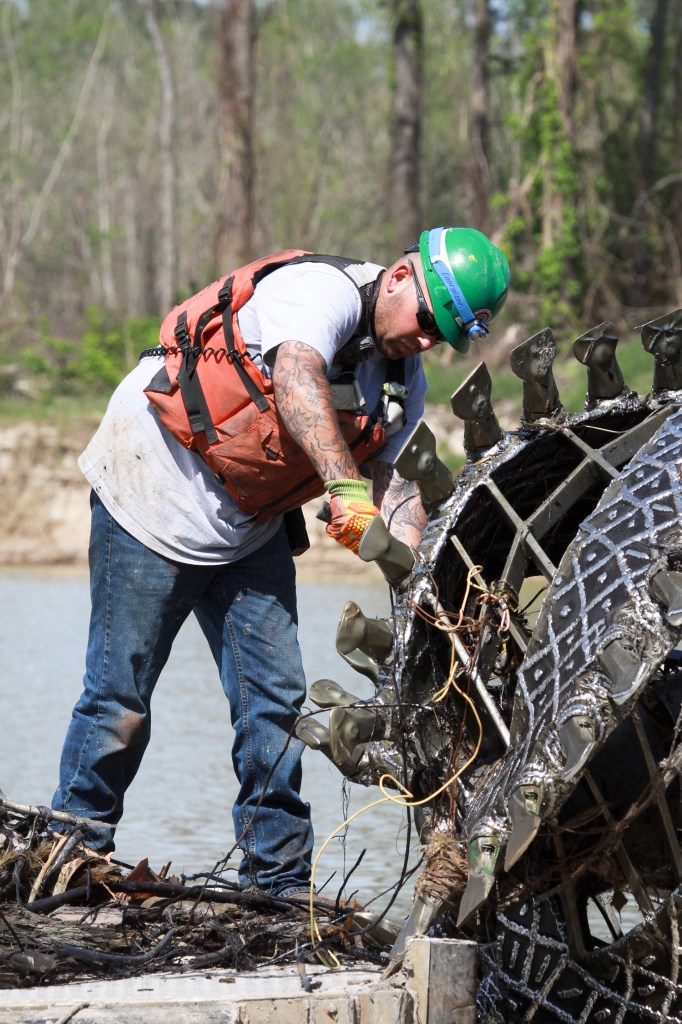
When that happens, productivity slows and crews must manually pick the material from the chisels on the dredge.
Note the pile of roots and sticks growing the men.
Here you get a better idea of how the roots and vines can clog the intakes on the cutter head. Dredging needs to stop many times each day to remove this material.
The “chisels” on the cutter head break up sand which the “cutter basket” then sweeps up. Pumps inside the steel cage suck the sand into the pipe and pump it back upstream to placement areas.
Once the dredge starts pumping again, the flow must be calibrated with three booster pumps attached to each line. At least one crew member mans each booster pump to coordinate with the others. They must avoid over- or under-pressure situations.
This shows a close up of one of the three booster pumps used by Great Lakes, the Army Corps’ lead contractor on the job. Callan Marine is a subcontractor to Great Lakes and also has three booster pumps.
This shot gives you an idea of how massive these pipelines are…
…and how much sediment they can pump per minute. There’s enough sediment moving here to fill up a dump truck in less than a minute.
The Eagle Sorters Mine is dredging this pit even as Army Corp contractors fill it up. Sand and silt recovered from the river may wind up in roadbeds or be used for mortar in the construction trades.

1.4 Million Cubic Yards Recovered to Date

Corps Engineers said that since Sept. 20, 2018, approximately 1.4 million cubic yards of Hurricane Harvey silt and debris have been pumped into the two placement areas. Ultimately, they expect to pump approximately 1.8 -1.9 million cubic yards to meet FEMA requirements, restore the river to pre-Harvey conditions, and to reduce flood risks.

Safety Warning

These images illustrate why boaters should stay away from the West Fork for now. It’s not safe. The FEMA funded emergency flood action should complete in early May, 2019.

Posted by Bob Rehak on 4/3/2019 with images courtesy of the Army Corps of Engineers

582 Days since Hurricane Harvey


Clock Starts Ticking on Army Corps Dredging Project

Officials from the U.S. Army Corps of Engineers (USACE) announced yesterday afternoon that representatives from Great Lakes Dredge & Dock Company, LLC of Oak Brook, IL, met with Corps’ contracting and project managers for a pre-construction conference. The meeting finalized project requirements for the $69,814,060 dredging and debris removal emergency operation and the clock has started ticking on the project.

The easterly limit of the U.S. Army Corps’ emergency dredging project on the West Fork of the San Jacinto.

The FEMA-funded project covers about two miles of the West Fork of the San Jacinto River near the West Lake Houston Parkway and Lake Houston. FEMA guidelines limit the operation to restoring pre-Harvey conditions.

Beginning of First Phase

“This is the beginning of the first phase of a very challenging project,” said Al Meyer, a USACE Galveston District administrative contracting officer.  “This project involves dredging and debris removal of 1.8 million cubic yards of sediment that has contributed to recent flooding in that area.”

The Focus for Next Week

He said the community should start to see activity within the next two-weeks. According to Corps Colonel Mark Williford, next week  teams will be engaged in:

  • Pre-dredge hazard surveys
  • Before-cut surveys
  • Disposal-area surveys
  • Staging-area set up

Meyer, a professional engineer with more than 35 years’ experience with the Corps, says the conference allowed project team members to interact with Great Lakes representatives to ensure a complete understanding of contract requirements.

“The clock starts today; our contractors have 270 days to complete the project that will work to reduce, but not eliminate flooding, and return the area to pre-Harvey conditions.” said Meyers.

Less than 4 Months from Survey to Dredging

This will be one of the first projects initiated as a direct consequence of Hurricane Harvey.

Corps surveying began in April to determine sediment levels within the West Fork of the San Jacinto River after FEMA responded to a State of Texas request under the Stafford Disaster Relief and Emergency Act of 1988. Since then, the Corps has developed models based on their survey findings, evaluated several different dredging plans, finalized specifications, bid the project, vetted the bids, awarded the job and started mobilizing for it.

The USACE Galveston District was established in 1880 as the first engineer district in Texas to oversee river and harbor improvements. The district is directly responsible for maintaining more than 1,000 miles of channel, including 250 miles of deep draft and 750 miles of shallow draft as well as the Colorado River Locks and Brazos River Floodgates.

Posted 7/19/2018 by Bob Rehak

324 Days since Hurricane Harvey