Tag Archive for: sediment

West Fork Sand Mine Sending Sediment Downstream from Settling Pond

5/17/2024 – The Hallett sand mine on the San Jacinto West Fork appears to have dug a trench across the maintenance road of its settling pond to lower the pond’s level. Murky wastewater is draining into the West Fork while the SJRA is currently releasing 10,875 cubic feet per second (CFS) from Lake Conroe in the wake of yesterday’s heavy rains.

Sediment released from the mine is being picked up by the Lake Conroe water and carried downstream. Note below how sediment has discolored the West Fork.

Picture taken 5/17/24, at the confluence of the West Fork, Spring Creek and Cypress Creek. Cypress joins Spring slightly upstream on the left. The branch on the right is immediately downstream from 20 square miles of sand mines between US59 and I-45.

Where The Sludge is Coming From

In the last few weeks I’ve posted extensively about how the West Fork has breached the dikes of a pit formerly owned by Hallett. As of this afternoon, the river continues to run through that pit. No attempt has been made by the new owner to re-establish the dikes. And that certainly contributes to downstream sedimentation.

But this afternoon, I discovered an additional source of sedimentation thanks to a tip from a nearby fishermen who stumbled across a breach in Hallett’s settling pond. See video below.

Video supplied by fishermen.

It’s hard to get a sense of the location from the close up, so here’s the location of the breach in a satellite image from Google Earth.

General location of breach and path to river in red oval.

And here’s a more detailed look at the path the water took on its way to the river.

Looking N. Silty water leaves Hallett’s settling pond through a trench dug in the tree-line. From there it flows through an abandoned sand mine and then through another breach into the West Fork.
Reverse angle shows silty water flowing out of Hallett settling pond into abandoned neighboring mine.
Detail cropped from shot above shows how heavy equipment worked the area.
Looking S downstream. Abandoned mine on left, West Fork in middle and breach through another pit on right.

Timing of Release Should Raise Eyebrows

The timing of this release is suspect: Friday afternoon just before regulators headed home for the weekend.

I’ve documented a history of breaches from this pond dating back to 2019 and the fishermen say they’ve seen breaches before that.

Hallett flushed water from this and other ponds after the January floods in 2024 but via different routes.

Lest you think I’m picking on Hallett, it isn’t the only sand mine emptying its settling pond into the West Fork.

I also documented an instance when the West Fork ran white from a release at the LMI Moorhead Mine upstream from Hallett. TCEQ estimated they released 56 million gallons of sludge into the river. That pond dropped 3-4 feet according to the TCEQ.

Regular Occurrence

The montage below shows the confluence of the West Fork and Spring/Cypress Creeks from different angles on different days. In all cases, the polluted branch was the West Fork. I took these shots while photographing West Fork sand mines from a rented helicopter.

Confluence

A former West Fork mine operator and a former water quality manager for the City of Houston tell me that releasing sediment-laden water under the cover of floods is standard operating procedure for many mines on the West Fork.

Who Will Bear the Cost of Clean Up, Dredging?

Think this doesn’t affect you? It affects your water quality and the cost of cleaning it up. Lake Houston supplies drinking water for more than two million people.

And if you live between the mines and Lake Houston, it probably will affect you another way.

Most sediment moves during floods. During Harvey, the West Fork swept through 20 square miles of sand mines between I-45 and I-69. According to the Army Corps, deposited sediment blocked the West Fork by 90%. That reduced the conveyance of the river and caused water to rise into homes and businesses. Almost 20,000 flooded in the Humble/Kingwood area.

Since then, taxpayers have spent more than $200 million on dredging. And the City is getting ready to launch another $34 million dredging program.

However, that program won’t address the mouth of the Kingwood Diversion Ditch at the River Grove Park boat launch.

KSA has obtained bids north of $800,000 to dredge the blocked area. Spending that kind of money will be necessary to keep the KSA boat launch open. It has become badly blocked by sediment during two floods since the start of the year.

Kingwood Diversion Ditch at River Grove Blocked by sediment
Here’s what that area looked like yesterday afternoon when the SJRA release rate was closer to 1500 CFS. Water level in river was still up about a foot above normal.

Living with sediment is all part of life on the river. But dredging intervals at River Grove have gone from 8 years before Harvey to 4 to 2 years since Harvey.

If this continues, KSA may be forced debate whether it can afford to keep the boat docks open.

Harris County Precinct 3 Commissioner Tom Ramsey, PE is trying to work with upstream authorities to reduce sedimentation that can lead to flooding. But it’s an uphill slog. No pun intended.

Posted by Bob Rehak on 5/17/2024

2053 Days since Hurricane Harvey

The thoughts expressed in this post represent opinions on matters of public concern and safety. They are protected by the First Amendment of the US Constitution and the Anti-SLAPP Statute of the Great State of Texas.

They Clearcut 533 Acres, Then Got 17 Inches of Rain

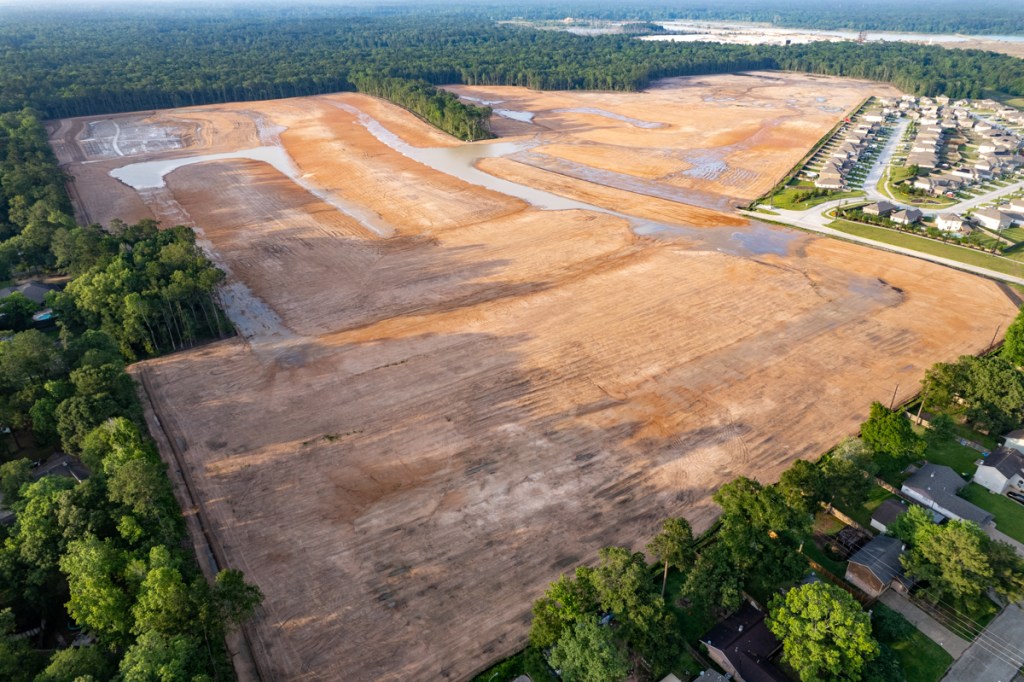
Construction is always the riskiest period during a development project. Especially when you clearcut 533 acres and get 17 inches of rain … in a week. However, thanks to best practices and luck, most people surrounding the Sila development in Huffman narrowly escaped what could have become a major disaster.

As the people in Woodridge Village learned repeatedly on far less rain, best practices can make all the difference. They lived near a development where stormwater detention basins were not built before the rain; the people near Sila did.

The new 553-acre Sila Project in Huffman on the East Fork of the San Jacinto seems to have had considerably less impact on neighbors. This is a story of people caught between a rising river and sheet flow coming down a slope.

Sila’s Similarities, Differences with Woodridge

Several similarities with the Woodridge project exist. Sila is big. Built on an identical slope. And clearcut. But after 17 inches of rain last week, the outcome was dramatically different.

Instead of flooding hundreds of homes below the development as Woodridge did, most residents near Sila only got water in their yards. One fish pond was ruined. At least two vehicles flooded. And at least one garage flooded.

The big differences between Sila and Woodridge?

Sila had already built stormwater detention basins. When the rain hit, a series of berms and ditches helped funnel runoff to the basins and away from neighbors. Silt fences intercepted much of the runoff. And crews replaced the fences when silt started to spill over the top.

Before looking at pictures, first let’s look at some stats that put the rainfall in perspective.

5- To 25-Year Rainfall

After Sila weathered this year’s January rains, it got slammed again in the week between April 29 and May 5 with almost 17 inches of rainfall.

Nearest official Harris County gage at FM1485 on East Fork San Jacinto showed 16.68 inches of rain fell in the seven days from April 29 to May 5.

That included 7 inches in one day. And half of that fell in one hour.

Of the 17 inches, 7.12 inches fell on 5/2/24 alone, with 3.48 inches in one hour.

NOAA defines a 7-day/17.1 inch rain in this area as a 25-year rainfall. Ditto for a one-hour 3.88 inch rain. Seven inches in one day, however, is only a 5-year event.

However, the East Fork peaked at FM1485 at a level equal to a 500-year flood according to Harris County Flood Control’s Flood Warning System. That’s because even heavier rain fell upstream in less time. It then reached FM1485 when heavy rains were falling there.

East Fork peaked over 77 feet at FM1485 on May 5.
According to HCFCD, 77 feet is more than a 500-year rain.

Also, according to HCFCD, to date, the area near FM1485 has received more than two thirds of a year’s average annual rainfall in about one third of the year – 34.72 inches!

Pictures Taken During Week of Heavy Rains

Northwood Country Estates resident Max Kidd provided many of the following photos taken at ground level during the flood.

They show mainly severe street flooding. Thankfully, Harris County Precinct 3 Commissioner Tom Ramsey’s crews had just finished cleaning roadside ditches. Otherwise these photos might have told a much worse story.

Water poured out of Sila across Northwood Country Road on 5/2, the day before the big rain.

On 5/3 and 5/4/24, Kidd took these photos.

Flooded home and vehicles.

Kidd believes the home above likely flooded from the East Fork. However, Sila runoff may have added to the flood depth.

Photos Taken After the Storm

Sila is so big that it’s hard to get it all in one shot. The aerial shots below were all taken on 5/6/24 after the rain ended.

Looking E across the southern portion of Sila. St. Tropez, a separate development is at very top of frame across FM2100. But Sila drains to the East Fork, and St. Tropez drains to Luce Bayou. Luce later re-enters the East Fork near its mouth at the headwaters of Lake Houston.
Sila had a swale behind the erosion to slow water running down a hill out of frame to the left. However, that swale filled in with sediment, according to Kidd. And water then flowed into a ditch behind the fence filling it with sediment, too.
Still, some sediment flooded into the backyards of neighbors.
A series of detention basins caught and channeled runoff through the development.
Shortly after the rain ended, it appears that bulldozers graded perpendicular to slopes to help retain or slow down any additional rain that might fall.

In the photo below, also note the forested corridors that break up Sila runoff. While large portions have been clear cut, those that haven’t help retain sediment.

Detention basin was holding water and emptying it slowly, presumably at the pre-development runoff rate.
Still, some sediment escaped the development. Note roadside ditch filling in at peak of triangle.

As I left after this photo session, I noticed workers replacing and reinforcing the silt fence above. But the photo below shows the volume of the sediment that escaped despite their efforts. A lot!

Drainage had filled in completely.
Kidd’s fish pond is no longer habitable by fish due to Sila runoff that polluted it.
Lowest of the detention basins at southwestern edge of development was sending stormwater into a wetland mitigation bank before it reached the East Fork.
Contractors had put silt fence at the outfall of the detention basin to help retain sediment.
But then they pumped water toward the river, through a mass of muck, creating more erosion. (Can’t win ’em all.)
Along the way to the river, some of the dirt will get a chance to settle out in the wetland mitigation bank.
Regardless, the East Fork was running orange on 5/6/24.

No doubt, several sources contributed to the discoloration. They include Sila, other upstream developments, sand mines and natural, river-bank erosion.

Few developments that I have observed go to as much trouble to control runoff as Sila. And few bother to leave trees these days. I wish more did. We might have less sediment clogging our rivers and contributing to downstream flooding.

Posted by Bob Rehak on 5/9/24

2445 Days since Hurricane Harvey

The thoughts expressed in this post represent opinions on matters of public concern and safety. They are protected by the First Amendment of the US Constitution and the Anti-SLAPP Statute of the Great State of Texas.

Flood Photos Raise Disturbing Sand-Mining Issues Again

Photos taken during last week’s flood raise disturbing questions all over again about sand mining so close to the San Jacinto.

Are:

  • Dikes strong enough? No.
  • Dikes high enough? No.
  • Setbacks from the river far enough? No.

Can:

  • Current flow through the mines? Yes.
  • The river stir up sediment? Yes.
  • The sediment escape the mines? Yes.

Will:

  • Miners convince legislators that the answers above are false? Yes.
  • More sediment in the river reduce conveyance downstream? Yes.
  • Anything change? No.

The sand mining photos below show dramatically that the river breached dikes, flowed through pits, stirred up sediment and carried it downriver. I have hundreds more, but these make the point.

Photos Taken May 3/4, 2024

In the picture below, the drainage channel bisects two abandoned sand mines that sit just downstream of the massive Hallett mine (out of frame to the left). Note current flowing from left to right and mixing with the clearer water in the drainage channel.

Northpark Channel approximately 3,000 feet back from where it normally enters West Fork beyond bottom of frame.

This photo and those below say at a glance how much sediment is being washed through and out of the sand mines.

Reverse angle in same area shows how large the mine complex is. At this point it is more than a mile wide (E to W) and 2.5 miles from N to S. River flows from upper right to upper left. Can you even tell where the river is?
Leak in dike of Hallett Mine into San Jacinto West Fork. Note water flowing over another dike into another pond in the background. River flows between the foreground and background.
Higher, wider shot from same area as above. Notice how river has penetrated Hallett pit on right in multiple places.
River flowed through that pit at the Hallett Mine on the San Jacinto West Fork.
Breach at far end of Hallett pit above has been open since January. Note river current cutting through pit and back into river at lower left. River flows from right to left.

Sediment Contribution to West Fork

The West Fork will remain above flood stage through tonight. It will be interesting to see how much new sediment works its way downstream. We will need a new river survey to document that.

The SJRA may also have to revise the conclusions of its recent sedimentation survey.

Luckily, the City of Houston has just started another dredging program to remove another 800,000 cubic yards of sediment above FM1960 where the East and West Forks come together.

Callan Marine getting ready to dredge northern part of Lake Houston

Good timing on that one.

Last question. Will the City be able to keep up with all the sediment coming downstream? No, in my humble opinion. At least not if we permit the sand mines to continue operating the way they do.

Gage readings at SH99 and US59 on the West Fork suggest that this was a 25 to 50 year flood. But the dikes should have been built to withstand a 100-year flood.

And while the mines above are built right next to the river, most other states require setbacks ranging from 100 to 1000 feet.

The Never-Ending Story

During Harvey, these same sand mines were implicated in contributing to the formation of sandbars downstream which reduced the conveyance of the West Fork. According to the Army Corps, the West Fork was 90 percent blocked in the area below. And that contributed to the flooding of thousands of homes and businesses.

South of the Kingwood Country Club’s Island Course, Hurricane Harvey deposited several feet of sand. It took the Army Corps months to dredge this area.

We seem to have developed a system whereby taxpayers subsidize miners. That only seems to encourage them to adopt more dangerous behaviors.

As one long-time resident who lives near the mines told me, “If Hallett thinks they can get away with something, they will try.”

In the miners’ defense, they claim they support the area’s growth. But that also entails clear-cutting thousands of acres. And you guessed it! That creates more erosion that clogs our rivers with even more sediment. More on that tomorrow.

The question is not whether we can live without sand mining. It’s whether we can have more responsible sand mining and development practices.

Posted by Bob Rehak on 5/7/2024

2443 Days since Hurricane Harvey

The thoughts expressed in this post represent opinions on matters of public concern and safety. They are protected by the First Amendment of the US Constitution and the Anti-SLAPP Statute of the Great State of Texas.

Search For Sediment Solutions Should Lead Straight to Colony Ridge

Harris County Flood Control, SJRA, and the Cities of Humble and Houston using funding provided in part by the Texas Water Development Board are searching for sediment solutions in the Upper San Jacinto River Basin. Their major scientific study includes all or parts of seven counties: Harris, Montgomery, Waller, Grimes, Walker, San Jacinto and Liberty – all land draining into Lake Houston.

From Technical Memorandum 1 of the Upper San Jacinto River Basin Regional Sedimentation Study.

The high-level goal: to better manage sediment in the river basin. Sediment reduces both floodway conveyance and the storage capacity of Lake Houston. Both contribute to the frequency and severity of flooding.

Among other things, the study partners hope to prioritize sediment hot spots so they can develop sediment solutions and recommendations.

I hope they look at Colony Ridge. It exemplifies a major hot spot and points the way to an obvious sediment solution – better enforcement of existing regulations.

Scope and Status of Sediment Study

The study is now about half complete. With much of the fieldwork complete, the partners will next focus on modeling, hotspot identification, area prioritization and sediment solutions, according to Matt Barrett, Water Resources and Flood Management Division Manager atSJRA.

To date, the study has examined a variety of factors:

  • Topographical characteristics (watershed size, length, slope, relief, etc.)
  • Land Cover (degree of development, forested percentage, agricultural, wetlands)
  • Soil Types and Erodibility
  • Meteorological (annual rainfall amounts and intensity).

The Colony Ridge area receives some of the highest rainfall totals and highest intensity rains in the river basin.

From Technical Memorandum #2 of the USJRB Sedimentation Study, Page 16. Colony Ridge location circled in red.

Colony Ridge also ranks among the most erodible areas in the entire river basin.

Soil erodibility in the basin. From Technical Memorandum #2, Page 13. Colony Ridge circled in blue.

So, you would hope that a development 50% larger than Manhattan, which is decimating forests and filling in wetlands would receive some scrutiny.

Colony Ridge erosion
Colony Ridge ditch has widened approximately 80 feet in 6 years due to lack of erosion control measures such as backslope interceptor swales and grass.
Colony Ridge is now 50 percent bigger than Manhattan
Rivers of mud in Colony Ridge. Even the erosion is eroding.
Guess which way to colony ridge
Sediment coming down the East Fork (right) from Colony Ridge
East Fork Mouth Bar cost $18 million to dredge.
San Jacinto East Fork Mouth Bar between Kingwood and Huffman cost $18 million to dredge.

Sediment Solutions Must Address Development Practices

Erosion occurs naturally. But poor development practices can accelerate the rate of erosion unnaturally.

Regulations in Liberty County call for backslope interceptor swales to prevent sheet flow over the sides of ditches. I have yet to see one such system anywhere in the 30+ square miles of Colony Ridge. What you typically see is this.

All that sediment washes downstream where it reduces the carrying capacity of rivers and the storage capacity of Lake Houston.

Liberty County regulations also call for planting grass on the side slopes of ditches and detention basins. The grass reduces erosion, too. But you don’t see much grass on those side slopes either.

Compare the ditch above with the ditch below in Harris County to see how grass and backslope interceptor swales can reduce erosion.

Small swales behind main slopes capture sheet flow heading toward the ditch. Pipes then take runoff to the bottom of ditch, thus reducing erosion on side slopes.

Here’s Colony Ridge again.

Three-mile-long Colony Ridge drainage ditch has no grass or backslope interceptor swales.

Address the Elephant in the Room Before the Next Disaster

Ironically, both Liberty and Harris County have almost identical regulations for erosion control. Harris County enforces them; Liberty County doesn’t.

Enforcement of development regulations is the elephant in the room.

So, as the SJRA and its partners search for sediment solutions, here’s one simple recommendation. Enforce regulations already on the books.

Colony Ridge and other developments that skirt regulations represent a disaster waiting to happen. Unfortunately, it will probably take a disaster, such as Harvey, to cause leaders to take action. But by then, it will be too late.

Posted by Bob Rehak on 10/20/23

2242 Days since Hurricane Harvey

The thoughts expressed in this post represent opinions on matters of public concern and safety. They are protected by the First Amendment of the US Constitution and the Anti-SLAPP Statute of the Great State of Texas.

How Development Delays Can Impact Flooding

For a variety of reasons, many new developments seem to be “on pause” these days. Developers clear and grade land. Then it may sit undeveloped for months or even years.

This leaves exposed soil unprotected by vegetation. That makes it more susceptible to erosion for longer periods. And the eroded soil can clog streams and creeks with excess sediment. That reduces conveyance and can contribute to potential flooding. The EPA classifies sediment as the most common pollutant in American rivers and streams.

I am not alleging that all of the developments below have flooded other properties – though some have. But in extreme storms, they may contribute to conditions that increase flood risk.

That raises the question: Can we reduce that risk? That, of course, requires understanding what’s slowing development. But let me show you some examples of stalled developments first.

Unprotected Soil

No one keeps statistics on how long cleared land remains undeveloped. But suddenly, it feels as though stalled developments surround us. Below are pictures of just a handful taken in the last few months near the Montgomery/Harris County border.

Royal Pines in Porter
Royal Pines in Montgomery County on White Oak Creek has flooded neighbors’ properties multiple times in the last six months. White Oak Creek actually rerouted itself across a portion of the development.
Royal Pines border with White Oak Creek (in woods). Note sediment escaping property into creek.
Royal Pines
After a 4-inch rain in January, White Oak Creek branched and started flowing across the cleared area.
Truck of Royal Pines neighbor one day after being washed. Flooding isn’t the only problem.

The neighbor stated that she spoke with the MoCo Engineers’ office last Friday and the stormwater detention plan still had not been approved. According to the neighbor, the developer was told by the county last January to submit revised detention and berm plans. The engineer also requested the developer to divert the runoff away from the neighbor’s property. But the developer evidently went ahead and built a detention basin without revising the plans. The development still floods neighbors’ property after every appreciable rain.

Los Pinos in Huffman

Phase I of Los Pinos in Huffman has sat virtually vacant for the better part of a year.

Saint Tropez in Huffman
Saint Tropez in Huffman, also vacant, drains into Luce Bayou.

Trailer Park in Hockley

New trailer park development in NW Harris County is sending sediment into the headwaters of Spring Creek. See below.

As you approach the creek, the slope increases…

…and despite the best efforts of the developer, sediment is escaping into the creek.
Hockley trailer park from ground
A river of mud…
Hockley trailer park from ground
…is flowing into Spring Creek.
Townsen Landing in Humble
A small part of Townsen Landing in Humble. The developer cleared land, but no homes have been built in the last year.
Valley Ranch in New Caney/Porter
Valley Ranch Medical Center construction in November 2021
20 months later they were building detention basins and channels to connect them. In March 2023, uncontrolled runoff was sending sediment into a ditch behind homes and businesses along FM1314.

Multiple Reasons for Development Delays

To do something about development delays, you need to understand the causes first. Those most often cited by developers and media have to do with:

  • Regulations. For instance, Magnolia officials enacted a moratorium on permit applications in December 2022 over concerns the city’s water supply couldn’t keep pace with growth in the area. The moratorium impacts new as well as current development projects.
  • Developers rank permitting delays as one of their biggest headaches.
  • Increasing land prices push developers into marginal, flood-prone land as a way to help control costs. But such land also causes permitting delays. Developers struggle with extra layers of studies and approvals from flood plain managers that can slow projects.
  • Rising interest rates that may undermine developers/builders economic assumptions.
  • Shortages of building materials. For instance, a global cement shortage, often linked to the war in Ukraine, makes planning difficult for land developers and road builders. According to a source at the Houston Contractors Association, Texas pours more concrete annually than the next two states (CA and FL) combined.
  • The pandemic, which led to other supply and labor shortages.

Such issues often loom larger for less experienced developers whose pockets may not be as deep as their more experienced competitors.

Regardless, silt fences are woefully inadequate in dealing with issues such as these.

Need to Re-Evaluate Construction and Permitting Practices

Some suggestions. Many areas do not require a permit to clear and grade land. Developers may begin the process assuming normal permitting time for their plans, but then run into unforeseen hiccups. As regulations have gotten more complex in the post-Harvey world, this has become increasingly common. Perhaps we need to require:

  1. Permit approvals before clearing and grading.
  2. Vegetated buffers around the perimeter of properties during development.
  3. Berms to protect neighbors and waterways during development
  4. Clearing and installing drainage in a portion of a property before moving onto another portion of the property (phased development).
  5. Governments throughout the region to standardize construction requirements.
  6. Governments to hire enough people to review plans a timely way.
  7. Some or all of the above.

Other ideas suggested by readers:

  1. Do not develop on land not suited for development in the first place.
  2. Stop developing so close to waterways.
  3. Zone land to allow natural drainage to exist in harmony with human occupancy.
  4. Keep some areas prone to flooding heavily vegetated permanently.

Half Billion Dollars for Sediment Removal

Sound expensive? Consider this.

Since Harvey, we have spent/plan to spend approximately a half billion dollars on dredging and sediment removal. Half of that has been spent on the East and West Forks of the San Jacinto, plus channels/streams around Lake Houston. The other half will be spent on sediment removal in:

  • Willow Creek
  • White Oak Bayou
  • Spring Creek
  • Little Cypress Creek
  • Greens Bayou
  • Cypress Creek
  • Barker Reservoir
  • Addicks Reservoir

We must find a compromise that works for everyone. People need places to live. Especially places that don’t flood.

Posted by Bob Rehak on June 7, 2023

2108 Days since Hurricane Harvey

The thoughts expressed in this post represent opinions on matters of public concern and safety. They are protected by the First Amendment of the US Constitution and the Anti-SLAPP Statute of the Great State of Texas.

Silty Detention Pond Flushed into Bens Branch

Contractors at the controversial mini rent home development called the Preserve at Woodridge Forest flushed a silt-laden detention pond into a stormwater channel leading to Bens Branch this week. The silty water migrated at least two miles downstream. The pictures below show the trail of silt.

On 4/17/22, Easter Sunday, I photographed a full pond and noticed a pump in the upper right (southeast) corner of the pond.

Looking east over Preserve at Woodridge Forest detention pond on Easter Sunday. Note pump in upper right and pond level.

Three days later, the pump was still going and the pond was nearly empty.

Pump still working on Wednesday.

The ditch between the Preserve and Kingwood Park High School was filled with identically colored water.

Color of water in ditch matches color of water in pond. Note pile of silt in ditch below pump hose in lower left.
Looking north past pump and the near-empty detention pond.
Equipment apparently cleared paths for northern end of pond to drain toward pump.

Where did all the silty water go?

Bens Branch south of Northpark Drive.
One block downstream, Bens Branch at Woodland Hills Drive.
Bens Branch at Tree Lane approximately 2 miles south of construction site. Resident Chris Bloch followed the pollution even farther downstream.

Fish Story

As I photographed the silty water above going down Bens Branch, two young boys with fishing poles came up to me. They looked at the water in disbelief and then looked at me quizzically. “Do you think it’s safe?” they asked.

“Hard to tell,” I said. “It’s runoff from a construction site upstream.”

They left without even dropping a hook into the water or saying a word. Smart kids.

Dangers of Sediment Pollution

The EPA published this brochure that explains some of the dangers of sediment pollution. Among them, it says, “Sediment in stream beds disrupts the natural food chain by destroying the habitat where the smallest stream organisms live and causing massive declines in fish populations. Sediment increases the cost of treating drinking water and can result in odor and taste problems.” Bens Branch empties straight into Lake Houston, the source of drinking water for 2 million people.

Sediment can also clog streams, reducing their carrying capacity. Harris County Flood Control recently cleaned out Bens Branch in a 4-phase project. According to the Kingwood Area Drainage analysis, it had been reduced to a 2-year level of service in places. That means it would flood on a 2-year rain.

No Permit Posted

For these reasons, the Texas Commission on Environmental Quality closely monitors construction sites. But the Preserve at Woodridge did not have a TCEQ Construction General Permit posted at the street. This web page seems to indicate they should have one. See Step 5. It says, “Before starting construction, post a copy of the Site Notice at the construction site. Leave the notice posted until construction is completed.”

Posted by Bob Rehak on 4/23/22, with thanks to Chris Bloch for alerting me to the story

1698 Days since Hurricane Harvey

The thoughts expressed in this post represent opinions on matters of public concern and safety. They are protected by the First Amendment of the US Constitution and the Anti-SLAPP Statute of the Great State of Texas.

FEMA Awards Nearly $250 Million to HCFCD for Sediment Removal

This morning, Harris County Flood Control District (HCFCD) announced an award of nearly $250 million from the Federal Emergency Management Agency (FEMA) to remove accumulated sediment from eight watersheds. They include:

  • Willow Creek
  • White Oak Bayou
  • Spring Creek
  • Little Cypress Creek
  • Greens Bayou
  • Cypress Creek
  • Barker Reservoir
  • Addicks Reservoir
Cypress Creek erosion near TC Jester. Photographed on 7/24/2021.

Removing More than 2 Million Cubic Yards Deposited by Harvey

Extreme flooding from Hurricane Harvey deposited the sediment when banks eroded and in some cases collapsed.

“This award allows us to continue the huge task of removing sediment from Flood Control District channels. It is estimated that more than 2.13 million cubic yards of sediment accumulated in multiple watersheds during the storm – enough to fill 213,000 dump trucks,” said Alan Black, Harris County Flood Control District Interim Executive Director. 

$6.25 Million Leverages Almost a Quarter Billion

“It will take several years to complete construction, but this award will allow us to make repairs to the drainage system and to restore the facility back to pre-disaster design, capacity and function. The federal cost share for this project is 90 percent, which allows our local taxpayer dollars to go further. We are extremely thankful to FEMA and TDEM (Texas Division of Emergency Management),” he continued.

The Flood Control District will be responsible for the remaining 10 percent of the project cost.  However, thanks to legislation passed by the Texas State Legislature in 2019, which established the Texas Infrastructure Resiliency Fund – Hurricane Harvey Account, the State of Texas is expected to reimburse up to 75 percent of that local share, bringing the total cost to the Flood Control District down to approximately $6.25 million.  

Construction to Start in Late 2022

According to Black, the cutting edge methods used by the Flood Control District team have rarely, if ever, been used on such a scale and took several years of close collaboration with TDEM and FEMA to receive approval.

As we have seen with other projects since Harvey, this is a complex process involving multiple steps. The money first has to work its way down from Washington. Then HCFCD must get it from TDEM. After that come preliminary engineering, final engineering, permitting, bidding, and approvals.

HCFCD expects first construction to start sometime in late 2022.

Posted by Bob Rehak on 8/9/2021

1441 Days since Hurricane Harvey

West Fork or Spring Creek: Which Contributes More Sediment to Lake Houston?

As the Lake Houston Area grapples with dredging, sedimentation surveys, sand trap studies and more, it’s important to understand where sediment comes from.

Month after month, I fly up and down the West Fork of the San Jacinto. More often than not, the confluence of Spring Creek and the West Fork (just west of I-69) looks like this.

West Fork (top) shows much more silt despite more flow coming from Spring Creek (left).

What Spring Creek Looked Like on Same Day

On this day (Friday, September 11), we took off from Intercontinental Airport and flew north over Spring Creek. Spring Creek looked like this.

Spring Creek north of Intercontinental Airport. Note how you can see the sandy bottom.

The difference in the water clarity is readily apparent. Yet in the 2000 Brown & Root study the authors said that Cypress and Spring Creeks contributed far more sediment. See Page 14. Sand miners, still quote and re-quote that study every chance they get.

What Accounts for Difference

So what accounts for the difference between the study and current visual observations? Mainly:

  • Upstream development
  • Sand mining
  • Storms that fall over one watershed, but not the other, on any given day

Twenty years after the Brown & Root study:

  • The heaviest development has shifted north into the West Fork watershed
  • Sand mining has expanded exponentially on the West Fork
  • Storms continue to fall over one or both watersheds.

Brown & Root’s findings on this one narrow issue (source of sediment) no longer reflect current conditions and visual observations.

Twenty square miles of sand mines between I-45 and I-69 have widened the West Fork tremendously since then, exposing far more sediment to floodwater. Worse, the mines’ dikes often breach, allowing millions of gallons of sediment to flow downstream. Even worse yet, the mines often pump water over the side of their dikes into the river or surrounding streams and forests.

The result is what you see above. Upstream from the sand mines, water flowed clearly on the West Fork, as it did on Spring Creek. Downstream, the West Fork looked like a sewer. The pictures below show some of the reasons.

Unless, otherwise noted, all the photos below were taken on 9/11/2020.

LMI River Bend mine. Not recent repair of breach and drainage ditch filled with silty water.
Same ditch goes under mine entrance. From there, the silty water goes into woods and then the West Fork.
At the LMI Moorehead mine, I spotted this pump.
At the same mine, this pipe and what looks like a fire hose send silty water into surrounding wetlands when the level in the pond at the right gets high enough.
One of the places where silty water enters the river.
Zooming out, you can see the source in the background.
Another mine where silty water leaks out of pits
The water collects in the woods and eventually flows into the West Fork.

The Result

This is the end result. The West Fork (top) is far more silty than flow from Spring and Cypress Creeks (left).

A Sampling of Previous Flyovers

West Fork (right), Spring Creek (left). Photo taken on 10/2/19.
West Fork (right), Spring Creek (left). November 4, 2019
West Fork (right), Spring Creek (Left). February 13, 2020
West Fork (top), Spring Creek (left). March 6, 2020.

I’m sure that when Brown & Root did its survey twenty years ago that Spring and Cypress Creeks contributed more sediment to Lake Houston. Today, however, I believe the West Fork contributes more.

It’s important to get this right if the community is to develop strategies that reduce the long term rate of sedimentation and save dredging dollars.

Posted by Bob Rehak on 9/18/2020

1116 Days after Hurricane Harvey

The thoughts expressed in this post represent opinions on matters of public concern and safety. They are protected by the First Amendment of the US Constitution and the Anti-SLAPP Statute of the Great State of Texas.

Woodridge Village Still Silting Up Taylor Gully

Despite countermeasures, such as silt fences and rock baskets designed to catch erosion, Woodridge Village is still silting up Taylor Gully. And this comes shortly after Harris County Flood Control just cleaned out the ditch to restore its conveyance.

Nicole Black-Rudolph captured these two photos downstream from Woodridge. They show the water in Taylor Gully at the Turtle Bridge in Woodstream. The first shows what the water normally looks like. The second shows what it looks like now.

Normal/Now Photos by Nicole Black-Rudolph showing increased silt in Taylor Gully.

Where Did Silt-Laden Water Come From?

Following Taylor Gully upstream, you come to 268 clear-cut acres – Perry Homes’ Woodridge Village. All pictures below show Woodridge Village on the morning of September 7, 2020. A nearby Elm Grove resident, Jeff Miller, reported .7 inches of rain fell in his gauge on 9/5 and 9/6. That wasn’t enough to cause flooding, but it was certainly enough to erode sediment as the pictures below show.

Looking SSW across Woodridge from the top of the N3 detention pond on the eastern border. Elm Grove is at top. Everything slopes toward Taylor Gully in the upper left.
Woodridge Village, looking NW from over Taylor Gully
Looking north at N3 detention pond day after rainfall. Silty water is still flowing out of the pond.
Looking east at the concrete lined portion of Taylor Gully on the Woodridge site where water exits the site and crosses into the open channel on the Harris County side of the county line, out of frame to the right (see below).
Looking south at Taylor Gully immediately south of the county line. Note how color of water in ditch matches the color of water on the right in the side-by-side comparison photo above.

Political Ping Pong

Perry Homes’ troubled development in Montgomery County has been caught in a political ping-pong match that has delayed either its ultimate build out or conversion into a regional detention facility. The match started in February when the City of Houston said Harris County should pay for the conversion. It has continued until now. Harris County Precinct One Commissioner Rodney Ellis keeps heaping one new condition after another on the sale of the property to Harris County Flood Control District.

Woodridge contributed to flooding Elm Grove Village in Kingwood (immediately to the south and across the Harris County line) twice last year. Perry contractors had clear cut 268 acres and filled in natural streams and wetlands that criss-crossed the property before fully installing detention ponds. When major rains stuck on May 7th and September 19th last year, sheet flow from Woodridge, coupled with water backing up in the streets of Elm Grove, flooded hundreds of homes. The area is still recovering.

Harris County Flood Control immediately started a project to restore the conveyance of the ditch which was badly silted, in part due to construction activities.

Now, despite best efforts to reduce erosion with conventional countermeasures, the exposed surface washes downstream with each rain. This re-deposits more sediment, which the Flood Control District just removed. (See two photos below from 2019.)

Taylor Gully Before 2019 Clean out.
Taylor Gully After 2019 Clean Out

Pray there’s movement on this deal soon. Perry Homes should plant grass on their property until the ping-pong match is over. Silt fences and rock baskets alone just don’t do the job.

Posted by Bob Rehak on 9/8/2020 with photos from Nicole Black-Rudolph and Rain Data from Jeff Miller

1106 Days since Hurricane Harvey and 355 since Imelda

The thoughts expressed in this post represent opinions on matters of public concern and safety. They are protected by the First Amendment of the US Constitution and the Anti-SLAPP Statute of the Great State of Texas.

Approximately 1,000 Plaintiffs File Suit Against Sand Mines in Harvey Flooding

On February 20th of this year, approximately 1,000 plaintiffs filed a 118-page lawsuit against 55 sand mining companies in the San Jacinto River Basin. Plaintiffs allege that the miners harmed them by decreasing the capacity and depth of Lake Houston and its tributaries by wrongfully discharging and negligently allowing the release of materials into waterways. That reduction of capacity, they say, contributed to flooding their homes and businesses.

Western half of LMI River Road mine in floodway and flood plain of San Jacinto West Fork. Note also in foreground how the mine undermined five pipelines carrying highly volatile liquids.

Background

To support their claims (¶613), plaintiffs cite violations of Texas Commission on Environmental Quality (TCEQ) regulations and the U.S. Clean Water Act. They claim:

  • Excessive, unauthorized discharge of silt into waterways
  • Failure to:
    • Obtain stormwater discharge permits
    • Prevent unauthorized discharges
    • Minimize generation of dust and off-site tracking

Past and Present Activities Cited

Some defendants, they say, operated above permit limits and others operated without any permits at all (¶614).

Plaintiffs say (¶615) that defendants have operated immediately adjacent to various waterways and in the flood plain, clearcutting all vegetation, and digging pits within feet of the riverbanks. Thus, there are no real barriers between mines and the rivers, they claim. Further, they allege that defendants have no plans in place for protection and preservation of their pits and loose sand during flood events, which occur frequently.

Then Came Harvey

Hurricane Harvey, they say, inundated mines and “thousands of acres of sand washed downstream, clogging the rivers and lakes, resulting in flood waters moving outside the banks and outside the flood plain, causing hundreds of millions of dollars in damages.”

Washed out road INSIDE sand mine during Harvey.
Submerged sand mines in the floodway of the San Jacinto West Fork during Hurricane Harvey in 2017

Alleged Violations of Water Code

The defendants had a duty to implement procedures to reduce the discharge of sediment into waterways, but did not, according to the plaintiffs. Thus, the proximate cause of plaintiffs’ injuries involved negligence and negligence per se. Defendants allegedly breached their duties under sections 11.086, 26.039, and 26.121 of the Texas Water Code, thus causing flooding and damage to plaintiffs’ property.

To prove negligence, personal injury plaintiffs must show that the defendants’ conduct fell below the applicable standard of care and that their actions were the actual and proximate cause of harm. 

In cases of negligence per se, defendants’ actions are assumed to be unreasonable if the conduct violates an applicable rule, regulation, or statute. That’s why lawyers cite the Texas Water Code, plus TCEQ and EPA regulations.

  • 11.086 of the Texas Water Code provides that no person impound the natural flow of surface waters, or permit impounding to continue, in a manner that damages property of another by the overflow of the water diverted or impounded.
  • 26.039 specifies that mine operators must notify the TCEQ of accidental discharges or spills that cause or may cause pollution as soon as possible.
  • 26.121 prohibits discharge of pollutants. Both the EPA and TCEQ consider sediment a pollutant.

Specific Omissions

Specific omissions, say the plaintiffs, include failing to:

  • Locate sand mines outside of floodways
  • Increase the width of dikes
  • Decrease the slope of dikes
  • Control erosion with vegetation
  • Replant areas not actively being mined
  • Protect stockpiles from flooding
  • Mine only above the deepest part of the river
Flooding from Hurricane Harvey in Kingwood’s Town Center where 100% of businesses were disrupted, most for approximately a year. Some still have not reopened. Photo by John Knoezer.

Nuisance Claim

The plaintiffs also allege nuisance. Under Texas law, nuisance refers to a type of legal injustice involving interference with the use and enjoyment of property. Specifically, plaintiffs say that the defendants’ negligent conduct caused paintiffs’ flooding, thus depriving them of the use of their homes.

Complaint against Forestar by Barrington Residents

On page 108, a subset of plaintiffs (those who live in the Barrington), lodge a complaint against Forestar (USA) Real Estate Group Inc. They allege that Forestar developed, marketed and sold homes in the subdivision without any standards for determining the elevation of a house relative to flood risk.

The Long Ride to Safety During Harvey. Barrington Photo by Julie Yandell.

“Despite having actual knowledge of the possibility of flooding in the Barrington Subdivision, Forestar did not advise homebuyers to purchase flood insurance,” says the complaint (¶640). “Nor did Forestar advise the residents of the Barrington Subdivision of its location on a floodplain, or that their elevations were changed due to lots being filled with dirt” when residents purchased homes.

Nevertheless, the complaint continues (¶643), homes were built at an “unreasonably low” elevation, given their location near the West Fork San Jacinto. “Forestar knew, or should have known, that houses needed to be built at an elevation adequate to prevent and/or reduce the likelihood of flooding.”

Clean out after Harvey in the Barrington. By Joy Dominique.

Damages Alleged

Plaintiffs allege damages that include:

  • Cost of repairs to real property
  • Cost of replacing personal property
  • Lost of use of real and personal property
  • Diminution of market value
  • Loss of income, business income, profits and business equipment
  • Loss of good will and reputation
  • Consequential costs, such as loss of time from work and alternate living expenses
  • Mental anguish
  • Pre- and post-judgement interest
  • Court costs

Conscious Indifference and Gross Negligence

¶658 asserts that the conduct of all defendants (sand mines and Forestar) qualifies as gross negligence under Texas law. The plaintiffs say that the defendants acts of omission involved an extreme degree of risk, considering the probability and magnitude of harm to others. Plus, “Defendants had actual subjective awareness of the risk involved in the above described acts or omissions, but nevertheless proceeded with conscious indifference to the rights, safety and welfare of plaintiffs and others.”

Where Case Stands

129th District Court Judge Michael Gomez signed a docket control order on 2/28/2020 that calls for:

  • All parties in the suit to be added and served with notice by 8/19/2020
  • Close of pleadings and start of mediation on 12/16/2020
  • End of discovery on 1/15/2021
  • All motions and pleas heard by 1/15/2021
  • Trial, if necessary, on 2/15/2021

To date, there have been several motions to transfer venue, dismiss the case, and change the judge.

Only Triple PG Sand Development, LLC has filed an answer to the plaintiffs’ claims; the company filed a general denial.

In a separate case, the Attorney General of Texas is suing Triple PG for failing to prevent and repair breaches in dikes that resulted in repeated unauthorized discharges of process wastewater and sediment into Caney Creek. Caney Creek joins the East Fork San Jacinto just downstream from Triple PG. Triple PG currently operates under an injunction that bars it from dredging.

Breach of Triple PG mine into Caney Creek and the headwaters of Lake Houston

Editorial Opinion

If successful, this case may force sand mines to operate more responsibly, now and in the future. For instance, it might force them to move farther back from rivers and out of floodways. Having taken thousands of photos of leaking sand mines from the air since Harvey, in my opinion, that might benefit everyone, not just the plaintiffs.

Giant sand bar at the mouth of the West Fork which backed water up through much of Kingwood, Atascocita and Humble.
Mouth bar on the East Fork San Jacinto grew by thousands of feet during Harvey and Imelda. Downstream from Triple PG and Texas Concrete Mines.

To read the entire lawsuit, click here.

Posted by Bob Rehak on August 2, 2020

1069 Days after Hurricane Harvey

The thoughts expressed in this post represent opinions on matters of public concern and safety. They are protected by the First Amendment of the US Constitution and the Anti-SLAPP Statute of the Great State of Texas.