It’s always nice to start the new year by looking at the big picture. And big pictures don’t get much bigger than this. The image below comes from NOAA’s Global Data Explorer. It shows sea surface temperature anomalies in the Pacific and Atlantic. Reds show areas with warmer than normal temperatures. Blues are cooler.
Sea surface temperature anomalies from 12/20/21 to 12/26/21. Source: NOAA.
Degrees of Variation
The dark red areas are a whopping 4-5 degrees Celsius above normal. The dark blues are 3-4 degrees Celsius below normal. It takes 1.8 degrees Fahrenheit to equal 1 degree Celsius. So in terms of the temperature scale that most people in the US use, that’s up to 9 degrees warmer and 7.2 degrees cooler – a 16.2 degree spread.
This helps to explain the record warm December we just had. Houston is in that band of red that stretches across the northern hemisphere. Also notice how red the Gulf of Mexico is.
According to the EPA, an increase in sea surface temperatures can lead to an increase in the amount of atmospheric water vapor over the oceans. “This water vapor feeds weather systems that produce precipitation, increasing the risk of heavy rain and snow.” And we just had extreme snowfalls from the Sierras to the Rockies.
Role of Ocean Currents
Ocean currents help distribute this moisture around the world. According to NOAA, “almost all rain that falls on land starts off in the ocean.”
“Ocean currents act much like a conveyor belt, transporting warm water and precipitation from the equator toward the poles and cold water from the poles back to the tropics,” says NOAA. “Thus, ocean currents regulate global climate, helping to counteract the uneven distribution of solar radiation reaching Earth’s surface. Without currents in the ocean, regional temperatures would be more extreme—super hot at the equator and frigid toward the poles—and much less of Earth’s land would be habitable.”
Cyclical Variation
Sea surface temperatures vary in cyclical, but irregular patterns (roughly every 3-6 years). Right now, we are under the influence of a La Niña pattern, that recurs every few years and can last as long as two years. This page on NOAA’s site explains what causes the changes. They often start with ocean currents veering off course for a period of time or stronger than normal trade winds.
Last week, the White House announced a government-wide initiative to make climate information more accessible and actionable. The effort targets individuals and communities hit by flooding, drought, wildfires, extreme heat, coastal erosion, and more.
Not everyone agrees on climate change. But we have all observed what happens when people fail to sufficiently heed climate risk. This effort to make climate information and science more accessible to the public is long overdue and welcome.
A better understanding of climate risks will empower communities to better prepare for them.
Below are 15 websites, reports and initiatives that may help those making important decisions about starting a business, buying a home, or protecting their communities.
NOAA’s redesignedClimate.gov. Upgrades to this website will better connect Americans to climate explainers, data dashboards, and classroom-ready teaching resources. It now better provides the public with clear, timely, and science-based information about climate. Climate.gov’s Global Climate Dashboard gives a data-driven readout on the state of the climate system with public-friendly explainers and answers to frequently asked questions. Climate.gov also provides access to commonly requested climate data and tools hosted by NOAA’s National Centers for Environmental Information.
Using an artificial intelligence platform to improve the search tool, allowing queries based on location so that users can find city and state-specific maps and data;
Cross-linking content to highlight all available resources sitewide that are relevant to each visitor’s unique interests;
Improving the mobile experience on tablets and smartphones; and
Redesigning pages with user experience and accessibility in mind.
These efforts build on FEMA’s announcement earlier this year of nearly $5 billion in funding available for community projects to prepare for extreme weather.
AnOffice of Science & Technology Policy (OSTP), NOAA, and the Federal Emergency Management Agency (FEMA) report on expanding and improving climate information and services for the public.
A Federal Geographic Data Committee report focusing on opportunities to enhance climate planning.
A FEMA initiative will assess National Flood Insurance Program standards to help communities update minimum floodplain management standards—which makes them eligible for federal flood insurance. The standards have not been substantially updated since 1976. But through a Request for Information, FEMA will gather stakeholder input to make communities more resilient while saving lives, homes, and money.
A report titled “Opportunities for Expanding and Improving Climate Information and Services for the Public,” charts a course for expanding accessibility and use of the federal government’s climate information to support all communities, including those who have been historically underserved, on climate planning and resilience activities. The report lays out opportunities to:
Focus climate services on the challenges that pose the greatest risks and opportunities
Foster interagency coordination and public-private partnerships
Enhance the usability of climate services for all Americans
The National Science Foundation will leverage its Societal Experts Action Network (SEAN) to support the work of National Climate Task Force’s Interagency Working Groups on Drought, Flood, Coastal, Extreme Heat, and Wildfire Resilience.
This information is a dream come true for weather wonks, science teachers and flood victims.
Posted by Bob Rehak on 10/17/2021 based on information provided by the White House, and thanks to FEMA’s Diane Innes Cooper for the heads up.
1510 Days since Hurricane Harvey
https://i0.wp.com/reduceflooding.com/wp-content/uploads/2021/10/20211017-Screen-Shot-2021-10-17-at-1.39.06-PM.jpg?fit=1200%2C724&ssl=17241200adminadmin2021-10-17 13:43:552021-10-17 14:59:27Government Moves to Make Climate Information, Decision Tools More Accessible
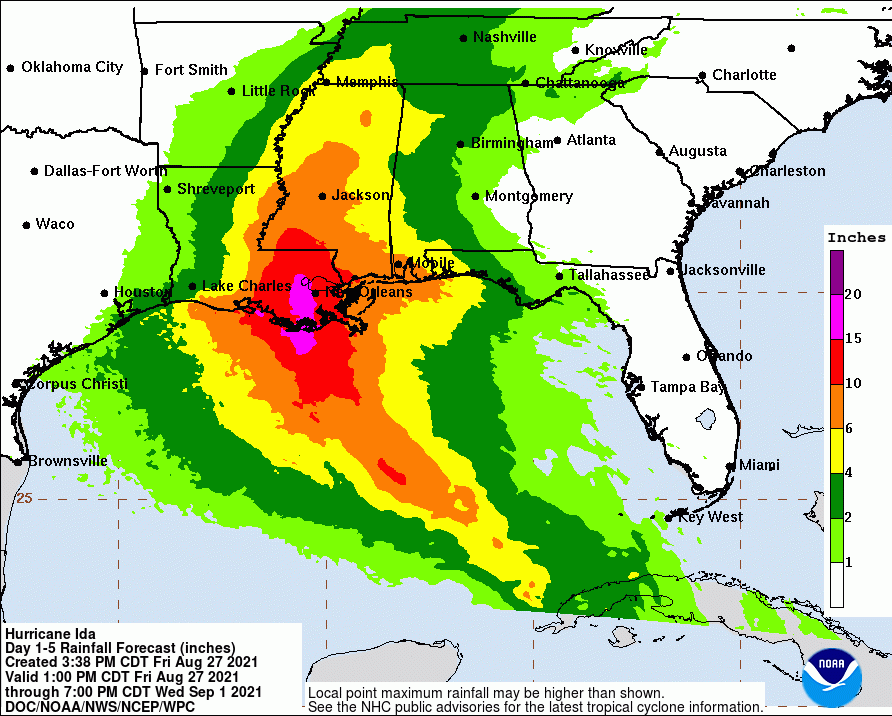
As of 3 p.m. CDT, the National Hurricane Center indicated Tropical Storm Ida had intensified into a hurricane about to cross over the western tip of Cuba. They warn that it could turn into a category 4 hurricane. It is currently predicted to cross over Louisiana, dump up to 20 inches of rain, and produce 15 feet of storm surge on Sunday.
Warnings Now In Effect
The NHC has also posted several warnings. They include:
Storm Surge Warning from Rockefeller Wildlife Refuge in Louisiana to the Mississippi/Alabama border.
Hurricane Warning for the coast of Louisiana including Lake Pontchartrain and Metropolitan New Orleans.
Tropical Storm Warning from the mouth of the Pearl River to the Mississippi/Alabama border.
Tropical Storm Warning for the coast of Louisiana from west of Intracoastal City to Cameron.
Hurricane Ida over the western tip of Cuba as of 3PM Houston timeon 8/27/2021
Rapid Intensification
According to the National Hurricane Center, radar indicated a closed eye 24 nautical miles wide. Recon aircraft measured winds at 70 knots – hurricane intensity – at 3 PM Houston time.
Once Ida moves past western Cuba and into the southeastern Gulf of Mexico, it will be moving through very warm waters, low wind shear, and a moist low- to mid-level atmosphere. These conditions should result in rapid strengthening during the next 24 to 36 hours.
In fact, with the higher initial wind speed, the intensity guidance has significantly increased.
Models now predict Ida will reach category 4 intensity. The NHC forecast explicitly calls for rapid intensification during the next 24 to 36 hours.
National Hurricane Center
Some fluctuations in intensity are possible as Ida nears the northern Gulf coast due to possible eyewall replacement cycles. Models also call for Ida’s wind field to expand while it moves over the Gulf of Mexico. As a result, there is higher-than-normal confidence that a large and powerful hurricane will impact portions of the northern Gulf coast by late this weekend and early next week.
Ida has wobbled a little right of the previous track, but the longer term motion continues to be northwestward at about 14 mph.
Tracking Quickly Toward Louisiana Then Slowing
Steering currents push Ida northwestward across the Gulf this weekend. But Ida after landfall they will also slow northward motion and cause the system to turn northeastward.
Key Messages
However, remember not to focus on the exact details of the track. Storm surge, wind, and rainfall impacts will extend far from the center, says the NHC.
1. Life-threatening storm surge and hurricane conditions will continue through tonight in portions of western Cuba. Life-threatening heavy rains, flash flooding and mudslides are expected across Jamaica, the Cayman Islands, and western Cuba, including the Isle of Youth.
2. There is a danger of life-threatening storm surge inundation Sunday along the coasts of Louisiana and Mississippi within the Storm Surge Warning area. Extremely life-threatening inundation of 10 to 15 feet above ground level is possible within the area from Morgan City, Louisiana, to the Mouth of the Mississippi River. Interests throughout the warning area should follow any advice given by local officials.
3. Ida is expected to be an extremely dangerous major hurricane when it reaches the coast of Louisiana. Hurricane-force winds are expected Sunday along the Louisiana coast, including metropolitan New Orleans, with potentially catastrophic wind damage possible where the core of Ida moves onshore. Actions to protect life and property should be rushed to completion in the warning area.
4. Ida is likely to produce heavy rainfall later Sunday into Monday across the central Gulf Coast from southeast Louisiana to coastal Mississippi and Alabama, resulting in considerable flash, urban, small stream, and riverine flooding impacts. As Ida moves inland, flooding impacts are possible across portions of the Lower Mississippi and Tennessee Valleys.
Story of the Storm in Picture
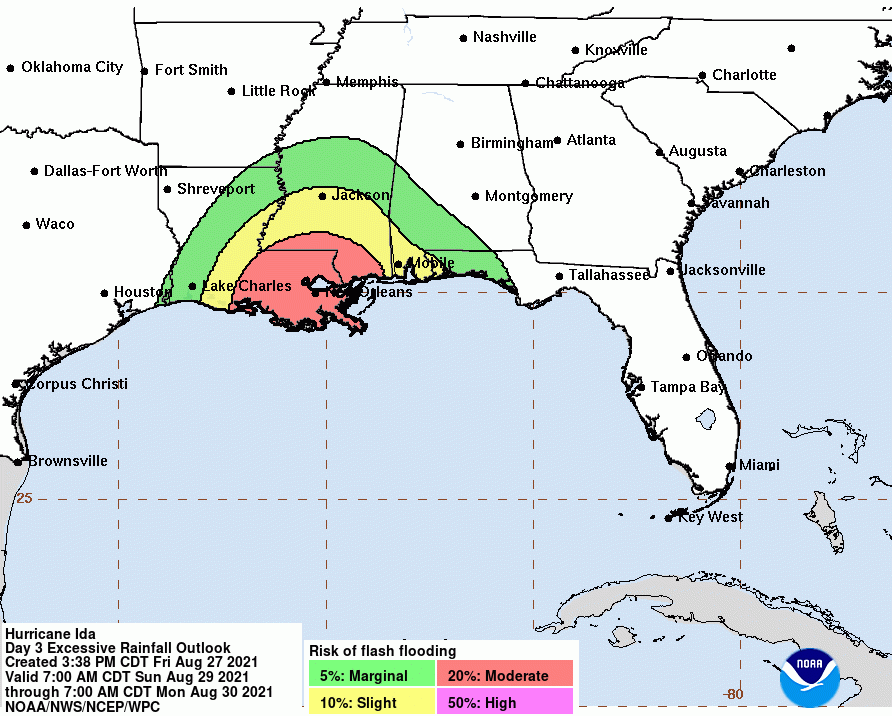
Confidence in track is increasing. Ida should reach the Louisiana and Mississippi coasts by Sunday afternoon.…but tropical-storm-force winds should arrive by Sunday morning.Most of the Houston area only has about a 10-30% chance of experience tropical-storm-force winds.And we have practically no chance of excessive rainfall that could create flash flooding.Portions of Louisiana, however, will like see 15-20 inches of rain.But the biggest threat by far to our neighbors will come from storm surge. Portions of the delta could see as much as 15 feet above ground level.
Prays for our neighbors. And thank God that we’re on the dry side of this storm. It should hit on August 29th, the fourth anniversary of when Hurricane Harvey triggered massive evacuations in the Lake Houston Area.
Posted by Bob Rehak on 8/27/2021
1459 Days since Hurricane Harvey
https://i0.wp.com/reduceflooding.com/wp-content/uploads/2021/08/155544WPCQPF_sm.gif?fit=892%2C716&ssl=1716892adminadmin2021-08-27 16:38:062021-08-27 16:40:37Ida Now Hurricane, Predicted to Intensify to Category 4, Take Aim at New Orleans
As of this 11 a.m this morning, the National Hurricane Center (NHC) says that Invest 99L has turned into Tropical Depression 9 (TD9). Satellite imagery now shows circulation in the area of low pressure over the west-central Caribbean which I posted about yesterday. Cuba and the Caymans have already issued tropical-storm warnings. Extremely heavy rainfall is expected there. And the storm should strengthen into a hurricane by Sunday. Yet the effects on the Houston region will like be felt offshore and in coastal areas.
Center of circulation starting to form. NOAA Satellite image as of 9:50 a.m. CDT on August 26, 2021.
TD9 Current Intensity and Location
The initial intensity of TD9 as of 11 a.m. Houston time is approximately 35 mph with gusts to 40. An Air Force Reserve reconnaissance aircraft is scheduled to be in the system later this afternoon to provide more information on the system’s structure and intensity.
TD9, now located just south of Grand Cayman, is moving northwestward at 13 mph. The National Hurricane Center (NHC) indicates the system should move steadily northwestward. That would bring the center near or over western Cuba late Friday, over the southeastern Gulf of Mexico on Saturday, and approaching the US Central Gulf coast on Sunday.
Models are in relatively good agreement regarding the track forecast for TD9. However, error at Day 4 is around 175 miles, so don’t focus on details of the long-range track forecast. Some shifts in the track are likely until the system consolidates and becomes better defined, according to the NHC.
The cone of uncertainty for TD9 at this point stretches all the way from Houston to Mississippi. Every point within the cone has an equal chance of being hit.
TD9 will move over warm waters of the northwestern Caribbean during the next 24-36 hours. This, in combination with low vertical wind shear and a moist environment, should allow for steady strengthening.
Rapid Intensification Likely in Next 48 to 72 Hours
NHC forecasts TD9 to become a tropical storm later today or tonight. It could approach hurricane strength as it passes western Cuba.
Once the system moves into the Gulf of Mexico, conditions support additional strengthening. The NHC forecast explicitly shows rapid intensification between 48 and 72 hours for now.
The NHC intensity forecast brings the system near major hurricane strength when it approaches the northern Gulf coast on Sunday.
NATIONAL HURRICANE CENTER
Most global models show significant intensification of TD9 over the Gulf of Mexico. As a result, there is higher-than-normal confidence that a strengthening tropical cyclone will be moving over the Gulf this weekend.
Key Messages
1. Tropical storm conditions are likely in the Cayman Islands tonight and western Cuba Friday, with dangerous storm surge possible in western Cuba.
2. The system will likely produce life-threatening heavy rains, flash flooding and mudslides across Jamaica, the Cayman Islands, western Cuba, and portions of the Yucatan Peninsula.
3. This system should approach the northern Gulf Coast at or near major hurricane intensity on Sunday, although the forecast uncertainty is larger than usual since the system is just forming. There is a risk of life-threatening storm surge, damaging hurricane-force winds, and heavy rainfall Sunday and Monday along the northern Gulf Coast from the Florida Panhandle to the upper Texas coast, with the greatest risk along the coast of Louisiana. Interests in these areas should closely monitor the progress of this system and ensure they have their hurricane plan in place.
Most of the Houston area has a 30-40% chance of experiencing tropical-storm-force winds from this storm.Tropical-storm-force winds could arrive by early Sunday morning.
Likely Hazards in Islands and Mainland
The main hazards associated with TD9 as it passes Cuba and the Caymans will be:
STORM SURGE:
2 to 4 feet above normal tide levels in areas with onshore flow. Near the coast, the surge will be accompanied by large and destructive waves.
WIND:
Tropical storm conditions are expected in the Cayman Islands tonight and Cuba on Friday.
RAINFALL:
The depression is expected to produce total rainfall accumulations of 6 to 10 inches with maximum totals of 15 inches across Jamaica. Rainfall totals of 8 to 12 inches with isolated maximum amounts of 20 inches are expected across the Cayman Islands, western Cuba, and the northeast Yucatan Peninsula. These rainfall amounts may produce life-threatening flash floods and mudslides. Rainfall from this system is likely to begin impacting portions of the central U.S. Gulf Coast by early Sunday.
SURF:
Swells generated by this system will begin affecting Jamaica, the Cayman Islands and Cuba tonight and Friday. These swells are likely to cause life-threatening surf and rip current conditions.
Lindner Cautiously Optimistic At This Point
Jeff Lindner, Harris County meteorologist believes, “Impacts along the upper TX coast will likely be increasing swells and minor coastal flooding at high tide late this weekend into early next week.”
Monitor forecasts closely in case things change and be prepared for anything. We still won’t reach the peak of hurricane season until mid-September.
Statistical peak of Hurricane Season is September 10.
Posted by Bob Rehak at noon on 8/26/2021 based on information from NHC and HCFCD
1458 Days after Hurricane Harvey
https://i0.wp.com/reduceflooding.com/wp-content/uploads/2021/08/144701_5day_cone_no_line_and_wind.png?fit=897%2C736&ssl=1736897adminadmin2021-08-26 12:23:532021-08-26 12:38:11TD9 Dumping Up to 20 Inches on Caymans, Hurricane Likely in Gulf by Sunday
Jeff Lindner, Harris County’s meteorologist, forecasts a potential hurricane threat for the western and northwestern Gulf of Mexico early next week. And it’s following the same track as Harvey – almost four years later to the day.
Current Location of 99L in South-Central Caribbean
A tropical wave currently designated 99L and moving westward in the Caribbean off the coast of Columbia still has no center of circulation. However, global models indicate that it will continue to develop over the western Caribbean Sea either Friday or Saturday and move into the south-central Gulf of Mexico over the weekend.
Area of Investigation 99L is that large blob between the eastern tip of Cuba and the northern coast of Colombia.99L on left should reach the southern Gulf by this weekend.
Still a Wide Range of Potential Tracks for 99L
There has been a significant shift during the last 24 hours to the right (east). The majority of the models now show 99L heading in the direction of the northwest Gulf of Mexico. However, models also show a wide range of potential tracks from northern Mexico to the Mississippi coast.
The black line is the most likely track but uncertainty remains high.
So, a fair amount of uncertainty exists in the forecast, especially since there is such spread in the ensemble guidance. The lack of a defined surface center at the moment increases that uncertainty.
Hurricane Harvey’s track in 2017. Note the similarity in area of origin and projected paths. Also note where Harvey intensified.
This weekend will be the fourth anniversary of Harvey. It’s eerie to note the similarities between that storm and this one.
Intensification Very Likely
Conditions over the Gulf of Mexico appear to be favorable for intensification.
Nearly all global models see 99L turning into a hurricane. Some see it turning into an intense hurricane in the Gulf by early next week.
Lindner warns that It is too early to start discussing impacts because of the uncertainty on the track. However, he does see increasing tides and 10-15 foot waves from Sunday into Monday. Rain chances will increase starting today and remain high into the weekend.
“Obviously,” says Lindner, “the forecast and potential impacts will have significant changes as the track become more clear in the coming days.”
Residents and interest along the TX and LA coast should review hurricane plans and make sure hurricane supplies are fully stocked. Monitor forecasts closely and frequently.
Posted by Bob Rehak on 8/25/2021 based on information from HCFCD, NOAA, NHC and Tropical Tidbits
1457 Days since Hurricane Harvey
https://i0.wp.com/reduceflooding.com/wp-content/uploads/2021/08/two_atl_5d0-3.png?fit=900%2C665&ssl=1665900adminadmin2021-08-25 11:39:052021-08-25 11:54:07So Far, 99L Headed Toward Gulf Along Same Track as Harvey
As we approach the 4th anniversary of Hurricane Harvey, the Atlantic basin is currently heating up with tropical activity. As remnants of one hurricane washing across New England, two more areas of concern move toward the Northeast. A third is heading toward the northwest Caribbean. It’s still too early to tell exactly where these storms will make landfall. But the presence of so many tropical disturbances signals the need to stay alert to daily weather forecasts.
Each of these storms has a 40-60% chance of tropical formation.
Five Day Outlook for Tropical Activity
8 PM outlook on 8/23/2021 indicates the storms heading toward the NW Caribbean have a 50% chance of tropical formation in the next five days. That’s up from 30% this morning.
Retreat of High-Pressure System Over Texas
National Hurricane Center (NHC) forecasts a tropical wave over the eastern Caribbean Sea will form a broad area of low pressure over the southwestern Caribbean Sea by late week. Thereafter, environmental conditions favor gradual development while the system moves west-northwestward to northwestward over the northwestern Caribbean Sea.
In addition to that, another major low pressure area over Mexico and the Bay of Campeche could move into the Gulf by this weekend though no tropical activity is forecast at this time.
Note massive low pressure system moving into Gulf.
Jeff Lindner, Harris County meteorologist, warns that as the high pressure ridge currently sitting over Houston begins to retreat north by Wednesday, “A series of tropical waves and disturbances will move from east to west across the US Gulf coast and into coastal TX from mid week onward. With a significant influx of Gulf moisture, showers and thunderstorms will return as early as Wednesday across much of the area and last likely into next week. Locally heavy rainfall will become an increasing threat by late week and this weekend with tropical moisture firmly in place over the region.”
Historical Norms for Late August
NOAA’s Climate Center shows that the projected path of the current areas of concern should follow historical norms for this time of the year.
This diagram shows the most likely areas for formation for hurricanes in August and their prevailing tracks. Source: NOAA’s Climate Center.
This is one of the reasons why.
Current sea surface temperatures in the Gulf are running 1.5 to 2+ degrees degrees above normal for the next seven days, with the warmer areas nearer the Texas Coast.
Historical Intervals Between Major Hurricanes
NOAA’s Climate Center shows the average interval for major hurricanes striking the Houston area is about every 25 years.
NOAA’s Climate Center also tracks the average return period for MAJOR hurricanes at various points along the coastline. They show that the Houston area can expect on average one major hurricane about every 25 years.
Of course, a hurricane doesn’t have to be major to cause major damage. Allison and Imelda were just tropical storms. And averages are just that – averages. Ike in 2008 and Harvey in 2017 each attained major hurricane status and hit Houston within 9 years of each other.
Posted by Bob Rehak on 8/23/2021 based on information from NHC and HCFCD
1455 Days since Hurricane Harvey
https://i0.wp.com/reduceflooding.com/wp-content/uploads/2021/08/two_atl_5d0-2.png?fit=900%2C665&ssl=1665900adminadmin2021-08-23 20:07:252021-08-23 20:10:00Atlantic Basin Heating Up with Potential Tropical Activity
Below is a quick digest of six flood-related stories affecting the Lake Houston Area.
Dredging is a Slow Go
Mechanical dredgers are slowly working their way through the channel south of Royal Shores. It connects the East and West Forks of the San Jacinto. Without dredging, the dredging equipment itself would not be able to make it through the channel.
However, the pace of the dredging is painfully slow. You can see the progress by comparing the two pictures below. I took them 22 days apart.
Taken on July 11, 2021Taken on August 2, 2021. Google Earth shows they went a little more than 600 feet in a little more than three weeks.
At about 200 feet per week with about 2,000 more feet to go, they should reach the East Fork in about another ten weeks.
Several boaters have commented on how the dredges can wait hours for a pontoon to ferry dirt back to the placement site. Their net takeaway: very inefficient. During a July 8 meeting at the Kingwood Community Center, Stephen Costello called this method of dredging “unsustainable.” He’s sooooo right. We will run out of luck long before we run out of places to dredge.
Mechanical dredging (shown in the photos above) is far slower and less efficient than hydraulic. Great Lakes hydraulic dredges removed 500,000 cubic yards of sediment from the mouth bar area in just two months – July and August of 2019. DRC’s mechanical dredges removed another 600,000+ cubic yards in the 19 months between January 2020 and July 2021.
Interestingly, Google Earth shows that when the dredgers reach the East Fork, they will be closer to the Triple PG Sand Mine in Porter than the current placement area south of River Grove Park. The Triple PG mine will also be less than half the distance of a mine that the Army Corps previously pumped spoils to from the mouth bar– the Eagle Sorters Mine on the West Fork.
Hmmmm. Triple PG. A placement area for East Fork spoils? A return to hydraulic dredging? Interesting thoughts.
Seasonal Lowering of Lake Conroe
Seasonal lowering of Lake Conroe has started as planned. SJRA is releasing 75 cubic feet per second, according to their dashboard.
Seasonal release is shown as a City of Houston (COH) Diversion.
When the lowering started on August 2, a day late, the lake was at 200.87. So releasing 75 CFS has brought the lake down .19 feet, a little more than 2 inches. Barring large rainfalls, this rate should reach the objective of 200 feet by September 1.
The National Hurricane Center shows two areas of concern in the Atlantic as of 2PM, Friday August 6th.
A few hundred miles south of the Cabo Verde Islands, a tropical wave (orange area) and a broad area of low pressure could turn into a tropical depression by late this weekend or early next week. Formation chance through 5 days…medium…60 percent.
Another tropical wave approaching the Lesser Antilles is a lower threat. NHC predicts development, if any, of this system will be slow and occur early next week. Formation chance through 5 days…low…20 percent.
NOAA Issues Mid-Season Hurricane Outlook
Another forecast released two days ago by NOAA says that atmospheric conditions are still conducive for an above-average hurricane season. See their predictions in the right hand column below. These numbers include the five named storms so far this season.
Attorney General Lawsuit Against Triple PG Mine Still Active
Craig Pritzlaff of the TCEQ assures me that despite visible lack of progress in the Attorney General’s lawsuit against the Triple PG mine for illegal discharges, the AG has not dropped the case. “Indeed, very few, if any, cases referred to the AG for civil prosecution are ever dropped,” he says. “Litigation, particularly environmental litigation, is a complicated and lengthy process. That process was further complicated by the COVID-19 pandemic, which halted court dockets across the State throughout 2020 and into 2021.”
Condos 250 Feet from 250,000 CFS
A Chinese developer is building yet more condos even closer to the West Fork in the Kings Harbor neighborhood.
See new construction bottom center. Lai finished the units at the right earlier this year. The nearest unit above will be about 250 feet from the San Jacinto West Fork.
During Harvey, more than 250,000 cubic feet per second came through this area. It flooded homes and businesses more than 10,000 feet from the river.
The thoughts expressed in this post represent opinions on matters of public concern and safety. They are protected by the First Amendment of the US Constitution and the Anti-SLAPP Statute of the Great State of Texas.
https://i0.wp.com/reduceflooding.com/wp-content/uploads/2021/08/20210802-DJI_0286.jpg?fit=1200%2C799&ssl=17991200adminadmin2021-08-06 16:46:402021-08-07 19:38:36Digest: Updates on Six Lake Houston Area Flood-Related Stories
NOAA has updated its climate statistics for the U.S. Every 10 years, the agency comes up with a “new normal” based on the last 30 years of data. The most recent 30 years, compared to previous averages, shows that our climate is getting hotter and wetter (at least in the Houston area).
Screen capture showing new “normal” temperature and precipitation for Houston Intercontinental Airport. Blue line represents precipitation. Orange = ave. minimum temp. Red = average temp. And dark red = average max temp.
Same data in tabular format.
The “normals” help farmers, energy companies, water managers, transportation schedulers and others whose businesses depend on weather plan their activities. That includes your local TV weather casters who constantly compare what they predict for tomorrow with what has happened in the past.
What’s Normal – From 30 years Down to The Hour
The NOAA stats come in annual, seasonal, monthly, daily and even hourly tables. Because the normals have been produced since the 1930s, they also help put current weather in a historical context.
The New York Times produced a series of animated “heat” maps that show changes in temperature and precipitation for those 30-year windows from the 1930s to today. Heat maps in this sense do not refer to temperature but to colors that reflect temperature or precipition differences. Hotter colors like red and orange reflect increases. Cooler colors like green and blue reflect decreases.
Choose Your Start/Stop Points Carefully
Curiously, the animations show the U.S. getting both hotter and colder through the decades. Likewise with wetter and drier. You can clearly see alternating cycles of hot and cold, wet and dry. As cycles come and go, where you chose your start and stop points lets you support or disprove your favorite climate change hypothesis.
The change is especially drastic between the new normals and the previous ones, from 2010. “Almost every place in the U.S. has warmed,” Dr. Michael Palecki told the Times. He manages the project at NOAA’s National Centers for Environmental Information.
Palecki claims the world has warmed by more than 1 degree Celsius (about 1.8 degrees Fahrenheit) since 1900, and that the pace of warming has accelerated in recent decades.
However, if you compared 1921-50 with 1941-70, you might think the world was cooling. The same goes for large parts of the county with dry/wet cycles. Although the Houston region has experienced increasing wetness on a fairly consistent basis, you can see drought ebb and flow through other parts of the country.
If you use 1900 as your start point and today as your stopping point, Palecki says the world has warmed by more than 1 degree Celsius (about 1.8 degrees Fahrenheit) and that the pace of warming has accelerated in recent decades. The precipitation maps show the Southwest becoming increasingly drier, while the Central and Eastern parts of the country are getting wetter.
These two “heat” maps show the change in average annual precipitation and temperature during the previous 30-year reporting period and today’s.
Says NOAA, “Most of the U.S. was warmer, and the eastern two-thirds of the contiguous U.S. was wetter, from 1991–2020 than the previous normal period, 1981–2010. The Southwest was considerably drier on an annual basis, while the central northern U.S. has cooled somewhat.”
For More Information
Check out the fascinating NY Times article or go straight to NOAA for far more detailed information.
Like all NOAA statistics, they are publicly available. You can even customize your own data searches based on time and location.
Posted by Bob Rehak on 5/13/2021 based on information from The NY Times and NOAA
1353 Days since Hurricane Harvey
https://i0.wp.com/reduceflooding.com/wp-content/uploads/2021/05/Screen-Shot-2021-05-13-at-1.24.08-PM.png?fit=2200%2C836&ssl=18362200adminadmin2021-05-13 13:44:502021-05-13 13:50:52NOAA Adopts New Normal: Hotter, Wetter
Borenstein says, “Over the past couple decades, meteorologists have been increasingly worried about storms that just blow up from nothing to a whopper, just like Delta. They created an official threshold for this dangerous rapid intensification — a storm gaining 35 mph in wind speed in just 24 hours.”
This NOAA water vapor image of Hurricane Delta makes the storm look like a giant splash in the atmosphere.
Delta was the sixth storm this year and the second in a week to reach that threshold for rapid intensification. Harvey was also such a storm.
Borenstein interviewed an MIT hurricane scientist named Kerry Emanuel. “This is not only happening more often, it is more dangerous,” said Emanuel. ““If you go to bed and there’s a tropical storm in the Gulf of Mexico and you wake up the next morning with a Category 4 about to make landfall, there’s no time to evacuate.”
Why So Many?
Some scientists attribute the trend to global warming, which they say increases sea-surface temperatures and makes rapid intensification possible.
Harris County Meteorologist Jeff Linder said, “Rapid intensification is due to a number of possible local factors. They include warm sea surface temperatures, light upper level winds, high moisture levels and storm structure. Some of this, especially sea surface temperatures, could be affected by climate change. El Niño and La Niña could affect the wind shear patterns making such intensification more likely at certain times. However, much of this is storm dependent on conditions with a particular storm.”
Whatever the reason, rapid intensification is an alarming trend. As our neighbors in Louisiana will confirm, it calls for a higher level of alertness.
Posted by Bob Rehak on 10/9/2020
1137 Days since Hurricane Harvey and 386 since Imelda
https://i0.wp.com/reduceflooding.com/wp-content/uploads/2020/10/1000x1000-1.jpg?fit=1000%2C1000&ssl=110001000adminadmin2020-10-09 07:28:502020-10-09 07:37:59NOAA Now Tracking Rapid Intensification of Storms
Instead, regular smaller rains kept the lake close to its monthly averages. Neither drought nor excessive heat caused lake levels, property values, business or tax revenues to plummet. Everything functioned much as it normally has since Lake Conroe was built in 1973.
Lake Stayed Near Monthly Averages
In the two months between April 1 and May 31, the lake only dropped below 200 feet by an inch or two for three or four days and then promptly refilled. In fact, at the end of May, 2.5 inches of rain caused the lake to rise above its seasonal norm, prompting a second release.
Two releases and smaller, spread-out rains kept the Lake Houston Area safe and Lake Conroe close to its monthly averages(200.32 for April and 200.44 for May; see below).Source: SJRA Board Presentation 7/23/20. Lake Conroe seasonal levels by month for 46 years. In April and May, Lake Conroe averages 200.32 and 200.44 respectively.Source SJRA Board Presentation.
During that time, the Lake Houston Area never flooded. Yet Lake Conroe was above its monthly average for the first three weeks of April. And it was only down about three inches for about three weeks in May.
The assertion that Lake Conroe is “normally” at 201 is a myth. That is the level at which the SJRA normally starts releases. Due to evaporation, which can take an inch a day, the lake is almost always well below that. A more accurate term for 201 would be “full pool.”
River Levels Up Slightly, but No Flooding
West Fork river levels rarely rose more than 2 or 3 feet even when rainfall was added to the release rate from Lake Conroe.
Release rates averaged about 600 cubic feet per second (cfs) and rarely exceeded 1000 cfs.
If the exercise proved anything, it was that releasing at those rates didn’t flood anyone.
River levels vs. rainfall for the last two weeks of the spring lowering.Source: SJRA Board Presentation 7/23/20.
Fall Lowering Starts This Saturday
The Houston Area lucked out with Hanna. Had the storm veered towards us, we would have received the torrential rains that swamped the Valley.
This fall, the lowering will be split into two phases: to 200 feet in August and 199.5 in September. The City of Houston has the right to call for an additional half foot in the event of a named storm.
Restatement of SJRA lake lowering policy for this year.Source: SJRA Board Presentation 7/23/20.
Even though Hanna missed us and Gonzalo fizzled, the next storm may not.
Finally, note that the target level for August (200 feet) is about an inch ABOVE the normal monthly average. So if evaporation does its job, the SJRA will not have to lower the lake.
Posted by Bob Rehak on 7/27/2020
1063 Days after Hurricane Harvey
https://i0.wp.com/reduceflooding.com/wp-content/uploads/2020/07/Release-Vs.-Lake-Levels.jpg?fit=1500%2C836&ssl=18361500adminadmin2020-07-27 16:12:472020-07-27 16:12:58SJRA Report on Spring Lowering of Lake Conroe