According to Beth Walters of the Harris County Flood Control District (HCFCD), work on the upstream portion of Taylor Gully in Kingwood will begin on Monday, July 15, weather permitting. There’s still uncertainty regarding the local impact of Tropical Storm Barry, however, equipment has already started showing up at the job site.
Taylor Gully at the county line is half blocked with silt due to erosion from the clearcut area in the Woodridge Village development behind this culvert.Photo courtesy of Jeff Miller.
From Bassingham to Harris County Line
The work will extend from Bassingham to the Harris County line where the Gully meets the new Woodridge Village development in Montgomery County.
Scope of Work
This work will include the following:
Desilt the channel
Reconstruct the backslope interceptor structures
Install new backslope interceptor pipes
Regrade backslope swales
Install new gates
Install new “No Trespassing Signs”
Re-Set the covers of the “E type” inlets that have been damaged
Next Steps
After completing this reach of the channel, HCFCD staff will investigate Taylor Gully further downstream, where HCFCD completed a desilt job in the spring of 2019, from Bassingham to the downstream end. HCFCD will open up any constrictions and desilt the channel if necessary.
Vital for Flood Mitigation
Approximately 200 homes near this channel flooded during the May 7th storm. According to residents, video taken during the storm, and still photos taken after the storm, overland sheet flow from Woodridge Village was the likely cause of their problems. Regardless, news of this effort will come as a great relief to Elm Grove and Woodstream residents who welcome every extra margin of safety they can get.
Kudos to the flood control district for jumping on this project. Commissioners Court approved the right of way acquisition only last Tuesday!
Work on Montgomery County Portion of Gully Also Proceeding
Elm Grove resident Jeff Miller also reported today that Woodridge has expanded a portion of Taylor Gully that runs through Montgomery County. Where the east/west portion of the ditch makes a 120 degree turn and starts heading south along the western border of North Kingwood Forest…
This corner and the portion of the ditch that extends straight down were expanded this week.
… the contractor widened the ditch and expanded the turn.
Dozens of homes flooded in North Kingwood Forest (left side of photo behind tree line) on May 7. This ditch had a tiny portion of current capacity at the time (see below). Photo courtesy of Jeff Miller.
For comparison, here is what the same ditch looked like on May 12.
Same ditch as above adjacent to North Kingwood Forest (on left) but on May 12.
To see what the entire turning radius NOW looks like, see this video.
Video courtesy of Jeff Miller.
More good and welcome improvements. Just wish they had been in place before May 7th.
Posted by Bob Rehak on 7/13/2019 with help from Jeff Miller.
683 Days after Hurricane Harvey and Two Months after the Elm Grove Flood
https://i0.wp.com/reduceflooding.com/wp-content/uploads/2019/07/IMG_2433-1.jpg?fit=1200%2C900&ssl=19001200adminadmin2019-07-12 20:06:372019-07-12 20:06:46Rehab Work to Begin on Upstream Portion of Taylor Gully Monday, July 15
Jeff Miller, an Elm Grove resident, just reported receiving a note from Harris County Flood Control District (HCFCD). Will Sherman, HCFCD’s Precinct 4 coordinator, indicated the following.
Plans for Taylor Gully
The right-of-way transfer to HCFCD for the upper portion of Taylor Gully (see map below) is scheduled to be on the next Commissioners Court agenda on July 9th.
HCFCD right of way access along Taylor Gully (left) should be complete by July 9.
That portion of Taylor Gully has become badly clogged with sediment due to the construction of Woodridge Village upstream just across the Montgomery County line.
Part of the erosion in the area clearcut for the new Woodridge Village subdivision. Tree line on the left is the Harris/Montgomery County Line. No erosion control measures were in place at the time of this photo during the heavy rains in early May.
Here’s what Taylor Gully looked like on 6/24/19.
Reinforced concrete box culvert on Taylor Gully at the Harris/Montgomery County Line. 10′ high culverts appear to be half clogged with sediment. Harris County is in foreground. Woodridge Village and Montgomery County are in background.Photo by Jeff Miller.
HCFCD plans to do it again “soon” as part of a general debris removal process on multiple channels in Kingwood.
The wider effort should begin this August.
Blockage on lower portion of Taylor Gully. Photo courtesy of Chris Kalman.When banks erode and trees fall into ditches and creeks, the trees can catch other debris floating downstream and form “beaver dams” that back water up into neighborhoods.
Work on Ben’s Branch Expanded
Yesterday, HCFCD extended its work on Ben’s Branch west of Woodland Hills. They excavated the area between North Woodland Hills and the businesses on the south side of North Park Drive (Walgreens, Firestone, McDonalds, etc.).
HCFCD maintenance work along Bens Branch west of Woodland Hills Drive in Kingwood. Photo courtesy of Thomas Blailock.
To Report Blockages Near You
If you are aware of downed trees blocking a channel near you:
Photograph it using a cell phone (most of which embed GPS coordinates in images)
Record the nearest street location and trail-access points
With contributions from Jeff Miller, Thomas Blailock and Chris Kalman
673 Days after Hurricane Harvey
https://i0.wp.com/reduceflooding.com/wp-content/uploads/2019/07/IMG_2433.jpg?fit=1200%2C900&ssl=19001200adminadmin2019-07-03 16:39:352019-07-03 17:07:47HCFCD Schedules Maintenance for Taylor Gully, Other Ditches
“Equity” proponents would have you believe that Harris County flood mitigation money is all going to high-income neighborhoods. However, data obtained from Harris County Flood Control under the Freedom of Information Act shows that construction spending for flood mitigation is highly concentrated in Precinct 1, which contains many low-to-moderate-income neighborhoods.
At the last Harris County Commissioner’s Court meeting, the issue of “equity” in the prioritization of bond funds came up again. Commissioner Rodney Ellis from Precinct 1 invited several groups to testify about how Low-to-Moderate Income (LMI) groups suffered at the expense of more affluent areas like Kingwood.
Alleged Bias Against LMI Groups Distorts True Picture
They alleged bias against LMI groups by focusing on only one aspect of flood mitigation: buyouts. They said that high-income areas received preference over low-income areas when buying out flooded homes. That’s because of higher home values and thus higher repetitive losses. However, by focusing on this one issue, and ignoring the big picture of Flood Control construction spending, these groups distort the true picture of where flood mitigation dollars actually go.
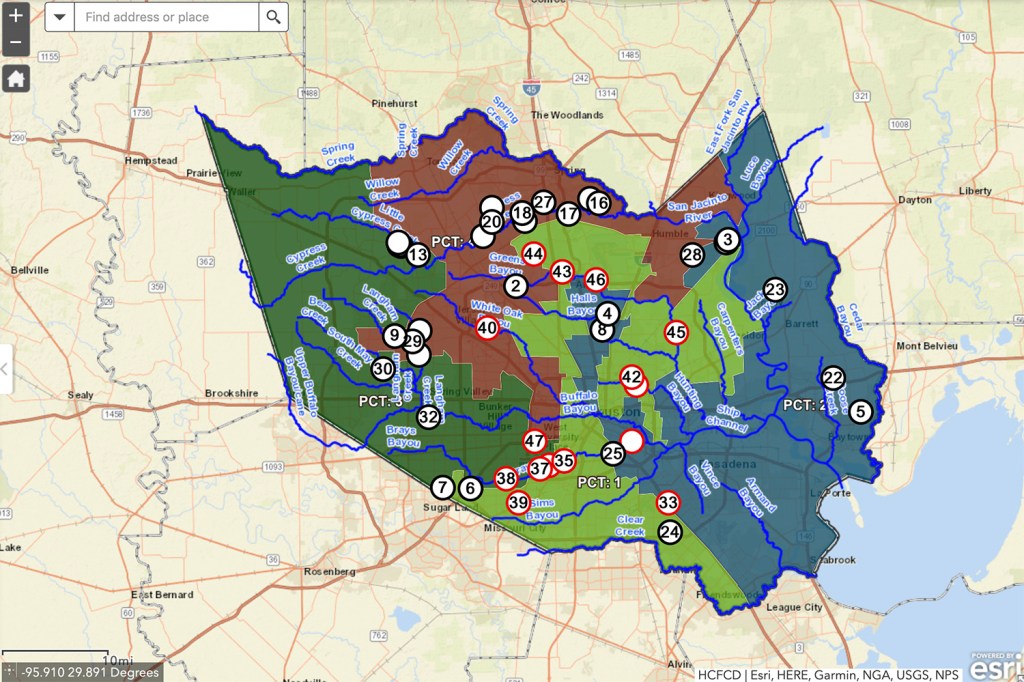
In the last 21 years, Precinct 1 has received at least four to five times more construction dollars from Harris County Flood Control than Precinct 4 which contains Kingwood.
In fact, Precinct One received the single largest construction project in the history of Harris County Flood Control. The excavation of the Kuykendahl and Glen Forest Stormwater Detention Basins cost $59,840,117.41. In contrast, during the last 21-years, the entire San Jacinto River Watershed (the largest in the county) received only $3,345,976.28 in construction funds – one-eighteenth of what that Precinct 1 detention basin project cost!
The money spent on the San Jacinto also represented just one half of one percent of the $663,894,766.38 spent on all construction by the Flood Control District during that 21-year period.
In contrast, the Brays and Sims Bayous, both of which run through Commissioner Ellis’ district, received almost 100 times that amount. The $330 million spent on those two watersheds alone represented virtually HALF of the entire $663.9 million Flood Control District construction expenses in the last 21 years!
Lopsided Distribution of Flood Mitigation Money
In fairness, note that those watersheds do not lie entirely within Precinct 1. However, Precinct 1 also contains parts of Greens Bayou, White Oak Bayou, Halls Bayou, Hunting Bayou, Buffalo Bayou and Clear Creek (see map above). If you add in even a small portion of $229.4 million spent on those watersheds, the Precinct 1 construction numbers become even more lopsided.
Greens received $74.3 million
White Oak received $47.8 million
Halls received $22.3 million
Hunting received $23.7 million
Buffalo received $44.3 million
Clear Creek received $17 million.
Meanwhile, Kingwood received $0 construction dollars but suffered more than a billion dollars worth of damage during Harvey. Yet Mr. Ellis and his friends imply we hog flood mitigation dollars from poor people. THEY demand EQUITY! It’s time someone called this what it is – BS.
Actual Construction Spending by Precinct since 1998
Between 1998 and 2019, Precinct 1 received 47% of all Flood Control District construction funds spent on projects entirely within each precinct. These percentages do NOT include spending on projects that cross districts.
Precinct 1
$275,835,964
Precinct 2
$103,529,679
Precinct 3
$143,873,825
Precinct 4
$62,427,867
Precinct Discrimination Disguised as “Equity”?
Precincts are supposed to be roughly equal in population. Yet these figures are so lopsided, one could argue that Mr. Ellis and his friends are deliberately crying discrimination to get a larger share of the pie at the expense of areas like Kingwood. But it’s more complicated than that; Precinct 1 is also taking money from LMI neighborhoods in other precincts.
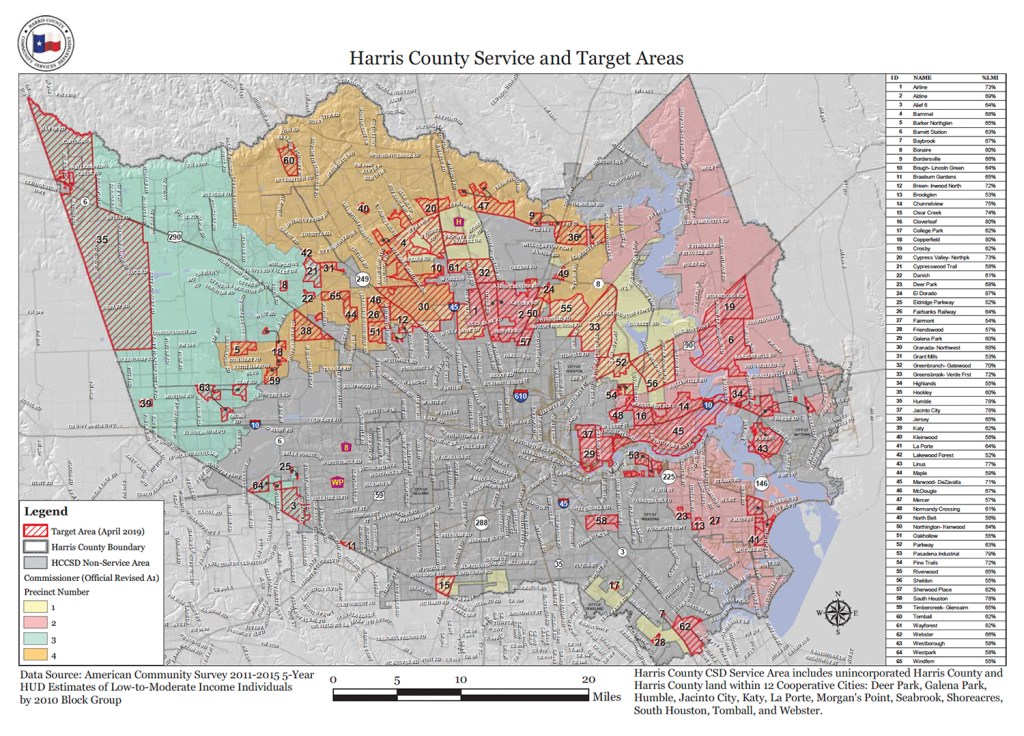
Look at the distribution of LMI neighborhoods throughout Harris County in the map below. It’s based on five years of recent HUD data. You can see a broad, concentrated LMI band across northern and eastern Harris County.
If anything, these numbers demonstrate a consistent pattern of geographic discrimination against residents of other precincts. Rodney Ellis’ Precinct 1 received 47% of construction dollars for flood control, leaving the other three precincts to divvy up the other half. Precinct 4 contains roughly one fourth of the population but received just 11% of construction dollars.
I’m not suggesting that the Precinct 1 projects were not needed or that the money was not spent wisely. I am suggesting that Precinct 1 LMI residents should not paint Kingwood as a villain. To do so is intellectually dishonest. We are not taking construction dollars from LMI neighborhoods. The County’s own data shows the opposite.
Precinct 1 is taking dollars from affluent and LMI neighborhoods alike.
I will cover other aspects of this story in upcoming posts. In the meantime, County Commissioners vote today on approving the vendor for the Kingwood Area Drainage Assessment. See item 2-B-5 on page 9. The approval of the study caused the equity flap at the last meeting. Let’s hope it doesn’t cause another one in this meeting. After all, the Flood Bond was sold to citizens as a tool to correct problems based on need, not income.
Posted by Bob Rehak on 6/25/2019
665 Days since Hurricane Harvey
https://i0.wp.com/reduceflooding.com/wp-content/uploads/2019/06/Active-Construction-Projects.jpg?fit=1500%2C999&ssl=19991500adminadmin2019-06-25 00:53:512021-07-29 16:18:03Where Flood Mitigation Money Has Really Gone: Part One
Harris County Flood Control District (HCFCD) has enhanced its Flood Warning System at www.harriscountyfws.org.
Flood Warning System Enhancements
The system can now provide:
Residents of Harris AND surrounding counties…
The ability to receive CUSTOMIZED water level AND rainfall alerts…
From ANY gage or gages IN THE ENTIRE REGION…
Via TEXT message, EMAIL, or BOTH.
When signing up, consider the gages nearest you plus those upstream. Upstream gages can give you more warning time.
How to Sign Up for Warnings
Sign up for the new flood warning system at www.fwsalerts.org. Create your free account, then customize your preferences. You can request notifications from more than 250 gage locations across the region. Gages are located in or operated by:
Harris County
Brazoria County
Fort Bend County
Montgomery County
Galveston County
Waller County
City of Mont Belvieu
City of Sugar Land
The Woodlands
San Jacinto River Authority
Residents will need to create an account and can then choose which gages they want to receive information from, i.e., those nearest them and those upstream from them. You can create custom alerts for various water levels, channel depths, rainfall intensities, and so forth. You can also default to four standard alerts.
1 inch of rainfall in 15-minutes
4 inches of rainfall in 1 hour
Channel flooding is possible (3 ft below bankfull)
Channel flooding is likely (bankfull)
When defined rainfall or water level values are reached indicating a potential for flooding, the new flood warning system will begin sending alerts that match your preferences.
Response to Harvey
“One of the biggest takeaways from Hurricane Harvey was the need for automated notifications to be delivered in a timely manner. This enhancement will help do that,” stated Jeff Lindner, Director of Hydrologic Operations and Meteorologist for the Flood Control District.
“Residents can use the new alerts feature to make timely, informed decisions on how to protect themselves, their families, and property,” said Lindner.
More Information
HCFCD has optimized the flood warning system for both desktops and mobile phones.
HCFCD encourages residents across the region to establish an account and sign up for alert notifications at www.fwsalerts.org.
Posted by Bob Rehak on 6/13/2019
653 Days since Hurricane Harvey
https://i0.wp.com/reduceflooding.com/wp-content/uploads/2019/06/FWS-Signup.jpg?fit=1500%2C1009&ssl=110091500adminadmin2019-06-13 17:20:242019-06-13 17:20:38Flood Control District Enhances Flood Warning System with Customizable Alerts
Harris County Flood Control tomorrow will ask the Harris County Commissioners Court tomorrow to approve money for a Kingwood-wide drainage assessment. One of the reasons why is shown below: trees that have fallen into Taylor Gulley since the last time someone from Flood Control reviewed it. That underscores the need for every community association to start a flood committee. With more eyes on drainage, we might be able to keep problems such as these at a sub-acute level and help prevent flooding from clogged ditches.
Thank You, Chris Kalman
Chris Kalman of Woodstream Village sent these pictures to Flood Control and to me last Friday. They show trees that fell into Taylor Gulley during the three huge storms early last month.
This and next four photos taken on Taylor Gulley near White Oak Creek. All photos courtesy of Chris Kalman.
Blockages, such as these, can quickly turn into even bigger blockages when they catch additional trees and debris swept downstream in floods. When blockages become big enough, they can back water up into neighborhoods.
Kudos to Chris for communicating these problems (and their locations) to Harris County Flood Control. HCFCD can’t be everywhere all the time; they have 2500 miles of natural streams and man-made ditches to patrol. They need the help of residents to report problems like these so that they can respond in a timely way.
Photographs like Chris’ help Flood Control find and recognize the problems when workers visit the site. After all, in print, one downed tree sounds a lot like another. Photos also help Flood Control visualize the number of people and type of equipment to bring. In addition, Chris provided them with a map.
Commissioners Court To Consider Kingwood Drainage Assessment Project
Matt Zeve, deputy executive director of the Flood Control District is adding an evaluation of Taylor Gully and the May storm event to the scope of work for this project.
The Lake Houston area has more trees than most other parts of town. We definitely need this.
Start a Flood Committee in Your CA
Also, please urge your community association to start a “flood committee” that A) periodically checks creeks and ditches for problems and B) reports them. Often people see problems but don’t recognize them as such. Or they recognize them, but assume someone else reported them already. That’s why, in my opinion, we need to set up a system for reporting problems such as these.
An organization like KSA could coordinate the flood committees of each CA. They could then compile a master list of problems so that Flood Control could better schedule and prioritize clearing and ditch restoration efforts. It would be much more efficient for Flood Control to deal with one entity rather than thousands of individuals, many of whom might duplicate each other’s efforts. Also, as Chris discovered, sometimes it’s difficult to know whom to email. But a group that manages reporting on a regular basis could quickly learn the proper channels.
Two-foot Sections
If your neighbors, CA or trail association tries to remove such blockages, remember this. Flood Control typically cuts trees like the one above into two foot sections. Two feet is small enough to float through culverts in the next flood without getting stuck.
Posted by Bob Rehak on 6/3/2019with photos by Chris Kalman
643 Days after Hurricane Harvey
https://i0.wp.com/reduceflooding.com/wp-content/uploads/2019/06/erosion1.jpg?fit=1500%2C844&ssl=18441500adminadmin2019-06-03 17:15:222019-06-03 17:15:35Kingwood Drainage Assessment on Commissioners Court Agenda Tuesday and Why We Need More Systematic Reporting
According to an Associated Press (AP) story published this weekend, “A recent study for the National Institute of Building Sciences found that society as a whole saves $7 in avoided costs for every $1 spent through federally funded grants to acquire or demolish flood-prone buildings.”
Idea Behind Buyouts
Buyouts are a strategy used by FEMA to avoid multiple payouts from the National Flood Insurance Program for properties that flood over and over again. At some point, it becomes cheaper to buy the home and tear it down than to fix it repeatedly. However, buyouts can take years to process and they are always voluntary. Moreover, even if a homeowner decides not to sell, the government continues to underwrite his/her insurance.
The AP story by David A. Lieb cited the case of Mosby, Mo. Residents there flooded three times in six weeks in 2015. Many quickly signed up for buyouts, but are still waiting for offers years later.
With 7/1 savings, one wonders why it takes government so long to acquire these homes? Buyout experts that I talked to say that one of the keys to successfully negotiating a buyout is making people offers BEFORE they rebuild their homes. That observation argues for the need to streamline the buyout process, not drag it out for years.
Attempt to Streamline Buyouts
The AP story quotes U.S. Rep. Peter DeFazio of Oregon, chairman of the House Transportation and Infrastructure Committee. His committee has jurisdiction over FEMA. He questions why “….[we] keep selling them (flooded homeowners) insurance and building in the same place?”
The article continues: “DeFazio wants to expand and revamp a buyout process that he describes as inefficient and irrational. He’s backing a proposed pilot project that would give homeowners a break on their flood insurance premiums, as long as they agree in advance to a buyout that would turn their property into green space if their homes are substantially damaged by a flood.”
What 240,000 cubic feet of water per second does to a dream home with a river view.Next building is scheduled for demolition on June 3.
Status of Forest Cove Townhome Buyouts on Marina Drive
The buyout process from Harvey is just getting started in some parts of Texas. Harris County Flood Control has already bought out many homes in the Forest Cove area. “We’ve purchased three entire buildings. One has been demolished and two more are in process,” said James Wade of the Flood Control District. “We have about 65% of the units along Marina Drive purchased and are working through the remaining units.”
But over in Liberty County, officials have just started the buyout process. Buyouts require cooperation between the federal government which funds them, and city or county officials which negotiate them. Therefore, the success of buyout programs often depends on the interest level of cities and counties.
Buyout Success Often Depends on City or County
Counties that aggressively pursue buyout dollars from the federal government can offer residents an option that other counties can’t or don’t.
While most of the Marina Drive townhomes in Forest Cove are structurally unsound and therefore uninhabitable, residents elsewhere, such as Tammy Gunnels in unincorporated Montgomery County, have clamored for buyouts with no luck for years. With the May 7th rains, her home has flooded now 11 times in 10 years.
I applaud Representative DeFazio’s attempt to reform the buyout system. It seems like one of those rare instances when the humane thing to do is also the most cost-effective thing to do.
Turning Problems into Natural Retention and Recreation
A more efficient buyout process will also help rejuvenate and beautify neighborhoods. In the case of Forest Cove, the City of Houston Parks Board and Harris County Precinct Four are already working together to build a greenbelt trail. The trail would connect the County’s new Edgewater Park, under development at Hamblen and US59 with Kingwood’s trail system. That could also open up the entire Spring Creek greenbelt system to Kingwood and Forest Cove hikers and bikers. I can’t wait!
Posted by Bob Rehak on 5/28/19
638 days since Hurricane Harvey
https://i0.wp.com/reduceflooding.com/wp-content/uploads/2019/05/San-Jac-5.17.19_92.jpg?fit=1500%2C1000&ssl=110001500adminadmin2019-05-28 20:33:292019-05-29 14:42:07AP Story Highlights Efforts to Streamline Buyout Process
Coordinated, fast action by the City, Harris County Flood Control, and concerned citizens reduced flood risk for many homes earlier this month. Together, they eliminated many blockages in drains and ditches that likely prevented many homes from flooding during the storms from May 3 through May 10. Perhaps we can learn from the experience and organize neighborhood groups that spot and report developing situations before they get out of hand and cause floods. Here’s what happened.
Triple Whammy: Three Major Storms
On Friday, May 3, late in the afternoon, heavy rains combined with high winds and possible tornadoes downed trees throughout Kingwood. Tree debris littered the ground everywhere. The City worked throughout the weekend to clear streets and drains. But large amounts of debris remained in yards and along greenbelts.
Then on Tuesday, more intense rains hit and flushed much of that debris into drains and ditches.
The City again sprang into action; Public Works sent crews out to inspect the storm drains for blockages. Camera and clean up crews have been here ever since.
Harris County Flood Control also sent crews out to clear ditches. Due to erosion and high winds, many trees had fallen into the ditches and were creating blockages.
Sadly, many homes did flood on Tuesday. The vast majority of those were near a massive construction site that altered drainage.
But had it not been for fast, coordinated action by the City, County and Citizens, many more homes elsewhere might have flooded on Friday, May 10, when Round Three of heavy rains hit the Lake Houston Area.
Example of How Things Can Go Right
Jennifer Coulter, a Kings Forest resident, reported a small creek totally blocked behind her home. The Coulters flooded badly in Harvey and have been hyper vigilant ever since. Jennifer detected a blockage in the ditch behind her home AFTER Tuesday’s storm on May 7. Here’s what it looked like. Harris County Flood Control sent a team out to clear the blockage BEFORE the Friday storm.
This bridge over a small ditch/creek in Kings Forest had become totally blocked in the previous storms.
Another view of the same ditch showing extent of blockage.
Wide shot illustrates how water would have been forced out of the ditch during a storm because of the blockage.Once blocked, additional debris can quickly pile up, making things even worse.
When notified, HCFCD immediately dispatched a crew. They managed to clear the blockage before the next storm hit. It took about an hour. Here’s what the same ditch looked like when they left.
Free flowing on both sides
A Minor but Important Success
I emailed Coulter after the Friday storm to see how she did. Her response: “Dry here. Looked like the backyard drained well, too. Huge sigh of relief from this address!”
This wasn’t the only success story before Friday’s rains. I’m aware of at least five similar blockages removed before the storm. No homes flooded near those areas that I am aware of…at least as a result of reported blockages.
That’s not to say that no homes flooded anywhere. I am sure some did and that is tragic. But this example underscores the need for better identification of issues and coordination in communicating them.
Importance of the Right Five
Management consultants often talk about the “Right Five” as a key element of success. Success happens when the Right People, get the Right Information, at the Right Time, at the Right Place, in the Right Format.
In this case, residents knew:
The Right People to contact (Flood Control, not the City, and the right people AT Flood Control)
The Right Information to give them (description of problem so they could send crews with the right equipment, photos of what they would encounter, everything they needed to take immediate action).
The Right Place to send them (GPS coordinates, nearest street intersections, and nearest access points for greenbelts).
The Right Format (easy to read and understand; clear; concise; digital for easy transmission to crews in field).
The Right Time (before the storm)
While we are at it, we should also give ourselves a pat on the back. Residents helped clear drains and ditches before the storm, too. That’s not only our right; it’s our duty. The City needs our help. Their crews can’t be everywhere at once; Houston covers a lot of territory.
Organizing to Reduce Flood Risk
How can we learn from our failures and replicate our successes? Last week, the Kings Forest Board of Directors voted to establish a permanent Flood Committee with two objectives:
Raise awareness among residents of issues that contribute to flooding
Identify and communicate problems we can’t resolve on our own to the Right People at the City and County.
In essence, the idea is to create a group like Neighborhood Watch or Crime Stoppers, but focused on flooding: Clog Stoppers! People who can spot problems and report them before they cause flooding.
Major examples of things that contribute to flooding:
Yard waste swept into sewers or dumped on greenbelts
Dead or dying trees about to fall into ditches
Not cutting deadfall into small pieces [large ones block culverts; max 2′ pieces recommended]
Irresponsible construction practices
Sand mining in floodways behind inadequate dikes
People altering drainage illegally
I hope the other community, trail, and commercial associations can form similar committees. Working together through KSA or some other grass roots organization, we can reduce flood risk for everyone. We can also help improve government efficiency by getting the right people, the right information, in the right place, at the right time, in the right format.
Posted by Bob Rehak on 5/20/2019
629 Days since Hurricane Harvey
https://i0.wp.com/reduceflooding.com/wp-content/uploads/2019/05/image001.jpg?fit=768%2C1024&ssl=11024768adminadmin2019-05-19 22:25:252019-05-20 06:00:56Homes That Didn’t Flood Because of Quick Action: Example of How to Reduce Flood Risk
Jeff Lindner, Director of Hydrologic Operations and Division Meterologist for Harris County Flood Control, just issued this warning”
“Multiple rounds of thunderstorms with heavy rainfall and some severe weather likely today into tonight.”
“Large cluster of thunderstorms with heavy rainfall extends from near Sealy to College Station and is moving eastward and will overspread much of the region N of I-10 over the next several hours. A second…powerful…bow echo with 70-80mph is rapidly approaching Corpus Christi and the coastal bend and may impact the Matagorda Bay area later this morning.”
“Active pattern will remain in place as several disturbances and a weak cold front move across the area today and tonight and into Saturday. Rounds of thunderstorms will produce heavy rainfall and isolated severe weather. Main severe threats today will be mainly west of I-45 and some of the storms this morning over south-central TX have shown some weak rotation.”
“Expect the current round of storms to move across the area between now and 1-2pm followed by a brief break and then another…potentially stronger round this evening into the overnight period.”
“Rainfall amounts of 1-3 inches will be possible today into early Saturday with isolated higher totals. In fact some of the higher resolution models are showing isolated amounts up to 4-5 inches under training bands today and tonight. Air mass is certainly moist and will be able to support some 1-2 inch per hour rainfall rates which will lead to street flooding.”
River Forecast
“Area rivers are responding to the recent heavy rainfall and will remain elevated and in flood (Trinity). Additional rains today and tonight and then again next week will only increase rises. The area river and hydro situation is starting to become worrisome given the potential for this pattern to maintain for the next 1-2 weeks.”
Posted by Bob Rehak on April 3, 2019
612 Days since Hurricane Harvey
00adminadmin2019-05-03 09:41:282019-05-03 09:41:53Possible Street Flooding Today
Jason Krahn of the Harris County Flood Control District (HCFCD) revealed plans tonight to begin restoring the conveyance of Bens Branch, one of the largest drainage channels in Kingwood. Bens Branch runs diagonally through the center of Kingwood from the new St. Martha Catholic Church to east of Kings Harbor where it joins the San Jacinto West Fork.
Harris County Flood Control will soon begin removing more than 8000 truckloads of sediment clogging Ben’s Branch.
Welcome Relief
News of the project will bring welcome relief to those who live near the creek and who flooded during Hurricane Harvey. Among them are residents of North Woodland Hills, Kings Forest, Bear Branch, Town Center, the Enclave, Kingwood Village Estates, and Kings Harbor.
Restoring Conveyance to 1990 Level
The objective of the project: to restore the conveyance that existed in 1990 when the creek was last widened and improved. Large portions of the creek have severe silting.
Krahn says Flood Control plans to excavate 1.3 miles of the ditch from near Kingwood Drive to past the YMCA – a total of 6,851 linear feet. The project will stop approximately 1,800 feet from Lake Houston. From that area, they plan to excavate 77,365 cubic yards of sediment that have built up since 1990. That equals about 8,600 dump-truck loads.
Flood Control also plans to bring in rock to shore up areas that have severely eroded.
Project Phasing and Timeline
The design phase of the project has completed and bidding will begin within two weeks, says Krahn, the project manager.
To access the areas to be excavated, Flood Control will use a combination of roads and adjacent property owners. They include Kingwood County Club, Harris County Precinct 4 Library, the YMCA, and the Kings Crossing Trail Association.
Expect the following phases:
Establishing access
Erection of construction fencing
Mobilization of equipment such as amphibious trackhoes and shallow-draft barges
Excavating material and storing it along the edges of the creek
Waiting two weeks for it to drain and dry
Hauling it away
Krahn expects to haul off 40 truck loads per day. He says the project should take a total of 250 calendar days. Thus, they should complete the project by next January.
Some trees may have to go, but Krahn vows to make every effort to keep as many trees as he can. He says he understands how much Kingwood values trees. He also points out that any trees on the banks did not exist when the ditch was last excavated; they have grown up since.
Procurement, bidding, and planning will run from April through June. Expect to see boots on the ground no later than July 1.
$2.1 Million Cost Expected
Total cost of the project is projected at about $2.1 million out of a $17 million total maintenance budget for all of Harris County. This money does not come out of the flood bond. It comes from the normal HCFCD maintenance and operations budget.
Soil Already Tested; Non-Hazardous
The county has already sampled and tested the soil that it will remove. It received a Class 2 Non-Hazardous Rating. That means it is not contaminated and can be stored anywhere. Krahn says that the winning contractor will propose disposal sites. Sometimes the fill will be used in road beds, to elevate property, or returned to old sand pits.
Warn Kids to Stay Away
Many people fish and play in the creek and job on its banks. Krahn requested residents to keep their children away from the construction zone once heavy equipment starts moving in. Operators will have their eyes on the job and not people jogging or fishing.
Thanks to Barbara Hilburn
A shout-out to Barbara Hilburn of Kingwood Lakes who has doggedly led the charge on internal drainage improvements since Harvey. Hilburn emphasized the need for a Kingwood-wide study of internal drainage to restore the entire system to its original capacity. She hopes that will work hand-in-hand with other improvements being made to the San Jacinto and the Lake Houston dam to reduce flood risk.
Posted by Bob Rehak on 3/20/2019
568 Days since Hurricane Harvey
https://i0.wp.com/reduceflooding.com/wp-content/uploads/2019/03/BensBranch-copy.jpg?fit=1024%2C768&ssl=17681024adminadmin2019-03-20 22:43:072019-03-20 23:29:16Harris County Flood Control to Begin Restoring Conveyance of Bens Branch In April
Harris County Flood Control has developed a new way to prioritize bond projects after a trial ballon turned into a lead balloon. Initially the county ranked projects based, in part, on readily available income statistics to achieve its equity goal in ranking projects.
However, giving low-to-moderate-income (LMI) neighborhoods higher priority than affluent neighborhoods facing greater flood threats hardly seemed fair. It sparked a tsunami of criticism.
When flood control shared its initial formula for ranking projects with small groups of community leaders, they pushed back immediately. They argued that the worst flooding problems should be tackled first. As a result, the county developed an alternative formula that didn’t rely on income.
Homes in Barrington in 500-year flood plain during Harvey. Photo courtesy of Julie Yandell. She was forced to flee with her husband and 81-year-old neighbor when waters rose without warning.
Factors in Initial Proposal
Version 1.0 of the prioritization attempted to rank-order projects based on seven factors, each given different weights.
Existing Conditions – Drainage Level of Service (How Bad Things Currently Are) – 20%
Equity (LMI) – 20%
Flood Risk Reduction (Looking only at # of Structures, not their Value) – 20%
Project Efficiency (Cost of project/# of Structures Benefitted) – 15%
Problems with Version 1.0
Scoring projects using these criteria pushed Kingwood – one of the hardest hit areas in the city – farther down the list in most cases. Therefore the leaders of the Lake Houston Area Grass Roots Flood Prevention Initiative sent a letter to the new County Judge listing these concerns.
Failure to appropriately recognize benefits from multi-million dollar partnership matching grants
Failure to capture full flooding impacts and full project benefits by not considering commercial property, schools, hospitals, and senior-care facilities
Not recognizing benefits to LMI areas received from projects executed in non-LMI areas
Not considering Costs/benefits of pre-Harvey Capital Improvement Projects
Lack of inclusion of URGENT NEED criteria in the matrix
Based on initial feedback, Harris County Flood Control has already posted version 2.0 of the ranking formula. The goal: to provide a defensible methodology for determining when one project will start versus another.
Differences in Version 2.0
Version 2.0 of the formula:
Takes LMI consideration out
Adds an eighth criteria, “Do we have a funding partner for a project? Yes/No?”
Changes weighting to give more urgency to parts of town that historically have had a lower level of service.
Looks at some old criteria in new ways.
Here are the new weights and criteria:
Flood Risk Reduction – 25%
Existing Conditions Drainage Level of Service – 20%
Lack of Service – 15%
Project Efficiency Weighting Factor – 15%
Partnership Funding – 10%
Long Term Maintenance Costs – 5%
Minimizes Environmental Impacts – 5%
Potential for Multiple Benefits – 5%
“You Have to Start Somewhere”
“You have to start somewhere,” said Zeve. “We’re trying to be as transparent as possible so people understand the order in which we attack projects.”
The revised project-priority list has not yet been posted. That should happen tonight or this weekend according to Zeve. They need to score and calculate many factors for hundreds of projects. I can’t wait to see the outcome. More news to follow tomorrow.
How to Be Heard
If you would like to participate in this process, or send written comments, please email Gabe Baker at gabe.baker@cjo.hctx.net.
Posted by Bob Rehak on 3/1/2019
549 Days since Hurricane Harvey
https://i0.wp.com/reduceflooding.com/wp-content/uploads/2019/02/IMG_0048-1-e1646428414628.jpg?fit=900%2C1200&ssl=11200900adminadmin2019-03-01 07:34:272019-03-01 09:41:17County Suggesting New Way to Prioritize Flood-Bond Projects