7/25/2026 – Last Thursday, a meteorological fluke spared the Lake Houston Area from the worst of Tropical Storm Bertha. Others nearby were not so lucky.
Throughout history, many cultures, military organizations, emergency managers, coaches and writers have coined sayings that contrast the value of preparation with luck. Here are some of my favorites that could apply equally to flood control.
Classic Proverbs
“Luck favors the prepared.” (Often attributed to Louis Pasteur in various forms)
“An ounce of prevention is worth a pound of cure.” (Ben Franklin)
“Failing to prepare is preparing to fail.”
“Hope for the best, prepare for the worst.”
“Dig the well before you’re thirsty.”
“Repair the roof while the sun is shining.” (Popularized by John F. Kennedy)
Military Sayings
“The more you sweat in peace, the less you bleed in war.”
“Proper planning prevents poor performance.” (Known as the Five Ps)
Emergency managers often express the same idea without mentioning luck:
“Preparedness saves lives.”
“Disasters don’t plan ahead. You can.”
“Prepared, not scared.”
“When seconds count, preparation matters.”
Some that mention luck:
“Hope is not a strategy.”
“Luck is not a plan.”
“Don’t confuse good luck with good judgment.”
“Past success is not proof of future safety.”
“Just because you’ve been lucky doesn’t mean you’re safe.”
“Luck eventually runs out; preparation doesn’t.”
“Every disaster survivor was lucky. The prepared ones needed less luck.”
“The safest families don’t count on luck; they count on preparation.”
“Ignoring risk is gambling. Preparing for it is responsibility.”
Flood Control
“The best time to prepare for the next flood is before the river rises.”
“Floods don’t care how lucky you’ve been.”
“Every floodplain eventually reminds people why it’s a floodplain.”
“Nature keeps no record of how many times you’ve gotten away with it.”
“A century without a flood doesn’t cancel tomorrow’s forecast.”
Past is Not A Prologue
Many people mistake the absence of past losses for the absence of risk, when in reality they may simply have benefited from a run of favorable conditions. Two poignant expressions in that regard:
“When it comes to protecting your family, hope is a virtue—but preparation is a responsibility.”
“Building your family’s safety on luck is like buying insurance after the storm has begun.”
What You Can Do
So, what can ordinary citizens do to prepare? I have a very short list of suggestions.
Become politically involved. Understand what is and isn’t being done to reduce your flood risk. And demand results.
Support HCFCD’s new executive director as he tries to turn the organization’s CIP program around and start, once again, building the projects voters approved almost 9 years ago.
Posted by Bob Rehak on 7/25/2026
3252 Days since Hurricane Harvey
https://i0.wp.com/reduceflooding.com/wp-content/uploads/2026/07/Bond-CIP-as-of-26.02.01.png?fit=2068%2C784&ssl=17842068adminadmin2026-07-25 17:33:122026-07-25 17:53:41Luck as a Flood-Control Strategy
10/7/2025 – Newly posted spending figures on the Harris County Flood Control District (HCFCD) website for the third quarter of 2025 show a continuing slowdown in spending. Last quarter, HCFCD spending fell below where we started after the flood-bond election in 2018 … almost to a quarter of what it was at the peak under previous management.
Adjusted for 25% inflation during the period shown, the drop off is even more dramatic. Yet we have more than $3 billion waiting to be spent for flood-mitigation projects.
HCFCD explained the delays by saying it is troubleshooting and working through issues related to each of the projects on its plate. When asked for details, a HCFCD spokesperson cited environmental and Army Corps permitting as examples.
HCFCD on Track to Spend $80 Million Less This Year than Last
The first shows incremental spending since the start of the 2018 flood bond.Last period reflects nine months.The second shows that spending in 2024 totaled $246 million.And the third shows that in the first 9-months of 2025, HCFCD spent only about half ($125 million) of the 2024 total.
At the current rate, annualized 2025 would equal $167 million. That’s $80 million less than last year’s total – a third less.
Only $2.1 Billion Spent after 7 Years
This graph shows that flood-bond spending to date totals almost $2.1 billion out of the $5.2 that voters and partners have pledged.
Screen capture from Microsoft Power BI chart on HCFCD Activity page showing breakdown of spending to date.
Out of that, spending in 2025 Q3 totaled approximately $33 million
During the third quarter, HCFCD spent at a rate lower than before the bond, especially when discounting for inflation.
Importance of Speed: Inflation and Deadlines
The first graph above (spending by quarter since 2018) shows two distinct trends: one up and the other down. The difference largely coincides with a management change in 2021.
The decline in the rate of project spending continues to concern flood victims. Not only do delays expose residents to more flood risk, delays also take a toll in inflation. Partially as a result, County Commissioners have already adopted a plan that trims the flood-bond project list. In making cuts, they focused on three primary factors:
Expected benefits that didn’t materialize
Projects that failed to attract matching funds
Projects that had low equity scores.
But there’s another threat: looming deadlines from the U.S. Department of Housing and Urban Development. In May 2021, GLO Commissioner George P. Bush announced that Harris County would receive $750 million.
However, the Disaster Relief grants come with a firm deadline of 2/28/27 – less than 15 months away. One former HCFCD employee told me that it typically takes 2 years to develop a detention-basin project. But another one told me HCFCD can put the pedal to the metal and do it in less time – if pushed.
The question at this point is, “Can HCFCD’s current management push hard and fast enough to get the jobs done before time runs out?” All of the HUD money is on a reimbursement basis. So, not finishing projects in time puts hundreds of millions at risk.
Of the Disaster Relief projects that have received authorization to use government funds so far, one is in construction – Arbor Oaks on White Oak Bayou.
In sharp contrast, according to the GLO, Phase II of the Brookglen Stormwater Detention Basin received authorization to use government funds in August 2024. And HCFCD anticipates advertising it for bids in November 2025.
Harris County’s purchasing database shows that, so far this year, HCFCD has only bid six capital improvement projects. Now it must bid and complete more than 30 projects in the next 2+ years to avoid losing close to a billion dollars.
Even my Weird Nephew Izzy understands that math. He called today and said, “We dug ourselves into a hole without digging many holes, Uncle Bob.” Longtime readers may remember that Nephew Izzy applied for the job of HCFCD executive director in 2021. Fortunately or unfortunately, he didn’t get the job. For Izzy’s take on all this, come back tomorrow.
Posted by Bob Rehak on 10/7/2025
2961 Days since Hurricane Harvey
https://i0.wp.com/reduceflooding.com/wp-content/uploads/2025/10/Q3-25-Spending-e1759876554808.png?fit=1100%2C660&ssl=16601100adminadmin2025-10-07 17:58:192025-10-07 18:14:182025 Q3 HCFCD Spending Figures Show Continuing Decline
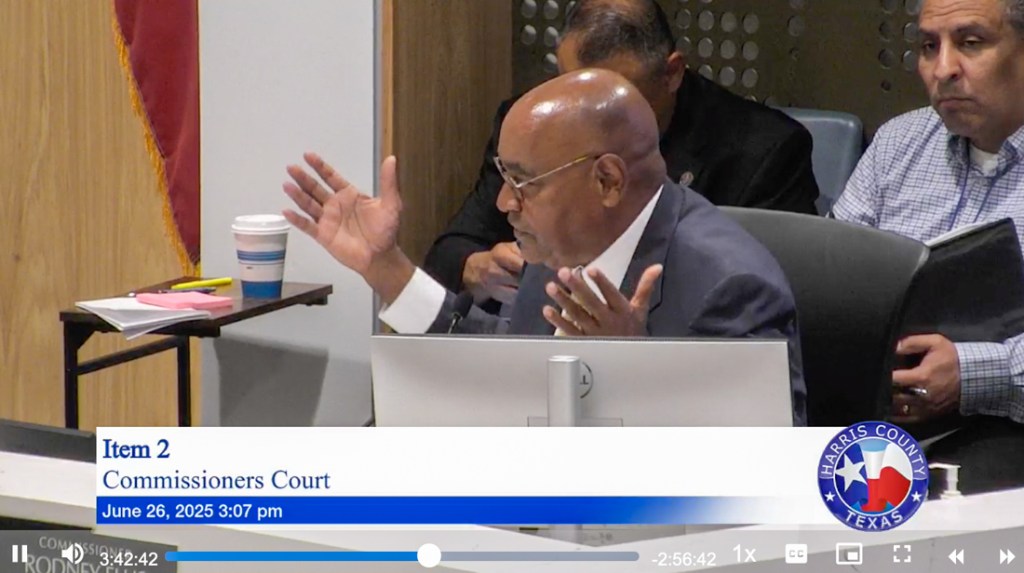
6/27/25 4PM – In a marathon discussion yesterday that stretched for hours, Harris County Commissioners Court struggled with how to plug a $1.3 billion shortfall in 2018 Flood-Bond funding. In the end, they voted 4-1 along party lines to apply all remaining flood-bond money exclusively to projects that ranked in the top quartile on Rodney Ellis’ Equity Prioritization Index.
Precinct 1 Commissioner Rodney Ellis arguing that remaining flood-bond funds be directed only to projects with a high “equity” component.
This will effectively defund all projects that fall into the second, third and fourth quartiles on Ellis’ Equity Prioritization Framework.
The Motion
Commissioners voted 4:1 to use all available flood-bond funds:
“To fully fund all current and future needs for projects in Quartile One, according to the 2022 Prioritization Framework, and direct the Harris County Flood Control District to work with court officers and report to Commissioners Court a project schedule by September 18th, 2025, on all future projects with a recommendation.”
Impact of Cuts
Precinct 3 Commissioner Tom Ramsey, the dissenting Republican, said, “It was like a bunker-busting bomb exploding yesterday. They blew up the 2018 bond program.” The decision will eliminate funding for 44 of the 48 bond projects that Ramsey had in his precinct.
“There’s no longer any money for them,” said Ramsey.
Ramsey will lose $424 million of flood-bond funding. He added, “Projects in the top quartile eat up every remaining available dollar in the bond. Every bit of it. There’s none left. Not a single dime.”
Only those marked with a #1 in the Quartile Column will be pursued at this point. The rest are effectively dead unless funding can be found elsewhere.
No Projects Left in Lake Houston Area
All HCFCD flood-bond projects in the Lake Houston Area fell below Ellis’ Equity Quartile #1 into the second, third, or fourth quartiles.
Following the Democratic plan will eliminate $20 million for Lake Houston Floodgates See Project G-103-Gates.
It will also eliminate any help for the Kingwood Diversion Ditch. The Kingwood Area Drainage Analysis called that the most important project in the area. And Kingwood experienced the highest flooding in the county during Harvey.
Chart showing feet above flood stage of 33 gages of misc. bayous in Harris County during Harvey.Gage on far left is Kingwood.
This doesn’t mean those projects will automatically die. But it is a setback.
It means project leaders will have to seek funding elsewhere for money that HCFCD had already committed years ago and that voters approved.
In that regard, Houston City Council Member Fred Flickinger had this to say about the Commissioner Court’s decision.
“Obviously the County’s handling of the flood bonds has been a concern for several years. Commissioner Ramsey is continuing to fight for our area to complete the necessary flood mitigation projects.
“However, regardless of the outcome at the County level, I have full confidence that the schedule I laid out in last year’s town hall meeting will in fact be held with the support of Representative Cunningham, Senator Creighton and Mayor Whitmire.”
Commissioner Ramsey also described the Gate project as his “Rubicon,” a reference to a Roman battle that represents a point of no return, i.e., a battle that must be won at all costs.
Uncertainty Surrounds 95 Active Projects
Ninety-five projects that fall into quartiles 2, 3 and 4 are listed as “Active.” HCFCD says it will move forward with any projects already in progress. But it’s unclear whether future stages will be implemented, i.e., moving from engineering to construction. We may know more in September.
HCFCD says they are moving forward with all HUD projects.
But GLO stressed the tightness of a February 28, 2027 deadline for 11 CDBG-DR projects valued at roughly $320 million. With only 20 months remaining to complete the projects, County Commissioners voted yesterday to take another three months to schedule projects.
For that group of projects, deadlines may be a bigger threat than funding. Think 17 months is plenty of time? It’s taken Harris County four years to get to this point with these projects! More uncertainty won’t speed things up.
Before the meeting, GLO Commissioner Dawn Buckingham warned county leaders to use the HUD funds “as quickly as possible.”
How Meeting Unfolded
Precinct 1 Commissioner Rodney Ellis, a master of political theater, packed the first two hours of Commissioners Court with surrogates during the public-comment portion of the meeting. The same people and groups that Ellis used to tarnish previous Harris County Flood Control District administrators showed up again. They even carried similar signs.
Over and over and over again, they complained about the lack of bond-program:
Equity
Results
Transparency
Dr. Tina Petersen, executive director of HCFCD, then led off the discussion with a PowerPoint presentation that she had been working to compile since February. The last slide shows how her team explored five different scenarios for maximizing available funding. (See her entire detailed report here.)
That set the stage for Precinct 1 Commissioner Rodney Ellis’ 20-minute boilerplate rant about historical discrimination against poor neighborhoods and how rich neighborhoods get all the money.
Disconnect between Ellis Rant and Reality
But there’s a basic disconnect between the rant and reality. Note that of all HCFCD spending since 2000, money has gone disproportionately to watersheds with a majority low-to-moderate-income (LMI) population. Between 2000 and 2022, 61% went to the one third of watersheds with an LMI-majority population. So, poor watersheds already receive the lion’s share of funding – almost twice as much as middle and upper income areas.
Busting the Myth: Between 2000 and 2022, in Harris county, poor, not rich neighborhoods have gotten the lion’s share of flood mitigation dollars since 2000.
Regardless, Ellis was on a roll. And by the time he was done, three of his Democratic colleagues (Hidalgo, Garcia and Briones) were demanding more equity.
They voted to ignore all five of the scenarios that Petersen spent months working on and focus only on projects that ranked high on Ellis’ equity scale.
When Ramsey pointed out that one of the poorest neighborhoods in Precinct 3, Barrett Station, was defunded, Ellis shot back that his equity formula was “agnostic” to politics. But the numbers tell a different story.
Expect frequent updates on this in coming months as the situation evolves.
To view video of the discussion, look for Item 2 here. Public appearances come before Item Two, and there are several breaks during the discussion.
Posted by Bob Rehak on 6/27/25 at 4PM
2859 Days since Hurricane Harvey
https://i0.wp.com/reduceflooding.com/wp-content/uploads/2025/06/20250627-Ellis-Item-2.jpg?fit=1100%2C616&ssl=16161100adminadmin2025-06-27 15:36:392025-06-27 23:43:12Remaining Flood-Bond Funds Going Only to Equity Projects