Giles Family Struggles to Overcome Two Floods; Prays for Perry Homes to Do Right Thing

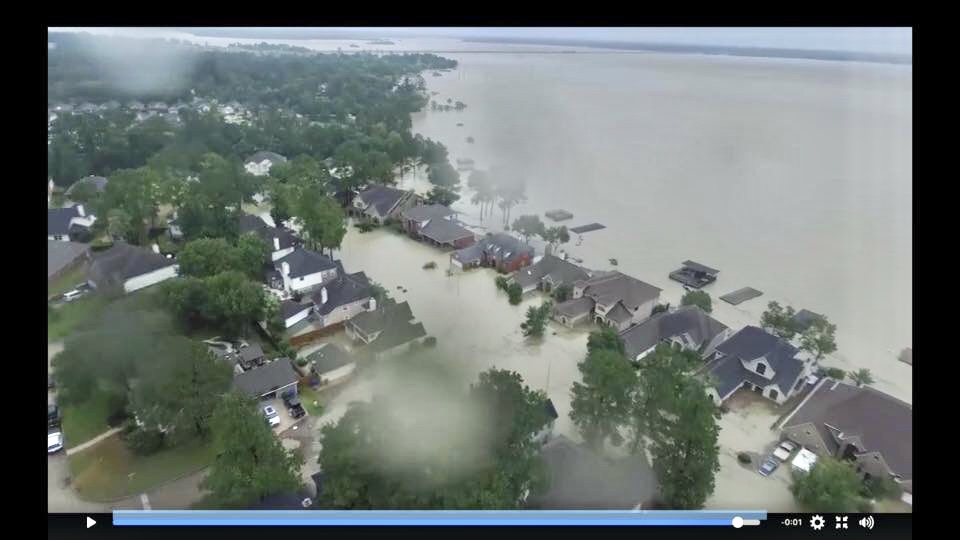
Three generations of the Giles family live together under the same roof in Elm Grove. Jerry Happ, Catrina Giles father, and Evonne Happ, plus Catrina’s children CJ, Dallas and Maverick. They had never flooded, not even in Harvey, until Perry Homes clear-cut 268 acres a block north of them without installing promised detention ponds. Then on May 7th and September 19th of 2019, they flooded twice. This is the story of how those floods affected a family and tore a neighborhood apart. As I drive up to their home on Shady Garden Drive for the interview, the first thing I noticed is that the foundation of their home is raised well above street level. In fact, it appears to be level with the top of my Chevy Tahoe. This is not an isolated case of a low-lying home.


Water Flows Down Street from Direction of Woodridge Village

Rehak: You said you wanted to make sure that Perry Homes knew about the damage that they inflicted on your community. Tell me what happened on May 7. Let’s start there. Where was the water coming from?

View from Giles front porch during Imelda

CJ (Catrina’s Oldest Son): It started off in the garage and my grandparents’ bedroom, which are on the north side of the house. Then it came in the back door and under the kitchen cabinets. And then it was just everywhere.

Rehak: It came in from the north? (The direction of Perry Homes’ development)

CJ: Yes.

Rehak: How high did it eventually get?

C. Giles: (Pointing to an electrical plug) Just under the outlets.

Gasoline, Paint, Paint Thinner Mixed with Floodwaters

Rehak: Tell me about the damage it caused. 

CJ: We had a lot of personal items in boxes in the garage. It completely destroyed everything under two feet. All our tools got really messed up. There were a lot of things floating around in the garage. Paint. Gasoline. Paint thinner was mixed in with the water. So, it was a pretty big mess.

J. Happ: It came in, like CJ said, from the north. We had a bedroom set downstairs here…

E. Happ: My sister gave it to us before she passed away. Now it’s gone.

Current Felt Inside the House

J. Happ: The water was so powerful! The pressure of the water was so intense that it caused boxes underneath the bed to move around. 

E. Happ: It broke my grandmother’s dishes that we stored under there! 

CJ: We had an entire tote filled with family pictures. The lid popped off from hitting the sides so hard. The pictures are all gone now.

Family Heirlooms Destroyed

Rehak: You talked about your grandmother’s china. How old would that have been?

E. Happ: I’m 62. (pausing to calculate then giving up) It was old. They don’t make that kind of crystal anymore. 

J. Happ: It was very old. Maybe late 1800’s.

E. Happ: And my bedroom furniture. I mean, no amount of money could ever replace that.

J. Happ: So, it was very devastating. A lot of personal items were in that room, and in the garage being stored at the time. They’re all gone now.

Rehak: I’m curious. You say the water pressure moved things around. It almost sounds like there was a current.

J. Happ: Oh, absolutely. Yes.

C. Giles: Everything in the lower cabinets was all destroyed.

It wasn’t, you know, water just coming in and oozing up. There was a current. Stuff was moving, even inside the cabinets.

Catrina Giles

Swing Set Picked Up by Flood and Moved

E. Happ: See that swing set back there by the big tree? The current picked it up and moved it against the shed.

Force of flood moved swing set and slide against shed (right)

J. Happ: When that water started coming in, we did the best we could. But we couldn’t move things fast enough. All of the furniture and appliances downstairs got damaged and had to be thrown out. 

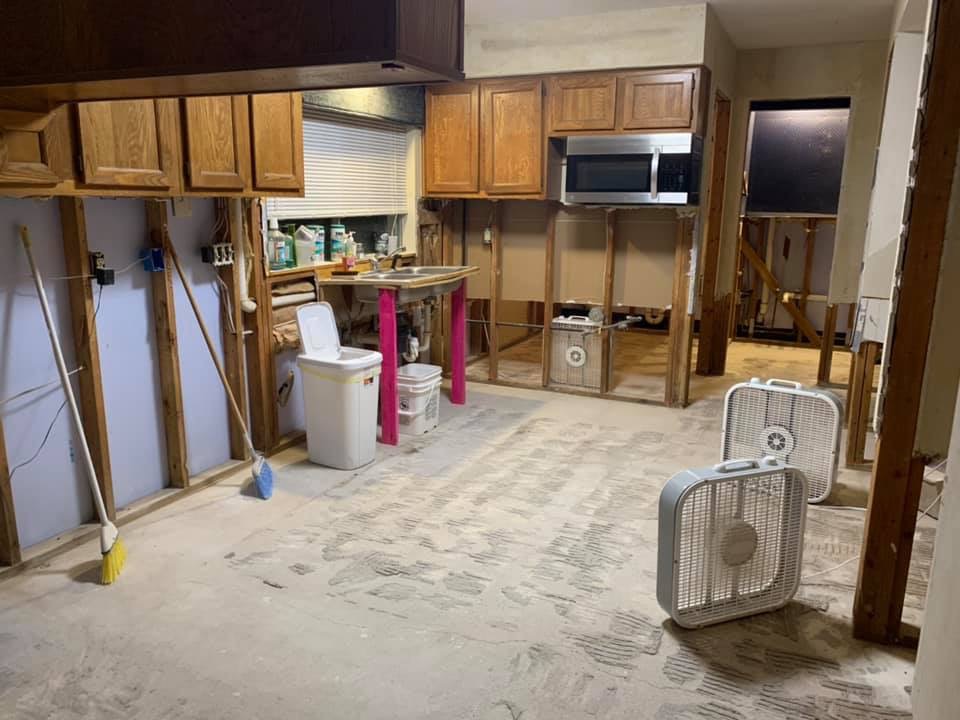
May flood took entire kitchen including appliances, plus washer/drier in utility room.

Refuse to Evacuate to Save Seven Animals

C. Giles: They asked us if we wanted to evacuate. Thank God we had the upstairs. Because they would only allow us to take one animal. And at the time we had seven.

We all have post traumatic stress now.

Evonne Happ

C. Giles: Yeah, It even affected our animals. They all lost weight. And two of them have died. One died shortly after the first flood from a snake bite. And the other just died from the stress. She had undergone her annual checkup, but her body just gave up at Christmas. We had to put her to sleep.

E. Happ: My dog’s scared to go out when it’s raining, even on the front porch. He used to sit on the front porch all the time with me. He won’t do it now if it’s raining, even if it’s just drizzling. He hides under the table. He’s scared of the rain because he KNOWS we’ll flood again. We. Could. Not. Control. Anything. And we got double the water the second time. 

Second Flood Twice as Worse as First

J. Happ: Twenty-seven inches in the garage.

Rehak: You got about a foot of water in the May flood and double that in the second?

CJ: Twenty-two inches IN the house.

Rehak: Tell me about life BETWEEN the two floods.

C. Giles: It was very stressful because my husband was working in Pittsburgh for the first flood and Finland for the second. We are just trying to manage. Although we did have insurance for the house, we didn’t have it for the contents.

CJ: And we’re one of the few here with flood insurance to begin with. 

“Just Not Comfortable Living Here Anymore”

C. Giles: Eventually we are going to hopefully try to sell. We’re just not comfortable living here anymore.

Rehak: And you had to pull out tile, cabinets?

J. Happ: Yes. We had to get two new sets of the cabinets, appliances, furniture, everythng. We were still paying on the first ones that were in the trash. When “Oh my God.” Yeah. “The second ones are apparently flooding.”

Effects on Family

Rehak: How did the rebuild affect you as a family?  

J. Happ: We all lived upstairs in cramped quarters for the better part of a year. All our appliances were gone. We had no way to cook. So, we either had to eat out or bring it in. 

We struggled as a family. It was a real hardship.

Jerry Happ, Catrina Giles father

All day long you have to listen to them hammer and saw. We had to go through all kinds of inspections for mildew. And before we could even get that, we had to get the driers, dehumidifiers and fans in here. We had that loud noise for, well, a month, before we could finally shut them down. There were a lot of different things going on at the time that caused a lot of real hardship.

C. Giles: That said, we basically have a brand-new home. We even have a new roof. 

Rehak: How did the roof get involved?

C. Giles: In May, we had hail damage. 

Rehak: Was Imelda just a repeat in September? Were you all still living upstairs and going through all the noise, construction and havoc?

Group: Yeah. Uh-huh. 

Finished First Rebuild Two Weeks Before Second Flood

C. Giles: We had just finished our rebuild two weeks before Imelda.

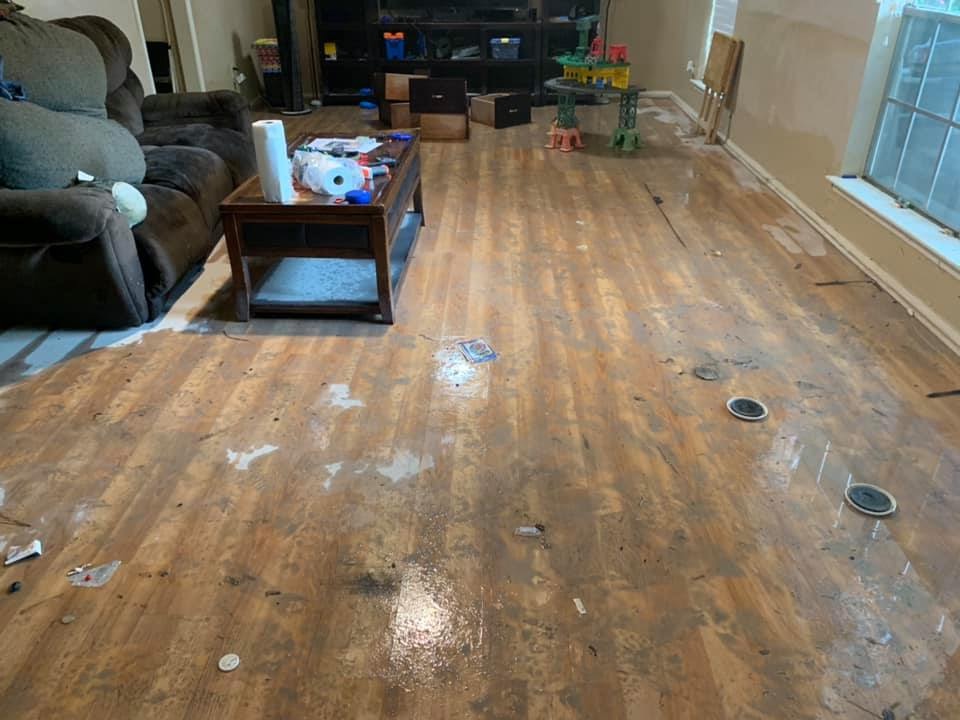
Floodwater in Giles living room during Imelda. When family saw water coming up during second flood, they immediately started moving furniture upstairs.

Rehak: And you’re done now with the second rebuild?

C. Giles: We have the windows and doors that need to be replaced. The front door and the sliding glass doors must be taken out. And these windows, because the muddy water came through them. 

When water receded, a thick layer of mud covered everything. So much sediment could only have come from one place: Woodridge Village.

Rehak: You’re considering selling the house?

Impact of Floods on Neighborhood

C. Giles: We know it’s NOT going to be a fast turnaround. Realtors said that we have to have several big storms and NOT flood for people to have confidence that this is going to be a safe neighborhood again. Meanwhile, the majority of our neighbors have already left.

Rehak: How many people on the block? 

C. Giles: On our corner, we’ve lost all four families. It’s like a ghost town here. In the cul de sac, they’re all gone, too.

Picture of neighbors house. Water still had not receded well after dark

E. Happ: At least 20 families here are gone. I sit on the porch all day because I smoke, so I see things and keep count.

Rehak: How far down the block did homes flood?

C. Giles: On our street, only two or three houses didn’t get affected by the first flood, but everybody got affected in the second. It was more…devastating. 

Home Values Under Water

J. Happ: The house across the street, around the corner, they finished remodeling the whole inside just before the May flood. And they were getting ready to sell it. The day before the flood, their realtor was going to put up a sign, but he decided to hold off. Then we had the flood. Well, they had the house up for $220,000. They only sold it for $115,000. They lost $100,000.

E. Happ: People in here had to just walk away from their homes.

Rehak: Really?

Group: Yeah. Yes.

E. Happ: Houses are still sitting there. 

CJ: There’s a house…they never gutted it from the first flood. They just up and left.

Rehak: How is that affecting you? Are there squatters or animals moving in?

Crime Up

C. Giles: Well, crime has picked up. We have all kinds of homes being broken into now. I mean, people are still living in campers and stuff and their houses are getting broken into. It’s just sad.

E. Happ: Contractors have left their vehicles in the neighborhood overnight. They’ve got broken into and all their equipment stolen. Luckily, that has not happened to our contractors.

C. Giles: The thieves don’t realize or care that people still live here. They think we’re all gone.

Rehak: Where do you go from here?

Post Traumatic Stress and Spinning in Circles

C. Giles: We are just taking it one day at a time and finally finding some normalcy. But then, the other night when it rained, I just sat there, you know, praying, “Please watch over my house.” Even my little autistic one, Maverick, who drew the picture of the house crying, could not go to sleep till like midnight.

Picture of house crying, by seven-year-old autistic Maverick Giles. The black part is tears, says Maverick. He says it represents him missing his home.

CJ: None of us sleep.

E. Happ: Maverick was so nervous. All he could do when he came in the house was spin in circles.

That’s how Maverick dealt with the house being all topsy-turvy. He’d just spin in circles.

Evonne Happ

C. Giles: It would be hard to move now. People are losing money on their houses and we’re just not in a place where we can afford that. So, we’re just trying to hang in there.

From Left to Right: Jerry Happ, Evonne Happ, CJ and Catrina Giles in front of their home on Shady Gardens in Elm Grove, now almost restored a second time.

E. Happ: We’ve been living here for the past five years. We’re gonna be leaving in the summertime, probably by August. I’ll go back to South Carolina. I can deal with those damn hurricanes; you can get out of their way. This! It just happened so fast. Each time.

Long-Distance Help

Rehak (to Catrina): What does your husband do?

C. Giles: He’s a quality manager working on a large project in Finland now.

Rehak: So, you’re restoring all this by yourself without your husband’s help?

C. Giles: He helped coordinate the insurance, inspections and contractors, but for the rip-out and rebuilding of our home…he hasn’t been able to be a part of that because of his work.  

Two Wrongs Don’t Make a Right

Rehak: What do you feel about Perry Homes at this point?

C. Giles: Well…there’s anger. They just really need to be held accountable for what happened.

J. Happ: These houses were built more than 35 years ago. They’ve gone through hurricanes. You know, large rainstorms, whatever. NEVER been flooded. All of this happened since they started building that development.

C. Giles: Right. Our street flooded during Harvey. But the water never came up in the yard even. Perry just needs to know that they not only affected adults. They affected animals. They affected children.

Some children have a Ziploc bag of their clothes right beside their bed. That’s so if they flood again, they have a change of clothes.

Catrina Giles

Rehak: If you had Kathy Perry Britton sitting right here across the table from you, what would you say to her?

C. Giles: Well. (long pause) I’d be nice. Two wrongs don’t make a right. So, we would pray for her and hope that she made the right decision and fixed that (pointing to development). Because too many people have been affected by this. Our community has been tarnished. 

Donna Dewhirst’s Harvey Experience

At its Feb. 20 board meeting, the San Jacinto River Authority will decide whether to continue lowering Lake Conroe temporarily until other flood mitigation measures can be put in place. Before then, Donna Dewhirst, a resident of Walden on Lake Houston, wanted to share some reminders of the damage that Harvey and the 80,000 CFS Lake Conroe release inflicted on the Lake Houston area.

A Horror Story in Pictures

Dewhirst’s outdoor kitchen took on knee-deep water. In the background, that’s the second story of her boat dock.
As water started to subside, Dewhirst found trees and other debris lodged in her dock. The flood destroyed her boat.
A 70-foot surprise became visible when floodwaters receded. The flood also destroyed Dewhirst’s boat.
The railroad bridge just down from her caught another boat swept away in the flood.

“The water reached my back porch at the foundation of my home, but amazingly my house and garage got no water in them,” said Dewhirst.

Dewhirst feels lucky.
Her neighbors less so.
As water receded, the extent of flooding became more apparent.

“It was horrific,” said Dewhirst. “But we were lucky compared to others. I planned returning to a flooded home, but God of Heaven spared me. My son in law had put Flex Seal on the back doors and taped it with duct tape a few feet up. I’m sure that helped. But honestly from the water line on the house, it truly was a sheer miracle we didn’t flood.”

Can It Be Averted In the Future?

Aerial view of Aquatic Drive on Walden on Lake Houston after the Conroe release. Dewhirst believes this photo came from Greg Toole. If not, please let me know. I will correct the credit or remove the image if the author wishes.

If lowering Lake Conroe temporarily until other flood mitigation measures can be put in place, such as additional flood gates on the Lake Houston dam, I’m all for it.

For more information about that program and how to make your voice heard, visit the Lake Lowering page on this web site.

Posted by Bob Rehak on 2/5/2020

890 Days after Hurricane Harvey and 15 days before the SJRA decision


Life at Ground Zero in Elm Grove

Nancy Vera and Edythe Cogdill live across the street from each other at the northern end of Village Springs. They moved to Elm Grove to build an idyllic life for themselves and their families. For years, it was a quiet, peaceful neighborhood filled with friends and block parties. Kids played in the streets and rode their bikes to schools on greenbelts. From their front porches, they could look north across the Montgomery County line and see forest laced with streams and trails. Then the bulldozers came. And spring rains. Suddenly, they found themselves at ground zero in a battle with Mother Nature, corporate giants, and a neighboring county that cared more about development than protecting downstream residents from flooding. Each woman flooded twice last year. As I interviewed them together, they shared their thoughts on every aspect of the experience.

Cogdill and Vera live at the tip of this 268-acre clear-cut funnel created by Perry Homes. See white dot for approximate location. Perry still has yet to install 75% of the promised detention.

Rehak: How badly did you flood in May and September?

Cogdill: We had about nine, 10 inches, in May. And 22 inches outside the fence during Imelda, but only 12 or 13 inches in the house. Our fence deflected a lot of water. 

Edythe Cogdill looks with worry at Perry Homes’ Woodridge Village. Her home and camper are behind her. Her home flooded twice last year from Woodridge. She captured the harrowing ordeals on video to share with the world.

Rehak: And Nancy, in May, how much did you get?

Vera: We got two feet.

Rehak: And in Imelda? 

Vera: Three.

Impact of Flooding on Neighborhood and Home Values

Rehak: We walked your block and discussed each house. All but one flooded. And you are the only two original families left. It’s like you’re living at ground zero.

Vera (left) and Cogdill (right) fret about the impact of renters on their once idyllic neighborhood.

Cogdill: Yes.

Rehak: Most of these other houses have sold to investors?

Cogdill: All with the exception of the one that has a brother living in it now. That family has to keep the house because they just bought it last year; they can’t afford to sell. 

Rehak: Talk to me about property values in the neighborhood. 

Cogdill: The house next door sold for $93,000. Our appraisal last year was $214,000.

Rehak: So it went for about half?

Cogdill: Another sold for $105,000. 

Vera: It was appraised before the floods at over $200,000.

Rehak: Again, about 50 percent. Would that be a fair estimate for these others up and down the block?

Vera: That’s what I’ve been hearing. My son’s friend’s house sold for eighty. That’s on the next street over.

Vera: Most people are getting $80,000 to $100,000 now.

Homes on their block seem to have been in a perpetual state of repair since last May.

Rehak: And what would that one have gone for before?

Vera: $160,000 to $200,000 depending on square footage.

Rehak: Still, about 50 percent. 

Vera: Yes. 

Remodeling Right Before Flood

Cogdill: We totally remodeled our house in March of 2018, a year before the flood. All new paint inside and out. Totally gutted the bathroom and redid it. Added a very expensive back porch. And then it flooded. 

Rehak: Did you have flood insurance?

Cogdill: We did.

Rehak: You did, too? (To Vera)

Vera: We did not have flood insurance in May. But I got flood insurance within a week after the first flood. 

Vera’s living room has been reduced to “life with lawn furniture.” She has lived this way for almost a year. She and her husband have so little faith in Perry’s promises to fix Woodridge that they postponed repairs until after hurricane season.

Flood Insurance Experiences in Back-to-Back Floods

Rehak: Talk to me about your flood insurance experiences. You said one of your neighbors had a problem. Even though most of the house was rebuilt after the first flood, they didn’t get credit for that?

Cogdill: The adjuster merged the claims because they did not have their inspection complete before the second flood. They were going to get something out of the second flood, but it didn’t nearly cover the loss. They had to redo everything. And they weren’t reimbursed for everything. 

After the second flood in five months and hassles with insurance adjusters, Vera’s neighbors gave up. An investor bought their headaches for 50 cents on the dollar.

And then they took a $10,000 loss on their camper. They bought the camper to live in after the May flood. They were days away from moving back into their house. And then everything – house AND camper – flooded again in September. So they were upside down. Her insurance gave them $10,000 less than what they owed on it. 

Never-ending Parade of Contractors

Vera: I just want to get everybody out of my house, because every day, every day, every day, somebody is there.

Rehak: You have no privacy anymore?

Cogdill: You have contractors that say, “We’ll be there at 7:00 a.m.” And then they don’t come. Or you might take off work to let someone in and they don’t show. 

Vera: And I had to buy cameras to put in my house, so I can see them. 

Cogdill: The lady with the camper worked from home. And they would pound on her  door every time, “Well, we’re here.” And she would be on a conference call. She just said, “I can’t do this anymore.” They’re gone now.

Managing Repairs and Full-Time Jobs

Rehak: I hadn’t really considered the “time off from work” aspect of all this. Nancy, you and your husband both work.

Vera: He can’t really take off because he’s overseeing a massive construction project. So I’m doing all the taking off.

Rehak: Where do you work?

Vera: I work for an insurance company. We handle benefits for school systems that we sell insurance to.

Cogdill: I was the construction manager on our rebuild. We were completely done with the remodel from the first flood.

Rehak: How long did it take you?

Finishing First Repairs Then Flooding Again

Cogdill: We finished two weeks before the September flood.

Rehak: How did that feel?

Cogdill: I sat down and I cried. It was exactly like the May flood. I was home alone and calling my husband every ten minutes, and then … then when it came in the back door, I just started bawling. And nobody could get home until right before dark. It started like eight o’clock in the morning.

Home Alone in Rising Waters

Rehak: What does it feel like when the water is coming up? 

Cogdill: Everybody’s telling me on the phone, “Do this and do that. Put this up and get the dogs. Be sure you get your medicines. And I’m just looking around like, wow, OK, the dogs are walking through puddles … in the house. We lost our car in the first flood. It was in the driveway.

Postponing Rebuild and Wondering

Rehak: Nancy, after the May flood, you were a little skeptical about what Perry was  going to do. So, you didn’t rebuild immediately. 

Vera: We lived in a house with no walls, nothing all summer. We put up that Tyvek paper on all the walls. So that kinda helped. My house never got too hot. We were lucky; our air conditioning was brand new. It held up when everybody else was losing theirs.

Rehak: So, when the second flood came, you didn’t have demo to worry about? 

The Vera kitchen after two floods, the first without insurance.

Vera: Partially. We had more damage the second time. A lot more.

Rehak: That’s right. You said it went up another foot. When did you make the decision to renovate and why?

Vera: We waited until hurricane season was over. And we said we would try to get it done as soon as possible. I was my own project manager to save money. We’re still on the fence as to whether we should sell and walk out.

I Bought This To Be My LIFE

Rehak: Let’s talk about that. Do you think Perry will sort this out?

Vera: You want to have hope.

Cogdill: You hope that they’re human. You want to keep your home.

Vera: This is my home. It’s not an investment. I bought this to be my LIFE. 

Cogdill: This is where I wanted to raise our kids. That’s the reason I live here. 

Vera: I don’t want to give up hope because in my gut I don’t want to sell my house. But then do you trust that they can fix it after you flooded twice … and you see that they’re not actually out there doing ANYTHING to problem solve?

The Cogdill and Vera families fret over the Perry detention pond that seems to be under perpetual construction. Building additional detention capacity that might help prevent future flooding does not seem to be a high priority for Perry. Meanwhile, they live in a state of perpetual fear.

Cogdill: It’s fixin’ to be, you know, flood season and all that. Why have they not been doing anything? 

Rehak: What would you like to see done out there now?

Cogdill: This is such a hard question because there have been so many things out there that people have said could happen, may happen. The most recent one is to make a 300-acre lake out of it if Harris County Flood Control takes over. But I have worries with that, too. Look at all the places that flood in Harris County.

Vera: Right now, we’re very gun shy about anything. We don’t have the correct answer either, because we’re not experts. All we know is that we don’t want to flood again.

Biggest Fear for Neighborhood

Rehak: Beyond flooding again, what’s your biggest fear for the neighborhood? 

Cogdill: Renters won’t take care of property as much as homeowners. They’re not going to keep up their yards. They’re not going to care about landscaping.

Rehak: Beyond your block, how many homes in this area have flipped or are up for sale.

Vera: Close to a hundred.

Ten homes in a row for lease in North Kingwood Forest by the same company. These are directly across Taylor Gully from Vera and Cogdill.

Cogdill: I would say 40 percent. 

Rehak: How many more homes do you think flooded the second time than the first? 

Vera: About 200 flooded the first time. At least 400 the second.

Living in a State of High Alert

Rehak: What would make you happy at this point?

Cogdill: We just want things back to normal.

Rehak: What do you consider normal? 

Cogdill: Not living with the fear. To have everybody’s homes that have been destroyed fixed, repaired, restored back to the original. 

Cogdill can never escape the fear of living with the development in the background. She worries about flooding a third time before someone fixes the problem.

Vera: Not to worry every time there’s a storm coming. We were up all night last night, even though we were told we were not going to flood again. But everybody was still glued to the TV, because we’re always on high alert. We ARE going to flood again because nobody has solved this problem. What do I want? To NOT live with anxiety all the time. But it’s always there.

Cogdill: I want to get back to a place where everybody is not whining, complaining, or scared. I want everybody’s homes fixed and to say, “Hey, we’re having a block party this month.” I just want to live in a normal community that’s not consumed with fear. 

Accountability and Oversight

Rehak: What role do you see Montgomery County Government playing in all of this?

Cogdill: Montgomery County should be liable. City of Houston should be liable. And once these people start being held liable over this stuff, maybe they’ll stop letting it slip through the cracks. You know, it’s just somebody somewhere along the way pushed a bunch of stuff under the rug. And all of them shut their eyes to it. They all should have been involved. But my understanding is that Montgomery County won’t come inspect it. They have a job. And they should do it. 

Vera: My biggest concern is that I don’t know what we can do about it. And we get a lot of spring rain.  

Running Out of Hope

Rehak: Have you considered raising your foundation?

Vera: It was going to be like close to a hundred thousand dollars to do it.

A never-ending story: Once immaculate lawns and proudly maintained homes have given way to trash piles.

Rehak: Last question. What do you feel about the way Perry Homes has handled this?

Vera: I think they’re sick. 


Such is life at ground zero in the flood zone.

Posted by Bob Rehak on 2/4/2020 with thanks to Nancy Vera and Edythe Cogdill for sharing their experience

890 Days since Hurricane Harvey and 139 since Imelda

The thoughts expressed in this post represent opinions on matters of public concern and safety. They are protected by the First Amendment of the US Constitution and the Anti-SLAPP Statute of the Great State of Texas.

Camille Pagel’s Hurricane Harvey Experience and Plea to Continue Lowering Lake Conroe

Harvey and the 80,000 CFS SJRA release during the storm destroyed virtually everything Camille Muñoz Pagel and her family had. The SJRA is now considering whether to continue lowering Lake Conroe seasonally and temporarily until other flood mitigation measures can be implemented. Pagel wants to share her experience in the hope that the SJRA will continue the policy which provides extra safety against flooding for people downstream.


How the Pagel Family Lost Most Everything They Had

This morning I reached a boiling point. AJ Corso from Montgomery has been on my poop list since last week’s meeting in front of the SJRA. His poster asking to “restore my dream” with his red boat in the foreground makes me want to scream. It’s not helpful, I know, but it seems so outrageous that we should even have to argue about this issue of safety at all.

That people are upset because they can’t put their bloody boats in the water for a little bit, while we downstream literally put ALL of our prized belongings on our yard is unfathomable.

One of the SJRA board members lives across the street and I hope he remembers what this was like and can reason peacefully with Conroe residents. It’s not a forever solution and it can save lives.

Deerwood Country Club on Sunday August 27, 2017. “The water level is chest deep here – about 5 feet,” said Pagel. The SJRA issued a press release at noon on that day saying they were releasing record amounts of water. By next morning, you couldn’t even see the golf course and the release rate would more than double.
Water in the Pagel home reached 4.5 feet after the release. “Almost every belonging we had was below 4.5 feet,” said Pagel.
“My kids didn’t get to jet ski. They got to gut their kitchen instead of being in school.” — Camille Pagel.

“I can’t imagine a world,” said Pagel, “where you see families lose everything and can only think of the time you lost jet skiing or boating.” 

“If these pictures can help Conroe folks see that this is about more than pleasure boating, please share them,” said Pagel.

— Camille Muñoz Pagel 

Well, Camille, I can’t imagine going through what you went through. So here they are world.


Last SJRA Board Meeting Before Big Vote

The next SJRA board meeting on February 20 will be your last chance to comment on their policy of lowering Lake Conroe seasonally until other flood mitigation measures can be put in place. For more details about the meeting and the policy, see the Lake Lowering page on this web site.

Please come. At the last board meeting, Kingwood people were outnumbered at least 20 to 1 by red-shirted residents from Lake Conroe.

January SJRA board meeting. Lake Houston area people are wearing white shirts in the foreground. Lake Conroe people are wearing red shirts.

Other Ways to Register Your Support

If you can’t make the meeting in person, please consider emailing the SJRA board about your Harvey experience. Please consider also signing this petition.

If you would like to share your pictures and story with Lake Conroe residents, please also consider sending them to me for publication via the Submissions page of this web site.

Posted by Bob Rehak on 1/30/2019 based on input from Camille Pagel

884 Days since Hurricane Harvey

Flooded 15-Year-Old With Autism Fights for Lowering Lake Conroe

Tuesday, the SJRA Board met to reconsider lowering Lake Conroe seasonally. Many Lake Houston Area residents there to testify felt bullied by the large and boisterous crowd of Lake Conroe residents. This is another story of bullying. It’s about how a young man with autism who was traumatized by flooding during Hurricane Harvey fought his way back. He’s now taking up the fight to continue lowering Lake Conroe seasonally. Below: the text of a letter he wrote to the SJRA Board. It took courage for Ryan to share this letter with the world. Spoiler alert: Keep a Kleenex handy as you read this. It’s inspirational.


Ryan Long’s Letter to the SJRA Board

From: Ryan Long, Kingwood, TX 77345

To: SJRA Board, P. O. Box 329, Conroe, Texas 77305

Dear SJRA,

My name is Ryan Long and I am a 15-year-old from Kingwood. In August of 2017, when I was 12, my home flooded after the release of water from Lake Conroe.  We do NOT live on a flood plain, and we NEVER had flooding in our neighborhood until the middle of the night of August 27th during Harvey.  

Foster’s Mill, where I live, had no warning to evacuate. When flood water came, the current was so great that regular boats could not get down my street to rescue people. Helicopters flew in all day and rescued people from roofs.

Rescued by USAF Special Forces

We were finally rescued in the evening on a boat by a Special Forces team from the U.S. Air Force, hours after flood waters came into our home. I, my family, and my community will feel the impact for years to come.

Harvey photo courtesy of Ryan Long

I have autism and am classified as “high-functioning.” Before Harvey, I loved school. But due to the Lake Conroe release during Harvey, I lost years of therapy and a year of schooling.

As I woke up on the third day of the storm, power had gone out. When I opened my curtain, I saw a river rushing right outside my home; the water so deep it was about to seep into my downstairs. I panicked and ran to my parents! As the day wore on, I watched as water crept in our home like a slowly rising tide until the Special Forces evacuated us. 

Harvey photo courtesy of Ryan Long

Descent into Darkness

Our journey out was rough. The destruction I saw traumatized me. I felt broken. Every day, I felt anxious. The first time it rained, I hid under a desk, certain it would happen all over again. I slept with the lights on at night. Darkness felt like a Halloween horror movie. School became traumatic. Walking down a crowded hall felt as if I were caught in a cage. Kids began to pick on me about my panic attacks. I isolated myself, even from friends. 

I could not figure out how to ask for help. I felt frantic when taking tests. I could not concentrate. My grades, a source of pride, began to suffer. Even with the help of teachers who recognized the problem, I still failed

The Long Road Back

My parents found a counselor who helped me find a way back. She talked to me about things I loved. Eventually, I started listening to her. Slowly, she taught me strategies to cope. She helped me overcome fears and taught me how not to feel so lost. My grades improved, and I learned to sleep in the dark again. 

Harvey photo courtesy of Ryan Long

However, I was still struggling with kids who frequently bullied me. After a particularly brutal, physical incident, I found the courage to stand up for myself and reported the incident – despite fear of retribution. 

At first, I wondered what changed that day. I finally found the courage to believe in myself. I started doing things with my friends again. And I finished the year with straight A’s.

It took more than a year before I learned to believe in myself again. Today, I am still anxious at times. I still do not like thunderstorms. And I still struggle occasionally on tests. But I no longer think I am too stupid to do the work. But I believe in myself. Harvey did not break me. I came out better in the end. But that doesn’t mean I want to go through it again.

Still Dealing with Anxiety

People not living with the repercussions of Harvey tend to forget what happened. They expect the trauma and damage to go away as soon as homes are repaired. However, two and a half years later I still have anxiety. 

My home is fixed but others on my street and many in my community are not. People still live on second floors with their downstairs in disarray. Other homes are abandoned. Many people are frightened when it rains. My mom has panic attacks when she hears helicopters. Damage – both physical and emotional – lingers on.

Harvey photo courtesy of Ryan Long

So, what does this have to do with the SJRA and the people of Lake Conroe? I beg you to remember that there are people and lives that have been devastated by flooding downstream. We ask that you continue the seasonal lowering of Lake Conroe until the flood mitigation can be completed on Lake Houston. 

Thank you for listening.

Sincerely,

Ryan Long


Posted by Bob Rehak on 1/23/2020 with grateful thanks and best wishes to Ryan Long

877 Days after Hurricane Harvey

Childhood Terror From Harvey: Ulrich Family’s Experience and Letter to SJRA Board

Colleen Ulrich gave me permission to share her family’s Hurricane Harvey experience. She captured the terror in this letter to the San Jacinto River Authority Board. It supports the continued seasonal lowering of Lake Conroe to provide a buffer against flooding until other mitigation measures can be put in place. Her home did not flood UNTIL AFTER the Lake Conroe release.

Full Text of Ulrich Letter

Dear SJRA Board Members,

The purpose of my email is to petition all SRJA Board Members to approve the temporary, seasonal lowering of Lake Conroe for 2020.
As an introduction, I have been a resident of Kingwood since August 2005 when I evacuated from New Orleans due to Hurricane Katrina. We never moved back because our family fell in love with our adopted state of Texas and our adopted home town of Kingwood. I live in the Barrington neighborhood with my husband and 10-year-old daughter. Our home was flooded with 2 feet 2 inches of water in August 2017. 

Colleen Ulrich’s vehicle during Hurricane Harvey after Lake Conroe release. This photo and those below courtesy of Colleen Ulrich. All used with permission.

 Childhood Memories

One of the issues that those opposed to the temporary, seasonal lowering of Lake Conroe is that they feel deprived of their ability to enjoy the lake and to create fun summer time boating memories for their families and children. As a mother and Kingwood resident, I am petitioning you to vote in favor of the temporary, seasonal lowering of Lake Conroe to ensure the safety of my child and all of the children of Kingwood and to ensure none of the Kingwood area children have any memories similar to the ones that were created from the flood in August 2017. 

Colleen Ulrich’s dining room during Hurricane Harvey after the SJRA opened the flood gates on Lake Conroe.

Our daughter, Alexandra, was 7 1/2 at the time and her memories include sitting on our stairwell alone in our home while my husband carried me on his back to be evacuated by boat because the quickly rising water was too high and the current too strong for me to walk by myself. Alexandra’s memories include riding in that same boat out of our neighborhood and seeing the houses with up to 4 feet of water in them. Alexandra’s memories include having her childhood bedroom destroyed by floodwaters.

I promise you that these memories will never fade for her.

The Ulrich living room after the Lake Conroe release during Harvey.

Fun Vs. Safety

So I petition to the Board, what is more important – creating fleeting childhood memories of a boat ride in the summer on Lake Conroe or averting traumatic childhood memories of a flood? 

What is more important – the perceived Lake Conroe falling property values or the safety of our children and residents?

Heirlooms underwater.

I am in agreement that the lowering of Lake Conroe and Lake Houston are both temporary solutions. And of course these temporary solutions should be revisited once all of the other permanent measures including the installation of additional gates in Lake Houston are put in place. But until that time, I pray that you will make the right decision and keep the temporary, seasonal lowering in place until permanent measures can ensure the safety of all the children and of all the residents of Kingwood and the surrounding areas.  

Ulrich kitchen, cabinets and appliances destroyed.
The piano that’s not so grand since Harvey.

Video of Evac

For your consideration, my husband recorded this video and posted it on YouTube so we can remind others of the trauma of that day.  This was his boat ride out of Barrington.

I appreciate your service to our community and your consideration of my appeal to approve the lowering of Lake Conroe.

Regards,

Colleen Ulrich

Address and Phone Number Withheld for Purposes of This Post


Tell the SJRA Board about your Harvey experience and why you would like to see them continue lowering Lake Conroe seasonally until other flood mitigation measures can be put in place. Come to the next board meeting and tell them in person or write them by visiting https://www.sjra.net/about/board/. Scroll down to the bottom of the page to see the email form.

Posted by Bob Rehak on 1/18/2020

872 Days after Hurricane Harvey

$50 Million Rebuild After Harvey Makes Fifth Largest Country Club in America Better Than Ever

I recently had the honor of interviewing Blake Roberts, general manager of the Clubs of Kingwood. Roberts took the job just five days before Hurricane Harvey and has led the Clubs’ remarkable comeback. From golf courses buried under as much as eight feet of sand to the clubhouse that took on six feet of water, Roberts and his team resurrected an operation that many would have written off. They turned it into a shining centerpiece and selling point for the entire Kingwood community…even as they fed members whose homes had been destroyed.

Rehak: When you combine Deerwood and Kingwood, this must rank as one of the larger clubs in the country. Is it in the Top 10?

Roberts: It’s actually #5 now.

Rehak: What happened during Harvey?

Roberts: We ended up with almost 18 feet of water across the entire golf course. We also had sand. Some areas had just a few inches but others had up to eight feet.

Rehak: Amazing. 

Buried in Sand

Roberts: The big issue we had was, “What do you do with all the sand?” And, “How do you turn it back into a golf course and make it better than ever. We have a phenomenal maintenance group. They redid three out of the five holes near the river that had the most silt on them. They re-contoured them to actually use the silt and sand dumped by Harvey.

Hurricane Harvey deposited several feet of sand on Kingwood Country Club’s golf courses near the river. This shot was taken on 9/14/2017. You can see crews already re-contouring one of the holes.

Rehak: You couldn’t just push it back into the river.

Roberts:  Correct. We spread it out over other parts of the golf course and used that as padding for the soil that was already out there. We came in with backhoes and started moving the dirt and trying to smooth it all out. Then we put sod right back over the top of it.

Downed trees, of course, made some of the bigger differences. When people play the courses today, they say, “I don’t remember this hole being this way.” That’s because you used to have a tree here and a tree there. But that was part of the contouring that went along with it to make it flow and drain for playing golf again.

Eaglet in nest on Kingwood Country Club Island Course. Photo courtesy of Emily Murphy. Eagles returned after the flood.

One of the biggest concerns for the members was our eagles’ nests. We’re happy to say they’re safe and sound and we have a huge Facebook following of the baby eagles that hatched this year!

18 Feet of Water On Courses, 6 in Clubhouse

Rehak: You said you had 18 feet of water on the course. How much was in the clubhouse?

Roberts: Almost six feet.

Rehak: What did reconstruction entail?

Newly redecorated reception area at the Kingwood Country Club

Roberts: We took out everything. Took out ceiling tiles. We took out all the way up because the mold started growing so quickly. We took everything down to the studs and bricks, and tossed out anything that could hold moisture.

Rehak: You lost some other facilities here, too. Tell me about those.

Roberts: We lost the fitness center. That ended up with about twenty eight inches of water in it. Of course the pools and everything else. We lost all of our pump houses. We lost our maintenance building. We lost the Forest Course which has the Golf Advantage School and the driving range.

Deerwood Completely Updated

Rehak: And what about Deerwood?

Roberts: We lost the Deerwood Club House and maintenance building. Deerwood ended up with about 34 inches. The water wicked up through the walls. With the building being a little bit older and not having as many updates, we went back in and changed it completely.

Roberts: How?

Roberts: It now has a restaurant where their golf shop used to be. And then we redid the men’s locker room. We redid the dining area. We put in a new bar area, new wet areas, new showers, new everything. Members tell me it’s the best thing that we could have ever done.

Improvements to Other Facilities at Kingwood

Rehak: What about your Lazy River and pool at the Kingwood Club? How did those fare in the flood?

Roberts: Not well. All of the equipment – from the umbrellas to the chairs to the tables – was pushed around in the flood. They damaged  the interior of the pools. So we drained all the water, completely power washed everything, re- plastered and started all over from the very beginning.

We even rebuilt all the cabanas because the cabanas had metal poles. There was a concern that if they sat in water with level four contaminants and you didn’t get everything, what happens when somebody touches it and then touches food?

We had the same concerns with fitness equipment. Some of it was above water, but we worried about microbial growth. So we took everything out. All the way down the concrete slab which they bleached the tar out of. Then we started over with brand new equipment.

Rehak: Incredible.

Newly renovated Lakeside Terrace where members dined during reconstruction. It had been flooded to the roofline.

Roberts: The Lakeside Terrace flooded all the way up to the roofline because of where it sits. So they took it all the way down to the studs and the glass walls. We power washed and bleached it. Just started all over again, replaced the roof, replaced the ceiling, replaced the insulation. It’s beautiful. More beautiful than it was before. Absolutely. Members actually dined out there for a little more than a year. Our “kitchen” was a 38-foot trailer for 15 months.

Giving Back to Community in Its Darkest Hour

Rehak: That raises an interesting question. How did you keep your staff focused through all this?

Roberts: The team actually bonded together, much like the community as a whole. We took more than 25,000 sandwiches and wraps to homeowners around the community right after Harvey. All of our clubs in the area sent food our way. We dispersed it throughout the entire community. That’s incredible. As soon as we could get a food truck here, we actually fed all of our members from the food truck. From the 8th of September all the way through the 8th of December. Every single day, members could come up and dine for free.

When the staff wasn’t working here, folks went into neighborhoods and helped random people moving  stuff out of their homes or ripping sheetrock out. There were so many random acts of kindness!

Rehak: That’s quite amazing.

Roberts: And the employees all bound together. They had a plan. Our goal was to get these golf courses back and a dining space before the end of the year, which we accomplished. Golf courses finished up on December 26, with the last trucks of sand going into the bunkers. And we had the Lakeside Terrace for members to dine. And April 9th, 2018, we opened up the fitness center. And then the pools opened on Memorial Day weekend that year like they were always scheduled to do. 

Membership Back Up But Still Room For Growth

Rehak: And how did the membership levels fare through all this. Did you take a hit?

Members teeing up on the driving range and working on the putting green.

Roberts: Oh yes. And we anticipated that would happen. We had more than 300 members whose homes flooded. So we allowed them to go to a “Hold” Category while they rebuilt their homes. They had plenty of time to complete fixes before coming back to full membership. 

$50 Million Investment In Community

Roberts: How much did it cost to restore all this?

We’re over $50 million currently. That includes Deerwood and Kingwood Clubs. It also includes a large fleet of golf carts and maintenance equipment that nobody really ever thinks about. But those carts aren’t cheap and neither are those big tractors that mow.

Ironically, we had taken precautions with all that equipment before the flood. We moved everything to the parking lot because the parking lot had never flooded before.

Rehak: So fifty million dollars! That’s a huge commitment. Was that a hard sell to your corporate office?

Roberts: Not really. They came back and said, “You know what? This has always been the heart of Kingwood. This is the heart of the community and we want to get it back to being bigger and better than ever.”

Part of the Kingwood Country Clubs gorgeous Lake Course

Manager Started Job 5 Days Before Harvey…and Stayed

Rehak: You started this job not long before Hurricane Harvey.

Roberts: Five days. When I tell people that, everyone asks, “Why did you stay?” I saw it as an opportunity. Can you imagine putting this on your resume? A 50 million dollar rebuild project on top of managing 90 holes of golf, a fitness center, tennis and all the other.

Rehak: It’s gorgeous. It looks like you’ve completely redesigned the clubhouse.

Roberts: Not completely redesigned, but completely refreshed. We kept most of the walls in the same spots, but the ones that we needed to move, we did. The new board room is an example.

Rehak: What did you do and how did you make it different?

Roberts: Well, we had a storage room behind the board room. We removed that wall and gained six extra feet. So we were able to put a very large table in there and make it the boardroom that it always should have been.

“We’re Still Discovering Little Things”

With other changes like that, we soft-opened this building (Kingwood CC clubhouse) in February, 2019. And we’re still considering ourselves under soft opening because we’re still discovering things.

Rehak: For instance?

Roberts: Little things. You originally go into re-building thinking, “I have all this covered.” And then you’re like, “I don’t have all this.” For instance, I’m still waiting on my coffee credenza to where I have member coffee available all of the time. It’s just little things like that. We built the building back and we’re  ninety-eight percent of the way…complete.

Rehak: Are you going to have an official grand reopening?

18th Hole of Kingwood Country Club’s Island Course.

Official Grand Re-Opening Coming Soon

Roberts: We ARE. But there are three projects we’re still trying to complete. The member porte-cochère entrance by the golf shop, the back patio, and our private-event entrance. Then we will consider the rebuild complete.

Rehak: Would you call this the opportunity to rebuild the club your dreams? It really does look pretty spectacular here.

Roberts: Yes, we were able to put all the little things back together that we wished for over the years, but never were able to do.

Rehak: Do any stories from the flood or the recovery really stand out in your mind? 

Roberts: 25,000+ sandwiches. Feeding members for months. Long days. Some of our crews did this by day. And by night, they were actually going to people’s houses and helping them rip out sheet rock and drywall and everything else. I was amazed to hear how many people were doing this and you know some of them are 50-60 years old.

Rehak: Is the membership level back up to where it was or it needs to be?

Roberts: We’re close. Very close to being back where we were before Harvey. But two other floods in 2015 and 2016 hurt us as well. So we still have room to grow.

Outside of newly renovated dining room.

Rehak: How are the courses? Are there spots you don’t want to hit your ball into?

Getting Even Better Every Single Day

Roberts: Not really. The best part about this was the golf courses getting that extra sand. I have people who have been members for 40 years saying, “This place is better than the day it was built.” It makes me smile knowing how far we’ve come.

Rehak: Did you have to replant the greens?

Roberts: All the greens survived except two. And we redid those with the three fairways. But if you didn’t know exactly where to look, you probably couldn’t tell. 

Rehak: If you had one thing to tell potential new members right now, what would it be?

Roberts: We’re back and better than ever. And we’re getting even better every single day. If you haven’t seen us lately, you probably should take a look again. Because you know what? What people may remember is completely different now. 

Posted by Bob Rehak on August 7, 2019

708 Days from Hurricane Harvey

After Eighth Flood in Five Years, Forest Cove Townhome Renter Forced Out and Burned Out

Before Harvey, Jennifer Parks lived in the Forest Cove Townhomes with her husband, four kids and cat. They absolutely loved the river lifestyle and the friendships they built with neighbors. Harvey was the eighth of seven floods in five years. It destroyed their 4-story townhome, a close knit community and a life they loved despite the trouble. This is a story about how a flood changed the trajectory of six people’s lives forever. It’s the latest in a series of Impact stories.

2019 Fire Brings Back Memories of 2016

Rehak: You lived in the complex on Timberline at Marina Drive that burned on July 4th this year?

Parks: Yes. We were the four-story unit at the end, two doors down from where there was another fire in 2016.

Rehak: How many fires have there been there this year?

Parks: Three. Two during the week of July 4th and one earlier over by the pool. 

Rehak: The fire department came out in force for this one. They had 10 fire trucks plus two ambulances. It was impressive.

Ten fire trucks were called out to battle the blaze in Parks’ townhome complex on July 4.

Parks: When we had the fire back in 2016 there were 32 fire trucks. The whole street was lined all the way. On both sides. Every truck in Kingwood, plus Porter and Atascocita came in. It was craziness but people lived there, then. So lives were at stake. Now, the townhomes are abandoned.

“We Always Flooded on My Husband’s Birthday”

Rehak: How long did you live there?

Parks: Five years. We moved in at the end of March, 2013. We had our first flood on Memorial Day. My husband’s birthday was Memorial Day and we always flooded on his birthday.

Rehak: (Laughs)

Parks: Yeah (also laughing sarcastically) it was nice. At first, we would flood from the streets when the storm drains backed up.  The first time I ever saw the river come over the bank was Memorial Day of 2016. It filled the area up like a bowl. People would drive around to look at it and splash water into our garage. It ruined everything we had on the floor.

Eight Floods in Five Years

Parks: We had a total of eight floods including Harvey in the five years we lived there.

Rehak: (Incredulous) Eight floods in five years!

Parks: Yeah. We had to move our vehicles and water got into the first story. Usually it would just splash in, but for the Tax Day flooding, we had three feet of water. That was the first time we left our house in a canoe. Then that Memorial Day we had eight feet. That was the second time we left in a canoe. Then there was Harvey. We had 20 feet.

Rehak: How many?

Parks: 20 feet is what FEMA measured.

Parks’ second story living room went under water during Harvey. FEMA says water reached 20 feet.

Rehak: Oh geez!

Parks: It went over my TV in the second story. 

Man Cave on First Floor

Rehak: Were those apartments vacant on the ground floor?

Parks: They were all built with the garage on the first. We have a big truck that did not fit in there. So we had a bar, darts and lights. Ours was decked out. It was more of a man cave than a garage. We never managed to get a lava lamp. But it was pretty cool. We were the neighborhood hang-out. We were always told that we were the welcoming committee.

As Harvey’s floodwaters receded, Parks’ husband took this picture from a canoe while returning to save the family cat.

The kids would be playing board games in the front. They had a TV, a table, a microwave and a refrigerator. It was like a snack hangout area. People would walk by, see us out there, and be like, “Hey, how you doin’!” That’s how we’d meet all the new neighbors. We were just in a friend’s wedding who we met that way. He went by one day to get the mail at stopped in to say hi. It was a very tight knit neighborhood to say the least.

Structural damage made townhomes unlivable. City condemned them all shortly after the flood.

Sense of Community Lost

Rehak: What brought you together? 

Parks:  Just living close to each other. Plus, the backyards were large. The driveways were very long. And then there was a big beautiful field. We have four kids. So our kids were always back there playing and we were outside. We did a lot of landscaping and gardening and we helped other neighbors. I think just being outside all the time was a large part of it because it was such a beautiful area to be outside.

Collapsed first floor game room where kids and neighbors once gathered.

Rehak: It’s easy to see why you miss it.

Parks: That’s how we made friends. And then there was the canoe.

Rehak: Canoe?

Parks: A neighbor with a canoe kept rescuing my children. Needless to say, we became very close with him. His name is Bob. 

And then there was all the bonding during cleanups. After the bigger floods, the sand deposits were crazy. It got in your house. So there was a lot of pressure washing and a lot of cleaning.

The first story had Blowout walls. They are intended to blow out with a flood.

Repairs and Clean Up Brought People Together

Rehak: So you had to rebuild those.

Parks: Yes. The structural walls with cement and cinder blocks … there was a lot of rebuilding those, too, and sand removal and pressure washing. The whole neighborhood just kind of came together. We would go from one drive to the next. Someone would be shoveling sand out of one. Someone would be pressure washing the next. I think that brought us really close together. We helped each other out. Then the Memorial Day flood happened and it was like ten times worse.

We had the Red Cross truck here three times a day with food. It was amazing. My kids joked, “Heyyyyy! We’re getting snacks from the Red Cross today!”

Rehak: Red Cross Cuisine!

Some of the sand deposited by Harvey in front of Parks’ Townhome.

Parks: Yes. And you know, it wasn’t bad…considering you work all day, and then you come home and you’re going to pressure wash or shovel sand. Because with sand come roaches and to try to keep the roaches out of everybody’s house, we’re trying to move the sand as quickly as possible.

Rehak: I hadn’t even thought about that.

Parks: It was disgusting. You would shovel it to scoop up sand and roaches would just scurry. And we never had roaches before the Memorial Day flood. Never! It was baaaad.

Why They Stayed Despite Flooding

Rehak: If you flooded eight times in five years, why did you stay?”

Parks: The first few weren’t that bad. Then the next two were big and really rough. We contemplated what we were going to do. One big argument for staying put was that our kids went to Foster Elementary school. It was and is an amazing school. And we didn’t want to pull our kids out. Another big factor was finding another rental in the area that was within our $1400 budget. That was just not happening unless it was an apartment. And we really didn’t want to do an apartment. Finally, there was also the beauty. Every time we felt we couldn’t go through another flood, we’d take a look at how beautiful it is here. We’d say, “It’s worth it to stay. And we have our community here.” So we stayed.

“You Know We’re Not Coming Back This Time, Right Bubba?”

I have a video of my husband and Bob in a canoe. As Harvey was receding, they went back and got our cat. In the video, it’s like the most heart wrenching thing you will ever hear. Bob says to my husband, “You know we’re not coming back here this time, right Bubba?”

Every single time I watch that video it brings me to tears because it tells you how much that place meant to all of us. My husband and I actually got married there. It’ll be four years in October. We got married right on the river bank. We had party tents in our driveway and we had a big wedding. It meant so much to us.

I get a little defensive when people say, “Oh, you lived in the crackhead apartments? No, it was not crackhead apartments in any way, shape, or form! Sorry if I get a little defensive. 

Parks surveys the gang graffiti where her children once played.

Too Heartbreaking To Go Home Again

Rehak: When you go down to your old neighborhood today, what does it make you feel?

Parks: I don’t go down there. I can’t. It’s heartbreaking. It’s disgusting. It amazes me how in two years … how it got so bad. A friend who is a police officer was down there after the last fire. He took pictures and there’s graffiti all over my beautiful garage. Like disgusting graffiti. And it’s…it’s gang graffiti. It’s absolutely gang graffiti. There are gangs living in my beautiful home. 

As Parks gave me a tour of her former property, she discovered this looseleaf notebook that looters had thrown from her kitchen. It contained a lifetime of recipes. She tried to salvage her family cookbook.

Our house was completely redone after the 2016 fire. All the walls. All new appliances. Everything was brand new. Flooring and carpeting. It was beautiful. So that’s the other thing people don’t know because they hadn’t been inside the townhomes. A lot of them were gorgeous. 

Rehak: Did your kids end up in a different school? 

Learning Firsthand What It Means to Be Homeless

Parks: We actually were able to stay. Because our status was “homeless,” which is always interesting, our daughter was able to stay for fourth grade at Foster without any question. That was fantastic. But then for the fifth grade we would have had to transfer. Her guidance counselor told me to note, “mental stability of the child at stake due a natural disaster.” And so she got to stay for fifth grade and finish up at Foster.

Rehak: Tell me about the homeless aspect for a second. What did that mean in practical terms? 

Parks: We were fortunate. I’m involved in Cub and Boy Scouts. One of my Cub Scout friends, she actually lived here her whole life. She knew that in the ’94 floods, a couple of the townhomes collapsed. So after Harvey she was, “Get out, get out, get out, right now.” She said, “Come stay with me.” I only knew the family for two years from Monday night Scout meetings. But we ended up living with them for months while we bought our current house. 

We were actually renting the townhome in Forest Cove, but wound up having to buy a house because we were “homeless.” It took time. While we were looking, we were considered “displaced due to natural disaster.” They condemned the townhomes pretty quickly. We couldn’t even think about going back because of structural damage. What else?

School Restores Sense of Normalcy for Kids

Parks: So the kids got free lunch at school. 

Foster Elementary was one of the highest impacted elementary schools between teachers and students because of where it is and because it services Forest Cove. 

Many of the teachers were impacted, too, and the school did amazing things, incredible things really … like blankets were donated to the kids. Something so simple. But my daughter didn’t have the blanket that she grew up with anymore. So you know having a new blanket was something really special. 

They gave all the kids year books that year. 

When the book fair came around, they gave the kids gift certificates.  

They were just a lot of little things that happened even after we bought our house. 

We moved in the day before Thanksgiving so we were pretty quick. Others were displaced for so much longer and still are. We were fortunate that we had friends and family that helped financially. We were able to furnish our new home. We have all this stuff and a beautiful house. But getting there was not fun.

Friends Now Farther But Not Forgotten

Rehak: I certainly understand that. What has happened to your old circle of friends? Are you still in touch?

Parks: We are. Except for one who moved pretty far away … out to Crosby. We see Bob at least on a weekly basis. That was a hard transition from seeing him every day to now only once a week or so. He bought a house in Porter. His daughter … I see her at least two or three times a week still.

And Jane and Rob. It’s gone from seeing them every day to once a month now.

Rehak: On balance, are you happier now?

Learning to Live with Moderate Neighborhood-Ness

Parks: I don’t know if you can compare. Everything in our lives is pre-Harvey or post-Harvey. Which kind of sucks. I would say that the happiness is different because we’ve made friends with our neighbors in Woodland Hills. We just don’t see as many people as often. But we still have moderate “neighborhood-ness.” I would say we’re equally happy.

I can tell you that the six to twelve months after Harvey was very, very difficult. Probably the most trying time in my life and my husband’s. And my kids! My kids were thoroughly traumatized, to say the least.

Rehak: Your lives were turned upside down.

Parks: It’s hard when the kids say, “Hey Mom, do you have X? And I have to say, “I’m sorry. No, we won’t have that anymore.” 

The tree under which Parks got married with all their neighborhood friends. San Jacinto West Fork and US59 Bridge are in the background.

It’s little stuff like my daughter’s Build-a-Bear. And all their school supplies that were sitting on our kitchen table. We had to get new school supplies all over again; I had just bought them the week before Harvey. That was fun. (Rolling eyes.)

Rehak: Not easy on a young family’s salary.

Husband Forced into New Job That Takes Him Farther from Family

Parks: And my husband did private construction. All of his tools were in our living room. Before Harvey, we moved them up from the garage so they wouldn’t get flooded or stolen. Then our living room flooded. We didn’t just lose our house. My husband lost his job, too, because we couldn’t just go out and replace thousands of dollars in tools. So he ended up going back to the oil fields and travelling. It’s not so bad on me, but…it’s hard on the kids.

Rehak: When you saw those townhomes burn, did you still have an emotional attachment to them? 

July 4 Fire Triggered PTSD

Parks: I’m so ready for them to just be gone. I don’t even care how they go. I’m tired of the community badmouthing them; they were not bad places. But at the same time there’s some PTSD. Because of the 2016 fire, all that trauma comes back really fast when we see fire. 

We had so much fun there for so many years. Ironically, we had a big fire pit out front and we would burn whatever was laying around. It was right on the river. We had crawfish boils over there and now we’re like, “Oh my gosh! This place is gone.” In a not-so-comfortable way.

Parks: Adding insult to injury?

Parks: Yes. Exactly. Exactly. “Insult to injury.”

Posted by Bob Rehak on July 30, 2019

699 Days after Hurricane Harvey

Christmas in July for Elaine Phillips

It wasn’t supposed to happen. But it did. After receiving two letters and two visits telling Elaine Phillips that the City could do nothing to fix her drainage, trucks magically showed up this morning … and fixed it. They gave her no explanation.

Epic Battle over Partially Blocked Drainage Swale

You may remember me posting about Elaine Phillips on June 21. Elaine was battling cancer, contractors, and the City of Houston bureaucracy all by herself. Her home had just flooded for the fifth time since 1997 and her husband was working in New York. The swale in front of her home had never been regraded and was partially clogged with sediment.

Surprise Turn of Events

“We had been told, as recently as Wednesday, 7/10, that nothing would be done in the near future, despite the unrelenting efforts of both Dave Martin’s office and Dan Crenshaw’s office,” said Elaine. “Then I woke up to four city trucks and a back hoe Thursday morning. They regraded the ditches from my house to the corner and Cindy’s house to the corner. Don’t know how, who, or why it’s happening, but I’m not going to look a gift-horse in the mouth. It’s Christmas in July! Many thanks to Kaaren Cambio from Dan Crenshaw’s office and Dave Martin’s office as well!”

Elaine Phillips newly graded ditch should help ensure positive drainage in future storms and move water away from her house faster.

Altogether, Phillips estimates that various city, county, and congressional representatives worked dozens of hours trying to help her for a job that ultimately took about five hours from start to finish.

Other Possibilities Still Remain

Phillips has also explored elevating her house and buyouts. Both remain possibilities thanks to their extra efforts on her behalf.

In the meantime, Phillips is giddy with glee. Until today, progress had remained elusive for 22 years.

For good measure, and in the spirit of Christmas, while the City of Houston crew was out helping Phillips today, they also deepened the ditches in four more homes near the same intersection.

A hearty thanks to the City from the Kings Forest Board and residents.

Posted by Bob Rehak on July 12, 2019

682 Days since Hurricane Harvey


Elaine Phillips’ May 7th Flood Story: One is the Loneliest Number

In 1969, the rock group Three Dog Night released a hit recording called “One is the Loneliest Number.” As I listened to Elaine Phillips tell me her story about the May 7th flood, I couldn’t get the song out of my head. Elaine, still fighting off the effects of chemo, found herself alone at home with floodwaters rising around her for the fifth time since 1997. With her husband in New York on business, and her grown children in Austin and Houston’s Midtown area, this CPA is now trying to fight cancer, contractors, and “government logic” – by herself. As this Kings Forest resident reaches for the Xanax, she’s still reaching out to help other “flood virgins,” as she calls them. Below are portions of my interview with a woman “at the end of her tether.”

Rehak: You bought this home in…

Phillips: July of 1997.

Rehak: And you’ve flooded how many times since?

Flooded Five Times in 22 years

Phillips: This is my fifth, I think. And it had flooded two times before we moved in.

Rehak: I took a picture of you earlier pointing to the water level from Harvey on your house. It looked like at least six feet.

Elaine Phillips showing how high the water reached in her home during Harvey.

Phillips: Yeah.

Rehak: You were reaching well above your head. Did it get that high previously? 

Phillips: Just enough to require three feet of your wall to be ripped down.

Water height on May 7
Erosion from/through the Phillips’ yard has likely caused sediment to alter the gradient in her drainage ditch.

Rehak: Earlier today, you and I walked around your property. You showed me a berm that your landscaper built to help divert water from your house to the drainage ditch. Erosion from that water was starting to crack your driveway and expose a drain pipe from your pool. So you’ve lost soil back there. And the water isn’t draining fully to the corner where it should. The city inspector who came out and talked to you about it said it was…?

Phillips: “Performing as designed. No action needed.”

Water sometimes flows backward from the drain toward the Phillips house.

Rehak: Your response to that was?

Phillips: It was designed to flood my home? Then success! (She throws up her hands and laughs.)

Rehak: Do you think that eroded sediment may have altered the gradient in the ditch and be backing water up? 

Phillips: Absolutely. Sometimes it flows backward in the ditch…away from the drain. I’ve lived here since ‘97 and we’ve never had the ditches worked on. Logic tells you that the sediment that gets left behind on all of these heavy rains is going to change the landscape and create more problems. 

Just Finished Harvey Repairs and Then…

Rehak: What happened on May 7th?

Phillips: The first thing we always notice is the backyard filling up. 

Rehak: And then?

Phillips: Within a heartbeat, it’s over the pool. And once it’s over the pool, it’s up to the back door.

On May 7, water started seeping through the back of the house from the pool area.

Rehak: And?

Phillips: Then I noticed it coming in. I ran to the front door and then it starts coming in there, too. But it starts at the back first. Then I watch the pool and once the pool has overflowed I know it’s a matter of minutes.

Rehak: You said on May 7th that the first water came from the back.

Phillips: The laundry room right there is where I noticed it first. I always start by putting a bunch of towels in front. Isn’t that adorable? Thinking that it’s just a little bit. And so I had towels in all the doors. I even sandbagged for Harvey. That was adorable, too.

Rehak: On May 7th, how long after the start of the rain did it take for the water to get in your house?

Phillips: It started around 10:30 a.m. and was in by 12:44 p.m. That’s when I shot this photo. There were never any breaks in it for the drains to catch up. 

Video showing intensity of rain on May 7, 2019.

Home Alone

Rehak: Your husband was working in New York?

Phillips: In the Empire State Building. I texted him that we were flooding and asked whether he was going to come home? He said, “Only if you need me.”

Rehak: He wins the sensitivity award.

Phillips: I’m glad you see the humor in that. I did what I could. I had already started taking some stuff upstairs. Then the next morning I just got in my car with my dogs and drove to Austin, where I stayed for five days. 

Refurbishing the kitchen that had just been refurbished from Harvey.

Begging for a Buyout

Rehak: Would you accept a buyout? 

Phillips: We’ve begged for one. FEMA has paid us around a million dollars over these five floods. It just makes common sense. As a CPA, I ask, “When do you cut your losses?” You buy this home and quit paying these people two to three hundred thousand every time they flood. But unfortunately FEMA’s not really here. We need to appeal to Harris County. I did speak to the county guy and he said they don’t buy out homes that aren’t adjacent to Flood Control property. So they continue to pay out. Hundreds of thousands each time it floods.

Rehak: You paid how much for your house?

Phillips: $180,000 back in 1997. 

Feeling a bit overwhelmed. Luckily, the home has an upstairs.

Repetitive Losses Add Up to 4-5X Value of House

Rehak: So they’ve already paid out the value of the house about five times! 

Phillips: I don’t know what one hundred and eighty thousand dollars in 1997 would equal in 2019. But yes, they’ve paid four to five times – at least. Thankfully, we’ve always had flood insurance from the day we bought it. I don’t think it was in a flood zone back then, but I think it’s deemed a 100-year flood zone now. We barely got done with the repairs from Harvey when May 7th hit. Our appliances were less than a year old!

The Phillips’ garage has become a carpentry shop.

One Problem on Top of Another

Rehak: You’re in chemo. Life’s been ganging up on you lately.

Phillips: I was diagnosed with cancer last November. It was a reoccurrence. I had cancer in 2009. I was in chemo from December to April and then two weeks after my last chemo, we flooded. And now I get to do this (gesturing to the construction work all around us). And I will say if there’s anything positive that came from it is that it has forced me to get up and start moving. I couldn’t just lay around convalescing.

Rehak: Your kids are grown and gone. Your son is in…

Phillips: Austin.

Rehak: Your daughter is in…

Phillips: Austin and the youngest son is down in Midtown in Houston. 

Rehak: And your husband is working in New York. You’re in a floating home. On chemo. Can it possibly get any worse?

Phillips: You know what? The sad thing is I know it can. And so I always feel blessed as long as my children are safe and healthy. The fact is this house is paid for. Yes, I can continue to live in it. I’ll just live upstairs and come down to cook or whatever.

Ideally, I would like to sell it. Or be bought out and then move to a house on a hill. A small house on a hill.

Lox and louvers for breakfast, anyone?

Feelings Toward Governmental Entities

Rehak: How has the government handled your case? You’ve dealt with them on the buyout issue…the drainage issue. What are you feeling at this point?

Phillips: Believe or not, I actually have nothing but positive feelings about FEMA other than the fact that they need an accountant that says, “Hey let’s quit paying this Phillips family. Let’s just buy their house.” Other than that, they pay quickly. Which makes it easy to get a contractor because if they know you have FEMA, they know they will get paid. In that respect, I have no problems with FEMA. 

The City? I’ve talked to well-meaning people; the man that came today couldn’t have been more polite. But nothing gets done. And there’s no rhyme or reason to what they do. They’re grading ditches two streets over. but not here. 

Rehak: So they’re grading ditches where people didn’t flood and not grading them where people did flood?

Phillips: Yes. They said, “Your area is at a lower elevation.” So basically, they’re saying, “You can’t be helped.” But I said, “So the people that need it most don’t get help?” The idiocy of it all! (She practically growls at this point.) 

Getting to a Happy Place

Rehak: What would you like to see happen now?

Phillips: In the short term as in now, tomorrow, next week? I would love the ditches to be regraded. From my house to the corner at the proper slope.

Rehak: That would cost less than fixing up the house again. (Then…noticing that she seems almost happy.) You don’t seem very stressed, despite all of this.

Phillips: I’ve been stressed since this entire thing started. The City, the County, the contractor, the workers, the adjuster…who has been a complete jerk this time…they all pushed me to the edge.  And then health issues, I’ve been so stressed out.

But then yesterday, something came over me. I just thought “I don’t even care anymore” and it was such a freeing feeling. When I was diagnosed six months ago, my doctor prescribed me some some Xanax (an anti-anxiety medication). I’m not sure where the Xanax is now, but I think I need to find it and just go to my happy place. (She laughs.)

I will just walk my dogs. WHISTLING a tune and I do not even care. I will say this.  Purging your home was an oddly good feeling to it.  Nothing purges your home like a flood. 

Putting Albums 4′ Up and Getting 6′ of Water

The worst part was, stupidly, things that belonged to my mom who is no longer with me. I lost all of that. It was on the first floor. My photo albums of my children. I put them on shelves four feet high. Then we got six feet of water. So, I’ve lost all of the things that can’t be replaced. That breaks my heart. I still kept those photo albums, but they’ve swollen like this big (she spreads her arms wide). And every time I open them I just want to cry, so I just don’t anymore. But as far as things, you know…clothes, shoes…I lost everything I owned. I don’t care. 

Rehak: Where do you go from here?

Phillips: Ideally…SELL IT. My husband has wanted to downsize forever. I just need to have a bit of a yard for the dogs…and on a hill. I don’t need a six bedroom, four-and-a-half bath house. I don’t regret living here one bit because my kids growing up here had an awesome time. I couldn’t have wished for a better neighborhood.

Rehak: What else would you like to tell people?

Looking for Results

Phillips: Everybody I talk to has been great. But I just haven’t seen any results. Even getting the debris picked up took a long time. It took four work requests. You put in a work request on 3-1-1. And then they say, “OK we’ll be out on such and such a day.” But then they didn’t come.

When I called to see what happened, they said, “Well, that work order is closed. It’s complete.” I say. “No, it’s not. The trash is still there.” So they rescheduled it and told me, “They’re coming tomorrow.” And guess what. They didn’t come again. It took four requests before they finally came! 

I think what put me over the edge before I arrived at my Xanax Happy Place was knowing that they graded the ditches over on Valley Manor. And that’s all I wanted here all along. 

Rehak: I feel for you. 

Flood Virgins

Phillips: I’d already been through chemo twice. It was hell. But never in my wildest dreams did I think a day of heavy rain would flood me.

 The people in Elm Grove. It broke my heart watching them being interviewed on TV, because I believe the majority of them did not have flood insurance. They had no reason to think they needed it when they were interviewing them on TV. They were just crying and sobbing. Grown men were crying! And it really broke my heart even though I was in the same boat, but I jokingly referred to them as “flood virgins” because they had no idea what it’s like. The heartbreak and the lack of control. There’s nothing you can do.

Tips for Dealing with Contractors

A lot of them had questions. Who do I call? What do I do? Can anyone recommend a contractor? They didn’t know where to go. I know it so well I don’t even need a contractor anymore. Maybe I should become their contractor. 

Despite digging in her heels from time to time, Elaine Phillips contractor has returned for the last three floods. She must be doing something right.

Rehak: Any tips for dealing with contractors?

Phillips: Except for $10,000 to $15,000 to get them started upfront, pay after the work is done. Only dole out money for work that’s completed. And don’t feel like you’re being bitchy if you say, “Well, I’ve already given you five thousand or ten thousand and you’ve only done this.” No. You dig in your heels. The contractor and I have a love/hate relationship. He loves it because we pay him. We pay him on time. And we pay him the full amount. But he also knows he has to work hard.

Posted by Bob Rehak on 6/21/2019

661 Days since Hurricane Harvey