Tag Archive for: Rogers Gully Mouth Bar

Rogers Gully Mouth Bar Gone!

Almost three months to the day since dredgers moved from the East Fork San Jacinto to Rogers Gully, dredgers have totally removed the above-water portion of the stream’s mouth bar. Aerial photos taken on 6/2/22 show dredgers now deepening the channel up to the limit of the HCFCD’s excavation of Rogers Gully in 2020.

Geologists use the term “mouth bar” to describe a sand bar that forms at the mouth of a stream. Where moving water meets standing water, the velocity slows and sediment drops out of suspension, forming a mouth bar. Mouth bars reduce the conveyance of a stream, forcing water up and out during floods. Removal of mouth bars reduces flood risk.

After Harvey, Rogers Gully had the largest mouth bar on the perimeter of Lake Houston with the exception of the West and East Forks of the San Jacinto. Jessica Beemer with Mayor Pro Tem Dave Martin’s office said they do not yet know where the dredgers will go next.

Before Picture

Mouth bar in February of 2020. Note HCFCD excavating channel further upstream in upper left of photo. The City of Houston owns the portion of the channel in foreground.

It didn’t really take three months to dredge this blockage. Dredgers literally had to dredge their way to the channel, according to State Representative Dan Huberty, who secured funding for additional dredging. The dredging started more than 1,000 feet out into the lake.

Today

Looking west, upstream on mRogers Gully. 6/2/22. No more mouth bar!
Wider shot from farther back, looking upstream from over Lake Houston. 6/2/22.
Shot taken looking east on 6/2/22.
Hauling the spoils to the east side of the Lake. 6/2/22.

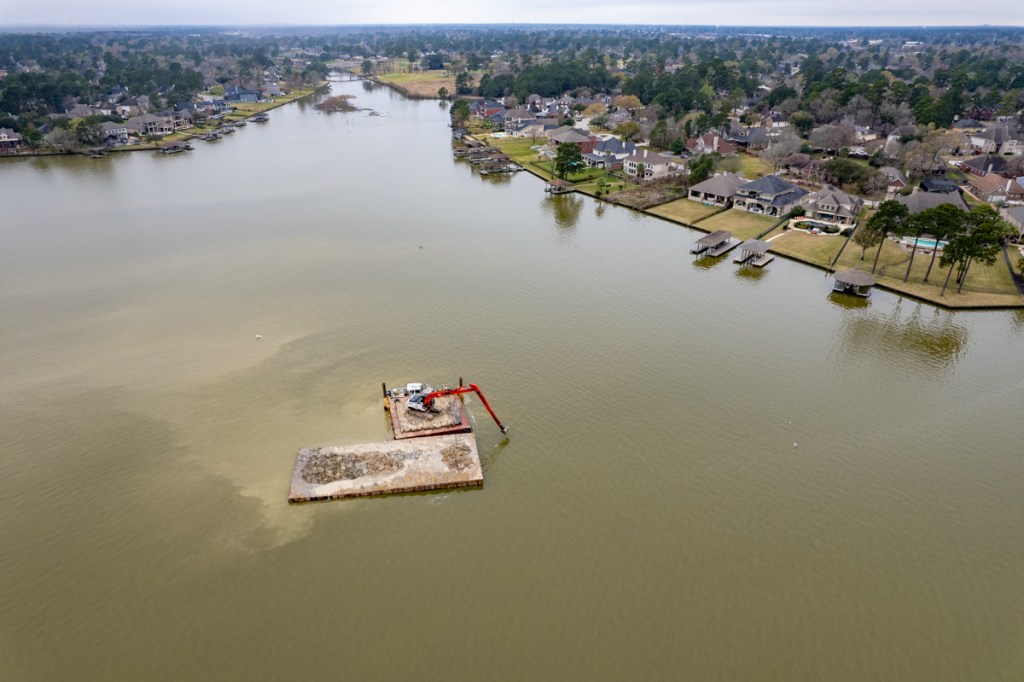
A marina on the east side of the lake has been converted to a temporary placement area. From there, truckers haul the dirt out of the floodplain to areas where it’s needed to elevate homes or roadways.

New site for transferring spoils.
Deposit site for dredging spoils. 2/27/22. Previous site was opposite River Grove Park on West Fork, almost 5 miles farther.

Put another one in the win column. Many people who flooded near Rogers Gully will face less risk this hurricane season as a result of this project.

Posted by Bob Rehak on 6/2/22

1738 Days since Hurricane Harvey

Dredgers Reach Rogers Gully Mouth Bar

When last I reported on Lake Houston dredging, the focus of operations had shifted from the East Fork to Rogers Gully. However, the dredgers were still stationed hundreds of feet offshore. According to State Representative Dan Huberty, shallow water forced them to dredge their way into the Gully. (See below.)

Location of dredge on March 1, 2022. Mouth bars, like the one in the foreground are deposited where water slows down as it reaches the lake.

Compare Photos Taken Today

Now, 2.5 months later, the dredgers have reached the Rogers Gully mouth bar and have completed dredging most of it.

Looking east toward Lake Houston. Compare photo above.
Looking west toward the Walden Country Club, upper right.

Aerial photos taken this afternoon show that all but a small portion has already been removed. The operation could be completed in the next week or two, weather permitting.

Pontoons ferry the spoils to a converted marina across the lake now used as a temporary placement area. From there, trucks take the spoils to a fill-dirt company on FM1960 near SH99 east.

Before Dredging Began

To appreciate the progress, compare the photo below taken two years ago.

Rogers Gully Mouth Bar
Rogers Gully Mouth Bar on June 16, 2020 before dredging started.

Harris County Flood Control District had just finished dredging the area behind the cart bridge about a month before I took the shot above. But the City owns the part of the gully near the lake.

Where Next?

It’s not clear yet where the dredges will go next. They’re on a mission, with money that Huberty helped obtain from the legislature, to open up more ditches and streams that empty into Lake Houston. Blockages like the one at Rogers Gully can reduce the conveyance of streams. They create sediment dams that back water up. And that contributes to flooding homes and businesses behind them.

The City of Houston issued a request for proposals to create a long-range dredging plan for the lake. However, no plan has yet been published. News to follow when it becomes available.

Posted by Bob Rehak on 5/20/22

1725 Days since Hurricane Harvey

How Blocked Up Is Rogers Gully?

On March 1, I posted about how dredgers had moved from the East Fork to Rogers Gully. Rogers Gully enters Lake Houston at the Walden Country Club. In my opinion, it has the worst mouth bar of all the channels that enter Lake Houston, with the exception of the East and West Forks of the San Jacinto. Harris County Flood Control finished dredging the channel itself almost two years ago. But the mouth bar is the City’s responsibility.

I went back to see how much of the mouth bar remained this morning and was shocked. The two dredges are still sitting far offshore, approximately where they were on March 1.

Here are several pictures that show their position this morning, 3/11/22.

Looking west from the mouth of Rogers Gully toward the dredges about a quarter mile away and the eastern shore of Lake Houston in the background.
Reverse angle. Looking over one of the two dredges toward the mouth of Rogers Gully.

Curious about why the dredges were working so far out, I asked State Representative Dan Huberty “Why?” Huberty, who secured money for the dredging, texted back a one-line answer.

“Can’t get into Rogers Gulley without dredging their way in.”

State representative dan huberty

Wow. I knew Rogers Gully was bad. But I had no idea it was that bad. This could be like getting to the East Fork from the West Fork. It took crews three months to dredge their way through the channel south of Royal Shores that connects the two forks.

It’s been almost two weeks since they started working here. And this area is far wider than the Royal Shores channel. Rogers Gully has apparently formed a wide and long “underwater” delta that extends far beyond the above-water portion.

So in answer to the question in the headline, “How blocked up is Rogers Gully?” It’s baaaad.

This underscores the need to establish a perpetual maintenance dredging program for Lake Houston, something the Army Corps recommended back in 2018 and that Brown and Root recommended in 2000. It’s not just about recreation. It’s about ensuring long-term water-supply capacity in the lake.

Posted by Bob Rehak on 3/11/22

1655 Days since Hurricane Harvey