Tag Archive for: $750 million

Lessons from Florida and Ian for Harris County

Best-selling Florida author/journalist Craig Pittman penned a poignant post for the Florida Phoenix about the state’s problems evacuating coastal communities before hurricanes. While the article uses evacuation to make a point, it’s really about a political culture that permits developments that put people’s lives at risk. It’s a cautionary tale for Texas, especially Harris County where flooding is such a huge issue and where the current leadership seems to have lost interest in mitigating it.

Ignoring Evacuation Standards

The title of Pittman’s article is “Development on Florida’s barrier islands made Ian evacuation virtually impossible.”

The story traces the approval of a high-rise development on a Florida barrier island that sought building permits, despite warnings that population density would lead to a 96-hour evacuation time.

Florida has a 16-hour evacuation standard. But only 9 of the state’s 45 counties can meet it. 

Florida Phoenix article by Craig Pittman

A loophole in Florida law lets developers mitigate evacuation delays with storm shelters. “They can do that by building new storm shelters, donating land for storm shelters, or donating money for storm shelters. In other words, it’s all about shelters, not about making it any easier to get off the island,” says Pittman.

“Dial a Prayer” for Buyers after Rebuilding

Then along came a hurricane named Ian – almost a Category 5 storm. Lee County (three barrier islands) didn’t issue evacuation orders until 24-hours in advance and at least 119 people died. 

Pittman ends with this sage advice regarding rebuilding in the same place. “You know the elected officials will be bowing to whatever those developers want. So, here’s my suggestion. They should approve building in those areas that Ian destroyed, but with one requirement. Every single would-be buyer should get a photo showing exactly what that spot looked like after Ian hit.”

“Then, if they still want to buy there, give them the phone number for Dial-A-Prayer. They’re going to need it, because if another Ian hits, the only one who can help them is Jesus.”

Similarities with Texas: Ill-Advised Political Decisions

Houston had a disastrous experience with evacuation during 180 mph Hurricane Rita. Evacuation attempts were tied to 107 deaths of Houston-area residents alone. Now, we don’t even try to evacuate from wind anymore. But as I read Pittman’s article, I thought of posts I have written about our ill-advised development practices that put people in harm’s way or that contribute to flooding. Some of the highlights include:

Light pole along evacuation route for Hurricane Harvey. A proposed high-rise development (that failed) would have had thousands trying to evacuate through this area. Photo by Jim Balcom.

How soon we forget!

Lessons for Harris County

Five years after Harvey, we’ve squandered an opportunity. Articles like those above are becoming more common, not less. As fear of flooding has receded, so has the zeal to hold developers to higher standards. And the pace of flood-mitigation efforts has slowed. We’ve squandered our best chance – perhaps ever – to address flooding.

For example, fourteen months after the Texas General Land Office notified Harris County that it would get $750 million to mitigate flooding, the County has yet to submit a plan for how it would spend the money. 

In fact, the county has yet to identify a single project in the plan. Lina Hidalgo, the Harris County judge, gave the project to her Community Services department instead of Flood Control. So far, Community Services has only identified a process for determining the plan. The department is still waiting on “direction from leadership” to identify projects that add up to $750 million. 

Duh! Did someone think of listing all the unfunded flood-bond projects? This is what I mean about the loss of zeal on the part of the county leader. 

The Public-Safety Threat and What to Do About It

Potential flooding is as much of a public-safety threat as crime. Harvey stole $125 billion from people and businesses. That’s more than $30,000 for every person in Harris County. It’s time we took flooding seriously again. We need to regain our sense of urgency about flood-reduction efforts. That’s why ReduceFlooding has endorsed Alexandra del Moral Mealer for County Judge. She is laser-focused on the issues that matter most in Harris County.

Posted by Bob Rehak on 10/18/22

1876 Days since Hurricane Harvey 

The thoughts expressed in this post represent opinions on matters of public concern and safety. They are protected by the First Amendment of the US Constitution and the Anti-SLAPP Statute of the Great State of Texas.

$750 Million MOD Going to GLO

Correction: since posting this, I have learned that Community Services has not even started compiling a list of projects that will comprise the Method of Distribution. The department has only defined a “process” for compiling the list and is waiting for “direction from leadership.”

On September 8th, the Harris County Community Services Department (CSD) distributed a schedule showing that it would complete the first draft of its Method of Distribution (MOD) for spending $750 million in mitigation funding by the end of the month.

The Texas General Land Office (GLO) and U.S. Department of Housing and Urban Development (HUD) allocated the money to Harris County earlier last year. The draft MOD will now hopefully go to the GLO for review and approval by the end of October.

What MOD Entails

Early last year, the GLO allocated the money to Harris County along with another $450 million to the Houston-Galveston Area Council.

A MOD lists projects and amounts. It shows how Harris County wants to distribute the money, i.e., who will get how much for what from the $750 million.

will this get any of the $750 million in CDBG-MIT funds from the GLO?
US 59 at Townsen Boulevard during Hurricane Harvey

The GLO must verify that all planned expenditures meet requirements of the funding allocated by HUD and Congress.

MOD Developed With Public Input

Harris County CSD held online and in-person meetings to share information with the public. English-language meetings were held on August 17th,  25th, and 31st. CSD also held a Spanish meeting on September 1st. They then gathered written and oral comments from the public. (The deadline to submit comments has passed.)

Next Steps

After a public planning meeting on September 8th, CSD spent the rest of September developing a draft Method of Distribution (MOD) for the $750 million. The department will now submit it to the GLO for review and preliminary approval. Steps after that include:

  • Publish Draft MOD by October 30
  • Nov 15-Dec 2 – 15-day public comment Period and hearing
  • Contract entities included in the MOD with funding level and gain confirmation of participation via Funding Acknowledgement Letter from entity
  • Dec 5-7 – Document Responses to Public Comment, add to Draft MOD document
  • December or January- Draft MOD document approved at Commissioners Court
  • January 2023 – Final MOD document submitted to GLO
  • GLO approval of final MOD and MOD allocated entities complete project information package process
  • March/April 2023 – MOD Entity project information packets submitted to GLO for review and approval
  • Kick-off contract development for projects.

So, the GLO has until the end of the month to review and approve the draft MOD. Once approved, CSD can publish it. Then CSD will hold more public meetings and submit any revisions to Commissioners Court and the GLO for final approval.

Pressure On to Develop Projects Quickly

Expect projects to begin sometime in the second quarter of 2023. But keep in mind that all dates are subject to change.

Starting to develop projects almost six years after Harvey will put some pressure on Harris County Flood Control and any other entities designated as recipients.

  • 50% of the grant must be expended by Jan. 12, 2027.
  • 100% must be expended by January 12, 2032 – 15 years after Harvey

Half of the $750 million must be spent within four years. To put that in perspective, Flood Control estimates it’s only 23.5% done with a 10-year flood-bond package four years after it was approved by voters.

Posted by Bob Rehak on 10/1/2022

1859 Days since Hurricane Harvey

How Would You Spend $750 Million on Flood Mitigation?

Harris County’s Community Services Department wants to know how you would spend $750 million? The U.S. Department of Housing and Urban Development (HUD) and the Texas General Land Office (GLO) allocated that amount to the County for flood mitigation in the wake of Harvey.

Flood Mitigation funds (MIT) go to projects that help communities reduce future flooding. They differ from Disaster Relief funds (DR). The latter help individuals recover from past floods.

GLO announced the $750 million allocation on March 18. HUD is NOT giving the money to Harris County outright. The County must first submit a plan of how and where it will use the money. Both HUD and GLO must approve that plan, called the Method of Distribution (MOD) before work can begin. Then, as vendors submit invoices, Harris County will submit them for reimbursement.

Notification of Planning Meeting For CDBG-MIT funding

Harris County wants your input on the plan. The Community Services Department will accept written and oral input regarding the use of funding and development of Harris County’s MOD at a planning meeting scheduled for:

Thursday, May 19, 2022

1:30 pm to 2:30 pm

Harris County Community Services Department (HCCSD) Office

9418 Jensen, Houston, Texas, 77093

Harris County will accept written input before May 30, 2022, 5:00 pm. via mail to Attn:  HCCSD Planning Section, 13105 Northwest Freeway Suite 400, Houston, Texas 77040 or by email to DRplancomments@csd.hctx.net.

To Request Special Accommodations at Meeting

Harris County will provide for reasonable accommodations for persons attending Harris County functions. Requests from persons needing special accommodations should be received by Harris County staff 48-hours prior to the function. The public hearing will be conducted in English and requests for language interpreters or other special communication needs should be made at least 72 hours prior to a function.

Please call 832-927-4700 or email DRplancomments@csd.hctx.net for assistance or additional information about this posting.

Restrictions on Use of Money

The funds represent an opportunity to mitigate disaster risks and reduce future losses in areas impacted by Harvey.

HUD defines mitigation as: “Those activities that increase resilience to disasters and reduce or eliminate the long-term risk of loss of life, injury, damage to and loss of property, and suffering and hardship, by lessening the impact of future disasters.”

Virtually all Harris County Flood Control District Bond Projects would qualify under that definition.

Eligible recipients include units of local government, special purpose districts, and port and river authorities.

The GLO encourages the prioritization of regional investments with regional impacts. Those include:

  • Projects that reduce risk from hurricanes, tropical storms and depressions, flooding, wind and other hazards
  • Disaster-resistant infrastructure
  • Upgrading water, sewer, solid waste, communications, energy, transportation, health and medical, and other public infrastructure
  • Multi-use infrastructure
  • Green or natural mitigation infrastructure.

Low-to-Moderate Income Requirement

At least fifty (50) percent of Harris County Mitigation MOD funds must benefit low-to-moderate income (LMI) persons.

Section 5.4.5.10 of Texas Action Plan Amendment 1

The table below shows the percentage of LMI Residents in each of Harris County’s 23 watersheds and the number of structures damaged in those watersheds by Harvey. Cross reference this information with the list of flood bond projects in making your recommendations for how to allocate the $750 million. And, of course, you don’t have to restrict yourself to flood bond projects.

Information obtained from Harris County Flood Control District Via FOIA Request.

Brittany Eck, GLO spokesperson, emphasized that the LMI requirement applies to “beneficiaries of a project.” She also said that GLO encouraged Harris County to look both upstream and downstream for beneficiaries. Not everybody in a watershed may benefit.

New Halls bayou detention pond
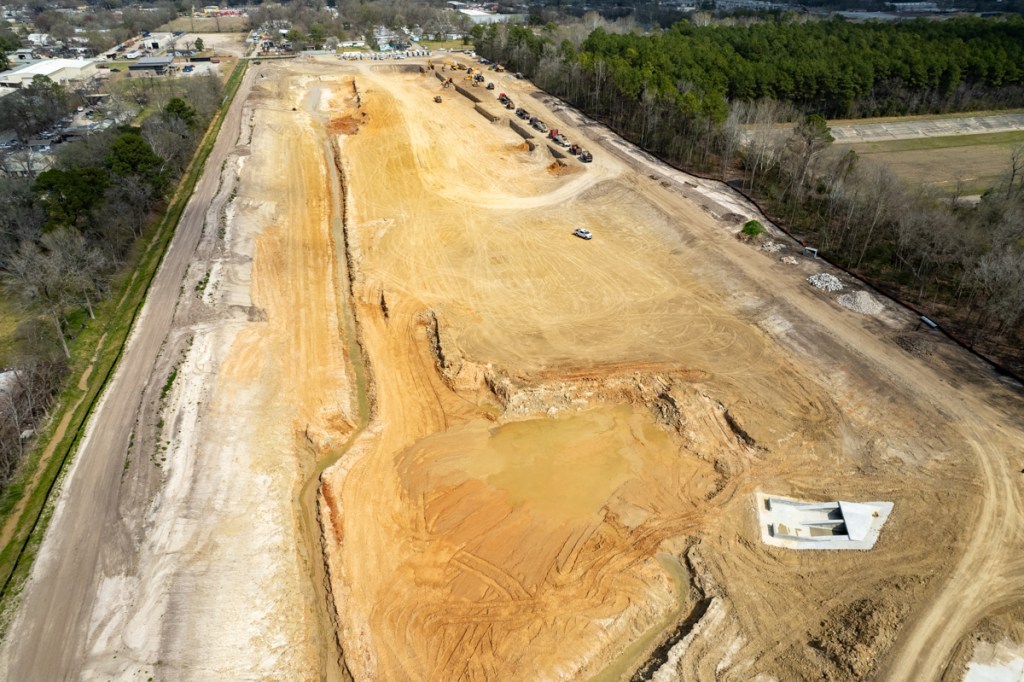
Just west of Keith Weiss Park along Halls Bayou, this new floodwater detention basin is taking shape. Detention basins, channel widening, and green infrastructure are all examples of types of projects the $750 million could help fund.

Pages 250-256 of the Action Plan contain the exact text of all requirements.

Time Limitation on Expenditure of Funds

No less than 50% of the $750,000,000 CDBG-MIT allocated to Harris County must be expended by January 12, 2027, with the full balance expended by January 12, 2032.

While this may sound like plenty of time, remember that today almost five years have passed since Harvey. And only 45 of 181 projects originally in the flood bond have begun construction. The rest are in still in feasibility surveys, engineering, or right-of-way acquisition.

All flood bond projects have already started and passed through one or more of those preliminary phases.

This Money Could Fully Fund the Bond Program

This $750 million, together with the Flood Resilience Trust approved last year by Commissioners Court last year, should be enough to fully fund every project in the bond program.

However, the County Administrator chose the Community Services Department (CSD) to recommend projects for the MOD. The thinking was that CSD was more in touch with the needs of LMI neighborhoods. Of course, CSD will consult with HCFCD on the final recommendations.

Posted by Bob Rehak on 5/14/2022

1719 Days since Hurricane Harvey

Harris County Commissioners Court Discusses What to Do with HUD, Flood Resilience Trust Money

If you managed to watch Harris County Commissioners Court yesterday, near the end you saw a lively and somewhat confusing discussion of flood mitigation funding. See the video at approximately 6:38:10. Agenda Item 249 was a request by Adrian Garcia to discuss disbursement of the $750 million in Community Development Block Grant Mitigation funds allocated to Harris County by the Texas General Land Office (GLO) and the US Department of Housing and Urban Development (HUD).

During the debate, commissioners also discussed approximately $830 million currently sitting in a Flood Resilience Trust that they created last July to compensate for an expected shortfall in flood-bond partner funding.

In the end, Commissioners made no decisions. But it became clear that Commissioners Ellis and Garcia leaned toward spending it in low-to-moderate income neighborhoods, cleaning out roadside ditches, and sharing money with the City of Houston.

Still No Plan for How to Spend $750 Million

HUD and GLO made the award on March 18, contingent on approval of what HUD calls a Method of Distribution (MOD). Basically, that’s a plan for how and where the money would be spent.

Commissioner Ramsey noted that the pursuit of the money was bi-partisan and that he hoped the distribution would be bi-partisan as well.

Commissioner Garcia said he was immensely frustrated because a) he just didn’t know when the $750 million was going to arrive, and b) what strings came with the money.

He then referenced the Flood Resilience Trust created by commissioners last year from toll road and other county funds. “If we’re going to be getting $750 million, then I think those other dollars (approximated $830 million in the Trust) can be put somewhere else for practical use,” said Garcia. He also noted that another hurricane season was fast approaching.

He then asked Dr. Tina Petersen, the new head of the Flood Control District, whether she had a chance to study this and come up with any recommendations. Petersen who has been in her job about a month said, “We’re working on that.” She reiterated that no project has been delayed due to a lack of partnership funding and that she was working hard to ensure none would be.

Garcia, Ellis Argue for More Money in LMI Neighborhoods

Garcia then claimed, without citing a source, that 70% of the people who flooded in an unspecified flood (but presumably Harvey) “are still without a given project.” He also said that $830 million had accumulated in the Flood Resilience Trust to date.

Commissioner Ellis claimed the County and City of Houston should each have gotten $1 billion and that he would continue to fight for the County’s other $250 million, as well as a billion for the City.

Ellis then tried to add up the amount of committed funding in the flood bond to date but forgot to add approximately $1.5 billion in partner funds already committed. Oops! With the $750 million and the money already in the flood resilience trust, the flood bond should be more than fully funded by now.

flood bond funding
As of the start of this year, HCFCD had $1.57 billion in committed partnership funding and $833 million in the flood resilience trust, leaving a gap of $100 million. The $750 million HUD allocation in March should have created a $650 million surplus.But nobody talked about that.

Ellis assumed the $750 million would be spent in Greens, Halls, and Hunting Bayou watersheds. All qualify as low-to-moderate income areas. But if you look at the latest flood-bond project list spreadsheet, Harris County Flood Control District needed $69 million in partner funding for Greens, $269 million for Halls, and $65 million for Hunting. So partner-funding needs for the three watersheds total about $400 million. That leaves about $350 million out of the $750. Nobody, however, even mentioned that in the discussion.

County Administrator Says “Not So Fast”

The County administrator David Berry then pointed out that we don’t have the $750 million yet. “It was not a direct allocation. The county must prepare the method of distribution (MOD) and a citizen participation plan first,” then get them approved by HUD and the GLO.

Then Berry dropped a bomb. He said, HCFCD was proposing projects, but not preparing the documents about how the money would be spent. That tells me the distribution will be based on political, not technical considerations.

Ellis Uses Threat of Title 6 To Support LMI Funding

Ellis concluded the discussion by saying that HUD used a Title 6 complaint as a lever against the GLO, “and if we’re not sensitive to [LMI, Social Vulnerability], there will be a Title 6 Complaint against us.”

Title VI, 42 U.S.C. § 2000d et seq., was enacted as part of the landmark Civil Rights Act of 1964. It prohibits discrimination on the basis of race, color, and national origin in programs and activities receiving federal financial assistance.

According to a summary of the Texas CDBG-MIT Action Plan Amendment approved by HUD, HUD requires that at least 50% of total funds must be used for activities benefiting low and moderate income (LMI) persons. However, the summary also states that “all programs will have an LMI priority.”
Click here to see the complete text of the GLO’s action plan amendment approved by HUD on March 18.

Berry didn’t see the LMI focus as a problem, though. He concluded by saying, “The goals of this court in terms of protecting the most people at the highest risk of flooding, and who are the most vulnerable from recovery, all of that seems straight up the alley of the way we should be distributing this money.”  

Ellis Wants More But…

Ellis said that he still wanted to fight for more funding. He felt the City of Houston and the County each deserved $1 billion. And he wanted to fight for another $250 million. He volunteered to fight on the City’s behalf, too. No one told him that all the flood mitigation money had already been committed.

Ellis claimed the City got $0, but HUD and the GLO made a direct allocation to the City of $61,884,000. And the Houston Galveston Area Council (H-GAC) received $488 million.

According to Brittany Eck, a spokesperson for the GLO, “Funding for three competitions, Harris County’s allocation, and the Regional Mitigation Program all totaled more than $3 billion. Entities within H-GAC were either awarded or allocated a little over 56% of that. Congress has not indicated additional funding may be coming, though it could appropriate additional funds at any time. But that is not likely.”

Posted by Bob Rehak on 4/6/2022

1681 Days since Hurricane Harvey

HUD Approves $750 Million to Harris County for Flood Mitigation

Today, the U.S. Department of Housing and Urban Development (HUD) approved the Texas General Land Office’s (GLO) amended plan for Community Development Block Grant Mitigation (CDBG-MIT). The amended plan allocates $750 million in funding for Harris County and an $488 million to the Houston-Galveston Area Council for additional mitigation projects in the region. The funds allocated to the county should now mean that the 2018 flood bond is fully funded, if numbers provided last month on partner funding to date are accurate.

George P. Bush Quote on Process

According to a press release issued by the GLO at 7PM, 3/18/22, “Ensuring Texans receive disaster recovery and mitigation funding in a timely manner to recover from Hurricane Harvey has always been my top priority,” said GLO Commissioner Bush. “The Biden Administration’s politically weaponized Department of Urban Development and Housing has forced us to fight through mazes of red tape to secure this direct allocation for Houstonians. I will continue to fight to send money to Texans as quickly as possible. The $750 million allocation will go directly to Harris County for projects that help mitigate future flooding events, creating a stronger more resilient Texas.”

George P. Bush, Commissioner, Texas General Land Office, 2019 photo

$1.138 Billion Total

HUD’s approval of the latest Harvey Action Plan brings the total infrastructure and mitigation investments in Harris County to more than $1.1 billion. HUD’s approval of the GLO’s plan to provide $750,000,000 to Harris County is in addition to HUD’s direct allocation of $61,884,000 to the City of Houston, plus $117,213,862.96 in CDBG-MIT awards for Harris County projects, plus $209,221,800 in infrastructure funds from CDBG-DR, equals $1,138,319,662.96 in total investment in projects within Harris County. Additionally, H-GAC continues to develop its method of distribution on more than $488 million for mitigation projects within the greater Houston region.

Bush first requested a direct allocation for Harris County in May of 2021 after the county received very little money from the first round of competition for HUD. A direct allocation would have allowed Harris County to work directly with HUD and taken the GLO out of the loop. However, HUD reportedly insisted that the GLO remain involved. Subsequently, the GLO developed a 650-page action plan for the $750 million. However, HUD found it insufficient. As of early this week, the action plan exceeded 1000 pages, according to a GLO spokesperson. That apparently provided HUD what it needed. HUD notified the GLO in a letter received after 5PM today.

Method of Distribution Must Still be Developed

However, Harris County won’t get all the money immediately.

Since last November, H-GAC has been developing something called a MOD (Method of Distribution) for its allocation. However, according to the GLO, because of the expense involved, Harris County has delayed developing its MOD until the the award was approved by HUD.

Harris County’s next step will be to develop its MOD which describes where the money will go, how it will be used, and who will get it. GLO will review that and forward it to HUD. After HUD approves the MOD, HUD still won’t write a check for $750 million to the county. The money will be reimbursed to the county in batches as it is spent on approved projects.

Flood Bond Close to Fully Funded Even without Resilience Trust

Still, this will go a long way toward fulfilling the potential shortfall in partner funding for the Harris County Flood Bond. Of the original $5 billion bond, half is being paid for by Harris County taxpayers. The County hoped to get local, state, and federal partners to fund the other half.

Last July, when it looked like the $750 million might not materialize, Harris County Commissioners approved a Flood Resilience Trust that committed $833 million from the Toll Road Authority and other Harris County sources of funding. That, along with partner funding already committed, was enough to keep construction of Harris County Flood Bond projects rolling through approximately 2026.

From a presentation to the Harris County Community Flood Resilience Task Force in February 2022.

Today’s approval should make the flood bond fully funded if the numbers above are accurate. That should come as good news for all citizens who have been fighting for limited dollars. With money in the trust, this should accelerate mitigation projects throughout the county. And even fund some not identified in the original bond!

Posted by Bob Rehak on 3/18/2022

1662 Days since Hurricane Harvey