Mercer Basin Illustrates Risks of HCFCD Slowdown for Quarter Billion in HUD Funding

8/8/25 – The Mercer Stormwater Detention Basin at FM1960 and the Hardy Tollroad along Cypress Creek illustrates the difficulty HCFCD will face as it attempts to build 11 comparable basins in the next year and a half.

The Mercer Basin, originally projected to take one year – on an expedited schedule – has taken more than two years already and is still many more months from completion.

If HCFCD maintains that pace for the other basins, it could miss a critical U.S. Department of Housing and Urban Development deadline.

HUD Funds Come with Expiration Date

In June this year, Harris County Flood Control District (HCFCD) received approval of Community Development Block Grant – Disaster Relief (CDBG-DR) grants to build 11 stormwater detention basins worth $326 million.

One (Arbor Oaks) is already in construction. But ten more projects valued at $289 million remain to be bid. Is there enough time to complete them before HUD’s immovable February 28, 2027, deadline?

The next ten basins don’t have 2.5 years. So unless HCFCD picks up its pace, low-to-moderate income areas across Harris County could lose a quarter billion dollars in funding. They can’t afford that.

Neither can areas like Lake Houston. Because Commissioners Court will start cancelling projects here to divert funds to the areas that lost grants.

Huge Difference Between Original and Actual Timeline

At 512 acre feet, the Mercer Basin is slightly larger than average. Construction experts tell me that a basin that size should take a year to build. And, in fact, that was the estimate Rodney Ellis gave a community meeting.

From Rodney Ellis presentation to Community on June 29, 2022.

But the project slid from the git-go. The county didn’t advertise it to potential bidders until 8/4/23. Then it took HCFCD four months to select a winning bid and issue a “notice to proceed” to the contractor.

Photos Taken 8/8/25 Show Construction Still Far From Complete

And the job, which was supposed to be finished a year ago this week, is still in construction. Worse, construction may not finish this year, according to a contractor I talked to who saw the pictures below.

Looking W at South Mercer detention basin at FM1960 and Hardy. FM1960 on left.
Looking S toward FM1960 at same basin. Hardy Tollroad in upper right.
Looking N at balancing culvert between two Mercer basins
North basin is closer to completion but still not done.
It appears contractors are still installing backslope interceptor swales and drain pipes.
Looking S at both basins with Cypress Creek snaking through frame from right to left.

Mercer Took 2X Longer than Predicted – So Far

From the invitation to bid to today has been 735 days – five days more than 2 years!

Even if all CDBG-DR projects in play went out for bids tomorrow, only 569 days remain until the ultimate, immovable deadline of Feb. 28, 2027. Even worse…

According to HCFCD’s latest bid schedule, 8 of 10 projects on HUD’s list won’t even go out for bid for another 2 to 10 months.

Lastest HCFCD Bid Outlook, Release 6/6/25

Here are HCFCD’s projected bid dates.

DR Bid Schedule

So, to summarize:

  • Mercer should have taken a year to finish from the invitation to bid, but has taken two years and could take another half year.
  • The other DR projects will have 18 months, but could take another 2 to 10 months before they even start bidding.

You can see the concerns. No margin for error. No weather delays allowed. And HCFCD still might not have enough time to complete projects.

George P. Bush announced this money was coming to Harris County more than four years ago when he was still commissioner of the Texas General Land Office. It took HCFCD (and the Harris County Community Services Department) four years to figure out how they wanted to spend the money he allocated. Now they’re leaving 18 months or less to actually build the projects.

Posted by Bob Rehak on 8/8/2025

2901 Days since Hurricane Harvey

The thoughts expressed in this post represent opinions on matters of public concern and safety. They are protected by the First Amendment of the US Constitution and the Anti-SLAPP Statute of the Great State of Texas.

Leadership Crisis in Harris County Government

8/7/25 – Lina Hidalgo threw another temper tantrum in Commissioners Court today, left and never returned. She also received a censure from her colleagues, the commissioners.

Worse, Harris County Flood Control District (HCFCD) seems adrift. Current HCFCD leadership seems to have no sense of urgency. Eight years after Harvey, less than a quarter of flood-bond IDs have been completed. And once again, despite tight deadlines that could mean the loss of hundreds of millions of dollars in funding, HCFCD brought no construction or capital improvement contracts to Court today for approval or even bidding.

Flood Control Slowdown

Eight years ago this month, Hurricane Harvey struck Harris County. It caused an estimated $125 billion dollars of damage. It dramatized our vulnerability and the need for improvements in flood control.

To address those needs, voters approved a $2.5 billion bond. Partners pledged another $2.7 billion.

Out of that money, HCFCD still has $3 billion waiting to build scores of projects. Yet…

Not one construction bid was brought to Commissioners Court for approval today.

Ability to Deliver Projects At Critical Time In Doubt

In the seven years since passage of the flood bond in 2018, HCFCD has completed only 43 of 181 Bond IDs. And yet, see what HCFCD asked for in Commissioner’s Court today. It’s typical of recent meetings.

Today’s agenda provides a glimpse of HCFCD’s ability to deliver projects and its priorities. Forty-two Flood-Control-related items were listed.

I summarized today’s flood-related agenda items below under their agenda category headings.

As you read through the items, notice how not one has to do with construction or a capital improvement project. Even as fixed deadlines for hundreds of millions of dollars in HUD grants are fast approaching.

Flood-Related Items on Agenda

Flood-Control-related items DID include:

Management and Budget

#8 – Debt service payments on September bonds

#9 – Debt service payments on October bonds

#13 – Approval of a methodology for charging indirect costs

#17 – Budget transfers

County Engineer

#24 – A 2-acre easement

#25 – A 15-acre easement

#53 – An agreement with a MUD to build a pedestrian bridge across a channel

#155 – Correction to a deed

#156 – Correction to another deed

Flood Control District

#157 – Mowing agreement with a MUD

#158 – Trail maintenance agreement with a MUD

#159 – Mowing reimbursement for a MUD

#160 – Landscaping maintenance agreement for one residential lot

#161 – Abandon an easement

#162 – Abandon another easement

#163 – Engineering agreement to re-certify a levee

#164 – Change order adding 120 days to a maintenance agreement

Economic Equity and Opportunity

#172 – Letter of non-objection for a foreign trade zone

Auditor

#270 – Approval of payroll

Purchasing

#289 – Bid approval for erosion and slope repair

#300 – Vision insurance for next calendar year

#301 – Dental insurance for next calendar year

#305 – Life insurance for next calendar year

#306 – Disability insurance for next calendar year

#314 – Pest management services

#315 – Tree removal services

#319 – Group medical insurance for next year

#339 – Change in contract amount for channel repair job

#356 – Inventory adjustment

Precinct 1

#366 – Maintenance agreement with City of Houston for detention basin

Transmittals

#451 – Transmittal of tax rate

#452 – Advertisement of channel-repair project

#456 – Tree-trimming and tree-removal contract

#460 – Mowing contract

Executive Session

#476 – Flood Control’s nominee for Appraisal District

Emergency/Supplemental Items

#490 – Contract with corrugated metal pipe provider

#491 – Repair contract for South Harris County

#492 – Channel rehab

#502 – Contract to supply modular buildings

#510 – Vehicle leases

#520 – Flood-bond update discussion (requested by Ramsey)

#521 – Flood-control maintenance discussion (also requested by Ramsey)

A Crisis of Leadership

Harris County government under the current administration has slowed to a crawl. Taxes go up. Yet delivery of service is down. Instead of doing more with less, Lina Hidalgo is doing less with more.

We have a crisis of leadership that started with a brain drain when political appointees under Lina Hidalgo replaced experienced, professional department heads.

Then despite performance issues, many of those new heads were given massive pay increases. For instance, HCFCD’s new department head received a raise of almost $90,000 per year despite declining performance.

HCFCD spending rate through Q2 2025

Judge Meltdown Leads to Censure

So, who is pushing projects ahead? It’s certainly not the county judge. She blew another gasket today. It was an embarrassing meltdown of epic proportions…shocking even by Harris-County standards.

At approximately 6:45 PM, Precinct 3 Commissioner Ramsey initiated a discussion of Rules of Conduct at Decorum during Commissioners Court Meetings.

Immediately after the members present adopted the rules, Ramsey made a second motion to censure Lina Hidalgo for her tantrum today and a previous use of profanity when children were present. That motion also passed. In legislative terms, a censure is a formal reprimand or strong rebuke of a member’s conduct or character.

Ramsey Addresses HCFCD Issues

Just before executive session Ramsey also addressed issues at HCFCD and the progress of projects. He specifically mentioned that no construction or capital improvement projects were on the agenda today, and requested an update from HCFCD on when projects were going out for bid.

Ramsey also reminded people that HCFCD promised to come back to court in September with details about what could and couldn’t be done within the available time and budget, and what would have to be phased.

Ramsey concluded with an admonishment. “We have some real severe deadlines that we’ve got to meet,” he said.

The sad thing is that by the time the next election rolls around, hundreds of millions of dollars in HUD funding could be off the table. It’s not gone yet. But the County needs to solve its leadership crisis if it ever hopes to reduce flood risk with that money.

Posted by Bob Rehak on 8/7/2025

2900 days since Hurricane Harvey

The thoughts expressed in this post represent opinions on matters of public concern and safety. They are protected by the First Amendment of the US Constitution and the Anti-SLAPP Statute of the Great State of Texas.

Diversion Ditch Study Did Not Consider Obvious Opportunities that Might Have Reduced Costs, Flood Risk

7/30/25 – The Preliminary Engineering Report (PER) of Kingwood Diversion Ditch Conveyance Improvements makes no reference to three obvious detention opportunities that could potentially reduce project costs and help protect people in Kingwood from flooding. Harris County Flood Control District (HCFCD) commissioned the PER in 2021 after the Kingwood Area Drainage Analysis identified fixing Diversion Ditch issues as one of the top priorities in Kingwood.

Chris Bloch, a local engineer and flood activist says he showed the detention opportunities to HCFCD. However, Neel-Schaffer did not consider them in its report for unknown reasons.

Detention South of River Will Not Help Flooding Along Diversion Ditch

The Neel-Schaffer PER recommended building 405 acre-feet of detention south of the San Jacinto West Fork. 

The location south of the river may help people downstream, but it will do nothing to reduce the volume of water flowing down the Diversion Ditch during a major storm. 

Detention south of the river will help people farther down the West Fork. But Bloch points out that locating detention along the Diversion Ditch would help both Kingwood residents and others downstream.

Overview: Three Stormwater Detention Opportunities Inside Kingwood

Bloch consulted with Stan Sarman before Sarman’s untimely death several years ago. Sarman was one of the consulting engineers who designed Kingwood’s original drainage for Friendswood. Bloch says that he and Sarman identified several recommendations to improve Kingwood drainage. From north to south, they include:

  • Adding detention between Northpark Drive and St. Martha Catholic Church
  • Removing a berm between Kings Manor and Kings Mill detention ditches, then increasing the width and depth of the combined ditches
  • Creating extra capacity near the proposed new San Jacinto River outfall of the Diversion Ditch.

According to Bloch, these alternatives could provide far more capacity than the 405-acre feet that Neel-Schaffer says it needs – especially if combined with some channel-widening opportunities. I will discuss channel widening in a future post. But first, let’s look closer at these three.

Opportunity #1

Neel-Schaffer evidently didn’t look at anything north of the Harris/Montgomery County line. Since Neel-Schaffer released its PER, the Lake Houston Redevelopment Authority announced plans to build 100 acre-feet of detention in the area where the Diversion Ditch splits off from Bens Branch just north of Northpark. That’s a quarter of the needed 405 acre-feet right there.

Opportunity #2

Removing the berm between the Kings Mill and Kings Manor ditches and increasing the width and depth of the combined ditches would provide another 100 acre-feet of detention capacity. Both ditches are owned by Montgomery County Municipal Utility Districts.  

Kings Mill is under fire to reduce runoff due to the new high-density Northpark Enclave development. Construction plans show runoff entering the Northpark evacuation route during extreme high-water events.  

Plus, additional Enclave runoff will further reduce Diversion-Ditch capacity. Parts of the Diversion Ditch have a 50% chance of flooding every year.

Opportunity #2 could help mitigate both Enclave and Diversion-Ditch capacity issues.

Dual drainage ditches separated by needless berm could provide another $100 acre feet of storage.
Looking East toward Russell Palmer Road. Eliminating the berm between Kings Mill and Kings Manor Drainage could provide an estimated 100 acre-feet of additional stormwater detention benefitting Kingwood residents.

Opportunity #3

Neel-Schaffer recommends extending the Diversion Ditch from below Deer Ridge Park to the West Fork – without forcing it to make an S-turn through River Grove Park. 

New outfall for Diversion Ditch (red line) creates another opportunity for more detention (in red box).

That coincides with one of the recommendations originally made by Sarman and Bloch. But Sarman and Bloch also called for construction of a large pond at the outfall location. This pond would slow water velocities exiting the Diversion Ditch and provide a sediment-settling area before the water enters the River.

Depending on the configuration, such a pond could provide another 80 to 100 acre-feet of inline detention.

High Cost of Detention South of River

Those three alternatives alone could provide approximately three quarters of the needed detention and reduce flood risk for more than 500 residents who flooded near the Diversion Ditch during Harvey. 

Bloch and Sarman identified other opportunities within the ditch to expand capacity. They could easily bring the total to far more than the 405 acre-feet needed. 

Neel-Schaffer makes a frank confession about its detention recommendation south of the West Fork on page 38 of its Preliminary Engineering Review. It says that…

“Although an offsite stormwater detention basin is feasible, the prospective benefits are negligible.”

Neel-Schaffer Kingwood Diversion Ditch Preliminary Engineering Review, Page 38

Yet the projected cost of the basin they proposed is between a quarter and a third of total project costs – almost $15 million out of $55 million. In fairness, Neel-Schaffer says on the same page, “Due to limited effectiveness and significant cost, the recommended detention basin should be further examined during final design.”

Final Design Getting Underway

On May 8, 2025, Harris County Commissioners Court approved a motion to advertise final design and construction of the diversion ditch project for bids. However, an engineering design firm has not yet been selected.

When they are, I hope they evaluate some of these recommendations.

A transmittal from HCFCD Executive Director Dr. Tina Petersen shows that the EPA and Texas Water Development Board have apparently pledged $7 million to the project. That won’t cover much construction. So, Petersen says HCFCD will continue to look for more grants. Her timeline shows construction starting in mid-2028…if she can find the money. 

These recommendations may help make the project more affordable.

Posted by Bob Rehak 7/30/25

2892 Days since Hurricane Harvey

The Dirty Dozen: 12 Ways Harris County Makes It Hard to Track Your Tax Dollars

7/23/25 – Ever wonder how someone could lose track of billions of tax dollars? It takes a lot of effort. But Harris County’s current Democratic leadership has proven adept at the task. Here are some of tricks of their trade.

1. Moving money around

That makes it more difficult to trace. Put Toll Road money into Flood Control. Put Flood Control money into Engineering. Then move it back again. And again. Establish a Flood Resilience Trust to supplement flood-bond funds. Then dissolve it. Never provide a full accounting. Whew. Even the county administrator couldn’t explain it clearly. Maybe that was the point.

2. Changing department heads and group managers

Replace professional hires with political hires. In Flood Control, Engineering, IT, Community Services. And 16 other departments. Then gut the management structure three or four levels beneath them. Lose institutional knowledge, project momentum and oversight capabilities.

3. Making the new department heads accountable to a new department

The County Administrator’s Office, for instance. It has had three heads in four years (David Berry, Diana Ramirez and Jesse Dickerman) and is searching for a fourth to replace Dickerman whose title is Interim Administrator. All within four years.

4. Replacing experienced professionals with political hires

Force remaining experienced professionals to do the work of the political hires…without a pay increase. One veteran professional, who needs to remain anonymous for fear of reprisals, told me, they’re “doing their best to drive off remaining staff, and not even bothering to find replacements. I am pretty sure it is well past the tipping point and the county is one disaster away from dysfunctional.”

5. Appealing routine Public Information Requests to the Texas Attorney General

Then if the AG upholds the request, charge thousands of dollars to email (months later) a PDF that was already sitting on someone’s computer.

6. Not updating websites

That makes it easier for Rodney Ellis to claim “Kingwood is getting all the money.” Parts of the HCFCD district website haven’t been updated for five years. See below.

Screen capture from Downloads page on 7/23/25 shows last update was November 2020.
7. Removing lists of Active Projects from your web site

That might enable people to quickly verify whether “Kingwood is getting all the money.” Make people dig for the information and pay for it instead.

8. Publishing spending updates annually that used to be monthly

The frequency of Flood Bond Updates has fallen off radically. That makes it difficult to track projects in near real time.

9. Hiring Consultants for $2 million to do the work of staff you lost

On the 7/10/25 commissioners court agenda, Item 250 was a contract extension with Berkeley Research Group, LLC for $1,995,000. The primary deliverable in this word salad seems to be a dashboard to help make projects’ status more visible. Of course, this could delay disclosure for additional months…as outsiders try to figure out what insiders can’t.

10. Not totaling columns of spreadsheets that stretch for dozens of pages

And don’t put headers on any pages past the first, either. Make people scroll back and forth until their eyeballs bleed or they give up. And make them perform complicated import/export procedures to total up columns that stretch to almost 40 pages.

11. Continually changing the way you allocate money to projects

At first it was on the basis of flood damage. But people could understand that. So, it changed. Over and over and over again. Until now, damage, flood risk and flood intensity have nothing to do with the formula for allocating flood bond money.

12. Not even telling people where bond money will go in the first place

Unlike the 2018 Flood Bond, Garcia’s 2022 $1.2 billion Bait-and-Switch Bond didn’t even tell people where money would be spent. Three years later, we still don’t know. So, no one can check on them.

Shortly before the vote on Garcia’s bond, commissioners agreed to give each precinct an equal share. That lasted until the day after the election. We’re still waiting to see where money is going. The County Engineer admits to spending $131 million in the last three years, but has published NO detail on what that money bought.

Is the current uproar over the flood bond an effort to deflect attention from more tax dollars that have gone MIA? We just don’t know.


Any one of these practices might be overlooked were it not for the presence of the others. But taken together, they feel like a concerted effort to “escape and evade” detection and accountability.

Posted by Bob Rehak on 7/23/25

2835 Days since Hurricane Harvey

The thoughts expressed in this post represent opinions on matters of public concern and safety. They are protected by the First Amendment of the US Constitution and the Anti-SLAPP Statute of the Great State of Texas.

Commissioners Clarify Stance on Flood-Bond Partnership-Project Funding

7/10/25 – In today’s Harris County Commissioners Court meeting, the Court clarified its stance on funding flood-bond partnership projects in the face of spending cuts announced in the last meeting.

Commissioners revisited a vote on a motion from their 6/26/25 meeting that cast doubt over completion of 80% of the projects in the 2018 flood bond. Among them were many projects that involved money pledged by partners at the federal, state and local levels.

Today’s meeting clarified that Commissioners do intend to fund partnership projects that fell below the first quartile on Rodney Ellis’ Equity Prioritization Framework. Including more flood gates for Lake Houston.

Revisiting Vote that Potentially Defunded Partnership Projects

Precinct 3 Commissioner Tom Ramsey kicked off the discussion on Item 277. (Note, however, that the video, which starts at approximately 58 minutes, calls it #177.)

The debate addressed the consequences of the vote in the last meeting to focus all remaining money in the bond on the top quartile of equity projects.

Further, the 6/26/25 motion said that future phases of those projects would also be funded – even if they weren’t included in the original bond.

That motion from June was approved 4:1 along party lines. However at the time, Precinct 3 Commissioner Tom Ramsey warned that it could potentially impact projects that had already received federal, state and local funding commitments. Partners included FEMA, HUD, the Texas Water Development Board, cities, and MUDs.

And, in fact, a scramble occurred among officials at all those levels as well as affected citizens to understand what the impacts were. They wanted to know whether Harris County was still committed to projects it originally had promised to help fund.

Prominent among those was the project to add more floodgates to the Lake Houston Dam. The County had pledged to donate $20 million to that project to complement more than $100 million pledged by other parties. But the project did not even receive an equity ranking.

Before the debate, Houston District E City Council Member Fred Flickinger spoke to Court about how important the gate project was. He addressed water security as well as flood safety. He also reminded commissioners about damage to the Lake Livingston dam after massive rains in May 2024. Flickinger’s message was clear: jeopardizing the water supply for more than two million people is unthinkable.

Ramsey Presents A Simplified Bond-Spending Analysis

Commissioner Ramsey presented much simpler bond-spending analysis than HCFCD had in the previous meeting.

Truth about the bond
Ramsey’s Full Presentation

And he arrived at very different conclusions. Ramsey made several key points.

  • The county needed to send a clear message about its commitment to HUD CDBG projects regardless of which quartile they fell into.
  • We have enough money left in the bond for many projects below the first quartile, plus contingency funds if we don’t fund future projects not in the original bond.
  • Decisions about funding should be on a project-by-project basis. But that may take several months to work through.

In the meantime, Ramsey made three motions to help reduce uncertainty re: the county’s commitment to certain projects. He introduced motions to fund:

  • All current needs of projects with CDBG commitments
  • Gates for Lake Houston (CI-028) and Buffalo Bayou Storage and Channel Conveyance Improvements (CI-017) for TIRZ 17
  • All current needs for Quartile 1

None of Ramsey’s motions received a second.

Ramsey Motions Modified by Ellis

Ellis then made a substitute motion which Ramsey agreed to:

“To fund all existing CDBG and other secured partnerships and grants tied to the Harris County 2018 Flood Bond.”

Ellis’ substitute motion carried unanimously. In other news…

Outrageous Travel Costs Approved

Also on the agenda was an $8,120 Flood Control District request for one person to attend a three day convention in San Francisco.

Ramsey made a motion to approve all spending requests except that one. However, the other commissioners and the county judge approved the junket.

The voting confused many viewers who initially thought Ramsey’s motion to kill the request was approved. That’s because of an unexplained two-part procedure for such motions.

Ramsey provided this clarification. “If we are pulling expenses out of a list of expenses, the process is for the Court to approve all expenses except the one I targeted. Then someone else makes a motion to approve the one I pulled. And that vote passed 3 to 1.”

Still confused?

All parties involved have confirmed the trip IS still on.

Commissioner Ramsey and HCFCD

The junket includes:

  • $3500 for three nights in a hotel when rooms could be booked through the convention sponsors for $249 per night.
  • $1700 for a registration fee listed at $945
  • $1500 for airfare that could be booked through Expedia for $185.

A HCFCD spokesperson explained that “The amount submitted was a rough estimate and is intended to provide an upper limit for approval and include buffers.”

Then she added, “All actual expenses are paid at reasonable market rates and in line with applicable public-sector pricing policies.”

No wonder we’re debating which projects to cut!

Posted by Bob Rehak on 7/10/2025

2872 Days since Hurricane Harvey

The thoughts expressed in this post represent opinions on matters of public concern and safety. They are protected by the First Amendment of the US Constitution and the Anti-SLAPP Statute of the Great State of Texas.

More Inconsistencies in HCFCD Bond Updates Demand State Audit

7/6/25 – The closer you look at the two most recent 2018 Flood Bond Updates from Harris County Flood Control District – 2024 Year End and 2025 First Quarter – the more eyebrow-raising inconsistencies you see in accounting.

Last week, I reported how “funds remaining” in the 2018 Harris County Flood Bond mysteriously decreased by a billion dollars.

Today, let’s focus on inconsistencies from the other side of the ledger – “spending.” Spending has two main components: Spent + Remaining Work in Progress. That’s because contractually HCFCD must pay to finish work under contract.

Breaking down those two components reveals another published inconsistency totaling $461 million.

Together, the “spending” and “funds remaining” inconsistencies may exaggerate a crisis being used to justify defunding projects in all but Rodney Ellis’ preferred neighborhoods. They make it appear as though we are both spending money and depleting reserves faster than we really may be. It’s hard to tell because I no longer trust the published numbers.

We need a state audit BEFORE defunding any projects.

Compare Reported Spending + Work in Progress

The graphics below come from the two reports. They summarize both money already spent and the value of remaining work in progress. At the end of 2024, Spent + In Progress work totaled $3.245 billion.

money spent and work in progress at end of 2024
From Page 3 of 2024 Year End Bond Update

But during 2025 Q1, the comparable total rose to $3.749 billion.

From Page 2 of 2025 First-Quarter Flood-Bond Update

That’s an increase of $504 million dollars in just three months.

Pretty impressive! Especially when you consider that it’s taken HCFCD seven years to spend $1.5 billion.

Now let’s subtract money already out the door so that we can focus on the “work in progress” component only. That’s where the mystery deepens.

HCFCD Spent Only $43 Million in Q1

HCFCD says it “spent” (past tense) $1.526 billion through the end of 2024.

From page 8, 2024 Year End Report

But by the end of the first quarter, money spent had climbed to $1.569 billion.

From Page 5 of 2025 Q1 Report

So, HCFCD actually spent – out of pocket – only an additional $43 million in the first quarter. Not nearly enough to account for a $504 million increase in three months. Subtracting $43 million from $504 million means…

HCFCD is claiming “Work in Progress” increased $461 million during the first quarter. But where is it?

No Proof Shown for Spending Commitments

HCFCD’s previous management used to update “active projects on the District’s website monthly. That enabled reporters like me to verify where the money was going.

In sharp contrast, HCFCD’s new management no longer lists “active projects” on the District’s website.

The 2025 Q1 update contains no backup information that shows where $461 million is being spent.

Neither does the county’s purchasing website.

Nor did a review of all Commissioners Court agendas for the quarter.

Too much just doesn’t add up. I’m not saying there’s fraud. This could just be sloth, incompetence, disorganization, the world’s worst financial reporting or the work of someone’s clueless cousin. But these numbers are being used to make policy decisions.

Long story short: We need a state audit before Rodney Ellis dismantles the 2018 bond program beyond all recognition.

Write your state representative, state senator, the Governor and the Attorney General today. It’s your tax money. Make sure you get some value for it.

Posted by Bob Rehak on 7/6/2025

2868 Days since Hurricane Harvey

The thoughts expressed in this post represent opinions on matters of public concern and safety. They are protected by the First Amendment of the US Constitution and the Anti-SLAPP Statute of the Great State of Texas.

Ellis Equity Cuts Likely Violate Bond Language Approved by Voters

In Harris County Commissioners Court on June 26, 2025, Democrats voted 4:1 along party lines to reallocate all remaining money in the 2018 Flood Bond to projects that scored in the top quartile of Commissioner Rodney Ellis’ Equity Prioritization Framework.

That will defund all but a handful of projects that voters approved. Is that legal?

Examination of bond language that voters approved shows Ellis and his colleagues likely violated six provisions: 14 A, B, C, D, F, and G. Let’s examine each, starting with G.

Basis for Prioritization Distorted

Paragraph 14(G) specifies an “equitable” distribution of funds. Ellis “reminds” people constantly that bond language gives commissioners the right to prioritize projects. But he never mentions how he redefined the basis specified for prioritization.

Ellis uses a self-serving definition of “equity” instead of “equitable.” His race-based formula prioritizes social vulnerability instead of flood-risk and flood-damage reduction.

Open any dictionary and you will see that equitable means fair and impartial. That’s not Ellis. His self-serving formula penalizes areas that have higher flood risk than his and that have received no or little help from HCFCD.

Funds Not Used for Purposes Described

Paragraph 14(A) says that funds must be used only for purposes described.

Yet the bond came packaged with a heavily promoted list of projects, many of which are being defunded to pay for items that were not on the list.

Due to a lack of transparency and questionable accounting, it is unclear what the bond proceeds are being spent on.  That may also violate 14(A).

Not Providing Benefits Throughout the County

Paragraph 14(B) says that projects will provide benefits throughout the county. Defunding all but the highest ranked “equity” projects will effectively create “funding deserts.” Remaining projects will not benefit taxpayers throughout the county.

Commissioner Tom Ramsey said, “This decision puts voter-approved funding of over $220 million in Precinct 3 at risk. It also threatens partnerships and matching funds from local, state, and federal agencies worth another $206 million. But the court voted to do just that, thus violating 14(B).

Bait-and-Switch

Paragraph 14(C) says that projects will include those described in the bond. But Ellis’ defunding will effectively kill many. Meanwhile, Ellis plans to fund others not in the bond. Promising one thing and delivering another is called bait-and-switch advertising.

The language in 14(C) was intended to focus HCFCD on delivering promised projects, not commissioners’ pet projects. But now, we are getting Ellis’ pet projects.

Rights of Way Endangered

Paragraph 14(D) says bond money will be used to purchase rights of way for the construction of future detention basins and channel improvements. The original bond list contained money to acquire land in the Little Cypress and Cedar Bayou watersheds.

But those projects fall below the cutoff in Ellis’ gerrymandering Equity formula. In the future, it may be impossible to purchase those rights of way. And without them, growth in those watersheds may doom another generation to flooding.

Slow-Motion Project Delivery

Paragraph 14(F) specifies that projects will be undertaken in an expeditious manner. But execution of the bond program has slowed dramatically under HCFCD’s current leadership.

Declining graph
Under the previous management team, HCFCD projects were launched quickly. Not so much anymore! 

HCFCD bid only three projects in 2024.

Slow execution has resulted in inflation undermining the bond’s purchasing power. It is unconscionable given the project output under previous HCFCD management. But Ellis doesn’t seem concerned about the slowdown or impact of inflation, either.

In fact, faced with tight Federal deadlines on HUD projects, he gave HCFCD Director Dr. Tina Petersen another 2.5 months to figure out how his equity cuts would affect projects.

Fine Print vs. Voter “Takeaway”

There may be fine print in the bond language that gives Ellis a technical “out” on some of these points. But generally, fine print does not legally excuse advertisers from creating a false or misleading impression. And this bond was heavily advertised.

In advertising law, especially under Federal and Texas consumer-protection laws:

  • Overall Impressions Matter:
    Courts look at the net impression an advertisement conveys to a reasonable consumer. If the overall impression is misleading, disclaimers buried in fine print generally won’t cure it.
  • FTC Standards:
    The Federal Trade Commission explicitly states that disclosures must be clear and conspicuous. Disclaimers that consumers are unlikely to notice or understand do not meet FTC standards.
  • Texas Deceptive Trade Practices
    If overall impressions mislead consumers, disclaimers hidden in fine print typically won’t absolve liability. The Texas Attorney General’s office has a clear standard: fine print does not cure deception.
  • Courts Generally Do Not Accept Fine Print as a Shield:
    Judges typically base rulings on the takeaway of an average consumer at first glance, not careful study of fine print.

Fine print can clarify net impressions, but it does not excuse deception.

The Ballot Box Cure

On balance, I feel misled. But rather than sue, I plan to use my voice and vote in the upcoming election. That will likely produce results faster than the courts.

Posted by Bob Rehak on 7/5/2025

2867 Days since Hurricane Harvey

The thoughts expressed in this post represent opinions on matters of public concern and safety. They are protected by the First Amendment of the US Constitution and the Anti-SLAPP Statute of the Great State of Texas.

With 25% Funding Shortfall, 80% of Flood-Bond Projects Cut

6/30/25 and 7/3/25 – Updated to clarify a distinction between Bond Projects and Bond IDs, and also correct several entries in tables.

6/29/25 – Analysis of documents released after the Harris County Commissioner’s Court meeting on 6/26/25, shows that because of a claimed 25% flood-bond funding shortfall, the county will stop funding 80% of Bond IDs and 75% of Bond projects. Precinct 3 will bear the most cuts.

Usually, precincts share equally, but in this case, Precinct 3, the lone Republican-led district will retain only 14% of active projects.

Before the meeting, the county had released only one blank page about what turned out to be the disappearance of more than a billion dollars.

Even worse, to make up for the claimed shortfall, Democratic Commissioners voted 4:1 along party lines to defund most of the remaining projects voters approved in the 2018 Flood Bond.

Something’s not adding up that demands an explanation.

Huh? 80% of Projects Cut after Losing 25% of Funding?

The $2.5 billion Bond was sold with a project list that totaled roughly $5.1 billion. However, partner funding more than made up the difference. Harris County Flood Control District (HCFCD) has commitments for another $2.7 billion – bringing the total available to $5.2 billion. A $1.3 billion shortfall is 25% of that total.

Questions:

  • Why the shortfall?
  • Why the disproportionate cuts?
  • Why are we only learning now – seven years into the bond?
  • Are the proposed cuts fair?

Reasons Proposed for Shortfall

In her presentation Dr. Tina Petersen, executive director of HCFCD, attempted to explain the shortfall by alluding to:

  • Cost increases (i.e., due to inflation)
  • Grant requirements
  • Changing regulations
  • Right-of-way acquisitions
  • Program structure

Others have alluded to:

  • Scope creep
  • Cumbersome processes related to Ellis equity formula
  • Slow execution
  • Political interference
  • Need for more money in the original bond
  • Changes in leadership at HCFCD
  • Personnel turnover at lower levels
  • Unnecessary bureaucracy that adds cost without adding value
  • Covid
  • Low initial estimates
  • Addition of projects
  • IT system issues

Why Such Draconian Cuts?

Why are the cuts so disproportionate to the shortfall?

High on the list of possible explanations would be the motion that Democratic members of Commissioners Court approved.

It called to focus only on projects in the top quartile of Ellis’ Equity Prioritization Index.

But it also called to fully fund future costs associated with those projects. That builds scope creep into the bond.

If, for instance, the Flood Bond only included a preliminary engineering review for a project, it will now include full engineering, design, right-of-way acquisition, construction, landscaping, turnover costs and bagels.

In other words…

Funding for projects that voters approved is being cut to pay for projects they didn’t approve.

It’s a fundamental breach of public trust.

Why Are We Only Learning Now?

Since Harris County Democratic Commissioners brought in new management, HCFCD has largely gone dark. For example:

  • The District, once a paragon of transparency, efficiency, and speed under the previous leadership, has largely stopped updating its website as performance decreased.
  • Harris County Flood Control bid only three projects last year.
  • Active projects used to be updated weekly. Now they’ve disappeared from the website.
  • Bond-update frequency fell from monthly to quarterly to semi-annually to whenever-we-get-around-to-it. The last one took more than a year.
  • When commissioners asked for an update in February, it took HCFCD five months to produce an overly complicated report that few understood.
  • The County’s Flood Resilience Task Force is still waiting for flood-risk data it requested years ago.

The lack of information masks serious issues that have built for years concerning the efficiency and transparency of Flood Control.

In last week’s discussion, Judge Lina Hidalgo complained repeatedly and bitterly about her lack of understanding, a lack of transparency and her inability to get simple, straight answers.

But hey, what kind of manager puts up with that? For seven years!

Are Cuts Fair?

The County uses Rodney Ellis’ Equity Prioritization Index to rank flood-mitigation Bond IDs from 0 to 10 using a multi-factor index. Some Bond IDs contain multiple projects. But whether you assess the cuts by Bond ID or Projects, P3 still suffers the most.

After a marathon 5-hour discussion, Commissioners voted to continue funding only projects scoring above 7.5. The rest will die.

Ellis’ scoring matrix gives 65% weight to factors such as race, household income, social vulnerability, population density, and housing density.

It gives no weight to flood damage, severity of flooding, flood frequency, or flood risk.

Ellis cherry-picked statistics to gerrymander flood-control dollars, not reduce damage.

Many of the remaining dollars in the bond will go to watersheds that have already received hundreds of millions of dollars in mitigation funds. Meanwhile…

Other watersheds that have been shortchanged will now have their pockets picked.

Precinct 3 had the highest flooding in the county during Harvey.

Yet Precinct 3, the lone, Republican-led precinct, bore the brunt of the funding cuts wide margins.

Precinct 3 projects will suffer the most.

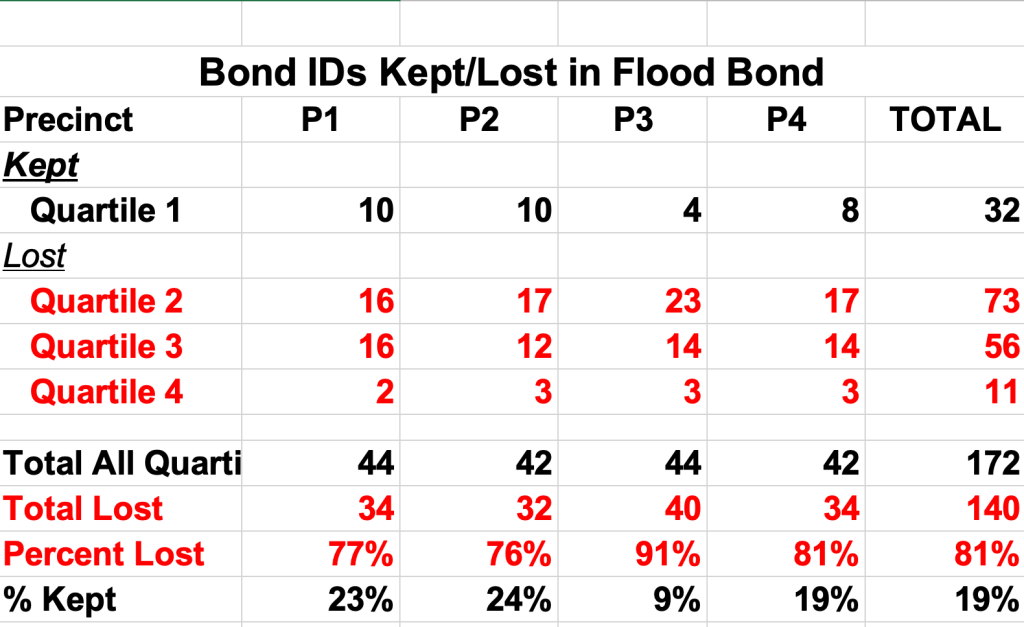
Here’s a breakdown of the totals by quintile and precinct. Because projects sometimes cross precinct boundaries, when a project did so, I counted it once for each precinct it benefitted.

Next, look at Bond IDs. A bond ID may contain multiple projects. And again, when a Bond ID benefited two precincts, I counted it twice. Percentages change slightly. But the same basic picture emerges…only more so:

Precinct 3 had the most Bond IDs defunded and kept the fewest.

Barrett Station is in Precinct 3. It’s one of the poorest areas in the county. And it had its funding cut. That shows this is more about politics than concern for the poor.

To compile these tables and the pie chart above, I counted Bond IDs and Projects in each quartile in this spreadsheet,

The funding cuts likely won’t affect a subset of 29 projects funded by HUD because those are 100% federally funded. Regardless…

The county will now pursue only one in four or five of the remaining bond projects/IDs.

Stunned citizens are struggling to comprehend the scope of the cuts, which will negatively impact roughly 80% of the county.

No wonder the county kept a tight lid on its analysis and didn’t post anything for the public to review before the meeting. Protesters might have showed up to counter two hours of testimony by Ellis’ surrogates last Thursday.

We Need to Demand…

  • Answers.
  • Action.
  • Accountability.
  • Fairness.

And we need them fast. Frankly, I’m surprised no one has filed a lawsuit yet. This feels like slow-motion voter fraud.

Posted by Bob Rehak on 6/29/25 and updated on 6/30/25

2861 Days since Hurricane Harvey

The thoughts expressed in this post represent opinions on matters of public concern and safety. They are protected by the First Amendment of the US Constitution and the Anti-SLAPP Statute of the Great State of Texas.

GLO Provides Update on HCFCD Grant Applications Totaling $850 Million

6/7/2025 – The Texas General Land Office (GLO) has provided an update on the status of more than $850 million in Harris County Flood Control District (HCFCD) grant applications related to Hurricane Harvey – including two that affect the Humble/Kingwood/Lake Houston Area.

GLO manages grants for the U.S. Department of Housing and Urban Development (HUD) in Texas. The grants in question are HUD Community Development Block Grants for Disaster Relief and Flood Mitigation – CDBG-DR and CDBG-MIT.

The dollars allocated to various projects have shifted slightly since the May update as HCFCD received firmer bids/estimates and revised applications slightly.

The first category (disaster relief) totals $323.2 million. The second (flood mitigation) totals $529.5 million. Together, they total $852.7 million.

Approval Status

GLO has approved all but one of the Disaster Relief grants and is in the process of finalizing the Flood Mitigation applications with HCFCD.

Brittany Eck, a GLO spokesperson, said “There is a tremendous amount of work in progress, reviewing applications and request-for-information (RFI) responses to ensure all HUD eligibility requirements are met.”

In addition, 10 of the CDBG DR projects are in various stages of design. Two have already attained authority to use grant funds and will soon be going to bid. Arbor Oaks has already been bid and soon will be awarded, according to Eck. Bids closed on June 2.

There are 15 CDBG MIT project applications under various levels of review and two still in development.

This is no small task. Applications average around a hundred pages of technical data and there are 28 applications altogether. In addition to developing all that information, proving up the beneficiaries and LMI requirements is an even bigger part of the process, according to the GLO.

Projects Affecting Lake Houston Area

Two projects on the list greatly affect residents and businesses in the Humble/Kingwood/Lake Houston Area.

TC Jester Basin

The first is the East TC Jester Basin/Compartment 1B. It is located on the east side of TC Jester Boulevard in the Cypress Creek Watershed.

A regional drainage study for the watershed found that flooding along tributaries of Cypress Creek is predominately due to stormwater from Cypress Creek backing up into tributaries, rather than a lack of sufficient stormwater conveyance capacity on the tributaries themselves.

Therefore, stormwater detention basins were recommended to help to reduce the risk of flooding.

East Basin/Compartment 1 is the large one in the center.

In September 2023, several parties held a press conference to announce funding for this project at the job site. This should be the last piece of the puzzle to fall into place.

Major funding announced for Cypress Creek Detention Project by Crenshaw, Harless, Ramsey and Petersen
2023 photo at TC Jester Detention Basin Press Conference, L to R, U.S. Representative Dan Crenshaw, State Representative Sam Harliss, Precinct 3 Commissioner Tom Ramsey, and Dr. Tina Petersen, Executive Director of HCFCD

The entire project (west and east basins) reportedly comprises 171 acres. The photo below shows the area where the first of the East Basins will go.

Looking east across TC Jester. Cypresswood Dr. runs up left side. HCFCD owns the large wooded property in center. Cypress Creek runs diagonally along the right side of the wooded area toward top of frame.

While benefits will accrue primarily to those who live nearby, Cypress Creek is a major tributary to Lake Houston. And all stormwater held back upstream helps people downstream, too.

GLO has already approved $24.6 million for this project.

Taylor Gully Channel Conveyance Improvements/Woodridge Stormwater Detention Basin

These two projects have been combined to speed up their approval. Together they should cost approximately $42 million and benefit residents in northeastern Kingwood.

Woodridge Village is the former Perry Homes development along the headwaters of Taylor Gully. After the developer cleared the property, hundreds of homes flooded multiple times.

Before Perry sold the property to HCFCD and the City of Houston, it excavated several small detention basins. But they fell about 40% short of Atlas 14 standards.

HCFCD then entered into an excavation and removal contract with Sprint Sand and Clay to increase stormwater detention capacity. The contractor eventually excavated almost enough to meet Atlas 14 standards. However, HCFCD was forced to terminate the contract when it applied for the HUD grant.

Woodridge Detention Basin on left. Long red/blue line is Taylor Gully.

Here’s how the site looked last week.

Woodridge Village on May 31 2025. New detention basin started but not connected yet to Taylor Gully (upper right).

This also will be a cooperative venture between local, state and federal authorities, including:

  • U.S. Congressman Dan Crenshaw (TX-02)
  • State Representative Charles Cunningham (TX HD-127)
  • Harris County Commissioner Tom Ramsey, P.E. (Precinct 3)
  • Houston City Council Member Fred Flickinger (District E)
  • Dr. Tina Petersen, P.E., Executive Director, Harris County Flood Control District

At a press conference on September 17, 2024, they discussed funding.

What Woodridge/Taylor Gully Project Includes

HCFCD applied for grants to:

  • Expand a portion of Taylor Gully and line it with concrete.
  • Build another stormwater detention basin on Woodridge Village holding 412 acre-feet.
  • Replace the culverts at Rustling Elms with a clear-span bridge.

HCFCD is working closely with GLO to move the application along as quickly as possible. That’s also true for the other CDBG-MIT projects. The CDBG-DR projects have tighter deadlines, which is why HCFCD/GLO focused on those first.

Posted by Bob Rehak on 5/7/2025

2839 Days since Hurricane Harvey

New State Budget Includes $200 Million for Area Flood Projects, Dredging

6/3/25 – The new 1,056-page Texas state budget includes more than $200 million for Houston-area flood mitigation projects and dredging.

The legislature allocated $50 million for Lake Houston dredging through the Texas Water Development Board and another $150 million for Houston/Harris County Area flood-mitigation projects.

That’s out of a total $581 million appropriated to TWDB for funding infrastructure, flood, wastewater and water-supply projects.

List of Other Local Flood-Mitigation Projects

Other Houston/Harris County flood-related projects include:

Dredging Program Must Make Business Sense

For the Lake Houston dredging district (HB1532) to succeed long term, the operation must make business sense. The legislation that formed the district stipulates it cannot impose taxes or fees. So operations must generate a funding stream from the sale of spoils for beneficial uses such as roads, development, and the Ike Dike.

However, in the near term, the dredging money allocated by the legislature could be used to help purchase dredging equipment and set up operations.

Many decisions lie ahead re: equipment, staging areas, staffing, sales of the spoils, maintenance, trucking, and more.

Frankly, I thought we might have to wait until the next session of the legislature in two years before we had a chance at seed money to launch the dredging district.

So, seeing the money in this state budget is a very pleasant surprise…as is the additional $150+ million for other flood-mitigation projects coming to the Houston region!

For More Information

To see the entire 1068-page state budget, click here. (Warning: 10 meg download.)

For the two pages relating to TWDB and flood mitigation projects, click here.

Posted by Bob Rehak on 6/3/2025

2885 Days since Hurricane Harvey