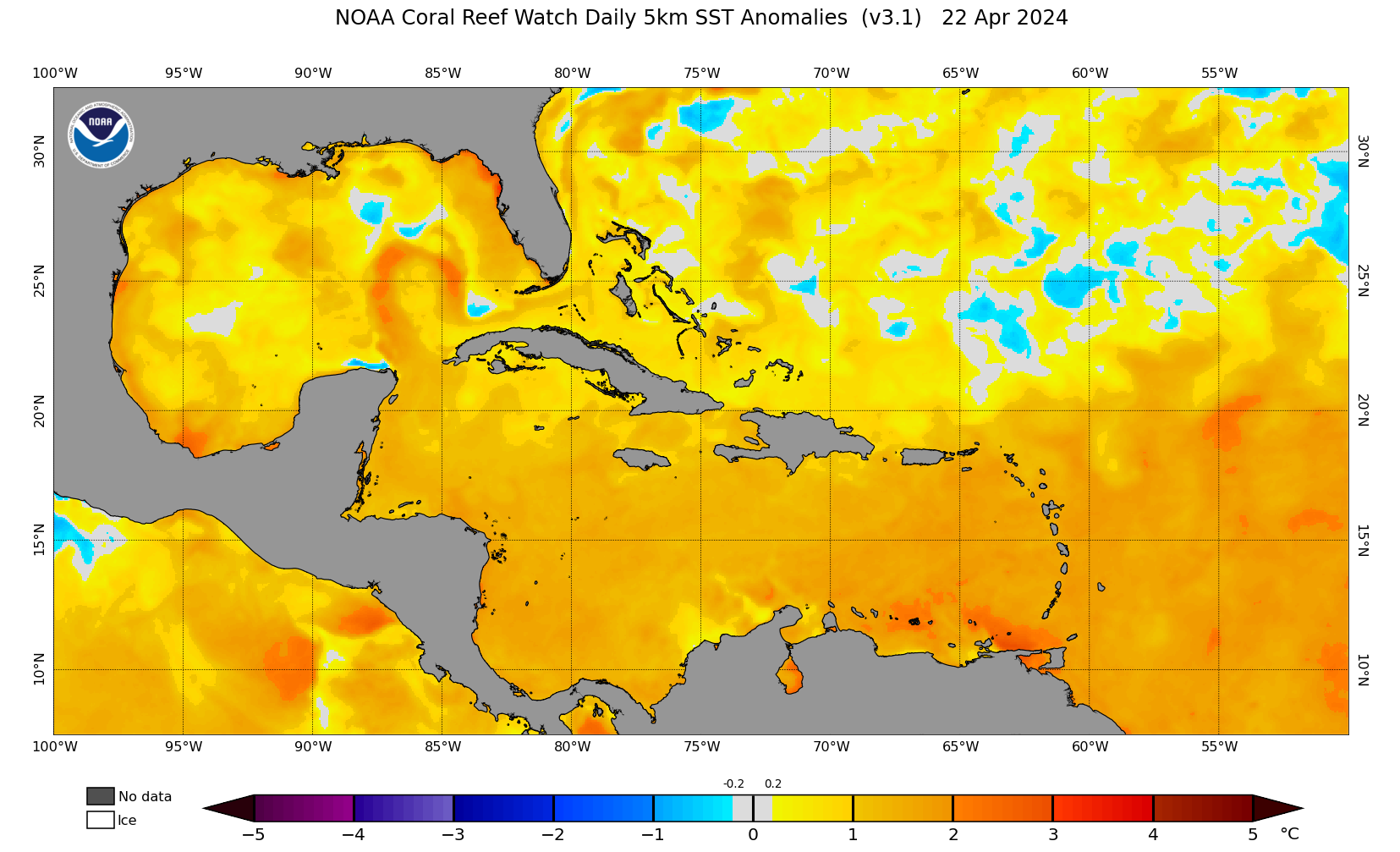
Gulf Water Temps Near Record Highs with Hurricane Season Just Days Away
5/27/26 – Based on sea-surface temperatures (SSTs), weather forecasters are already talking about the possibility of an early season tropical storm in the Gulf. NOAA’s SST Anomalies page shows that as of yesterday, Gulf water temps were already well above normal and near record highs set in 2024.

Such SSTs help form tropical systems by warming the air and making it rise. Hurricane forecasters note that a significant lack of hurricane activity in 2025 left the region with an abundance of hot water that was not “churned up” or cooled by major storms.
Although NOAA predicts a below-normal Atlantic season with eight to 14 named storms, the near-record heat in the Gulf—averaging 2.5 degrees warmer than normal—remains a significant “wild card” for storm intensity.
Conflicting Trends
The other major factor influencing tropical forecasts this year is the growing El Niño.
El Niño tends to suppress tropical storm formation in the Atlantic by creating wind sheer that tears apart tropical storms before they intensify.
However…
Early season storms – even during El Niño years – can and do create widespread damage.
Consider these “A” storms:
- Hurricane Andrew in 1992 (Cat 5) ranks as the 9th most costly storm
- Tropical Storm Allison in 2001 ranks # 23 on NOAA’s list of all-time costliest storms.
- Hurricane Agnes in 1972 (Cat 1) ranks as the 22nd most costly storm
- Hurricane Alicia in 1983 (Cat 3) ranks as the 33rd most costly storm.
A story by Dinah Voyles Pulvery in today’s USA Today titled “Hurricane forecasters fear supercharged, early-season storms in 2026″ contained almost two dozen terrifying pictures from Hurricane Agnes in 1972.
Matthew Rosencrans of NOAA’s Climate Prediction Center told USA Today that El Niño has the biggest impacts on Atlantic hurricanes that form deep in the tropics. But in the Gulf, there may be more favorable pockets for storms to form.
Three of the four storms above happened during El Niño years.
- 1983 was a major El Niño year – one of the strongest of the 20th century. Forecasters considered it unprecedented at the time.
- 1972 was one of the more significant 20th-century El Niño events prior to the very large 1982–83 event.
- An El Niño that developed in 1991 persisted through much of 1992.
2001 had neutral conditions. El Niño did not develop until 2002.
Don’t Underestimate Potential for Rapid Intensification
Just hours ago, AccuWeather warned that sea surface temperatures in the Gulf are already running near the threshold for tropical development.
And according to Ken Graham, director of the National Weather Service, people often think hurricanes will give them more lead time than they actually do. But that’s not usually true. Graham told USA Today. “Every Category 5 that’s made landfall in this country was a tropical storm or less at three days out.”
For hurricane preparation tips, consult the Preparation Tab on my Links Page. Hurricane season officially starts in five more days. Also…
Save the Date: Flickinger to Host Preparedness Open House
On Thursday, June 4, from 5-6:30 PM, Houston City Council Member Fred Flickinger will host an open house at Kingwood Community Center (4102 Rustic Woods Drive, Kingwood TX 77345) with:
- Houston Office of Emergency Management
- CenterPoint Energy
- Comcast
- xfinity
- UnionPacific
- Trees for Houston
According to the Council Member, the event will feature practical safety information about resources designed to help you, your family and your neighborhood prepare with confidence, such as:
- Safe vegetation practices and the Right Tree, Right Place approach
- When and why to call 811 before you dig
- How to stay safe around railways and utility equipment
- Hurricane preparedness tips and local resources
Flickinger said, “Ask questions, explore helpful information and share what matters most in your neighborhood so we can better support the community we serve.”
One of the first things people often lose in Kingwood is power when trees fall against overhead lines. And with the loss of power comes loss of communication. So it’s important to have a plan before that happens.
Posted by Bob Rehak on 5/27/2026
3193 Days since Hurricane Harvey