Tag Archive for: jetting

CoH Public Works Kicks Off Tree Lane Bridge Rehab Project

City of Houston (COH) Public Works Department held a kick-off meeting with contractors and the Bear Branch Trail Association (BBTA) this morning for the Tree Lane Bridge Rehabilitation Project. Public Works and the contractors outlined plans for the project. They also discussed access through BBTA property and safety protocols.

Chris Bloch (left) and Lee Danner (center) of BBTA met with contractor and Houston Public Works representatives at bridge on 2/21/24.

Construction should begin by mid-March and take approximately 150 days.

Project Scope

The $909,000 project will involve:

  • Creating access areas for equipment
  • Removing all existing concrete under the bridge and along the sidewalls
  • Establishing a 2-foot deep by 32-foot-wide low-flow channel from 20 feet upstream to 20 feet downstream of the bridge
  • Rebuilding wing walls
  • Restoring outfalls for local drainage
  • Restoring the work site and replanting trees.

See the construction plans here.

Safety Warning

Contractors will meet with the Bear Branch Elementary School principal to understand normal drop-off and pick-up times. They will then work around those times to try to minimize traffic interference.

Regardless, the City urged parents to warn children to stay away from the construction zone, which will be on both sides of the bridge. Lots of heavy equipment will be maneuvering in tight spaces with limited visibility near Bear Branch Elementary. Observe all traffic warnings and flag men.

Reason for Project

Embankments under the bridge have degraded significantly in the last 10 years. This is largely because of jetting.

Jetting is caused when water backs up behind a bridge that is too small for the volume of water coming down a stream. Pressure upstream of the bridge forces turbulent water to shoot out the downstream side destroying anything in its way. See six images below taken 2/21/24.

Looking upstream at eastern side of bridge. Jetting has blown out concrete under the bridge.
Damaged storm sewer outfall.
Exposed abutment
Downcutting as floodwater tries to make more room for itself.
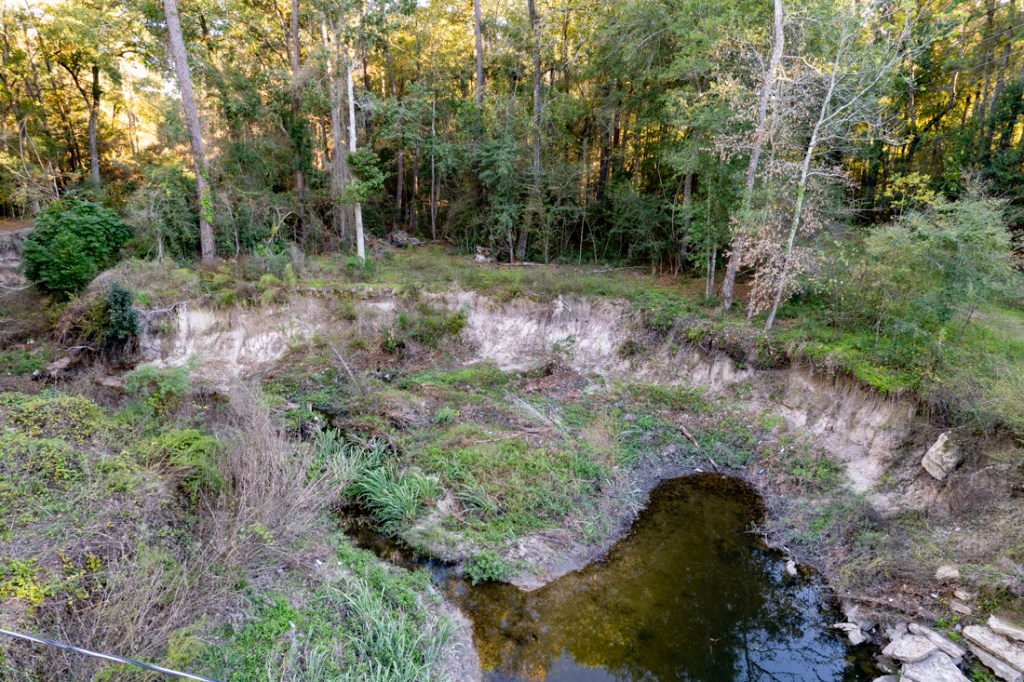
Jetting continues to erode a large basin south of the bridge.
Note how narrow creek is upstream (Left). Right = effect of jetting downstream.

It Wasn’t Always This Way

The erosion has started in the last ten years and accelerated with upstream development.

In general, developments increase the time of accumulation of runoff. Compared to a densely developed area, when rain falls on a forest, it trickles its way to the creek. But if it falls on concrete and rooftops, it rushes to the creeks through storm sewers.

For illustration purposes, the graph below shows the actual change along Brays Bayou.

time of accumulation
Change in time of accumulation in Brays Bayou as watershed developed over 85 years.

If development were sufficiently mitigated, post-development runoff would be no higher than pre-development. But given the amount of recent erosion, some development upstream from Tree Lane is likely insufficiently mitigated.

I’ve lived near the Tree Lane Bridge for 40 years. For the first 30, erosion was no problem. Now look at it. Compare the two satellite images below.

In 2014, you could barely see creek.
Same area in 2023.

Chris Bloch, an engineer, says that at the time of Imelda in 2019, the open space under the bridge was 500 square feet. The design approved by COH and Harris County Flood Control District will add approximately 64 square feet in the form of a low-flow channel. Contractors will add that where the stream has already downcut.

If the 500 SF estimate is accurate, another 64 SF would represent a 12.8% increase in the carrying capacity of the channel under the bridge.

Will It Be Enough Conveyance?

This will be the second time in three years that the city has repaired the bridge and its embankments.

The state of the bridge now is worse than it was after Imelda, BEFORE the last repair job. And no storms since Imelda have even came close to Imelda’s magnitude. That means insufficiently mitigated development may have played a role in building flood peaks faster and higher; and undermining the bridge.

So, will 12.8% be enough to eliminate more jetting? Only time will tell. Keep your fingers and toes crossed.

Sign Up for Project Updates

You can sign up for project updates by visiting Houston Public Works’ “Engage Houston” page for this project.

Posted by Bob Rehak on 2/21/24

2367 Days since Hurricane Harvey

Tree Lane Bridge over Bens Branch Still Standing

The recent drought has reduced the rate of erosion under the Tree Lane/Bens Branch Bridge for now. But with wetter weather expected, we need to accelerate the repair effort. Recent pictures show the desperate need for repairs to the bridge. It’s next to Bear Branch Elementary School where more than 600 students attend grades K-5.

Power of Moving Water

The current state of this bridge and the area around it is a testament to the power of moving water … more than engineers designed the bridge to handle.

Water jetting under the bridge during storms has ripped away great slabs of concrete, eroded side walls, and partially blocked a storm drain outfall.

Condition of Tree Lane Bridge over Bens Branch on 11/24/23

It has also eroded the channel. Rip rap has done little to halt the erosion.

11/24/23. Condition of Tree Lane Bridge over Bens Branch.

Downcutting has exposed utility lines. And stormwater has carried chunks of concrete downstream like toothpicks.

11/24/23. Bens Branch downstream of Tree Lane Bridge.

Before Hurricane Harvey, the tree canopy in this area was so dense, one could barely see Bens Branch from the air. Now, there’s a gaping hole in the landscape caused by the “jetting.”

11/24/23. Downstream erosion of greenbelt caused by jetting water from under bridge.

As more and more water builds up behind the bridge during storms, it causes water to shoot under the bridge with greater pressure and accelerate erosion.

One can’t help but wonder whether the random and cumulative impact of several large storms caused this damage. Whether insufficiently mitigated upstream development helped nature along. Or whether the bridge simply reached the end of its normal life.

The City of Houston attempted to repair this bridge in March 2020. By January of 2023, it was worse than ever. And in June of 2023, I wrote about damage accelerating.

But a prolonged, intense drought last summer put an end to the acceleration. A close comparison of recent photos with those taken six months ago shows that the bridge now looks much like it did last June.

When Will Bridge Be Fixed?

I have learned that both the City of Houston and Harris County Flood Control District (HCFCD) are studying the bridge. In August, the City even allocated money to fix it. However, HCFCD worried about the impact to its Bens Branch channel. The two entities are now trying to reach a mutually agreeable solution.

Having lived near here for 40 years, one thing is clear to me. We can’t count on drought to prevent more erosion forever.

During El Niño years (like now), much of Texas is cooler and wetter than average. Northern storms generally track farther south, producing more clouds, rain and severe weather, according to the NWS.  

Perhaps we’ll get some good news on Tree Lane bridge repairs or replacement by Christmas. I’ll let you know when we get the engineering report.

Posted by Bob Rehak on 11/28/23

2282 Days since Hurricane Harvey

Flood Damage To Tree Lane Bridge Over Ben’s Branch Accelerates

Since I last reported on damage to the Tree Lane Bridge over Ben’s Branch in January, the situation has worsened considerably.

  • Concrete reinforcements under and on both sides of the bridge have collapsed from undercutting, erosion and jetting.
  • The stream has downcut, exposing pipelines.
  • Jetting has carved out a cavernous area south of the bridge.
  • Erosion has reached within a few feet of a utility corridor.
  • Storm sewer outfalls have been exposed, undercut and punctured by massive slabs of displaced concrete.
  • Bridge supports, once protected by sidewalls, have been exposed to more erosion.

Pictures Taken on 6/12/23 Show Extent of Damage

The bridge will probably not collapse in the next big rain. However, the cumulative damage to all these components underscores the need for urgent repair. It also underscores the need for mitigation to reduce the jetting that caused the damage.

Looking at downstream eastern side of Tree Lane bridge
Looking NE at downstream, eastern side of Tree Lane bridge
Wider shot from same position reveals two exposed pipelines.
Looking upstream under Tree Lane Bridge. Downcutting under bridge threatens western wall also.
Looking upstream under Tree Lane Bridge. Note how downcutting threatens western (left) wall also.
Giant slabs of concrete have destroyed outfall.
AS
Erosion downstream of the Tree Lane bridge now is within approximately ten feet of a utility corridor.

Damage Accelerating, Repaired Just Three Years Ago

The city repaired the Tree Lane Bridge in March of 2020. Compare this post to see how it looked then. It’s amazing how much damage could be done in three years to a bridge that weathered multiple hurricanes and tropical storms for more than 50 years.

That’s a testament to insufficiently mitigated development upstream that sends ever greater volumes of water downstream – more than the opening under the bridge was designed for.

For a description of how jetting works, check this post. Basically, water backs up behind the bridge, putting greater pressure on the water flowing under the bridge.

Let’s hope the City can repair the Tree Lane Bridge again before school starts in the fall. The bridge borders Bear Branch Elementary School where 638 students attend classes.

Please check bridges near you and report any damage.

Posted by Bob Rehak on 6/12/2023

2113 Days since Hurricane Harvey