Tag Archive for: Charles Cunningham

Flickinger Provides Updates on Lake Houston Gates, Dredging District

6/18/25 – While speaking to the Kingwood Executive Group this morning, Houston District E City Council Member Fred Flickinger reassured members that the project to add more flood gates to the Lake Houston Dam was on track. He said that the engineering and environmental survey work should be completed by the end of this year as previously promised.

Houston City Council Member Fred Flickinger addressing members of Kingwood Executive Group today.

However, he also cautioned that a potential cost increase might skew the critical Benefit/Cost Ratio (BCR) used to evaluate grant applications.

In an update on a related drainage issue, Flickinger explained how important the passage of Rep. Charles Cunningham’s Lake Houston Dredging District bill was for the Lake Houston area. Specifically, he talked about how dredging done to date reduced predicted peaks in the May 2024 flood by more than 2 feet and kept water from entering homes throughout Kingwood and the Lake Houston Area.

Latest on Gates Project

After Hurricane Harvey, many people focused on the addition of more flood gates to the Lake Houston Dam could reduce lake levels and flooding by letting water out faster before and during major storms.

Lake Conroe’s dam can release water 15 times faster than the gates on Lake Houston’s dam.

The gates on Lake Houston’s dam release water so slowly that the City must begin releasing water days before a storm to create significant extra storage capacity in the lake.

With a lead time measured in days, forecasts can change before storms arrive. But with a higher release capacity, dam operators could wait until they were certain a storm would hit before opening the gates.

Flickinger stated that the engineering for the additional gates should be at least 90 percent complete by the end of 2025.

“At that point in time,” said Flickinger, “they’ll be able to get accurate BCRs. And they’re already working on the environmental study. Black & Veatch is handling that.”

Community meetings within the next 4 to 5 months will give the public a chance for input.

Construction Still Predicted to Start in 2028, Completion in 2029

“I think they’ll be able to start construction in 2028 and complete the project in 2029,” said Flickinger. “Nothing’s really changed with the dates in the last six months.”

Early indications are that the project could need another $35 million. Flickinger said, “That could delay the project a little bit if they don’t get the BCR they need. But we got it one time; I think we’ll get it a second.”

Flickinger was referring to when Dave Martin, his predecessor convinced FEMA to include social benefits in the calculation of the BCR. Typically, benefits must exceed costs before FEMA or any other group will award a grant.

Since Flickinger took office, the plan for the gates has significantly changed. The original plan was to construct crest gates on the concrete portion of the spillway. However, because of the risk involved, the City could not find a contractor willing to bid on that job.

The new plan is to add tainter gates to the earthen portion of the dam. The project basically turned into a “start over.”

Kudos to Crenshaw and Cunningham

In his talk today, Flickinger also addressed dredging – past, present and future.

He thanked US Rep. Dan Crenshaw and State Rep. Charles Cunningham. “We’re dredging out on the lake today,” said Flickinger. “That’s part of the money that Congressman Crenshaw got for us. We’re moving 800,000 cubic yards of sediment. And that makes a huge difference,” said Flickinger, before lauding HB1532, Rep. Charles Cunningham’s bill that will create a permanent dredging district on Lake Houston.

The Computer Model that Missed and the Legislation that Didn’t

To underscore the importance of dredging, Flickinger explained how computer models missed predictions for the timing and crest of the May 2024 floods in the Lake Houston Area … at a time when water was already lapping at the foundations of thousands of homes.

“The expectation was that the water would crest two feet higher than it did. But they missed it because their model did not include all the dredging that had been done over the last several years. They missed by about two feet and a day. The river was supposed to crest two feet higher and one day later,” said Flickinger.

“But all the dredging allowed the water to flow into the lake and over the dam faster than what they thought it would. So the dredging is a huge deal.”

HB1532, the bill to create a Lake Houston Dredging and Maintenance District, finally passed in this year’s session of the state legislature – after three previous tries.

“Sediment comes into the river and the lake 24 hours a day, seven days a week,” said Flickinger. “And unless we do something about that, it’s going to be a huge problem.”

Even though Cunningham got the dredging district over the goal line this year, Flickinger was quick to acknowledge assists from Senators Paul Bettencourt, Brandon Creighton and Mayes Middleton who helped push it through the Senate.

Posted by Bob Rehak on 6/18/2025

2850 Days since Hurricane Harvey

Urgent Help Needed: Lake Houston Dredging District Bill Gets One Last Chance

5/26/25 – The Texas Senate Local Government Committee will hear testimony on HB1532, the Lake Houston Dredging District bill, on Monday, May 26, 2025 – Memorial Day beginning at 9 AM.

Most people had given up on the bill and considered it effectively dead for this session. But when I checked this morning, there it was – on the agenda…for the holiday. So please help.

About the Bill

Rep. Charles Cunningham’s HB1532 would create a dredging and maintenance district for Lake Houston within Harris County. It would not have the power to impose taxes. But it could receive initial funding from the state legislature, and then raise additional money by selling the spoils from dredging operations for beneficial uses.

Such uses could include building the Ike Dike, raising homes out of floodplains, improving roads and more.

The Army Corps recommended forming such an entity for ongoing maintenance when it finished its Emergency West Fork Dredging Project after Harvey. It could finally become reality with your help.

How You Can Help

Given the holiday and late notice, it will be difficult for most people to testify in person at tomorrow’s hearing. But there’s another way to help.

Please thank Senator Bettencourt, the chair of the committee, and Senator Creighton, who sponsored a companion bill in the Senate.

Also email members of the committee NOW through their Senate web pages:

Key Points to Make

Subject Line: Please Support HB1532

Message:

  • During Hurricane Harvey in 2017, 13,000 homes and almost half of all the businesses in the Lake Houston Area flooded. It didn’t have to be that bad. Sediment had built up for decades reducing the conveyance of tributaries.
  • After the Army Corps finished its Emergency Dredging project, they recommended permanent maintenance dredging.
  • HB1532 would enable that. It would reduce flood risk for thousands of homes and businesses – without raising taxes.
  • It would also increase storage in Lake Houston, which provides water to 2 million people. And that number is growing rapidly.
  • HB1532 is a strategic investment in the future growth of the Houston region. Please support it.

Thank you for taking the time! Please forward this post to everyone you know and ask for their help.

Posted by Bob Rehak on 5/26/2025

2827 Days since Hurricane Harvey

Dredging Progress on Lake Houston and In Austin!

4/12/25 – Dredging is making progress on Lake Houston and in Austin.

The City of Houston’s most recent West Fork dredging program started last December near the channel south of Royal Shores. The channel connects the San Jacinto East and West Forks. Callan Marine is pumping the spoils through the channel, across the East Fork, up Luce Bayou to a placement area adjacent to the Luce Inter-Basin Transfer Canal.

I did a brief update about the expansion of the placement area in January. At the time, the dredge was still operation between the channel and the northern extremity of Atascocita Point. And Callan was doubling the size of the placement area.

Since then, the dredge moved about a half mile downstream toward FM1960. And Callan has filled the expanded placement area approximately one-third of the way up. Callan estimated the program would take a year. And that was about a third of a year ago.

In a separate but related effort, State Representative Charles Cunningham’s bill to create a Lake Houston Dredging and Maintenance District picked up some additional support and was considered by the House Natural Resources Committee on April 9. The Committee “reported it favorably”

Photos Taken Today Show Dredging Progress

My estimate on one-third complete is purely a guess based on the original timetable and a visual assessment of the placement area. See the photos below, all taken today.

Looking south toward FM1960 Bridge. Dredge is in upper center.
Closer shot reveals dredge bit was submerged and the dredge was pumping.
Supply boat docks with dredge.
Dredge was at left end of red line this morning and pumping to placement area in red box in upper right.

This program uses money left over from the U.S. Army Corps of Engineers Emergency West Fork Dredging Program. Therefore, dredging is restricted to the West Fork.

Map of current dredge plan. Today, the dredge was operating slightly NW of the #4 position.

The dredge you saw above is pumping spoils approximately four miles to the northeast. Dredging “spoils” are the materials, including sand, silt, clay, and other organic matter, removed from the bottom of the Lake.

Below is a photo of the placement area for the spoils.

Looking E toward Dayton and Liberty. Luce Bayou Inter-Basin Transfer Canal (left) and placement area (right).

Spoils enter at lower left via a pipeline. Water carrying the sediment then works its way through the maze of compartments in the pond and circles back to where it entered. The closer shot below shows the dirt spreading out. Eventually it will be hard enough to build homes on.

The maze slows down the speed of the water and allows dirt to drop out of suspension.
Higher shot shows a “delta” forming within the pond. Before this operation is complete, bulldozers will spread the dirt around evenly.
Spoils enter the pond through the pipe on the right. De-silted water exits the pond just a few feet away. It returns to Lake Houston through the canal in the upper right.

Progress on Cunningham Bill to Create Lake Houston Dredging/Maintenance District

The immensity of this task dramatizes the need for State Rep. Charles Cunningham’s bill (HB1532) to create a Lake Houston Dredging and Maintenance District. The project above covers only a tiny portion of the lake, which is losing capacity due to sedimentation.

Cunningham’s bill would create a permanent dredging district for Lake Houston.

In March, the bill picked up three additional sponsors: Armando Walle (District 140), Harold Dutton, Jr. (District 142) and Valorie Swanson (District 150).

On 3/19/25, the House Natural Resources Committee heard testimony on the bill. See video starting at approximately 1:23 here.

On 4/9/2025, the House Natural Resources Committee reported it favorably as substituted and recommended it be put on the Local & Consent Calendar.

That’s good news. You can follow the bill’s progress here.

We still have a long way to go. But so far, so good.

For More Information on Dredging

See these related posts:

2025/01/15 New West Fork Dredging Program Off to Fast Start

2024/12/21 West Fork Dredging Spoils Being Deposited Near Luce IBT Canal

2024/12/20 City’s New Dredging Program Launched

Posted by Bob Rehak on 4/12/25

2783 Days since Hurricane Harvey
Don’t Miss Town Hall Meeting Thursday Evening

9/18/2024 – Houston City Council Member Fred Flickinger will host a town hall meeting on Thursday 9/19/24 at the Kingwood Community Center. Doors open at 6PM. The program starts at 6:30.

Houston District E City Council Member Fred Flickinger

The event will feature a series of informational presentations at tables where residents can talk to representatives of various city departments. It will also feature several presentations, followed by Q&A.

Even though the program will be hosted in Kingwood, all residents of the Lake Houston Area including Huffman are welcome to the town hall and will find something of value. The agenda includes topics that apply to everyone, such as status of the Lake Houston Dam Gates Project.

Time, Date, Place

  • Thursday, September 19th
  • Program: 6:30 p.m. to 8:00 p.m.
  • Kingwood Community Center
  • 4102 Rustic Woods Drive
  • Kingwood, Texas 77345

Featured Speakers

Speakers will address issues crucial to the safety and success of the Lake Houston Area. They include:

  • State Representative Charles Cunningham will kick off the meeting. He will discuss his priorities going into the next legislative session.
  • Houston At-Large City Council Member Twila Carter will also talk about her priorities.
  • Harris County Precinct 3 Commissioner Tom Ramsey hopes to make the meeting, but will be coming from budget meetings downtown and may not make it if they run over.
  • New Coastal Water Authority Board Director Dan Huberty will give an update on the project to add more flood gates to the Lake Houston Dam.
  • Ekaterina Fitos, Houston’s Water Planning Director, will discuss the status of dredging and sand traps, designed to reduce sedimentation and flood risk.
  • Mark Wilfalk, Houston’s Director of Solid Waste Management, will go over storm debris pickup following Hurricane Beryl. He will cover lessons learned and what they will do differently in the next disaster.
  • Tom Broad, chair of the Lake Houston Redevelopment Authority, will give an update on the Northpark Expansion Project.
  • New Houston Police Chief J. Noe Diaz will inform residents of his priorities moving forward.
  • Sergeant Rajesh Sawlani, also with HPD, will talk about crime suppression tactics and strategies being implemented in other parts of the City. He will also cover the growing homeless population in Kingwood.

Booths around the perimeter of the room will feature Houston:

The ambitious town hall agenda covers a lot of territory. So, come early. Mingle with neighbors. And ask your questions at the tables if you can. It’s been a year since we last had a town hall meeting with Dave Martin.

Posted by Bob Rehak on 9/18/2024

2577 Days since Hurricane Harvey

Urgent Request: Support HB1093 to Improve Water Quality, Reduce Flooding, Save Tax Dollars

State Representative Charles Cunningham has introduced HB1093. The bill would ensure cleanup of abandoned sand mines in the San Jacinto watershed. It requires miners to post a bond that covers cleanup costs. So, if an irresponsible miner walks away from a mine before reclamation, the public doesn’t have to pay the deadbeat’s costs.

A bond is like an insurance policy that guarantees the performance of obligations.

Without a bond, miners who profited for years from a mine can simply walk away when they are done mining, foisting cleanup costs onto the public or leaving blight behind.

How Bad Is the Problem?

Right now, there are at least six mines on the East and West Forks of the San Jacinto that were left a mess. Such abandoned sand mines are increasingly becoming a blight that imperils water quality in Lake Houston, the source of drinking water for 2 million people.

  • Rusting equipment leaks poisons and poses safety problems.
  • Un-stabilized soil increases rates of erosion and contributes to flooding.
  • Steep banks in pits slump away in slabs threatening neighboring properties and businesses.
  • Blight reduces surrounding property values and business activity

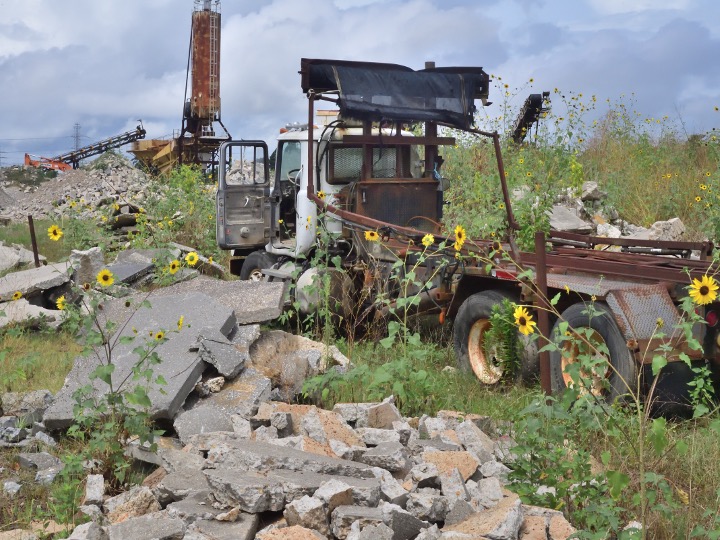
Miners are supposed to remove equipment and structures before they abandon a mine. But not all do. See the pictures below.

Leaking equipment near Riverview Drive in Porter on West Fork. Google Earth images show this in same location since 2008.
abandoned dredge
Dredge abandoned in Humble mine in 2017.
Abandoned excavator in Porter mine on West Fork
Abandoned dredge in Plum Grove mine.
Abandoned processing equipment in Humble mine.
Abandoned processing equipment and vehicle in Humble mine since 2017.

Miners are also obligated to grade and stabilize soil before they leave a mine, then replant vegetation similar to the surrounding area to reduce sediment pollution. But not all do.

Ungraded, un-stabilized soil in East Fork Plum Grove Mine.
Ungraded soil and abandoned equipment in East Fork Mine
A flood later swept through the mine above, sending sediment down the East Fork.
Defunct sand pit in Humble. Steep slopes – ungraded and unvegetated – erode and threaten neighboring business.

Community Consequences

Most sand moves during storms. This island appeared after Hurricane Harvey between Humble and Kingwood. It blocked the West Fork by 90%, according to the Army Corps and contributed to the flooding of thousands of homes and businesses.
Confluence of the San Jacinto West Fork with Spring Creek. Images taken on different days from different angles, but in each case the dirty water comes from the West Fork, where we have 20 square miles of mines on a 20 mile stretch of the river between I-45 and I-69.

Most responsible miners will clean up on their own. But experience shows, a few bad apples will not. And when they walk away, the cost to the public can be enormous. Dredging costs alone have exceeded $226 million in the Lake Houston area since Harvey.

How You Can Help

Please help reduce this and related cleanup costs in the future. Ensure that sand miners don’t pass their remediation costs on to taxpayers.

Make sure HB1093 at least gets to the House floor for a vote this year.

In the last session, a similar bill by former Representative Dan Huberty, HB4478, never made it out of the Natural Resources committee.

HB1093 deserves a hearing. Please write the chair and vice chair of Natural Resources asking them to consider it.

The committee will likely recommend King’s HB10. It will fund the creation of 7-million acre-feet of new water supplies for rural areas.

Let’s do something that won’t cost taxpayers a penny to protect a water supply we already have. Support HB1093. And please forward this link to all your friends, family and neighbors.

Posted by Bob Rehak on 3/18/23

2027 Days after Hurricane Harvey

The thoughts expressed in this post represent opinions on matters of public concern and safety. They are protected by the First Amendment of the US Constitution and the Anti-SLAPP Statute of the Great State of Texas.