County Judge Lina Hidalgo has asked for your opinion on the composition and by-laws of a new Community Resilience Task Force. The purpose of the task force is to make recommendations on how to allocate flood-bond spending to help minorities, low income households, and other socially vulnerable groups … even more.
Argument for Social Vulnerability
The Judge argues that low income households have a harder time recovering from floods. For instance, the inability to repair a flood-damaged home can create health consequences as mold multiplies. The loss of a vehicle can mean the loss of a job and subsequent eviction.
Data Shows Spending Favors Vulnerable Segments 4:1 So Far
Active HCFCD projects in neighborhoods that rank above and below .5 on the CDC’s social vulnerability index. The blue segment represents less affluent, minority neighborhoods, which current have 79% of the active bond projects.HCFCD buyouts in neighborhoods that rank above and below .5 on the CDC’s social vulnerability index. The blue segment represents less affluent, minority neighborhoods.They have 80% of all the buyouts.
Whether you are looking at mitigation projects or buyouts, the most socially vulnerable neighborhoods tend to get FOUR TIMES more than less socially vulnerable neighborhoods.
Yet Judge Hidalgo, Commissioner Ellis and Commissioner Garcia want to increase that percentage even more … for the next 30 years … with their Community Resilience Task Force.
Questions Posed by Lopsided Emphasis
The questions are:
What happens to everyone ELSE who floods?
Will they get NO help?
What is a FAIR and EQUITABLE distribution?
Does the NUMBER of damaged structures not merit consideration?
Will the DISPARITY in spending discourage middle class flood victims and motivate them to leave the county if they flood again?
Why are certain commissioners using the word “equity” to describe “disparity”?
Today is the end of the month and the last day to submit comments to the Judge if you want them to be considered.
Below is a poignant letter written by Jennifer Coulter, a mother with two young children. She and her husband had just started a company before Harvey. So they didn’t have the credit history to qualify for an SBA loan. And their income from the previous year threw them into the lowest category for a Homeowner Assistance Grant. Two years after applying, they’re still waiting for a call-back.
And because they lived outside the 500-year flood plain, they didn’t have flood insurance. Nevertheless, they managed to restore their home by cashing in retirement accounts. They worry now about whether they can afford college for their kids.
Jennifer Coulter’s Letter to Judge
Dear Judge Hidalgo and members of the CRTF,
Please find my public comments and questions below as they relate to the proposed draft bylaws for the Community Resiliency Task Force and the inclusion of social vulnerability guidelines in flood mitigation project considerations.
My family lives in Kingwood. We flooded in Kingwood following Hurricane Harvey, and chose to reinvest in our community by rebuilding our home. We did not have flood insurance at the time of the flood. We also did not quality for an SBA loan. We used retirement savings to fund the rebuild. As a result, our personal financial security has changed dramatically.
The Kingwood and Lake Houston area has historically received a disproportionate amount of flood mitigation project investment related to the greater Houston and Harris County area. Meaning, we have received far less. The proposed social vulnerability guidelines would continue that trend, perhaps even worsening it for this area.
As a family, we have made the difficult decision that if flooded again, we will not rebuild and again reinvest in this community. Without a fair investment in flood mitigation projects based upon flood vulnerability rather than social vulnerability, we are almost certain to flood again.
We are not alone. There are many homeowners, who if able, will relocate out of Harris County if flooded again. My questions to the task force are:
How do you intend to fund this 30-year plan if your tax base leaves?
Is making this vital tax base expendable a wise long-term solution to improve flood mitigation in ANY community within Harris County?
If you are not choosing project allocation based upon engineering and likeliness to flood, how do you intend to redirect flood waters to areas chosen to receive flood mitigation improvements? Do you have a means to tell rising flood waters to only go to those areas that received improvements and not to those that didn’t qualify for improvements because they weren’t socially vulnerable enough?
Thank you for your time, Jennifer Coulter
I know many people like the Coulters. The prospect of more flooding with no mitigation has them at the end of their tethers. Especially after they voted for the flood bond and its promise of equity. One has already moved to Montgomery County.
Contact the Judge NOW
Please email the Judge and tell her that we need more balance in flood bond spending. Do it now! Tomorrow is too late.
Email CRTF@cjo.hctx.net to submit comments. Please be polite and succinct.
https://i0.wp.com/reduceflooding.com/wp-content/uploads/2020/07/SVI-Projects-July-2020.jpeg?fit=1200%2C800&ssl=18001200adminadmin2020-07-30 15:20:232020-07-30 15:20:35Your Last Chance to Register Your Opinion on Disparity in Flood-Bond Spending
Yesterday’s Harris County Commissioners Court meeting contained two separate discussions of vital interest for those worried about flooding in Elm Grove. Thankfully, the Commissioners post video of their meetings online so you can hear exactly what they had to say as well as how they said it.
The meeting went from 10am well into the evening hours. So you can go directly to the relevant portions, I’ve provided the timing code below. All are approximate. Here’s the link: https://harriscountytx.new.swagit.com/videos/62513. Make sure you go to Section V of the video.
County Discusses City’s Partial Adoption of Atlas-14 Standards
The first discussion lasts approximately 10 minutes from 5:20 to 5:30 into the video. It related to Item 1V on the agenda, the adoption of Atlas 14 standards by municipalities within Harris County.
Precinct One Commissioner Rodney Ellis uses that opening to introduce Elm Grove as a topic that wasn’t on the agenda. See Ellis at 5:21:25. He asks how we can get neighboring counties to participate.
Harris County Commissioner Rodney Ellis speaking on Woodridge Village buyout
At 5:22:29, Blount clarifies that the proposed rule changes would apply to the City’s ETJ (extra territorial jurisdiction. That includes most of southern Montgomery county. Blount explains why that’s important. “It’s about protecting our investment in projects so their benefits are not eroded.” He then clarifies that what the county proposes the City adopt is really “Best practices.”
Then, at 5:23:20, Ellis asks whether adoption of Atlas 14 will affect the prioritization of bond projects. Blount confirms it will.
At 5:24:50, Ellis asks whether City has already adopted Atlas 14. Blount explains the City adopted part but not all of the County’s recommendations. “They say they’re going to but they haven’t,” says Blount. “Adopting halfway isn’t helpful,” he says. “They need to adopt the whole thing…both storm-sewer sizing and detention-pond sizing.”
5:27:50 Hidalgo says “It’s about sustainable growth. We want to make sure we’re not flooding people downstream as we grow.”
5:29:50 Hidalgo transitions the discussion to buyouts and land conservation.
Intro to Discussion of Bond Costs and Elm Grove
The second important part for Elm Grove residents runs 42 mins. In this portion of the meeting, Ellis craftily draws Russ Poppe, executive director of Harris County Flood Control, into a discussion of cost escalation relating to flood bond projects. It later becomes clear when the discussion shifts to Elm Grove that Ellis worries the Perry purchase could consume so much money that it would delay or cancel Precinct One projects. This section runs roughly from 7:53 to 8:35.
If the narrative below sounds disjointed, that’s because it was. People kept interrupting each other. The discussion becomes heated. Ellis keeps repeating the same points over and over again as though his fellow commissioners are dullards and don’t get it.
Price Increases and Status of Bond Budget
At 7:53, Ellis queries Poppe about price increases for mitigation projects. Poppe explains that because of increase demand, the price of riprap is up 3X. Poppe also explains that “haul rates” have increased because they are now hauling dirt farther, i.e., beyond the 500-year flood plain. He says, “The biggest component of our costs is the excavation and hauling of dirt.”
7:56 Poppe talks about buyouts (Item 1B on the supplemental agenda). He talks about available funds, the process, number of homes bought out to date, and 400 applications “in process.”
Ellis Shifts Discussion to Perry Buyout
7:58:10 Ellis raises issue of Perry Homes’ Woodridge Village buyout in Montgomery County.
7:58:30 Ellis talks about original conditions for purchase: City would adopt Atlas 14 including inside its ETJ, that Montgomery County would also adopt Atlas 14, and that the City would contribute assets equal to half of the purchase price. He then estimates that the cost of additional detention ponds on the property could range from $20 – 30 million. Poppe confirms that as accurate.
7:59:30 Ellis adds up component costs: $14 million to acquire, possibly $30 million to develop. “That’s $44 million,” he almost shouts as he leans into the camera.
Ellis Proposes New Condition to Purchase
At 7:59:51Ellis proposes a new condition to the sale. He wants the county’s offer to Perry to now say that half of development costs must also be covered by the City…not just the half of the purchase price. He also says that the City must actually adopt the Atlas 14 requirements in their entirety, not just “promise to adopt them” at some point in the future. Finally, he wants the Atlas 14 requirements to apply to the City’s extra territorial jurisdiction.
He wants a 50:50 split of ALL costs and wants the City to put up assets to purchaseanddevelop the land.
He wants City assets put up before the purchase so that development of the land won’t be in limbo.
He makes a motion clarify the offer. Garcia seconds the motion.
8:06:48 Cagle reminds people that the offer has already been sent to Perry. He says the letter went out without any requirement about the City’s participation in future development of the property.
Argument Over Past/Future Tense in Wording of ILA
8:07:20 Ellis shifts the discussion. He reads the original letter proposing an interlocal agreement (ILA) with the City. He complains about use of the word “executed” in regard to the ILA. It says the Atlas 14 requirements “will be” executed when the ILA is signed. He worries about the future tense. He wants the letter to say “Once Atlas 14 regulations have been adopted” (past tense). By that, he means the deal will become effective once the City has adopted the regulations, not when they promise to adopt them at some unspecified point in the future.
It’s clear that he is wary of City promises. He worries about how long it might take to actually adopt Atlas 14. “They could adopt them 20 years from now.”
8:08:40 Ellis clarifies wording of his motion.
8:09:30 Ellis explains why he’s raising this subject outside of executive session: “to put the light of day on the deal.”
8:09:40 Ellis repeats: “My position is all three. Atlas 14. Half of purchase. Half of construction.”
8:10:20 Ellis paints the downside of investing in Montgomery County. “They could put another development up next door and benefit from $30 million worth of detention ponds we built without putting a dime up and doing nothing to stop flooding.”
8:10:35 Garcia interjects. He wants a policy about how Harris County spends dollars in another county.
8:12:10 Cagle agrees that he wants the City to adopt the Atlas 14 provisions before a purchase. Simply signing an interlocal agreement is not enough, he says.
Radack Proposes Deadline for City Adoption of Atlas 14
8:13:42 Radack says, “The City won’t adopt Atlas 14, so we might as well cut to the chase and adopt a deadline. That gives you a clear path.”
8:15:00 Ellis talks about how the project was “heavily lobbied.” “There’s a lawsuit on it,” he adds. He predicts people will say, “So when are you going to do it.” He implies, “Now, we’re liable” for anything that happens.
8:17:10 Hidalgo asks Poppe: How would you clarify the letter so the City knows Atlas 14 must be adopted (past tense), not just that they will adopt it (future tense).
8:17:20 Poppe reads the letter. It says, “Upon execution of the ILA, City of Houston will adopt by default…” Poppe thinks that language covers the problem.
“County Has Made No Commitment to Do a Project Out There”
8:18:00 Poppe says “We’ve made no commitment to do a project out there.”
8:18:30 Ellis goes rogue-elephant negative. “What are you going to do? Turn it into a birding park? You gonna pay for half of that?”
Hidalgo asks whether the language is clear. Poppe says “I will be happy to share the language tomorrow.”
Ellis says, “I want to make a motion so it will be clear.”
8:20 Ellis again makes the motion that includes the same three conditions: City contributes half of purchase and half of construction. City also adopts all Atlas 14 provisions.
8:21:30 Poppe reminds commissioners that the offer letter was already sent on the 14th of May, the day before the 15th deadline.
8:22:00 Hidalgo restates the motion.
Possibility of State or Federal Participation
8:22:15 At this point the discussion shifts a bit. They examine the possibility of 3rd party participation.
8:22:27 Ellis offhandedly reveals his motives at this point. He doesn’t want others taking money from his projects. “I know how this game works,” he says.
8:23:42 Cagle summarizes changes. “We want the City to ADOPT the standards.” “I’m fine with that,” he says. But then he adds that the second change, about construction costs, “hasn’t been in any of our discussions.”
8:23:55 Ellis asks, “Commissioner, what are we going to do with it?”
Cagle Reminds Commissioners of Two Key Elements
8:24:25 Cagle says, “There are two aspects to this development. One of them is that the developer is already putting in some detention ponds in advance and they did not go up on their price because of that work.” Cagle adds that he wants to build a plan before the purchase. He thinks they may be able to sell the extra dirt that needs to be removed. “Problem is though that that’s slower; it will depend on other projects that are going on in region.” By that he means there needs to be a market for the dirt.
Ellis Again Repeats Concerns
8:27:15 Ellis repeats his concerns yet again. “Houston should put up half of the price.” “Why is Harris County doing it all?” Then he goes back to his demands and says, “The current letter does not reflect all three of those conditions.”
8:29:30 Hidalgo clarifies motion.
Radack Reminds Commission that No Estimates Yet Exist
8:30:40 Radack breaks in and asks how long will it take to come up with an estimate of costs. “It will be very difficult to do anything unless the City and State know how much it will cost.”
8:31:43 A very frustrated and exasperated Jack Cagle says “I feel slapped around.”
8:32:45 Cagle says, “If the second part of the motion is that our partners have to put in as much as we do, I’m fine with that.”
Cagle Makes Motion Reflecting Ellis’ Concerns
8:33:25 Cagle finally makes a motion that includes all three conditions, after Ellis defers to him.
8:33:30The motion passes unanimously.
8:33:38 Ellis asks for yet another restatement of the motion.
8:34:00 Hidalgo reads the motion into the record.
8:34:44 End of Elm Grove discussion.
Posted by Bob Rehak on 5/20/2020
995 Days after Hurricane Harvey
https://i0.wp.com/reduceflooding.com/wp-content/uploads/2020/05/Harris-County-Commissioner-Rodney-Ellis.jpg?fit=1200%2C824&ssl=18241200adminadmin2020-05-20 18:49:462020-08-07 13:48:02County Posts Video of Meeting in Which Conditions Were Added to Purchase of Perry Property
A marathon 10-hour meeting of Harris County Commissioners Court ended on a hopeful note for Elm Grove Village. But it was an emotional roller-coaster ride. Commissioners discussed whether to purchase Woodridge Village from Perry Homes and use it to build a giant detention facility to protect Elm Grove from future flooding.
The northern part of the 268-acre flood-prone Woodridge Village
Recap of Meeting
Before adjourning to executive session, commissioners discussed their concerns about a potential deal in open session. If you watched it live, you probably worried at that point. Commissioners Ellis and Garcia seemed to look for ways to kill any deal.
For instance, Ellis asked pointed questions about line items in the Flood Bond. He wanted to know what line item the money would come from for Elm Grove. Russ Poppe, Executive Director of the Flood Control District, explained that they set aside money for “San Jacinto Watershed drainage improvements in general.”
Ellis said, “But it wasn’t set aside for this?” Poppe replied that Elm Grove flooding happened after the Bond election, but that it fit the criteria for drainage improvements in the SJR watershed. And Ellis again said, “So it wasn’t set aside for this.”
Video of the meeting has not yet been posted.
Ellis, Garcia, Hidalgo Always Vote as Block
I’ve been told by reliable sources that since the last election, Hidalgo, Garcia and Ellis have ALWAYS voted as a block on every issue. So when they went into executive session, I bit my fingernails.
But when the commissioners and county judge came back from executive session, the feeling was more hopeful. We don’t have an agreement to approve a deal. But we have an agreement to keep negotiating.
What Harris County Still Wants
Here’s what commissioners want:
HCFCD will formally request an extension from Perry Homes on its March 31 deadline. This should not be a problem. People aren’t exactly lining up to buy the jinxed Perry Homes property.
HCFCD will also pursue an inter-local agreement with Montgomery County (MoCo) requesting that MoCo follow Atlas 14 guidelines – especially within the City of Houston’s (CoH) extra territorial jurisdiction. MoCo already has adopted the new higher standard since approving Perry Homes’ permits. However, their Atlas-14 standards differ slightly from Harris County’s because MoCo is further north and receives less rainfall. This should not be a deal killer either.
HCFCD will also request an inter-local agreement with CoH. At a town hall meeting in March, the City made it abundantly clear that it would not contribute cash to a buyout. So in lieu of cash, Harris County will request that the City provide assets that could help Engineering or Flood Control complete County projects more cost effectively.
After that the meeting adjourned.
Thank You
Thanks to Precinct 4 Commissioner Jack Cagle who put this item on today’s agenda and has kept pushing it. Thanks also to everyone who wrote or called the commissioners requesting their support. Your efforts made a difference. Keep praying.
Posted by Bob Rehak on 4/7/2020
752 Days since Hurricane Harvey and 201 since Imelda
https://i0.wp.com/reduceflooding.com/wp-content/uploads/2019/11/RJR_4421-2.jpg?fit=1500%2C1000&ssl=110001500adminadmin2020-04-07 21:24:352020-04-07 22:03:53Outcome of Commissioners Court Meeting Hopeful for Elm Grove
In tomorrow’s Harris County Commissioners’ Court meeting, county leaders will discuss, in executive session, the possibility of purchasing Woodridge Village land from Perry Homes. The idea: to build a large detention basin with sufficient capacity to keep Elm Grove from flooding again.
Then Elm Grove flooded twice in five months, on May 7th and September 19th, 2019. Approximately two hundred homes flooded in May. Two or three times that number flooded in September.
The flooding was not due to normal street flooding or overflow from Taylor Gully. Overland sheet flow from Woodridge Village caused it.
Clearcutting increased the amount and rate of runoff in both storms so that it accumulated at the county line culvert quickly and overflowed into Elm Grove streets.
Even that capacity is undersized by approximately 40% because Perry contractors used pre-Atlas 14 rainfall statistics in their computer modeling.
The water table is much higher than Perry anticipated. Their 15-foot deep detention basin is constantly about one-third filled with water, reducing detention capacity even more.
About a quarter to a third of the site was previously wetlands. Standing water there has not evaporated for months.
If Harris County doesn’t buy it and convert it into a detention basin, Elm Grove is likely to flood again.
The recurrent flooding and uncertainty have caused many families to flee the affected area already. Homes are selling for 50 cents on the dollar. Many homes remain vacant and rotting. Many who are left can’t afford to move.
It’s becoming a public-health and mental-health issue at this point. People are reluctant to repair their homes until they are certain of mitigation that has a chance to succeed.
Hints
Be positive. Harris County didn’t cause this problem.
Don’t flame. Honey attracts more bees than vinegar.
Don’t demand. They have many problems to solve.
Specify that this relates to Item IV on the agenda for 4/07/20. It relates to a request by Commissioner Cagle to discuss the purchase of real property in the Elm Grove area needed for flood control purposes.
Of the four other votes on the Court, Cagle needs commitments from two to make this happen. Steve Radack, Precinct 3 Commissioner; Lina Hidalgo, County Judge; and Adrian Garcia, Precinct 2 Commissioner are the most likely supporters.
951 Days after Hurricane Harvey and 200 since Imelda
https://i0.wp.com/reduceflooding.com/wp-content/uploads/2020/04/Harris-County-Logo.jpg?fit=800%2C800&ssl=1800800adminadmin2020-04-06 15:29:312020-04-06 15:43:51Last Chance to Ask County Leaders to Help Prevent Elm Grove Flooding
Harris County Precinct 4 Commissioner Jack Cagle has placed an item on next Tuesday’s Commissioners’ Court Meeting that will affect the future of Kingwood. It’s to discuss the possibility of Harris County Flood Control spending $10 million to buy the Perry Home’s Woodridge Village property. It contributed to flooding hundreds of homes in Elm Grove and North Kingwood Forest TWICE last year.
Where Will Two More Votes Come From?
Cagle needs at least two more votes on Commissioners Court in addition to his own to approve the effort. Reportedly, Judge Lina Hidalgo, Commissioner Adrian Garcia in Precinct 2 and Commissioner Steve Radack in Precinct 3 are the most “gettable.”
Here’s how you can help. Email or call these officials today. Urge them to support Cagle’s motion. Do it NOW. I’ve listed their contact info below.
At Stake: The Future of Kingwood
Ten flooded homes in a row, all vacated. Photo taken in North Kingwood Forest in December 2019. All homes back up to Woodridge Village.
Without help, Elm Grove and North Kingwood Forest could drag down the reputation of the entire Kingwood community.
Additional flooding could devastate remaining homeowners. Many were already struggling to pay repair bills from two floods. Now corona-virus layoffs make that even more difficult.
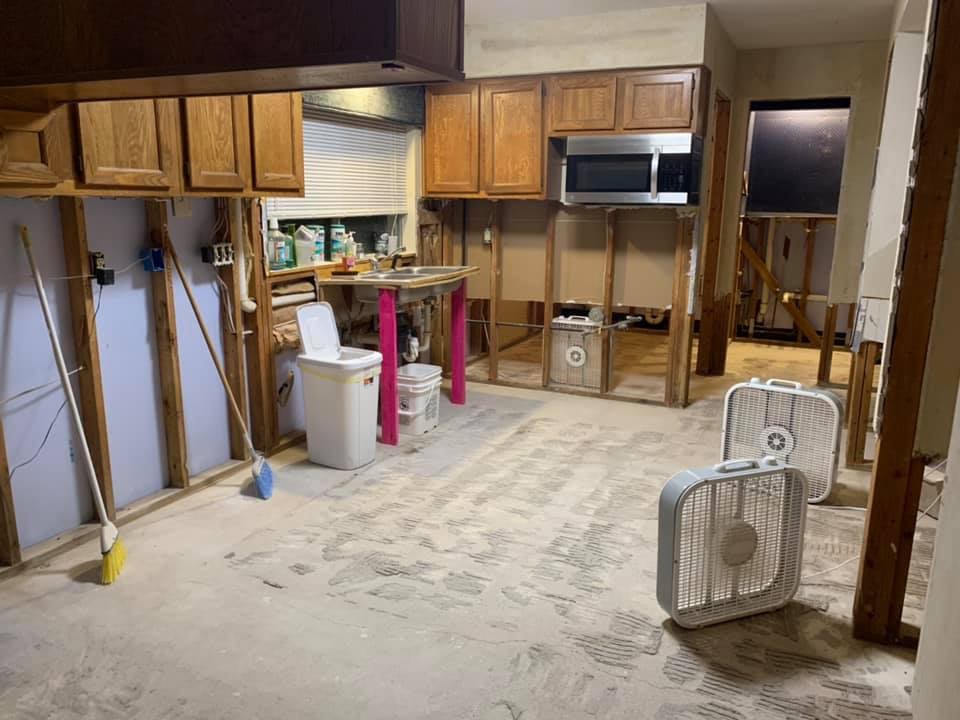
Elm Grove kitchen home five months after being flooded a second time.
These are working class neighborhoods. As much so as any in Harris County. People simply can’t afford to flood again.
Language in last year’s flood bond allows Harris County Flood Control District to buy property in neighboring counties for the purpose of building upstream detention. The lack of detention on Perry Homes’ property is the primary reason hundreds of homes in Kingwood flooded. Two years after clearing the property, Perry Homes still has constructed only 23% of the needed detention.
No Other Good Alternatives At This Time
Harris County Flood Control reportedly can start work on expanding detention capacity as soon as Commissioners reach a deal.
If they can’t, Perry has said it will sell Woodridge Village to another developer or continue to develop the property itself. However, if that happens, the detention ponds on the property would still likely be undersized by 40%. That’s because Perry Homes rushed to get their plans approved before the new, higher Atlas-14 rainfall standards went into effect.
Help Now! Here’s How
To contact Judge Hidalgo, Commissioner Garcia or Commissioner Radack:
Remind them that Harris County receives drainage from at least FIVE surrounding counties. This problem is a county-wide problem, not just a Precinct 4 problem.
Please call or write now if you live in the Kingwood, Huffman, Humble or Atascocita areas. Even if you did not flood, flooding from Woodridge Village affects you and your home value. No one in this area can afford to let this sore fester any longer.
Posted by Bob Rehak on 4/1/2020
946 Days after Hurricane Harveyand 195 since Imelda
https://i0.wp.com/reduceflooding.com/wp-content/uploads/2019/09/Elm-Grove-9.19_68.jpg?fit=1500%2C1000&ssl=110001500adminadmin2020-04-01 16:09:432020-04-01 18:46:07What You Can Do Right Now to Encourage HCFCD to Buy Woodridge Village Property