

The Cheap Water is Gone: Montgomery County’s Water Crisis Demands Leadership
11/1/26 – A guest editorial by Paul Cote of Montgomery County Concerned Citizens. Cote was a MUD president for 10 years. Reprinted with permission. Note: Although Cote’s focus is on water affordability, excessive groundwater pumping can also lead to subsidence which exacerbates flooding.
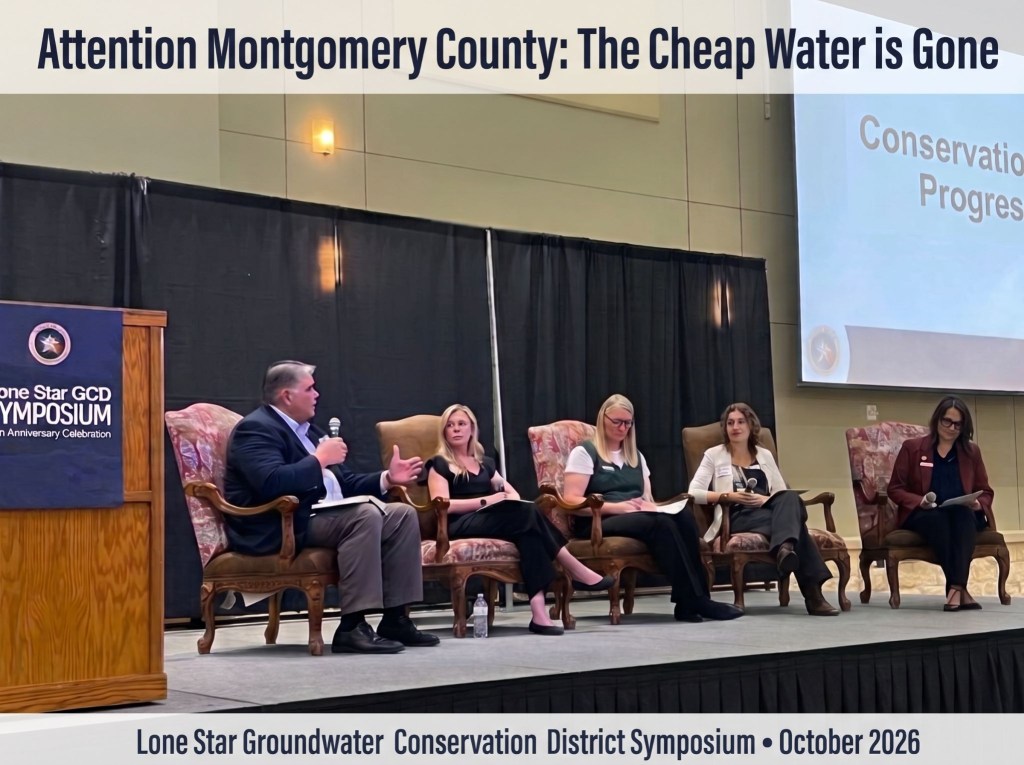
For Montgomery County residents, the message delivered at the Lone Star Groundwater Conservation District (LSGCD) Symposium was impossible to ignore: “The cheap water is gone.”
For years, local families were told that our groundwater supply was virtually endless and that local water bills could stay rock-bottom without regional planning. In 2017, State Representative Will Metcalf championed legislation that shifted the LSGCD board from an appointed body of regional representatives to an elected board, backed by campaigns promising to “restore affordable water.” Yet years later, groundwater professionals from across Texas, Montgomery County, and the LSGCD confirmed the opposite: relying on groundwater alone has become one of our community’s most expensive choices.
The Hidden Cost: How Depleting Groundwater Hits Your Pocketbook
When public officials debate water, the conversation often gets bogged down in technical jargon. But for local homeowners, water affordability is fundamentally a pocketbook issue:
- Pumping Faster Than Nature Refills: Montgomery County’s underground aquifers naturally replenish at about 65,000 acre-feet per year; the estimated current annual pumping is over 120,000 acre-feet per year, but it is proposed to allow pumping up to roughly 200,000 acre-feet annually.
| Natural Replenishment Rate | Current GW Pumping Rate | Proposed GW Pumping Rate |
| ~65,000 acre-feet / year | ~135,000 acre-feet / year | ~200,000 acre-feet / year |
- The Debt Treadmill: Because we pull water out far faster than nature replaces it, underground water levels drop. When neighborhood water wells run dry or burn out prematurely, Municipal Utility Districts (MUDs) and cities must borrow millions of dollars to drill deeper or build emergency fixes.
- Paid Through Property Taxes, Not Just Water Bills: These multi-million-dollar emergency repairs are financed through 20- to 30-year voter bonds. Even if your monthly water meter fee appears stable, the cost shows up on your annual property tax bill under the MUD or city debt service rate.
- The Cost of Inaction: Over the next decade, continuing down this uncoordinated path exposes Montgomery County taxpayers to a conservative estimate of $2 billion to over $4 billion in emergency well replacements, higher electric pumping bills, and ground-shifting repairs. This estimate is based on a GMA 14 study by LSGCD and the number of wells that cannot be lowered in the aquifer to keep well pumps submerged.
The City of Conroe provides a clear cautionary tale. After struggling with dropping well levels during recent droughts, Conroe had to pause construction and take on hundreds of millions in utility-related debt to secure emergency surface water and repair or replace failing wells. Waiting for an emergency does not save money; it quadruples the bill.
The Governance Gap: What No One is Protecting Our Future Groundwater
At the symposium, attendees were encouraged to set up backyard rain barrels. Collecting rainwater is a great personal conservation habit, but rain barrels cannot supply neighborhood fire hydrants, run schools, or support commercial employers.
The deeper problem is that no single local agency currently protects long-term community groundwater supplies. LSGCD Board President Jim Spigener highlighted this exact governance gap during a public water symposium in November 2023, asking plainly:
“Who’s the entity that can take on making sure Montgomery County has an adequate supply of water? I don’t think it exists right now.” Three years later, no planning entity exists, and no call for action at this symposium.
The LSGCD issues pumping permits, but under state law, it does not build pipelines, finance water treatment plants, or deliver drinking water to homes and businesses. Meanwhile, individual cities, many private water providers, and over 100 independent MUDs are left to fend for themselves in isolated silos.
For instance, while the LSGCD regulates groundwater withdrawal thresholds, it has no mandate or legal authority to finance or build regional surface-water pipelines. At the same time, over 100 individual MUDs across Montgomery County independently manage neighborhood water infrastructure and issue voter-backed debt bonds. Without a formal mechanism linking LSGCD permitting directly to MUD infrastructure planning, each entity operates in isolation, leaving Montgomery County without a central authority responsible for long-term supply resilience.
County leadership at the symposium noted limitations in managing growth under current local control policies. They also highlighted the county’s fragmentation: about 80% of residents live in unincorporated areas with limited capacity to fund large-scale alternative water infrastructure.
Addressing this issue requires systematic tracking of groundwater levels across all regulated production wells to detect emerging vulnerabilities early. A regional triage framework will also prioritize high-risk areas, such as South Montgomery County, for immediate infrastructure support and state funding opportunities.
Without unified leadership or a centralized authority to oversee long-term infrastructure, Montgomery County remains trapped in a fragmented system where water costs continue to rise unchecked. Bridging this governance gap is essential to secure our water future and protect local taxpayers from skyrocketing financial burdens.
A 4-Step Action Plan for Regional Water Security
Keeping future water affordable does not mean abandoning groundwater, nor does it require painful sacrifices. It requires our community to replace finger-pointing with a coordinated, long-range economic roadmap:
- Create a Unified County Water Planning Authority: The Texas Legislature should authorize a countywide water authority, similar to successful regional authorities in neighboring counties, such as Harris and Fort Bend Counties, that unites County Commissioners, city officials, MUD directors, Private water providers, and business leaders.
- Adopt a Balanced Water Portfolio (“Conjunctive Use”): The most cost-effective water system blends resources. By using treated surface water from Lake Conroe during cooler winter months and resting our groundwater wellfields, we allow underground water levels to stabilize. This prevents well burnouts and protects communities when summer heat spikes.
- Recycle Water for Irrigation: Landscape watering accounts for roughly half of our peak summer water demand. Master-planned developments must do so by integrating low-water-use landscaping (xeriscaping) while using recycled, treated community water for parks, medians, and golf courses, preserving drinking-quality water and avoiding the need to float expensive tax bonds for new wells.
- Commission a 50-Year Economic Water Cost Study: Rather than guessing what water will cost next year, local leaders must partner on an independent, long-term economic study to identify the lowest-cost supply mix for the next five decades.
Montgomery County’s competitive edge has always been family affordability, good schools, and thriving neighborhoods. When water costs spiral out of control, home values and household budgets take the hit.
We can’t defer securing affordable water or solve it through fragmented efforts. Our county commissioners, city officials, and MUD board members must act now by coming together to establish a unified regional water planning authority and craft a comprehensive, long-term economic strategy. The era of near-free water has ended, and our community’s financial future depends on decisive action from state and local leaders today. Let’s open the dialogue over a mug of coffee in the near future.
How You Can Take Action Today
Community leadership starts with engaged residents. Here are three concrete ways you can help drive regional water solutions:
- Attend Your Local MUD & City Council Meetings: Ask your local elected board members about their long-term water supply strategy, well maintenance reserves, and conjunctive use plans.
- Contact Your County Commissioner & State Representative: Advocate for legislative support and local inter-agency cooperation to establish a unified Montgomery County Water Planning Authority.
Promote Efficient Neighborhood Water Use: Support HOA landscape policy updates that allow xeriscaping and smart irrigation controls to lower outdoor summer water demand.
Express interest in attending our next MUGs & MUDs Coffee Meetup. For details and to join our mailing list, email: mccc2035@gmail.com.
About Montgomery County Concerned Citizens
Montgomery County Concerned Citizens is a grassroots network of Residents, Municipal Utility Leaders, and public officials dedicated to promoting transparency, accountability, and informed public engagement on water issues that affect Montgomery County’s future. The group serves as a forum for water-related education, discussion, and collaboration among citizens and local leaders.
Mission Statement
Montgomery County Concerned Citizens aims to empower residents through education, encourage active participation in local government, and advocate for responsible water policies that protect the county’s natural resources, infrastructure, and quality of life. The organization works to ensure public decisions are made openly and responsibly, in the best interests of current and future generations of Montgomery County residents.
Posted for Paul Cote, Montgomery County Concerned Citizens
3351 Days since Hurricane Harvey


