Tag Archive for: ETJ

Floodplain Maps for 5,316 Acres West of Kingwood Contradict Developer’s Claim

11/4/2025 – FEMA floodplain maps contradict a claim made by Scarborough Development/San Jacinto Preserve in a presentation made to the City of Houston and Harris County officials on 10/29/25.

The developer recently bought 5,316 acres, mostly in the floodplains and floodways of Spring and Cypress Creeks, and the San Jacinto West Fork. The land lies in both Montgomery County and the City of Houston’s extra territorial jurisdiction. The developer also wants to build a bridge into Harris County.

In documents obtained from the City of Houston, the developer claimed it would only be “developing land at or above the Atlas 14 100-year floodplain.” See copy in red box below.

Presented by developer to City of Houston and Harris County on 10/29/25.

However, superimposing their development plan on FEMA’s current floodplain maps developed before Atlas 14 contradicts that claim. Why?

The extent of proposed development matches the limits of pre-, not post-, Atlas 14 100-year floodplains.

Net: developing in this area is more dangerous than it may look. 500-year floodplains could soon become 100-year floodplains.

For more detail, see the discussion of Atlas-14’s history and the sequence of maps below.

A Brief History of Atlas 14

FEMA’s current floodplain maps for this area date to 2014, four years BEFORE the start of Atlas 14 in Texas. And to my knowledge, FEMA has not yet released new flood maps based on Atlas 14 for this region.

From FEMA floodplain map of Scarborough/SJP property. Effective date: 8/18/2014. Screen captured today.

NOAA began updating rainfall precipitation frequency estimates in 2004; they called the effort “Atlas 14.” But NOAA didn’t update Texas statistics until 2018. Such rainfall estimates form the basis for flood maps.

In Montgomery County (MoCo), pre/post estimates for the standard 100-year/24-hour rainfall varied by more than a third. MoCo adopted Atlas 14 values of ~16.1 inches for the 24-hr, 1% storm (at Conroe), up from the previous standard of ~12 inches. That’s an increase of 4.1 inches or 34%.

Just as important, until earlier this year, MoCo drainage regulations often let developers avoid building stormwater detention basins that would offset that additional rainfall.

Also consider that Montgomery County has been one of the fastest growing counties in the region and in America. Its population has grown by almost a third (31%) since 2018. That population growth comes with a growth of impervious cover (roofs, driveways, streets, parking lots, etc.) that doesn’t soak up rainfall.

I’m not aware of any recent studies that show the cumulative impact of additional rainfall and impervious cover together with a deficit of detention.

Given those issues, common sense says flood elevations would increase. And in fact, preliminary guidance from Harris County indicates that floodplains will expand by 50% to 100% when FEMA releases updated flood maps based on Atlas 14.

New Plans Show Development Extending to Old 100-Year Floodplain

When I first saw the developer’s new plans, the plans didn’t seem to match the claim that they would only develop land “at or above the Atlas 14 100-year floodplain.” That made me suspicious. So, I performed an experiment.

I superimposed the developer’s plans over FEMA’s current (pre-Atlas 14) map dated 2014. I then varied the opacity of the layers in Adobe Photoshop so I could see how the two matched up. Long story short, they matched perfectly. See the sequence of images below.

Layer 1: From FEMA’s Flood Hazard Layer Viewer. Scarborough property is in center between Spring Creek (diagonal) and West Fork (right). Brown areas = 500-year floodplain. Aqua = 100-year. Striped = floodway.

Next, I superimposed the development plan that Scarborough presented to City of Houston and Harris County.

Layer 2: Gray areas with waffle pattern represent claimed “net developable area.” Red = property boundary.

Then, I varied the opacity of the development plan until you could see the floodplains behind it.

Composite with partial transparency of overlay

Enlargement clearly shows that development stops at the old, pre-Atlas-14, 100-year floodplain.

White lines from 2014 FEMA map form boundary between 100- and 500-year floodplains. And waffle patterns from developer’s plans stop at white lines.

New maps reflecting higher rainfall rates and more impervious cover will likely show those white lines cutting well into the brown so-called developable areas, if not eliminating some altogether.

Where Did Developer’s Claim Come From?

So, where did the developer’s Atlas 14 claim come from? I have talked to three people who were in the meeting. Not one could tell me with certainty. They all expressed reservations and doubts about it.

I have also reached out to Scarborough several times to understand their position, but they have yet to return phone calls or emails.

So, I’m going to remain skeptical until I see proof of their claim and FEMA’s new Atlas 14 maps. FEMA may release them in 2026. But the proposed maps will then go through public comment and revision cycles. That could mean they won’t become official for at least another three years.

Make This An Election Issue

In my opinion, the best use for this property would be to turn it into a state park. That would help protect areas both up and downstream. With an election coming up next year, our representatives will have their ears to the ground. The time to start a letter-writing campaign is now. Contact all candidates.

Turn this into an election issue.

Make sure we elect someone who is more interested in protecting public safety than private profits.

Posted by Bob Rehak on 11/4/25

2989 Days since Hurricane Harvey

The thoughts expressed in this post represent opinions on matters of public concern and safety. They are protected by the First Amendment of the US Constitution and the Anti-SLAPP Statute of the Great State of Texas.

Easy Way to Track New Developments Near You

If you live in the City of Houston or within its extra-territorial jurisdiction (ETJ), the City provides an easy way for you to track the progress of new developments near you.

Step One: Go To the Plat-Tracker Map

The City provides an interactive map based on geographic information system (GIS) technology. In your browser, go to a website called Houston Plat Tracker Plats. GIS maps translate database information into a familiar map format.

Houston Plat Tracker Map as of 3/17/2021. Look at the size of those two proposed subdivisions northeast of Lake Houston!
  1. After navigating to the site, scroll and zoom to your area of interest.
  2. Select a base map to suit your taste. Choose from satellite views, street maps, topographic maps and more. Do this by clicking on the four squares in the upper left hand corner.
  3. Turn on the layers that interest you. Choose from City Limits, Council Districts, Management Districts, TIRZs (tax increment reinvestment zones), ETJ, historical districts, and more. Do this by clicking on the layers icon next to the base map icon.
  4. With the tools in the upper right corner, you can draw on the map, measure distance and direction, print, bookmark and share.
  5. By now, the map should be populated with a mass of color-coded outlines.
  6. Click on any colored area to find background information about it, such as the developer and the application number. At the bottom of the informational pop-up box, there’s an interactive link to the City’s Planning Department website where you can learn more about the project.

Step Two: Look Up More on the City Planning Department Website

The City Planning Department website offers much more information about projects that may concern you, especially if they are coming up for a vote in the Planning Commission. Here you’ll find interactive and PDF spreadsheets that list which projects will be considered in the next meeting of the Planning Commission. The site also lists the:

  • Subdivision plat name
  • Application Number
  • When the developer submitted files
  • Subdivision Plat type
  • Whether a variance request exists
  • The location of the issue on the agenda
  • County, City, Council District, Precinct
  • Key Map code
  • Census Tract
  • Zip Code
  • School District
  • Address of the development.
  • TIRZ, Management District, Historic Districts if applicable
  • Super Neighborhood Council
  • Park Sector
  • Proposed Land Use
  • Property Size
  • Number of Lots
  • Appraisal District ID
  • Developer
  • Applicant Company
  • Applicant’s Name
  • Applicants Phone
  • Subdivision Plat with flood zones, if any, superimposed

The Houston Plat Tracker Plats website contains future and past agendas, the planning commission calendar, and development regulations. It also contains a design manual and a host of other tools in case you feel something is amiss.

Finally, it lets you set up an account so you can get notifications of what future meetings will consider.

Possible Step 3

If you find something disturbing, sign up to express your concerns at the Planning Commission, or call your city council person’s office.

You can also request copies of the drainage analysis and construction plans at a certain point in the project.

Informed citizens keep everyone conscientious. No one cares about your home like you! So keep your eyes open for new projects in your neighborhood or upstream.

To learn more about 15 other GIS maps that the City makes available online, visit this start page. You can find fascinating information about land use, demographics, flood hazards and more. Good luck.

Posted by Bob Rehak on 3/17/2021

1296 Days since Hurricane Harvey

Bald Eagle Joins Protest of New Woodlands Development

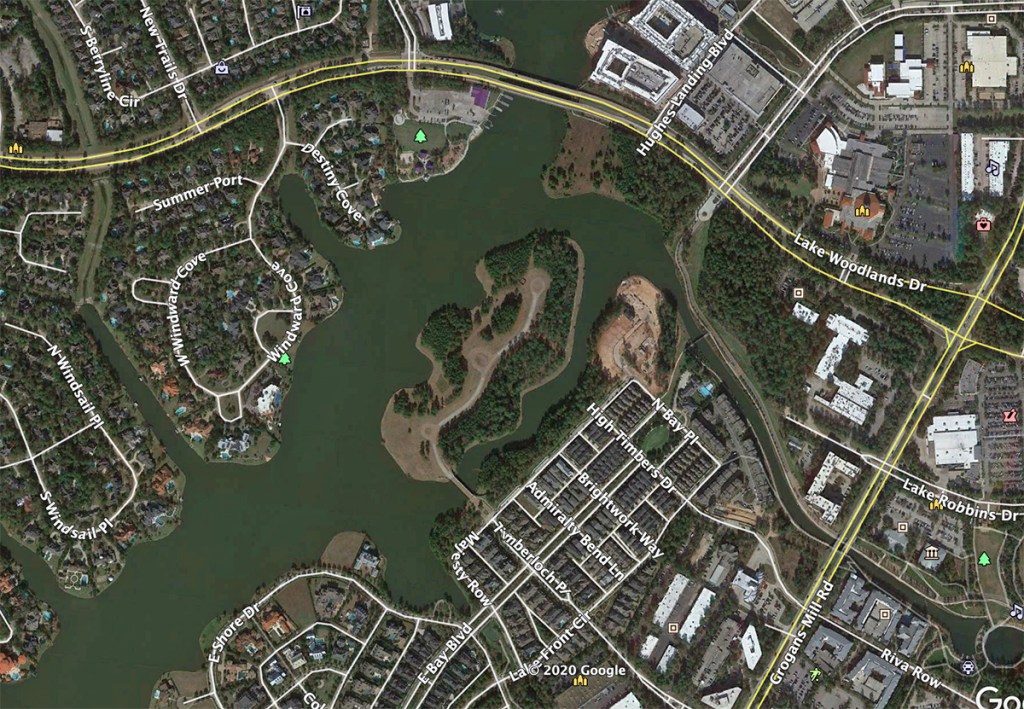
Last Saturday morning (9/26/2020), Sally and JG Geis were out walking around Lake Woodlands. They came across a gathering of people protesting a proposed new development on Mitchell island in the lake.

The Woodlands Land Development Company, L.P., a subsidiary of Howard Hughes Corporation seeks to re-plat Mitchell Island in the center of the photo.

The protesters’ concerns centered around the re-platting of the development. They feared it would bring an increase in traffic, create demands on local infrastructure, and impact nesting eagles. The majestic raptors in The Woodlands have attracted birders and tourists for decades.

Higher Density Now Planned in Sensitive Area

The 23-acre island was originally platted for 19 homes with a minimum size of 7,000 square feet. The new plan consists of 58 high-end residential homesites, which will reportedly start at $1 million.

According to nearby residents, the new plan will affect a pair of nesting bald eagles which visit the area every year.

As if on cue, one of the eagles flew into a nearby tree to watch the protest.

Cell phone photo of bald eagle watching protest at entrance to Mitchell Island on Saturday. By Sally Geis.
Enlargement of eagle within previous photo. By Sally Geis.

Notice of October 1 Online Public Hearing

Public Notice of Project. Photo by Sally Geiss. According to the sign, the Planning Commission will hear virtual testimony starting at 2:30PM on October 1.

From 1+ acre lots to 10 foot lot lines. Note the credit line near the bottom. LJA Engineering! Wherever there is controversy, we seem to find LJA Engineering.

Trying to Beat the Clock on New Regs and Flood Maps?

After LJA rushed to get their plans for Woodridge Village approved before new Atlas-14 rainfall statistics went into effect, hundreds of homes in Elm Grove flooded. Is LJA trying to beat the clock once again before new regulations and floodplain maps go into effect?

This island sits within the extra-territorial jurisdiction of the City of Houston (CoH). So it must meet CoH floodplain requirements. The City and Harris County are trying to harmonize their floodplain regulations. Changes in those regulations could affect development on the island. Most of the island currently lies in the .2%-annual-chance floodplain. But portions lie in the 1%-annual-chance floodplain. See below. When new flood maps are redrawn, parts of that .2% floodplain could be reclassified as 1%.

Cross-hatched = floodway. Aqua = 1% annual chance of flooding. Brown = .2% annual chance. Source: FEMA National Flood Hazard Layer Viewer. Note: These zones could soon change because flood insurance maps are being redrawn.

Chapter 19 of the City Code currently requires minimum flood protection elevation of 2 feet above the 0.2 percent flood. However, the new plat does not show any retention ponds that could provide fill.

Proposed layout shows larger lots facing lake and smaller lots facing east where smaller homes already exist. For a high-resolution PDF of the entire plat, click here.

Elevating 58 homes will take lots of fill to meet the CoH minimum elevation requirement. Where will that fill come from? Outside the development? How will that affect the floodplain for surrounding homes? So many questions!

Let’s hope that the people in the City’s Planning and Development department have eyes as good as that eagle’s.

Posted by Bob Rehak on 9/29/2020

1127 Days since Hurricane Harvey

The thoughts expressed in this post represent opinions on matters of public concern and safety. They are protected by the First Amendment of the US Constitution and the Anti-SLAPP Statute of the Great State of Texas.

Tools to Track Permit Applications for Developments Near You

Have you ever been flooded by a new development? Did you learn about the development AFTER bulldozers started knocking down trees? There’s a much better way. The City of Houston offers several tools to help you track applications for new developments long before the bulldozers start belching diesel fumes.

GIS PlatTracker Map

The first is an interactive, color coded GIS map that shows the status of all permit applications in the City and its ETJ (extra-territorial jurisdiction). The ETJ extends well beyond the boundaries of the City. Going up 45, it extends to 242. Going up 59, it extends to Roman Forest.

City of Houston PlatTracker map for Northeast Houston and Lake Houston Area as of 4/30/2020

If someone has applied for a permit to develop a piece of land, it will show up on the map. Notice the purple areas along the West Fork west of the Kingwood Country Club. That’s how I learned about the reactivation of Romerica’s plans.

The color of the parcels corresponds to the stage of the application. Clicking on the parcel pulls up an information panel that gives you more history including the date the developer submitted the application, when it will be reviewed, the review stage, and more.

Zoom in and out as wide as you want. Just be aware that the wider you zoom, the longer it takes the screen to refill with all the plat information. There’s a lot more of it!

As I zoomed out around Kingwood, the number of new developments that I was unaware of shocked me. If you want to see humongous changes, look south of Humble, east to Huffman, west to Spring, and north to Porter and New Caney. Kingwood is a relative island of quiet in a sea of change.

Other Related Interactive Maps

The PlatTracker Plat Map is just one of thirty other interactive maps that you can use to explore and monitor the City around you. They include, but are not limited to:

  • Land use
  • Water flood hazards
  • Governmental boundaries
  • Demographics
  • Annexation history
  • Address and Permit Information

PlatTracker Agenda/Spreadsheet

Once you have identified a development you are interested in, another site can help you learn more about when the Houston Planning Commission will consider applications related to the site. It will also give you:

  • Subdivision plat name
  • Application Number
  • Date Submitted
  • Subdivision type
  • Variance requests
  • Location on the Commission’s agenda
  • County
  • Council district
  • Precinct
  • Census Tract
  • Zip Code
  • School district
  • TIRZ (tax increment reinvestment zone) if any
  • Superneighborhood Council
  • Land Use
  • Number of Lots
  • Acreage
  • Appraisal district numbers
  • Developer Name
  • Applicant Company
  • Applicants Name
  • Phone Number

You can even download the latest documents related to the application.

For Planning Commission meeting dates and agendas, click here.

Situational Awareness for Concerned Citizens

Wow. Everything you need to put your mind at ease. Or stage a protest. All at your fingertips.

These are great tools for concerned residents and citizen activists.

I’m sure a lot of Elm Grove residents wish they had known about these tools before the bulldozers started knocking down trees in Woodridge Village.

For future reference, I’ve added links for these sites within ReduceFlooding’s Links Page under the Community heading.

Posted by Bob Rehak on 4/30/2020

975 Days since Hurricane Harvey